Quim. Nova, Vol. 29, No. 2, 373-375, 2006
Nota Técnica
*e-mail: [email protected]
A CONVENIENT METHOD FOR THE DETERMINATION OF MOISTURE IN AROMATIC PLANTS
Flávio A. Pimentel*
Departamento de Ciência dos Alimentos, Universidade Federal de Lavras, CP 37, 37200-000 Lavras - MG, Embrapa Acre, CP321, 69901-180 Rio Branco – AC
Maria das Graças Cardoso, Ana Paula S. P. Salgado, Priscila M. Aguiar e Vanisse de F. Silva Departamento de Química, Universidade Federal de Lavras, CP 37, 37200-000 Lavras - MG Augusto Ramalho de Morais
Departamento de Exatas, Universidade Federal de Lavras, CP 37, 37200-000 Lavras - MG David Lee Nelson
Departamento de Alimentos, Faculdade de Farmácia, Universidade Federal de Minas Gerais, 31270-901 Belo Horizonte - MG Recebido em 10/12/04; aceito em 15/8/05; publicado na web em 13/1/06
A method is proposed for the determination of the moisture content of aromatic plants. This method is based on the co-distillation of the starting material in a modified Clevenger apparatus with four organic solvents (toluene, cyclohexane, dichloromethane and carbon tetrachloride). The results were compared with those obtained by oven drying at 105 oC and steam distillation of the essential
oil. The efficiencies of the methods were shown to be equivalent. The solvent distillation method was more practical, especially with respect to operating time (2 h).
Keywords: aromatic plant; moisture content; essential oil.
INTRODUCTION
Among other chemical constituents, aromatic plants possess essential oils resulting from secondary metabolism. These substances have a great economic potential, especially in the food, pharmaceutical and perfumery sectors. Thus, the number of studies on the chemical composition and biological properties of these oils, as well as the taxonomic, environmental and cultivation factors that lead to variations in their quantity and quality, has been growing1.
The ISO (International Standard Organization) defines essential oils as the products obtained from parts of plants through steam distillation, as well as by pressing the pericarps of citric fruits. In general, they are composed of complex mixtures of volatile, lipophilic, liquid and odiferous substances. They may also be described as volatile oils, ethereal oils and essences1.
The research on active substances from plants in Brazil is still incipient. Until the beginning of the 1980’s, it was estimated that the chemical composition of less than 1% of the species of Brazilian flora was known2. Even considering that significant increments in
the knowledge of Brazilian flora have occurred in the last two decades, there is still a large gap to be filled3. On the other hand,
the results of published research on essential oils have revealed little with respect to the methods utilized, leaving doubts as to the values obtained. Among the parameters evaluated, the determination of the moisture content of the starting material is of fundamental importance for the comparison of the various treatments on a dry basis. One method utilizing xylene for the determination of humidity in aromatic plants has been recommended4. The use of ovens at
temperatures above 35 oC for this purpose would mask the results
since there may be loss of essential oils in addition to the moisture at this temperature. Considering the above mentioned problems, the present work discusses the development of a method for
determining the moisture content in aromatic plants utilizing different organic solvents with the aim of attending the scientific community as well as others interested in this area.
EXPERIMENTAL PART
The starting material consisted of fresh leaves from the Cymbogon nardus, Cymbopocum citratus, Thymus vulgaris, Piper aduncum, Piper hispidinervum, Menta aryensis and Menta villosa species cultivated in the Medicinal Plants Garden of the Federal University of Lavras. The studies were performed in the autumn during the period from April to June, when the average temperature varied from 17.3 to 20.6 oC. Ten grams of chopped leaves from each species
were submerged in 125 mL of each of the solvents toluene, cyclohexane, carbon tetrachloride and dichloromethane. The respective mixtures were placed in distillation flask (500 mL) coupled to a modified Clevenger apparatus. The flasks were heated at 100 ± 5 oC with heating mantles. The distillates containing two phases
(aqueous and organic) were collected in graduated glass tubes and the volumes of the aqueous phases were measured. The calculation of the moisture content was based on a 100 g sample. The experiment was conducted in a completely randomized delineation with three repetitions and the treatments were arranged in a 3 by 4 factorial scheme constituted by the factors distillation time (1, 2 and 3 h) and solvents (toluene, cyclohexane, carbon tetrachloride and dichloromethane), the toluene being considered as a control for the other solvents. The choice of this solvent was based on the AOAC Official Method, Da 2b-42, for the determination of moisture in products containing volatile substances5.The comparative analyses
of all the solvents occurred separately relative to the control. That is, one sample was distilled with cyclohexane and with toluene. A second sample was distilled with dichloromethane and with toluene and a third sample with carbon tetrachloride and toluene. Each repetition of the analyses was performed in duplicate.
374 Pimentel et al. Quim. Nova
the moisture content, the moisture content was determined by drying in an oven at 105 oC6, while the essential oil content was determined
by steam distillation using a modified Clevenger apparatus7,8. To
extract the essential oil, 100 g of fresh leaves from each species was chopped and transferred to a distillation flask (l L) containing water. The extraction was performed for four hours at constant temperature. The distillate was centrifuged to separate the phases, and the volume and density of the essential oil were measured.
The two procedures (oven and essential oil) were performed simultaneously. The quantity of essential oil extracted from each starting material was deducted from the loss in weight obtained by the oven method to calculate the moisture content. The yields of the essential oils were determined for the dry weights of the samples whose moisture contents were determined by the solvent and oven methods. RESULTS AND DISCUSSION
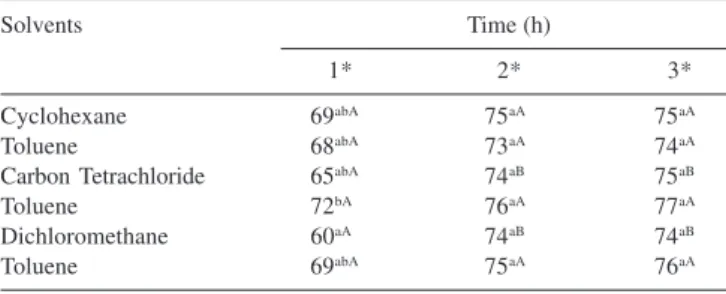
After one hour of distillation, significant differences in the determination of the moisture contents relative to the control were only observed for dichloromethane and carbon tetrachloride for the Menta arvensis e Menta villosa species. After two hours of distillation, no differences in moisture contents relative to the control were observed, although the values were higher than those observed during the first hour of distillation.
The control and the distillation with cyclohexane were the treatments that presented the greatest efficiency in terms of distillation duration. A significant difference between the first and succeeding hours was observed for the control in the treatments of only one species (Piper hispidinervum); for cyclohexane in the treatment of two species (Cymbogon nardus and Menta villosa); for carbon tetrachloride with Cymbogon nardus, Piper aduncum, Menta arvensis and Menta villosa;and for dichloromethane with Piper aduncum, Menta arvensis and Menta villosa (Tables 1 to 7).
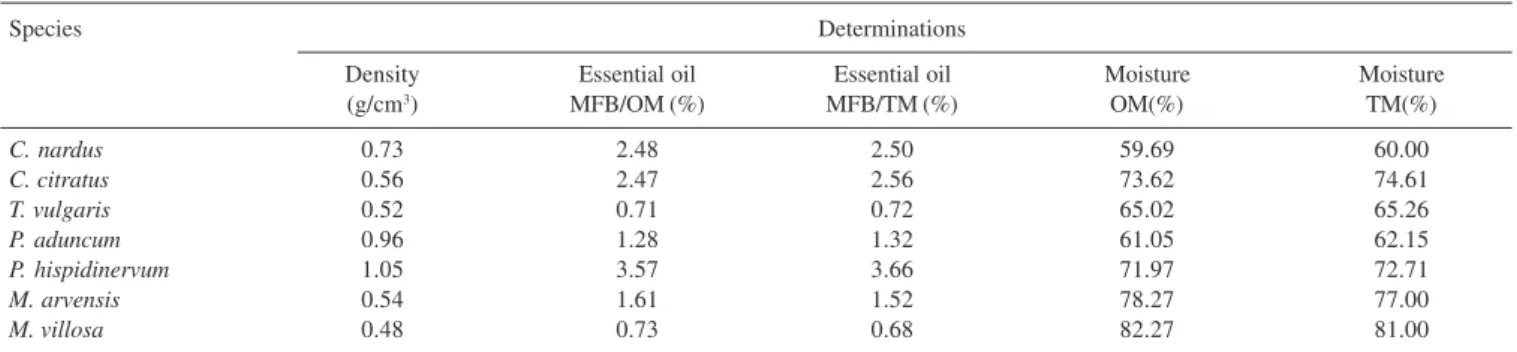
With the exception of Piper hispidinervum,the essential oils obtained all had densities lower than that of water(0.48 – 0.96 g/ cm3). The yields of the essential oils on a dry weight basis, using
the oven and toluene distillation methods, had very low differences (0.01 – 0.09%), as was also the case for the moisture contents (0.24 – 1.27%; Table 8).
Although the methods tested gave very similar results for the moisture contents of aromatic plants, the use of solvents was more efficient in terms of operational time. The determination of moisture content by the solvent method was performed in two hours, while at least 24 hours are necessary using the oven method. In addition, the oven method requires a separate determination of the yield of essential oil for the calculation of the moisture content. The fact
Table 3. Average moisture contents (%) of fresh leaves of Thymus vulgaris as
a function of the types of solvents used during each distillation period
Solvents Time (h)
1* 2* 3*
Cyclohexane 47aA 53aA 53aA
Toluene 50aA 54aA 54aA
Carbon Tetrachloride 45aA 52aA 52aA
Toluene 50aA 54aA 54aA
Dichloromethane 45aA 50aA 50aA
Toluene 50aA 54aA 54aA
*Averages in the same column followed by the same lower case letter do not differ at 5% of probability by the Tukey test; averages in the same row fol-lowed by the same upper case letter do not differ. CV (%) = 11.05; Overall average = 51.24.
Table 2. Average moisture contents (%) of fresh leaves of Cymbopocum citratus
as a function of the types of solvents used during each distillation period
Solvents Time (h)
1* 2* 3*
Cyclohexane 66aA 69aA 69aA
Toluene 66aA 70aA 70aA
Carbon Tetrachloride 64aA 68aA 68aA
Toluene 66aA 70aA 70aA
Dichloromethane 63aA 69aA 69aA
Toluene 66aA 70aA 70aA
*Averages in the same column followed by the same lower case letter do not differ at 5% of probability by the Tukey test; averages in the same row fol-lowed by the same upper case letter do not differ. CV (%) = 5.74; Overall average = 67.96.
Table 1. Average moisture contents (%) of fresh leaves of Cymbogon nardus
as a function of the types of solvents used during each distillation period
Solvents Time (h)
1* 2* 3*
Cyclohexane 55aA 69bB 69bB
Toluene 63aA 68bA 68bA
Carbon Tetrachloride 57aA 66abB 65abB
Toluene 63aA 67bA 63abA
Dichloromethane 53aA 57aA 58aA
Toluene 58aA 63abA 61abA
*Averages in the same column followed by the same lower case letter do not differ at 5% of probability by the Tukey test; averages in the same row fol-lowed by the same upper case letter do not differ. CV (%) = 6.32; Overall average = 62.37.
Table 4. Average moisture contents (%) of fresh leaves of Piper aduncum as
a function of the types of solvents used during each distillation period
Solvents Time (h)
1* 2* 3*
Cyclohexane 69abA 75aA 75aA
Toluene 68abA 73aA 74aA
Carbon Tetrachloride 65abA 74aB 75aB
Toluene 72bA 76aA 77aA
Dichloromethane 60aA 74aB 74aB
Toluene 69abA 75aA 76aA
*Averages in the same column followed by the same lower case letter do not differ at 5% of probability by the Tukey test; averages in the same row fol-lowed by the same upper case letter do not differ. CV (%) = 5.21; Overall average = 72.19.
Table 5. Average moisture contents (%) of fresh leaves of Piper hispidinervum
as a function of the types of solvents used during each distillation period
Solvents Time (h)
1* 2* 3*
Cyclohexane 62bA 64aA 64aA
Toluene 63bA 65aA 65aA
Carbon Tetrachloride 67bA 71aA 71aA
Toluene 65bA 70aA 70aA
Dichloromethane 46aA 66aB 66aB
Toluene 53aA 68aB 68aB
375 A Convenient Method for the Determination of Moisture in Aromatic Plants
Vol. 29, No. 2
Table 7. Average moisture contents (%) of fresh leaves of Menta villosa as a
function of the types of solvents used during each distillation period
Solvents Time (h)
1* 2* 3*
Cyclohexane 73bA 80aB 80aB
Toluene 77bA 81aA 81aA
Carbon Tetrachloride 65aA 78aB 78aB
Toluene 77bA 81aA 81aA
Dichloromethane 65aA 76aB 76aB
Toluene 77bA 81aA 81aA
*Averages in the same column followed by the same lower case letter do not differ at 5% of probability by the Tukey test; averages in the same row fol-lowed by the same upper case letter do not differ. CV (%) = 4.57; Overall average = 72.06.
Table 6. Average moisture contents (%) of fresh leaves of Menta arvensis as
a function of the types of solvents used during each distillation period
Solvents Time (h)
1* 2* 3*
Cyclohexane 70bA 73aA 73aA
Toluene 72bA 74aA 74aA
Carbon Tetrachloride 65abA 72aB 73aB
Toluene 72bA 74aA 74aA
Dichloromethane 61aA 71aB 71aB
Toluene 72bA 74aA 74aA
*Averages in the same column followed by the same lower case letter do not differ at 5% of probability by the Tukey test; averages in the same row fol-lowed by the same upper case letter do not differ. CV (%) = 4.57; Overall average = 72.06.
Table 8. Average results for the analyses of moisture and essential oil contents of fresh leaves from seven aromatic plant species
Species Determinations
Density Essential oil Essential oil Moisture Moisture
(g/cm3) MFB/OM (%) MFB/TM (%) OM(%) TM(%)
C. nardus 0.73 2.48 2.50 59.69 60.00
C. citratus 0.56 2.47 2.56 73.62 74.61
T. vulgaris 0.52 0.71 0.72 65.02 65.26
P. aduncum 0.96 1.28 1.32 61.05 62.15
P. hispidinervum 1.05 3.57 3.66 71.97 72.71
M. arvensis 0.54 1.61 1.52 78.27 77.00
M. villosa 0.48 0.73 0.68 82.27 81.00
MFB = Moisture Free Basis; OM = Oven Method; TM = Toluene Method
that four different solvents with different degrees of toxicity were efficient in the determination of the moisture contents signifies that the methods may be very widely applicable.
CONCLUSIONS
The oven and toluene methods were equally efficient in the determination of the yields of essential oils and moisture. For the determination of the moisture content by the solvent method, the use of dichloromethane, cyclohexane, carbon tetrachloride and toluene are recommended. A preliminary test to define the ideal distillation period for the part of the plant to be studied is recommended. ACKNOWLEDGMENTS
The EMBRAPA Acre and the Conselho Nacional de Desenvol-vimento Científico e Tecnológico (CNPq) for financial assistance and for doctorate and research fellowships.
REFERENCES
1. Simões, C. M. O.; Schenkel, E. P.; Gosmann, G.; Mello, J. C. P.; Mentz, L. A.; Petrovick, P. R.; Farmacognosia da planta ao medicamento, 5a ed., UFRGS/UFSC: Porto Alegre/Florianópolis, 2003.
2. Gottlieb, O. R.; Mors, W. B.; J. Agric. Food Chem. 1980, 28, 96. 3. Shapiro, J. P.; Arch. Insect Biochem. Physiol. 1991, 17, 191.
4. Jacobs, M.; The Chemical Analysis of Foods and Food Products, 3rd ed., van Nostrand Reinhold Co.: New York, 1958.
5. AOCS Official Method Da2b-42.; Official Methods and Recommended
Practices of the American Oil Chemists Society, 4th ed., American Oil
Chemists Society: Champaign, 1994.
6. Instituto Adolfo Lutz; Normas analíticas do Instituto Adolfo Lutz, 3a ed., Débora D. Estrella Rebocho: São Paulo, 1985.
7. Craveiro, A. A.; Fernandes, A.G.; Andrade, C. H. S.; Matos, F. J. de A.; Alencar, J. W.; Machado, M. I. L.; Óleos essenciais de plantas do Nordeste, 1a ed., UFC: Fortaleza, 1981.