Printed in Brazil - ©2006 Sociedade Brasileira de Química 0103 - 5053 $6.00+0.00
Short Report
* e-mail: [email protected]
New Hopane Triterpene from
Eleocharis
sellowiana
(Cyperaceae)
Ana Lúcia T. G. Ruiz,*,a, b Aderbal F. Magalhães,a Aparecida D. Faria,c Eva G. Magalhãesa
and Maria do Carmo E. Amaralc
a
Instituto de Química, Universidade Estadual de Campinas, CP 6154, 13084-862 Campinas - SP, Brazil
b
Centro Pluridisciplinar de Pesquisas Químicas, Biológicas e Agrárias, Universidade Estadual de Campinas, CP 6171, 13083-970 Campinas - SP, Brazil
c
Instituto de Biologia, Universidade Estadual de Campinas, CP 6109, 13083-970 Campinas - SP, Brazil
Do extrato hexânico de Eleocharis sellowiana foram isolados o novo triterpeno 3α -hidroxi-13α,17α,21β-hopano-15,19-diona e hexadecanoato de E-fitila, caracterizados por dados de RMN e EM.
A new triterpene named 3α-hydroxy-13α,17α,21β-hopan-15,19-dione and E-phytyl hexadecanoate were isolated from the hexanic extract of Eleocharis sellowiana. NMR and MS experiments determined the molecular structures.
Keywords:Eleocharis, Cyperaceae, hopane-like triterpene
Introduction
The genus Eleocharis R. Br. (Cyperaceae, Cyperoideae, Scirpeae) includes about 200 species, occurring in wet environments like swamps, lakes and rivers margins. Their aerial parts are formed by simple, not ramified stalks that end in a spiciform inflorescence formed by numerous very inconspicuous flowers. Their subterraneous parts are formed by roots and stem (called rhizome or stolon, depending on its form). E. sellowiana Kunth occurs in Mexico, Colombia, Paraguay and Brazil. This species is widely distributed in São Paulo State.1 As many other plants from wet
environments like swamps, lakes and rivers margins, Eleocharis species are subject of only a few studies. According to the literature2 only E. dulcis Trin., E.
coloradoensis (Britt.) Gilly, E. acuta R. Br., E. microcarpa Torr. and E. smallii L. had been subjected to phytochemical analysis before.
In continuation of our phytochemical analysis of Eleocharis genus,3 the hexanic extracts of E. sellowiana
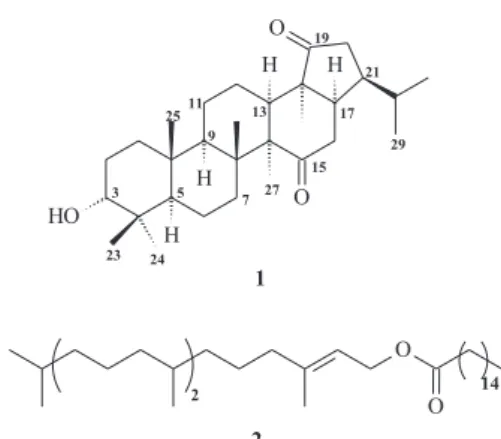
(subterraneous and aerial parts) were subjected to a detailed chromatographic analysis resulting in the isolation of a new pentacyclic triterpene named 3α -hydroxy-13α,17α,21β-hopan-15,19-dione (1) and E-phytyl hexadecanoate (2) (Figure 1).
Results and Discussion
Compound 1 was deduced as having an elemental formula of C30H48O3 by HREI-MS (observed M+•= 456.3607; required
M+•= 456.3604). The presence of five signals as singlets (δ H
0.85, δH 0.89, δH 0.94, δH 0.97 and δH 1.15) and two signals
as doublets (δH 0.86, d, J 7.0Hz, CH3-29, and δH 1.00, d, J 7.0Hz, CH3-30) attributed to eight methyl groups in its 1H
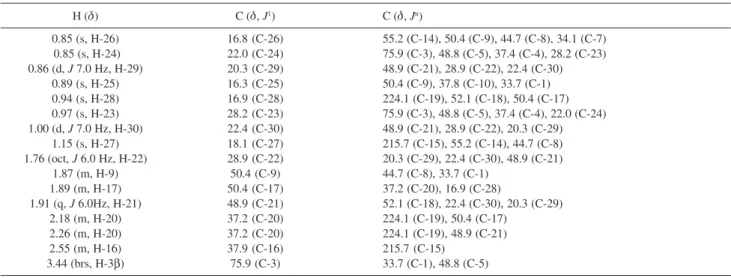
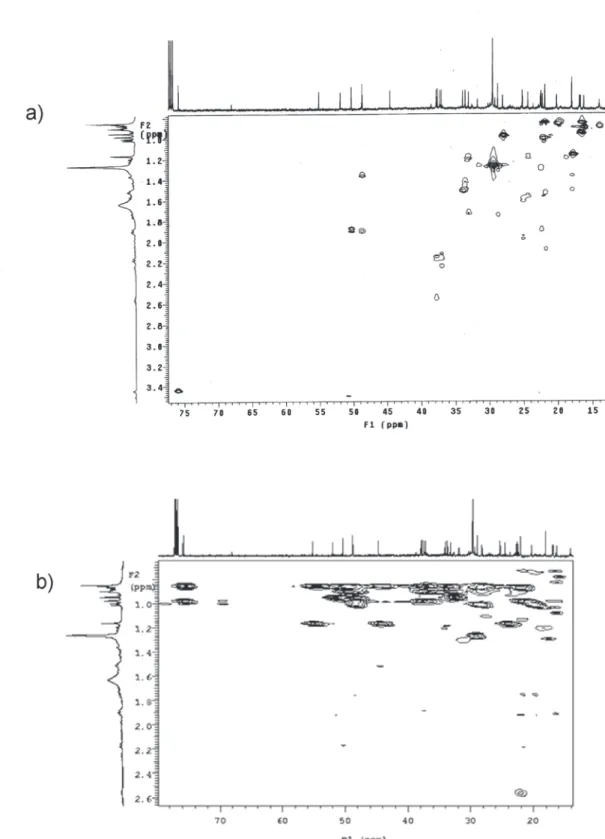
NMR spectrum (Table 1) suggested a hopane-like or a lupane-like triterpene skeleton. The broad singlet at δH 3.44 (brs,
H-3) together with the chemical shift of C-3 at δC 75.9 (CH) in its 13C NMR spectrum (Table 2) suggested the presence of
804 Ruiz et al. J. Braz. Chem. Soc.
a 3α-OH group4 (Table 2) while the signals in at δ C 215.7
(C-15) and δC 224.1 (C-19) showed correlation with the
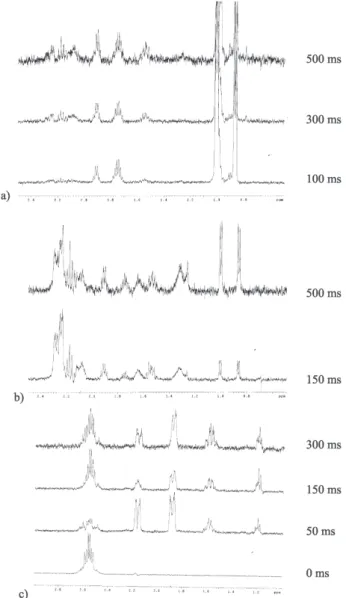
methyl hydrogens at CH3-27 e CH3-28 in the HMBC NMR experiment (Table 1). These correlations indicated that both carbonyl carbons should not be present at C-ring. Analyzing the other correlations obtained in the HMBC NMR experiment, it was possible to determine the presence of the carbonyls at C-15 (D-ring) and at C-19 (E-ring) (Figure 2). The relative configuration at C/D and at D/E rings fusions was deduced through the valuable information about correlations among the hydrogen spin systems at carbons C-16, C-20 and C-30 furnished by the 1D-TOCSY NMR experiment (Figure 3). Accordingly, when hydrogens H-20 were irradiated, it was possible to identify the hydrogens H-21 (q, J 6.0Hz), H-22 (oct, J 6.0 Hz), H-29 (s) and H-30 (s). On the other hand, when the hydrogens H-16 were irradiated, only the hydrogen H-17 was observed. The absence of polarization transference between H-17 and H-21 points out to a very small coupling constant between these hydrogens and consequently to a cis-D/E rings fusion with a β-isopropyl group. The C/D rings fusion should be a cis-fusion with the hydrogen H-13 in a α-position. Through the corresponding molecular model it is possible to see that the methyl group CH3-26 is under the C-19 carbonyl protection cone, which explains the lower chemical shift of CH3-26 (δH 0.85) hydrogens when compared to those related for the 17α,21β -hopane (δH 0.95).5 In its NOESY-1D spectrum, it was
observed that when CH3-27 (δH 1.15) was irradiated
increments were observed in H-7a (δH 1.72, 1.78%), H-9a (δH 1.90, 0.95%) and H-12a (δH 1.52, 2.13%) but not in CH3
-28 (δH 0.94). On the other hand, when CH3-28 (δH 0.94) was irradiated increments were just observed in H-22 (δH 1.76,
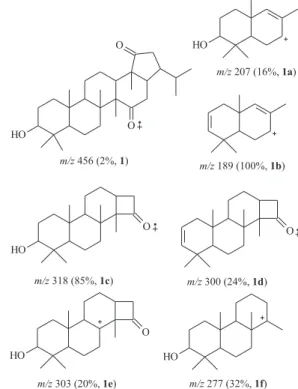
1.66%), corroborating with a cis-C/D rings fusion. In its HR-EIMS spectrum, there are some important fragment ions6
that corroborated with the hydroxyl group at C-3 (m/z 207, 16%, 1a and m/z 189, 100%, 1b) and with carbonyl groups location at D- and E-rings (m/z 318, 85%, 1c; m/z 300, 24%,
1d; m/z 303, 20%, 1e; m/z 277, 32%, 1f) (Figure 4). Compound 2 (C28H48O), isolated from the hexanic extract of E. sellowiana (aerial part), was identified as E-phytyl hexadecanoate by comparison of their 1H and 13C
NMR and MS data with those previously published.7 The
occurrence of compound 2 in the genus Eleocharis is described here for the first time.
Experimental
General
Thin layer chromatography (TLC): Silica gel 60 F254 Al sheets (Merck); detection at 254 and 365 nm and with anisaldehyde in acidic ethanol solution,8 CC = column
chromatography. 1H, 13C NMR and 2D experiments Varian
Inova-500 (Palo Alto, CA, USA) spectrometer at 11 tesla. Chemical shifts of the compounds were recorded in CDCl3 solutions and were quoted relative to TMS for 1H NMR
(δ 0.0) and to CDCl3 (δ 77.0) for 13C NMR. Atributions:
The triterpene numering (see Figure 1) is used in the results
Table 1.1H NMR (500 MHz, CDCl
3) and observed correlation in HSQC (vicinal C-H) and in HMBC (long-range C-H) spectra (CDCl3, 11 Tesla) of 1
H (δ) C (δ, J1) C (δ, Jn)
0.85 (s, H-26) 16.8 (C-26) 55.2 (C-14), 50.4 (C-9), 44.7 (C-8), 34.1 (C-7) 0.85 (s, H-24) 22.0 (C-24) 75.9 (C-3), 48.8 (C-5), 37.4 (C-4), 28.2 (C-23) 0.86 (d, J 7.0 Hz, H-29) 20.3 (C-29) 48.9 (C-21), 28.9 (C-22), 22.4 (C-30)
0.89 (s, H-25) 16.3 (C-25) 50.4 (C-9), 37.8 (C-10), 33.7 (C-1) 0.94 (s, H-28) 16.9 (C-28) 224.1 (C-19), 52.1 (C-18), 50.4 (C-17) 0.97 (s, H-23) 28.2 (C-23) 75.9 (C-3), 48.8 (C-5), 37.4 (C-4), 22.0 (C-24) 1.00 (d, J 7.0 Hz, H-30) 22.4 (C-30) 48.9 (C-21), 28.9 (C-22), 20.3 (C-29)
1.15 (s, H-27) 18.1 (C-27) 215.7 (C-15), 55.2 (C-14), 44.7 (C-8) 1.76 (oct, J 6.0 Hz, H-22) 28.9 (C-22) 20.3 (C-29), 22.4 (C-30), 48.9 (C-21)
1.87 (m, H-9) 50.4 (C-9) 44.7 (C-8), 33.7 (C-1)
1.89 (m, H-17) 50.4 (C-17) 37.2 (C-20), 16.9 (C-28)
1.91 (q, J 6.0Hz, H-21) 48.9 (C-21) 52.1 (C-18), 22.4 (C-30), 20.3 (C-29)
2.18 (m, H-20) 37.2 (C-20) 224.1 (C-19), 50.4 (C-17)
2.26 (m, H-20) 37.2 (C-20) 224.1 (C-19), 48.9 (C-21)
2.55 (m, H-16) 37.9 (C-16) 215.7 (C-15)
3.44 (brs, H-3β) 75.9 (C-3) 33.7 (C-1), 48.8 (C-5)
and discussion and for spectroscopic data. HREIMS experiment: VG Auto Spec 10000 Micromass (Manchester, UK) instrument with an ionizing potencial of 70 eV, m/z (rel. intensity in%), direct probe.
Plant material
Samples of E. sellowiana were collected in Campinas, Brazil, and identified by two of the authors (A. D. F. and M. C. E. A.). Voucher specimens (A. D. Faria et al. 1000 - E. sellowiana) have been deposited in the Herbarium of the Botany Department of the Biology Institute of Unicamp (UEC), Campinas-SP, Brazil.
Extraction
The collected plant (Es = E. sellowiana) was separated into aerial (270.0g, EsA) and subterraneous (428.0g, EsS)
parts. Extracts of fresh subterraneous part were obtained by maceration with ethanol. The resultant extracts were combined, concentrated and diluted with H2O to get an aqueous EtOH solution, which was partitioned with hexane (EsSH, 358.4 mg) and CHCl3 (EsSC, 1303.4 mg); the respective aq. EtOH layers were then named EsSHE (3010.0 mg). The air-dried milled aerial part (named EsA, 95.8g) was successively extracted in a Soxhlet apparatus with hexane (EsAH, 2249.3 mg), CH2Cl2 (EsAD, 447.9 mg) and MeOH (EsAM, 3052.0 mg).
Isolation
Part of the hexanic extract EsSH (300 mg) was subjected to flash CC over silica gel,8 eluted first with
CHCl3-Hex (4:1). The eluent polarity was increased by the gradual addition of chloroform and then methanol until reaching 100% of methanol, furnishing 159 fractions (15
Table 2. 13C NMR data of 1 and 3
C 1 3
δC
a δ
C b
CH2-1 33.7 33.2
CH2-2 25.3 25.3
CH-3 75.9 76.2
C-4 37.4 37.5
CH-5 48.8 48.8
CH2-6 18.5 18.3
CH2-7 34.1 33.2
C-8 44.7 41.8
CH-9 50.4 50.0
C-10 37.8 37.2
CH2-11 21.9 20.9
CH2-12 24.5 24.1
CH-13 50.4 49.9
C-14 55.2 41.9
C-15 215.7 34.7
CH2-16 37.9 21.9
CH-17 50.4 53.9
C-18 52.1 44.1
C-19 224.1 41.3
CH2-20 37.2 26.6
CH-21 48.9 51.1
CH-22 28.9 73.9
CH3-23 28.2 28.3
CH3-24 22.0 22.1
CH3-25 16.3 15.7
CH3-26 16.8 17.0
CH3-27 18.1 17.1
CH3-28 16.9 16.2
CH3-29 20.3 28.7
CH3-30 22.4 30.9
a125 MHz, CDCl 3;
bTanaka and Matsunaga, reference 4.
Figure 3. Observed correlation in 1D-TOCSY experiment of 1.
806 Ruiz et al. J. Braz. Chem. Soc.
mL), which were reduced to 21 groups after TLC. Group 3 (29.4 mg, fractions 7 and 8), after successive preparative TLC run with CHCl3-MeOH (40:1) and with Et2O-Hex (2:1), afforded 1 (4.0 mg).
3α-hydroxy-13α,17α,21β-hopan-15,19-dione (1)
It was obtained as a colorless oil; 1H NMR (CDCl
3,
500MHz): Table 2; 13C NMR (CDCl
3, 125MHz): Table 3;
HREI-MS (70eV), m/z (%): 456.3607 (2), 441.3680 (9), 318.2508 (85), 303.2231 (20), 300.2370 (24), 277.2109 (32), 233.1865 (12), 207.1671 (16), 189.1581 (100), 177.1566 (7), 175.1408 (38), 152.1162 (10), 139.1056 (17), 137.1275 (9), 135.1118 (62), 121.0952 (52), 109.0966 (41), 107.0806 (56), 97.0590 (84), 95.0801 (63), 93.0646 (48). After solvent evaporation, part of the hexanic extract EsAH (467.0 mg) was fractionated by successive preparative TLC run with CH2Cl2-MeOH-H2O (85:15:1). These furnished seven fractions, which were numbered according to their decreasing polarities. Part of the seventh fraction (174.1 mg) was fractionated by successive preparative TLC run with CH2Cl2-Hex (9:1). These eleven fractions were numbered according to their decreasing polarities. The fraction 7.11 was purified by preparative TLC continuously run with Hex-Et2O (39:1) during 100 min to afford 2 (4.0 mg) which was analyzed by its NMR and MS spectra data.
Acknowledgments
The authors are grateful to FAPESP for financial support and for the scholarship awarded to Ana Lúcia T.G. Ruiz. Dr. Maria do Carmo E. do Amaral also thanks CNPq for a research grant.
Supplementary Information
Supplementary data are available free of charge at http://jbcs.sbq.org.br, as PDF file.
References
1. Faria, A. D.; MSc. Dissertation, Universidade Estadual de Campinas, Brasil, 1998.
2. Clifford, H. T.; Harbone, J. B.; Phytochemistry 1969, 8, 123; Stevens, K. L.; Merrill, G. B.; J. Agric. Food Chem. 1980, 28, 644; Van Aller, R. T.; Clark, L. R.; Pessoney, G. F.; Rogers, V. A.; Lipids 1983, 18, 617; Miles, D.H.; Tunsuwan, K.; Chittawong, V. J.; J.Agric. Food Chem.1994, 42, 1561; Quayyum, H. A.; Mallik, A.U.; Orr, D. E.; Lee, P. F.; J. Chem. Ecol.1999, 25, 221.
3. Amaral, M. C. E.; Faria, A. D.; Magalhães, A. F.; Magalhães, E. G.; Ruiz, A. L. T. G; Phytochem. Anal.2004, 15, 125; Magalhães, A. F.; Ruiz, A. L. T. G.; Flach, A.; Faria, A. D.; Magalhães, E. G.; Amaral, M. C. E.; Biochem. Syst. Ecol. 2005,
33, 675; Ruiz, A. L. T. G.; Magalhães, E. G.; Magalhães, A. F.; Faria, A. D.; Amaral, M. C. E.; Serrano, D. R.; Zanotti-Magalhães, E. M.; Zanotti-Magalhães, L. A.; Braz. J. Pharmacogn. 2005, 15, 98.
4. Olea, R. S. G.; Roque, N. F.; Quim. Nova1990, 13, 278; Tanaka, R.; Matsunaga. S.; Phytochemistry 1992, 31, 3535.
5. Ageta, H.; Shiojima, K.; Chem. Pharm. Bull.1990,38, 347. 6. Budzikiewicz, H.; Wilson, J. M.; Djerassi, C.; J. Am. Chem.
Soc.1963,85, 3688; Shiojima, K.; Arai, Y.; Masuda, K.; Takase, Y.; Ageta, T.; Ageta, H.; Chem. Pharm. Bull.1992, 40, 1683. 7. Pereira Jr., O. L.; Wolter Filho, W.; da Rocha, A. F. I.; de
Carvalho, M. G.; Braz Filho, R.; Quim. Nova 1990, 13, 247; Hasan, M.; Burdi, D. K.; J. Nat. Prod. 1991,54, 1444. 8. Magalhães, A. F.; Ruiz, A. L. T. G.; Tozzi A. M. G. A.;
Magalhães, E.G.; Phytochemistry 1999, 52, 1681.
Received: September 17, 2004
Published on the web: April 28, 2006
Printed in Brazil - ©2006 Sociedade Brasileira de Química 0103 - 5053 $6.00+0.00
Supplementary Information
* e-mail: [email protected]
New Hopane Triterpene from
Eleocharis
sellowiana
(Cyperaceae)
Ana Lúcia T. G. Ruiz,*,a, b Aderbal F. Magalhães,a Aparecida D. Faria,c Eva G. Magalhãesa
and Maria do Carmo E. Amaralc
a
Instituto de Química, Universidade Estadual de Campinas, CP 6154, 13084-862 Campinas - SP, Brazil
b
Centro Pluridisciplinar de Pesquisas Químicas, Biológicas e Agrárias, Universidade Estadual de Campinas, CP 6171, 13083-970 Campinas - SP, Brazil
c
Instituto de Biologia, Universidade Estadual de Campinas, CP 6109, 13083-970 Campinas - SP, Brazil
Figure S1.1H NMR spectrum (500 MHz, CDCl
S2 Ruiz et al. J. Braz. Chem. Soc.
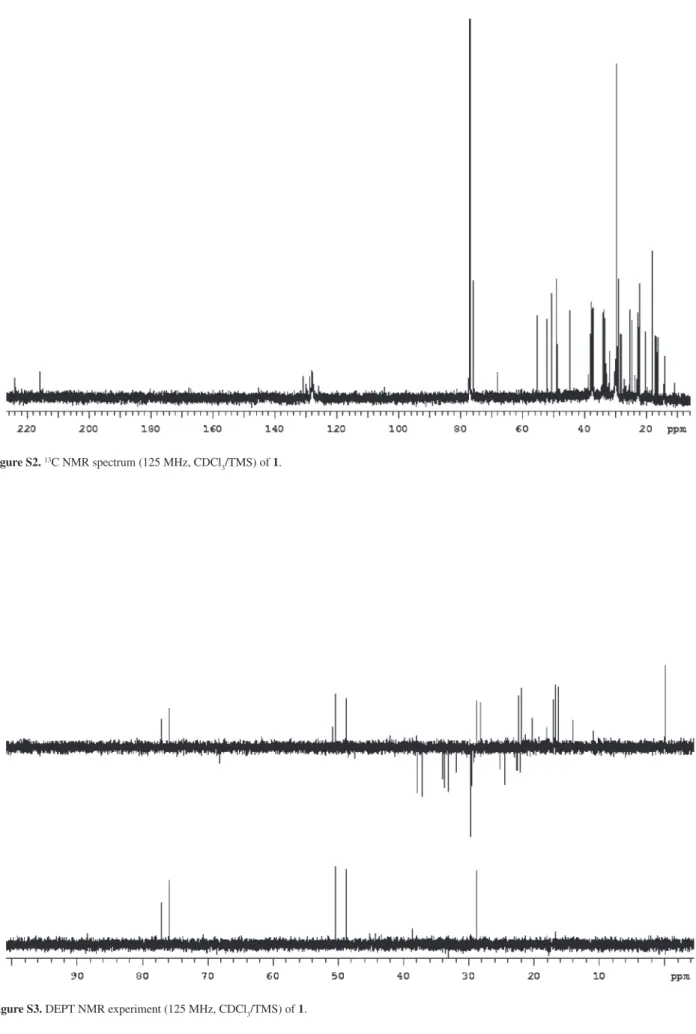
Figure S2.13C NMR spectrum (125 MHz, CDCl
3/TMS) of 1.
Figure S5. 1D NOESY NMR experiment (500 MHz, CDCl3/TMS) of 1; H-3β (δH 3.44) was irradiated.
S4 Ruiz et al. J. Braz. Chem. Soc.
Figure S6. 1D NOESY NMR experiment (500 MHz, CDCl3/TMS) of 1; H-27 (δH 1.15) was irradiated.
S6 Ruiz et al. J. Braz. Chem. Soc.
Figure S9. 1D TOCSY experiment (500MHz, CDCl3/TMS) of 1. a) H-30 (δH 1.00) was irradiated; b) H-20 (δH 2.18) was irradiated; c) H-16
(δH 2.55) was irradiated.