Anthraquinone-2,6-disulfonate (AQDS) as a catalyst to enhance the
reductive decolourisation of the azo dyes Reactive Red 2 and
Congo Red under anaerobic conditions
M.C. Costa
a, S. Mota
a, R.F. Nascimento
b, A.B. Dos Santos
a,* aDepartment of Hydraulic and Environmental Engineering, Federal University of Ceará, Brazil bDepartment of Chemistry, Federal University of Ceará, Brazila r t i c l e
i n f o
Article history: Received 26 May 2009
Received in revised form 3 August 2009 Accepted 4 August 2009
Available online 29 August 2009
Keywords: Anaerobic treatment Congo Red Reactive Red 2 Redox mediator Co-substrates
a b s t r a c t
In this study, we assessed the catalytic effect of anthraquinone-2,6-disulfonate (AQDS) to enhance the reductive decolourisation of the azo dyes Reactive Red 2 and Congo Red in batch and continuous-flow experiments. While testing the anaerobic sludge 1 in assays free of AQDS, the highest values for the first-order kinetic constant (k1) were found with co-substrates formate and glucose. In the assays that contained 50lM of AQDS, the k1 values increased with all co-substrates tested, increasing by 3.5-fold
when ethanol was the electron donor. The upflow anaerobic sludge blanket (UASB) reactors R1 (AQDS-free) and R2 (AQDS-supplemented) reached excellent decolourisation efficiencies (higher than 90%) even for the high Congo Red concentration tested (1.2 mM). However, electron donor depletion in the influent drastically decreased the colour removal capacity in both bioreactors. Reactor R2 presented higher stabil-ity and decolourisation efficiency compared to R1, indicating that the addition of a redox mediator can be valuable for treating dye-coloured wastewaters.
Ó2009 Elsevier Ltd. All rights reserved.
1. Introduction
Azo dyes represent the most important class of dyes used in the textile industry. They are characterized by the presence of one or more azo groups (–N@N–) and the bonds between two or more
aromatic rings (Zollinger, 1987).
The discharge of dye-coloured wastewaters in the environment represents both environmental and public health risks because of the negative ecotoxicological effects and bioaccumulation in wild-life (Chung and Stevens, 1993). Most importantly, many dyes and their reduced products are carcinogenic and mutagenic (Chung and Cerniglia, 1992). Additionally, colour in surface water is aes-thetically undesirable and may affect photosynthesis, thereby compromising aquatic life (Manu and Chaudhari, 2002).
Methods currently used to treat textile wastewaters have tech-nical and economical limitations (Dos Santos et al., 2007). Most of the physico-chemical methods that remove colour from waters are expensive, produce large amounts of sludge, and are inefficient for some soluble dyes. Biological treatment of dyed-waters can be cheaper than physico-chemical treatment, but some dyes are
recalcitrant and toxic to microorganisms (Van der Zee and Villaver-de, 2005).
Colour removal by aerobic bacteria is usually low (10–30%), be-cause oxygen is a better electron acceptor compared to the azo dyes (Stolz, 2001; Dos Santos et al., 2007). However, under anaer-obic conditions, azo dyes can act as electron acceptors, and higher decolourisation rates are usually reported (Manu and Chaudhari, 2002; Méndez-Paz et al., 2005; Dos Santos et al., 2005, 2007; Singh et al., 2007).
Redox mediators (RM) can enhance many reductive processes under anaerobic conditions, including azo dye reduction. Qui-none-based compounds have shown to work as redox mediators by promoting electron transfer in chemical and microbiological reactions (Cervantes et al., 2001; Field and Brady, 2003; Dos Santos et al., 2007). Quinone-based compounds are enzymatically reduced by bacteria to form hydroquinones, which subsequently reduce azo dyes in a purely chemical reaction (Rau and Stolz, 2003), thereby increasing electron transfer from the electron donor, usually or-ganic substrates, to the electron acceptor azo dye (Dos Santos et al., 2005).
The type and availability of electron donors are important in achieving good colour removal in bioreactors operated under anaerobic conditions (Van der Zee and Villaverde, 2005). Anaerobic microorganisms are capable of utilizing different electron donors to promote reductive decolourisation of dyes. However, each
0960-8524/$ - see front matterÓ2009 Elsevier Ltd. All rights reserved. doi:10.1016/j.biortech.2009.08.015
* Corresponding author. Address: Department of Hydraulic and Environmental Engineering, Federal University of Ceará, Campus do Pici, Bloco 713. Pici. CEP: 60451-970, Fortaleza, Ceará, Brazil. Tel./fax: +55 85 3366 9490.
E-mail address:[email protected](A.B. Dos Santos).
Contents lists available atScienceDirect
Bioresource Technology
anaerobic consortium has an optimal electron donor that gives the highest decolourisation rates.
Aromatic amines are formed during dye reduction and they are normally recalcitrant under anaerobic conditions. Since aromatic amines are toxic, carcinogenic, and contain Chemical Oxygen De-mand (COD), post-treatment is needed (Field et al., 1995). Some investigations indicate that aromatic amines can be mineralized by aerobic bacteria, or by using chemical-oxidative processes ( Pin-heiro et al., 2004).
The present investigation aimed to evaluate, in batch and con-tinuous-flow experiments, the catalytic effect of the compound AQDS to enhance the reductive decolourisation of the azo dyes Reactive Red 2 (RR2) and Congo Red (CR) in the presence of differ-ent co-substrates and operational conditions.
2. Methods
2.1. Materials
The azo dyes used in the experiments were RR2 (Procion Red MX-5B,50% of purity, Aldrich Chemical Company) and CR (ana-lytical grade, Vetec), whose molecular structures are shown inFigs. 1 and 2. RR2 is a monoazo (MW of 615.34 g per mol) and CR is a diazo (MW of 696.98 g per mol). The compound anthraquinone-2,6-disulfonate (AQDS) (98% of purity, Aldrich Chemical Com-pany) was selected as a redox mediator, whose molecular structure is shown inFig. 3. The compounds acetate, glucose, ethanol and formate were tested as co-substrates.
2.2. Batch experiments
Two anaerobic consortia were tested separately in batch exper-iments: consortium 1 (sludge 1) was collected from an UASB reac-tor placed in a brewery (Fortaleza, Ceará, Brazil); consortium 2
(sludge 2) was collected from an UASB reactor placed in a paper-mill industry (Eerbeek, The Netherlands).
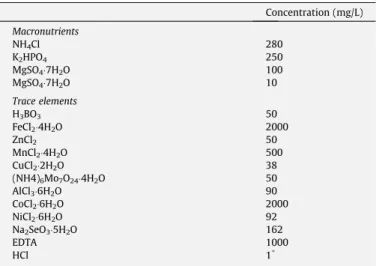
The anaerobic consortium was tested in the concentration of 1.5 g VSS (volatile suspended solids)/L. It was transferred to 117-mL batch assays, with 50 117-mL of basal medium that consisted of macronutrients and 1 mL/L of trace elements (concentrations are shown inTable 1). The medium was buffered with 2.5 g/L of so-dium bicarbonate to keep the pH around 7.1.
Dyes and AQDS were tested with concentrations of 0.3 mM and 50
l
M, respectively (Dos Santos et al., 2003). The co-substrates used in batch experiments were acetate, glucose, ethanol and for-mate, tested in the same concentration of 1.5 g COD/L.Batch bottles were sealed with butyl rubber stoppers and alu-minum crimp caps, and the headspace was purged with N2:CO2
(70%:30%) for 1 min to establish anaerobic conditions. Subse-quently, organic substrates, dyes and redox mediators were added. The batch assays were placed in a room temperature of about 28 ± 2°C under agitation of 150 rpm.
2.3. Continuous-flow experiments
Two UASB reactors were operated with a Hydraulic Retention Time (HRT) of 8 h, and kept at room temperature (28 ± 2°C). The
reactors were named R1 (AQDS-free) and R2 (AQDS-supple-mented). Both reactors were 42.5 cm height and 4 cm in diameter, for a total volume of 0.53 L. Anaerobic consortium 1 was added to the reactors (30 g VSS/L), and the sludge blanket occupied approx-imately 2/3 of the reactor height.
The synthetic wastewater contained the same basal medium described for the batch experiments, the dye CR, cosubstrate and sodium bicarbonate (2.5 g/L). AQDS was added to R2 influent in the concentration of 50
l
M. The influent was prepared 3 times a week and stored at 4°C to avoid biological contamination.The dye CR was tested in concentrations of 0.6 mM and 1.2 mM. Ethanol was selected as co-substrate and the initial organic loading rate (OLR) was 2.5 kg COD/m3.day. Different OLRs were tested, and
there was a period during which no co-substrate was added, in or-der to evaluate the consortium’s capability to use the dye as a car-bon and energy source.
2.4. Analyses and calculations
Colour removal of the RR2 and CR was determined photometri-cally at wavelength readings of 539 nm and 486 nm, respectively,
N N
N
N N Cl
Cl OH NH
SO3Na NaO3S
Fig. 1.Chemical structure of the azo dye Reactive Red 2.
Fig. 2.Chemical structure of the azo dye Congo Red.
S ONa O
O O
O S
O
O NaO
Fig. 3.Chemical structure of the redox mediator AQDS.
Table 1
Basal medium composition.
Concentration (mg/L)
Macronutrients
NH4Cl 280
K2HPO4 250
MgSO47H2O 100
MgSO47H2O 10
Trace elements
H3BO3 50
FeCl24H2O 2000
ZnCl2 50
MnCl24H2O 500
CuCl22H2O 38
(NH4)6Mo7O244H2O 50
AlCl36H2O 90
CoCl26H2O 2000
NiCl26H2O 92
Na2SeO35H2O 162
EDTA 1000
HCl 1*
*HCl concentration was 1
which gave the maximum absorbance for each dye. Samples were diluted in a phosphate buffer in Eppendorff tubes. In order to avoid turbidity interference, samples were centrifuged at 13,000 rpm for 2 min.
For batch experiments, sample collection was conducted visu-ally observing colour loss in the bottles, at which samples from all bottles were usually collected.
For continuous-flow experiments, samples were collected from the influent and effluent of the reactors. Alkalinity, pH, volatile fatty acids (VFA) and chemical oxygen demand (COD) were ana-lyzed twice a week, according to Standard Methods (APHA, 2005). The first-order rate constant ‘‘k1” was determined for dye con-centration using the Eq.(1):
At¼A0ekt ð1Þ
where, at is the absorbance at time‘‘t”,A0is the initial absorbance at
t= 0, ‘‘k1” is the first-order rate constant (day1) and ‘‘t” is the time
elapsed (days). Time was plotted against ln (At/A0) and thek-value
was estimated by the slope of a linear regression, using the Micro-soft Excel solver tool.
3. Results and discussion
3.1. Effects of different electron donors on the reductive decolouri-sation of azo dyes by two anaerobic consortia
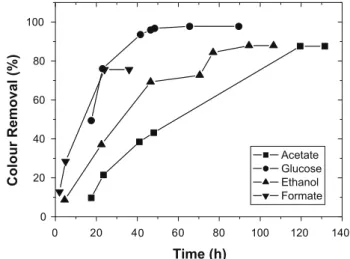
Table 2 shows the effect of different electron donors on RR2 reduction by two anaerobic consortia for AQDS-free assays. In terms of first-order kinetic constant, formate was the most effec-tive electron donor to promote RR2 decolourisation with both con-sortia. However, compared to 97.8% found with glucose, the final colour removal efficiency with formate was only 75.6%, as shown inTable 2andFig. 4. Such behavior was likely due to the fact that formate was preferentially converted into methane, suggesting a competition between dye reduction and methanogenesis (Dos San-tos et al., 2006).
Méndez-Paz et al. (2005), investigating colour removal of the azo dye Acid Orange 7 in batch assays supplemented and deprived with co-substrate, showed that dye reduction was considerably en-hanced when glucose was added as co-substrate.Dos Santos et al. (2005)tested glucose as the electron donor in the same concentra-tion as used in the present investigaconcentra-tion, and obtained 100% RR2 (0.3 mM) reduction with mesophilic and thermophilic granular sludges.
Although acetate presented a low rate of RR2 reduction (0.31 day1), the final colour removal capacity (87.6%) was better
than that achieved with formate, as shown inFig. 4.Van der Zee et al. (2001b)reported higher RR2 reduction rates (260 mg/L) with hydrogen as the electron donor compared to acetate. The biochem-ical explanation for low azo dye reduction with methanogenic substrates is still largely unclear, but likely the acetoclastic meth-anogens are not important for reductive decolourisation compared to the hydrogenotrophic methanogens (Dos Santos et al., 2006).
Data shown inTable 2also indicate that anaerobic inoculum 2 provided better decolourisation rates compared to inoculum 1, probably because the co-substrates ethanol and formate could be oxidized much faster by the anaerobic microorganisms and pro-duced more electrons to reduce the dye. Therefore, the sludge source plays a role in the decolourisation rates reported.
The chemical control showed that the dye was stable to photo-degradation, and endogenous and autoclaved controls showed that the colour removal was a biotic mechanism (data not shown).
3.2. AQDS as a catalyst to enhance the reductive decolourisation of azo dyes
The redox mediator AQDS (50
l
M) can act as catalyst in the reductive decolourisation of azo dyes, increasing the first-order ki-netic constant (k1) with all co-substrates tested, as shown inTable 2.The azo dye reduction in the presence of redox mediators oc-curs in two steps. First, the redox mediator is biologically reduced by non-specific enzymes. Second, the electrons are chemically transferred to the azo dye, as the terminal electron acceptor, with consequent mediator regeneration (Dos Santos et al., 2007).
For co-substrate ethanol, incubated with consortium 1, AQDS addition increased thek1-value 3.5-fold. Interestingly for acetate, considered a poor co-substrate for dye reduction, the AQDS impact was 2.2-fold, which was comparable to the results achieved with glucose.
In most of the cases, the redox mediator also increased the final colour removal efficiency with all co-substrates tested (Table 2), indicating that, with regard to competition for electrons (including methanogenesis), AQDS channelled more electrons towards the dye reduction compared to the assays lacking this compound.
Table 2
Effect of different co-substrates and the redox mediator AQDS on RR2 reduction.
Anaerobic consortia Electron donor (1.5 gCOD/L) Without AQDS With AQDS (50lM)
Colour removal efficiency (%) k1 (day1) Colour removal efficiency (%) k1 (day1)
Sludge 1 Acetate 87.6 0.31 88.6 0.70
Glucose 97.8 1.30 96.3 2.96
Ethanol 87.9 0.54 96.4 1.88
Formate 75.6 1.48 92.7 4.68
Sludge 2 Ethanol 97.1 1.83 96.9 4.74
Formate 91.9 2.74 93.3 7.59
0 20 40 60 80 100 120 140
0 20 40 60 80 100
Colour Removal (%)
Time (h)
Acetate Glucose Ethanol Formate
The catalytic effect of only 7
l
M AQDS to accelerate RR2 reduc-tion (260 mg/L) was also found by Van der Zee et al. (2001b), increasing the decolourisation rates 2-fold with hydrogen as a co-substrate.Dos Santos et al. (2003)obtained a 5-fold increase in RR2 reduction when testing 0.012 mM AQDS with a mixture of glucose and volatile fatty acids (VFA) as a co-substrate.Data on the catalytic effect of AQDS to accelerate CR reduction is shown inTable 3. CR reduction with ethanol as a co-substrate was faster than that found for RR2, indicating that the latter is more re-calcitrant under anaerobic conditions to reductive processes.
Differences in chemical structure such as chromophores and auxochromes, the number of azo bonds, aromatic ring and substi-tuent positions, redox potentials, etc., directly affect the biological and chemical steps involved on dye reduction (Hao et al., 2000; Rau et al., 2002; Dos Santos et al., 2007). Because of so many vari-ables, different behaviors with respect to reductive decolourisation rates can be found.
With dye CR and sludge 1, thek1-values were 3.8 day1 and
5.1 day1, for the bottles free and supplemented with AQDS,
respectively (Table 3). Therefore, AQDS increased the dye reduction by 1.4-fold. In the presence of RR2, the k1-value achieved was 0.54 day1, and AQDS increased the rates by 3.5-fold. These results
indicated that the catalytic effect of AQDS on dye reduction was more evident with RR2. Probably the effect was due to the higher recalcitrance of RR2 to reductive processes, compared to CR, which masked the AQDS impact.
The electron donor concentration used in batch experiments (1.5 g COD/L) was likely not a limiting factor for the reductive decolourisation of CR and RR2. The consumption of 1 mol of O2
represents a reaction with 4 mols of electrons. If 1 mol of O2
repre-sents 32 g COD, 1 mol of electrons corresponds to 8 g COD. Because CR is a diazo, in theory 8 electron equivalents are required to re-duce one molecule of CR dye. Therefore, to rere-duce 0.3 mM of the dye 2.4 mM (19.2 mg COD/L) of electrons are required. For RR2 (monoazo), 4 electron equivalents are required to reduce one mol-ecule of RR2. Therefore, 1.2 mM (9.6 mg COD/L) of electrons is re-quired to reduce 0.3 mM of RR2.
Although CR is a diazo, it was less recalcitrant to reductive pro-cesses, which was probably because of its linear structure com-pared to RR2, thereby decreasing steric hindrance effects and facilitating azo cleavage. Additionally, RR2 contained a triazine group, which generally gives a high recalcitrance to reductive pro-cesses because of the competition for electrons between nitrogen atoms from the triazine group and the nitrogen from the azo link-age (Van der Zee et al., 2001a).
In addition to the structure/activity relationship effect, azo dye reducing microorganisms and other microbes present in anaerobic consortia compete for the same electrons, which mean that it is necessary to understand the minimal electron donor (co-substrate) dosage to sustain dye reduction in batch and continuous-flow experiments (Dos Santos et al., 2006).
3.3. Effect of an AQDS gradient on the reductive decolourisation of dye RR2
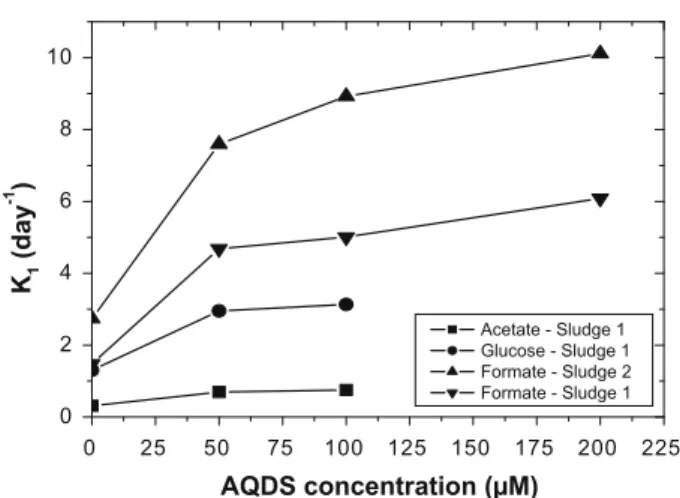
The effect of an AQDS gradient on azo dye reduction was tested. Data onTable 4suggest that increasing the catalyst concentrations
had a positive effect on dye reduction. However, the impact was not that significant, indicating that low AQDS concentrations were enough to catalyse reductive decolourisation. This finding is important because AQDS addition has a cost and its concentration should be kept to a minimum.
When the AQDS concentration was doubled the initial concen-tration (Table 4) thek1 value increased only 1.5-fold for all the experiments. A very highk1 value (10.1 day1) was achieved in the bottles that contained consortium 2, formate as co-substrate and 200
l
M-AQDS (Fig. 5).Dos Santos et al. (2004)found a 1.9-fold increase in RR2 reduc-tion compared to the AQDS-free assays while testing 24
l
M of AQDS with a mixture of glucose and VFA as a cosubstrate. In the latter experiment, the concentration of 10 mM AQDS increased the k1-value 5.9-fold, but severely inhibited acetate conversion to methane.Table 3
RR2 and CR reduction with ethanol as the electron donor (1.5 gCOD/L).
Anaerobic consortia Azo dyes AQDS (lM) Colour removal efficiency (%) K1 (day1) Standard deviation
Sludge 1 Congo Red 0 97.5 3.80 0.05
Congo Red 50 99.3 5.12 0.07
RR2 0 87.9 0.54 0.07
RR2 50 96.4 1.88 0.06
Table 4
Reductive recolourisation of RR2 in the presence of different electron donors and AQDS concentrations.
Anaerobic consortia
Electron donor (1.5 gCOD/L)
AQDS (lM)
Colour removal efficiency (%)
k1 (day1)
Standard deviation
Sludge 1 Acetate 0 87.6 0.31 0.02
50 88.6 0.70 0.03
100 88.5 0.75 0.04
Sludge 1 Glucose 0 97.8 1.30 0.06
50 96.3 2.96 0.10
100 96.0 3.13 0.07
Sludge 1 Formate 0 75.6 1.48 0.01
50 92.7 4.68 0.42
100 93.3 5.00 0.19
200 93.1 6.09 0.12
Sludge 2 Formate 0 91.9 2.74 0,05
50 93.3 7.59 0.23
100 94.9 8.93 0.76
200 93.6 10.11 0.33
0 25 50 75 100 125 150 175 200 225
0 2 4 6 8 10
K
1(day
-1
)
AQDS concentration (µM)
Acetate - Sludge 1 Glucose - Sludge 1 Formate - Sludge 2 Formate - Sludge 13.4. Performance of the anaerobic bioreactors in terms of colour and COD removal
Data for continuous-flow experiments are shown in Table 5. Period 1 was the acclimation time; no dye was added to the reac-tors. In Period 2, the azo dye CR was added at a concentration of 418 mg/L (0.6 mM), and in Period 3 twice that concentration of CR was added. The organic loading rate was changed starting in Period 4 onwards, but the same CR concentration of 1.2 mM (Table 5) was used.
High colour removal efficiencies (>90%) were achieved in the bioreactors, even for the high dye concentrations tested (1.2 mM or 836 mg/L).Isik and Sponza (2005)found 100% CR decolourisa-tion, but the concentration was only 100 mg/L, i.e. at least 8 times lower than the concentration tested in the current experiment.
While testing the organism D. alaskensis, Diniz et al. (2002)
found that the azo dye CR was toxic to the cells, in concentrations higher than 0.5 mM, i.e. in a concentration 2.4-fold lower than the concentration used in the present investigation (1.2 mM). No inhi-bition of CR or its reduced products was found in terms of cosub-strate oxidation, as VFA effluent concentration for reactors R1 and R2 was 271.7 and 294.8 mg CH3COOH/L, respectively. The re-sults showed that it is advantageous to use anaerobic consortia compared to pure cultures, because the high microbe diversity in anaerobic consortia helps to decrease toxicity effects and enhance process stability.
AQDS addition in reactor 2 increased colour removal efficiency compared to the AQDS-free reactor 1 (Table 5). However, the dif-ference was not as high as the rates achieved in batch experiments with CR (Table 3).
Dos Santos et al. (2005)in an experiment with RR2 (0.3 mM) found that the reactor supplemented with 25
l
M of AQDS achieved colour removal efficiency up to 32% higher than the AQDS-free reactor. Such a difference was probably due to the dyes tested, since in this case it was easier to reduce the CR compared to RR2, thus masking the AQDS effect.Brauna et al. (2009)found decolourisation efficiencies of about 80% while testing dye RR2 (20 mg/L), with the same electron donor and OLR used in the present study.
In Period 2, COD removal was 77.4% and 83.3%, for bioreactors R1 and R2, respectively. When the dye concentration was in-creased, which contributed to increase the influent COD, the effi-ciency decreased slightly to 49.3% (R1) and 40% (R2).
Singh et al. (2007)reported 46% COD removal efficiency in an experiment with azo dye Acid Orange (200 mg/L). The COD effi-ciency dropped to 35% when the dye concentration was increased to 300 mg/L.Brás et al. (2005)operated a lab scale UASB reactor and achieved colour removal efficiencies of 92% and 85% for azo dye Acid Orange 7 in concentrations of 60 mg/L and 300 mg/L, respectively. However, they found that COD removal efficiency
de-creased from 92% (60 mg/L) to 67% (300 mg/L), thereby indicating a more evident effect on COD removal capacity compared to the col-our removal capacity.
In Period 4, the OLR was decreased to 1.0 kg COD/m3
d and the decolourisation efficiency was higher than 90% in both reactors. However, for an OLR of 0.5 kg COD/m3
d (Period 5), colour re-moval efficiencies decreased to 85.2% (R1) and 87.3% (R2).
When co-substrate ethanol was completely suspended (Period 6), the reactors efficiencies started to collapse, and the decolourisa-tion decreased to 23.7% (R1 AQDS-free) and 17.2% (R2 AQDS-sup-plemented). In this period, COD efficiencies decreased to 58.8% (R1) and 44.5% (R2).
Isik and Sponza (2005), tested a lower CR concentration (100 mg/L), and achieved 99% decolourisation even when glucose was removed from the system. They also reported a decrease from 78% to 68% on COD efficiency when glucose concentration was de-creased from 500 mg/L to 100 mg/L. The results of the present investigation indicate the importance of an electron donor, to-gether with its type and concentration, to sustain dye reduction, as well as the ratio of electron donor and dye concentrations.
Brauna et al. (2009)found in continuous-flow experiments that the RR2 reduction decreased 2.5-fold when the ethanol concentra-tion decreased from 1000 mg COD/L to 100 mg COD/L.Brás et al. (2001)achieved higher dye reduction rates operating a methano-genic sequenced batch reactor with the azo dye Acid Orange 7 (100 mg/L) when the co-substrates glucose and sucrose were in-creased from 300 to 3000 mg COD/L.O´Neill et al. (2000)treated an effluent containing 0.75 g/L of azo dye Red H-E7B using two dif-ferent starch concentrations (1.9 and 3.8 g/L), and showed that the decolourisation capacity of the system increased for the higher starch concentration.
In Period 7, co-substrate feeding was re-established but at low concentration (33 mg COD/L), corresponding to an OLR of 0.1 kg COD/m3
d. Colour removal efficiencies were 21.4% (R1) and 15.0% (R2) (Table 5). As previously mentioned, 1.2 mM of CR de-mands 9.6 mM electron equivalents or 76.8 mg COD/L. Therefore, the co-substrate concentration was not enough to provide electron equivalents to remove the colour in both reactors.
It is important note that the catalytic effect of AQDS on reduc-tive decolourisation was only observed when the co-substrate (electron donor) was present. During periods of depletion or low co-substrate concentration (periods 6 and 7, respectively), the AQDS-free bioreactor R1 had a better performance than the AQDS-supplemented bioreactor R2. This indicates that the better R2 performance in the other periods was indeed due to the work of AQDS as a catalyst.
When OLR increased to 1.0 kg COD/m3
d, in Period 8, high col-our removal efficiencies were re-established, reaching 89.9% and 98.5% for reactors R1 and R2, respectively. COD removal was lower than the values found in Period 4, likely because the
microorgan-Table 5
Performance of the anaerobic bioreactors in terms of colour and COD removal.
Period 1 2 3 4 5 6 7 8
End of the period (days) 12 23 85 145 169 183 198 229
OLR of co-substrate ethanol kgCOD/m3d 2.5 2.5 2.5 1.0 0.5 – 0.1 1.0
Co-substrate ethanol (mgCOD/L) 833 833 833 333 166 – 33.3 333
CR (mM) – 0.6 1.2 1.2 1.2 1.2 1.2 1.2
pH (R1) – 8.1 ± 0.1 7.9 ± 0.2 8.1 ± 0.1 8.1 ± 0.1 8.5 ± 0 8.4 ± 0.2 8.0 ± 0.3
pH (R2) – 8.2 ± 0 8.0 ± 0.3 8.2 ± 0.1 8.2 ± 0.1 8.6 ± 0 8.4 ± 0.2 8.1 ± 0.1
% CODsol removal (R1) – 77.4 ± 15 49.3 ± 11 54.5 ± 33 75.9 ± 16 58.8 ± 13 56.2 ± 34 32.8 ± 11
% CODsol removal (R2) – 83.3 ± 9 40 ± 14 60 ± 28 50.5 ± 19 44.5 ± 11 29.6 ± 6 35.5 ± 16
% Colour removal (R1) – 94.9 ± 3 96.5 ± 7 94.2 ± 15 85.2 ± 9 23.7 ± 10 21.4 ± 5 89.9 ± 16
% Colour removal (R2) – 99.2 ± 2 98.1 ± 4 98.4 ± 9 87.3 ± 10 17.2 ± 8 15.0 ± 12 98.5 ± 1
isms were still recovering the activity lost during the co-substrate depletion period.
In general, the low COD efficiencies found were attributed to the consortium incapacity to convert the aromatic amines formed. These compounds probably did not cause toxicity to the anaerobic microorganisms, since no remarkable acetate accumulation was found. Thus, post-treatment is required to eliminate non-reduced azo dyes and the aromatic amines formed.
4. Conclusions
Colour removal efficiencies higher than 90% were found in con-tinuous-flow experiments, even for the high CR concentrations tested. The OLR change had an evident effect on the reductive decolourisation. Therefore, it is important to establish the lowest co-substrate concentration necessary to maintain high decolouri-sation efficiencies.
The catalytic effect of AQDS for increasing decolourisation rates was observed with all co-substrates tested in batch experiments and low concentrations of redox mediators were enough to en-hance thek1-values. However, AQDS addition in the continuous-flow experiments did not have the same significant effect on CR reduction, but the AQDS-supplemented bioreactor R2 presented higher stability and colour removal efficiency.
Acknowledgements
The authors would like to thank the Laboratory of Sanitation (Labosan) of the Federal University of Ceará (UFC), Christus School, and CNPq (Conselho Nacional de Desenvolvimento Científico e Tenológico) for the PhD scholarship and financial support (Process 470310/2007-3 from Edital Universal). Finally, we thank the assis-tance of the Laboratory of Water (Lanágua) of UFC.
References
APHA, Standard Methods for the Examination of Water and Wastewater, 21ªed., American Public Health Association, 2005.
Brás, R., Ferra, M.I., Pinheiro, H.M., Gonçalves, I.C., 2001. Batch tests for assessing decolourization of azo dyes by methanogenic and mixed cultures. Journal of Biotechnology 89, 155–162.
Brás, R., Gomes, A., Ferra, M.I.A., Pinheiro, H.M., Gonçalves, I.C., 2005. Monoazo and diazo dye decolourisation studies in a methanogenic UASB reactor. Journal of Biotechnology 115, 57–66.
Brauna, C.H.C., Mota, S., Dos Santos, AB., 2009. Reductive decolorization of the azo dye RR2 in the absence and presence of redox mediator and the electrons acceptor nitrate. Engenharia Sanitária e Ambiental 14 (2), 275–284. Cervantes, F.J., Van Der Zee, F.P., Lettinga, G., Field, J.A., 2001. Enhanced
decolourisation of acid orange 7 in a continuous UASB reactor with quinones as redox mediators. Water Science and Technology 44, 123–128.
Chung, K.T., Cerniglia, C.E., 1992. Mutagenicity of azo dyes: structure-activity relationships. Mutation Research 277, 201–220.
Chung, K.T., Stevens, S.E.J., 1993. Degradation of azo dyes by environmental microorganisms and helminths. Environmental Toxicology and Chemistry 12, 2121–2132.
Diniz, P.E., Lopes, A.T., Lino, A.R., Serralheiro, M.L., 2002. Anaerobic reduction of a sulfonated azo dye, Congo Red, by sulfate-reduction bacteria. Applied Biochemistry and Biotechnology 47, 147–161.
Dos Santos, A.B., Cervantes, F.J., Yaya-Beas, R.E., Van Lier, J.B., 2003. Effect of redox mediator, AQDS, on the decolourisation of a reactive azo dye containing triazine group in a thermophilic anaerobic EGSB reactor. Enzyme and Microbial Technology 33, 942–951.
Dos Santos, A.B., Cervantes, F.J., Van Lier, J.B., 2004. Azo dye reduction by thermophilic anaerobic granular sludge, and the impact f the redox mediator AQDS on the reductive biochemical transformation. Applied Microbiology and Biotechnology 64, 62–69.
Dos Santos, A.B., Traverse, J., Cervantes, F.J., Van Lier, J.B., 2005. Enhancing the electron transfer capacity and subsequent colour removal in bioreactors by applying thermophilic anaerobic treatment and redox mediators. Biotechnology and Bioengineering 89 (1), 42–52.
Dos Santos, A.B., Bisschops, I.A.E. e Cervantes, F.J., 2006. Closing process water cycles and product recovery in textile industry: perspective for biological treatment. In: F.J. Cervantes, A.C. Van Haandel, et al. (Ed.), Advanced biological treatment processes for industrial wastewaters, vol. 1. International Water Association, London, pp. 298–320.
Dos Santos, A.B., Cervantes, F.J., e Van Lier, J.B., 2007. A review on current technologies for decolourisation of textile wastewaters: perspectives for anaerobic biotechnology. Bioresource Technology 98, 2369–2385.
Field, J.A., Brady, J., 2003. Riboflavin as a redox mediator accelerating the reduction of the azo dye Mordant Yellow 10 by anaerobic granular sludge. Water Science and Technology 48 (6), 187–193.
Field, J.A., Stams, A.J.M., Kato, M., Schraa, G., 1995. Enhanced biodegradation of aromatic pollutants in cocultures of anaerobic and aerobic bacterial consortia. Antonie van Leeuwenhoek 67, 47–77.
Hao, O.J., Kim, H., Chang, P.C., 2000. Decolourisation of wastewater. Critical Reviews in Environmental Science and Technology 30, 449–505.
Isik, M., Sponza, D.T., 2005.Effects of alcalinity and co-substrate on the performance of an upflow anaerobic sludge blanket (UASB) reactor through decolorization of Congo Red azo dye. Bioresource Technology 96, 633–643.
Manu, B., Chaudhari, S., 2002. Anaerobic decolorisation of simulated textile wastewater containing azo dyes. Bioresource Technology 82, 225–231. Méndez-Paz, D., Omil, F., Lema, J.M., 2005. Anaerobic treatment of azo dye Acid
Orange 7 under fed-batch and continuous conditions. Water Research 39, 771– 778.
O´Neill, C., Hawkes, F.R., Hawkes, D.L., Esteves, S., Wilkox, .J., 2000. Anaerobic– aerobic biotreatment of simulated textile effluent containing varied ratios of starch and azo dye. Water Research 34(88), 2355–2361.
Pinheiro, H.M., Touraud, E., Thomas, O., 2004. Aromatic amines from azo dye reduction: status review with emphasis on direct UV spectrophotometric detection in textile industry wastewaters. Dyes and Pigments 61, 121– 139.
Rau, J., Stolz, A., 2003. Oxygen-insensitive nitroreductases NfsA and NfsB of Escherichia coli function under anaerobic conditions as lawsone-dependent azo reductases. Applied and Environmental Microbiology 69 (6), 3448–3455. Rau, J., Knackmuss, H.J., Stolz, A., 2002. Effects of different quinoid redox mediators
on the anaerobic reduction of azo dyes by bacteria. Environmental Science and Technology 36, 1497–1504.
Singh, P., Sanghi, R., Pandey, A., Iyengar, L., 2007. Decolorization and partial degradation of monoazo dyes in sequential fixed-filmed anaerobic batch reactor (SFABR). Bioresource Technology 98, 2053–2056.
Stolz, A., 2001. Basic and applied aspects in the microbial degradation of azo dyes. Applied Microbiology and Biotechnology 56, 69–80.
Van der Zee, F.P., Villaverde, S., 2005. Combined anaerobic–aerobic treatment of azo dyes – a short review of bioreactor studies. Water Research.
Van der Zee, F.P., Lettinga, G., Field, J.A., 2001a. Azo dye decolourisation by anaerobic granular sludge. Chemosphere 44, 1169–1176.
Van der Zee, F.P., Bouwman, R.H.M., Strik, D.P.B.T.B., Lettinga, G., Field, J.A., 2001b. Application of redox mediators to accelerate the transformation of reactive azo dyes in anaerobic bioreactors. Biotechnology and Bioengineering 75, 691–701. Zollinger, H., 1987. Color Chemistry – Syntheses, Properties and Applications of