A bio-chemostratigraphical test of the synchroneity of biozones in the
upper Silurian of Estonia and Latvia with some implications for
practical stratigraphy
Dimitri Kaljo
a, Rein Einasto
b, Tõnu Martma
a, Tiiu Märss
a, Viiu Nestor
aand Viive Viira
aa
Institute of Geology at Tallinn University of Technology, Ehitajate tee 5, 19086 Tallinn, Estonia; [email protected], [email protected], [email protected], [email protected], [email protected]
b
TTK University of Applied Sciences, Pärnu mnt. 62, 10135 Tallinn, Estonia; [email protected]
Received 17 April 2015, accepted 22 August 2015
Abstract. The paper discusses the reliability of different biozones in terms of their synchroneity when crossing facies boundaries within a sedimentary basin. Graptolite biozones are the most trusted ones, but also biozones based on conodonts, chitinozoans and less ‘authoritative’ groups like ostracodes and vertebrates are used. The integration of bio- and chemostratigraphy aids the understanding of the pattern and timing of fossil distribution. Despite different environments most of the analysed biozones are in general synchronous units and in the majority of cases their time signals do not contradict each other. The much discussed Ozarkodina crispa (and its two morphs) has a stratigraphical range in the East Baltic that is longer than commonly recognized elsewhere. Its first occurrences in Estonia have been reported from shallow-water facies below the Mid-Ludfordian Carbon Isotope Excursion. The geographical distribution of Oz. crispa is much wider in the upper Ludfordian open shelf rocks and a few occurrences are also known in the lowest Přídolí in the East Baltic. Analogous ecostratigraphical trends are characteristic of some other fossil species. The analysis demonstrates that, when properly studied, all of the fossil groups considered can provide useful biostratigraphical information. The subdivision of the Přídolí Series into two stages is discussed. Bio-chemostratigraphical data confirm the late Ludfordian age of the Kuressaare Formation and its correlatives. The bio- and chemostratigraphical testing of biozonal indices suggests some tentative correlations with other areas, in particular the type Ludlow area, and enables identification of the Silurian–Devonian boundary in the East Baltic.
Key words: Baltica, biostratigraphy, chemostratigraphy, facies, Silurian, synchroneity of units.
INTRODUCTION
Ecostratigraphy was officially inaugurated as an IGCP project in 1973 and became popular within the next two decades. A leading idea was that most fossils occur in specific facies (wider or more limited) suitable to them. Facies changes over a larger basin are as a rule diachronous and biozones are tied to them, especially in a shallow sea. The inhabitants of deeper waters could therefore more likely be used as precise chronostrati-grapic tools.
Our project in the 1980s aimed at testing these ideas; however, it was left unfinished. Much time has passed and not all participants are among us now, but we would like to note important contributions by colleagues from Riga (Latvia) – Lilita Gailite and Rita Ulst, and from the Institute of Geology, Estonian Academy of Sciences in Tallinn – Einar Klaamann, Reet Männil, Heldur Nestor, Madis Rubel and Lembit Sarv (all except Heldur are deceased). Here we discuss just a fraction of the data collected and concentrate on one aspect – how reliable
different biozones are in terms of their synchroneity when crossing facies boundaries within a sedimentary basin or over a wider area. Graptolite biozones are usually the most trusted ones, but we will also analyse the behaviour of biozones based on conodonts and chitinozoans, and also on less ‘authoritative’ groups of fossils such as ostracodes and ‘microvertebrates’ (mostly thelodont and acanthodian microremains).
Nowadays we have carbon isotope chemostrati-graphy with the possibility of using δ13C excursions as time markers for the independent checking of the diachroneity or synchroneity of biozonal units. As a basis for this discussion three drill core sections (Ohesaare, Ventspils-D3 and Pavilosta-51) studied for
δ13
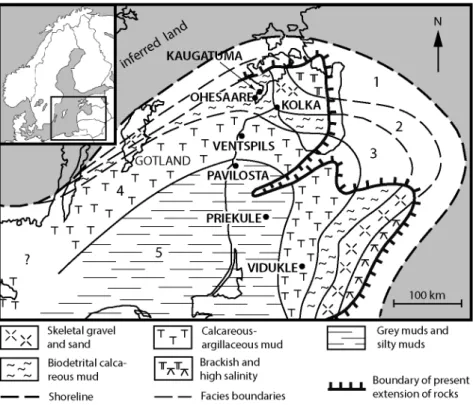
C and also some data from three others located in the same area on the east coast of the Baltic Sea were considered. The Kaugatuma and Ohesaare boreholes on the Sõrve Peninsula in Estonia and the Kolka-54 borehole in the north of the Kurzeme Region of Latvia are located rather close to the Silurian shore and three more Latvian ones (Ventspils, Pavilosta and Priekule-20) are in the offshore area (Fig. 1). In addition to the main goal of the paper, expressed above, we use results of the complex bio-chemostratigraphical synchroneity test for elaborating our views about several current topics of upper Silurian stratigraphy, including details of chrono- or time correlation, boundary criteria and Přídolí sub-divisions. Being familiar with a recent paper by Cramer et al. (2015), we should note that in our paper terms like ‘time marker’, ‘dating’, etc. are used from the positions of relative time concept in geology.
Samples for geological and isotope studies (whole-rock δ13C analyses) from the Ohesaare, Ventspils and Pavilosta cores are kept at the Institute of Geology at Tallinn University of Technology (see www. sarv.gi.ee). A more complete set of carbon isotope data (including new analyses from the Pavilosta core) is available online at http://dx.doi.org/10.15152/GEO.14. All palaeonto-logical collections studied for biozonal indices are referred to in the papers quoted above.
GEOLOGICAL SETTING
The study interval embraces the entire upper Silurian. Based on the commonly accepted stratigraphical frame-work (Gailite et al. 1987; Nestor 1997; Männik 2014), the sections (Fig. 2) are subdivided into four regional stages (RSs): the Paadla and Kuressaare RSs of the Ludlow and the Kaugatuma and Ohesaare RSs of the Přídolí. This chronostratigraphy is complicated in the shallower sea area (Estonia) by some gaps in the Paadla RS (Märss 1992; Jeppsson et al. 1994; Nestor 1997; Viira & Aldridge 1998), which have partly been filled in
by recent studies (Viira & Einasto 2003) or confirmed by chemostratigraphy (Kaljo & Martma 2006; Kaljo et al. 2012). Thus, the Paadla RS fits rather uncomfortably into the type Ludlow framework even if a plausible correlation of some horizons is possible (Viira & Aldridge 1998; Märss & Miller 2004; Loydell & Frýda 2011).
In terms of lithostratigraphy, the Torgu, Kuressaare, Kaugatuma, Ohesaare, Dubysa, Pagegiai (Mituva and Engure), Ventspils, Minija and Jura (Targale) formations (below Fm. or fms) have been established (Fig. 2) and mostly subdivided into beds or members (not shown here). Such a terminology reflects changes in three main lithofacies belts, from the shoreface towards the deeper shelf and basin, as well as sea level fluctuations and a general regressive trend through the late Silurian. The list of facies belts below is based on a model of facies zonation of the Palaeobaltic Basin compiled by Nestor & Einasto (1977) and later modified terminologically by different authors (Bassett et al. 1989; Kaljo et al. 1991; Nestor & Einasto 1997). It is presented here in a slightly generalized manner and without involving aspects of shelf/ramp relationships. We assume in general that these changed during the late Silurian regression when a wide epicontinental shelf sea narrowed to a pericontinental sea of the ramp type.
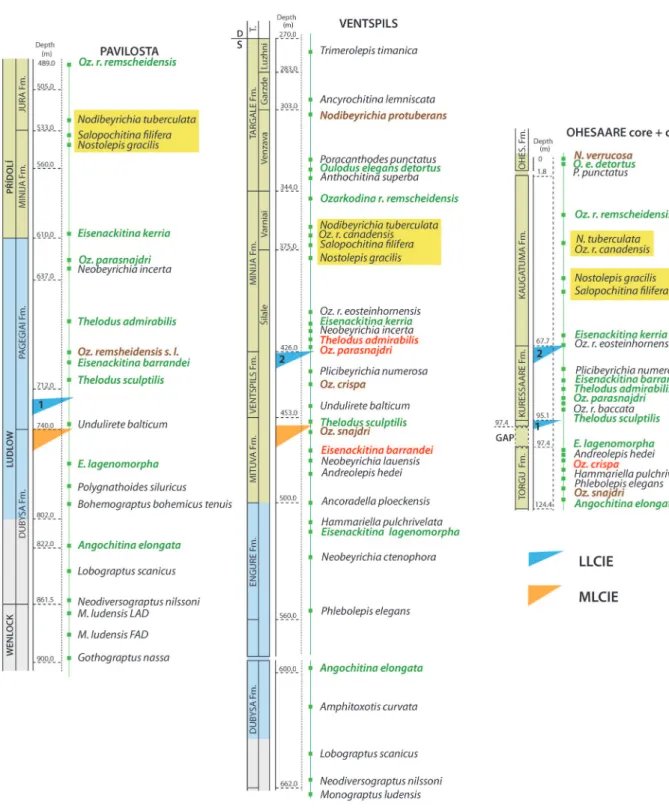
In Fig. 2 the three generalized facies belts (compare the caption of Fig. 1) are marked by colours for easier consideration of the differences in environmental con-ditions where the biozonal index species under study were living:
(1) shallow carbonate shelf (green) – different lime- and dolostones with marl intercalations dominate the entire study interval of the Ohesaare and Kolka-54 (not shown; location in Fig. 1) sections, the upper and middle parts of the Ventspils core and the upper part of the Pavilosta core;
(2) gentle slope of the carbonate shelf (= outer shelf) (blue) – marls with limestone nodules and rare interbeds occupy most of the lower part of the Ventspils core and the middle part of the Pavilosta core;
(3) intracratonic and basinal depression (grey) – relatively deep-water graptolitic marls and argillites occur in most of the lower part of the Pavilosta core and at the bottom of the Ventspils core.
MATERIAL AND METHODS
To understand the synchroneity problems, we used carbon isotope data for chemostratigraphical checking of biostratigraphical data. The δ13C curves are based on ca 300 whole-rock analyses from the Ohesaare, Ventspils (Kaljo et al. 1997, 1998, 2012) and Pavilosta
(new data; Table 1) cores. The Ventspils curve is the most complete showing the major Mid-Ludfordian Carbon Isotope Excursion (MLCIE) peaking with a
δ13
C value of 5‰ at a depth of 465 m in the uppermost Mituva Fm., and the Late Ludfordian twin excursion (LLCIE) with two minor peaks within the Ventspils Fm., respectively LLCIE1 (1‰) at 446 m and LLCIE2 (1.4‰) at 427 m. The same set of excursions, but less complete, is identified in the Pavilosta core at the boundary of the Dubysa and Pagegiai fms (MLCIE 4.2‰ at 739 m) and in the lowermost part of the latter (LLCIE1 2‰ at 723.7 m). The Late Ludfordian twin excursion is rather weakly represented in the Ohesaare section (LLCIE1 0.5‰ at 95 m and LLCIE2 1‰ at 72 m), but the MLCIE is missing there due to a stratigraphical gap. There are several discontinuity surfaces that can serve as a probable MLCIE level in the uppermost part of the Torgu Fm. Based on fossil occurrences (Figs 2 and 3), we have used here the one at 97.4 m. However, this is only tentative, as there are several surfaces that, alone or together, could mark a bigger gap.
Presuming that the approximate peak levels of the
δ13
C excursions are more-or-less synchronous, especially in such closely located sections as the studied ones, we apply these levels as chronostratigraphical benchmarks for analysing the stability and synchroneity issues of the first appearance datums (= FADs). We use the FADs of index species, not the full ranges of biozones, believing that this method makes Fig. 3 more readable without significant loss of information. Anyway, when discussing the figure, we consider also whole range data (e.g. of Eisenackitina lagenomorpha). Plotting the FADs of the most valuable biozonal index species against the noted benchmarks according to the actual depths of occurrences along the sections (Fig. 3), we try to understand how stable the consecutive order of the FADs is and whether these appearances are synchronous in sections of different facies origin. For this purpose the FADs of five graptolite biozonal species and nine ostracode indices in the Latvian sections are shown according to data from Gailite et al. (1987) and Ohesaare ostracode data from Sarv (1971). Those of seven chitinozoan biozones are presented according to Nestor (2009, 2011, 2012), seven conodont ones from Viira & Aldridge (1998) and Viira (1999, 2000) and seven vertebrate indices according to Märss (1986, 1997) and Märss & Männik (2013).
GENERAL COMMENTS ON BIOSTRATIGRAPHY
(Neodiversograptus nilssoni, Lobograptus scanicus) date the lowermost Ludlow without any notable problems (Figs 2, 3). Graptolites became rarer higher in the section, but still the upper Gorstian Pristiograptus tumescens minor Biozone (Bz. below) and a continuation into the lower Ludfordian with Bohemograptus bohemicus tenuis and Pseudomonoclimacis tauragensis are recognizable. Paškevičius (1997) considers the latter (according to Urbanek 1997 synonymous with Monograptus haupti Kühne) as an index species of a rather wide biozone between the L. scanicus Bz. and the Monograptus balticus Bz. (see Loydell 2012). The last occurrences of B. b. tenuis are known from the topmost Dubysa Fm. of the Pavilosta core below the Eisenackitina lagenomorpha Bz. and the MLCIE. Simultaneously with facies changes (shallowing of sea and appearance of the corresponding carbonate rocks) shelly fauna became dominant in fossil associations.
Conodonts traditionally play a leading role in Silurian microfossil biostratigraphy but chitinozoans have also
proved their high value. The most important papers for understanding the conodont faunas of Baltica are Jeppsson (1983, 2005) and Viira (1999, 2000). For chitinozoans those by Eisenack (1968), Laufeld (1974) and Nestor (2009, 2011, 2012) are the most valuable (a general background is available in Verniers et al. 1995). The vertebrate microremains of the region have been thoroughly studied by many authors (Gross 1967; Karatajūtė-Talimaa, 1978; Märss 1986, 1997; Fredholm 1988; Talimaa 2000). The biostratigraphical renown of these fossils is high, but the low level of knowledge in many areas elsewhere hampers their wider usage. Numerous studies (e.g. Martinsson 1967, 1977 in Gotland; Gailite in Gailite et al. 1967; Sarv 1968, 1971 and Rubel & Sarv 1996 in the East Baltic; Siveter 1989, 2009 in Britain) have made ostracodes popular in Silurian stratigraphy. The present authors believe that ostracode information is worthy of wider stratigraphical use in this part of the world. To support this view, a few examples are given below.
Fig. 2. Lithological logs, stratigraphy, facies interpretation, δ13C trend and a selection of ranges of fossils dating certain
Estonian Journal of Earth Sciences, 2015, 64, 4, 267–283
Fig. 3. First appearance datums of the upper Silurian biozonal index species in the three core sections plotted according to actual occurrence depths and their synchroneity evaluated based on the chemostratigraphical time levels. Font colours are as follows: black – normal synchronous occurrences; green – in general the same but some comments are needed; red – for some reason the occurrence is abnormal; brown – the occurrence may be doubtful due to problems with taxonomy, identification, etc. The FADs
of a group of typical mid-Přídolí index species are highlighted with yellow background. Abbreviations: LLCIE – Late Ludfordian
THE DISTRIBUTION OF THE FIRST APPEARANCE DATUMS
The Ventspils section (Fig. 3) is the most complete and we have listed there 31 FADs of biozonal index species (four species occur only in this section) from the bottom of the Ludlow to the end of the Přídolí. The Ohesaare core, consisting of shallower-water rocks, is incomplete due to slight erosion at the top and gaps in the lower and middle Ludlow. The Pavilosta section, representing the deepest part of the basin, is complete in the main part but more deeply truncated at the top (the uppermost Přídolí is missing). For easier reading the names of index species are coloured according to the evaluation given in the text and explained in the caption of Fig. 3.
Graptolite biozonal indices are featured in black in Fig. 3, i.e. all appearances are considered synchronous as far as these are not only single occurrences but supported by ranges. The FAD of the deep-water conodont Polygnathoides siluricus in Pavilosta (Viira 1982) is also shown in black because its several occurrences in this section are recorded at an expected level below the MLCIE (e.g. as in the Vidukle core, Martma et al. 2005 and on Gotland, Jeppsson 2005). This species is not found in shallower facies but its value as a chronostratigraphic marker is high. Other fossils indicated in black will be commented on below.
The consecutive order of the FADs of the analysed indices is mostly logical or the FADs occur at least in the ‘right’ interval with slight variation in order. This convinces us that these FADs (green and black font in Fig. 3) are more or less synchronous (e.g. Angochitina elongata, Eisenackitina lagenomorpha), especially when their correlation lines do not cross the levels with carbon isotope excursions (MLCIE, LLCIE). The FAD of the latter species occurs in Ohesaare just below a gap, believed to mark the MLCIE in that section, and above another possible gap (a discontinuity surface at 100.0 m), which may suggest that this first occurrence is a slightly belated ‘FAD’. Other indices, e.g. the vertebrates Thelodus sculptilis and T. admirabilis, ostracodes Undulirete balticum and Neobeyrichia incerta, conodont Ozarkodina remscheidensis eosteinhornensis, chitino-zoan Eisenackitina barrandei, can cross facies boundaries (i.e. also formational boundaries), but remain generally in the same time interval as in the Ventspils section. Thelodus admirabilis and Oz. snajdri parasnajdri (Fig. 3) show a slight diachroneity when they appear above the LLCIE2 level. All the named examples of FADs occur close to the MLCIE and LLCIE so that the isotope excursions control well these appearance levels.
However, as usual, not all is so straightforward. For example, Oz. snajdri appears in the lower Torgu Fm. in the Ohesaare core, which is well below a gap where
the MLCIE is anticipated, just below the MLCIE in the Ventspils core and a doubtful broken specimen was found far above the LLCIE1 in the Pavilosta core. According to Viive Viira, there might be some taxonomic problem involved, as was the case with Oz. crispa, which is not represented by its typical form in the Baltic but by morphs α2 and α3 (Viira & Aldridge 1998). The distribution of the morphs seems more or less random, with slight preference for α2 occurring more commonly at some localities but without a clear pattern. This allows us to use in our discussion the name Oz. crispa, provided that we remember we are not talking about a typical morph α1, but about two others still belonging to the same species concept (Viira & Aldridge 1998). This policy is in accord with the comment by C. Corradini after checking these early morphs in 2014 confirming that ‘these are clearly conspecific with those in Sardinia and mostly else-where’ (Peep Männik, pers. comm.). Taking Oz. crispa, as represented in our data set, we see (Figs 2–4; the Kaugatuma core and several localities in the outcrop area; Viira & Aldridge 1998) that FADs in shallow-water facies appear in the Sauvere and Himmiste beds of the Paadla Fm. These beds are usually correlated with the Upper Bringewood–Lower Leintwardine fms of Britain (Märss & Miller 2004) or Upper Hemse Beds of Gotland (Jeppsson et al. 1994), clearly underlying the MLCIE level in these areas. Slightly southwards (and seawards) from the shoreface, in the Kaugatuma and Ohesaare cores, Oz. crispa occurs also in the topmost Paadla (Uduvere Beds) and Torgu fms, whereas a LAD is reported from the lowermost Kuressaare Fm. in Kaugatuma. A bit farther southwards in the Kolka core (see Fig. 1 for location) the range of Oz. crispa is entirely within the Kuressaare Fm., and in the Ventspils core to the time represented by the Ventspils Fm. with a LAD at the bottom of the Minija Fm. In summary, we see here a striking ecostratigraphical trend, where a species was widening its distribution area towards the deeper sea during the second half of the Ludlow when a general regression was dominating and a relatively big sedimentary hiatus formed in peripheral areas of the basin in the mid-Ludfordian. In general, the range of this index species characterizes well the upper Ludfordian with its FAD in the middle of the stage and LAD very low in the Přídolí.
Oz. s. parasnajdri is within the lower Kaugatuma RS, which is in harmony with the ecostratigraphical trend mentioned in the case of Oz. crispa. A single occurrence of Oz. s. parasnajdri in Ventspils is documented above the LLCIE2 very low in the Minija Fm. but still below the FAD of Eisenackitina kerria. In the Pavilosta core the range of Oz. s. parasnajdri begins lower – at the top of the Pagegiai Fm. (Fig. 3) and its LAD reaches the level of E. kerria. The index species E. kerria, partly together with Oz. r. eosteinhornensis, seems to be a good marker for the bottom of the Přídolí Series in certain sections, but regional differences are complicating the interpretation (Nestor 2011, p. 200). The lower boundary of the Minija Fm. might also be diachronous as it commonly is.
Eisenackitina barrandei shows an identical FAD of the biozone in the Ohesaare and Pavilosta sections between the MLCIE and LLCIE2 within the upper Ludfordian Kuressaare Fm. Only two Ludlow specimens (both cf.) have been identified from the Ventspils core and a few more (without cf.) from the bottom of the Přídolí (in all sections, see Nestor 2011). These data seem too scarce for fixing the FAD of E. barrandei below the MLCIE. The taxonomy needs to be revised. Based on the occurrences of E. barrandei in Ohesaare and Pavilosta, it seems reasonable to consider the upper Ludfordian a typical level for this species but some occurrences in the bottom of the Přídolí are normal as well as are known from the type Prague area (Paris in Kříž et al. 1986).
The Přídolí begins in the Ohesaare and Ventspils core sections just above the LLCIE2 and is defined by the FADs of Oz. r. eosteinhornensis and E. kerria. The latter marks the same level also in the Pavilosta core, but the records of Oz. remscheidensis s.l. need a revision. In the middle of the Přídolí there appear Salopochitina filifera, Nostolepis gracilis and Oz. r. canadensis, and slightly higher Oz. r. remscheidensis and Nodibeyrichia tuberculata (Fig. 3). Rubel & Sarv (1996, p. 185) noted that the N. tuberculata Bz. is ‘the best known and widely used time marker in upper Silurian stratigraphy’, and despite its seeming diachroneity in Fig. 3 (caused by differences in unit thicknesses), the FADs listed above are more likely synchronous. Based on the above considerations, we accept that the upper boundary of the Minija Fm. is diachronous as is common in lithostratigraphy.
The highest FADs established in the Baltic Silurian are harder to characterize due to the incompleteness of core sections. The top of the Pavilosta section is rather deeply eroded so that only the lower part of the Jura Fm. is represented. The uppermost layers of the Ohesaare section are also missing but still Oulodus elegans detortus, Poracanthodes punctatus and Nodibeyrichia protuberans/verrucosa (previously called N. jurassica, Sarv 1982; see Hansch & Siveter 1994) occur in the cliff section (Fig. 3). The first species occurs in the highest levels of the Přídolí at Klonk and elsewhere (Jeppsson 1988; Viira 1999, 2000). On the other hand, Anthochitina superba is not recorded from the Ohesaare cliff, even if several other members of this association are common in that section (see above and Fig. 3). We do not think that there is a real sedimentary gap but additional sampling might help to clarify this issue. The last biozonal FAD (Trimerolepis timanica) shown in Fig. 3 co-occurs with several other vertebrates (e.g. Goniporus alatus, Loganellia cuneata, Oniscolepis dentata) in the very top of the traditional Silurian in the Ventspils core. Turinia pagei (index of the eponymous biozone) and Paralogania kummerovi appeared at the bottom of the lower Lochkovian Tilže Fm. and practically the entire vertebrate association of the earlier biozone, except for Trimerolepis timanica range into that level. Such a situation at a systemic boundary points to a rather continuous transition. In a few core sections (Stoniškiai, Nida; Karatajūtė-Talimaa 1978; Karatajūtė -Talimaa & Brazauskas 1995) in southwestern Lithuania nearly the same vertebrate assemblage as in the Ventspils core occurs at the Silurian/Devonian (S/D) boundary. The exception is that the position of Trimerolepis timanica is occupied by Trimerolepis lithuanica, while Paralogania kummerowi appears before the latter.
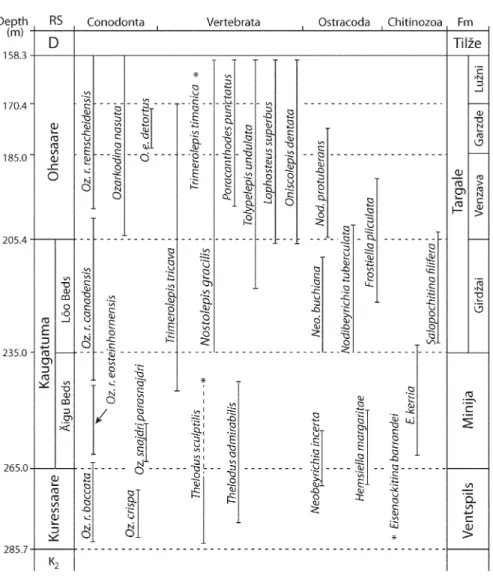
The N. ‘jurassica’ problem is illustrated in Fig. 4. This figure demonstrates that the key species of conodonts
(Viira 1999), chitinozoans (V. Nestor, unpublished data), vertebrates (Märss 1986 revised) and ostracodes (Sarv 1977) found in the Kolka-54 core are the same as in the Ohesaare cliff and Ohesaare 1 and 2 core sections and they occur at comparable stratigraphical levels and order. We have used here the ostracode nomenclature as suggested by Hansch & Siveter (1994) – in Estonia ‘verrucosa’, in Latvia ‘protuberans’. However, we think that a distinction algorithm should be based on morpho-logical differences, which are not very convincing as yet, and not so much on geography. On the other hand, there is nothing out of ordinary in two rather closely related species occurring in neighbouring sections at the same stratigraphical level, whereas one of those species is long-ranging through all of the Přídolí (ca 4 My; Melchin et al. 2012). Nodibeyrichia verrucosa has been described from the Platyschisma Shale Member of the Downton Castle Sandstone (Shaw 1969). If the correlation by Loydell & Frýda (2011) is correct (discussed below), its FAD will move to the middle Ludfordian.
DATING THE MID-LUDFORDIAN CIE AND THE SCOPE OF THE LATE LUDFORDIAN
Ludfordian of Gotland that ‘encompasses the topmost Hemse Group and the overlying Eke … and basal Hamra– Sundre fms’, corresponding to the upper P. siluricus– Oz. snajdri conodont biozones (Jeppsson 2005), has been called ‘Late Ludfordian’ (Eriksson & Calner 2008, p. 255). A reason for this dating remains enigmatic (cf. also Loydell & Frýda 2011).
The precise dating of the MLCIE in terms of biostratigraphy is to some extent uncertain, particularly the upper limit of the excursion above the LAD of N. kozlowskii (the top of this biozone in the Czech Republic is noted as an erosional surface by Lehnert et al. 2003). Recent data from the Mielnik IG-1 core of Poland (Kozłowski & Sobien 2012) and Kosov Quarry in the Barrandian (Frýda & Manda 2013) demonstrate convincingly that a gradual and small increase in δ13C values begins in the middle of the N. kozlowskii Bz. and a rapid shift to high values (6.7‰ in Mielnik; ca 9‰ in Kosov) occurs just above it. The peak of the excursion occurs in an interzone between the LAD of N. kozlowskii and the FAD of Pseudomonoclimacis latilobus, marking the beginning of the late Ludfordian according to Urbanek & Teller (1997). Kozłowski & Sobien (2012) show clearly that the interzone belongs to the mid-Ludfordian. Frýda & Manda (2013, fig. 5), however, are less exact, placing the Pristiograptus dubius postfrequens Partial-range Interval Zone in their section below the Ps. latilobus–Slovinograptus balticus Bz., but correlating it with the lower part of the latter elsewhere, i.e. into the upper Ludfordian. It seems to be a technical error and in the text they classify the CIE as Mid-Ludfordian.
Indeed, it is rather difficult to show this level correctly, because some authors have not noticed the data of Urbanek (1997) that a group of specific graptolites appeared in the Mielnik section in the lower part of the upper Ludfordian: first Ps. latilobus (at 823.0 m), then Monograptus (Wolynograptus) hamulosus and S. balticus (at 819.85 m) and half a metre higher Monograptus (Formosograptus) formosus. The practically nearly synchronous appearance of the group complicates the usage of M. formosus for defining stage slices Lu2 and Lu3 as suggested by Cramer et al. (2011). For full clarity let us quote all details from the Mielnik core based on data by Urbanek (1970, 1997): Neocucullograptus kozlowskii ranges from 873.4 to 854.6 m (= LAD or the kozlowskii Event). The following 31.6 m of core above that level, with a low-diversity assemblage of Pr. dubius postfrequens (this subspecies occurs throughout the Ludfordian; Urbanek et al. 2012), is classified as an interzone or Partial-range Interval Zone between the LAD of N. kozlowskii and FADs of the index species of the next graptolite biozone (listed above). Thus, the interzone discussed belongs by definition to the
N. kozlowskii Bz., making up its uppermost part, and is thus mid-Ludfordian in age. This fact is important for the exact dating of the MLCIE and the lower boundary of the upper Ludfordian follows at the FAD of Ps. latilobus or some other species of the group mentioned above (Urbanek & Teller 1997; Kozłowski & Sobien 2012).
Kaljo et al. (1997) reported the last index species (Ps. latilobus) from the Priekule core (Latvia) ca 50 m above the peak of the MLCIE. Pseudomonoclimacis latilobus is not a long-ranging species and its occurrence in the Mietuva Fm. in Priekule is an incidental find that cannot be classified as a FAD or LAD. It occurs in a logical position, indicating that the bottom of the upper Ludfordian in this section is below the 975.8 m level. At the same time this causes some doubts about the correctness of the lithostratigraphy applied in Priekule. Paškevičius et al. (1995) reported several late Ludfordian graptolites from the lower part of the 178 m thick Pagegiai Fm. (or RS according to their terminology) in Stoniškiai (SW Lithuania), beginning with Ps. latilobus and Ps. tauragensis (the latter comes from the Dubysa Fm.) at the very bottom. The ranges of S. balticus and M. cf. valleculosus begin ca 20 m higher. Other pristiograptid species including P. dubius sub-species are also rather common. The upper part of the Pagegiai Fm. is graptolite-bearing also in the Torava core, located rather close in the Kaliningrad region of Russia and there three occurrences of Monograptus formosus have been registered within the upper 20 m. The very high sedimentation rate in the study area during the late Ludlow (and Přídolí) that might mean also an unsuitable environment for graptolites may have resulted in the rather sporadic and limited graptolite ranges observed. Another reason may be insufficient study, but it is very intriguing that the appearance of specific late Ludfordian graptolites (latilobus–balticus– formosus), which in the Mielnik section is practically simultaneous (within 3 m), is extended over a much wider section thickness in the central part of the same basin, but probably not over a much longer time interval.
THE AGE OF THE KURESSAARE FORMATION
et al. (2011), namely the FAD of Oz. crispa in the Ohesaare section occurs below the MLCIE (correlated into a gap within the uppermost Paadla RS) and surely below the LLCIE1. In the Ventspils core it occurs above the MLCIE and LLCIE1, i.e. within the upper Ludfordian (Fig. 3) as commonly accepted and continues above the LLCIE2 in the lower beds of the Minija Fm. (Viira 1999). However, the fact that Oz. crispa has a longer range in our sections and its LAD occurs in the bottom of the Přídolí does not change earlier chrono-correlations of the Kuressaare and Ventspils fms (Kaljo & Martma 2006; Kaljo et al. 2012) supported both bio- and chemostratigraphically. In addition to carbon isotope data (above and Fig. 2), close correlation between these two formations is indicated by different fossil occurrences, especially of the chitinozoan E. barrandei, the conodont Oz. r. baccata, the ostracode Plicibeyrichia numerosa and the thelodont T. sculptilis. The bottom of both formations is clearly marked by the MLCIE and LLCIE1, but the positions of their tops depends on how well the lower boundary of the Přídolí Series can be correlated into the Baltic sections. The official definition is based on a GSSP in the Požary section of the Prague Basin within bed No. 96 where a primary guide is the FAD of Monograptus parultimus (Kříž et al. 1986). This species is not found in the East Baltic but has been reported from Poland (Urbanek 1997). The data available on chitinozoans (E. barrandei) and conodonts as dis-cussed in this paper above are most promising and support without doubt our current age determinations.
Advocating for an upper Silurian standard conodont biozonation, Corradini (2009) stressed some important views related to the issues considered above. We agree with his opinion about the taxonomic revision of some ozarkodinids and prefer to use the subspecies concept of Oz. remscheidensis s.l., allowing a rather clear conodont biozonation for the Přídolí Series in the East Baltic. Every area has some specific characters in conodont and other faunas, e.g. most authors show the Oz. crispa Bz. at the top of the upper Ludfordian (Corradini 2009), but in our sections the FAD of this species is within the middle Ludfordian and the LAD is in the lowermost Přídolí (see above). On the other hand, Corradini (2009) and Corriga et al. (2009) show that the Oulodus e. detortus Bz. is much wider in Sardinia (including half of the Přídolí and continuing into the Devonian) than in the Barrandian (Jeppsson 1988) and Baltic areas (Viira 2000). There may be a taxonomic problem involved but all such peculiarities like the long-ranging Oz. eosteinhornensis s.l. Bz. in the type Přídolí or highly detailed icriodontid biozones on Gotland should be considered when a global biozonation is attempted. Anyway, we agree with Corradini (2009) that there is still a long way to go.
CORRELATIONS WITH THE TYPE LUDLOW AREA
Searching for the MLCIE in the type Ludlow area (Shropshire), Loydell & Frýda (2011) evaluated critically different data sets from Europe and elsewhere, and the East Baltic in particular. Most of their analyses and results are very much in harmony with our views, expressed in this paper or earlier. Now we wish to comment on and clarify some aspects. Let us begin with the MLCIE ‘coinciding’ with the N. kozlowskii Bioevent. According to Lehnert et al. (2007), cited by the former authors, the MLCIE commences just above the LAD of N. kozlowskii, thus the CIE follows the extinction event that ended within the eponymous biochron. Such details seem important when looking for environmental impli-cations or reasons for events. However, the main idea of Loydell & Frýda (2011) was based on the pattern that the MLCIE elsewhere in the world is associated with a clear facies change (shallowing event) marked by lithology (more carbonate rocks in Vidukle; Martma et al. 2005), gaps (several in Ohesaare; Fig. 2), etc. The authors took samples across two most striking formational boundaries (Upper Leintwardine/Lower Whitcliffe fms and Upper Whitcliffe/Downton Castle Sandstone fms) and subsequently analysed them for carbon isotopes. As a result an organic carbon isotope excursion (of ca 3‰), commencing in the uppermost Upper Whitcliffe Fm. and continuing into at least the first 1.28 m of the Downton Castle Sandstone Fm., was identified. Analysis of the published biostratigraphical data from the Upper Whitcliffe and Downton Castle Sandstone fms followed, with the conclusion that these were consistent with a mid-Ludfordian (rather than Přídolí) age for the lower part of the Downton Castle Sandstone Formation. Such a conclusion brought about rather serious changes in the Silurian stratigraphy of Britain and elsewhere and therefore the conodont, chitinozoan and thelodont data used as evidence deserve appropriate attention.
The conodont data, summarized from the Ludfordian of the Welsh Borderland by Märss & Miller (2004), include an association of species very similar to the one known in the Baltic and elsewhere but the local distribution pattern remains obscure. Only Oz. cf. crispa or morph α3 of this species (Miller 1995; Viira & Aldridge 1998), recognized from the top of the Upper Whitcliffe Fm. and used by Loydell & Frýda (2011) in their discussion, needs a comment.
that in shallow-water settings in Estonia its FAD is recorded from the Paadla and Torgu fms underlying the MLCIE. In open shelf areas in Latvia it mainly ranges throughout the upper Ludfordian with a few occurrences at the very bottom of the Kaugatuma and Minija fms of the Přídolí. A similar pattern is obvious also in the case of the Oz. parasnajdri Bz., which in Ohesaare occurs in the upper Ludfordian but is found in the lower Přídolí in the Kolka and Ventspils cores (Figs 3, 4). Having in mind the ecostratigraphical trend described above for Oz. crispa in the East Baltic, we can agree that the uppermost Upper Whitcliffe Fm. containing morph α3 ‘could be considerably older than latest Ludfordian’ (Loydell & Frýda 2011, p. 201). Still, it seems much less probable than the previous conclusion that this cf. crispa is present in Britain in the most usual interval of the species above the MLCIE. We consider it highly improbable to push all of the ‘remscheidensis plexus’ conodonts (Oz. r. baccata a.o.; Märss & Miller 2004) together with morph α3 to a slightly but significantly lower stratigraphical level.
Chitinozoan ranges seem to be less ambiguous. Only the exact identification of E. barrandei sometimes causes problems, but in general its biozone is a good analogue of the Oz. crispa Bz. for the topmost Ludlow. A dissonance seems to be E. clunensis reported from the Upper Whitcliffe Fm. (Loydell & Frýda 2011), which occurs in the Baltic together with E. philipi below the MLCIE. The latter species is known from the upper beds of the Upper Leintwardine Fm. and higher, up to the lower part of the Upper Whitcliffe Fm., above which the chitinozoan record is very poor indeed.
In Estonia and Latvia (Pavilosta) the E. barrandei Bz. is documented in the upper Ludfordian beds 15–40 m above the MLCIE. This explains the absence of this species on Gotland because the upper Hamra–Sundre Beds reach the equivalent of only the lowermost Kuressaare Fm. (Kaljo & Martma 2006). The occurrence of Oz. crispa in the Sundre Fm. (in Holmhällar 1; Jeppsson et al. 2005) causes some uncertainty in the last statement, but is well within the range known in Latvia. The ranges of Angochitina elongata, E. philipi (except those with cf. in Ohesaare) and E. clunensis are all below the peak level of the MLCIE, whereas some LADs are very close. Eisenackitina lagenomorpha is long-ranging (LAD in the Přídolí), but appears at some distance below the MLCIE (Figs 2–4) in beds correlated with the uppermost Gorstian in Baltic (Nestor 2009) and the Lower Bringewood Fm. in Britain (Sutherland 1994). All the above information on chitinozoans indicates that most likely the Lower Whitcliffe Fm., underlain by the Saetograptus leintwardinensis Bz., belongs partly to the middle Ludfordian and the MLCIE should be looked for in its upper part or in the bottom of the Upper
Whitcliffe Fm. Perhaps there is not any highly striking facies change available, but Baltic (sensu lato) experience shows that also more discrete changes will do.
Such a correlation is also supported by thelodont data, e.g. the first occurrences of long-ranging Thelodus parvidens in the Lower Whitcliffe Fm. (Märss & Miller 2004) and these in the uppermost Paadla RS (Märss 1986: rare finds, mass occurrences in the Kuressaare Fm.) but below the MLCIE in the East Baltic (details in Fig. 2) and in the Eke Beds, exactly at the MLCIE level, on Gotland (Miller & Märss 1999) seem to be nearly synchronous. The distribution pattern of Paralogania ludlowiensis (Miller & Märss 1999) is interpreted by us as nothing but an additional example of environmentally controlled distribution of a long-ranging species.
We have always stressed that bio- and chemostrati-graphy should be considered together, because rather often poor biostratigraphy hampers getting reliable results. However, the situation is vice versa in the case of the type Ludlow area – the chemostratigraphical studies embrace only two small parts of the whole section exposed in the area. Kaljo et al. (2012) established two smaller δ13C excursions within the upper Ludfordian of the East Baltic. It means that there are other excursions that could be correlated with that at the Ludlow Bone Bed, e.g. LLCIE2, and then Frostiella groenvalliana might be in the right position (cf. Siveter 2009). As we said above, we consider the idea by Loydell & Frýda (2011) very interesting, but an additional series of carbon isotope analyses from (at least) the entire Upper Whitcliffe Fm. would contribute considerably to further discussions.
IDENTIFICATION OF THE
SILURIAN/DEVONIAN BOUNDARY IN THE EAST BALTIC
Lochkovian) together with some ‘Silurian’ elements (Karatajūtė-Talimaa 1978; Karatajūtė-Talimaa & Brazauskas 1995). These vertebrate fossils have commonly been considered as ‘heralds’ of the Devonian Period but we cannot decide without other details which part of the Lochkovian is represented if ‘Silurian’ elements are missing.
The most complete sections include the Ventspils and Kolka-54 sections discussed above (see Fig. 4) and several others where Ul′st (1974) described a transitional unit (the Lužni Member of the Targale Fm.) at the S/D boundary. However, the boundary markers mentioned above cannot be used for exact correlation with the S/D boundary stratotype in Klonk (GSSP, in bed No. 20), where the primary criteria are graptolites not found in the East Baltic.
Potentially, carbon isotope chemostratigraphy could be of more help, as demonstrated by several papers (Saltzman 2002; Buggisch & Joachimski 2006; Malkowski et al. 2009) describing a major δ13C excursion at the S/D (= SIDE of Kaljo et al. 2012). Only the last analysis from the very top of the Ventspils core showed an elevated value, which seems to fit the pattern seen elsewhere. Conodonts are promising as well. Jeppsson (1988) showed that Oulodus e. detortus occurs at Klonk in a short interval (less than 2 m thick) called the ‘post-Monograptus transgrediens Interzone’ (the range of detortus occupies about half of it). He cited also some data from the neighbourhood – the situation is in general the same in the Cellon section, but the level of the S/D boundary is not exact. The interzone is much longer (127 m) in the Chelm core (East Poland). However, it should be remembered that this core comes from an area of great thickness of the Přídolí, where O. e. detortus occurs in the uppermost 24 m.
Baltic data about the range of O. e. detortus (Viira 2000) fit well into this biozonation pattern. In the Ventspils core it occurs between depths of 306.2 and 333.0 m in the lower half of the Targale Fm., i.e. its LAD is 36 m below the S/D boundary, marked on the Silurian side by occurrences of Trimerolepis timanica just below the boundary at 270 m. The Kolka-54 core adds a piece of information about the uppermost Silurian in the discussed area. As commonly accepted, a small gap occurs at the S/D boundary, but perhaps in the bottom of the Lochkovian above the FADs of O. e. detortus and Tr. timanica that are represented there together with several other ‘Silurian’ fossils (Fig. 4). Proceeding from this information, we accept the S/D as it is, and as O. e. detortus occurs at a depth of 173–182 m (within 9 m), its LAD is 15 m below the S/D boundary. Summarizing the above data about the occurrences of O. e. detortus in several environmentally different areas, it seems justified to stress two aspects. First, as a
specific biozonal unit the O. e. detortus Bz. occurs within the limits of the Oz. r. remscheidensis range close to the S/D boundary but usually not at the boundary. Second, as shown by Jeppsson (1988), the O. e. detortus Bz. is stable, lying in a non-graptolitic interzone between the Monograptus uniformis and M. transgrediens biozones. This observation allows us to date in terms of graptolite biostratigraphy also the topmost Silurian rocks in the shelly facies realm. Still, data from Sardinia, quoted above, indicate that the situation may not be so regular or simple.
BIOZONES AND POSSIBLE STAGES OF THE PŘÍDOLÍ SERIES
typical representatives of the so-called Beyrichien-Kalk association (Martinsson 1977; Hansch 1985), very charac-teristic of the uppermost Silurian in the carbonate rock and shelly fauna realm. Surely ostracodes, in association with conodont and microvertebrate data, are promising for defining a stage level boundary within the Přídolí. As we are aiming at the subdivision of a series with the duration of ca 4 My or less and there are no serious environmental reasons for striking lithological or faunal changes, we could try to correlate rather small events. It seems most important to detect the boundary level by considering several fossil groups, including the pelagic graptolites. A possibility of involvement of graptolites was mentioned when discussing O. e. detortus and its links to the M. transgrediens Bz. Data from the Łeba and other drill cores in North Poland indicate some relationships between graptolite and ostracode associations (Witwicka 1967; Zbikowska 1974). Conodonts and chitinozoans in the type sections of the Přídolí in the Prague area (Kříž et al. 1986) offer some additional tie points. Based on the above information it seems possible to achieve a reasonable correlation between graptolite and non-graptolite assemblages. Such an old ecostrati-graphical approach is rather troublesome and not so popular nowadays; however, carbon isotopes are not very promising in the Přídolí, at least as yet. Still, we do have an alternative – we can declare that the Přídolí is not a series but the youngest stage in the Ludlow. This would not be a bad alternative, but we prefer to keep the stratigraphy as stable as possible.
CONCLUSIONS
The results of our study confirmed that not only archistratigraphical groups (here graptolites, conodonts and chitinozoans) but also such groups as ostracodes and microvertebrates, when properly studied, can provide useful biostratigraphical information.
Despite the changing environment, most of the analysed FADs and the corresponding biozones are, in general, synchronous units and in the majority of cases their ‘time signals’ do not contradict each other. How-ever, some conodont species (e.g. Oz. crispa within a stage and slightly also Oz. snajdri parasnajdri) show a certain ecostratigraphical trend where earlier repre-sentatives occurred in shallower facies and younger ones farther from the shoreface.
Our study is based mostly on data from three core sections located within a rather small sedimentary basin. Thus we cannot be sure that longer distances and larger facies differences may have greater influence on the synchroneity of the FADs.
Integration of bio- and chemostratigraphy helps the understanding of the pattern and timing of fossil dis-tribution. Based on these and lithological markers, we can find reasons for discrepancies in biodata and secure a trustworthy correlation of sections that formed in different facies conditions.
An ecostratigraphical or a complex bio-chemostrati-graphical correlation of the Přídolí rocks in different facies realms of the East Baltic and Poland can provide trustworthy and sufficiently widely distributed criteria for the subdivision of this series into stages. The following steps in this issue depend on the International Subcommission on Silurian Stratigraphy of the IUGS.
Acknowledgements. The authors thank Gennadi Baranov for help with computer graphics. Bradley D. Cramer and David K. Loydell are thanked for detailed reviews of the manuscript. Their remarks and suggestions considerably improved the paper. The study was partly supported by grants PUT 611 and ETF9039 from the Estonian Research Council. This paper is a contribution to IGCP 591.
Supplementary online data
Supplementary online data associated with this article can be found in a table at http://dx.doi.org/10.15152/GEO.14. The table presents a set of whole-rock carbon isotope data from the Pavilosta (Kurzeme, Latvia) drill core.
REFERENCES
Bassett, M. G., Kaljo, D. & Teller, L. 1989. The Baltic region. In A Global Standard for the Silurian System (Holland, C. H. &. Bassett, M. G., eds), National Museum of Wales, Geological Series, 9, 158–170.
Buggisch, W. & Joachimski, M. M. 2006. Carbon isotope stratigraphy of the Devonian of Central and Southern Europe. Palaeogeography, Palaeoclimatology, Palaeo-ecology, 240, 68–88.
Corradini, C. 2009. Looking for a late Silurian Standard Conodont Zonation: still a long way to go. Rendiconti della Societa Paleontologica Italiana, 3, 273–274. Corriga, M. G., Corradini, C. & Ferretti, A. 2009. Silurian
conodonts from Sardinia: an overview. Rendiconti della Societa Paleontologica Italiana, 3, 95–107.
Cramer, B. D., Brett, C. E., Melchin, M. J., Männik, P., Kleffner, M. A., McLaughlin, P. I., Loydell, D. K., Munnecke, A., Jeppsson, L., Corradini, C., Brunton, F. R. & Saltzman, M. R. 2011. Revised correlation of Silurian Provincial Series of North America with global and regional chronostratigraphic units and δ13Ccarb chemostratigraphy. Lethaia, 44, 185–202.
examples of the quest for precision in stratigraphy. Earth-Science Reviews, 141, 136–153.
Eisenack, A. 1968. Über Chitinizoen des Baltischen Gebietes. Palaeontographica, A 131, 137–198.
Eriksson, M. J. & Calner, M. 2008. A sequence stratigraphic model for the Late Ludfordian (Silurian) of Gotland, Sweden: implications for timing between changes in sea level, palaeoecology, and the global carbon cycle. Facies, 54, 253–276.
Fredholm, D. 1988. Vertebrate biostratigraphy of the Ludlovian Hemse Beds of Gotland, Sweden. GFF, 110, 237–253. Frýda, J. & Manda, Š. 2013. A long-lasting steady period
of isotopically heavy carbon in the late Silurian ocean: evolution of the δ13C record and its significance for an integrated δ13C, graptolite and conodont stratigraphy. Bulletin of Geosciences, 88, 463–482.
Gailite, L. K., Rybnikova, M. V. & Ulst, R. Zh. 1967. Strati-grafiya, fauna i usloviya obrazovaniya silurijskikh porod srednej Pribaltiki [Stratigraphy, Fauna andDeposition Conditions of Silurian Rocks in the Central East Baltic]. Zinatne, Riga, 304 pp. [in Russian].
Gailite, L. K., Ulst, R. Zh. & Yakovleva, V. I. 1987. Strato-tipicheskie i tipovye razrezy silura Latvii [Silurian Stratotypes and Key Sections of Latvia].Zinatne, Riga, 184 pp. [in Russian].
Gross, W. 1967. Über Thelodontier-Schuppen. Palaeonto-graphica, A 127, 1–67.
Hansch, W. 1985. Ostracode fauna, stratigraphy and definition of the Beyrichienkalk sequence. Lethaia, 18, 273–282. Hansch, W. & Siveter, D. J. 1994. ‘Nodibeyrichia jurassica’
and associated beyrichiacean ostracode species and their significance for the correlation of the late Silurian strata in the Baltic and Britain. Journal of Micropalaeontology, 13, 81–91.
Jeppsson, L. 1983. Silurian conodont faunas from Gotland. Fossils and Strata, 15, 121–144.
Jeppsson, L. 1988. Conodont biostratigraphy of the Silurian– Devonian boundary stratotype at Klonk, Czechoslovakia. Geologica et Palaeontologica, 22, 21–33.
Jeppsson, L. 2005. Conodont-based revisions of the Late Ludfordian on Gotland, Sweden. GFF, 127, 273–282. Jeppsson, L., Viira, V. & Männik, P. 1994. Silurian
conodont-based correlations between Gotland (Sweden) and Saaremaa (Estonia). Geological Magazine, 131, 201– 218.
Jeppsson, L., Calner, M. & Eriksson, M. E. 2005. Locality descriptions. In The Dynamic Silurian Earth, Sub-commission on Silurian Stratigraphy Field Meeting 2005, Field Guide and Abstracts (Eriksson, M. E. & Calner, M., eds), Sveriges Geologiska Undersökning, Rapporter och Meddelanden, 121, 22–47.
Jeppsson, L., Eriksson, M. E. & Calner, M. 2006. A latest Llandovery to latest Ludlow high-resolution biostrati-graphy based on the Silurian of Gotland – a summary. GFF, 128, 109–114.
Kaljo, D. & Martma, T. 2006. Application of carbon isotope stratigraphy to dating the Baltic Silurian rocks. GFF, 128, 123–129.
Kaljo, D. L., Viira, V. J., Klaamann, E. R., Männil, R. P., Märss, T. I., Nestor, V. V., Nestor, H. E., Rubel, M. P., Sarv, L. I. & Einasto, R. E. 1983. Ekologicheskaya model silurijskogo bassejna Vostochnoj Pribaltiki [Ecological model of the East Baltic Silurian Basin]. In Problemy
ékologii fauny i flory drevnikh bassejnov [Ecological Problems of Fauna andFlora of Ancient Basins]. Nauka, Moscow, 43–61 [in Russian].
Kaljo, D., Nestor, H. & Einasto, R. 1991. Aspects of Silurian carbonate platform sedimentation. In The Murchison Symposium: Proceedings of an International Conference on the Silurian System (Bassett, M. G., Lane, P. D. & Edwards, D., eds), Special Papers in Palaeontology, 44, 205–224.
Kaljo, D., Kiipli, T. & Martma, T. 1997. Carbon isotope event markers through the Wenlock–Pridoli sequence in Ohesaare (Estonia) and Priekule (Latvia). Palaeo-geography, Palaeoclimatology, Palaeoecology, 132, 211–224.
Kaljo, D., Kiipli, T. & Martma, T. 1998. Correlation of carbon isotope events and environmental cyclicity in the East Baltic Silurian. In Silurian Cycles. Linkages of Dynamic Stratigraphy with Atmospheric, Oceanic, and Tectonic Changes (Landing, E. & Johnson, M. E., eds), New York State Museum Bulletin, 491, 297–312.
Kaljo, D., Martma, T., Grytsenko, V., Brazauskas, A. & Kaminskas, D. 2012. Přídolí carbon isotope trend and upper Silurian to lowermost Devonian chemostrati-graphy based on sections in Podolia (Ukraine) and the East Baltic area. Estonian Journal of Earth Sciences, 61, 162–180.
Karatajūtė-Talimaa, V. 1978. Silurian and Devonian Thelodonts from the USSR and Spitsbergen. Mokslas, Vilnius, 335 pp. [in Russian].
Karatajūtė-Talimaa, V. & Brazauskas, A. 1995. Distribution of vertebrates in the Silurian of Lithuania. Geologija (Vilnius), 17 (for 1994), 106–114.
Kozłowski, W. & Sobien, K. 2012. Mid-Ludfordian coeval carbon isotope, natural gamma ray and magnetic susceptibility excursions in the Mielnik IG-1 borehole (Eastern Poland) – dustiness as a possible link between global climate and the Silurian carbon isotope record. Palaeogeography, Palaeoclimatology, Palaeoecology, 339–341, 74–97.
Kříž, J., Jaeger, H., Paris, F. & Schönlaub, H. P. 1986. Přídolí – the fourth subdivision of the Silurian. Jahrbuch der Geologischen Bundesanstalt, Wien, 129, 291–360. Laufeld, S. 1974. Silurian Chitinozoa from Gotland. Fossils
and Strata, 5, 1–130.
Lehnert, O., Frýda, J., Buggisch, W. & Manda, Š. 2003. A first report of the Ludlow Lau Event from the Prague Basin (Barrandian, Czech Republic). In Proceedings 7th IGC-FMSSS INSUGEO (Ortega, G. & Acenolaza, G. F., eds), Serie Correlacion Geologica, 18, 139–144. Lehnert, O., Frýda, J., Buggisch, W., Munnecke, A., Nützel, A.,
Kříž, J. & Manda, Š. 2007. δ13C records across the late Silurian Lau Event: new data from middle latitudes of northern peri-Gondwana. Palaeogeography, Palaeo-climatology, Palaeoecology, 245, 227–244.
Loydell, D. K. 2012. Graptolite biozone correlation charts. Geological Magazine, 149, 124–132.
Loydell, D. K. & Frýda, J. 2011. At what stratigraphical level is the mid Ludfordian (Ludlow, Silurian) positive carbon isotope excursion in the type Ludlow area, Shropshire, England? Bulletin of Geosciences, 86, 197–208.
global biogeochemical perturbation. Geological Magazine, 146, 674–689.
Männik, P. 2014. The Silurian System in Estonia. In 4th Annual Meeting of IGCP 591, Estonia, 10–19 June 2014, Abstracts and Field Guide (Bauert, H., Hints, O., Meidla, T. & Männik, P., eds), pp. 123–128. University of Tartu.
Märss, T. 1986. Silurian Vertebrates of Estonia and West Latvia. Valgus, Tallinn, 104 pp. [in Russian, with English summary].
Märss, T. 1992. Vertebrate history in the late Silurian. Proceedings of the Estonian Academy of Sciences, Geology, 41, 205–214.
Märss, T. 1997. Vertebrates of the Přidoli and Silurian– Devonian boundary beds in Europe. Modern Geology, 21, 17–41.
Märss, T. & Männik, P. 2013. Revision of Silurian vertebrate zonation and correlation with conodont succession. Estonian Journal of Earth Sciences, 62, 181–204. Märss, T. & Miller, C. G. 2004. Thelodonts and distribution of
associated conodonts from the Llandovery–lowermost Lochkovian of the Welsh Borderland. Palaeontology, 47, 1211–1265.
Martinsson, A. 1967. The succession and correlation of ostracode fauna in the Silurian of Gotland. Geologiska Föreningens i Stockholm Förhandlingar, 89,350–386. Martinsson, A. 1977. Baltoscandia. In The Silurian–Devonian
Boundary (Martinsson, A., ed.), IUGS Series A, 5, 45–51. Martma, T., Brazauskas, A., Kaljo, D., Kaminskas, D. &
Musteikis, P. 2005. The Wenlock–Ludlow carbon isotope trend in the Vidukle core, Lithuania, and its relations with oceanic events. Geological Quarterly, 49, 223– 234.
Melchin, M. J., Sadler, P. M. & Cramer, B. D. 2012. The Silurian Period. In The Geologic TimeScale 2012, Vol. 1 (Gradstein, F. M., Ogg, J. G., Schmitz, M. D. & Ogg, G. M., eds), pp. 525–558. Elsevier.
Miller, C. G. 1995. Ostracode and conodont distribution across the Ludlow/Pridoli boundary of Wales and the Welsh Borderland. Palaeontology, 38, 341–384.
Miller, C. G. & Märss, T. 1999. A conodont, thelodont and acanthodian fauna from the Lower Pridoli (Silurian) of the Much Wenlock area, Shropshire. Palaeontology, 42, 691–714.
Nestor, H. 1997. Silurian. In Geology and Mineral Resources of Estonia (Raukas, A. & Teedumäe, A., eds), pp. 89– 106. Estonian Academy Publishers, Tallinn.
Nestor, H. E. & Einasto, R. E. 1977 Fatsial no-sedimento-logicheskaya model silurijskogo Pribaltijskogo peri-kontinentalnogo bassejna [Facies-sedimentary model of the Silurian Palaeobaltic pericontinental basin]. In Fatsii i fauna silura Pribaltiki [Facies and Fauna of the Baltic Silurian] (Kaljo, D. L., ed.), pp. 89–121. Institute of Geology, Estonian Academy of Sciences, Tallinn [in Russian, with English summary].
Nestor, H. & Einasto, R. 1997. Ordovician and Silurian carbonate sedimentation basin. In Geology and Mineral Resources of Estonia (Raukas, A. & Teedumäe, A., eds), pp. 192–204. Estonian Academy Publishers, Tallinn. Nestor, V. 2009. Biostratigraphy of the Ludlow chitinozoans
from East Baltic drill cores. Estonian Journal of Earth Sciences, 58, 170–184.
Nestor, V. 2011. Chitinozoan biostratigraphy of the Přídolí Series of the East Baltic. Estonian Journal of Earth Sciences, 60, 191–206.
Nestor, V. 2012. A summary and revision of the East Baltic Silurian chitinozoan biozonation. Estonian Journal of Earth Sciences, 61, 242–260.
Paškevičius, J. 1997. The Geology of the Baltic Republics. Vilnius University, Geological Survey of Lithuania, Vilnius, 388 pp.
Paškevičius, J., Lapinskas, P., Brazauskas, A., Musteikis, P. & Jacyna, J. 1995. Stratigraphic revision of the regional stages of the Upper Silurian part in the Baltic Basin. Geologija(Vilnius), 17, 64–87.
Rubel, M. & Sarv, L. 1996. Reconstruction and use of the succession of East Baltic Silurian ostracodes. Proceedings of the Estonian Academy of Sciences, Geology, 45, 177–188.
Saltzman, M. R. 2002. Carbon isotope (δ13C) stratigraphy across the Silurian–Devonian transition in North America: evidence for a perturbation of the global carbon cycle. Palaeogeography, Palaeoclimatology, Palaeoecology, 187, 83–100.
Sarv, L. 1968. Ostracode Families Craspedobolbinidae, Beyrichiidae and Primitiopsidae in the Silurian of Estonia. Valgus, Tallinn, 104 pp. [in Russian, with English summary].
Sarv, L. 1971. Silurian ostracodes in the Ohesaare boring. Eesti NSV Teaduste Akadeemia Toimetised, Keemia, Geoloogia, 20, 349–355 [in Russian, with English summary].
Sarv, L. 1977. K raschleneniyu razrezov verkhnego silura Srednej i Yuzhnoj Pribaltiki po ostrakodam [On the Upper Silurian ostracode stratigraphy in the Middle and South of East Baltic area]. In Fatsii i fauna silura Pribaltiki [Facies and Fauna of the Baltic Silurian] (Kaljo, D. L., ed.), pp. 159–178. Institute of Geology, Estonian Academy of Sciences, Tallinn [in Russian, with English summary].
Sarv, L. 1982. On ostracode zonation of the East Baltic Upper Silurian. In Ecostratigraphy of the East Baltic Silurian (Kaljo, D. & Klaamann, E., eds), pp. 71–78. Valgus, Tallinn.
Shaw, R. W. L. 1969. Beyrichian ostracodes from the Downtonian of Shropshire. Geologiska Föreningens i Stockholm Förhandlingar, 91,52–72.
Siveter, D. J. 1989. Ostracodes. In A Global Standard for the Silurian System (Holland, C. H. & Bassett, M. G., eds), National Museum of Wales, Geological Series, 9, 252– 264.
Siveter, D. J. 2009. Silurian. In Ostracods in British Stratigraphy (Whittaker, J. E. W. & Hart, M. B., eds), pp. 45–90. The Micropalaeontological Society, Special Publications, Geological Society of London.
Sutherland, S. J. E. 1994. Ludlow chitinozoans from the type area and adjacent regions. Palaeontographical Society Monograph, 591, 1–104.
Ulst, R. Zh. 1974. O granitsakh verkhnego silura v Latvii [On boundaries of the Upper Silurian in Latvia]. In Regionalnaya geologiya Pribaltiki [Regional Geology of the East Baltic] (Sorokin, V. S., ed.), pp. 32–37. Zinatne, Riga [in Russian].
Urbanek, A. 1970. Neocucullograptinae n. subfam. (Graptolithina) – their evolutionary and stratigraphic bearing. Acta Palaeontologica Polonica, 15, 163–388. Urbanek, A. 1997. Late Ludfordian and early Přidoli
monograptids from the Polish Lowland. Palaeontologia Polonica, 56, 87–231.
Urbanek, A. & Teller, L. 1997. Graptolites and stratigraphy of the Wenlock and Ludlow Series in the East European Platform. Palaeontologia Polonica, 56, 23–57.
Urbanek, A., Radzevičius, S., Kozlowska, A. & Teller, L. 2012. Phyletic evolution and iterative speciation in the persistent Pristiograptus dubius lineage. Acta Palae-ontologica Polonica, 57, 589–611.
Verniers, J., Nestor, V., Paris, F., Dufka, P., Sutherland, S. & Van Grootel, G. 1995. A global Chitinozoa biozonation for the Silurian. Geological Magazine, 132, 651–666. Viira, V. 1982. Late Silurian shallow and deep water
cono-donts of the East Baltic. In Ecostratigraphy of the East
Baltic Silurian (Kaljo, D. & Klaamann, E., eds), pp. 79– 87. Valgus, Tallinn.
Viira, V. 1999. Late Silurian conodont biostratigraphy in the northern East Baltic. Bolletino della Societa Paleontologica Italiana, 37, 299–310.
Viira, V. 2000. Latest Silurian (Ohesaare Stage) conodonts and the detorta zone in the northern East Baltic. Proceedings of the Estonian Academy of Sciences, Geology, 49, 44–62.
Viira, V. & Aldridge, R. J. 1998. Upper Wenlock to Lower Pridoli (Silurian) conodont biostratigraphy of Saaremaa, Estonia, and a correlation with Britain. Journal of Micropalaeontology, 17, 33–50.
Viira, V. & Einasto, R. 2003. Wenlock–Ludlow boundary beds and conodonts of Saaremaa Island, Estonia. Proceedings of the Estonian Academy of Sciences, Geology, 52, 213–238.
Witwicka, E. 1967. Ostracods of the Upper Silurian in Poland. Kwartalnik geologiczny, 11, 39–61.
Zbikowska, B. 1974. Upper Silurian ostracod zones in the Chojnice area (NW Poland). Bulletin de L’Academie Polonaise des Sciences, Serie des Sciences de la Terre, 22, 45–48.