81
Pakistan Veterinary Journal
ISSN: 0253-8318 (PRINT), 2074-7764 (ONLINE) Accessible at: www.pvj.com.pk
Effect of Orally Administered
Enterococcus faecium
EF1 on Intestinal Cytokines and
Chemokines Production of Suckling Piglets
Yi Huang§, Ya-li Li, Qin Huang, Zhi-wen Cui, Dong-you Yu, Imran Rashid Rajput, Cai-hong Hu and Wei-fen Li* Key Laboratory of Molecular Animal Nutrition and Feed Sciences, College of Animal Science, Zhejiang University, Hangzhou, P.R. China, 310058; §Present address: College of Animal Science and Technology, Guangxi University, Nanning, P.R. China, 530005
*Corresponding author: [email protected]
A R T I C L E H I S T O R Y A B S T R A C T
Received: Revised: Accepted:
July 06, 2011 August 02, 2011 August 02, 2011
Key words:
Chemokine Cytokine
Enterococcus faecium
Intestinal mucosa
The objective of this study was to determine the effect of orally administered
Enterococcus faecium EF1 on intestinal cytokines and chemokines production in piglets. Twenty-four newborn piglets were randomly divided into two groups. The treatment group (T1), orally administered sterilized (110 ºC for 30 min) skim milk
10% (2 ml/piglet/day) with addition of viable E. faecium EF1 (5~6×10⁸ cfu/ml) on 1st, 3rd and 5th day after birth. The control group (T0), were fed the same volume of
sterilized skim milk without addition of probiotics. Feeding trial was conducted for 25 days of suckling age. At the end of trail six piglets were randomly selected from each group to collect the samples of jejunum and ileum mucosa to observe the cytokines and chemokines production. The results showed that concentrations of IL-10 and TGF- 1 significantly increased in T1 group. Whereas, production of IL-1 ,
IL-6, IL-12, IFN- and IL-8 decreased in T1 compared to T0. Levels of TNF-α were
increased in jejunal mucosa, while decreased in ileal mucosa comparatively in T1
group. Our findings revealed that oral administration of E. faecium EF1 induced a strong anti-inflammatory response in the small intestine. These immunomodulatory effects of this bacterium might contribute to maintenance of immune homeostasis in the intestine of piglets.
©2011 PVJ. All rights reserved
To Cite This Article: Huang Y, YL Li, Q Huang, ZW Cui, DY Yu, IR Rajput, CH Hu and WH Li, 2012. Effect of
orally administered Enterococcus faecium EF1 on intestinal cytokines and chemokines production of suckling piglets. Pak Vet J, 32(1): 81-84.
INTRODUCTION
It is generally accepted that the viability of probiotic bacteria is necessary for a better activation of the intestinal immune system. Galdeano et al.(2004) reported that viable bacteria stimulated the intestinal mucosal immune system to a much greater extent than nonviable bacterial cells. Applications of probiotics have been revealed immune modulating properties since its application to exert, beneficiary effects particularly in animals and human. Moreover, lactic acid bacteria (LAB) modulate both innate and adaptive immunity (Nissen et al., 2009), and Enterococcus faecium is one of LAB with inhibitory effects against several important entero- pathogens (Pollmann et al., 2005). It has been demonstrated that immunological effects of LAB include modulated expression of cytokines, antibodies production (He et al., 2005), clonal expansion of IgA B-lymphocyte
and immune response, while these effects have been proven to be strain specific (Galdeano et al., 2007). Furthermore, E. faecium effects in dogs and mice to stimulating intestinal IgA production (Benyacoub et al., 2005) and modulating the composition of blood lymphocyte populations in cats (Veir et al., 2007), and levels of total IgG and cytotoxic T cells in the jejunal epithelium of piglets could reduce (Scharek et al., 2005). Early administration of E. faecium could modulate the composition of blood lymphocytes and might have effect on the expression patterns of immune cells in ileal Peyer’s patch in pigs (Scharek et al., 2009). In the present study, we designed the experiment to determine the effects of viable E. faecium EF1, on cytokines and chemokines production in both, jejunal and ileal mucosa of sucking piglets and mechanisms of host’s small intestine mucosal immune response to probiotics.
Pak Vet J, 2012, 32(1): 81-84.
82
MATERIALS AND METHODS
Bacterial Isolation and Preparation: The E. faecium
EF1 used in this experiment was isolated and identified by Institute of Feed Science, Zhejiang University. The bacterial strain was cultured in de Man-Rogosa-Sharpe (MRS) broth (Oxoid; England) in anaerobic condition at 37 °C till log phase. Centrifugation (4000 rpm) was used to separate the bacterial strain. Furthermore, bacteria were washed twice with phosphate buffered saline (PBS; pH 7.4), and re-suspended in 10% sterilized skim milk to prepare required concentration (5~6×10⁸ cfu/ml).
Selection of Animals: All animals used in this experiment were purchased from Tongfushuangfeng Farming Coopera- tive in Tongxiang, China. Twenty-four newborn piglets ([Large White × Landrace] × Duroc), were randomly divided into two groups. The control group (T0) and treatment group
(T1) with addition of viable E. faecium EF1. Each group had
three replicates with four piglets per replicate.
Feeding Design: Piglets of (T0) were fed with 10%
sterilized skim milk (2 ml/piglet/day), and (T1) received
10% sterilized skim milk (2 ml/piglet/day) with addition of viable E. faecium (5~6×10⁸ cfu/ml) on the alternative days 1st, 3 rd and 5th day post partum. From day 12 onward,
all piglets had free access to pre-starter diets and ad libitum access to water. The feeding trial was conducted according to instructions of Animal Care Committee of Animal Science College, Zhejiang University.
Sample collection: All the experiment piglets were fed till weaning period (25 days). Randomly six piglets from each group were sacrificed by exsanguinations on the day of weaning. Immediately appropriate sections of piglets were dissected carefully and intestinal parts (jejunum and ileum) were selected. The collected parts were washed with sterile saline solution to remove intestinal contents. Then mucosal contents of jejunum and ileum were collected and weighed. The samples were homogenized in sterile saline solution and centrifuged at 4000 rpm for 20 min. The supernatant was collected and stored at −20 °C until cytokine and chemokine concentrations were determined.
Determination of cytokines by ELISA: Concentrations of interleukin-10 (IL-10), transforming growth factor-beta 1 (TGF- 1), tumor necrosis factor-alpha (TNF-α), 1 beta (IL-1 ), 6 (IL-6), interleukin-12 (IL-interleukin-12), interferon-gamma (IFN- ) and interleukin-8 (IL-8) were determined using the porcine Enzyme-Linked Immunosorbent Assay Kit (ELISA Kit; R&D Systems, Inc.) according to the manufacturer’s instructions.
Statistical analysis: Data were analyzed using the one-way analysis of variance procedure of SPSS 16.0 for Windows (SPSS Inc., Chicago, USA). Differences between treatments were evaluated with unpaired t-test.
RESULTS
Concentrations of anti-inflammatory cytokines in the
intestinal mucosa: The secretion of IL-10 was
statistically increased in both jejunal and ileal mucosa of
probiotic supplemented piglets. Conversely, the production of TGF- 1 was decreased (P<0.01) in jejunal mucosa in T1 group whereas no difference was observed
in ileal mucosa between two treatments (Table 1).
Table 1: Effect of oral administration of E. faecium on the secretion of anti-inflammatory cytokines in jejunal and ileal mucosa of piglets
Item IL-10 (ng/L) TGF- 1 (ng/L)
Control (T0) 99.58±7.46 74.59±1.89
Jejunal Mucosa
Probiotic-fed (T1) 155.99±6.40** 229.75±3.15**
Control (T0) 77.46±4.34 50.04±1.22
Ileal Mucosa
Probiotic-fed (T1) 94.37±4.10* 59.11±6.02 Data were expressed as mean ± SD. Statistically significant difference with respect to control, *P<0.05 and **P<0.01.
Concentrations of pro-inflammatory cytokines in the intestinal mucosa: TNF-α production increased (P<0.01) in jejunal mucosa while it was suppressed (P<0.01) in ileal mucosa in T1 group. In addition, the production of
IL-1 , IL-6, IL-12 and IFN- was significantly inhibited in T1 (Table 2).
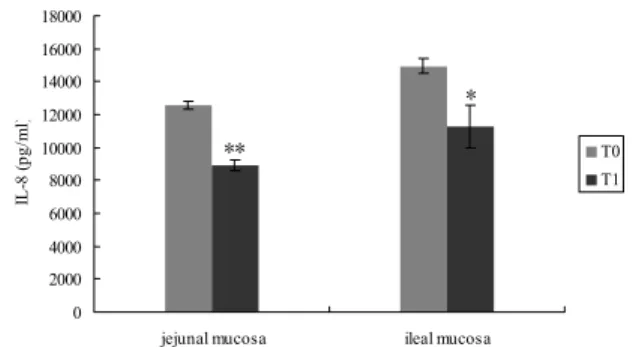
Concentrations of chemokines in the intestinal mucosa: As shown in Fig.1, significant inhibition of IL-8 production was found in both jejunal and ileal mucosa of probiotic-fed piglets.
*
**
0 2000 4000 6000 8000 10000 12000 14000 16000 18000
jejunal mucosa ileal mucosa
IL
-8
(
p
g
/m
l)
T0 T1
Fig. 1: The IL-8 production in jejunal and ileal mucosa of control and probiotic-fed piglets.Data were expressed as mean ± SD. Statistically significant difference with respect to control, *P<0.05 and **P<0.01.
DISCUSSION
The development and maintenance of immune homeostasis of intestine essentially depends on signals from the gut flora (Zeuthen et al., 2006). Plenty of bacteria present in the gut of a normal host could stimulate the innate immune system and then trigger physiological inflammation through the membrane-bound or soluble factors, including cytokines (IL-10, TGF- 1, TNF-α, IL-1 , IL-6, IL-12 and IFN- ) and chemokines (IL-8 and MCP-1) (Clavel and Haller, 2007). The cytokines and chemokines released from leukocytes or infected tissues could exhibit regulatory functions in both innate and acquired immunity (Tosi, 2005).
Pak Vet J, 2012, 32(1): 81-84.
83
Table 2: Effect of oral administration of E. faecium on the secretion of pro-inflammatory cytokines in jejunal and ileal mucosa of piglets
Item TNF-α (pg/mL) IL-1 (ng/L) IL-6 (ng/L) IL-12 (ng/L) IFN- (pg/mL)
T0 48.47±5.88 1622.2±45.11 82.22±4.65 131.62±8.01 2360.8±134.04
Jejunal Mucosa
T1 73.00±4.38** 940.59±44.21** 35.21±5.43** 85.86±4.44** 1335.5±125.33**
T0 160.95±3.83 2205.3±93.79 107.91±1.43 206.84±4.01 2058.8±95.95
Ileal Mucosa
T1 69.82±1.76** 1154.4±38.55** 45.88±3.98** 78.21±5.22** 1939.2±103.62 Data were expressed as mean ± SD. Statistically significant difference with respect to control, *P<0.05 and **P<0.01.
TGF- 1 in piglets treated with E. faecium. The results indicate that E. faecium EF1 possesses remarkable immunomodulatory activity in intestinal mucosa inducing anti-inflammatory cytokines. Moreover, Clavel and Haller (2007) reported that IL-10 and TGF- 1 had interrelated roles in maintaining intestinal homeostasis to commensal bacteria. The findings of Di Giacinto et al. (2005) showed that daily administration of the probiotic (VSL#3) to mice ameliorated colitis by inducing IL-10 and TGF- 1 bearing regulatory cells.
Furthermore, lactic acid bacteria (LAB) augment the production of an array of pro-inflammatory cytokines, such as TNF-α, IL-1 , IL-6, IL-12 and IFN- , thereby triggering physiological inflammation. Several LAB strains could induce the secretion of TNF-α by dendritic cells and peripheral blood mononuclear cells and increase the number of TNF-α producing cells in the gut lamina propria (Zoumpopoulou et al., 2008; de Moreno de LeBlanc et al., 2008). The interesting finding of the current study was that the production of TNF-α was improved in jejunal mucosa while it was decreased in ileal mucosa of the T1 group.
Our findings manifested that, IL-1 , IL-6 and IL-12 concentrations decreased in both jejunal and ileal mucosa in T1 group as compared to T0. Our results are in
disagreement with studies of other authors (Mohamadzadeh et al., 2005), where it has been shown that gram-positive probiotic bacteria, such as
Lactobacillus reuteri, were capable of inducing high secretion of pro-inflammatory cytokine IL-1 from dendritic cells and mononuclear cells. Vinderola et al. (2007) described that there was an increase in the number of IL-6+ cells in the gut lamina propria, which tended to up-regulate the release of IL-6 by the intestinal epithelial cells in animals fed with LAB. Examination of the pig small intestinal epithelial cells as well as macrophages cultured in vitro with E. faecium showed potent induction of pro-inflammatory cytokine IL-6 (Nissen et al., 2009). In addition, Lactobacillus plantarum and Streptococcus macedonicus also induced a strong up-regulation of pro-inflammatory cytokine IL-12 in vitro (Zoumpopoulou et al., 2008). IFN- is essential for the maturation of some immune cells and controls their cellular proliferation in intestine (Rumbo et al., 2004). Many studies have suggested Lactobacillus spp. and Streptococcus spp. augmented the number of IFN- producing cells and synthesis of IFN- in the small intestine of mice (Paturi et al., 2007; de Moreno de LeBlanc et al., 2008). On the contrary with the previous results, the lower levels of IFN- in jejunal mucosa were found in T1 group in our study.
Like many other LAB, our results also demonstrated that application of E. faecium suppressed the synthesis of IL-8 in intestinal mucosa. This might indicate that, as an autochthonous bacterium in pigs, an inflammation suppressive function of E. faecium seems to be possible (Scharek et al., 2009). IL-8 governs the progress of most
local small bowel inflammations. It attracts and directs neutrophils to the site of inflammation, an instant response that is triggered to eliminate the pathogen. It may suggest that lactobacilli may impart their welfare to the intestine by inhibiting IL-8 production (Skjolaas et al., 2007; Vizoso Pinto et al., 2009).
The presented results showed higher concentrations of anti-inflammatory cytokines and lower concentrations of pro-inflammatory cytokines and chemokines in intestinal mucosa of sucking piglets supplemented with E. faecium. These results are in line with a previous study that oral administration of E. faecium induced a strong up-regulation of the expression of IL-10 and down-up-regulation of IL-8 expression in the intestinal mucosa of rats (Tarasova et al., 2010). In this study, we also found that the incidence of diarrhea in the T1 group was far lower
than T0 group (data not shown). It indicated that E.
faecium triggered a potent anti-inflammatory response, which contributed to the regulation of intestinal innate immunity and homeostasis. Moreover, E. faecium also induced a pro-inflammatory response just above the “threshold level” by suppressing synthesis of the pro-inflammatory cytokines and chemokines. Reiff and Kelly (2010) indicated that probiotics had the potential to alter intestinal bacterial diversity, enhance gut barrier function and modulate host immune response. Galdeano et al. (2007) reported that probiotic bacteria could act as adjuvants of the mucosal immune response and were able to induce signals on intestinal epithelial and immune cells that evoked different cytokine responses in the intestine. The future challenge is to unravel the underlying pathways driving the beneficial probiotic-mediated immunomodulatory effects.
In addition, different levels of immune modulation were induced in jejunum compared with the ileum. This may be attributed to differences in the bacterial community between jejunum and ileum. The jejunum had less microbial diversity compared to the ileum (Wang et al., 2005). Therefore, the host may up or down-regulate the innate immune response in order to maintain a healthy flora balance and intestinal homeostasis.
In conclusion, these findings indicate that E. faecium
EF1 exhibits both anti-inflammatory and immuno- stimulatory activities, which essentially regulate the immunological homeostasis in piglets during sucking period.
Acknowledgements
This study was supported by the Key Science and Technology Program of Zhejiang Province, China (No. 2006C12086).
REFERENCES
Benyacoub J, PF Perez, F Rochat, KY Saudan, G Reuteler, N Antille, M Humen, GL De Antoni, C Cavadini, S Blum and EJ Schiffrin, 2005.
Pak Vet J, 2012, 32(1): 81-84.
84
Clavel T and D Haller, 2007. Molecular interactions between bacteria, the epithelium, and the mucosal immune system in the intestinal tract: implications for chronic inflammation. Curr Issues Intest Microbiol, 8: 25-43.
de Moreno de LeBlanc A, S Chaves, E Carmuega, R Weill, J Antoine and G Perdigon, 2008. Effect of long-term continuous consumption of fermented milk containing probiotic bacteria on mucosal immunity and the activity of peritoneal macrophages. Immunobiology, 213: 97-108.
Di Giacinto C, M Marinaro, M Sanchez, W Strober and M Boirivant, 2005. Probiotics ameliorate recurrent Th1-mediated murine colitis by inducing IL-10 and IL-10-dependent TGF-bearing regulatory cells. J Immunol, 174: 3237-3246.
He F, H Morita, A Kubota, AC Ouwehand, M Hosoda, M Hiramatsu and J Kurisaki, 2005. Effect of orally administered non-viable
Lactobacillus cells on murine humoral immune responses. Microbiol Immunol, 49: 993-997.
Galdeano CM, A de Moreno de LeBlanc, G Vinderola, ME Bonet and G Perdigón, 2007. Proposed model: mechanisms of immunomodulation induced by probiotic bacteria. Clin Vaccine Immunol, 14: 485-492.
Galdeano CM and G Perdigón, 2004. Role of viability of probiotic strains in their persistence in the gut and in mucosal immune stimulation. J Appl Microbiol, 97: 673-681.
Mohamadzadeh M, S Olson, WV Kalina, G Ruthel, GL Demmin, KL Warfield, S Bavari and TR Klaenhammer, 2005. Lactobacilli activate human dendritic cells that skew T cells toward T helper 1 polarization. Proc Natl Acad Sci USA, 102: 2880-2885.
Nemeth E, S Fajdiga, J Malago, J Koninkx, P Tooten and J van Dijk, 2006. Inhibition of Salmonella-induced IL-8 synthesis and expression of Hsp70 in enterocyte-like Caco-2 cells after exposure to non-starter lactobacilli. Int J Food Microbiol, 112: 266-274.
Paturi G, M Phillips, M Jones and K Kailasapathy, 2007. Immune enhancing effects of Lactobacillus acidophilus LAFTI L10 and
Lactobacillus paracasei LAFTI L26 in mice. Int J Food Microbiol, 115: 115-118.
Pollmann M, M Nordhoff, A Pospischil, K Tedin and LH Wieler, 2005. Effects of a probiotic strain of Enterococcus faecium on the rate of natural chlamydia infection in swine. Infect Immun, 73: 4346-4353. Powrie F, R Correa-Oliveira, S Mauze and RL Coffman, 1994.
Regulatory interactions between CD45RBhigh and CD45RBlow CD4+ T cells are important for the balance between protective and pathogenic cell-mediated immunity. J Exp Med, 179: 589-600. Reiff C and D Kelly, 2010. Inflammatory bowel disease, gut bacteria and
probiotic therapy. Int J Med Microbiol, 300: 25-33.
Rumbo M, P Anderle, A Didierlaurent, F Sierro, N Debard, JC Sirard, D Finke and JP Kraenhenbuhl, 2004. How the gut link innate and adaptive immunity. Ann N Y Acad Sci, 1029: 16-21.
Scharek L, M Filter, D Taras, P Wrede and MFG Schmidt, 2009. Influence of an Enterococcus faecium probiotic on the development of Peyer’s patches B cells in piglets. Arch Anim Nutr, 63: 343-355. Scharek L, J Guth, K Reiter, KD Weyrauch, D Taras, P Schwerk, MF
Schmidt, LH Wieler and K Tedin, 2005. Influence of a probiotic
Enterococcus faecium strain on development of the immune system of sows and piglets. Vet Immunol Immunop, 105: 151-161. Skjolaas KA, TE Burkey, SS Dritz and JE Minton, 2007. Effects of
Salmonella enterica serovar Typhimurium, or serovar Choleraesuis,
Lactobacillus reuteri and Bacillus licheniformis on chemokine and cytokine expression in the swine jejunal epithelial cell line, IPEC-J2. Vet Immunol Immunop, 115: 299-308.
Tarasova E, E Yermolenko, V Donets, Z Sundukova, A Bochkareva, I Borsсhev, M Suvorova, I Ilyasov, V Simanenkov and AN Suvorov, 2010. The influence of probiotic Enterococcus faecium strain L5 on the microbiota and cytokines expression in rats with dysbiosis induced by antibiotics. Beneficial Microbes, 1: 265-270.
Tosi MF, 2005. Innate immune responses to infection.J Allergy Clin Immunol, 116: 241-249.
Veir JK, R Knorr, C Cavadini, SJ Sherrill, J Benyacoub, E Satyaraj and MR Lappin, 2007. Effect of supplementation with Enterococcus faecium
(SF68) on immune functions in cats.Vet Ther, 8: 229-238. Vinderola G, C Matar, J Palacios and G Perdigón, 2007. Mucosal
immunomodulation by the non-bacterial fraction of milk fermented by Lactobacillus helveticus R389. Int J Food Microbiol, 115: 180-186. Vizoso Pinto MG, M Rodriguez Gómez, S Seifert, B Watzl, WH
Holzapfel and CM Franz, 2009. Lactobacilli stimulate the innate immune response and modulate the TLR expression of HT29 intestinal epithelial cells in vitro. Int J Food Microbiol, 133: 86-93. Wang M, S Ahrné, B Jeppsson and G Molin, 2005. Comparison of bacterial
diversity along the human intestinal tract by direct cloning and sequencing of 16S rRNA genes. FEMS Microbiol Ecol, 54: 219-231. Zoumpopoulou G, B Foligne, K Christodoulou, C Grangette, B Pot and
E Tsakalidou, 2008. Lactobacillus fermentum ACA-DC 179 displays probiotic potential in vitro and protects against trinitrobenzene sulfonic acid (TNBS)-induced colitis and salmonella infection in murine models. Int J Food Microbiol, 121: 18-26.