T
E
M
A
S
L
IV
R
E
S
F
R
E
E
T
H
E
M
E
S
1 Departamento de
Odontologia Preventiva e Social, Faculdade de Odontologia, Universidade Federal do Rio Grande do Norte. Av. Salgado Filho 1787, Lagoa Nova. 59056-000 Natal RN. [email protected]
2 Universidade Federal da
Bahia.
An analysis of reproducibility of DAI
and IOTN indexes in a Brazilian scene
Análise da reprodutibilidade dos índices DAI e IOTN
em um cenário brasileiro
Resumo O objetivo deste estudo foi avaliar a capacidade dos índices DAI e IOTN em predizer a necessidade de tratamento ortodôntico baseado em uma propriedade: reprodutibilidade. O índice DAI foi desenvolvido nos Estados Unidos (1989) e iden-tifica dez alterações oclusais que resultam, mate-m aticamate-m ente, emate-m escores, comate-m pesos específicos baseados em um determinado grau de importân-cia de acordo com o julgamento de pessoas leigas. O IOTN foi desenvolvido na Inglaterra ( 1989) e possui um componente estético – AC – e um com-ponente dentário – DHC. O comcom-ponente AC con-siste em uma escala ilustrada com 10 fotos as quais representam um escala hierárquica de necessida-de necessida-de tratamento ortodôntico. Os instrumentos para coleta de dados foram uma régua plástica do componente DHC e a escala visual do componen-te AC para o índice IOTN; sonda periodontal da OMS utilizada no índice DAI . A amostra foi com-posta por sessenta pacientes. Os resultados indi-cam que ambos os índices foram altamente repro-dutíveis de acordo com os coeficientes de Pearson e Spearman. Para esses coeficientes, foram utili-zados, respectivamente, teste t de Student e Wil-coxon. O resultado de correlação entre os exami-nadores variou entre r = 0,85 e r = 1,00.
Palavras-chave Reprodutibilidade, DAI, IOTN, Tratamento ortodôntico
Abstract The aim of this study was to evaluate the ability of the indexes DAI and IOTN in pre-dicting the need of orthodontic treatment based in one property: reproducibility. The index DAI was developed in USA in 1989 and can identify 10 occlusal alterations that result, m athem ati-cally, in scores, with weights based in its relative importance according with the judgment of lay-people. The IOTN was developed in England also in 1989 and incorporates an aesthetic component AC and a component of dental health DHC. The AC component consists on a scale illustrated with 10 photos which had been divided in bands of degrees in accordance with a hierarchic scale and classifies the patients in degrees of treatment need-ed. The instruments of collection of the data were: plastic rule of DHC component and an aesthetic visual scale of component AC praised for the IOTN and one periodontal OMS probe praised for DAI. The sample was composite by 60 patients. The results indicated that both indexes were highly reproducible in accordance with Pearson and Spearman coefficients, which were strengthened by t-tests of Student and Wilcoxon, respectively. The correlation results between the exam iners had varied between r=0.85 and r=1.00.
Key words Reproducibility, DAI, IOTN, Orth-odontic treatment
Rejane Bezerra de Lima 1
Ângela Cristina Pinto de Paiva 1
Arthur Costa Rodrigues Farias 2
L
Introduction
Nowadays, the existing health services are defi-cient in supplying basic oral health attention to the great majority of the population and this number becomes even more reduced when it is considered oral specialized service. Regarding to occlusal problems, where there is a need of doing an intervention orthodontic, this situation is even more serious. In fact, it is becoming a reality more distant to patients of lower income1.
A way to outline such problems would be to know the epidemiologic situation of a certain population. Then, services could be planed and executed with justness to overcome the indiscrim-inate service for free demand or it demands drug addict2. Therefore, some indexes that affect
mal-occlusion at a collective level were developed. Based on scientific parameters, such indexes al-low an evaluation of the need for treatment of a certain population group, identifying the indi-viduals with more treatment needed, it could be executed in a simple way and allowing a fairer access to the services3-5.
Because of aspects as the great variety of oc-clusal indexes, variables related to the size of the sample, to the appraised scholars’ socioeconom-ic factor among other, it exists in the literature many studies with specific characteristics that it turn difficult the comparison not only in relation to the malocclusion prevalence3 found as in
rela-tion to the reproducibility6-8 to the consistence8-11
and to the benefits brought by the orthodontic treatment12.
Therefore, in agreement with the problems already described, Emrich et al.13 emphasized that
the explanation to the great variability of the re-sults of studies on the prevalence of the malocclu-sion was the unanimity absence among the pro-fessionals than it would be really an malocclusion and, therefore, only for them the classification of Angle14 would reach that homogeneity degree.
Due to the availability of several indexes and taking into account their characteristics, it is evi-dent the need for accomplishment of a study that evaluates the reproducibility and the capacity of diagnostic prediction of the need of orthodontic treatment15.
Then, comparisons were carried out among cases diagnosed thoroughly by two examiners making use of two indexes used, DAI16 and IOTN17.
In this way, the objectives of this work were: to evaluate the reproducibility of IOTN Dental Index and Aesthetic Component of Health and of the Index of Dental Aesthetics, as established
by OMS18; to compare the two indexes regarding
the reproducibility; to compare the reproducibil-ity of the components AC and DHC of IOTN.
Material and method
The reproducibility of the indexes DAI and IOTN that consists of the capacity of an index in ex-pressing the same values obtained when an indi-vidual is re-examined by the same examiner or by different examiners, it was evaluated. With this purpose, 60 scholars with the age 12 year-old were appraised by two trained examiners and gagged. To start the data collection, explanatory letters were given to the director of the school with intention of asking permission so that this study could be developed. Besides, parents of each selected student signed a term of consent to carry out the study approved by ethic committee.
Used indexes
Index of Orthodontic Treatment Need (IOTN)
This index has an Aesthetic component (AC) and one of dental health (DHC).
The DHC registers, through a plastic ruler extolled by the index, the occlusal characteristics of an malocclusion that harm the teething and adjacent structures. There are five levels, from the Degree 1 (there is no need for treatment) up to the Degree 5 (there is a great need for treat-ment). This index serves as basic guide for an impartial judgment of the malocclusion. There are two m anners of evaluating the data from DHC index. The first one takes into account only the degree (from 1 to 5), and the second indicates the cause for the categorization at this level. Each characteristic is represented by a letter besides the number of the Degree, being like this, 5a for larger overjet than 9mm.
The aesthetic component (AC) consists of a scale of ten colored pictures showing different levels of beauty of the smiles which was the same adopted by Evans and Shaw19 denominated of
S
aú
d
e C
o
le
tiv
a, 1
5
(3
):7
8
5
-7
9
2
, 2
0
1
0
Dental Aesthetic Index (DAI)
The index of Dental Aesthetics is constituted by three groups of different conditions, which are: teething (dental loss), space (crowding, spac-ing, diastema (mm), previous maxillary crowd-ing (mm) and crowdcrowd-ing previous mandibular (m m )) an d occlusion (m axillary overjet an d mandibular (mm), vertical open bite previous (mm) and relationship molar)17.
Data evaluation
IOTN index
The component of dental health of this index can be subdivided in three stages of severity ac-cording to the need of orthodontic treatment. If the patient is framed within the degrees 1 and 2 is considered to be without or little need for orth-odontic treatment. At the degree 3 is considered to be with moderate need of orthodontic treat-ment and at the degrees 4 and 5 is considered to be with severe need of orthodontic treatment.
In the same way, this criterion can be applied to the aesthetic component of this index. The degrees from 1 to 4 are related to patients with-out or little need for orthodontic treatment, the degrees 5, 6 and 7 with moderate need of orth-odontic treatment and the degrees 8, 9 and 10 are related to severe need for orthodontic treatment.
DAI index
The final scores of the DAI index are obtained m athem atically through which som e of their components are multiplied by their respective weights. The final result is then added to the con-stant of an equation of value 13. The resulting sum represents the DAI score.
The severity of the malocclusion within a pop-ulation is classified based on the score obtained through the evaluation of the characteristics oc-clusal that results in the final score. Patients with smaller scores than 25 are considered with any or little need. Scores between 26 to 30 are consid-ered with elective treatment indication and scores between 31 to 35 or larger than 36, are consid-ered with treatment indications highly desirable and indispensable, respectively.
To evaluate and to compare the degree of orth-odontic treatment need of the cases analyzed, according with both indexes, the patients who were considered without the need for orthodon-tic treatment, according to DAI, presented scores up to 25, with moderate need of treatment with scores of 26-35 and with severe treatment need with larger scores than 36.
Statistical hypotheses
H0= Both indexes are reproducible H1 = Both indexes are not reproducible H0= The index DAI has better reproducibility than IOTN
H1 = The index DAI doesn’t have better re-producibility than IOTN
H0= The component DHC of IOTN is more reproducible than AC
H1 = The component DHC of IOTN is not more reproducible than AC
Statistical analysis
To evaluate the reproducibility it was verified the agreement among the data obtained by the examiners in relation to DHC-IOTN, AC-IOTN, to the characteristics of the DAI, the patients’ AC and the positive or negative answers of them when questioned by each examiner if there was a need for orthodontic treatment.
In order to achieve this goal, it was necessary to separate the quantitative variables with and without normal distribution and the qualitative ones (categories and strips) to the statistical tests could be used in an appropriate way.
The statistical tests applied in this study will be described for each type of variable with their respective functions to a significance level of 5% a) Quantitative variables with normal dis-tribution: Pearson Correlation coefficient and t test of Student
b) Quantitative variables without normal dis-tribution: Spearman Correlation coefficient and Wilcoxon test
c) Qualitative variables in categories: kappa Coefficient and Wilcoxon test or proportions test d) Qualitative variables in strips: kappa Co-efficient and Chi-square test or Fisher test.
Results
L
The data that did not present a normal dis-tribution also presented a high correlation ac-cording to the Spearman correlation coefficient, being in a decreasing order of correlation: overjet mandibular and open bite (r = 1.00), diastema (r=0.997), maxillary crowding (r = 0.947), teeth-ing (r = 0.92), crowdteeth-ing mandibular (r = 0.852). The results obtained from the Wilcoxon test corroborated with the data obtained by the t test and also did not demonstrate significant dif-ference between the medium obtained for these characteristics (Table 2).
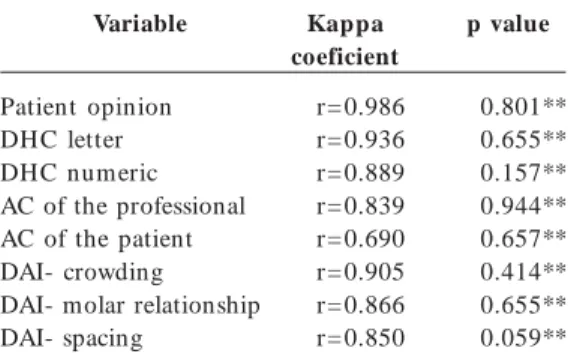
The accordance obtained among the categor-ical data were also high (Table 3) being presented in decreasing order of Kappa correlation: the patient’s opinion r = 0.986, subcategories of DHC (letter) r=0.936, because they are easier to agree than the number of DHC, DHC (numeric value) r = 0.889, AC of the professional r=0.839, AC of th e patien t r= 0.690. Th e Kappa correlation among the components of the DAI also in de-creasing order were: crowding r=0.905, molar relationship r=0.866 and spacing r = 0.850. In order to evaluate if there was significant differ-ence among the results obtained by the two ex-aminers, the Wilcoxon test was used, except for the patient’s opinion. For all these variables, the
value of p was not statistically significant and, therefore, there has no difference among the two examiners. For the patient’s opinion, the test of proportions was used because they are consid-ered to be objective answers and also, the value of p did not show significant difference between the two examiners.
The degree of need of orthodontic treatment according to the two examiners was evaluated by strips (SNT, NMT and NST) in accordance with each index (Table 4). In order to evaluate the dis-tribution of the data among the strips of the in-dexes DAI, DHC-IOTN, AC-IOTN and the pa-tient’s AC, the chi-square or Fisher test was car-ried out. The results indicated that the value p=0,00 was statistically significant for both in-dexes, evidencing that a significant difference ex-isted. Therefore, the distribution of the data ob-tained among the examiners was not statistically the same. The classification of the strips by scores can give this type of result.
Table 2. Correlation Spearman Coefficient and the
p value according to the Wilcoxon test for variables
without normal distribution. Natal (RN), 2006.
Variable
Overjet mandibular Open bite
Diastem a
Maxillary crowding Teething
Mandibular crowding
Spearm an coeficient
r= 1.00 r= 1.00 r= 0.997 r= 0.947 r= 0.923 r= 0.852
p value
p=1.0 ** p=1.0 ** p=0.08 ** p=0.10 ** p=0.31 ** p=0.65 **
*Sig.; **NS.
Table 1. Correlation Pearson Coefficient and the p
value according to the t test of Student for variables with normal distribution. Natal (RN), 2006.
Variable
Final DAI Maxillary Overjet
Pearson coeficient
r= 0.96 r= 0.96
p value
p=0.34 ** p=0.68 **
*Sig.; **NS.
Table 3. Correlation Kappa Coefficient of the categorical data and the p value according to the
Wilcoxon tests or proportions. Natal (RN), 2006.
Variable
Patient opinion DHC letter DHC numeric AC of the professional AC of the patient DAI- crowding DAI- molar relationship DAI- spacing
Kappa coeficient
r= 0.986 r= 0.936 r= 0.889 r= 0.839 r= 0.690 r= 0.905 r= 0.866 r= 0.850
p value
0.801** 0.655** 0.157** 0.944** 0.657** 0.414** 0.655** 0.059**
*Sig.; **NS.
Table 4. Correlation Kappa coefficient and the p value according to the chi-square test of the degree for the need of orthodontic treatment. Natal (RN), 2006.
Variable
DH C AC DAI
AC of the patient
Kappa coeficient
r= 0.86 r= 0.84 r= 0.78 r= 0.65
p value
p=0.00 * p=0.00 * p=0.00 * p=0.00 *
S
aú
d
e C
o
le
tiv
a, 1
5
(3
):7
8
5
-7
9
2
, 2
0
1
0
The frequency of the data obtained by the ex-aminers in relation to the degrees of need for orth-odontic treatment in agreement with the indexes DAI, DHC-IOTN, AC-IOTN and the patient’s AC, can be visualized in the Figures 1, 2, and 3.
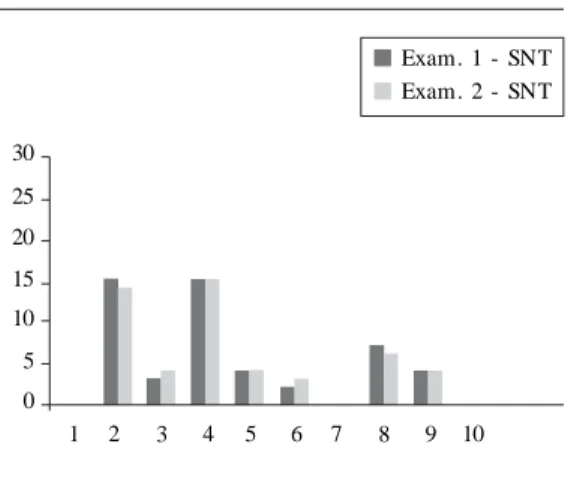
Regarding the frequency of the scores of each index, the results indicated that the degrees 4 and 5 regarding severe need (NST) were the most
frequent for the index DHC-IOTN (Figure 4), the degrees 2 and 4 for AC-IOTN (Figure 5) equivalent the without need of orthodontic treat-ment (SNT) and for the index DAI in the strip among 26-35 was the score 33 (moderate need of treatment) and in the strip among 36-100 the score 39 (severe need of orthodontic treatment) (Figure 6).
Figure 2. Distribution of the data obtained by the examiners related to cases with the need for moderate orthodontic treatment according to the indexes DAI, DHC-IOTN, AC-IOTN and the AC of the patient. Natal (RN), 2006.
DAI DH C-IOTN AC-IOTN AC-PAC 0
10 20 30 40 50 60
Exam. 1 - SNT Exam. 2 - SNT
Figure 1. Distribution of the data obtained by the examiners related to cases without the need for orthodontic treatment according to the indexes DAI, DHC-IOTN, AC-IOTN and the AC of the patient. Natal (RN), 2006.
DAI DH C-IOTN AC-IOTN AC-PAC 0
10 20 30 40 50 60
Exam. 1 - SNT Exam. 2 - SNT
Figure 3. Distribution of the data obtained by the examiners related to cases without the need for severe orthodontic treatment according to the indexes DAI, DHC-IOTN, AC-IOTN and the AC of the patient. Natal (RN), 2006.
DAI DH C-IOTN AC-IOTN AC-PAC 0
10 20 30 40 50 60
Exam. 1 - SNT Exam. 2 - SNT
Figure 4. Most frequent values according to the DHC-IOTN index. Natal (RN), 2006.
1 2 3 5
0 5 10 15 20 25 30
Exam. 1 - SNT Exam. 2 - SNT
L
Discussion
Based on the premise that the conventional orth-odontic diagnosis is qualitative and, therefore, a descriptive procedure that hinders a quantitative evaluation, many quantitative systems of evalu-ation of the malocclusion and of the need for orthodontic treatment have been developed dur-ing the last fifty years. Each index summarizes a group of characteristic occlusal that results in numeric values. For each one of these indexes a cut point exists below which the severity of the malocclusion is considered smaller than the need of orthodontic treatment and values above this
point the cases are considered with need of orth-odontic treatment. As a consequence, an index with cut point works as a diagnosis test8.
The correlation results obtained among the examiners were considered high, for the variables with and without normal distribution, in
accor-dance with Eklund et al20. They emphasize the
difficulty of specifying a kappa value as a stan-dard for an appropriate calibration. This is be-cause the kappa value varies according to the to-tal agreement and of the characteristics of the distribution. In addition, when evaluating if there was statistical difference among the results ob-tained by the examiners it was not observed any
difference to the values of p for DAI and IOTN.
Richmond et al.21 also proved the
reproduc-ibility of IOTN evaluating the consensus of opin-ions about the need for treatment within a group of 74 dentists, orthodontists and general
practi-tioners. According to Otuyemi and Noar22, who
evaluated the variability among the indexes DAI, OI, HMAR, there are a high level of reproducibil-ity and correlation among them.
Considering the categorical data, it can be observed that according to the table III, except for the patients’ AC, the other data resulted in kappa values were considered high. In addition, when
the value of p is evaluated it was not observed
significant difference between the two examiners. Comparing with the other classification meth-ods with IOTN and DAI it is important to em-phasize some points. The Classification of
An-gle14 indicated to have low reproducibility16 and it
was proven useless to the analysis of the priority for treatment. For the epidemic use, the
registra-tion techniques described by Björk et al.23 are
con-sidered acceptable concerning the precision to identify the several aspects of the occlusion, in up to 80% of agreement. However, they do not eval-uate the priority for treatment. The attribution of weight to some aspects of the occlusion promotes a certain concern of feeling to give them a degree of severity, and then to prioritize the treatment.
Several indexes were created with that principle
24-27. Perhaps, the great diversity of occlusalindexes
is explained by some of them do not register a
great variation of occlusal characteristics, to
present a certain subjectivity degree, to be used with different objectives for which they were ex-tolled, due to the great diversity of works that make impossible the comparison and evaluation of their reproducibility. As a consequence, the in-dexes DAI and IOTN present advantages because they have been extolled to evaluate the need of orthodontic treatment and be reproducible. Figure 6. Most frequent values according to the
DAI index. Natal (RN), 2006.
13-25 36-100
0 5 10 15 20 25 30
Exam. 1 - SNT Exam. 2 - SNT
26-35
Figure 5. Most frequent values according to the AC-IOTN index. Natal (RN), 2006.
0 5 10 15 20 25 30
Exam. 1 - SNT Exam. 2 - SNT
S
aú
d
e C
o
le
tiv
a, 1
5
(3
):7
8
5
-7
9
2
, 2
0
1
0
The data obtained in this study were based
on the results pointed out by Yeh et al.28, who
indicated that the two indexes DAI and IOTN are capable to identify the patients’ occlusal charac-teristics, despite of existing few studies that
com-pare them objectively29,30. These indexes have
sim-ilar objectives, however, with different applica-tions. Although the index DAI seems to be easier to use, it does not evaluate some occlusal charac-teristics, such as: cross bite, deep overbite and
deviation of medium line22. Another aspect to be
taken into account is that the margin of error of
the DAI is larger, since the occlusalcharacteristics
are measured with the probe periodontal and they can reflect great alterations, when the corre-sponding weights are added to the measures. The IOTN index allows an easier evaluation since it possesses classification degrees established pre-viously, in DHC and in AC. However, concerning the component aesthetic, also in aesthetic scale representative pictures of open bite and cross bite are not had, for instance, besides each individu-al’s own subjectivity in analyzing her. A safeguard should be made to DHC-IOTN that inhibits some characteristics once it only takes into account the most serious.
The importance of the patient’s aesthetic per-ception regarding the orthodontic treatment can-not be underestimated. In other words, the pa-tients that received treatment should also be
sat-isfied with the aesthetic and functional benefits28.
Based on this, the patients’ opinion was evaluat-ed and also comparevaluat-ed regarding the reproduc-ibility. Then, the patients were questioned in dif-ferent moments and by difdif-ferent examiners. The data indicated that there was not a significant difference among the opinions of these patients to the two examiners. In other words, almost 100% of the patients agreed that there is a need for orthodontic treatment in relation to the two moments in that it was investigated. However, the reproducibility was not so relevant when the patient evaluated the aesthetic visual scale.
In relation to the reproducibility of the com-ponent AC of IOTN checked by the examiners, it was observed that the subjectivity of “perceiving” something similar in the scale of pictures it is minimized in the professionals’ case, differently that what it happens with the patients that a lot of times appear for the picture that a situation that they would like to be or that they find to be the more aesthetics.
As it can be observed in Figures 1, 2, and 3 there was a clear tendency of the patients to indi-cate scores regarding without need of
orthodon-tictreatment (from 1 to 4) when compared with
the results obtained by the two examiners with the indexes DAI and DHC-IOTN, mainly. There-fore, these results corroborate the findings of
Lewit26, which emphasized that the opinions of
patients associated to the need for treatment have been previously registered by the dental and fa-cial appearance and the patients’ complaint, this not always coincides with the professionals’ eval-uations in relation to the treatment need.
In this way, subsequent studies should be ac-complished in different populations, with ent needs for orthodontic treatment, with differ-entiated groups of orthodontists that allow a val-idation of these indexes in clinical different reali-ties from those where they arose, in the sense of corroborating the discoveries of the present study.
Conclusions
According with the obtained data it could be con-cluded that, regarding the reproducibility, both indexes were reproducible when comparing the data obtained by the two examiners. When eval-uating, in decreasing order of reproducibility, which index was more reproducible in relation to the strips of treatment need the result obtained was DHC-IOTN, AC-IOTN and DAI. Therefore, the index IOTN was more reproducible than the index DAI. The two components of IOTN were reproducible, however, DHC was more than AC, maybe this is explained by the subjectivity degree when evaluate the aesthetic visual scale of the com-ponent AC.
Collaborations
L
References
Allen ND. Han dicappin g m alocclusion assessm en t record in direct m outh exam ination. Am J Orthod
1970; 58:67-72.
Foster TD, Men ezes DM. Th e assessm en t of o c-clusal features for public health plan n in g purpos-es. Am J Orthod 1976; 69:83-90.
Miguel JAM. Estudo epidemiológico da severidade das más oclusões em escolares de 12 anos de idade da Rede Municipal de Ensino do Rio de Janeiro [dissertação].
Rio d e Jan eir o ( RJ) : Facu ld ad e d e O d on t ologia, Universidade do Estado do Rio de Janeiro; 1998. Calheiros AA. Avaliação dos resultados dos tratamen-tos realizados na clínica de Ortodontia da FO – UERJ
[ m on ografia] . Rio de Jan eiro ( RJ) : Facu ldade de Odon tologia, Un iversidade do Estado do Rio de Janeiro, 1999.
Shaw WC, O’Brien KD, Richm ond S. Quality con-trol in orthodontics: Influencing the receipt of orth-odontic treatment. Br Dent J 1991; 170(2):66-68.
Buchanan IB, Downing A, Stirrups DR. A compar-ison of th e in dex of orth odon tic treatm en t n eed applied clin ically an d to diagn ostic records. Br J Orthod 1994; 21:185-188.
Keeling SD, McGorray S, Wheeler T, King GJ. Im -p r ecisio n in o r t h o d o n t ic d iagn o sis: Reliab ilit y of clinical measures of malocclusion. Angle Orthod
1996; 66(5):381-392.
Beglin FM, Firestone AR, Vig KW, Beck FM, Kuthy RA, Wade D. A com par ison of the reliability an d validity of 3 occlusal indexes of orthodontic treat-m ent need. Am J Orthod Dentofacial Orthop 2001;
120(3):240-246.
Tu rn er SA. Occlu sal In dex revisited. Br J Orthod
1990; 17(3):197-203.
Rich m on d S, Dan iels CP. In tern ation al com pari-son s of profession al assessm en ts in orthodon tics: part I – treatm en t n eed. Am J Orthod Dentofacial Orthop 1998; 113:37-46.
Scivier GA, Menezes DM, Parker CD. A pilot study to assess the validity of the Orthodontic Treatment Priority Index in English schoolchildren. Com m u-nity Dent Oral Epidemiol 1974; 2:246-252.
Sheats RD, McGorray SP, Keeling SD, Wheeler TT, Kin g GJ. Occlu sal traits an d perception of orth -odontic need in eighth grade students. Angle Orthod
1998; 68(2):107-114.
Em rich RE, Brodie AG, Blayn ey JR. Prevalen ce of Class I, Class II an d Class III m alocclusion s (An -gle) in an Urban Popu lation . An epidem iological study. J Dent Res 1965; 44:947-953.
An gle EH . Classificat ion of m alocclu sion . Dent. Cosm os 1899; 41:248-264.
Car los JP. Evalu ation of in dexes of m alocclu sion .
Int Dent J 1970; 20:606-617.
Brook PH, Shaw WC. The development of an Index of orthodontic treatment priority. Eur J Orthod 1989;
11:309-320.
1.
2.
3.
4.
5.
6.
7.
8.
9.
10.
11.
12.
13.
14.
15.
16.
Con s NC, Jen n y J, Koh ou t FJ, Son gp aisan Y, Jo-tikastira D. Utility of the dental aesthetic index in in d u st r ialized an d d evelo p in g co u n t r ies. J Pu b Health Dent 1989; 49(3):163-166.
World Health Organization. Oral health surveys: basic m ethods. 4th ed. Geneva: ORH/EPID; 1997. Evan s R, Shaw WC. Prelim in ar y evalu ation of an illustrated scale for rating dental attractiveness. Eur. J. Orthod.1987; 9:314-318.
Ecklun d SA, Moller IJ, Leclercq M-H . Calibration of Exam iners for Oral Health Epidem iological sur-veys. Geneva: WHO; 1993.
Richmond S, Shaw WC, O’Brien KD, Buchanan IB, Stephen s CD, An drews M, Rober ts CT. Th e rela-tion ship between the in dex of orthodon tic treat-ment need and consensus opinion of a panel of 74 dentists. Br Dent J 1995; 178:370-374.
Otuyemi OD, Noar JH. A comparison between DAI and SCAN in estimating orthodontic treatment need.
Int Dent J 1996; 46(1):35-40.
Björk A, Krebs AA, Solow B. A method for epidemi-ological registration of malocclusion. Acta Odontol Scand 1964; 22(1):27-41.
Grainger RM. Orthodontic treatm ent priority index.
Washington, D.C.: National Center for Health Sta-tistics; 1967.
Salzmann JA. Malocclusion severity assessment. Am J Orthod 1967; 53(2):109-119.
Lewit DW, Virolainen K. Conformity and indepen-den ce in adolescen ts’ m otivation for orthodon tic treatment. Child Cev 1968; 39:189-200.
Summers CJ. The occlusal index: A system for iden-tifying an scoring occlusal disorders. Am J Orthod
1971; 59(6):552-567.
Yeh MS, Kooch ek AR, Vlaslalic V, Boyd R, Rich-mond S. The relationship of 2 professional
occlus-al indexes with patients’ perceptions of aesthetics, function, speech, and orthodontic treatm ent need.
Am J Orthod Dentofacial Orthop 2000; 118:421-428.
Beglin FM, Firestone AR, Vig KW, Beck FM, Kuthy RA, Wade D. Comparison of the reliability and va-lidity of three occlusal index of orthodontic treat-m ent need. Am J Orthod Dentofacial Orthop 2001;
120:240-246.
Tar vit DJ, Freer TJ. Assessin g m alocclu sion – the
time factor. Br J Orthod 1998; 25(1):31-34.
Artigo apresentado em 21/05/2007 Aprovado em 10/09/2007
17.
18.
19.
20.
21.
22.
23.
24.
25.
26.
27.
28.
29.