AR
TICLE
1 Secretaria de Vigilância em Saúde, Ministério da Saúde. Esplanada dos Ministérios Bloco G. 70058-900 Brasília DF Brasil.
[email protected] 2 Australian Research Centre for Population Oral Health, The University of Adelaide. Adelaide Australia.
Self-reported oral health in the Brazilian adult population:
results of the 2013 National Health Survey
Abstract Abstract Oral diseases are a relevant public health problem in Brazil, because of their prevalence and magnitude in the population. Population-based surveys are essential tools for the election of groups and demands priority at-tention, . The aim of this paper was to describe the self-reported oral health status of the popu-lation, according to sociodemographic factors. A descriptive study was conducted using the Nation-al HeNation-alth Survey data of 2013. Indicators associ-ated with oral hygiene practices and oral health conditions were analyzed. Men, elders, blacks and browns, individuals with no education and with incomplete elementary level, residents in rural areas and in the northeast had the lowest frequencies of the indicators of oral hygiene and health self-perception oral as good or very good. Total loss has affected about 16.0 million. Both total tooth loss as the loss of 13 or more teeth was more frequent among women, individuals aged 60 and older, poorly educated, residents in rural areas. It is concluded that the data from the Na-tional Health Research -PNS 2013 reinforce the need for policies and actions that minimize the inequalities in oral health, ensuring access to the most vulnerable population sub-groups according to their health needs.
Key words Oral health, Epidemiological survey, Self-report
Lucélia Silva Nico 1
Silvânia Suely Caribé de Araújo Andrade 1
Deborah Carvalho Malta 1
Gilberto Alfredo Pucca Júnior 1
N
ic
Introduction
Oral health issues are a significant public health problem due to their percentage prevalence and
the scale of the population1. There have been few
studies with nationwide scope on the condition of Brazilians’ oral health. Highlights have been the epidemiological surveys on oral health in the Brazilian population made by the Health
Minis-try in 19862, 19963 (with school children only),
20034 and 20105.
Comparison between these epidemiological
surveys2-4 shows that the condition of adult
Bra-zilians’ oral health has improved6. In 1986 the
‘CPOD’ index (the sum of cases of permanent teeth with caries, extractions due to caries and restorations) was 22.5% in the adult population aged 35 to 44 and the P component (number of
teeth extracted) contributed 66% of that total2.
After two decades, this profile was practically un-changed: the average CPOD in adults was 20.1, with a contribution of 65.7% from the lost teeth
(P) component3.
The data of the last epidemiological survey (2010)5 show that incidence of caries in the adult
population aged 35-44 is lower than in the 2003 survey4. And in relation to loss of teeth, the data
of the National Oral Health Survey (SB Brazil 2010) showed 25% of adults having lost a tooth, with the average of lost teeth varying from 13.5 in 2002/2003 to 7.4 in 2010. However, more than half of elderly people had edentulism (total loss
of teeth), both in 2010 and in 2002/20037. As to
the effect of collective measures, fluoridation of the public water supply has been one of the prin-cipal measures, and a very effective method of control of dental caries8.
Population-based studies are essential tools for identification of the groups and demands that should receive priority attention, and also for preparation of instruments for formation and health of public policies. With this in mind the Health Ministry made the 2013 National Health
Survey (PNS 2013)9, in partnership with the
Bra-zilian Geography and Statistics Institute (IGBE).
The 2013 PNS9 employed self-assessment
for responses by the Brazilian population to its questionnaire on health – an indicator that is in fact used both in Brazil10 and internationally11.
Self-assessment has an acceptable degree of va-lidity12 for ascertaining the number of teeth
pres-ent and the need for prosthesis, as well as being an indicator used in epidemiological surveys due to its advantages in relation to clinical exam-ination (the gold standard for diagnosis of oral
health situation), and also taking time, costing less and not requiring a specialized professional.
The objective of this article is to describe the self-referred oral health situation of the Brazil-ian population, according to social-demographic factors.
Methods
A descriptive study was carried out using the data
of the 2013 Brazilian National Health Survey9, a
partnership between the Brazilian Geography and Statistics Institute (IBGE) and the Brazilian Health Ministry.
The PNS is a household-based survey, with a sampling process that takes place in three stages: primary sampling units were sectors or groups of sectors from the census; households were the secondary units; and the tertiary units comprised one selected resident aged 18 or over from the household. The primary sampling units of the PNS were obtained from the Master Sample, which is the sampling structure of the IBGE’s In-tegrated Household Surveys System (SIPD).
The selection of the sub-sample of the prima-ry sampling units was made by simple random sampling. On this basis, a fixed number of per-manent private households in each primary unit was selected. This selection was made from the National File of Addresses for Statistical Purpos-es (CNEFE) in its most recent use. Within each household selected, one resident aged 18 or over was chosen by lot to answer the specific question-naire.
The size of the sample was decided taking into account the level of precision desired for the estimates of some indicators of interest. The minimum size decided for the sample was 1,800 households in each unit of the Brazilian federa-tion (the States, and the Federal District). Initial-ly, 81,254 households were selected, and the in-terviews were carried out in 64,348 households. All the analyses of the PNS were weighted for the primary sampling units, for the households and all their residents and also for the resident selected. Details on the process of sampling and weighting are available in the report of the PNS9.
sched-aúd
e C
ole
tiv
a,
21(2):389-398,
2016
uled for the dates and times that were best for the informants, in advance, with two or more visits per household. The PNS questionnaire was divided into modules, for characteristics of the household, of all the residents (schooling, in-come, work, disabled people, health plan cover-age, use of the health services, health of children under the age of two, health of the elderly) and of the adult resident selected (styles of life, percep-tion of state of health, accidents and incidents of violence, chronic illnesses, women’s health, pre-natal care, healthcare and medical care).
This study analyzed the following indicators relating to oral health:
Oral health practices
a) Proportion of people aged 18 or over who brush their teeth at least twice a day;
b) Proportion of people aged 18 or over who use toothbrush, toothpaste and dental floss to clean their teeth;
c) Proportion of people aged 18 or over who change their toothbrush for a new one at least once every three months.
Oral health conditions
d) Proportion of people aged 18 or over who consider their oral health to be good or very good;
e) Proportion of people aged 18 or over who have an intense or very intense degree of difficul-ty in eating due to problems with teeth or den-tures;
f) Proportion of people aged 18 or over who have lost all their teeth;
g) Proportion of people aged 18 or over who have lost 13 or more teeth;
h) Proportion of people aged 18 or over who use some type of dental prosthesis.
Estimates were made of the proportions and their respective 95% confidence intervals
(CI95%), by gender (male, female); age group
(18-29; 30-39; 40-59 and 60 or over); race/skin color (white, black, mixed-race); level of schooling (no schooling, or primary schooling incomplete; pri-mary schooling incomplete; secondary schooling complete and higher education incomplete; and higher education complete); area of residence (urban, rural); and official geographic Region of Brazil (North, Northeast, Southeast, South, and Center-West). The data were analyzed using Stata software, version 11.0 in the Survey module for complex samples. The plan of the 2013 PNS was approved by the Brazilian National Research Eth-ics Committee of the Health Ministry.
Results
Oral hygiene practices
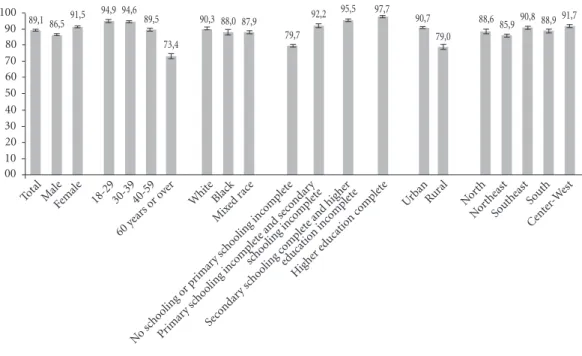
In Brazil, 89.1% of people aged 18 or over brushed their teeth at least twice a day (n = 60,202). The habit was less frequent among men (86.5%), people aged 60 or over (73.4%), black people (88.0%) and mixed-race people (87.9%), those without schooling or with primary school-ing incomplete (79.7%), those resident in rural areas (79.0%), and those resident in the North-east Region (85.9%) (Figure 1).
In relation to the individuals who used a toothbrush, toothpaste and dental floss to clean their teeth (n= 58,905), the lowest proportions were found among males (48.4%), those aged 60 or over (29.1%), those of African-Brazilian skin color (43.6%), those of mixed race (47.1%), those without schooling or with primary educa-tion incomplete (29.2%), those resident in rural areas (30.4%), and those resident in the North-east (38.4%) (Figure 2).
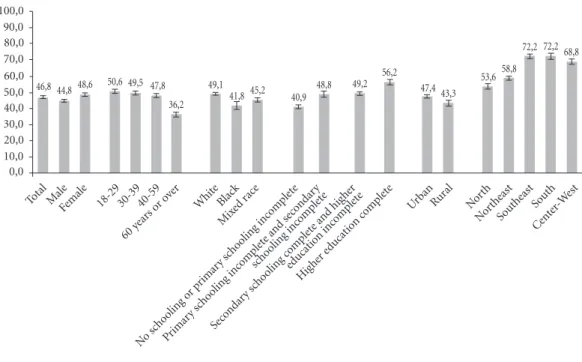
Of people aged 18 or over (n = 58,905), 46.8% said they changed their toothbrush for a new one with at least three months of use, with the lowest frequencies observed among men (44.8%), the elderly (36.2%), those of African race origin (41.8%) and of mixed race (45.2%), those without schooling or without completed primary education (40.9%), those resident in rural areas (43.3%), and those resident in the Southeast (43.2%) and Center-West (43.5%) Re-gions (Figure 3).
Oral health conditions
N
ic
Figure 1. Distribution of people aged 18 or over who brush their teeth at least twice a day, according to selected variables, with indication of 95% confidence interval. Brazilian National Health Survey, 2013.
Total Male
Female 18-29 30-39 40-59 Whit
e Black Mix
ed r ace
No sc hooling o
r primar y scho
oling inc omple
te
Primar y scho
oling inc omple
te and se condar
y
scho oling inc
omple te
Seco ndar
y scho oling c
omple te and hig
her
educat ion inc
omple te
Highe r educat
ion c omple
te
60 y
ears o
r ove
r
Urban Rur al
Nort h
Nor theast
Sou theast Sou
th
Cent er-W
est
89,1 86,5 91,5 94,9 94,6 89,5 73,4
90,3 88,0 87,9 79,7
92,2 95,5 97,7 90,7
79,0
88,6 85,9 90,8 88,9 91,7
00 10 20 30 40 50 60 70 80 90 100
Figure 2. Distribution of people aged 18 or over who use a toothbrush, toothpaste and dental floss for cleaning teeth, by selected variables, with indication of 95% confidence interval. National Health Survey, 2013. Brazilian National Health Survey, 2013.
53,0 48,457,1 61,4 64,9
51,7
29,1 59,9
43,6 47,1
29,2 52,6
69,7 83,2
90,7
79,0
43,0 38,4
61,8 54,0
61,7
0,0 10,0 20,0 30,0 40,0 50,0 60,0 70,0 80,0 90,0 100,0
Total Male
Female 18-29 30-39 40-59 Whit
e Black Mix
ed r ace
No sc hooling o
r primar y sc
hooling inc omple
te
Primar y sc
hooling inc omple
te and se condar
y
scho oling inc
omple te
Seco ndar
y scho oling c
omple te and hig
her
educat ion inc
omple te
Hig her e
ducat ion c
omple te
60 y
ears o
r ove
r
Urban Rur al
Nort h
Nor theast
Sou theast Sou
th
Cent er-W
aúd
e C
ole
tiv
a,
21(2):389-398,
2016
Figure 4. Distribution of people aged 18 or over who consider their oral health to be good or very good, by selected variables, with indication of 95% confidence interval. National Health Survey, 2013.
67,4 65,8 68,9 74,0 70,1 63,5 62,3 73,1
61,2 62,5 57,5 66,8 73,3
83,4
69,2
56,6 59,8 58,8
72,2 72,2 68,8
0,0 10,0 20,0 30,0 40,0 50,0 60,0 70,0 80,0 90,0 100,0
Figure 3. Distribution of people aged 18 or over who change their toothbrush for a new one at least every three months, by selected variables, with indication of 95% confidence interval. National Health Survey, 2013.
46,8 44,8 48,6 50,6 49,5 47,8 36,2
49,1
41,8 45,2 40,9
48,8 49,2 56,2 47,4 43,3
53,6 58,8
72,2 72,2 68,8
0,0 10,0 20,0 30,0 40,0 50,0 60,0 70,0 80,0 90,0 100,0
Total Male
Female 18-29 30-39 40-59 Whit
e Black Mix
ed r ace
No sc hooling o
r primar y scho
oling inc omple
te
Primar y scho
oling inc omple
te and se condar
y
scho oling inc
omple te
Seco ndar
y scho oling c
omple te and hig
her
educat ion inc
omple te
Highe r educat
ion c omple
te
60 y
ears o
r ove
r
Urban Rur al
Nort h
Nor theast
Sou theast Sou
th
Cent er-W
est
Total Male
Female 18-29 30-39 40-59 Whit
e Black Mix
ed r ace
No sc hooling o
r primar y scho
oling inc omple
te
Primar y scho
oling inc omple
te and se condar
y
scho oling inc
omple te
Seco ndar
y sc hooling c
omple te and hig
her
educat ion inc
omple te
Hig her e
ducat ion c
omple te
60 y
ears o
r ove
r
Urban Rur al
Nort h
Nor theast
Sou theast South
Cent er-W
N
ic
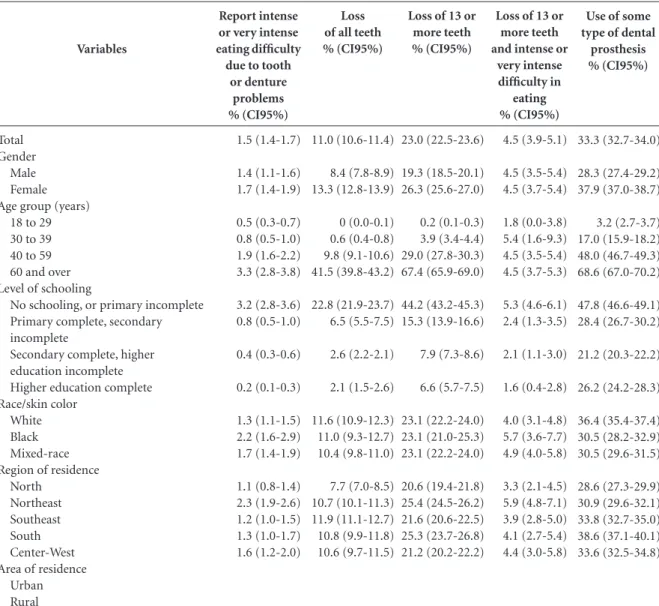
In Brazil, 60,202 people aged 18 or more an-swered questions about the difficulty of feeding themselves due to problems with teeth or false teeth. Of these, 1.4% of the males and 1.7% of the females had an intense or very intense degree of difficulty in feeding themselves due to problems with teeth or false teeth. This difficulty was more frequent in people aged 40-59 (1.9%), and 60 or over (3.3%), and also in those without schooling or with incomplete primary education (3.2%). People of black skin color, residents in rural ar-eas and residents in the Northar-east had the high-est percentages reporting intense or very intense
difficulty in feeding themselves due to problems with teeth or false teeth: 2.2%, 2.3% and 2.3%, respectively (Table 1).
60,202 adults answered the questionnaire on loss of teeth. The survey estimated that 11.0% of people aged 18 or over had lost all their teeth, the highest proportion being in women (13.3%), people aged 60 or more (41.5%), people what education or with incomplete primary education (22.8%), and people living in rural areas (15.0%) and in the North Region (7.7%). There was no statistically significant difference for the skin col-or variable (Table 1).
Use of some type of dental
prosthesis % (CI95%) 33.3 (32.7-34.0) 28.3 (27.4-29.2) 37.9 (37.0-38.7) 3.2 (2.7-3.7) 17.0 (15.9-18.2) 48.0 (46.7-49.3) 68.6 (67.0-70.2) 47.8 (46.6-49.1) 28.4 (26.7-30.2) 21.2 (20.3-22.2) 26.2 (24.2-28.3) 36.4 (35.4-37.4) 30.5 (28.2-32.9) 30.5 (29.6-31.5) 28.6 (27.3-29.9) 30.9 (29.6-32.1) 33.8 (32.7-35.0) 38.6 (37.1-40.1) 33.6 (32.5-34.8) Variables Total Gender Male Female Age group (years)
18 to 29 30 to 39 40 to 59 60 and over Level of schooling
No schooling, or primary incomplete Primary complete, secondary incomplete
Secondary complete, higher education incomplete Higher education complete Race/skin color
White Black Mixed-race Region of residence
North Northeast Southeast South Center-West Area of residence
Urban Rural
Report intense or very intense eating difficulty due to tooth
or denture problems % (CI95%) 1.5 (1.4-1.7) 1.4 (1.1-1.6) 1.7 (1.4-1.9) 0.5 (0.3-0.7) 0.8 (0.5-1.0) 1.9 (1.6-2.2) 3.3 (2.8-3.8) 3.2 (2.8-3.6) 0.8 (0.5-1.0) 0.4 (0.3-0.6) 0.2 (0.1-0.3) 1.3 (1.1-1.5) 2.2 (1.6-2.9) 1.7 (1.4-1.9) 1.1 (0.8-1.4) 2.3 (1.9-2.6) 1.2 (1.0-1.5) 1.3 (1.0-1.7) 1.6 (1.2-2.0)
Table 1. Proportion of indicators of condition of oral health in adults aged 18 or over, by selected variables, with indication of 95% confidence interval. National Health Survey, 2013.
Loss of all teeth % (CI95%) 11.0 (10.6-11.4) 8.4 (7.8-8.9) 13.3 (12.8-13.9) 0 (0.0-0.1) 0.6 (0.4-0.8) 9.8 (9.1-10.6) 41.5 (39.8-43.2) 22.8 (21.9-23.7) 6.5 (5.5-7.5) 2.6 (2.2-2.1) 2.1 (1.5-2.6) 11.6 (10.9-12.3) 11.0 (9.3-12.7) 10.4 (9.8-11.0) 7.7 (7.0-8.5) 10.7 (10.1-11.3) 11.9 (11.1-12.7) 10.8 (9.9-11.8) 10.6 (9.7-11.5)
Loss of 13 or more teeth % (CI95%) 23.0 (22.5-23.6) 19.3 (18.5-20.1) 26.3 (25.6-27.0) 0.2 (0.1-0.3) 3.9 (3.4-4.4) 29.0 (27.8-30.3) 67.4 (65.9-69.0) 44.2 (43.2-45.3) 15.3 (13.9-16.6) 7.9 (7.3-8.6) 6.6 (5.7-7.5) 23.1 (22.2-24.0) 23.1 (21.0-25.3) 23.1 (22.2-24.0) 20.6 (19.4-21.8) 25.4 (24.5-26.2) 21.6 (20.6-22.5) 25.3 (23.7-26.8) 21.2 (20.2-22.2)
Loss of 13 or more teeth and intense or
aúd
e C
ole
tiv
a,
21(2):389-398,
2016
The loss of 13 or more teeth was reported
by 23% of adults (≥ 18 years), and was more
frequent in women (26.3%), people aged 60 or over (67.4%), people without schooling or with incomplete primary education (44.2%), people living in rural areas (33.1%) and people living in the South (25.3%) or Northeast (25.4%) Re-gions. No statistically significant differences were observed for the variable skin color (Table 1).
Of the people who lost 13 or more teeth, 4.5% reported intense or very intense difficulty in feeding themselves, there being no difference for gender, skin color, place of residence (city/ rural), or Region. The lowest percentage of re-port of intense or very intense difficulty in eat-ing, among those who lost 13 or more teeth, was in the 18-29 age group (1.8%); the largest pro-portion was among those with no education or incomplete primary education (5.3%) (Table 1).
As to the use of some type of dental prosthesis
(and = 44,921), 33.3% of adults (≥ 18) reported
this factor, the majority being: women (37.9%); people aged 60 or over (68.6%); those without education or with incomplete primary educa-tion (47.8%); those of white skin color (36.4%); and residents in the South (38.6%) and South-east (33.8%) Regions. No statistically significant differences were found for location of residence (Table 1).
Discussion
The data of the 2013 PNS showed that men, el-derly people, black and mixed-race individuals, those without schooling or with incomplete pri-mary education, and those living in rural areas or in the Northeast had the lowest frequencies of in-dicators of adequate oral hygiene and of self-per-ception of their oral health as good or very good. Reports of intense or very intense difficulty in eating due to problems with teeth or dentures increased with age and was also greatest among those with low schooling, those of black or mixed race, and those resident in rural areas and in the Northeast.
The literature shows a positive association between frequency of brushing of teeth and the feminine gender, young adults and those with a higher level of schooling10,11.A systematic review
that aimed to identify an association between so-cial, demographic, economic, psycho-social and behavioral factors and self-perception of condi-tion of oral health showed that women have the highest correlation with the act of care, both
per-sonal and family, visit the health services more frequently and express the existence of morbid-ities more8,12-14 .
In a survey on adults between age 20 and 59, living in a rural settlement, it was evident that self-assessment or oral health was more frequent in adults with low schooling and in those of black
skin or mixed race15, similar to the data of the
PNS. However, in that study, which was a local study, the highest prevalence of negative self-as-sessment was in younger people and women, in contrast to the PNS, which was a nationwide study. Advancing age had an influence on wors-ening self-perception of oral health, also corrob-orating the other studies. A study with the data of the 2010 SB Brasil (Brazil Oral Health [Saúde Bucal] Study) for the Southern region showed adults and elderly people with lower income hav-ing the worst self-assessment of oral health16.
Difficulty in eating also reflects the inequali-ties in oral health in Brazil. According to data of the SB Brasil survey, made in 2002 and 2003 in 250 Brazilian municipalities with adults of the 35-44 age group, the factors associated with self-per-ception of regular or bad mastication were: not receiving preventive information about oral health; having less than 23 teeth in the mouth; need for a partial or total prosthesis; self-percep-tion of oral health as regular or bad/very bad; pain in teeth and gums; and a need for dental treatment. Adults living in the Northeast, those of mixed-race or African-Brazilian background, and those with the lowest level of schooling had the worst self-perception of mastication15.
In relation to loss of teeth, 16.0 million peo-ple had total loss. Both total loss of teeth and the loss of 13 or more teeth were more frequent in: women; respondents aged over 60; those with low schooling; and those resident in rural areas. The occurrence of dental loss in Brazil, according to the National Oral Health Survey (SB Brasil) of 2010, was greatest in: elderly people; women; people of lower income and schooling; and
resi-dents in the North and Northeast regions15.
The development of caries as an illness is the principal cause of loss of teeth, followed by gum disease. Use of tobacco is the largest risk factor for its development in adults17. In relation to the
social determinants related to loss of teeth, the demographic and socio-economic characteristics have high significance for this condition among individuals: the number of teeth lost in adults is greater among the elderly, women, people with low socio-economic conditions and low
N
ic
access to advance dental services for conservation treatment is shown to be one of the reasons why dental extraction is seen as the most viable alter-native, principally among those with less pur-chasing power18.
Loss of teeth is a recognized and serious problem of public health, being a significant in-dicator for the population’s oral health, with an extremely high influence in individuals’ quality
of life19. Its impact reduces functional capacity
such as chewing and speech, as well as adverse conditions of a nutritional, aesthetic and psy-chological nature, with reduction of self-esteem and social integration20. Skin color, self-referred
need for dental treatment, and low schooling are considered predictors both for negative self-eval-uation of oral health13-15 and also for loss of teeth;
low schooling and low income are considered de-termining factors for tooth loss15.
Of those who have lost 13 or more teeth and have intense or very intense difficulty in eating, the lowest percentage was among the youngest and the greatest among those with low schooling. One of the elements that helps with chewing and consequently nutrition is the number of teeth in the mouth: a functional dentition has at least 21
natural teeth20. As a probable hypothesis for why
younger people should have more difficulty in mastication, a lower level of resilience than the elderly have for dealing with challenges related to the function of the mouth (pains, discomfort, food restriction) is cited. Loss of teeth, a marker for inequalities in oral health, affects more in-dividuals with lower schooling and income, be-cause they have less access to dental services and to measures to promote health8,21,22 .
The majority of individuals who reported use of some type of dental prosthesis was found in women, elderly people, people with low school-ing, people with black skin or of mixed race, and those resident in the South and Southeast. The greater use of prostheses in women can be ex-plained by the fact that they used dental services
more than men21. Elderly people and those with
low schooling reported use of prostheses more frequently, probably due to greater loss of teeth16.
Also, individuals of white skin, and residents in the South and Southeast, used dental services more, according to data from the PNAD (Na-tional Household Sample Surveys) of 1998 and 200323.
Another study that used data from epidemio-logical surveys carried out by the Health Ministry in the years 1986, 2003 and 2010 showed the ex-perience of caries, expressed by the CPOD index
(total of permanent teeth with caries, teeth lost and teeth filled), and dental health, expressed by the OH-D index (total of healthy teeth plus filled teeth) relative to the number of functional teeth, compared to random samples of residents aged 35-44 in each Brazilian Region. There were re-ductions in the CPOD index and increase in the OH-D index in all the regions in the period from 1986 to 2010. The North Region, which had the worst level in 1986, showed the greatest gain in terms of functional teeth. The investigators con-cluded that there has been a transition to better oral health in Brazilian adults. It is plausible to propose that addition of fluoride to the water and to toothpaste, higher incorporation of pre-ventive services, and improvement in human de-velopment indicators arising from public policies are related to this improvement24.
In view of these data it is really possible to affirm that the oral health conditions of Brazilian adults have improved, over the years. However, in relation to the oral health of elderly people, the situation has not changed, with a high prev-alence of edentulism (total loss, of all the teeth),
and teeth with caries25. The Epidemiological Oral
Health Conditions Survey of the Brazilian Pop-ulation, the SB Brasil Project (2002–03) found a critical situation of oral health for elderly people: 54.8% having completely lost all their teeth, an average CPOD (number of teeth with caries, lost or filled) of 27.93, and less than 10% with more
than 20 teeth in the mouth4. These findings are
strongly influenced by a cohort effect and a pe-riod effect. The greater part of Brazilian elderly people lived their infancy and youth unexposed to fluoridation in water (which was begun in Bra-zil in the 1950s), but fluoridation of toothpastes (begun at the end of the 1980s) shows itself to be the principal reason for the decline in dental car-ies and in a large proportion of the losses of teeth detected in this population group.
Periodic nation-wide epidemiological sur-veys are of great importance for planning, as-sessment and monitoring of health conditions and services. It is known that people’s behavior is conditioned, among other aspects, by their perceptions and the importance that they attri-bute to them. Offering health services is not al-ways synonymous with people seeking out these services. Thus, to know how each individual perceives his or her own health is an important step for understanding the pattern of demand for health services12-14,25.
aúd
e C
ole
tiv
a,
21(2):389-398,
2016
general, but were frequent among the elderly, and also among those with low schooling. A system-atic review of the literature over the period 1986-2004 on the oral problems most prevalent among Brazilian elderly people revealed that the average values of the CPOD index were between 25 and 31, with a large percentage of individuals having no teeth at all, reflecting the inefficacy historical-ly present in the public dental healthcare services, limited to series of extractions and urgency ser-vices based on the curativist model25.
As a limitation of this study, we highlight the non-realization of clinical examination to verify the oral health situation of the adults in-terviewed. However, it is necessary to note also that self-perception of oral health is less associ-ated with clinical situations and more linked to subjective factors26. According to the literature27,
self-perception about the number of teeth has high validity.
Final considerations
In Brazil inequalities in oral health are an histor-ic phenomenon, evidencing vulnerabilities in the rural area, in the North and Northeast Regions,
and among those with less schooling8,13,20. The
interventions in public health in the field of oral health principally affect groups with lower so-cio-economic conditions that preliminarily and intensely make use of the advantages of beneficial public health policies, such as fluoridation of the
public water supply8. The data of the 2013 PNS
underscore the need for policies and actions that minimize the inequalities in oral health, ensuring access to more vulnerable population sub-groups in accordance with their health needs.
Collaborations
N
ic
Petersen PE. Tobacco and oral health: the role of the World Health Organization. Oral Health Prev Dent 2003; 1(4):309-315.
Moreira TP, Nations MK, Alves MSCF. Dentes da de-sigualdade: marcas bucais da experiência vivida na pobreza pela comunidade do Dendê, Fortaleza, Ceará, Brasil. Cad Saude Publica 2007; 23(6):1383-1392. Moreira RS, Nico LS, Tomita NE. O risco espacial e fatores associados ao edentulismo em idosos em mu-nicípio do Sudeste do Brasil. Cad Saude Publica 2011; 27(10):2041-2054.
Ervin RB, Dye BA. The effect of functional dentition on Healthy Eating Index scores and nutrient intakes in a nationally representative sample of older adults. J Pu-blic Health Dent 2009; 69(4):207-216.
Araújo CS, Lima RC, Peres MA, Barros AJD. Utilização de serviços odontológicos e fatores associados: um es-tudo de base populacional no Sul do Brasil. Cad Saude Publica 2009; 25(5):1063-1072.
Barros AJD, Andréa DB. Desigualdades na utilização e no acesso a serviços odontológicos: uma avaliação em nível nacional. Cien Saude Colet 2002; 7(4):709-717. Pinheiro RS, Torres TZG. Uso de serviços odontológi-cos entre os Estados do Brasil. Cien Saude Colet 2006; 11(4):999-1010.
Nascimento S, Frazão P, Bousquat A, Antunes JLF. Condições dentárias entre adultos brasileiros de 1986 a 2010. Rev Saude Publica 2013; 47(Supl. 3):69-77. Moreira RS, Nico LS, Tomita NE, Ruiz T. A saúde bucal do idoso brasileiro: revisão sistemática sobre o quadro epidemiológico e acesso aos serviços de saúde bucal. Cad Saude Publica 2005; 21(6):1665-1675.
Vasconcelos LCA, Prado Júnior RR, Teles JBM, Men-des RF. Autopercepção da saúde bucal de idosos de um município de médio porte do Nordeste brasileiro. Cad Saude Publica 2012; 28(6):1101-1110.
Pedro REL, Bos AJG, Padilha DMP, Silva-Filho IGD. Validação de entrevista por telefone para avaliação da saúde bucal em idosos. Rev Brasileira de Ciências do En-velhecimento Humano 2012; 8(2):213-220.
Article submitted 26/10/2015 Approved 07/12/2015
Final version submitted 09/12/2015 17.
18.
19.
20.
21.
22.
23.
24.
25.
26.
27. References
Fernandes LS, Peres MA. Associação entre atenção bá-sica em saúde bucal e indivíduos socioeconômicos mu-nicipais. Rev Saude Publica 2005; 39(6):930-936. Brasil. Ministério da Saúde (MS). Levantamento epi-demiológico em saúde bucal: Brasil, zona urbana 1986. Brasília: MS; 1988. (Série C: Estudos e Projetos, 4). Pinto VG. Saúde bucal coletiva. São Paulo: Editora San-tos; 2000.
Brasil. Ministério da Saúde (MS). Projeto SB Brasil 2003: condições de saúde bucal da população brasileira 2002-2003. Resultados principais. Brasília: MS; 2004. Brasil. Ministério da Saúde (MS). Projeto SB Brasil 2010: resultados principais. Brasília: MS; 2011. Borges MC, Campos ACV, Vargas AMD, Ferreira EF. Perfil das perdas dentárias em adultos segundo o capi-tal social, características demográficas e socioeconômi-cas. Cien Saude Colet 2014; 19(6):1849-1858. Antunes JLF, Narvai PC, Ferreira JL, Narvai PC. Po-líticas de saúde bucal no Brasil e seu impacto sobre as desigualdades em saúde. Rev Saude Publica 2010; 44(2):360-365.
Ramires I, Buzalaf MAR. A fluoretação da água de abastecimento público e seus benefícios no controle da cárie dentária – cinquenta anos no Brasil. Cien Saude Colet 2007; 12(4):1057-1065.
Instituto Brasileiro de Geografia e Estatística (IBGE). Pesquisa Nacional de Saúde: 2013: acesso e utilização dos serviços de saúde, acidentes e violências: Brasil, grandes regiões e unidades da federação. Rio de Janeiro: IBGE; 2015.
Maes L, Vereecken C, Vanobbergen J, Honkala S. Tooth brushing and social characteristics of families in 32 countries. Int Dent J 2006; 56(3):159-167.
Garbado MCL, Moysés ST, Moysés SJ. Autopercepção de saúde bucal conforme o Perfil de Impacto de Saúde Bucal (OHIP) e fatores associados: revisão sistemática. Rev Panam Salud Publica 2013; 33(6):439-445. Moura C, Gusmão ES, Santillo PMH, Soares RSC, Coe-lho RS, Cimões R. Autoavaliação da saúde bucal e fato-res associados entre adultos em áreas de assentamento rural, Estado de Pernambuco, Brasil. Cad Saude Publica 2014; 30(3):611-622.
Braga APG, Barreto SM, Martins Lima AMEB. Auto-percepção da mastigação e fatores associados em adul-tos brasileiros. Cad Saude Publica 2012; 28(5):889-904. Santos S, Patrícia MH, Soares RSC, Cimões R. Autoava-liação da saúde bucal e fatores associados entre adultos em áreas de assentamento rural, Estado de Pernambu-co, Brasil. Cad Saude Publica 2014; 30(3):611-622. Matos DL, Lima-Costa MF. Auto-avaliação da saúde bucal entre adultos e idosos residentes na Região Su-deste: resultados do Projeto SB-Brasil, 2003 Self-rated oral health among Brazilian adults and older adults in Southeast Brazil. Cad Saude Publica 2006; 22(8):1699-1707.
Barbato PR, Nagano HCM, Zanchet FN, Boing AF, Pe-res MA. Perdas dentárias e fatoPe-res sociais, demográfi-cos e de serviços associados em adultos brasileiros: uma análise dos dados do Estudo Epidemiológico Nacional (Projeto SB Brasil 2002-2003). Cad Saude Publica 2007; 23(8):1803-1814.
1.
2.
3. 4.
5. 6.
7.
8.
9.
10.
11.
12.
13.
14.
15.