Actively station
Effects on global cognition of mature adults and
healthy elderly program using eletronic games
Tiago Nascimento Ordonez1, Felipe Borges1, Camila Sato Kanashiro1, Carolina Carneiro das Neves Santos2, Samara Santos Hora1, Thais Bento Lima-Silva3
ABSTRACT. Studies show that aging is accompanied by decline in cognitive functions but also indicate that interventions, such as training on electronic games, can enhance performance and promote maintenance of cognitive abilities in healthy older adults. Objective: To investigate the effects of an electronic game program, called Actively Station, on the performance of global cognition of adults aged over 50 years. Methods: 124 mature and elderly adults enrolled in the “Actively Station” cognitive stimulation program of São Caetano do Sul City, in the State of São Paulo, participated in training for learning of electronic games. Participants were divided into two groups: training group (TG) n=102 and control group (CG) n=22. Protocol: a sociodemographic questionnaire, the Mini-Mental State Examination (MMSE), the Addenbrooke’s Cognitive Examination Revised (ACE-R), the Memory Complaint Questionnaire (MAC-Q), the scale of frequency of forgetfulness, the Geriatric Depression Scale (GDS-15), the Geriatric Anxiety Inventory (GAI), the Global Satisfaction with Life Scale, and two scales on learning in the training. Results: The cognitive performance of the TG improved significantly after the program, particularly in the domains of language and memory, and there was a decrease on the anxiety index and frequency of memory complaints, when compared to the CG. Conclusion: These findings suggest that the acquisition of new knowledge and the use of new stimuli, such as electronic games, can promote improvements in cognition and mood and reduce the frequency of memory complaints.
Key words: elderly, cognition, cognitive stimulation, electronics equipment and games.
ESTAÇÃO ATIVAMENTE: EFEITOS NA COGNIÇÃO GLOBAL DE ADULTOS MADUROS E IDOSOS SAUDÁVEIS COM UM PROGRAMA DE ESTIMULAÇÃO DE JOGOS ELETRÔNICOS.
RESUMO. Estudos mostram que o envelhecimento é acompanhado por declínio nas funções cognitivas, mas também indicam que as intervenções como o treinamento de jogos eletrônicos podem melhorar o desempenho e promover a manutenção de habilidades cognitivas em idosos saudáveis. Objetivo: Investigar os efeitos de um programa de jogos eletrônicos, denominado Estação Ativamente no desempenho da cognição global de adultos com mais de 50 anos.
Métodos: 124 adultos maduros e idosos inscritos no “Programa de estimulação cognitiva: Estação Ativamente” da Prefeitura Municipal de São Caetano do Sul, do estado de São Paulo. Participaram de um treinamento para aprendizagem de jogos eletrônicos. Os participantes foram divididos em dois grupos: grupo treino n=102 e grupo controle (GC) n=22. Protocolo: um questionário sociodemográfico, o Mini Exame do Estado Mental (MEEM), o Exame Cognitivo de Addenbrooke’s Revisado (ACE-R), o Memory Complaint Questionnaire (MAC-Q), uma escala de freqüência de esquecimentos, a Escala de Depressão Geriátrica (GDS-15), a Escala de Ansiedade Geriátrica (GAI), a escala de satisfação geral com a vida e duas escalas sobre a aprendizagem do treinamento. Resultados: Observou-se que o desempenho cognitivo do GT melhorou significativamente após participação no programa, especificamente nos domínios de linguagem e memória, houve diminuição no índice de ansiedade e na frequência de queixas de memória, quando comparado ao GC. Conclusão: Estes achados sugerem que a aquisição de novos conhecimentos e o uso de novos estímulos como os jogos eletrônicos, podem trazer ganhos à cognição, ao humor e à diminuição da frequência de queixas de memória.
Palavras-chave: idosos, cognição, estimulação cognitiva, equipamentos eletrônicos e jogos.
This study was conducted at the Escola de Artes, Ciências e Humanidades da Universidade de São Paulo. Gerontologia, São Paulo SP, Brazil.
1Escola de Artes, Ciências e Humanidades da Universidade de São Paulo. Gerontologia, São Paulo SP, Brazil. 2Faculdade de Medicina de Ribeirao Preto - Saúde
em Comunidade Universidade de Sao Paulo, Ribeirao Preto SP, Brazil. 3 Grupo de Neurologia Cognitiva e do Comportamento do Departamento de Neurologia da
Faculdade de Medicina da Universidade de São Paulo, São Paulo SP, Brazil.
Thais Bento Lima-Silva. Universidade de São Paulo / Faculdade de Medicina / Departamento de Neurologia – Av. Dr. Enéas de Carvalho Aguiar, 255 – 01246-903 São Paulo SP – Brazil. E-mails: [email protected] and [email protected]
Disclosure: The authors report no conflicts of interest.
Received April 16, 2017. Accepted in final form May 19, 2017.
INTRODUCTION
T
he shift in the demographic pyramid relects the exponential growth of the elderly population worldwide, yet the majority of this contingent tends to feel excluded by the functional declines associated with aging that can afect vision, hearing, self-esteem, motor coordination, short-term memory, concentration and reaction abilities, among others.1In general, the younger generation is conident in using technology and assimilates change easily as, since their early years, they have explored electronic toys and/ or played on mobile phones. However, the older genera-tion, born before the development of the digital world, has more diiculty accessing these technologies. In addi-tion, some elderly individuals may lack the motor skills needed to competently use digital devices.1-4
Numerous studies have shown that older adults are interested and able to achieve independence in the use of computer games.2 hese investigations also reveal that contact with technology can yield beneits such as improved social interaction and mental stimulation.3,4
Studies show that aging is accompanied by decline in cognitive functions but research also indicates that cognitive interventions can enhance performance and promote maintenance of cognitive abilities in healthy older adults.5-7 Such interventions have also been associ-ated with functional preservation.8-10
Regarding electronic games use by older adults, there are a number of studies on postural control, bal-ance, fall prevention, physical activity incentives, and functional performance.1-3 he positive efects of using games include improving physical function, decreasing depression, and enhancing cognition and quality of life in older adults. Improved socialization and motivation to exercise have also been reported.1-3 Most of the stud-ies assessing older adults in virtual tasks involved older adults with acquired physical and cognitive diseases, while healthy older adults were only part of the control group.3 However, research into the use of games as a means of facilitating the use of computers and reducing loneliness of healthy older adults is scarce.10
Many modalities of cognitive training have been tested in both healthy and cognitively-impaired elderly.11-15 Shapira et al.16 studied a sample of Israeli elderly and found that group learning of the use of computer games and of active searching on the Inter-net in old age promoted a signiicant improvement in aspects such as depression, loneliness and self-control. he results demonstrated that Internet use can con-tribute to well-being and a sense of empowerment in interpersonal interactions, improving cognitive
func-tioning and contributing to feelings of autonomy and independence.
Chen et al.17 performed a study comparing the sense of psychological well-being among older adults wishing to learn how to play computer games with those who did not. In the study, those elderly interested and able to achieve this goal (learning information technology for suring the web and playing computer games) attained higher scores on the personal growth scale applied. he authors highlighted that these elderly perceived them-selves as growing, developing individuals, had more goals, and a greater sense of direction in life compared to those showing no interest in learning new skills, such as use of computers and the Internet.
We investigated the efects of the stimulation pro-gram on participants’ global cognition. We also exam-ined the impact of program participation on depressive symptoms, anxiety symptoms, memory complaints and learning satisfaction in adults older than 50 years.
METHODS
Participants. A total of 124 mature and adults older than 50 years enrolled on the “Actively Training” run by the São Caetano do Sul City Hall were recruited for the study. Participants were divided into two groups: training group (TG) and control group (CG).
he TG initially comprised 102 individuals, two of which were later excluded: one for dropping out of the activity and the other for being diagnosed with Alzheim-er’s Disease. he excluded subjects took part in the inter-vention but their data were not included in the analy-ses. hus, the TG contained 102 participants, 12.87% male and 87.13% female, aged 50-89 years (M=68.43; SD=9.42). he CG comprised 22 individuals, 21.05% male and 78.95% female, aged 50-87 years (M=69.57; SD=9.08). he total sample (TG and CG) consisted of 124 mature and older adults.
he inclusion criteria adopted in this study were: being a resident of São Caetano do Sul, aged >50 years, having suicient sensory faculties (hearing and vision) to take part in the interventions, basic motor loco-motion skills, no previous diagnosis of dementia or depression, and being available to participate in the socioeducational activity centered on memory and in the computer cognitive training.
drugs that could afect the central nervous system were included. None of the participants fulilled the Diagnos-tic and StatisDiagnos-tical Manual-IV19 criteria for depression; all scored <6 points on the Geriatric Depression Scale (GDS).20
Protocol. he sociodemographic data were collected using a questionnaire including the following variables: gender, age, schooling, marital status, family income, occupation (working and/or retired)
Global cognition. he Addenbrooke Cognitive Exam-Revised (ACE-R)21,22 consists of a brief cognitive assess-ment battery testing ive diferent cognitive domains. he highest score is 100 points, distributed as follows: attention and orientation (18); memory (35); verbal luency (14); language (28); and visuospatial abilities (5). Higher scores indicate better performance. he scores regarding each of the six domains can be computed separately and their sum gives the total ACE-R score of which 30 points are derived from the MMSE.18
Memory complaints. In order to examine memory complaints, the Memory Complaint Questionnaire (MAC-Q)23 was applied. Respondents are asked if their performance today is the same, better, much better, worse or much worse than it was when they were 18 years old on six memory domains. he maximum score is 35 points, and the higher the score, the greater the presence of memory complaints. A score above 25 on this instrument is considered suggestive of the pres-ence of memory complaints.23,24
An adapted version of the frequency of forgetful-ness (EFE) scale by McNair25 and Vianna-Paulo26 was also used. Based on this scale, participants indicated how often they forgot passwords, peoples’ names, among other commonly forgotten items, selecting Never (0), Sometimes (1), Frequently (2), or Always (3). Scores range from 0 to 45 points on the scale, with higher scores denoting greater frequency of memory complaints or forgotten items. To date, no studies have established a cut-of point, for frequency of forgotten items, which would be indicative of clinically signiicant memory deicits.
Screening depression and anxiety. he Geriatric Depression Scale – GDS-15: the GDS is one of the most commonly used measures for screening depression in the elderly population. In the present study, a brief version of the instrument in Portuguese consisting of 15 questions with answers classiied as yes or no, and a cut-of point
of 5/6 (non-case/case), was adopted. Total score on the GDS is calculated based on the sum of the responses and indicates extent of depressed mood, with 0 being the lowest score and 15 the highest. he version used was adapted from Yesavage et al.27 and is considered a valid and reliable scale for use in Brazilian samples.20,28
he Geriatric Anxiety Inventory (GAI) was used to assess geriatric anxiety symptoms.29,30 he GAI consists of 20 dichotomous items and a score of 12 or higher suggests the presence of generalized anxiety disorder.
Subjective well-being. he Overall Satisfaction with Life (OSL) scale: a ive-point scale ranging from 1 (very unsatisied) to 5 (highly satisied) created by Neri31 to measure subjective well-being indicated by satisfaction with life for three domains: health and physical capacity, mental capacity and social involvement.
Satisfaction with training. Upon program conclusion at six months, the participants of the Actively Station training answered a semi-structured questionnaire containing questions related to satisfaction, evaluation and atti-tudes regarding technological games.4,32 he question-naire consisted of 21 Likert-type items, each with four response alternatives. At the end of this questionnaire, based on two open questions, the participants were asked to say what aspects of the course they most and least liked during the training.
Description of study venue. he study was carried out at the community center for the hird Age of São Caetano do Sul city. he city, situated in the Greater ABC- São Paulo area, is renowned nationally for its policies promoting active healthy aging and for having high population aging. According to data from the Seade Foundation, 35.8% (n 53,963) of the local population was 50 years of age or older in the months: June, July and August of 2016. In addition, the city ranks as having the highest Human Development Index in Brazil.33
Inte-grated Centers for Health and Education of the hird Age (CISE, acronym in Portuguese).
he CISEs are social support facilities based on intersectoral partnerships that provide services in the areas of health, education, leisure, sports, culture, social welfare, legal aid, well-being and tourism to its 19,500 registered users.
Procedures and ethical aspects. Each of the 12 training sessions included a 45-minute educational intervention aimed at ofering information about memory and aging, and at changing negative beliefs about aging, memory and health. his educational component followed a pre-determined protocol. During each session, diferent memory subsystems were explored and aspects of memory which tend to remain stable with aging were highlighted. Special attention was given to the stability observed in immediate memory, semantic memory and implicit memory. After the educational interven-tion, participants were divided into small groups, led by Gerontologists, and spent 45 minutes learning how to use the electronic games equipment.
he electronic games equipment was Japanese and purchased by the sponsors of this study after visits to leisure centers for the elderly in Japan, where electronic games stations are common for health promotion and activities for prevention of cognitive decline in the pop-ulation of diferent age groups. All the equipment used was adapted for use in Brazilian elderly people, such as: design, ergonomic adaptation, audiovisual and language of software. hese changes were implemented via a pilot stage with a group of ten elderly people which took place one month before the intervention stage of the study. hese adaptations were implemented with the aid of information system and computational engineering pro-fessionals. he training courses ofered to the elderly in this study, as well as the manual adapted to replicate the methodology used and the guidelines for the purchase of the equipment, are available from the authors upon request by e-mail .
In all sessions, participants of the intervention trained for 15 minutes on each item of electronic equip-ment, starting the training with stimulation of atten-tion and working memory (on the Taikô equipment), then episodic memory training with cards (equipment involving memory of igures that began with the pre-sentation of 12 cards). Subsequently, subjects trained attention on the equipment with the use of the hammer. Finally, they played a game on the dance equipment, concluding participation on the program in a fun and interactive way (games described in Appendix).
All games had graded levels of diiculty. Every three consecutive encounters, participants were placed on a higher diiculty level, starting from beginner level, pro-gressing to easy, then moderate and inally, the diicult level. Although the participants in the control group did not perform the intervention, they were placed on a waiting list, followed by the same number of sessions. hey were followed by gerontologists with experience in cognitive stimulation, who monitored them in small groups of ten participants at most.
he study was conducted in compliance with Inter-national ethics standards (Declaration of Helsinki).
Analysis of results. he information gathered by applying the instruments was irst submitted to descriptive statistical analysis. In order to describe the sample proile according to the several study variables, frequency tables of categorical variables, and descrip-tive statistics including measures of position and spread (mean, standard deviation, median and maximum) of continuous variables, were constructed.
he Chi-square test comparing proportion of a given response between groups was employed to determine associations for responses of the categorical variable gender between the groups.34 he continuous variables of interest in this study were analyzed using the Kol-mogorov-Smirnov test. he test conirmed that the data required parametric tests. herefore, given the non-normal distribution of the data, the ordinal and con-tinuous variables for the groups were compared using the Mann-Whitney test. he Wilcoxon test for related or paired samples was used to compare the before and after diference in the groups for total and domain scores on the instruments applied.
Cronbach’s α coeicient was used to analyze the internal consistency reliability of the responses on the Satisfaction, Assessment and Attitudes in Relation to the Actively Station training. Alpha values ≥0.60 indi-cate moderate consistency and ≥0.70 high consistency.35 Data were keyed into the Excel Oice 2010 application and subsequently analysed using the statistics software package Statistica v.7.0 (2004). he level of signiicance adopted for the statistical tests was 5%, i.e., p-value <0.05.
RESULTS
education in the EG were 68.57 (9.53) and 8.91 (4.91) years, respectively. he CG had a mean (SD) age of 70.23 (8.25) years and education of 8.41 (4.22) years (Table 1).
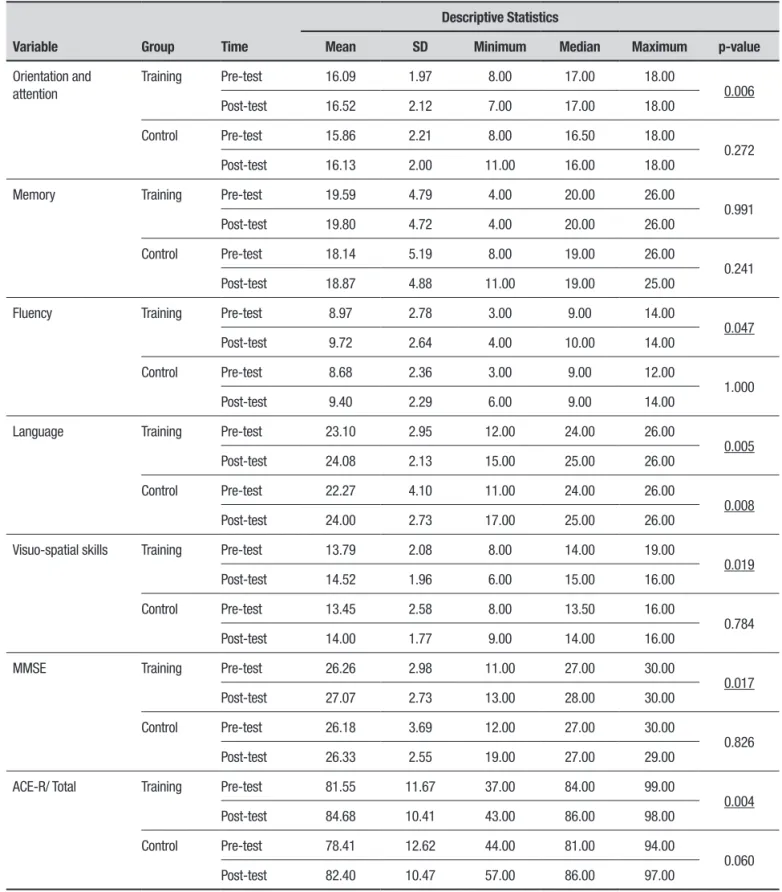
he individuals in the TG and CG were matched for sociodemographic variables. At a 95% conidence level, there was no signiicant diference between the groups for gender, age, education or retirement status (Table 1). Comparison of the performance of the individuals belonging to the same group TG over time revealed a signiicant increase in total score on the ACE-R and its subdomains: attention and orientation, verbal luency, visuospatial ability and the Mini-Mental State Exam (MMSE). In the CG, scores difered only for language (Table 2).
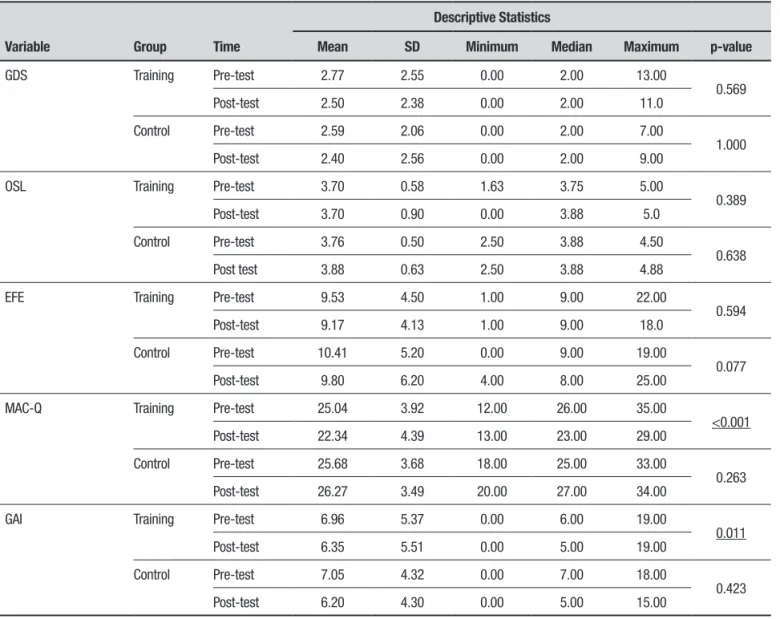
Comparison of the performance of the individu-als belonging to the same group (TG or CG) over time revealed a signiicant decrease in memory-related com-plaints (MAC-Q) and anxiety levels in the TG (Table 3).
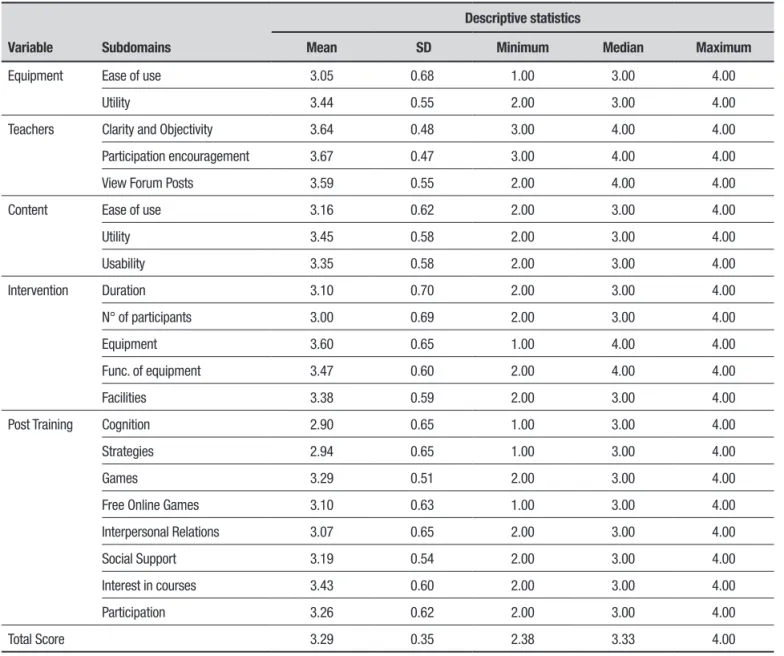
Satisfaction, assessment and attitudes regarding the actively station training. Data for Satisfaction, Assessment and Attitudes for the Actively Station Training are given in Table 4. his scale showed excellent internal consistency, as evidenced by the Cronbach coeicient of 0.873. With regard to the training participants’ responses, the indi-viduals generally rated the project positively, particu-larly for clarity and objectivity, doubts and queries, and machines.
Chart 2 below shows the aspects that the training participants most liked. Four categories of aspects were derived from content analysis: I liked the monitors, the teaching approach, mixing with others and expanding my knowledge.
With regard to the aspects least liked by the partici-pants of the training, according to participant reports, one category was cited by most participants: duration of the training (Chart 3).
Table 1. Socio-demographic profile of participants.
Variable
Global
Groups
p-value
Training Control
N % N (102) % N (22) %
Sex Male 19 15.32 14 13.73 5 22.73
Female 105 84.68 88 86.27 17 77.27 0.288
Age (in years) Mean (SD±) 68.86 9.31 68.57 9.53 70.23 8.25
Median 69.00 68.00 71.50
Minimum-maximum 50.00-89.00 50.00-89.00 52.00-84.00 0.359
Education Elementary School (incomplete) 38 30.65 33 32.35 5 22.73
Elementary School (complete) 23 18.55 16 15.69 7 31.82
High school (incomplete) 5 4.03 4 3.92 1 4.55
High school (complete) 23 18.55 20 19.61 3 13.64
Higher education (incomplete) 11 8.87 9 8.82 2 9.09
Higher education (complete) 22 17.74 18 17.65 4 18.18
Mean (SD±) 8.82 4.78 8.91 4.91 8.41 4.22
Median 8.00 8.00 8.00
Minimum-maximum 0.00-27.00 0.00-27.00 1.00-16.00 0.893
Retired No 27 21.77 24 23.53 3 13.64
Yes 96 77.42 78 76.47 19 86.36
Table 2. Comparison pre and post-test between training and control group.
Variable Group Time
Descriptive Statistics
Mean SD Minimum Median Maximum p-value
Orientation and attention
Training Pre-test 16.09 1.97 8.00 17.00 18.00
0.006
Post-test 16.52 2.12 7.00 17.00 18.00
Control Pre-test 15.86 2.21 8.00 16.50 18.00
0.272
Post-test 16.13 2.00 11.00 16.00 18.00
Memory Training Pre-test 19.59 4.79 4.00 20.00 26.00
0.991
Post-test 19.80 4.72 4.00 20.00 26.00
Control Pre-test 18.14 5.19 8.00 19.00 26.00
0.241
Post-test 18.87 4.88 11.00 19.00 25.00
Fluency Training Pre-test 8.97 2.78 3.00 9.00 14.00
0.047
Post-test 9.72 2.64 4.00 10.00 14.00
Control Pre-test 8.68 2.36 3.00 9.00 12.00
1.000
Post-test 9.40 2.29 6.00 9.00 14.00
Language Training Pre-test 23.10 2.95 12.00 24.00 26.00
0.005
Post-test 24.08 2.13 15.00 25.00 26.00
Control Pre-test 22.27 4.10 11.00 24.00 26.00
0.008
Post-test 24.00 2.73 17.00 25.00 26.00
Visuo-spatial skills Training Pre-test 13.79 2.08 8.00 14.00 19.00
0.019
Post-test 14.52 1.96 6.00 15.00 16.00
Control Pre-test 13.45 2.58 8.00 13.50 16.00
0.784
Post-test 14.00 1.77 9.00 14.00 16.00
MMSE Training Pre-test 26.26 2.98 11.00 27.00 30.00
0.017
Post-test 27.07 2.73 13.00 28.00 30.00
Control Pre-test 26.18 3.69 12.00 27.00 30.00
0.826
Post-test 26.33 2.55 19.00 27.00 29.00
ACE-R/ Total Training Pre-test 81.55 11.67 37.00 84.00 99.00
0.004
Post-test 84.68 10.41 43.00 86.00 98.00
Control Pre-test 78.41 12.62 44.00 81.00 94.00
0.060
Post-test 82.40 10.47 57.00 86.00 97.00
Chart 1. Services offered to visitors of the Integrated Health and Education Centers of the city of São Caetano do Sul.
Department Services offered
Cheers Outpatient care in nursing, medicine, geriatrics, physiotherapy, psychology, hydrotherapy, nutrition and dentistry.
Education Language and literacy courses.
Recreation Ecumenical events, festivals and dances.
Sports Gymnastics, bodybuilding, stretching, adapted sports, Pilates, walking and water aerobics.
Culture Performing arts, plastic arts, visual arts, literature and music workshops.
Social assistance Crafts workshops, patchwork, macrame, needlework, mosaic, rag doll, embroidery, wicker, carton.
Legal Assistance Legal assistance once a week
Welfare Hairdressing, manicure and pedicure
Tourism Sociocultural Tourism Program of the 3rd Age - tours to museums, parks, local fairs, cinemas and trips to the countryside and
coast of São Paulo and other states.
Source: Collection of the city of São Caetano do Sul, 2016, http://www.saocaetanodosul.sp.gov.br/
Table 3. Comparison pre and post-test between training and control groups.
Variable Group Time
Descriptive Statistics
Mean SD Minimum Median Maximum p-value
GDS Training Pre-test 2.77 2.55 0.00 2.00 13.00
0.569
Post-test 2.50 2.38 0.00 2.00 11.0
Control Pre-test 2.59 2.06 0.00 2.00 7.00
1.000
Post-test 2.40 2.56 0.00 2.00 9.00
OSL Training Pre-test 3.70 0.58 1.63 3.75 5.00
0.389
Post-test 3.70 0.90 0.00 3.88 5.0
Control Pre-test 3.76 0.50 2.50 3.88 4.50
0.638
Post test 3.88 0.63 2.50 3.88 4.88
EFE Training Pre-test 9.53 4.50 1.00 9.00 22.00
0.594
Post-test 9.17 4.13 1.00 9.00 18.0
Control Pre-test 10.41 5.20 0.00 9.00 19.00
0.077
Post-test 9.80 6.20 4.00 8.00 25.00
MAC-Q Training Pre-test 25.04 3.92 12.00 26.00 35.00
<0.001
Post-test 22.34 4.39 13.00 23.00 29.00
Control Pre-test 25.68 3.68 18.00 25.00 33.00
0.263
Post-test 26.27 3.49 20.00 27.00 34.00
GAI Training Pre-test 6.96 5.37 0.00 6.00 19.00
0.011
Post-test 6.35 5.51 0.00 5.00 19.00
Control Pre-test 7.05 4.32 0.00 7.00 18.00
0.423
Post-test 6.20 4.30 0.00 5.00 15.00
Table 4. Satisfaction, evaluation and attitudes regarding training on games for Training Group (TG).
Variable Subdomains
Descriptive statistics
Mean SD Minimum Median Maximum
Equipment Ease of use 3.05 0.68 1.00 3.00 4.00
Utility 3.44 0.55 2.00 3.00 4.00
Teachers Clarity and Objectivity 3.64 0.48 3.00 4.00 4.00
Participation encouragement 3.67 0.47 3.00 4.00 4.00
View Forum Posts 3.59 0.55 2.00 4.00 4.00
Content Ease of use 3.16 0.62 2.00 3.00 4.00
Utility 3.45 0.58 2.00 3.00 4.00
Usability 3.35 0.58 2.00 3.00 4.00
Intervention Duration 3.10 0.70 2.00 3.00 4.00
N° of participants 3.00 0.69 2.00 3.00 4.00
Equipment 3.60 0.65 1.00 4.00 4.00
Func. of equipment 3.47 0.60 2.00 4.00 4.00
Facilities 3.38 0.59 2.00 3.00 4.00
Post Training Cognition 2.90 0.65 1.00 3.00 4.00
Strategies 2.94 0.65 1.00 3.00 4.00
Games 3.29 0.51 2.00 3.00 4.00
Free Online Games 3.10 0.63 1.00 3.00 4.00
Interpersonal Relations 3.07 0.65 2.00 3.00 4.00
Social Support 3.19 0.54 2.00 3.00 4.00
Interest in courses 3.43 0.60 2.00 3.00 4.00
Participation 3.26 0.62 2.00 3.00 4.00
Total Score 3.29 0.35 2.38 3.33 4.00
*Evaluation of duration, physical space, infrastructure and number of participants.
Chart 2. Responses for “what you liked most during the training”.
Categories Responses
Monitors For the training I liked everything, especially the teachers.
Teaching Method The didactic and practical part.
Interaction with others Socialization, motor activities, memorization activities, cognitive activities.
Knowledge Gain Knowledge of techniques that help us to keep our brains active.
Chart 3. Responses for “what you least liked during the training”.
Category Responses
Duration of training The duration was short.
DISCUSSION
he objective of the present study was to assess the efects of the stimulation program on participants’ global cognition, depressive symptoms, anxiety symp-toms, memory complaints and learning satisfaction in adults older than 50 years. In the present study, after participating in the Actively Station intervention, the individuals from the training group showed signiicant improvement in language performance compared to the subjects from the control group. his may suggest that the individuals in the TG performed the semantic search faster, with improvement in verbal memory and processing speed skills for verbal materials. Studies such as that by Bopp and Verhaeghen36 have documented maintenance of semantic and verbal memory during the normal aging process, where this may allow greater improvements when these are abilities stimulated.
he indings reported by Machado37 showed that after use of computers and computer games, the elderly participants felt satisfaction with their own perfor-mance, expressing feelings of inclusion in the techno-logical and social world. In the present study, satisfac-tion with the teacher, the content and positive attitudes in relation to the IT training had a strong inluence on participant improvements. he importance of the moti-vation provided throughout the learning process, and not only during the initial stages, was highlighted.
In the same vein, the study by Tomporowski38 revealed that, despite learning diiculties due to sensory and short-term memory decline, elderly students, when properly guided and motivated, tend to feel satisied and supported, and consequently learn new information as efectively as younger students.
Besides these results for satisfaction and motivation, Keyes39 stated that critical stimulation on the intel-lectual task being undertaken by older adults can aid the learning process. his critical stimulation is a way of promoting the adaptation and lexibility of elderly with regard to the teaching model put in practice in an intervention for the third age.40 In the present study, the use of historical facts about IT and the Internet and the focus on information of common interest such as health and aging during the classes, probably promoted this stimulation.
he preparation of printed materials for the course also aided participant learning. he feedback on actions, prior preparation of instructions and clear outlining of the main objective of the tasks to be learned proved fun-damental activities of the researcher in teaching elderly about Internet use.40
Missotten et al.41 and Ready et al.42 reported that
cognitive decline negatively impacts QoL. herefore, it follows that improvements in cognitive can positively inluence self-rating of life. he results found on the EDEP were congruent with the indings of Irigaray et al. (2011) who reported signiicant improvement in the TG on the domains Environment, Personal Growth, Self-acceptance and Create after training episodic memory, attention and executive functions. However, unlike the study by Irigaray et al.,43 the present investigation employed scores for factors identiied in a previous study on this scale in Brazil.44
Nevertheless, no single formula is universally valid for all older adults and therefore, when devising a digi-tal inclusion training program, it is important to take into account who the elderly are, where they come from, and what they expect from the service. Knowledge on all relevant aspects of the aging process is required to structure an efective program relecting the reality of the participants involved.
For the majority of the older adults, learning com-puter games was a special achievement. Many reported during the interventions that they now play games with their children at family get-togethers. Curiosity to learn new things led to the perception by the elderly that there are no limits to realizing desires, dreams or overcoming obstacles. Based on the results of the pres-ent study, it can be concluded that the use of technology by the older adults contributed to mental health and to achieving good quality of life during old age. he interac-tion during and outside the training also helped reduce social isolation and loneliness.
Critical stimulation during teaching, clear and objec-tive language, recognition of students’ knowledge, and planning of actions by the researcher were fundamental for eicacy of learning. he inclusion of the elderly in the world of IT and learning, the development of new methods, and discussions on achieving this, appear to be goal of common interest to both public and private educational institutions.4 At the University of São Paulo, there are examples where these goals have been sought since implementation of the Open University of the hird Age in 1993.45
subjective memory may require the use of an interven-tion protocol which includes goal-setting and feedback information, matched to cognitive tasks organized in increasing level of diiculty.48 In other words, a psycho-educational protocol with information on memory and aging, such as the one reported in the current training protocol, seems to be insuicient to generate changes in perceptions about cognition.
Overall, the Actively Station project has produced promising results. It has provided a space for interaction of young and older adults and promoted a rich array of communication through digital and technological inter-activity. he project has given both these age groups the opportunity to discover and build new meanings, par-ticularly with respect to the social roles which they can and wish to engage in throughout their aging process. Elderly individuals, who are expected to merely convey experiences and knowledge, have put themselves into a situation where they know little or nothing about a spe-ciic context or sphere, and can experience the challenge of experimenting the new and a sense of inexperience in which they assume the role of a student.
his study provides important contributions, because it shows that interventions with electronic games can stimulate and promote better cognitive performance in Brazilian adults and elderly without dementia or depression. It should be highlighted that the gerontological literature emphasizes the importance of cognitive preservation by promoting the maintenance of autonomy, independence and lowering risks of hos-pitalization and institutionalization in the elderly. he program could be replicated in other Brazilian cities as a health promotion measure and public policy in Ger-ontology. his study has some limitations, including the fact that the participants were recruited from the setting of a health and education center for the elderly, where results reported were representative of active older adults. he efect of the cognitive training on sat-isfaction with learning can be increased. Additionally, the participants of the TG were not compared against a group receiving another type of intervention or to an
active CG, a comparison which could have allowed the efect of interacting in a group to be identiied. Also, the distribution of participants across the groups was not fully randomized and may have introduced some bias in favor of the TG. Future studies should replicate the method of this study with a larger number of sessions and fewer participants to further elucidate the relation-ship among learning, cognitive performance, satisfac-tion, motivasatisfac-tion, attitudes and beliefs with regard to technology.
Acknowledgments. he authors are grateful for the support of São Caetano do Sul city hall, State of São Paulo, Brazil and for the inancing of the study by the B & P Editorial, Barueri city, São Paulo, Brazil.
Author contribution. Tiago Nascimento Ordonez: invited and selected the study participants, coordinated stim-ulation sessions with electronic games, assisted in the ethical procedures of the study and in the choice of research sites, performed the data analyses and partici-pated in the drafting of the manuscript. Felipe Borges: invited and selected the study participants, coordinated stimulation sessions with electronic games, assisted in the ethical procedures of the study, in the choice of research site and participated in the drafting of the manuscript. Camila Sato Kanashiro: conducted the evaluations, coordinated stimulation sessions with electronic games, typed the protocols and participated in qualitative data analyses. Carolina Carneiro das Neves Santos: carried out the evaluations, coordinated stimulation sessions with electronic games, typed the protocols and participated in qualitative data analysis. Samara Santos Hora: carried out the evaluations, coor-dinated stimulation sessions with the electronic games, typed the protocols and participated in qualitative data analysis. hais Bento Lima da Silva: coordinated the team, carried out the intervention, reviewed the litera-ture, performed data analyses and participated in the drafting of the manuscript.
REFERENCES
1. Anderson F, Annet M, Boschof WF. Lean on Wii: physical rehabilitation with virtual reality Wii peripherals. Studies in Health Technology and Infor-matics, Amsterdam, 2010;154:229-34. In: http://booksonline.iospress. nl/Content/View.aspx?piid=16772. Acessed in: 20 Feb. 2017. 2. Sposito LAC, Portela ER, Bueno EFP, Carvalho WRG de, Silva FF da,
De Souza RA. Experiência de treinamento com Nintendo Wii sobre a funcionalidade, equilíbrio e qualidade de vida de idosas. Motriz rev. educ. fis.(impr). 2013;19(2):532-40.
3. Sales MB. Desenvolvimento de um checklist para a avaliação de
aces-sibilidade da Web para usuários idosos. Dissertação (Mestrado em Engenharia de Produção) – Universidade Federal de Santa Catarina, Florianópolis, 2002.
4. Ordonez TN, Yassuda MS, Cachioni M. Elderly online: effects of a digital inclusion program in cognitive performance. Arch Gerontol Geriatr. 2011;53(2):216-9.
6. Irigaray TQ, Gomes Filho I, Schneider RH. Efeitos de um treino de Atenção, Memória e Funções Executivas na Cognição de Idosos Saudáveis. Psicol Refl Crít. 2012; 25(1):188-202.
7. Lima-Silva TB, Yassuda MS. Treino cognitivo aliado á ação psicoedu-cativa em idosos hipertensos: efeitos na cognição., Psicol Refl Crít. 2012;25(1):30-40.
8. Rebok GW, Ball K, Guey LT, Jones RN, Kim HY, King JW, et al. Ten-Year Effects of the Advanced Cognitive Training for Independent and Vital Elderly Cognitive Training Trial on Cognition and Everyday Functioning in Older Adults. J Am Geriatr Soci. 2014;62(1):16-24.
9. Willis SL, Tennstedt SL, Marsiske M. Long-term effects of cognitive training on everyday functional outcomes in older adults. J Am Med Assoc. 2006;269(23):2805-14.
10. Bagwell DK, West RL. Assessing compliance: active versus inactive trainees in a memory intervention. Clin Interv Aging. 2008;3(2):371-82. 11. Carvalho FCR, Neri AL, Yassuda MS. Treino de memória episódica com
ênfase em categorização para idosos sem demência e depressão. Psicol Refl Crít. 2010; 23(2):317-23.
12. Kawashima R. Mental Exercises for Cognitive Function: Clinical Evidence. J Prev Med Public Health. 2013;46:22-7.
13. Silva HS, Yassuda MS. Memory training for older adults with low educa-tion: mental images versus categorization. Educ Gerontol. 2009;35(10): 890-905.
14. Ordonez TN, Cachioni M. Universidade Aberta à Terceira idade: a experiência da Escola de Artes, Ciências e Humanidades. Rev Bras Ciênc Envelhec Hum - RBCEH, Passo Fundo, 2009;6(1):74-86. 15. Lima-Silva TB, Oliveira ACV, Paulo DLV, Malagutti MP, Danzini VMP,
Yassuda MS. Treino cognitivo para idosos baseado em estratégias de categorização e cálculos semelhantes a tarefas do cotidiano. Rev Bras Geriatr Gerontol. 2011;14,(1):65-74.
16. Shapira N, Barak A, Gal I. Promoting older adults’ well-being through Internet training and use. J Aging Mental Health. 2007;11:477-84. 17. Chen Y, Persson A. Internet use among young and older adults: Relation
to psychological well-being. Educ Gerontol. 2002;28:731-44. 18. Brucki SMD, Nitrini R, Caramelli P, Bertolucci PHF, Okamoto IH.
Sugestões Para o Uso do Mini-Exame do Estado Mental. Arq Neurop-siquiatr. 2003;61(3-B): 777-81.
19. American Psychiatric Association. Diagnostic and statistical manual of mental disorders. 4 ed. Washington, DC: American Psychiatric Associa-tion; 1994.
20. Paradela EMP, Lourenço RA, Veras RP. Validação da Escala de Depressão Geriátrica em um ambulatório geral. Rev Saúde Pública. 2005;39(6):918-23.
21. Mioshi E, Dawson K, Mitchell J, Arnold R, Hodges JR. The Adden-brooke’s Cognitive Examination Revised (ACE-R): a brief cognitive test battery for dementia screening. Int J Geriatr Psych. 2006;21:1078-85. 22. Carvalho VA, Barbosa MT, Caramelli P. Brazilian Version of the Adden-brooke Cognitive Examination-revised in the Diagnosis of Mild Alzheimer Disease. Cogn Behav Neurol. 2010;23(1):8-13.
23. Croock TH, Feher EP, Larrabee GJ. Researsh and Reviews, Assess-ment of Memory Complaint in Age-Associated Memory ImpairAssess-ment: The MAC-Q, Int Psychogeriatrics. 1992;4(2):165-76.
24. Mattos P, Lino V, Rizo L, Alfano A, Araújo C, Raggio, R. Memory complaints and test performance in healthy elderly persons. Arq Neurop-siquiatr. 2003;61(4): 920-4.
25. McNair M, Kahn R. Self-assessment of cognitive deficits. In: Crook T, Ferris S, Bartus R (orgs.). Assessment in Geriatric Psychopharmacology. New Canaan: Powey, 1983;137-44.
26. Paulo DLV, Yassuda MS. The relation between memory complaints in the elderly and education, cognitive performance, and symptoms of depres-sion and anxiety. Rev Psiquiatr Clín. 2010;37(1):23-6.
27. Yesavage JA, Brink TL, Rose TL, Lum O, Huang V, Adey M, Leirer VO. Development and validation of a depression screening scale: A prelimi-nary report. J Psychiatr Res. 1982-1983;17:37-49.
28. Almeida OP, Almeida SA. Reliability of the Brazilian version of the ++abbreviated form of Geriatric Depression Scale (GDS) short form. Arq Neuropsiquiatr. 1999;57(2B):421-6.
29. Pachana NA, Byrne GJ, Siddle H, Koloski N, Harley E, Arnold E. Devel-opment and validation of the Geriatric Anxiety Inventory. Int Psychoge-riatr. 2007;19(1):103-14.
30. Massena PN, de Araújo NB, Pachana N,et al.Validation of the Brazilian Portuguese Version of Geriatric Anxiety Inventory - GAI-BR, Int Psycho-geriatr. 2014;20:1-7.
31. Neri AL. Escala para a avaliação de satisfação na vida referenciada a domínios. Manuscrito não publicado. Universidade Estadual de Campinas, Campinas, 1998.
32. Villar F. Personas mayores y ordenadores: valoración de una experiencia de formación. Rev Esp Geriatr Gerontol. 2003;38(2):86-94.
33. Human Development Index in Brazil data reference in 2013: http:// cidades.ibge.gov.br/xtras/perfil.php?lang=&codmun=354880&search =sao-paulo|sao-caetano-do-sul, Accessed in November 2016. 34. Vieira S. Introdução à Bioestatística. 3. ed. Rio de Janeiro: Elsevier;
1980.
35. Cronbach LJ. Coefficient alpha and the internal structure of tests. Psychometrika, 1951;16:97-334.
36. Bopp KL, Verhaeghen P. Age-related differences in control processes in verbal and visuo-spatial working memory: Storage, transformation, supervision, and coordination. J Gerontol Psychol Sci. 2007;62:239-46. 37. Machado LR. Metas motivacionais de idosos em inclusão digital (disser-tação). Porto Alegre: Pontifícia Universidade Católica do Rio Grande do Sul; 2007.
38. Tomporowskizz PD. Effects of acute bouts of exercise on cognition. Acta Psychol, 2003;112(3):297-324.
39. Keyes CLM, Shmotkin D, Ryff CD. Optimizing well-being: The empir-ical encounter of two traditions. J Personal Soc Psychol. 2002;82(6): 1007-22.
40. Aleven V, Stahl E, Schworm, S, Fischer F, Raven W. Help seeking and help design in interactive learning environments. Review Educ Res. 2003;73:277-89.
41. Missotten P, Squelard G, Ylieff M, Di Notte D, Paquay L, De Lepeleire J, et al. Relationship between quality of life and cognitive decline in dementia. Dement Geriatr Cogn Disord. 2008;25(6):564-72.
42. Ready RE, Ott BR. Quality of life measures for dementia. Health Quality Life Outcomes, 2003;1:11-9.
43. Irigaray TQ, Schneider RH, Gomes Filho I. Efeitos de um treino cognitivo na Qualidade de vida e no Bem-estar Psicológico de Idosos. Psicol Refl Crít. 2011;24(4):810-8.
44. Queroz NC, Neri AL. Bem-estar psicológico e inteligência emocional entre homens e mulheres na meia-idade e na velhie. Psicol Refl Crít. 2005;18(2):292-9.
45. Ordonez TN, Cachioni M. Universidade Aberta à Terceira idade: a experiência da Escola de Artes, Ciências e Humanidades. Rev Bras de Ciênc Envelhec Hum- RBCEH, Passo Fundo; 2009;6(1):74-86. 46. Yassuda MS, Batistoni SST, Fortes AG, Neri AL. Cognitive training for
healthy older adults: benefits and mechanisms of gain. Psicol Refl Crít. 2006;19(3):32-40.
47. West RL, Hastings EC. The relative success of a self-help and a group-based memory training program for older adults. Psychol Aging, 2011;24(3):586-94.
48. West RL, Bagwell DK, Dark-Freudeman A. Self-Efficacy and Memory Aging: The Impact of a Memory Intervention Based on Self-Efficacy. Aging Neuropsychol Cogn. 2008;15(3):302-29.
APPENDIX A
Electronic games and equipment used on cognitive stimulation program.
TAIKO
TAIKO MAT