Sentence production in rehabilitation
of agrammatism
A case study
Marcela Lima Silagi1, Fernanda Naito Hirata2, Lúcia Iracema Zanotto de Mendonça3
ABSTRACT. Agrammatism is characterized by morphosyntactic deficits in production of sentences. Studies dealing with the treatment of these deficits are scarce and their results controversial. The present study describes the rehabilitation of a case diagnosed as chronic Broca’s aphasia, with agrammatism, using a method directed to sentence structural deficits. The method aims to expand the grammatical repertoire by training production of sentences with support from contexts that stimulate actions and dialogues. The patient showed positive results on all types of sentences trained and generalized the gains to spontaneous speech. However, these benefits were not sustained in the long term.
Key words: agrammatism, aphasia, rehabilitation.
PRODUÇÃO DE SENTENÇAS NA REABILITAÇÃO DE AGRAMATISMO: UM ESTUDO DE CASO
RESUMO. O agramatismo é marcado por déficits morfossintáticos na produção das sentenças. Estudos que abordam o tratamento destas dificuldades são escassos e controversos. O presente estudo descreveu a reabilitação de uma paciente com agramatismo associado à afasia de Broca em fase crônica, por meio de programa de estruturação de sentenças. Trata-se de método que visa à expansão do repertório gramatical através do treino com apoio de contextos que estimulam ações e diálogos. A paciente obteve resultados positivos em todos os tipos de frases treinadas, com ganhos generalizados para contextos de fala espontânea. No entanto, os benefícios não se mantiveram em longo termo.
Palavras-chave: agramatismo, afasia, reabilitação.
INTRODUCTION
B
roca’s aphasia can result from focal cere-brovascular accident or larger lesions be-yond the Broca’s area.1his syndrome ischar-acterized by reduced luency with impaired
repetition of sentences, diiculties in naming,
reading and writing with relatively preserved comprehension of language. Agrammatism with sentences that are reduced in both length and grammatical complexity contribute to reduced luency.2 he speech of individuals
with agrammatism is paused and character-ized by omission/substitution of grammatical morphemes and verbs.3 Besides spontaneous
speech, agrammatism can be observed in rep-etition, reading and writing. he oral
compre-hension of sentences whose meanings depend
on the syntax can also be afected.2,3 Caplan4
interprets agrammatic deicits as a result of a
reduction in cognitive resources such as work-ing memory and attention.
Agrammatism is not expressed homoge-neously in Broca’s aphasia. Faroqi-Shah and
hompson5 report that some individuals
have deicits predominantly in verb
produc-tion, while others have diiculty using items
from closed grammatical classes. Diferences
in manifestation across languages can also be expected. Among the diferent approaches to
rehabilitation, some methods focus on struc-turing sentences; others focus on the produc-tion of verbs while a third centers on the use of functional grammatical categories.5
Wisen-burn et al.6 conducted a meta-analysis of 21
1Speech Pathologist, MSc, Department of Physiotherapy, Speech-Language and Hearing Sciences and Occupational Therapy, School of Medicine, University of São Paulo, SP, Brazil. 2Speech Pathologist. Laboratory of Neurolinguistic Investigation, School of Medicine, University of São Paulo, SP, Brazil. 3Neurologist, MD, PhD – Clinicas Hospital – School of Medicine, University of São Paulo, SP, Brazil. Catholic University of São Paulo, SP, Brazil.
Marcela Lima Silagi. Rua Cipotânea 51 – Cidade Universitária – 05360-160 São Paulo SP – Brazil. E-mail: [email protected]
Disclosure: The authors report no conflicts of interest.
studies on the eicacy and efectiveness of therapy for
agrammatism and found gains in most approaches. One of the methods for the treatment of agrammatism de-scribed in the literature is the Sentence Production Pro-gram for Aphasia (SPPA).7he method aims is to expand
the repertoire of grammatical structure of sentences. he
sentence-stimuli were selected from the observation of frequent errors among persons with aphasia.8he
train-ing is hierarchized from repetition to spontaneous pro-duction in context. SPPA is indicated for individuals with basic preservation of auditory comprehension, memory and attention. he SPPA was translated from its original
English version into Brazilian Portuguese, without ad-aptations. A consensus on the Brazilian version (was not published) was obtained after exhaustive discussion.
hompson and Bastiaanse9 argue that the study of
agrammatism is important both theoretically and clini-cally, because it comprises important domains of data that can serve as a test for models of normal linguistic capacity and plays a crucial role in the construction of these models. Moreover, studying patterns of recovery from agrammatism can also be informative, providing a window into the organization of the language system.
he same authors stated that lesion-deicit studies also
remain important as a means of relating linguistic con-structs to the brain mechanisms of language, specii
-cally issues associated to neuroplasticity.
his case-study is of interest for the following
rea-sons: [A] the heterogeneity of patients with agramma-tism which hampers the establishing of a homogeneous
sample and justiies single-case studies; [B] the lack of
information about agrammatism, particularly in Por-tuguese; [C] the scarcity of studies on rehabilitation of agrammatic patients with large left hemispheric lesions – most studies focus on mild-moderate impairments; [D] the controversies regarding the therapeutic results obtained using the method of structuring sentences. Against this background, the aim of the present study was to describe the rehabilitation of a patient with agrammatism associated with Broca’s aphasia, using a method of structuring sentences.
CASE REPORT
GAA, a 35-year-old woman with 10 years of schooling, dextral, and retired packer, sufered an ischemic
cere-brovascular accident (CVA) in the region of the middle cerebral artery (Figure 1) in 1995.
Magnetic resonance imaging (MRI), (24/10/2001) re-vealed lesions in cortical and subcortical areas of language (Figure 1A). On Single Photon Emission Computed To-mography (SPECT) (31/10/2001) (Figure 1), there was a large perfusion deicit in the left hemisphere (Figure 1B).
Besides global aphasia syndrome, diagnosed in the acute phase and which evolved to Broca’s aphasia with severe agrammatism, GAA had persistent right hemiplegia, pre-dominantly in the upper limb. Ten years had elapsed be-tween the CVA and the reported therapeutic intervention.
Procedures. Before training production of sentences with the SPPA,7 GAA was evaluated by the Boston
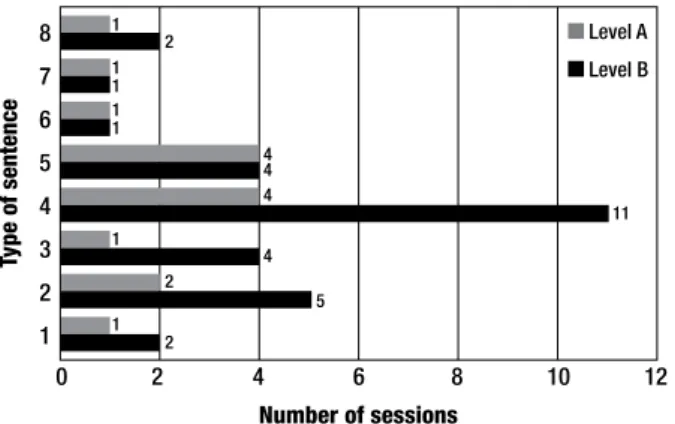
1. Imperative; 2. Imperative Transitive; 3. Wh-Interrogative – What and Who;4. Wh-Interrogative – Where and When; 5. Declarative Transitive; 6. Declarative Intransitive “He fixes cars”); 7. Comparative; 8. Yes – No questions.
Figure 2. Number of sessions needed to attain 85% correct answers.
tic Aphasia Examination-Short Form (BDAE-SF) which includes sub-tests of oral comprehension of words, sen-tences and texts, oral confrontation naming, repetition, production of descriptive (he Cookie heft scene) and
written language.3hese data were registered on videos.
An additional description of the Cookie heft scene was
used as an independent measure to analyze generaliza-tion and transfer of learning. Severity of aphasia was rated by the Boston Aphasia Severity Rating Scale, a measure used as a summary of sub-tests. Previously, she was submitted to a conventional multimodal stimula-tion therapy10 to elicit language production through
rep-etition, phonemic cueing, reading in a variety of linguis-tic and situational contexts, and consequently improved repetition of short phrases and global communication (initiative to introduction, maintenance and diversity of topics, increasing of partners of conversation).
On the SPPA, eight types of sentence were trained. Each type contained 15 stimuli (total of 120 igures of
scenes+ target sentences). Each type of sentence was presented at two levels of diiculty, as prescribed by the
method: 1) Level A - the target sentence was presented simultaneously with an action scene, depicting its use in context, for repetition after the speech therapist had presented the story. 2) Level B – the story had to be complemented with the target sentence, without the beneit of repetition. (See examples online – Figure 3).
he sentences of each type were presented in blocks.
When GAA answered correctly at level A (facilitation by repetition), the stimulus level B (confrontation of scene for spontaneous emission of the target sentence) was immediately presented. he SPPA was planned for 32
sessions distributed in weekly sessions of 30 minutes (about four sessions per sentence).
Performance was scored according to the following criteria: 1 point for correct answers (including success-ful self-correction, after initial error); 0.5 for partially
correct answers (only one word was omitted or mistak-enly produced, compromising both the syntax and the meaning of the sentence); 0 for incorrect responses in which two or more words were omitted or incorrectly produced, or if the target sentence contained only one word and it was not produced correctly. Situations when GAA failed at level A and where consequently level B was not applied, were considered “not applicable” (NA). he
criterion for the continuation of the blocks was a score of at least 13 out of 15 items (85% correct).
RESULTS
On the BDAE-SF reduced version, applied pre-SPPA, the patient showed functional oral language comprehen-sion, non-luent, reduced oral expression, restricted to
single words with pauses, prolongations and occasion-ally phonemic paraphasias. Oral language comprehen-sion pre-SPPA was: 15/16 (93%) for comprehencomprehen-sion of words; 9/10 (90%) in comprehension of commands; 3/6 (50%) in auditory comprehension of complex material.
On the Aphasia Severity Rating Scale, communica-tion ability was “hrough fragmentary expression; great
need for inference, questioning, and guessing by the lis-tener. he range of information that can be exchanged
is limited, and the listener carries the burden of commu-nication, which corresponds to level 1 (minimum score = 0, maximum = 5).
he proile of the patient was consistent with the
di-agnosis of Broca’s aphasia with agrammatism. Results of BDAE-SF pre-therapy, post-therapy and follow-up af-ter one year are available in Table 1 on-line.
GAA underwent 30 weekly sessions of SPPA. Her performance is depicted in Figure 2. She did not prac-tice the SPPA at home, and was encouraged to engage in conversations based on daily events.
GAA improved performance after training with the SPPA. She was able to repeat, and spontaneously build, all types of sentences although some kinds of sentences proved more diicult. he horizontal sequence shows
the number of sessions designed for blocks of each type of sentence. Qualitative performance of the patient and number of sessions are available on-line – Figure 4.
After the SPPA, GAA was able not only to expand the type of sentences produced but also the use of verbs and function words for a semi-spontaneous situation – de-scription of the Cookie heft scene (Figure 5 on-line).
DISCUSSION
his study described the rehabilitation of a patient with
imme-diate results were positive and the patient was able to build all types of sentences after 32 sessions of therapy.
hese gains were transferred to semi-spontaneous
pro-duction elicited by the Cookie heft scene.3he positive
results obtained immediately after training, however, need to be examined with caution.
GAA was in the chronic phase of CVA at the begin-ning of traibegin-ning with the SPPA. he aphasia was severe,
with production limited to telegraphic sentences, ab-sence of verbs and functional morphemes. Previous therapeutic trials had not reduced the agrammatism. In training with the SPPA, despite having diiculties with
verbs, GAA required about 3.75 sessions to achieve spon-taneous production in most types of sentences, which is compatible with the expectations of the author.7 It is
possible that the simultaneous visual confrontation of the action verbs in the scenes facilitated the performance of GAA. Positive results in therapy to produce verbs from observation of videos have been reported.11 Although
this strategy has not been applied to GAA, it is possible that the observation of static actions in context triggered representations of actions, leading to beneicial results,
similar to the efect of the videos. However, in more
com-plex situations such as transformations of syntax (canon-ical to interrogative), GAA had greater diiculty
produc-ing the sentence spontaneously, without the support of repetition. his was the case of interrogative sentences
built with morphemes of time (when) and place (where). GAA omitted the morphemes and adopted the telegraph-ic style. In addition to processing the “interrogation”, she had to employ adverbial forms which refer to verbs, a
dif-icult category to produce for the patient. GAA needed 11
sessions to produce this type of sentence spontaneously. In the description of the Cookie heft scene, which
was not trained, GAA improved the use of function words, particularly articles, and decreased agrammatic deletions. hese positive gains immediately after
stimu-lation by SPPA however, were not maintained at follow-up after a year.
here are controversies over positive results using
the method of structuring sentences, SPPA, in the treat-ment of agrammatism. Helm-Estabrooks and Nicholas7
reported positive results, Doyle12 et al and Fink13
veri-ied partially positive results with restriction of gains
to the type of sentences trained while Faroqi-Shah and
hompson proposed that partial results are due in part
to the severity of the aphasia.5he results of GAA did
not support this position. After the SPPA, gains were observed in language production in untrained situa-tions, such as the description of the Cookie heft scene.
Furthermore, GAA increased the use of grammatical
morphemes from training structuring of sentences, which constitutes an inter-modality transfer.
We must consider that GAA had severe aphasia, which may have contributed to the absence of positive results in the follow-up. Another important factor to be discussed is the time elapsed between the stroke and application of SPPA, beyond the desirable range recom-mended by the literature. Moreover, we must consider that the efects of intensive and concentrated practice,
valued in the literature on aphasia rehabilitation, were not taken into account in this therapeutic program.14-16
he structural (MRI) and functional (SPECT)
neuro-images of GAA revealed sequela in the left hemisphere, including basal ganglia, in parallel with integrity of the right hemisphere. he large lesion of GAA compromises
the areas previewed in a cortical model for agramma-tism.9 Recent studies, based on a lesion model, have
dem-onstrated the role of striatal damage in grammar learn-ing and use. Observations of Huntlearn-ington’s disease in its early stage have provided data about morphological and syntactic diiculties.17,18he extent of GAA’s lesion
pre-cludes the justiication of gains by recruitment of areas
of the left hemisphere; one possible explanation is re-cruitment of the right hemisphere. he use of sentences
in context, as proposed by SPPA, induces activation of se-mantic aspects of syntactic production in the preserved hemisphere. he recruitment of homologous areas of
the right hemisphere to compensate for syntactic dei
-cits was shown in tests using the functional technique after CVA-induced aggramatism19 and in cases of CVA.20
Considering the study design and the efects of
reha-bilitation, it is possible to classify the evidence from this case study for clinical practice under class III, and recom-mend it as optional, with possible efectiveness in
prac-tice in rehabilitation of agrammatism.21 Recent literature
on eicacy of aphasia recognizes the positive efect of an
intensive and concentrated training schedule, but these studies are limited to lexical deicits.14-16 An interesting
perspective would be to verify the efects of massive and
concentrated practice on structuring sentences, as well as parsing of underlying forms of sentences and training of verbs and other morpho-functional categories.
In conclusion, it was possible to describe and veri-fy partially positive results in this case study with the SPPA. In severe cases such as that of GAA, it is inter-esting to take into account the possibility of using com-bined methods, structured based on the principles of evidenced-based practice.
REFERENCES
1. Alexander MP. Aphasia: clinical and anatomic aspects. In: Feinberg TE, Farah MJ. Behavioral Neurology and Neuropsychology. New York; McGraw-Hill; 1997:133-149.
2. Ardila A. Major aphasic syndromes: Wernicke’s aphasia and Broca’s aphasia. In: Ardila A. Aphasia Handbook. E-book. Pdf; 2014: 60-75. 3. Goodlass H, Kaplan E, Barresi B. The assessment of aphasia and
relat-ed disorders. 3 relat-ed. Philadelphia. Lippincott Williams and Wilkins; 2001. 4. Caplan D, Waters G, Howard D. Slave systems in verbal short-term mem-ory. Aphasiology 2012;26(3-4): doi:10.1080/02687038.2011.642795. 5. Faroqi-Shah Y, Thompson CK. Approaches to treatment of agramma-tism. In: Bastiaanse R, Thompson CK, editors. Perspectives on agram-matism. Hove. Psychology Press; 2012:158-191.
6. Wisenburn B, Donahue C, Sobrinski M. A meta-analysis of therapy efficacy for agrammatism due to aphasia. Presentation at American Speech-Lan-guage Hearing. Philadelphia, PA: Association Annual Convention; 2010. 7. Helm-Estabrooks N, Nicholas M. Sentence Production Program for
Aphasia. 2ª ed. Pro-Ed.; 2000.
8. Goodglass H, Gleason JB, Bernholtz ND, Hyde MK. Some linguistic structures in the speech of a Broca’s aphasic. Cortex 1972;8:191-212. 9. Thompson CK, Bastiaanse R. Introduction to agrammatism. In: Bas-tiaanse R, Thompson CK, editors. Perspectives on agrammatism. Hove. Psychology Press; 2012:1-16.
10. Coelho CA, Sinotte MP, Duffy JR. Schuell’s stimulatin approach to re-habilitation. In: Chapey R (editor). Language Intervention Strategies in Aphasia and Related Neurogenic Communication Disorders. Philadel-phia: Wolters Kluwer/ Lippincott Williams & Wilkins; 2008:403-449. 11. Bonifazi S, Tomaiuolo F, Altoè G, Ceravolo MG, Provinciali L, Marangolo
P. Action observation as a useful approach for enhancing recovery of verb production: new evidence from aphasia. Eur J Phys Rehabil Med 2013;49:473-481.
12. Doyle PG, Goldstein H, Bourgeois MS. Experimental analysis of syntax training in Broca’s aphasia: a generalization and social validation study. J Speech Hear Dis 1987; 52:143-155.
13. Fink R, Schwartz M, Rochon E, Myers J, Socolog G, Bluestone R. Syn-tax stimulation revisited: an analysis of generalization of treatment ef-fects. Am J Speech Lang Pathol 1995;4:99-104.
14. Cherney LR, Patterson JP, Raymer A, Frymark T, Schooling T. Evi-dence-based systematic review: effects of intensity of treatment and constraint-induced language therapy for individuals with stroke-induced aphasia. J Speech Lang Hear Res, 2008; 51:1282-1299.
15. Allen L, Mehta S, McClure JA, Teasell R. Therapeutic interventions for aphasia iniciated more than six months post stroke: a review of the evidence. Top Stroke Rehabil 2012;19:523-535.
16. Kelly H, Brady MC, Enderby P. Speech and language therapy for apha-sia following stroke. Cochrane Database Syst Rev (5):CD000425, 2010. 17. Teichmann M, Dupoux E, Kouider S, et al. The role of the striatum in
rule application: the model of Huntington’s disease at early stage. Brain 2005;128:1155-1167.
18. Teichmann M, Dupoux E, Cesaro P, Bachoud-Lévi AC. The role of the striatum in sentence processing: evidence from a priming study in early stages of Huntington’s disease. Neuropsychologia 2008;46:174–185. 19. Thompson CK, den Ouden DB, Bonakdarpour B, Garibaldi K, Parrish
TB. Neural plasticity and treatment-induced recovery of sentence pro-cessing in agrammatism. Neuropspychologia 2010;48:3211-3227. 20. Thompson CK, Riley EA, den Ouden DB, Meltzer-Asscher A, Lukic S.
Training verb argument structure production in agrammatic aphasia: Behavioral and neural recovery patterns. Cortex 2013;49:2358-2376. 21. Cicerone KD, Langenbahn DM, Braden C, et al. Evidence-Based
Figure 3. Examples of sentence-stimulus presentation at the levels A and B.
SENTENCE TYPE: IMPERATIVE INTRANSITIVE.
Level A probe:
Therapist: Nick´s school bus arrives in 15 minutes and Nick is still asleep. So, his mother tells him, “Wake up!”. What does his mother say? Patient: Wake up!
Level B probe:
Therapist: Nick´s school bus arrives in 15 minutes and he is still asleep. So what does his mother tell him to do? Patient: Wake up!
Figure 4. Number of sessions used and the qualitative performance of the patient for each type of sentence.
Type of sentence Notes
1. Imperative Intransitive tThe sentences are short containing one-three words (eg, “Caution”, “Wipe your feet”).
2. Imperative Transitive 3. Wh-Interrogative –
What and Who
tGreater number of sessions was carried out to sentences of type 4. GAA had difficulties with use of adverbs
(references from place and time to the verb). (Eg: “Where are my shoes?”, “When will he graduate?”). She returned to the pattern of restricted telegraphic sentences, and omitted the interrogative pronouns.
tGAA employed in colloquial interrogative form (eg, “Where are my shoes?”, “What time are you going?”.
4. Wh-Interrogative –
Where and When
5. Declarative Transitive tThere was more focus on the use of personal pronouns according to the figurative board (eg. “I buy popcorn”
“He fixes cars”). 6. Declarative Intransitive
7. Comparative tGAA emphasized the use of the comparative adjective of superiority and verbs “have” and “be” in the present
tense only agreeing with the pronouns in the third person singular (eg. “She is taller”, “He has more money”).
8. Yes-No questions tWas noted it was easy the use of the pronoun treatment (“você”=“you”) present in most phrases (eg, “Do you
like meat?”).
Figure 5. Description of Cookie Theft scene: (1) before training with the PPSA, (2) immediately after and (3) 12 months after training*.
1. Pré PPSA
[a]1 mamãe é ... derramô tornera é .../ [o]1 meninu caiu [da]2 cadeira .../ [o menino está pegando]3 biscoito 2. After PPSA
a moça [está]4 lavando o prato aí derramô [na]2 cozinha água /também dois garoto não a menina o home o banco caiu ... o menino tá quase caindo ...
a menina “dá pra mim” (gesto de pedido) bolacha5 parece biscoito 3. Follow up – after 12 mounths
a moça lavando o prato também [a torneira da]3 pia [está]4 aberta /a menina está [pegando]4 biscoito também o menino pegando biscoito caiu7
*Items presuppositions were inserted in [...].
Legend: 1. Deletion of the definite article; 2. Deletion of the preposition; 3. Telegraphic sentence; 4. Deletion of the verb; 5. Substitution of verb by gestural information; 6.Telegraphic construction; 7. Error of ordering the items.
Table 1. Oral producion sub-tests of BDAE-SF: pre (SPPA), after the training and after 12 mounths.
Sub-tests BDAE-SF Pre-trainning After trainning Follow up (after 12 mounths)
Automatic sequences 4/4 (100%) 4/4 (100%) 4/4 (100%)
Word repetition 3/5 (60%) 4/5 (80%) 4/5 (80%)
Sentence repetition 1/2 (50%)* 1/2 (50%)** 1/2 (50%)***
Responsive naming 6/10 (60%) 10/10 (100%) 10/10 (100%)
Naming in categories 7/15 (47%) 8/15 (53%) 8/15 (53%)
Repetition: “Ele pega o jornal na mesa do café”: * Ele café; ** Ele pega café; *** Ele pega o jornal na mesa do café.
Table 2. Description of Cookie Theft pre, after application of the SPPA and after 12 months.
Word classes Pre-PPSA After PPSA After 12 mounths p*
Verbs 3 6 3
Pre-PPSA X after PPSA P=0.05 The other comparisons showed no
significant differences.
Nouns 5 12 7
Articles 0 7 4
Prepositions 0 1 0
Conjunctions 0 1 0
![Figure 1. [A] Magnetic Resonance Imaging (MRI). Sequela affecting the cortex in left fronto-temporo-parietal region, centrum semiovale and also the sub- sub-cortical caudate nucleus](https://thumb-eu.123doks.com/thumbv2/123dok_br/15188518.527069/2.892.66.784.722.1018/magnetic-resonance-imaging-sequela-affecting-parietal-semiovale-cortical.webp)