Translation and Validation into Portuguese Language of the
Medication Regimen Complexity Index
Ana Carolina Melchiors
1, Cassyano Januário Correr
1, Fernando Fernández-Llimos
2Universidade Federal do Paraná1 e Faculdade de Farmácia - Universidade de Lisboa2, Curitiba, PR – Brasil, Lisboa – Portugal
Summary
Background: The complexity of pharmacotherapy is a result of a multiplicity of prescribed regimen factors, including the number of different drugs in the regimen, the number of dosage units per dose, the total number of prescribed doses per day and administration instructions. The Medication Regimen Complexity Index (MRCI) is a specific, reliable and valid tool used to measure the complexity of pharmacotherapy, originally developed in English language.
Objective:Transcultural translation and validation of this tool into Brazilian Portuguese.
Methods:A cross-sectional study was developed with 95 type-2 diabetes patients, receiving multiple medications. The validation process included translation into Portuguese, back-translation and pre-test of the tool, creating a new version called the Pharmacotherapy Complexity Index (PCI). The psychometric parameters were assessed, including convergent validity, discriminant validity and reliability (interclass and test-retest correlation).
Results: The complexity of pharmacotherapy measured by the MRCI-Brazil had an average score of 15.7 points (SD=8.36). MRCI-Brazil showed significant correlation with the number of medications (r=0.86; p<0.001) and age of patients (r=0.28, p=0.005). Interrater reliability analysis found an intra-class correlation (ICC) of 0.99 (p<0.001) and test-retest correlation was of 0.997 (p<0.001).
Conclusion:The results have shown that the Brazilian version of the MRCI presents adequate validity and reliability, and may be useful in clinical practice and research involving the analysis of the drug regimen complexity. (Arq Bras Cardiol 2007;88(6):624-628)
Key words:Drug therapy/utilization/economics; patient compliance; guidelines.
Mailing address: Cassyano Januário Correr •
Pinheiro Guimarães, 420/444 - 80330-250 - Curitiba, PR - Brazil E-mail: [email protected]
Manuscript received October 16, 2006; revised manuscript received Febru-ary 12, 2007; accepted FebruFebru-ary 12, 2007.
Introduction
The pharmacotherapy represents the main therapeutic resource to cure and control diseases. Among the determinant factors of the extension of medication use by the population is the constant development of new drugs, the use of drugs allied to clinical directive recommendations and the population’s demand for drug consumption. Additionally, the changes in the epidemiological profile and predominance of chronic diseases have increased the need for multiple treatments, a phenomenon known as polypharmacy. The result for the patients is the existence of higher-complexity therapies1.
Several studies have identified the complexity of pharmacotherapy as one of the main factors for non-compliance to treatment2-6. In hypertensive and diabetic
patients, for instance, the number of medications7 or the
dosage frequency8 have been associated to lower treatment
compliance and worse blood pressure or metabolic control. Treatment compliance can be defined as the “The extent to
which a person’s behaviour – taking medication, following a diet, and/or executing lifestyle changes, corresponds with agreed recommendations from a health care provider”9.
Several definitions of the complexity of pharmacotherapy can be found in the literature. Some are simple, involving only the number of medications and/or daily doses1,5 and
others are more comprehensive, such as the one performed by Stone et al6. In general, it is accepted that the complexity
of pharmacotherapy consists of multiple characteristics of the prescribed regimen, including at least the number of different drugs in the regimen, the number of daily doses, the number of dosage units per dose, the total number of daily doses and associations between dose and diet6,10.
Studies carried out in recent years have evaluated the complexity of pharmacotherapy in a wide array of diseases, such as epilepsy5, schizophrenia11, hypertension12,
type-2 diabetes13, HIV/AIDS3,6 and specific population groups
such as the elderly14-16, polymedicated patients1 and
renal transplanted patients17. Some of these studies have
dietary restrictions imposed by the administration of the medications in HIV-positive patients6.
This variety of definitions and interpretations can impair the uniformity of the measurement of this parameter. Important aspects, such as special use instructions (for instance, take it with food) or required medication management actions (take half a pill or crush the pill before taking it) can be ignored in the calculation of the complexity of pharmacotherapy5, making the
comparison and generalization of scientific studies difficult. Considering the importance of the relation of the complexity of pharmacotherapy with treatment compliance and the difficulty in standardizing the measurement of this parameter, George et al18 developed an index, called Medication Regimen
Complexity Index (MRCI). The MRCI is a tool used to measure the complexity of pharmacotherapy of an individual patient, which is divided in three sections: A, B and C. Section A corresponds to the information on dosage forms, section B corresponds to the information on dose frequency and Section C corresponds to additional information, such as drug specific time and concomitant use with food, among others. Each section is scored based on the analysis of the patient’s pharmacotherapy and the complexity index is obtained by adding the points (scores) of the three sections18.
The MRCI is the only currently validated tool found in literature used to measure the complexity of pharmacotherapy, which was originally written in the English language. The validation of this tool for our country can help the studies involving therapy compliance and strategies for its improvement, allowing a better standardization of methodology and result comparison. The aim of this study is the adaptation and validation of the Medication Regimen Complexity Index tool into Brazilian Portuguese.
Methods
A transversal study was carried out between October and December 2005. Pharmacotherapeutic files of 105 patients with type 2 diabetes who were using oral antihyperglycemic agents or insulin were analyzed and were participating in a clinical study on pharmaceutical concern in community pharmacies in the city of Curitiba, Paraná. The use of medication was analyzed for each patient in its totality, including prescribed anti-diabetic medication and drugs used for other conditions, such as hypertension and dyslipidemia. The medications used for acute conditions or used when necessary were also taken into account. For each patient, the first constant pharmacotherapeutic regimen was considered from the date the patient was included in the study. This study was developed by the Department of Pharmacy of the Federal University of Paraná, being approved by the Research Ethics Committee of Hospital das Clinicas, protocol # CEP-HC n. 092ext046/2003-08. All patients gave their written informed consent prior to study enrollment.
Transcultural translation - The process of translation and validation followed international recommendations19,20
and considered studies that had used the tool for Brazilian patients21. The tool was submitted to two translators
who were fluent in the English language, who knew the underlying objectives and concepts of the study and whose
mother language was Portuguese. The two translations were compared, generating a consensual version, which was called “Version 1”.
At the second phase, the Version 1 of the tool was submitted to back-translation into the English language. It was carried out by a translator who was fluent in the English language and did not know the underlying objectives and concepts of the study. This new English version was compared to the original tool and the correction of the casual discrepancies originated a new version, called “Version 2”.
At the third phase, an evaluation committee that consisted of three healthcare professionals who were bilingual revised all parts of the tool Version 2, checking semantic, idiomatic, cultural and conceptual equivalence. After this phase, the third version of the tool, called Version 3, was generated. The latter was then submitted to a pre-test, using a fictitious patient presented to three clinical pharmacists who had not taken part in the prior phases of the study. They described their main doubts and difficulties in using the tool and their assessments were based on the validity of the content and face validity. The final version was attained after the committee’s assessment and index adjustments, based on the proposed modifications.
Validation -The tool was used together with the patients’ files by two separate researchers. After applying the tool, psychometric analyses were carried out aiming at assessing its validity and reliability. Test selection was based on the normal distribution of data confirmed by the Komolgorov-Smirnov test. The construct validity was analyzed by theconvergent validity, checking the correlation between the total score of the index and the number of medications of the treatment, using Pearson’s correlation coefficient.
The discriminant validitywas analyzed from the correlation between the total score of the complexity and independent variables. The body mass index (BMI) was used with Pearson’s correlation coefficient and differences in scores between genders were used with Student’s t test.
To estimate reliability, the inter-rater reliability was assessed by comparing the results from two different and independent users and the test-retest reliability was assessedby having the same user repeat the filling out of the index twice during a thirty-day interval, for all patients.
The reliability analyses used the intraclass correlation coefficient (ICC)(95%CI). The database was organized by double-typing the measured results and statistical tests were carried out through the SPSS v.12.0 software. Significance was set at p<0.05.
Results
Of the 105 patients that participated in the study, 10 were excluded from the validation study. The reasons for the exclusion were the failure in using antihyperglycemic agents (3 cases) or absent data from the medical files, which prevented the adequate use of the measurement tool (7 cases). A total of 95 patients were included in the study (90.4%).
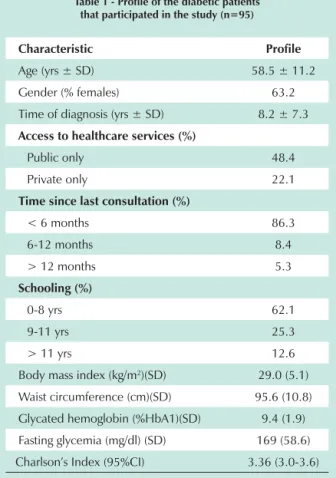
healthcare services, time since the last medical appointment, schooling, body mass index (BMI), waist circumference, glycated hemoglobin (HbA1) levels, fasting glycemia levels and blood pressure. The patients were also evaluated regarding Charlson’s comorbidity Index, which evaluates patients’ comorbidity load, allowing an estimate of the ten-year mortality risk22. The index presents a linearity between 0-5
points, with 0 corresponding to 99% of chance of survival and 5 to 34% of chance of survival in a ten-year period. The data are summarized in Table 1.
Table 1 - Profile of the diabetic patients that participated in the study (n=95)
Characteristic Profile
Age (yrs ± SD) 58.5 ± 11.2
Gender (% females) 63.2
Time of diagnosis (yrs ± SD) 8.2 ± 7.3
Access to healthcare services (%)
Public only 48.4
Private only 22.1
Time since last consultation (%)
< 6 months 86.3
6-12 months 8.4
> 12 months 5.3
Schooling (%)
0-8 yrs 62.1
9-11 yrs 25.3
> 11 yrs 12.6
Body mass index (kg/m2)(SD) 29.0 (5.1)
Waist circumference (cm)(SD) 95.6 (10.8)
Glycated hemoglobin (%HbA1)(SD) 9.4 (1.9)
Fasting glycemia (mg/dl) (SD) 169 (58.6)
Charlson’s Index (95%CI) 3.36 (3.0-3.6)
SD - standard deviation; CI - confidence interval.
The mean number of medications per patient was 4.5 (SD=2.5). Most of the patients used only oral antihyperglycemic agents (84.3%); 49.4% used antihypertensive drugs, 18% used hypolipemiant drugs and 34.8% used platelet antiaggregant agents. These conditions were taken into account as they are clinically significant for diabetic patients and the ones that are most often observed23,24. The most frequently used medications
for these conditions are summarized in Table 2.
The transcultural adaptation process resulted in the Portuguese version of the tool, called Índice de Complexidade da Farmacoterapia – ICFT. The translated tool includes instructions for its use and maintains the same presentation of the original version.
The complexity of pharmacotherapy measured in the population by the ICFT obtained a score of 15.7 points (SD=8.36). The maximum score obtained was 45.5 at a
treatment that included 12 medications and the minimum score was 4, in a treatment that consisted of only one pill a day. There was a significant correlation between the number of medications and the ICFT obtained (r=0.86; p<0.001), showing a convergence between these parameters.
Additionally, there was a difference regarding the ICFT scores among patients using the same number of medications, demonstrating the significance of other factors in the calculation of the index. The mean of the ICFT and its dispersion considering a 95%CI shows an overlap of results and dispersion increase with the increase of the total of medications. These results are show in details in Table 3.
Table 2 - Medications that are most frequently used by diabetic patients (n=95)
Medication % patients
Glibenclamide 56.2
Metformin 55.1
Acetyl salicylic acid (ASA) 33.7
Captopril 22.5
Simvastatin 13.5
Hydrochlorothiazide 11.2
Nifedipine 9.0
Propranolol 7.9
Table 3 - Number of medications being used and Medication Regimen Complexity Index (MRCI) in diabetic patients (n=95)
Number of medications
Number of
patients MRCI 95%CI
1 12 5.3 4.2-6.5
2 7 9.1 5.5-12.7
3 18 11.5 9.8-13.1
4 13 14.6 12.7-16.5
5 11 15.5 13.1-18.0
6 14 19.8 16.8-22.9
7 9 20.9 18.2-23.6
8 3 28.3 7.3-49.2
9 4 24.8 13.7-35.9
10 3 33.0 13.2-52.7
12 1 45.5
-Total 95 15.7 14.0-17.4
CI - confidence interval.
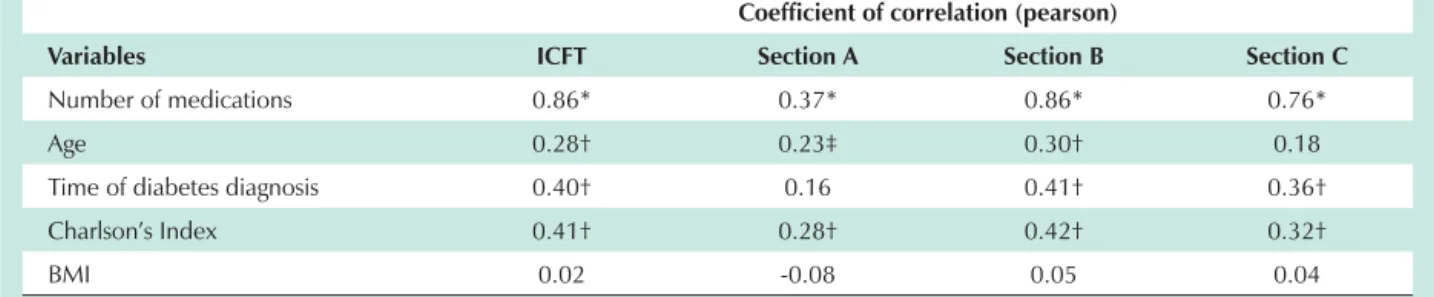
The ICFT also showed a significant correlation with age (r=0.28, p=0.005), specifically in Section A (dosage forms) and Section B (dosage frequency). The exception was Section C of the tool, which deals with the additional information on the medications and was not significantly correlated with age (r=0.18; p=0.08).
The divergent validity analysis between the ICFT score and BMI reached r=0.02 (p=0.790), showing a low correlation among the variables. No significant difference was found between ICFT scores for men and women (15.5±7.1 vs. 15.8±8.9; p=0.873). The patients who were followed exclusively at the Public Health Service presented treatment with similar complexity (ICFT=16.0, SD=9.4) when compared to those followed exclusively at private healthcare services (ICFT=15.2, SD=6.7; p=0.709).
No significant correlation results were observed between the ICFT and clinical parameters such as HbA1 (r=0.06; p=0.56) and fasting glycemia (r=-0.15; p=0.14). The correlation results between ICFT and the main independent variables are shown in Table 4.
Regarding reliability, a high correlation was observed between the results of the ICFT applied by two different raters to the same sample of patients. The interrater ICC was 0.99 (p<0.001) for the total ICFT and showed results > 0.98 among the three sections. The test-retest reliability reached a correlation (ICC) of 0.997 and 1.00, 0.99 and 0.99 for sections A, B and C, respectively. The means of the ICFT results at the test-retest were not significantly differently either (15.7±8.3 versus 15.6±8.1; p=0.32).
Discussion
The ICFT is a tool that measures the complexity of pharmacotherapy regardless of socioeconomic, pharmacological or clinical variables. This tool is based solely on the necessary actions for the drug administration, i.e., which is the pharmaceutical form, frequency and other additional information that must be taken into account by the patient for the correct administration of the medication. This tool can be useful in clinical research and practice, as it provides valuable information on the elements that constitute the complexity of pharmacotherapy, allowing an estimate of the degree of difficulty in therapy compliance exhibited by
Table 4 - Correlation between MRCI and its domains and independent variables of the study participants (n=95)
Coefficient of correlation (pearson)
Variables ICFT Section A Section B Section C
Number of medications 0.86* 0.37* 0.86* 0.76*
Age 0.28† 0.23‡ 0.30† 0.18
Time of diabetes diagnosis 0.40† 0.16 0.41† 0.36†
Charlson’s Index 0.41† 0.28† 0.42† 0.32†
BMI 0.02 -0.08 0.05 0.04
* p<0.001; †p<0.01; ‡p<0.05; MRCI - medication regimen complexity index; ICFT - índice de complexidade da farmacoterapia; Section A refers to dosage forms; Section B refers to the frequency of medication administration and Section C to the additional information regarding medication use; BMI - body mass index.
the patient. In order to use it, however, it is necessary to have an adequate version that has been validated into our language and a system of clinical data registry.
The process of validation of the original tool included phases of design and the comparison of its results with the analysis made by the specialists’ committee18. Starting from the original
study, ours analyzed the characteristics of reproducibility, validity and reliability of the tool in Brazilian Portuguese. In order to do so, we chose to use the methodology for translation and validation of tools that is internationally accepted and broadly utilized19,20.
As in the original tool (MRCI), the ICFT in Brazilian Portuguese has three sections, being divided as follows: section A: dosage forms; section B: dosage frequency and section C: additional information. As the tool is to be filled out by the healthcare professional and not by the patient, its system allows several medications and additional information to be included into the assessment, making it broader.
Some tools published in the literature do not allow a complete evaluation of the complexity1 or assess other
concepts rather than the complexity of pharmacotherapy17.
The content and face validity were analyzed by the evaluation and pre-test committees, respectively, as established in the methodology of translation by Guillemin et al19. In the pre-test phase, there were difficulties
concerning the understanding of some instructions of the ICFT, which were modified to facilitate the understanding of the healthcare professional at the moment of filling it out. One of the suggestions made by the pre-test pharmacists was to create an electronic tool using the ICFT, in order to shorten the time needed for filing it out and make its use helpful in clinical practice.
The main reported difficulties regarding the use of the instrument during the pre-test were related to the registry of the additional pharmacotherapy instructions. The main divergent points were those regarding the need of taking some medications with food, which were solved with the literature, use at specific times, considered even when the frequency is fixed (i.e., every 12 hrs) and the use of insulin, considered as multiple units at the same time.
only factor1,6. The results showed that the ICFT is capable
of differentiating the complexity of treatments with the same number of medications, corroborating the concept that simply counting the number of medications does not correspond to the complexity.
The divergent validity was demonstrated by comparing the results of the ICFT between genders and BMI. Considering that these factors do not have direct influence on the complexity of treatment itself, the low correlation found is within the expected and demonstrates the absence of influence of external factors on the index calculation.
At the calculation of the tool reliability, the test-retest was carried out, which demonstrated a high correlation of the total ICFT as well as of the its sections, applied before and after 1 month, and the intra-class reliability that also showed high correlation between the raters. The data obtained at this phase is similar to that of the original ICFT18.
This validated tool allows the development of new research on the association between therapy compliance and therapy complexity, including the possible definition of ICFT cutoffs from which the compliance presents significant decreases or increases. Such studies can be quite useful in generating strategies to stimulate compliance directed at the reduction of therapy complexity in polypharmacy and multidiagnosis conditions and numerous clinical practice scenarios (outpatient clinic, healthcare units, and community
pharmacies). Additionally, the association between therapy complexity and the occurrence of favorable or undesirable clinical outcomes can collaborate in the optimization of pharmacological treatments.
Although this study was carried out in type 2-diabetic patients, the ICFT can be used with any type of patients or pharmacological treatment.
Conclusions
The translated version into Brazilian Portuguese of the Medication Regimen Complexity Index (MRCI), which was called Pharmacotherapy Complexity Index (PCI) demonstrated an adequate psychometric quality and can be used to compare not only groups of patients, but also individual patients. Its usefulness in clinical practice and research is due to the analysis of the compliance determinants as well as the effects of health interventions on the complexity of pharmacotherapy.
Acknowledgements
The authors wish to thank the Professors and Clinical Pharmacists of the Pharmacy Service and the Pharmaceutical Care of Centro Universitário Positivo (UNICENP), for their willing collaboration in the validation of this tool: Paula Rossignoli, Renata B. Schulz and Rodrigo A. de Paula e Souza.
References
1. Muir AJ, Sanders LL, Wilkinson WE, Schmader K. Reducing medication regimen complexity: a controlled trial. J Gen Intern Med. 2001;16(2):77-82.
2. Ryan AA. Medication compliance and older people: a review of the literature. Int J Nurs Stud. 1999;36(2):153-62.
3. Trotta MP, Ammassari A, Melzi S, Zaccarelli M, Ladisa N, Sighinolfi L, et al. Treatment-related factors and highly active antiretroviral therapy adherence. J Acquir Immune Defic Syndr. 2002;31 (Suppl 3):S128-S131.
4. Levy G. Medication non-compliance: when hard science meets soft science. International Congress Series. 2001;1220:125-33.
5. DiIorio C, Yeager K, Shafer PO, Letz R, Henry T, Schomer DL, et al. The epilepsy medication and treatment complexity index: reliability and validity testing. J Neurosci Nurs. 2003;35(3):155-62.
6. Stone VE, Hogan JW, Schuman P, Rompalo AM, Howard AA, Korkontzelou C, et al. Antiretroviral regimen complexity, self-reported adherence, and HIV patients’ understanding of their regimens: survey of women in the HER study. J Acquir Immune Defic Syndr. 2001;28(2):124-31.
7. Strelec MA, Pierin AM, Mion D Jr. The influence of patient’s consciousness regarding high blood pressure and patient’s attitude in face of disease controlling medicine intake. Arq Bras Cardiol. 2003;81(4):349-54, 3-8. 8. Guillausseau PJ. Impact of compliance with oral antihyperglycemic agents
on health outcomes in type 2 diabetes mellitus: a focus on frequency of administration. Treat Endocrinol. 2005;4(3):167-75.
9. World Health-Organization. Adherence to long-term therapies: evidence for action. Geneva: WHO; 2003.
10. Svarstad BL, Bultman DC. The patient: behavioral determinants. In: Remington’s: The Science and Practice of Pharmacy. 20th ed. Philadelphia: Lippincott Williams & Wilkins 2000. p. 1948-56.
11. Donohoe G, Owens N, O’Donnell C, Burke T, Moore L, Tobin A, et al. Predictors of compliance with neuroleptic medication among inpatients with schizophrenia: a discriminant function analysis. Eur Psychiatry. 2001;16(5):293-8.
12. Andrejak M, Genes N, Vaur L, Poncelet P, Clerson P, Carre A. Electronic pill-boxes in the evaluation of antihypertensive treatment compliance: comparison of once daily versus twice daily regimen. Am J Hypertens. 2000;13(2):184-90.
13. Donnan PT, MacDonald TM, Morris AD. Adherence to prescribed oral hypoglycaemic medication in a population of patients with Type 2 diabetes: a retrospective cohort study. Diabet Med. 2002;19(4):279-84.
14. Griffiths R, Johnson M, Piper M, Langdon R. A nursing intervention for the quality use of medicines by elderly community clients. Int J Nurs Pract. 2004;10(4):166-76.
15. Johnson M, Griffiths R, Piper M, Langdon R. Risk factors for an untoward medication event among elders in community-based nursing caseloads in Australia. Public Health Nurs. 2005;22(1):36-44.
16. Schlenk EA, Dunbar-Jacob J, Engberg S. Medication non-adherence among older adults: a review of strategies and interventions for improvement. J Gerontol Nurs. 2004;30(7):33-43.
17. Tucker CM, Fennell RS, Pedersen T, Higley BP, Wallack CE, Peterson S. Associations with medication adherence among ethnically different pediatric patients with renal transplants. Pediatr Nephrol. 2002;17(4):251-6. 18. George J, Phun YT, Bailey MJ, Kong DC, Stewart K. Development and
validation of the medication regimen complexity index. Ann Pharmacother. 2004;38(9):1369-76.
Clin Epidemiol. 1993;46(12):1417-32.
20. Guillemin F. Cross-cultural adaptation and validation of health status measures. Scand J Rheumatol. 1995;24(2):61-3.
21. Correr CJ, Melchiors AC, Rossignoli P, Fernandez-Llimós F. Aplicabilidad del estado de situación en el cálculo de complejidad de la medicación en pacientes diabéticos. Seguimiento Farmacoterapéutico. 2005;3(2):103-11. 22. Charlson ME, Pompei P, Ales KL, MacKenzie CR. A new method of classifying
prognostic comorbidity in longitudinal studies: development and validation. J Chron Dis. 1987;40(5):373-83.
23. Sociedade Brasileira de Diabete. Consenso Brasileiro sobre Diabete: diagnóstico e classificação do diabete melito e tratamento do diabete melito tipo 2. Rio de Janeiro: Diagraphic; 2003.