2013 Mar.-Apr.;21(2):604-9 www.eerp.usp.br/rlae
Corresponding Author: Edinêis de Brito Guirardello
Universidade Estadual de Campinas. Faculdade de Enfermagem Rua Tessália Vieira de Camargo, 126
Bairro Barão Geraldo
CEP: 13083-887, Campinas, SP, Brasil E-mail: [email protected]
Validation of the Brazilian version of the Attentional Function Index
Carla Klava dos Reis Dutra
1Edinêis de Brito Guirardello
2Objectives: To assess the reliability and validity of the Brazilian version of the Attentional
Function Index. Method: Methodological study. The sample was made up of 138 students from
an undergraduate nursing course. The psychometric properties were assessed through the
convergent construct validity, using the Brazilian version of the Attentional Function Index and
the Portuguese-language version of the Profile of Mood States instrument, while the reliability
was measured by its internal consistency, expressed by the Cronbach Alpha Coefficient. Results:
The Cronbach Alpha Coefficient was 0.86 for the total score, and varied from 0.64 to 0.86 in
the three subscales. A strong significant negative correlation (r=-0.64; p<0.0001) was obtained
for the convergent validity. Conclusion: The Brazilian version of the Attentional Function Index
resulted in satisfactory levels of validity and reliability, demonstrating its viability for use in
practice and in undertaking further research.
Descriptors: Attention; Translation; Validation Studies.
1 RN, MSc.
Dutra CKR, Guirardello EB.
Introduction
Human behavior may be understood under three
functional systems: cognition, which refers to the aspects
of behavior related to the handling of information;
emotion, which refers to feelings and motivations; and
the executive functions, understood as the forms of
expression of behavior(1).
Cognition may be understood as a general term for
the processing of thought, perception and judgment(1),
and may be classiied as receptive functions (abilities for selecting, acquiring, classifying and integrating
information), memory and learning (stored and accessed
information), thought (organization and mental
reorganization of information) and expressive functions
(means through which the information is expressed or
becomes an action)(1).
There are also the variations of mental activities,
understood as characteristics of behavior involved in the mental processes’ eficiency. These may be classiied in three categories: level of consciousness (level at
which the organism is receptive or not to the stimuli);
activities of attention (abilities or processes which make
the organism receptive to the stimuli, whether these
are internal or external); activities of reason (speed
with which the mental activities are performed and
the speed of the motor responses)(1). Thus, attention
permeates the cognitive functions and contributes in the
development of the mental processes.
The ability to concentrate, that is, the capacity to
direct attention (CDA) is essential for the performance
of any human being’s activities of daily living. The
simple fact of “paying attention” involves complex
neurocognitive processes(2) and requires the person to
use mental effort.
Attention is described as the concentration of the
mind on an object or thought, in spite of various other
stimuli occurring simultaneously(3). The CDA, on the
other hand, depends on a series of neural inhibitory
mechanisms which act by blocking stimuli and competing
distractions which may happen during an arranged
activity.(4).
One of the ways an individual can deal with the
problem of the complexity of information and stimuli
is to focus his or her attention on just a few aspects,
judged to be the most relevant, in a determined period
of time, and ignore the rest. As it is not possible to be
attentive to everything at the same time, certain objects
or activities are selected for perception, while others are
ignored(1).
To understand how an individual can be distracted
in different directions, and why particular situations can
be unpleasant or stressful, it is necessary to understand
two of the mechanisms of attention, which are distinct
in terms of the effort involved in their use. One of them,
termed involuntary attention, is based in interests and
does not require the use of mental effort; while the
other - termed voluntary or directed attention - is used
when it is necessary to pay attention to something which
is not necessarily interesting, and depends on mental
effort(4-5).
The key point involved is the concept of inhibition, as what maintains the focus on a speciic thought is not the reinforcement in this speciied mental activity, but rather the inhibition of everything that there is around.
Thus, inhibiting the competing distractions helps the
individual to sustain or maintain the original focus of
attention(4-5).
Directed attention is fundamental in daily life, as it is important to complete a low of thought, to learn new information, to plan activities, to carry out self-care, to
think clearly, and to maintain intentional activity despite
environmental distractions(2-6). In Brazil, situations
demanding attention have been the focus of studies with
nurses(7) and patients(8-9), with instruments therefore
being needed for evaluating these individuals’ CDA.
There are subjective and objective measures
for examining CDA in healthy people and those with
health problems, such as chronic illnesses. As objective
measures, there are the Digit Span Forward (DSF) and
the Digit Span Backward (DSB), both used for assessing
the CDA of an individual.(10) As a subjective measure,
there is the Attentional Function Index (AFI)(2), which
has been used in studies involving people with chronic
health problems(2,10-11) and in healthy individuals(12-13).
The AFIis an instrument of subjective assessment
and aims to measure how the person assesses his or her functioning in speciied situations which require concentration. The irst version of this was developed with 16 items, on a scale of the visual analogic type going
from zero to 100mm, with two extremes(11), and was
used in diverse populations(2,13-15). One study in Brazil(16)
evaluated nurses’ perception of attentional functioning,
using the version of the AFI with 16 items, and showed a
negative association between the situations of attentional
demand and the ability to direct attention – that is, the
greater the situation of attentional demand, the lower
the nurses perceived their attentional functioning.
The most recent version of the AFI is made up of
Rev. Latino-Am. Enfermagem 2013 Mar.-Apr.;21(2):604-9.
which evaluated the functioning perceived by the person
during their activities of daily living which demand
mental effort; Attentional lapses (3 items), which evaluated the dificulties perceived during tasks which require concentration, and Interpersonal effectiveness
(3 items), which measures how the person perceives his or her interaction in speciied circumstances and events which depend for attention on inhibitory
efforts(11). The AFI has satisfactory reliability, with an
internal consistency coeficient varying between 0.84 and 0.94 in studies with healthy people and people with
health problems(2,10-12,14,17). Regarding the AFI’s validity,
the construct validity was assessed using exploratory
factorial analysis, which resulted in a scale with 13 items,
and the divergent and convergent construct validity was
assessed, showing correlations with the measurements
of assessment of concentration and confusion state by
the POMS(11).
The students are considered healthy individuals
who can experience different sources of attentional
demands such that their cognitive performance is inluenced, including when this is detrimental to the carrying-out of academic activities. In this context, the
use of instruments capable of assessing attentional
functioning – such as the AFI – can contribute to the
teaching of nursing, through the evaluation of the
performance of daily activities, which is directly related
to the undergraduates’ level of attention.
After Professor Cimprich had given her approval, the
AFI, in its new version, with 13 items(11) was translated
and adapted to the Brazilian culture following the
stages recommended in the international literature(18):
translation from English to Portuguese, back-translation
of the instrument into English, evaluation by a group
of judges, and the carrying-out of a pre-test. In this study, the choice of the AFI was justiied due to its being a subjective measurement of assessment of attention
involving both people with chronic health problems and
healthy individuals, and due to its presenting satisfactory
psychometric properties of validity and reliability.
Considering the importance of evaluating the
instrument’s psychometric properties after the process
of cultural adaptation, this study’s objective was to
evaluate the reliability and validity of the Brazilian
version of the AFI.
Method
This is a methodological study, characterized by
testing of data collection instruments. The participants
were students from the undergraduate nursing course of
a university in the state of São Paulo.
The study obtained a favorable decision from
the institution’s Research Ethics Committee (Process
n° 235/2005). After the subjects had been invited to
participate and their consent had been obtained, they
were requested to sign the Terms of Free and Informed
Consent.
Data collection was undertaken by the researcher over two consecutive weeks. In the irst week, collection took place with the 3rd and 4th year students, and in the
second, with the students from the 1st and 2nd years. The
subjects were approached in the classroom and while
in possession of the self-administered instruments, and
were advised to hand them in to the researcher after illing them out.
The Brazilian version of the AFI (B-AFI), the Portuguese-language version of the Proile of Mood States (POMS)(19) and a ile for socio-demographic
characterization were used for data collection.
The Brazilian version of the AFI is made up of 13
items and its subjects are requested to draw a mark
along a response line, on a visual analog scale, which best
describes their perception in regard to the performance
of the activities related to each one of the items. A
general score is based on the sum of each score and the
average of all the items. High scores represent high levels
of perception of attentional functioning and low scores
represent low perception of attentional functioning(2,15).
The POMS is a self-administered instrument for
evaluating mood. It is composed of 65 words, distributed
in six domains: tension (9 items); depression (15 items);
anger (12 items); vigor (8 items); fatigue (7 items);
confusion (7 items); and friendliness (7 items), which describe feelings on a Likert-type scale with ive points: 0=nothing, 1=a little, 2=more or less, 3=signiicantly, 4=extremely(19).
The scores are obtained by summing each domain’s
averages; the higher the score, the greater the presence
of alterations in the mood state. It is emphasized that
the POMS, as well as its domains, has been correlated
with the AFI in studies with students(13) and women with
breast cancer(11,15).
It is stressed that for the correlation of the
instruments regarding meaning and magnitude, the
following hypothesis was considered: that there is
a strong negative correlation between the Brazilian
version of the AFI and the Portuguese-language version
of the POMS, as the greater the perceived attentional
Dutra CKR, Guirardello EB.
For the analysis, students who reported a previous
or ongoing history of mental problems were excluded,
as were those who mentioned using medications which can interfere in cognition. This information was
presented by the participants in the socio-demographic characterization ile.
The data was organized using the program
Excel-Windows/XP, and was analyzed by the statistical services using the Statistical Analysis System (SAS - System
for Windows) program, version 9.1.3 - 2002/2003.
Descriptive statistics (measurements of position, standard-deviation and percentages) were used to
analyze the sample and the instruments. The average of
the scoring from the subjects’ responses was obtained from the total of the items and for each subscale of the
B-AFI. In the case of the POMS, the sum of the subjects’ responses for each subscale was obtained.
The reliability of the total of the items and of
the subscales of the B-AFI was analyzed in terms of its internal consistency using the Cronbach Alpha Coeficient, with a minimum acceptable limit of 0.70(20).
The B-AFI’s subscales’ validity was evaluated using validity of the convergent type of construct, using
the Portuguese-language version of the POMS. The convergent construct validity was expressed by the Pearson co-eficient, which veriies a linear association between two variables(20). This co-eficient can present
values varying between -1.00 (a perfect negative
correlation), 0.0 (absence of correlation), and +1.0
(perfect positive correlation).
To assess the magnitude of the correlation co-eficient, values from 0.1 to 0.3 are considered a weak linear correlation, 0.3 to 0.5, a moderate linear
correlation, and over 0.5, a strong linear correlation(21).
For the statistical tests, the level of signiicance of 5% was considered (α=0.05).
Results
The sample was made up of 138 nursing students from a public university in the state of São Paulo, with
an average age of 21.6 (sd= 2.5) years. The majority was female (94.9%), single (92.7%) and mentioned having some type of leisure activity (68.8%).
Table 1 – Distribution of frequencies and percentages of
the nursing students’ socio-demographic characteristics.
Campinas, São Paulo, Brazil, 2011
Characteristics
Sample distribution
n %
Sex
Female 131 94.9
Male 7 5.1
Year of course
1st 35 25.4
2nd 32 23.2
3rd 38 27.5
4th 33 23.9
Marital status
Single 128 92.7
Married 8 5.8
Living with Partner 2 1.4
Where lives and with whom
Parents, in Campinas 44 31.9
Parents in other city 16 11.6
Student house in Campinas 41 29.7
Uni. accommodation 13 9.4
Alone in Campinas 10 7.2
Other 14 10.1
Leisure activity
No 43 31.2
Yes 95 68.8
Work
No 126 91.3
Yes 12 8.7
Engaged in research
No 111 80.4
Yes 27 19.6
Extra-curricular placements
No 119 86.2
Yes 19 13.8
Scholarship*
No 106 76.8
Yes 32 23.2
*Allowance for work and/or food and/or transport.
In relation to housing, 31.9% of the students live with their parents in the city of Campinas, 29.7% live in housing shared by students and 9.4% live in university accommodation. The majority of the students does not
work, does not participate in research projects and does
Rev. Latino-Am. Enfermagem 2013 Mar.-Apr.;21(2):604-9.
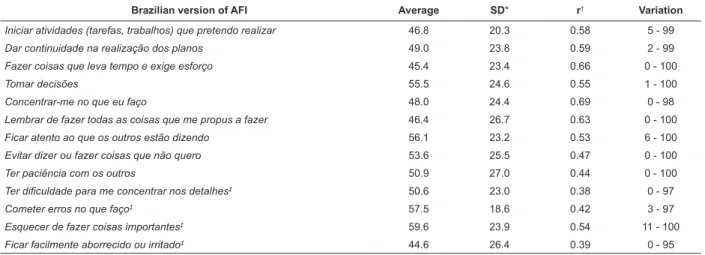
The reliability of the Brazilian version of the AFI was assessed by calculating the Cronbach Alpha Coeficient, which demonstrated satisfactory internal consistency for
all the instrument’s items, with a score of 0.86, found
also for the subscales (Table 3).
Table 2– Descriptive analysis of the Brazilian version of the Attention Function Index. Campinas, São Paulo, Brazil,
2011
Brazilian version of AFI Average SD* r† Variation
Iniciar atividades (tarefas, trabalhos) que pretendo realizar 46.8 20.3 0.58 5 - 99
Dar continuidade na realização dos planos 49.0 23.8 0.59 2 - 99
Fazer coisas que leva tempo e exige esforço 45.4 23.4 0.66 0 - 100
Tomar decisões 55.5 24.6 0.55 1 - 100
Concentrar-me no que eu faço 48.0 24.4 0.69 0 - 98
Lembrar de fazer todas as coisas que me propus a fazer 46.4 26.7 0.63 0 - 100
Ficar atento ao que os outros estão dizendo 56.1 23.2 0.53 6 - 100
Evitar dizer ou fazer coisas que não quero 53.6 25.5 0.47 0 - 100
Ter paciência com os outros 50.9 27.0 0.44 0 - 100
Ter diiculdade para me concentrar nos detalhes‡ 50.6 23.0 0.38 0 - 97
Cometer erros no que faço‡ 57.5 18.6 0.42 3 - 97
Esquecer de fazer coisas importantes‡ 59.6 23.9 0.54 11 - 100
Ficar facilmente aborrecido ou irritado‡ 44.6 26.4 0.39 0 - 95
*Standard deviation
†Pearson correlation coeficient
‡Items with inverted values
Table 3 – Average, standard deviation and internal consistency of the subscales of the Brazilian version of the AFI.
Campinas, São Paulo, Brazil, 2011
Subscale Average Standard deviation Cronbach Alpha
Effective action 50.2 17.4 0.86
Attentional lapses 55.9 16.9 0.65
Interpersonal effectiveness 49.7 20.1 0.64
Total of items 51.1 14.7 0.86
For evaluating the validity of the convergent construct the total of the items of the Brazilian version of the AFI was correlated with the sum of the items from the Portuguese-language version of the POMS.
This indicated a strong negative correlation (r=-0.64; p-value<0.0001).
Discussion
The subjects are a group of young students, the
majority of whom are female, single, resident in the city of Campinas, and who carry out some form of leisure activity. The majority of the students does not work, does not participate in research projects and does not
undertake extra-curricular placements.
The reliability analysis indicates that the Brazilian version of the AFI resulted in high internal consistency (α=0.86), which corroborates other studies which
analyzed the internal consistency of the Attentional
Function Index with both healthy individuals and people
with health problems, with Cronbach Alpha values
between 0.84 and 0.96(2,10-12,14,17).
A strong negative correlation was obtained (r=-0.64;
p<0.0001) between the Brazilian version of the AFI
and the Portuguese-language version of the POMS,
evidencing validity and reliability for use in the Brazilian
culture.
It is noteworthy that the initial hypothesis regarding the meaning and magnitude was conirmed – that is, the greater the perception of attentional functioning, the
lower the POMS score, meaning that the alteration of
mood presented by the student was lower.
It stands out that the negative correlation between
these two instruments is owed to the fact that high values
on the POMS score represent a high level of alteration
of mood state, while high values of the AFI represent a
Dutra CKR, Guirardello EB.
what the individual judges to be good attentional
functioning. Thus, a negative correlation is expected
between these two instruments. It is noteworthy that
the POMS, along with its domains, has been correlated
with the AFI in research with students(12) and women
with breast cancer(10-11,14,22).
To evaluate its reliability and validity in other
populations, however, further studies are necessary, as
this study was conducted only among nursing students.
Conclusion
The present study showed that the Brazilian
version of the AFI is a valid instrument for measuring
how a person evaluates their functioning in the face of speciied situations requiring concentration. Although it has demonstrated good acceptability and psychometric
properties, further studies will be necessary to evaluate
its reliability and validity in other groups of individuals. Researchers and clinicians can beneit from the use of this instrument with a view to evaluating cognitive suffering, especially the eficiency perceived in the functions used in routine activities, both among healthy
people and among those with health problems.
Thus, it may be concluded that the Brazilian version
of the AFI may be used safely to measure the theoretical
concept it is proposed to measure, for populations
similar to that studied.
References
1. Lezak MD, Howieson DB, Loring DW. Neuropsychological
assessment. 4th ed. Oxford University Press: New York;
2004.
2. Cimprich B. Attentional fatigue following breast
cancer surgery. Res Nurs Health. 1992; 15:199-207.
doi:10.1002/nur.4770150306.
3. James W. The principles of psychology. Vol 1. New
York: Cosimo; 2007. [original work published in 1890].
4. Kaplan S, Kaplan R. Cognition and environment:
functioning in an uncertain world. Michigan: Ulrich´s; 1983.
5. Kaplan S. The restorative benefits of nature:
toward an integrative framework. J Environ
Psychol. 1995;15(3):169-82. doi:10.1016/0272-4944(95)90001-2.
6. Cimprich B. Age and extent of surgery affect
attention in women treated for breast cancer. Res Nurs
Health. 1998;21:229-38.
doi:10.1002/(SICI)1098-240X(199806)21:3<229.
7. Santos LSC, Guirardello EB. Nurses’ attention demands
in the work setting. Rev. Latino-Am. Enfermagem.
2007;15(1):27-33.
8. Pontes L, Guirardello EB, Campos CJG. Demandas de
atenção de um paciente na unidade de transplante de
medula óssea. Rev Esc Enferm USP. 2007;41(1):154-60.
9. Reis CK, Guirardello EB, Campos CJG. O indivíduo
renal crônico e as demandas de atenção. Rev Bras
Enferm. 2008;61(3):336-41.
10. Lehto R, Cimprich B. Anxiety and directed attention
in women awaiting breast cancer surgery. Oncol Nurs
Forum. 1999;26(4):767-72.
11. Cimprich B, Visovatti M, Ronis DL. The attentional
function index – a self report cognitive measure.
Psycho-Oncol. 2011;20(2):194-202.doi:10.1002/pon.1729.
12. Tennessen CM, Cimprich B. Views to nature:
effects on attention. J Environ Psychol. 1995;15:77-85.
doi:10.1016/0272-4944(95)90016-0.
13. Sanders CM, Yankou D, Andrusyszyn MA. Attention
and restoration in post-RN students. J Contin Educ Nurs.
2005;36(5):218-25.
14. Cimprich B, So H, Ronis DL, Trask C. Pre-treatment
factors related to cognitive functioning in women newly
diagnosed with breast cancer. Psycho-Oncology. 2005;
14(1):70-8. doi: 10.1002/pon.821.
15. Lethbridge K, Yankou D, Andrusyszyn MA. The effects
of a restorative intervention on undergraduate nursing
student’s capacity to direct attention. J Holist Nurs.
2005;23(3):329-47. doi:10.1177/0898010105279610.
16. Roscani, ANCP, Guirardello EB. Attention demands in
the workplace and the capacity to direct attention of nurses.
Rev. Latino-Am. Enfermagem. 2010;18(4):778-85.
17. Stark MA. Relationship of psychosocial tasks of
pregnancy and attentional functioning in the third
trimester. Res Nurs Health. 2001; 24:194-202.
doi:10.1002/nur.1022.
18. Beaton DE, Bombardier C, Guillemin F, Ferraz MB.
Recommendations for the cross-cultural adaptation of
the DASH & QuickDASH outcome measures. Am Acad
Orthop Surg. 2007;3-13.
19. Peluso, MAM. Alterações de humor associadas à
atividade física intensa. [tese de doutorado]. São Paulo
(SP): Universidade de São Paulo; 2003.
20. Hair JF, Black WC, Babin B, Anderson RE, Tatham RL.
Multivariate data analysis. 6th ed. Prentice-Hall: New
Jersey; 2009.
21. Burns N, Grove SK. The practice of nursing research:
conduct, critique & utilization. 4th ed. Philadelphia, PA:
Saunders; 2001.
22. Cimprich B. Pretreatment symptom distress in
women newly diagnosed with breast cancer. Cancer