Occurrence Of severe and mOderate
traumatic brain injury in patients attended
in a brazilian teaching hOspital
Epidemiology and dosage of alcoholemy
José Weber Vieira de Faria
1, Sérgio de Andrade Nishioka
2, Guilherme Leonel Arbex
1,
Gustavo Gil Alarcão
4,
Wender Barbosa de Freitas
5Abstract – This study aimed at observing aspects of epidemiology in order to investigate the use of alcohol in patients older than 18 with severe and moderate traumatic brain injury, which were attended in the Clinics Hospital of the University of Uberlândia. Positive alcoholemy was found in 39.3% of the patients. Of the 33 positive exams alcoholemy was found higher than 60 mg/dL in 28 (84.6%). There was not significant relation between alcoholemy levels and trauma severity. The major prevalence occurred on Saturdays nights. The most frequent types of external causes were transportation accidents (64.74) followed by accidental falls (17.27%) and physical aggression (16.55%). 93.9% of the patients with positive alcoholemy were men aged 20-29. 24.2% of the ones with positive alcoholemy died yet no significant difference was found in the study of the ones with negative alcoholemy (n=51) (p=0.93); RR= 0.9; IC95%=0.40-2.08.
KEy wORdS: alcohol, traumatic brain injury.
Resumo – Os objetivos deste estudo são investigar aspectos da epidemiologia e identificar o uso de álcool em pacientes com traumatismo craniencefálico grave e moderado em maiores de 18 anos atendidos no Hospital de Clínicas da Universidade Federal de Uberlândia. Encontrou-se alcoolemia positiva em 39,3% dos pacientes. Nos 33 exames positivos, foram observadas alcoolemias superiores a 60 mg/dL em 28 (84,6%). Não houve relação significativa entre os níveis de alcoolemia e a gravidade do trauma. Maior prevalência ocorreu aos sábados, no período noturno. Os tipos de causa externa mais freqüentes foram os acidentes de transporte (64,74%), seguidos de quedas acidentais (17,27%) e de agressões (16,55%). dos pacientes com alcoolemia positiva, 93,9% eram do sexo masculino, com maior prevalência dos 20 aos 29 anos. dentre aqueles com alcoolemia positiva, 24,2% vieram a falecer, não havendo diferença significante com os pacientes com alcoolemia negativa (n=51) (p=0,93); RR= 0,9; IC95%=0,40–2,08.
PALAvRAS-CHAvE: álcool, traumatismo craniencefálico.
Clinics Hospital of the University of Uberlândia, MG, Brazil: 1Assistant Physician of the Chirurgical department, Chief of the Neurosurgical Service,
University of Uberlândia, Master (Uberlândia MG, Brazil); 2Assistant Professor of the Medical Clinics, University of Uberlândia, doctor (Uberlândia MG,
Brazil); 3Resident Physician of the General Surgery Subject of the Medicine Faculty, University of Uberlândia (Uberlândia MG, Brazil); 4Resident
Physi-cian of the Psychiatry Subject of the Medicine Faculty, State University of São Paulo (São Paulo SP, Brazil); 5Resident Physician of the Orthopedics and
Trauma Subject, Medical Faculty of the University of the Triângulo Mineiro (Uberaba MG, Brazil). Received 6 June 2007, received in inal form 28 September 2007. Accepted 27 November 2007.
Dr. Guilherme Leonel Arbex – Rua Francisco Vicente Ferreira 170 / 300-R - 38408-102 Uberlândia MG - Brasil. E-mail: [email protected]
Traumatic brain injury (TBI) is responsible for deaths, functional, psychological, and physiological permanent sequels1. It is an important problem of public health in de-veloped countries and those in development, and know-ing the characteristics of the patients who suffer TBI is es-sential for a proper planning when of the attendance2. The use of alcohol is frequently a preceding factor that causes
pro-gram after hospital liberation5-8,once three quarters of a group of patients with acute alcoholic intoxication show evidences of chronic use.
In many studies interviews have been done with the trauma patient in order to clinically identify if he/she has drunken alcohol beverages. Some of the tests are Cage, MAST (Michigan Alcoholism Screening Test) and AUdIT (Alcohol use disorders identiication test), without alco-holemy dosage. TwEAK and The History of trauma scale tests try to associate alcoholic blood levels with the clin-ical status of possible drunkenness9,10. The criteria for pos-itive acute intoxication vary according to literature. Al-though the majority agrees on a 100 mg/dL blood level as a positive level, some authors consider a 1 mg/dL al-coholemy as being positive3. Alcohol blood concentra-tion isn’t frequently measured in American countries, and most of them don’t have a pre-determination of the limi-trophy levels to consider the individual as being legally intoxicated11.
In Brazil, the level above 60 mg/dL doesn’t allow driv-ers to drive their vehicles as the possibility of a fatal acci-dent with vehicles is doubled for each increase of 2 mg/ dL in the driver’s alcoholemy12. The level of relation be-tween alcoholemy and the injury depends on the infor-mation font used, and signiicant differences are found when information comes from the police department, on duty physicians or sheriffs5. These differences can also oc-cur if the intoxication is based on behavior disturbanc-es, blood or respiratory drug dosage13,14. when of the an-alyze of patients with brain injury, many authors veriied the presence of alcohol in the blood stream in almost 50% of the patients5,15-18, being the majority men aged 25-32 years old10. Positive alcoholemy is more frequent in pa-tients that are victims of intentional injuries such as phys-ical aggression, and when related to seasonality it is more common on weekends, holidays and at night19,20. A bibli-ographical revision in Brazil found that there aren’t any studies that speciically consider alcoholemy in patients that are victims of TBI.
The objectives of this study are: a) to investigate as-pects of this epidemiology and; b) to identify the use of alcohol in patients attended in a Brazilian university hos-pital who had severe and moderate TBI.
methOd
In order to know the epidemiology a prospective study was carried out with 139 patients having severe and moderate TBI, age ≥18 years old, which were attended in the Emergency Room of the CH/UFU, in Uberlândia-MG (500,488 inhabitants), from January-december 2002.
we considered as having TBI the trauma patients that would match the deinition proposed by Jennett21 and that were
con-sidered as having severe and moderate TBI, respectively those
patients who had a score between 3-8 and 9-13 points in the Glasgow Coma Scale (GCS). Patients with mild TBI were also in-cluded (GCS 14 or 15) that is, the ones that in the irst 24 hours of internship had the consciousness level decreased for values
≤ 13 in the GCS.
data were collected in interviews with their families, help-ers or witnesses being used a protocol containing, among oth-ers, information related to the patient identiication, day, time and type of trauma, means of transportation for the hospital, activity developed during the event and socioeconomic class. data were later stored in a Microsoft Access® data bank with an interface developed in delphi 6.0.
For alcoholemy dosage a sub-group of 56 patients was formed. They were attended in sequence with GCS between 3-13 points (TBI severe and moderate) for a period of 4 consecu-tive months, which were conveniently chosen from August-No-vember 2002. A second sub-group with 28 patients with GCS of 14 and 15 (mild TBI) was formed for comparison, also in a se-quential way. Samples were collected during 2 non-consecutive weeks chosen by random (by simple rafle) in the period of col-lection of the irst sub-group.
A term of consent was explained and applied. The protocol was approved by the Committee of Ethics in Research of UFU.
Laboratory test
Using Axsym® System we used the Tdx®/TdxFLx® Ethanol test for total blood ethanol quantitative determination, consid-ering positive alcoholemy values higher than 10 mg/dL. Informa-tion was analyzed without the patient identiicaInforma-tion.
Statistical methods
For comparison between proportions qui-square method and Fisher’s scale were used as appropriate. Risk reasons were also calculated with reliability intervals of 95%. For statistic cal-culations software EpiInfo 6.04d was used (Centers for disease Control and Prevention, Atlanta, GA, EUA).
results
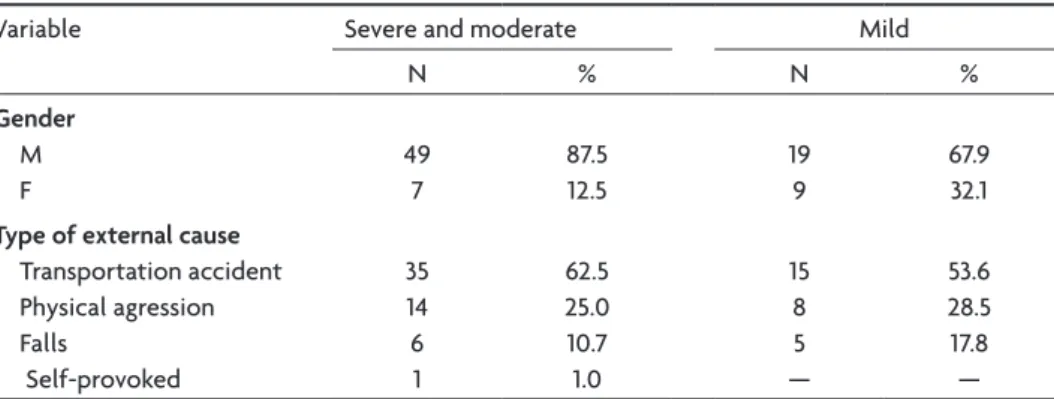
The age of the 84 patients evaluated on alcoholemy varied between 18-85 years old, average of 40.6 and 34.8 years old, respectively for severe, moderate and mild TBI. 89.2% of the mild TBI and 76.8% of the severe and moder-ate TBI were in an age range of 18-49 years old. (Table 1). There was no signiicant difference in the comparison between gender and average of age related to the trauma severity. The most frequent types of external causes were transportation accidents (64.74%), followed by accidental falls (17.27%) and physical aggressions (16.55%).
A signiicant relation between the frequency of alco-holemy levels and the trauma severity was not observed (Table 2).
The major prevalence of positive alcoholemy during the week occurred on Saturdays (66.7%), followed by Fri-days (53.8%) and ThursFri-days (40.0%) as illustrated in Figure
Table 1. Distribution according to gender and type of external cause. Patients with severe, moderate and mild TBI (n=84), selected for blood collection for alcohol dosage; age ≥18 years old; patients at-tended in the ER of CH of UFU.
variable Severe and moderate Mild
N % N %
Gender
M F
49 7
87.5 12.5
19 9
67.9 32.1
Type of external cause
Transportation accident Physical agression Falls
Self-provoked
35 14 6 1
62.5 25.0 10.7 1.0
15 8 5 —
53.6 28.5 17.8 —
Fig 1. Relationship of patients with positive alcoholemy with the number of patients attended in each day of the week (n=84) with TBI diagnosis in the ER of the CH of UFU.
Fig 2. Circadian distribution of patients arrival with TBI, and dosage of alcoholemy (n=84) in patients attended in the ER of CH of UFU.
Table 2. Relationship between the alcoholemy levels and trauma severity in patients with TBI attended in the ER of CH of UFU.
Alcoholemy level (mg/dL)
Severe and moderate (N=22)
Mild (N=11 )
N % N %
10–49 2 50 2 50
50–99 3 75 1 25
≥100 17 68 8 32
≥60 19 68 9 32
1. The majority of patients with positive alcoholemy ar-rived at night (Fig 2).
Regarding the activities in the moment of trauma, 55% of the patients were in their leisure time, while 15% were working.
There was no difference between employment and al-coholemy as 41.9% of the patients with alal-coholemy and 58.1% of the patients without alcoholemy were employed (p=0.34).
In trafic accidents it is observed that 8 (43.1%) motor-cyclists, 3 (60.0%) automobile passengers, 5 (29.4%) pe-destrians and 2 (33.3%) bicyclers had positive alcoholemy (qui-square test; p=0.63). It was observed that among the patients with positive alcoholemy (n=33), 24.2% died dur-ing internship with no signiicant difference when com-pared with the patients with negative alcoholemy (n=51) (p=0.93); RR=0.9; IC 95%=0.40–2.08.
discussiOn
A positive alcoholemy was obtained (>10 mg/dL) in 39.3% of the patients; this frequency was slightly inferior to the ones found in the international literature, which vary from 42 to 56%2,4,6,15,16,22. In Brazil there are no speciic studies on alcoholemy and TBI. There are studies on al-coholemy in victims of external causes, with prevalence of 28.9%–80.7%19, and the discrepancies can be attributed to differences between geographical and seasonal regions (southeast and northeast). data have been collected in Recife, during Carnival, with a probable high consump-tion of alcohol19.
It was observed that the majority of patients were in their leisure time and the major occurrence of TBI was af-ter work hours; this was a signiicant information as com-pared with work hours, and it is also according to litera-ture2, although the majority of authors don’t investigate this variable15-16. A signiicant relation with employment was not observed, what corroborates the literature16,23.
The major frequency of positive alcoholemy at night and on weekends, mainly on Saturdays (66.7%) is
accord-ing to the indaccord-ings of Nery Filho apud Gazal-Carvalho et al.19 and Maull et al.20.
Regarding gender a signiicant positive alcoholemy was observed in men (45.8%) when compared with wom-en (12.5%). Literature data vary from 49–68% of positive alcoholemy for the male sex2,4,11.
The most frequent age range was that of young adults what is in accordance with the majority of the au-thors4,6,11,15,17,19,24,25, although others have found a predomi-nance between ages 40–49 years old2. However, a higher percentage between 50–59 years old was proportionally observed, probably related with the small number of pa-tients evaluated in this age range in our study.
Alcoholemy varied according to an external cause, be-ing more frequent in physical aggressions (50%) followed by transportation accidents (38%) and falls (18%), what was similar to the indings of other authors2,4, although some ind more prevalence in transportation accidents11. In a study with fatal victims of falls a positive alcoholemy was observed in 48% of the cases26. Brazilian authors ob-served frequency of positive alcoholemy in trafic acci-dents higher than the ones found in this work for general traumas19, what can be explained by the methodology and object of study.
The proportion of positive alcoholemy was higher in severe traumas, although not signiicant, what is coinci-dent with the indings of Kraus3. However, there is con-troversy on what regards the association of positive alco-holemy and injury severity19, once the severity evaluated by GCS is inluenced by alcohol16,22, and can be transitory and apparent.
Some reports show that the frequency of fatal acci-dents increases according to alcoholemy risk26, and on the other hand there is a report of association between TBI and death in alcoholemy patients. It is important to say that an accident associated to alcohol is not necessarily caused by them. Our indings refer to patients that did not die before hospital assistance. Also, our objective was not to study the alcohol-mortality relationship.
The high frequency of positive alcoholemy and its as-sociation with intentional and violent trauma25 emphasize their importance as a severe public health problem in this city. These data should call attention of public authori-ties, health caretakers, and population for the necessity of programs and measures that aim the control of this problem.
In conclusion, we believe that this is the irst Brazilian study that investigates the use of alcohol in patients with TBI. data found on severe and moderate TBI corroborate the international literature. It was identiied that
occur-Table 3. Distribution according to age range of patients with TBI in relation to positive alcoholemy; patients attended in the ER of CH of UFU.
Age range Alcoholemy
yes No
N (33) % N (51) %
18–19 2 50.0 2 50.0
20–29 11 47.8 12 52.2 30–39 6 26.1 17 73.9 40–49 7 38.9 11 61.1
50–59 3 60.0 2 40.0
rences are more frequent in young adults. Those occur-rences are related to transportation accidents, on week-ends, and at night. Unfortunately the use of alcohol in Brazil is similar to the countries studied. These data are preliminary, however suficient to have measures taken, which can reduce the negative impact of alcohol intake, besides encourage and evidence the necessity of other studies that can analyze a bigger sample, and investigate other variables.
references
1. Klauber MR, Connor-Barrett E, Marshal LF, Bowers, SA. The epidemi-ology of head injury: a prospective study of an entire community – San Diego County, Califórnia, 1978. Am J Epidemiol 1981;113:500-509. 2. Colli BO, Sato T, Oliveira RS, et al. Características dos pacientes com
trau-matismo craniencefálico atendidos no Hospital das Clínicas da Facul-dade de Medicina de Ribeirão Preto. Arq Neuropsiquiatr 1997;55: 91-100. 3. Kraus JF, Morgenstern H, Fife D, Conroy C, Nourjha P. Blood alcohol testes, prevalence of involvement, and outcomes following brain inju-ry. Am J Public Health 1989;79:294-299.
4. Rivara FP, Jurkovich GJ, Gurney JG, et al. The magnitude of acute and chronic alcohol abuse in trauma patients. Arch Surg 1993;128:907-913. 5. Dikmen SS, Machamer JE, Donovan DM, Winn HR, Temkim NR. Alco-hol use before and after traumatic head injury. Ann Emerg Med 1995; 26:167-176.
6. Colquitt M, Fielding P. Drunk drivers and medical and social injury. N Engl J Med 1987;317:1262-1269.
7. Brismar BO, Engstrom A, Rydberg ULF. Head injury and intoxications: a diagnostic and therapeutic dilemma. Acta Chir Scand 1983;149:11-14. 8. Bombardier CH, Ehde D, Kilmer J. Readiness to change alcohol drinking habits after traumatic brain injury. Arch Phys Med Rehabil 1997;78:592-596. 9. Skineer H A, Holt S, Schuller R, Roy J, Israel Y. Identiication of alcohol abuse using laboratory tests and a history of trauma. Ann Intern Med 1984;101:847-851.
10. Cherpitel CJ. Screening for alcohol problems in the emergency depart-ment. Ann Emerg Med 1995;26:158-166.
11. Barss P, Smith GS, Baker SP, Mohan D. Injury prevention: an
interna-tional perspective epidemiology, surveillance, and policy. New York: Oxford University Press, 1998;5:158-159.
12. Kraus JF, McArthur DL. Epidemiologic aspects of brain injury. Neurol Clin 1996;14:435-450.
13. Öström M, Huelke DF, Waller PF. Some biases in the alcohol investiga-tive process in trafic fatalities. Accid Anal Prev 1992;24:539-545. 14. Wintemute GJ, Teret SP, Kraus JF, Wright M. Alcohol and drowning: an
analysis of contributing factors and a discussion of criteria for case se-lection. Accid Anal Prev 1990;22:291-296.
15. Gale JL, Dikmen S, Wyler A, Temkin N, Maclean A. Head injury in the paciic northwest. Neurosurgery 1983;12:487-491.
16. Rimel RW, Giordani B, Barth JT, Jane JA. Moderate head injury: complet-ing the clinical spectrum of brain trauma. Neurosurgery 1982;11:344-351. 17. Kirby JM, Maul KI, Fain N. Comparatibility of alcohol and drug-use in
injury drivers. Sauthern Med J 1992;85:800-802.
18. Turizo RA, Giraldo CA. Mortalidad por trauma encefalocraneano. Instituto de Medicina Legal, Dseccional Medellín. Medellín: Ed Co-lombia, 1985:291-300.
19. Gazal-Carvalho C, Cotrim-Carline B, Silva AO, Sauaia N. Prevalência de alcoolemia em vítimas de causas externas admitidas em centro ur-bano de atenção ao trauma. Rev Saúde Públ 2002;36:47-54.
20. Maull KI, Kinning LS, Hickman JK. Culpability and accountability of hospitalized injured alcohol-impaired drivers: a prospective study. JAMA 1984;252:1880-1883.
21. Jennet B, Murray A, Carlin J, Mckean M, MacMillan R, Strang I. Head injuries in three scottish hospitals units. Scottish head injuries study. Brit Med J 1979;2:955-958.
22. Jagger J, Fife D, Venberg K, Jane AJ. Effect of alcohol intoxication on the diagnosis and apparent severity of brain injury. Neurosurgery 1984;15: 303-306.
23. Turner AP, Bombardier CH, Rimele CT. A typology of alcohol use pat-terns among persons UIT recent traumatic brain injury or spinal cord injury: implications for treatment matching. Arch Phys Med Rehabil 2003;84:358-364.
24. Ballin JC. Alcohol and the driver: council on scientiic affairs. JAMA 1986;255:522-527.
25. Bogner JA, Corrigan JD, Myrsiw WJ, Clinchot DA. Comparison of sub-stance abuse and violence in the prediction of long term reabilitation out-cmes after tramatic brain injury. Arch Phys Med Rehabil 2001;82:571-577. 26. Hartshorne NJ, Harruff RC, Alvord Jr EC. Fatal head injuries in