DOI: 10.1590/0004-282X20150134
ARTICLE
BRBN-T validation: adaptation of the
Selective
Reminding Test
and
Word List
Generation
Validação da BRBN-T: adaptação do Selective Reminding Test e do Word List Generation
Mariana Rigueiro Neves1, Ana Margarida Passos1, Aristides Ferreira1, Cláudia Sousa2, Andreia Sá2, Maria José Sá2
Multiple sclerosis (MS) is a chronic, neurodegenerative disease whose various neurological manifestations have a multidimensional impact on patients’ lives and clinical sta-tus1,2. It mostly afects young adults, aged between 20 and 45
and it has a prevalence of about 450,000 patients in Europe and around 5000 patients in Portugal3. In addition to the physical symptoms associated with MS,40 to 70% of the pa
-tients sufer from cognitive deicits that neurological exams
cannot detect4,5,6. his cognitive impairment can occur in the
early stages of the disease and increase over time, having a negative impact on the MS patients’ quality of life2,4,5,7.
Given the frequency and the importance of the cogni-tive impairment of MS, appropriate neuropsychological
assessment is an extremely relevant complementary pro
-cedure to neurological exams4,8. hese results, supported by
normative quality data, provide important support for clini-cal and therapeutic decisions, assessment of intervention
eicacy and MS research1.herefore, it is important to have
instruments that are sensitive, reliable and easy to admin -ister in order to implement neuropsychological assessment as a part of the routine care of MS patients. In recent years,
brief test batteries to assess cognition in MS have been pro -posed and the most commonly reported in the literature is the Brief Repeatable Battery of Neuropsychological Tests
(BRBN-T) which has been validated in several cultures and
languages1,4,8 and has proved to be oneof the most sensitive
1Instituto Universitário de Lisboa (ISCTE-IUL), BRU-IUL, Lisboa, Portugal; 2Hospital S. João, Serviço de Neurologia, Porto, Portugal.
Correspondence: Mariana Rigueiro Neves;Instituto Universitário de Lisboa (ISCTE-IUL), BRU-IUL; Av. das Forças Armadas, Sala 2W8; 1649-026 Lisboa, Portugal; E-mail: [email protected]
Conlict of interest: There is no conlict of interest to declare.
Received 11 April 2014; Received in inal form 14 May 2015; Accepted 02 June 2015.
ABSTRACT
Objective: This study aims to present the Selective Reminding Test (SRT) and Word List Generation (WLG) adaptation to the Portuguese population, within the validation of the Brief Repeatable Battery of Neuropsychological Tests (BRBN-T) for multiple sclerosis (MS) patients.
Method: 66 healthy participants (54.5% female) recruited from the community volunteered to participate in this study. Results: A combination of procedures from Classical Test Theory (CTT) and Item Response Theory (ITR) were applied to item analysis and selection. For each SRT list, 12 words were selected and 3 letters were chosen for WLG to constitute the inal versions of these tests for the Portuguese population. Conclusion: The combination of CTT and ITR maximized the decision making process in the adaptation of the SRT and WLG to a different culture and language (Portuguese). The relevance of this study lies on the production of reliable standardized neuropsychological tests, so that they can be used to facilitate a more rigorous monitoring of the evolution of MS, as well as any therapeutic effects and cognitive rehabilitation.
Keywords: neuropsychological tests, multiple sclerosis, working memory, verbal luency, psychometrics.
RESUMO
Objectivo: Este estudo tem como objectivo a adaptação do Selective Reminding Test (SRT) e do Word List Generation (WLG) para a população portuguesa, no decurso da validação da Brief Repeatable Battery of Neuropsychological Tests (BRBN-T) para doentes com esclerose múltipla (EM). Método: 66 sujeitos saudáveis (54.5% sexo feminino), foram recrutados da comunidade e voluntariaram-se para, participar neste estudo. Resultados: Uma combinação de procedimentos da Teoria Clássica dos Testes (TCT) e da Teoria de Resposta ao Item (TRI) foi aplicada à análise e seleção dos itens. Para cada lista do SRT foram selecionadas 12 palavras e para o WLG foram escolhidas 3 letras, que constituem a versão inal destes testes para a população Portuguesa. Conclusões: A combinação da TCT e da TRI maximizou a tomada de decisão na seleção de itens na adaptação do SRT e do WLG para uma língua e cultura diferentes (o Português). A relevância deste estudo prende-se com a produção de testes de avaliação neuropsicológica idedignos, que podem ser utilizados na monitorização rigorosa da evolução da EM, efeitos da terapêutica e reabilitação cognitiva.
measures for detecting cognitive impairment in MS6,9,10. As the MS cognitive deicits most frequently involve working
and episodic memory, sustained attention, information
pro-cessing speed and mental lexibility6,9,11, Rao et al.4 found that
the most sensitive tests for detecting cognitive impairment in this disease were: Selective Reminding Test (SRT), 10/36 Spatial Recall Test (SPART), Symbol Digit Modalities Test
(SDMT), Paced Auditory Serial Addition Test (PASAT) and
Word List Generation (WLG)1,4,10. here is a consensus regard
-ing BRBN-T psychometric properties, particularly its
sensi-tivity and reliability in detecting cognitive impairment4,6,8. A study by Strober10 and Sepulcre9 found that BRBN-T has
discriminative validity, as it distinguishes MS from healthy controls, with MS patients performing worse than the con-trols. Many studies have also showed that BRBN-T test
re-sults are correlated with multiple brain MRI measures, such
as ventricle enlargement12, neocortical volume13 and reveal longitudinal changes in MS5.
The surplus values associated with the use of psycho-logical testsis that they provide a common measurement scale, and hence the potential for ascertaining the
differ-ences and similarities in unobservable aspects of inter -est in a population14,15,16. However, this potential cannot be fully realized, unless tests are used with comparable
validity in all the populations involved14. Cross-cultural
differences are considered an important issue in any re-search that deals with neuropsychological assessment15,16.
Despite the fact that cognitive disturbances associated with brain pathology have similar manifestations across the human species, cognitive abilities measured by neu -ropsychological tests represent, at least in their contents,
culturally learned abilities15. Human performance on neu-ropsychological tests is, therefore, influenced by a range of moderating variables, such as: culture, primary language
and level of education14,15. For these reasons, the
assess-ment of a different cultural group using the original neuro-psychological tests, procedures and norms, results in con-ceptual errors in assessment14,15,16,17.
hus, in order to routinely implement neuropsycho-logical assessment in MS, we need to devise accurate
neu-ropsychological tests, with determined and established norms, validated for the speciic population we intend to analyze16,18. his study is part of a project whose goal is to
improve the neuropsychological assessment of MS patients
in Portugal, through the adaptation and validation of the
BRBN-T. As SRT and WLG are tests with a strong verbal con -tent (they use a list of words and a set of letters, respec-tively), special attention is needed when adapting them
to other languages (e.g. Portuguese). In this case, a precise
translation requires the maintenance of words
frequen-cy between the original (English) and the target language (Portuguese)19. his exploratory study aims to adapt the
SRT and WLG to the Portuguese context, and for the efect
a combination of procedures from Classical Test heory
(CTT) and Item Response heory (IRT) approaches was used in order to maximize the decision making process for
words and letters selection.
METHOD
Subjects
Sixty-six healthy participants participated in the study and gave informed consent. he participants were recruit -ed among relatives and friends from the m-edical team of the hospital and from the research team, among relatives and friends of MS patients from the MS Outpatient Clinic (Hospital de S. João) and word of mouth. All participants
were aware of the experimental nature of this study. he so -ciodemographic characteristics of the healthy participants
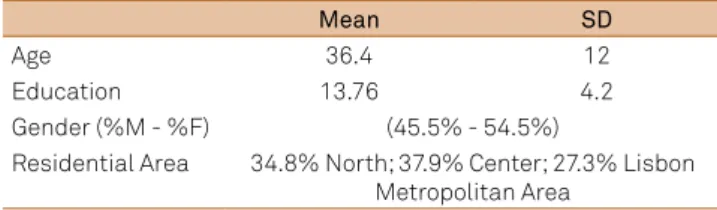
are presented in Table 1. he majority of the participants who performed in the battery of tests was women (54.5%) with an average age of 36,4 years old (ranging from 21 to 59) and not graduated (57.6%).
Inclusion criteria for the study were: i) age 20 or older, ii) Portuguese as their native language, iii) attended school in Portugal, iv) completed primary school. Exclusion criteria for the study were: i) neurological disorder, ii) serious head inju
-ry, iii) major psychiatric illness, iv) history of alcohol or drug abuse, v) learning disability, vi) other major medical illness
-es and vii) regular dosage of antidepr-essants or anxiolytics. Every person had the necessary vision, audition and motor skills to complete the testing.
Data collection was previous approved by the Portuguese Data Protection Authority and by the ethical committee of
Hospital de São João.
Neuropsychological tests procedures
he participants were examined by two well-trained neu
-ropsychologists. he tests used in this exploratory study were administrated in a standardized way and in a ixed order:
(i) SRT20, (ii) WLG4, (iii) Symbol Search21, (iv) Coding21 and
(v) Delayed recall of the SRT. he administration of all of the tests took approximately 25 minutes.
(i) Selective Reminding Test (SRT): measures verbal learn
-ing and memory through a learn-ing task in a paradigm of multiple trials. he list includes 12 words which the examiner reads at a rate of one word per two seconds. he participant
Table 1. Sociodemographic characteristics of the healthy participants undergoing Selective Reminding Test and Word List Generation Portuguese adaptation (N = 66).
Mean SD
Age 36.4 12
Education 13.76 4.2
Gender (%M - %F) (45.5% - 54.5%)
is instructed to recall all 12 words. In every consecutive tri-al only the words that are missed in the preceding one are
given to the participant. After 15 minutes, the participant is asked to recall the 12-word list. he SRT distinguishes be -tween short-term and long-term memory components and
also examines the consistency of retrieval from long-term memory. he test was scored according to the rules previ
-ously published4,20.
(ii) Word List Generation (WLG): evaluates the
spontane-ous production of words and mental lexibility, when given a letter from the alphabet and within a limited amount of time (one minute) (phonemic verbal luency task). he scoring
procedures consist of totaling the correct responses4.
(iii) Symbol Search and (iv) Coding: two subtests from the
Wechsler Adult Intelligence Scale-III that evaluate informa-tion processing speed21.
Translation and adaptation of SRT and WLG
Many authors maintain that it is more suitable to trans
-late words and expressions from the original test into those
with the same frequency of use in the target language (in this
case, Portuguese)19, as an efort to approximate the level of diiculty of the words in the two languages16,19,22.
During the translation process, the Basic Vocabulary of Portuguese23 was used by two independent linguists to trans -late the lists of words according to the norms for word
fre-quency in English and Portuguese16,22. Following this, the translations were analyzed by a group of neuropsycholo
-gists that constructed experimental versions for this study (18 words were tested for each list). he selection of letters fol
-lowed a similar procedure: within the original forms of WLG 5 letters which present equivalent levels of frequency and dii
-culty in the Portuguese lexicon were tested in this study.
Item analysis and selection
Item analysis and selection was based on a set of criteria established according to the CTT and IRT. he decision for the
inclusion of IRT parameters, which is very useful when
validat-ing and studyvalidat-ing neuropsychological test batteries24, is related
to the advantages associated with this approach (e.g. people
and item results are calibrated on a common scale)12,25. Item diiculty index (P) and item discrimination index (D) were
in-cluded to select the words for the inal lists in SRT. Prefers to the proportion of participants that responds correctly to the item (P = R / T; R = number of correct responses to the item; T= total number of responses). he results range from 0 (all
participants fail) and 1 (all participants succeed)17. Garret’s
ty-pology was used as a guideline regarding the P values to select
the twelve words for each list: 50% of the words between 0.25 and 0.75, 25% below 0.25 and 25% above 0.7517.
D refers to the degree in which an item diferenti
-ates in the same direction as the global test, ranging from -1.0 to + 1.0. he formula used to calculate this in
-dex is D = X1SD - X×√nn0(1 - n -1)n (X1 – mean of the test scores
of the participants that succeed on the item; X – over -all mean on the global test; SD – standard deviation of
the results; n – total number of participants; n1 – number
of participants that succeed on the item; n0 - number of
participants that failed on the item)16,17. he discrimina -tory power – asymmetry coeicient and kurtosis coei -cient - and normality – Kolmogorov-Smirnov Test - were
also analyzed considering the CTT approach.
As IRT measures item adjustment – init and outit mean
square – and the range of the person measures estimates
were used. In this case, the items are analyzed in order to know if they it the model (p < 0.01) or, on the contrary, if they present excessive init and outit measures12. he range of person measure estimates represents the amplitude of the
diiculty of the participants (between the best and the worst
performance on the LOGIT measures)18,26.
Data analysis
he statistical analyses were performed with IBM PASW 18 software - descriptive statistics, t-test, asymmetry co
-eicients, kurtosis coeicients and Kolmogorov-Smirnov
test - and with Winsetps software for IRT analyses (item
ad-justment - init and outit mean squares - and person mea -sure estimate range).
RESULTS
Selective Reminding Test results
hree diferent lists were tested. Since each list was test -ed on only 22 participants, it was decid-ed not to use IRT
pa-rameters. herefore, the criteria for SRT analyses were the
item diiculty index (P) and item discrimination index (D).
he SRT index chosen as the basis of these analyses was
Consistent Long Term Retrieval (CLTR) as prior research shows that CLTR is one of the most sensitive measures for recent memory4.
First, it was established that word selection would be based on the P values according to Garret’s typology17.
However, when there were words with the same P, the
cho-sen word would be the one that precho-sented the best D values
(i.e., high correlated with other items).
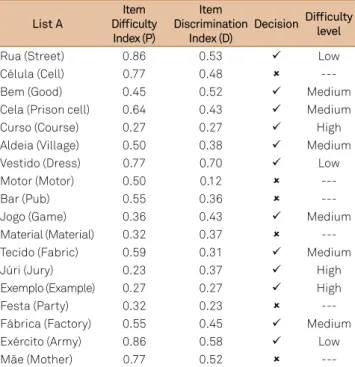
Table 1 shows the results on D and P for each word in
keeping with Garret’s typology17. hus, the words chosen (ü) and their level of diiculty (low, medium or high) are indi -cated according to Garret’s typology17. It is important to note
that, after the selection of the 12 words, they were
random-ized in order to constitute the inal version of SRT for the Portuguese language. his procedure was followed for the
other two remaining lists.
Word List Generation results
IRT criteria. he goal was to select three letters for the inal
version of the WLG test in Portuguese.
In the irst stage, and after a literature review, it was con
-cluded that if the efect of the variables “age” and “gender” on phonemic verbal luency performance is not very consensu
-al, the same is not true for “educational level”. Many studies have analyzed the inluence of this variable on the perfor
-mance of phonemic verbal luency and a robust efect regard
-ing the level of education has been demonstrated: the level
of education is a strong predictor of the performance on this
task, with increasing educational achievement being associ
-ated with higher luency scores27,28,29. hus, the inluence of
the level of education on the participants’ performance for
each letter was analyzed: D was the only one that did not dif
-ferentiate between participants with high levels of education and participants with low levels of education (see Table 2). herefore, D was excluded from the next analyses.
For each letter – P, A, F and S - item adjustment and the
range of person measures estimate (IRT), as well as
discrimi-natory power and normality (CTT) were analyzed. he goal was to select the three letters that presented best results for
each parameter and then choose the three, which had the
best performance for all of them. Table 3 shows the results for each letter for each of the parameters analyzed.
he results in Table 4 show that the letters do not match concerning both asymmetry and the kurtosis coef
-icient [-0.5, 0.5]. P, F and S presented the best asymmetry coeicients and P, A and S presented the best kurtosis co
-eicients. Regarding normality, P, A and F were the letters that presented a normal distribution with K-S values ≥ 0.05. Additionally, performance in phonemic verbal luency was
assessed to see if it itted the model (p < 0.01) or if there were items with excessive init and outit mean square residuals30.
According to Linacre12, the letters that best itted the model
(p < 0.01) are P, F and S. Regarding the range of person mea-sures estimate, it was found that all letters had a wide range
between the person with the highest and the person with the lowest performance score. However, the distribution was narrower for the letter F (-2.76 < Di < 0.97). hus, as a result of
these analyses, the letters selected for the Portuguese version of the WLG test were P, F and S.
DISCUSSION
Over the last years, neuropsychological assessment of MS-related cognitive impairment has received growing atten-tion in the routine care of these patients5,6,8,9. Unfortunately, in many clinical settings neuropsychological batteries are no
well-validated and this can compromise the usefulness of
the results to MS patients care. he relevance of our study lies on the illustration of the key aspects from psychomet
-ric theory that must be considered when adapting neuro
-psychological tests to a new population, so that they can be considered reliable tools to assess cognition, in this case for MS patients. In this study, a combination of procedures from Classical Test heory and Item Response heory was applied to item analysis and selection. he decision for this combina
-tion was taken in order to draw the best of both approaches, enrich the decision making process, and reine the results of
SRT and WLG adaptation, within the validation of BRBN-T to
the Portuguese population of MS patients. In our opinion, the combination of these two approaches represents a contribu
-tion to a systematiza-tion of procedures, which still appear in
a hardly consensual way in the literature, and that can
con-tribute for future work.
hree lists were drawn up for Selective Reminding Test
(Portuguese version), in order to guarantee that alterna
-tive versions are available for repeated testing in the routine
care of MS patients (one of the BRBN-T main advantages is
to have multiple versions available for situations in which
the plan is to repeat testing over time) 1,8. Like in other stud
-ies with SRT19, the translation rule concerning the mainte-nance of words frequency and diiculty levels between the
Table 2. The Item Dificulty Index and Item Discrimination Index for each letter of List A.
List A
Item Dificulty Index (P)
Item Discrimination
Index (D)
Decision Dificulty level
Rua (Street) 0.86 0.53 ü Low
Célula (Cell) 0.77 0.48 û
---Bem (Good) 0.45 0.52 ü Medium
Cela (Prison cell) 0.64 0.43 ü Medium
Curso (Course) 0.27 0.27 ü High
Aldeia (Village) 0.50 0.38 ü Medium
Vestido (Dress) 0.77 0.70 ü Low
Motor (Motor) 0.50 0.12 û
---Bar (Pub) 0.55 0.36 û
---Jogo (Game) 0.36 0.43 ü Medium
Material (Material) 0.32 0.37 û
---Tecido (Fabric) 0.59 0.31 ü Medium
Júri (Jury) 0.23 0.37 ü High
Exemplo (Example) 0.27 0.27 ü High
Festa (Party) 0.32 0.23 û
---Fábrica (Factory) 0.55 0.45 ü Medium
Exército (Army) 0.86 0.58 ü Low
Mãe (Mother) 0.77 0.52 û
---Table 3. The inluence of the level of education on the phonemic verbal luency test (Descriptive statistics and t-test).
- 12 years (n = 38) + 12 years (n = 28)
t p-value
Mean SD Mean SD
P 11.29 4.07 13.54 4.38 -2.146 0.036
A 9.24 3.90 11.43 3.06 -2.465 0.016
D 8.92 3.67 10.00 3.67 -1.180 0.242
F 9.82 3.35 11.82 3.39 -2.391 0.020
S 10.13 2.86 11.79 3.14 -2.227 0.029
original (English) and the target language (Portuguese) was
applied - a fundamental step when adapting
neuropsycho-logical tests where verbal content has a special relevance19,22. After this stage, the most suitable strategy for selecting the words to be included on a list that intend to assess verbal learning and memory, seemed to be the performance of an
item diiculty index and an item discrimination index
anal-yses. his procedure was also conducted in other studies21, 31 and it allows a comprehensively analyses of each item. In
this paper, only one of the three lists which were constructed
is presented (Table 1). Although, these item analyses and se -lection procedures were applied to the other two, and each
one of the lists combines twelve words with diferent levels of diiculty: easy, medium and diicult17, as an efort to draw up three lists of equivalent diiculty. hese adaptation pro
-cedures will allow future reliable cross-cultural studies with
other countries that also have normative data on BRBN-T. Regarding Word List Generation, discriminatory power
and normality analysis (CTT) and item adjustment (IRT) were analyzed. However, in the irst stage of these analy
-ses, and knowing that the variable level of education is highly correlated with the performance on verbal luency tasks27,28,29, we analyzed the inluence of this variable in our
results. Founding that D was the only letter that did not dif-ferentiate participants with high levels of education from
those with low levels of education (p < 0.005), we excluded it from the next set of analyses. P, A, F and S were then ana
-lyzed according to the criteria previously established (CTT plus IRT measures), and the letters P, F and S were those that showed the best performance for all of the analyzed param
-eters – better asymmetry and kurtosis coeicients, non-signiicant K-S test, adequate init and outit values, high
-er variability of p-erson measures range. In fact, consid-ering
that Rasch measures overcome some limitations found in
the CTT literature (e.g., sample size characteristics)18, the results suggested adequate init and outit values for the
tested letters, as well as ample intervals that show some
distance between participants’ performances. hereby, P, F and S were chosen to constitute the inal version of WLG in the Portuguese language. Although “A” presented good re
-sults in the Portuguese context, we choose P, F and S, which showed more suitable scores for this context according to the predeined criteria. In our opinion, these results provide
important information for future studies with Portuguese-speaking subjects in terms of which letters should be used to produce words in a phonemic verbal luency task. Likewise, the information which was obtained through the applica
-tion of this methodology goes far beyond what would be
achieved if only descriptive statistics were applied32.
Despite the contribution of the present study to the psy -chometric procedures applied to neuropsychological
as-sessment, there are some limitations that must be pointed
out: the fact that is a convenience sample constituted only
for healthy subjects who volunteered to participated in this test adaptation, although this neuropsychological battery is
targeted to MS patients33, and the number of participants,
particularly the number of participants per list of words (N = 22), restricted the use of IRTprocedures to word analy-ses and selection.
Although more studies need to be conducted to improve comparability of the Portuguese forms of SRT and WLG, as well to enhance their robustness to ensure clinical eicacy,
the results of this study are promising and might, at least,
sug-gest some guidelines for future work on the translation and
adaptation of neuropsychological tests. Additional research
would be important to demonstrate the clinical usefulness of these forms and it would be very interesting to administer these Portuguese SRT and WLG forms to other Portuguese-speaking populations, culturally and linguistically diferent,
in order to compare the results and thus, cross-validate them. A challenge for cross-cultural neuropsychology still is the
development of uniformed and standardized procedures for tests translation and adaptation within diferent countries, so that the inluence of cultural diferences on neuropsy -chological test scores can have a minor impact14,15,16,17. In the Portuguese context, it is absolutely necessary to produce and deliver validated and standardized neuropsychological tests to those working in clinical practice, so that they can imple -ment structured routines of neuropsychological assess-ment in the care of neurological patients.
Acknowledgements
he authors thank to Associação Líquido Céfalo-Raquidiano
and Biogen Idec.
Table 4. Results for the letters P, A, F and S from the phonemic verbal luency test (CCT and IRT parameters).
Classical Test Theory Item Response Theory
Discriminatory power Normality Item adjustment Person measure estimate range
Asymmetry coeficient Kurtosis coeficient K-S Test Init mean square Outit mean square Measure Range
P 0.44 0.13 0.17 0.96 0.99 (min: -2.48; max: 2.34)
A 0.93 -0.52 0.20 0.93 0.96 (min: -2.78; max: 1.22)
F -0.33 -0.61 0.20 0.95 0.98 (min: -2.76; max: 0.97)
S 0.45 -0.19 0.04 0.97 0.98 (min: -2.62; max: 1.20)
References
1. Solari A, Mancuso L, Motta A, Mendozzi L, Serrati C. Comparison of two brief neuropsychological batteries in people with multiple sclerosis. Mult Scler. 2002;8(2):169-76. doi:10.1191/1352458502ms780oa
2. Bilgi E, zdemir HH, Bingol A, Bulut S. Evaluation of the effects of group psychotherapy on cognitive function in patients with multiple sclerosis with cognitive dysfunction and depression. Arq Neuropsiquiatr, 2015;73(2):90-5. doi:10.1590/0004-282X20140144 3. Sá MJ. Neurologia clínica: compreender as doenças neurológicas.
Porto: Ed. Universidade Fernando Pessoa; 2009.
4. Rao SM, Leo GJ, Bernardin L, Unverzagt F. Cognitive dysfunction in multiple sclerosis. I. Frequency, patterns, and prediction. Neurology. 1991;41(5):685-91. doi:10.1212/WNL.41.5.685
5. Amato MP, Ponziani G, Siracusa G, Sorbi S. Cognitive dysfunction in early-onset of multiple sclerosis: a reappraisal after 10 years. Arch Neurol. 2001;58(10):1602-6. doi:10.1001/archneur.58.10.1602 6. Brooks JB, Borela MC, Fragoso YD. Assessment of
cognition using the Rao’s Brief Repeatable Battery of Neuropsychological Tests on a group of Brazilian patients with multiple sclerosis. Arq Neuropsiquiatr. 2011;69(6):887-91. doi:10.1590/S0004-282X2011000700007
7. Costa DC, Sá MJ,Calheiros JM. The effect of social support on the quality of life of patients with multiple sclerosis. Arq Neuropsiquiartr. 2012;70(2):108-13. doi:10.1590/S0004-282X2012000200007 8. Aupperle RL, Beatty WW, Shelton FN, Gontkovsky, ST. Three screening
batteries to detect cognitive impairment in multiple sclerosis. Mult Scler. 2002;8(5):382-9. doi:10.1191/1352458502ms832oa 9. Sepulcre J, Vanotti S, Hernández R, Sandoval G, Cáceres F, Garcea O
et al. Cognitive impairment in patients with multiple sclerosis using the Brief Repeatable Battery-Neuropsychological test. Mult Scler. 2006;12(2):187-95. doi:10.1191/1352458506ms1258o
10. Strober L, Englert J, Munschauer F, Weinstock-Guttman B, Rao S, Benedict, RH. Sensitivity of conventional memory tests in multiple sclerosis: comparing the Rao Brief Repeatable Neuropsychological Battery and the Minimal Assessment of Cognitive Function in MS. Mult Scler. 2009;15(9):1077-84. doi:10.1177/1352458509106615 11. Guimarães J, Sá MJ. Cognitive dysfunction in multiple sclerosis.
Front Neurol. 2012;3:74 doi:10.3389/fneur.2012.00074. 12. Christodoulou C, Krupp LB, Liang Z, Huang W, Melville P, Roque C
et al. Cognitive performance and MR markers of cerebral injury in cognitively impaired MS patients. Neurology. 2003;60(11):1793-8. doi:10.1212/01.WNL.0000072264.75989.B8
13. Amato MP, Bartolozzi ML, Zipoli V, Portaccio E, Mortilla M, Guidi L et al. Neocortical volume decrease in relapsing-remitting MS patients with mild cognitive impairment. Neurology. 2004;63(1):89-93. doi:10.1212/01.WNL.0000129544.79539.D5
14. Raykov T. A method for testing group differences of scale validity in multiple population studies. Br J Math Stat Psychol. 2005;58(1):173-84. doi:10.1348/000711005X38005
15. Ardilla A. Directions of research in cross-cultural
neuropsychology. J Clin Exp Neuropsychol. 1995;17(1):143-50. doi:10.1080/13803399508406589
16. American Educational Research Association (AERA); American Psychological Association (APA); National Council on Measurement
in Education (NCME). Standards for educational and psychological testing. Washington, DC: American Educational Research Association; 1999.
17. Almeida L, Freire T. Metodologia de investigação cientíica em psicologia e educação. 5a ed. Braga: Psiquilíbrios; 2003.
18. Ferreira AI, Almeida L, Prieto G. The role of processes and contents in human memory: an item response theory approach. J Cogn Psychol. 2011;23(7):873-85. doi:10.1080/20445911.2011.584692
19. Campo P, Morales M, Juan-Malpartida M. Development of two spanish versions of the verbal selective reminding test. J Clin Exp Neuropsychol. 2000;22(2):279-85. doi:10.1076/1380-3395(200004)22:2;1-1;FT279
20. Buschke H,Fuld PA. Evaluating storage, retention, and retrieval in disordered memory and learning. Neurology. 1974;24(11):1019-25. doi:10.1212/WNL.24.11.1019
21. Wechsler D. WAIS-III: Manual da escala de inteligência de Wechsler para adultos - Terceira Edição. Lisboa: CEGOC-TEA; 2008. 22. Hambleton R. K. Adapting educational and psychological tests for
cross-cultural assessment. New Jersey: Lawrence Erlbaum; 2005.
23. Universidade de Lisboa, Centro de Linguística. Português
fundamental, vocabulário e gramática. Lisboa: Instituto Nacional de Investigação Cientíica; 1984. Tomo 1, Vocabulário.
24. Prieto G, Delgado AR, Perea MV, Ladera V. Scoring neuropsychological tests using the Rasch model: an illustrative example with the Rey-Osterrieth Complex Figure. Clin Neuropsychol. 2010;24(1):45-56. doi:10.1080/13854040903074645
25. Magno C. Demonstrating the differences between classical tests theory and item response theory using derived test data. Int J Educ Psychol Assess. 2009;1(1):1-11.
26. Bond TG,Fox CM. Applying the Rasch model. Mahwah, NJ: Lawrence Erlbaum; 2007.
27. Hughes DL,Bryan J. Adult age differences in strategy use during verbal luency test performance. J Clin Exp Neuropsychol. 2002;24(5):642-54. doi:10.1076/jcen.24.5.642.1002 28. Mathuranath PS, George A, Cherian PJ, Alexander A, Sarma
SG, Sarma, PS. Effects of age, education and gender on verbal luency. J Clin Exp Neuropsychol. 2003;25(8):1057-64. doi:10.1076/jcen.25.8.1057.16736
29. Oberg G, Ramírez M. Cross-linguistic meta-analysis of phonological luency: normal performance across cultures. Int J Psychol. 2006;41(5):342-7. doi:10.1080/00207590500345872 30. Ferreira AI, Almeida LS, Prieto G. Construction of a
memory battery for computerized administration, using item response theory. Psychol Rep. 2012;111(2):585-609. doi:10.2466/03.04.PR0.111.5.585-609
31. Wechsler D. WMS-III: Manual da escala clínica de memória de Wechsler - Terceira Edição [Lisboa: CEGOC-TEA, 2008. 32. Senhorini M, Amaro Júnior E, Ayres A, Simone A, Busatto GF.
Phonemic luency in Portuguese-speaking subjects in Brazil: ranking of letters. J Clin Exp Neuropsychol. 2006;28(7):1191-200. doi:10.1080/13803390500350969