The fragile x-associated tremor
and ataxia syndrome (fxTas)
Leonardo Pires Capelli1, Márcia Rúbia Rodrigues Gonçalves2, Claudia C. Leite3, Egberto R. Barbosa2, Ricardo Nitrini2,Angela M. Vianna-Morgante1
ABSTRACT
FXTAS (Fragile X-associated tremor and ataxia syndrome) is a late- onset neurodegenerative
disorder affecting mainly men, over 50 years of age, who are carriers of the FMR1 gene
premutation. The full mutation of this gene causes the fragile X syndrome (FXS), the most common cause of inherited mental retardation. Individuals affected by FXTAS generally present intention tremor and gait ataxia that might be associated to specific radiological and/or neuropathological signs. Other features commonly observed are parkinsonism, cognitive decline, peripheral neuropathy and autonomic dysfunction. Nearly a decade after its clinical characterization, FXTAS is poorly recognized in Brazil. Here we present a review of the current knowledge on the clinical, genetic and diagnostic aspects of the disease.
Key words: FXTAS, fragile X-associated tremor/ataxia syndrome, fragile X syndrome,
movement disorders, essential tremor, gait ataxia, CGG repeats, FMR1 gene.
A síndrome de tremor e ataxia associada ao X frágil (FXTAS)
RESUMO
A FXTAS (síndrome de tremor e ataxia associada ao X frágil) é uma doença neurodegenerativa de início tardio que afeta principalmente homens acima dos 50 anos de idade, portadores
de pré-mutação do gene FMR1. A mutação completa desse gene é responsável pela
síndrome do cromossomo X frágil (SXF), a causa mais comum de deficiência mental herdada. Indivíduos afetados pela FXTAS geralmente apresentam tremor de intenção e ataxia de marcha que podem estar associados a sinais radiológicos ou neuropatológicos específicos. Outras características comumente observadas são parkinsonismo, declínio cognitivo, neuropatia periférica e disfunções autonômicas. Quase uma década após sua caracterização clínica, a FXTAS é mal conhecida por médicos no Brasil. Esta revisão apresenta o conhecimento atual sobre os aspectos clínicos, genéticos e diagnósticos da síndrome. Palavras-chave: FXTAS, tremor e ataxia associados ao X frágil, síndrome do X frágil,
distúrbios do movimento, tremor essencial, ataxia de marcha, repetições CGG, gene FMR1.
Correspondence Angela M. Vianna-Morgante Rua do Matão 277 / 337 05508-090 São Paulo SP - Brasil E-mail: [email protected]
Support
FAPESP (CEPID - Center for the Study of Human Genome, 98/14254-2); CNPq
Received 22 March 2010
Received in final form 24 March 2010 Accepted 6 April 2010
1Department of Genetics and Evolutionary Biology, Institute of Biosciences, University of São Paulo (USP), São Paulo SP, Brazil; 2Department of Neurology, School of Medicine, USP; 3Department of Radiology, School of Medicine, USP.
By the end of the 1990s, the occurrence of an unknown neurological disease afect-ing the elderly was brought to the atten-tion of the Hagermans, at the University of Colorado, Denver, USA. For some years already, their main research interest had been the Fragile X Syndrome (FXS, MIM 300624), the most frequent form of inher-ited mental retardation, caused by the mu-tation of the FMR1 gene (Fragile X Men-tal Retardation 1 gene, MIM 309550), on
the X chromosome. he recurrent reports on fallings and diiculties to perform dai-ly activities in consequence of tremor ex-perienced by maternal grandparents of the mentally retarded boys prompted them to investigate these complains in detail. In 2000, during the 7th International Fragile X
present-ed, and approximately one third of FXS relatives in the au-dience declared the presence of the neurological signs in elderly members of their families. his gave further sup-port to the idea that a neurological syndrome was associ-ated to the premutation of the FMR1 gene. his syndrome was characterized and named FXTAS (Fragile X associ-ated - tremor and ataxia syndrome; MIM 300623)1-3.
he FMR1 gene contains a 5’ untranslated CGG repeat - (CGG)n - that is polymorphic in the general population, varying in length from 6 to about 55 triplets [(CGG)6 to (CGG)~55]. Premutations are characterized by expanded (CGG)n between 55 to 200 triplets; these alleles are func-tional, producing both messenger RNA (FMR1 mRNA) and protein (FMRP, fragile X mental retardation protein). When the (CGG)n is expanded to more than 200 triplets - a full mutation - the gene becomes non-functional, as the consequence of abnormal methylation of the adjacent CpG island and the repeat itself. he absence of the pro-tein, the FMRP, is responsible for the fragile X syndrome, the most common cause of inherited mental retardation (review in Jacquemont and coleagues4).
he clinical picture of FXS (mental retardation, mac-roorchidism, facial abnormalities, joint laxity, hyperactiv-ity and autistic features) is completely distinct from the FXTAS phenotype. In FXTAS, intention tremor and gait ataxia are the major clinical symptoms; parkinsonism, cognitive decline, peripheral neuropathy and autonom-ic dysfunctions might be associated. Radiologautonom-ical and neuropathological features also contribute to the estab-lishment of the FXTAS diagnostic. he relatively recent nine-year description of the FXTAS contrasts with about three decades of clinical characterization of the FXS and the identiication of FMR1 as the gene responsible for the disease 19 years ago2. his late recognition of FXTAS
might be the consequence of the occurrence of two com-pletely distinct clinical entities associated with the same gene: a neurodevelopmental disease, the FXS, present since childhood without any signiicant progression dur-ing adulthood, and a late-onset neurodegenerative disor-der manifested after the ifth decade of life, the FXTAS. In addition, it was believed that the functional premutation could not cause neurological problems, and the move-ment disorders observed in a number of elderly FXS rel-atives were ascribed to the aging process2,5,6.
FXTAS is not the only condition associated to the pre-mutation of the FMR1 gene. Premutated women tend to present primary ovarian insuiciency (FXPOI, fragile X-associated primary ovarian insuiciency), and about 20% of them have premature menopause (POF, cessation of menses before 40 years of age)7,8.
fxTas - Case description
Here we summarize the clinical and radiological
fea-tures of one male patient afected by FXTAS who was identiied in a Brazilian FXS/FXTAS/POF family reported by Capelli and coleagues9. his patient, a retired
watch-man, started with gait diiculties and frequent fallings due to the sensation of weakness in the lower limbs, at the age of 59 years. In the following years, intention tremor appeared in the upper limbs, impairing execution of dai-ly tasks, as eating and writing. At 72 years of age, a cane was necessary to support locomotion. Neurological ex-amination, at 74 years of age, revealed a deinite low score in the Mini-Mental State Examination (18 points), despite his 8 years of schooling. he patient presented global cer-ebellar syndrome evidenced by tendon dance, dysarthria, gait ataxia, dyssynergy, dysdiadochokinesia and dysme-tria, in addition to postural and kinetic tremor in the up-per limbs, scoring 45/100 in ICARS. Mild parkinsonism was noticed by rest tremor in the right hand. A peripheral motor syndrome was detected, with reduction of strength in the lower limbs and absence of relexes. Non-inhibited bladder was observed.
Magnetic resonance imaging (MRI) revealed in axi-al FLAIR images corticaxi-al and subcorticaxi-al atrophy, sym-metric lesions in the periventricular white matter and hy-persignal in the middle cerebellar peduncle (Figure) .his patient passed away at the age of 77 years in an accident. Neuropathological analysis or autopsy of the brain was not performed. He was a carrier of a FMR1 premutation with (CGG)109.
fxTas: Clinical, radiological and neuropathological aspects
Following the initial description of FXTAS1,
sever-al studies on its symptoms and signs sever-allowed establish-ing a clinical, radiological and pathological picture of the syndrome.
– Progressive intention tremor mainly observed dur-ing intentional movements aimdur-ing at performdur-ing daily tasks (eating, writing, and grabbing objects) or during maintenance of a position against gravity (postural trem-or). Tremor causes moderate-to-severe incapacity, gen-erally afecting the upper limbs, irst the dominant hand, and then the other hand5,10.
– Gait Ataxia: FXTAS patients initially exhibit wide-based gait, frequent fallings and incapacity of tandem gait. Progressively, locomotor supports (cane, walker) become necessary and, at the inal stages of the disease, individuals are confined to wheelchairs or, eventually, bedridden10,11.
switches, disinhibition, irritability, inappropriate or reclu-sive behavior and anxiety are usually present. his pattern is consistent with the frontal-subcortical type of demen-tia. Generally the FXTAS leads to complete loss of auton-omy due to dementia5,10-15.
– Parkinsonism is characterized by slowness of movements, rigidity, rest tremor and reduction of facial expression10,16.
– Peripheral neuropathy afects the lower limbs and is characterized by decrease or loss of deep tendon relex-es, reduction of touch and vibration sensations, tingling, lower extremity pain, abnormalities in proprioceptive re-sponse, and muscular weakness in the proximal portion of the lower limbs2,10,17.
– Autonomic dysfunctions: bowel incontinency, blad-der incontinency and impotence are frequently observed5.
he irst symptom of the disease varies between inten-tion tremor1,11,18,19 or gait ataxia2,5,10, generally beginning
between 50 and 70 years of age (mean of 60 years). Not always these two symptoms appear concomitantly but, independently of the order of appearance, in up to two years they are generally present, as in the case reported above. Beginning of falls occurs around six years after the appearance of motor problems, and necessity of locomo-tion support is present between 5 to 15 years. hen, par-kinsonism, peripheral neuropathy, cognitive decline and autonomic dysfunctions might appear. he diagnosis of FXTAS is performed approximately 10 years after the ini-tial symptoms. Life expectancy is variable, between 5 to 25 years after diagnosis, with a mean of about 21 years. End-stages of FXTAS include laryngeal muscle weakness and death is commonly caused by dysphagia10,17,19,20.
In addition to the clinical features, radiological and neuropathological signs also contribute to establish the correct diagnosis of FXTAS. Magnetic resonance imaging (MRI) examination revealed an abnormal brain pattern, which allowed classifying the syndrome as a white matter
disease, afecting the periventricular and the subcortical regions of the brain. he principal radiological sign is the hyperintensity of the middle cerebellar peduncle (MCP sign) seen in T2 and FLAIR acquisitions5,21, which is
pres-ent in 60% of the FXTAS patipres-ents10. Generalized brain
at-rophy, with decrease in volume of cerebrum (mainly the parietal and frontal regions), mesencephalon, pons and cerebellum is observed, always disproportional for age21,22.
he abnormalities observed in MRI agreed with the neuroanatomical analyses of 11 brains of individuals who died with FXTAS, which exhibited degenerated regions and demyelination in white matter of cerebrum and cere-bellum, mild to moderate cortical atrophy, increased size of the brain ventricles and spongiform intercellular ede-ma in the middle cerebellar peduncle, corresponding to the MCP sign21,23.
Neuropathological analyses also contribute to FXTAS diagnosis. Postmortem examination revealed the presence of eosinophilic intranuclear inclusions in neurons and as-trocytes throughout cortex, basal ganglia, thalamus, sub-stantia nigra, dentate nucleus and brainstem, with the highest number in hippocampus. Inclusions were also observed in neurons of the cranial nerve XII, autonom-ic neurons of the spinal cord, ganglion cells of the adrenal medulla, dorsal root ganglia, paraspinal sympathetic gan-glia, myenteric ganglia of the stomach and subepicardial autonomic ganglion of the heart. Inclusions were not pres-ent in oligodendrocytes, anterior horn neurons of the spi-nal cord, neurons of sural and sciatic nerves, and cells of skeletal muscles, urinary bladder and esophagus. Purkinje cells did not present inclusions either, but exhibited degen-erative axonal swelling (torpedo formation) and Bergman gliosis23-25. he presence of inclusions has not been
evalu-ated in large cohorts of patients. It varies substantially be-tween the few reported cases, and a possible relationship with FXTAS clinical variability has been suggested. How-ever, further studies are necessary to clarify this issue25.
The neuroanatomical and neuropathological find-ings could explain the clinical phenotypes of FXTAS pa-tients: the brain atrophy in frontal and parietal regions associated with demyelination of the cerebral white mat-ter and presence of inclusions in the cerebral neocortex, hippocampus and basal ganglia might explain the frontal-subcortical type of dementia with its cognitive and behav-ioral disturbances. he motor abnormalities could be the consequence of cerebellar degeneration associated with the presence of inclusions in substantia nigra, basal gan-glia and brainstem. Inclusions in spinal cord probably ex-plain the autonomic dysfunctions10,23,24. Recently, the
pres-ence of inclusions was reported in the pituitary gland and Leydig cells; moreover, hypothyroidism has been reported to be common in premutated women with FXTAS. hese observations led to the proposal of hormonal dysfunction also being a feature of the clinical picture of FXTAS26,27.
FXTAS may afect premutated women, but the syn-drome predominantly afects male carriers. his gender-related diference might be the consequence of the ran-dom inactivation of one X chromosome in somatic cells of females. Premutation carriers, being mosaic of cells with the premutation or the normal allele as the active one, would have the symptoms alleviated or absent. A hor-monal factor is also a possibility that cannot be excluded2.
Possible molecular mechanism causing the fxTas
he two to 10 times higher levels of the FMR1 mRNA, associated with a mild decrease of FMRP, represent the molecular phenotype in premutated carriers compared to normal individuals. his molecular imbalance would be the consequence of a feedback mechanism probably relat-ed to a less efective processing of FMRP synthesis. he ex-panded (CGG)n in the premutation mRNA would impair the protein synthesis, and the consequent reduced levels of FMRP would in turn lead to an elevated production of the mRNA. FXTAS has never been observed in carriers of the full mutation of the FMR1 gene. Since these individu-als do not produce FMRP, the reduction of this protein per se cannot be the cause of FXTAS. A toxic-gain-of-func-tion model of the FMR1 mRNA was then put forward, resembling that proposed for myotonic dystrophy2,28-30.
In this model, an over-interaction of trinucleotide-binding proteins and translational factors with the FMR1
mRNA would occur due to the excess of the FMR1 mRNA and/or to its expanded (CGG)n. As a consequence, the amount of these proteins and factors would be reduced in the cell pool, thus impairing several cellular process-es2. hese molecular abnormalities are associated with the
appearance of eosinophilic nuclear inclusions. It was ob-served that the FMR1 mRNA was sequestered into these inclusions in neurons and astrocytes associated to teins with critical neuronal functions, as myelin basic
pro-tein, lamin A/C, αβ-crystallin, tropomyosin, hnRNPA2/ B1, Pur-α and CUGBP1 in addition to ubiquitin23,31-35.
Mi-croarray expression analysis of plasmids containing pre-mutated alleles revealed alterations in genes involved in several functions as synapses, chaperones, ubiquitination, motor coordination and apoptosis36.
It is not precisely known if the process of inclusion formation is ubiquitously occurring in different brain regions. It is speculated that neurons presenting high amounts of FMR1 mRNA and associated proteins would request chaperones and components of the ubiquitin-pro-teasomal pathway, in an attempt to alleviate this molec-ular abnormality; in case of failure, the inclusions would be formed. Depending where this process occurred, the inclusions could have an initial protective efect, avoid-ing cell death, as in the hippocampus, with the highest concentration of inclusions. However, in diferent types of cells, the process of inclusion formation could be fast and highly toxic, triggering the apoptosis pathway, and causing neurodegeneration, as would be the case of the loss of Purkinje cells in the cerebellum32,37-39.
FXTAS represents a new class of inclusion diseas-es. Immunocytochemical studies showed that antibod-ies anti-tau and anti-α-synuclein did not react against the FXTAS inclusions, evidencing a distinct clinical enti-ty from diseases caused by the accumulation of tau pro-tein (Pick disease) or synuclein (Parkinson disease). he FXTAS inclusions are also polyglutamine-negative, difer-ing from those in CAG-expansion disorders. Finally, the localization of the inclusions (nucleus of neurons and as-trocytes) distinguishes FXTAS from pathologies present-ing similar clinical pictures, as multiple system atrophy (MSA), in which the inclusions are in the cytoplasm of oligodendrocytes2,24.
animal models for fxTas
he animal models constructed to study FXTAS con-irmed the involvement of the expanded (CGG)n and/or the high levels of FMR1 mRNA in the process of inclu-sions formation.
Jin and colleagues42 used Drosophila as a model to
study FXTAS. A human genomic fragment containing a (CGG)90 inserted through an expression vector into
Dros-ophila cells was enough to cause neurodegeneration and disturb eye morphology, more pronounced with aging. Inclusions were observed in the nucleus as well as in the cytoplasm, with more than one inclusion per nucleus, contrasting with the single and nucleus-restricted inclu-sions in humans. hese diferences could relect diferent protein-mRNA interactions in Drosophila.
Despite of the presence of inclusions in these ani-mal models, the clinical symptoms and signs were con-sidered extremely mild when compared to those in hu-mans. herefore, they cannot be considered as ideal mod-els for the human FXTAS phenotype43.
Diagnostic criteria for fxTas
he diagnostic criteria for FXTAS were proposed by Jacquemont and coleagues5, in a study of 26 afected
in-dividuals carrying the FMR1 premutation. Each catego-ry to discriminate FXTAS patients consists of a combi-nation of clinical, radiological and pathological signs and symptoms (Table 1).
Based on these criteria, individuals are considered as being deinitively afected by FXTAS if they present tremor or ataxia and the MCP sign or, otherwise, any major clinical or radiological sign associated to the ob-servation of intranuclear inclusions in postmortem stud-ies. Patients with a probable diagnosis of FXTAS present tremor and ataxia or the MCP sign associated with par-kinsonism, memory or executive function deicit. Final-ly, possible FXTAS is attributed to those patients present-ing ataxia or tremor, associated with white matter lesions or brain atrophy.
Although these signs and symptoms allow the estab-lishment of FXTAS diagnosis with diferent degrees of certainty, the presence of the FMR1 premutation is
man-datory for the inal diagnosis. he detection of the pre-mutation allows associating speciic signs and symptoms to FXTAS, which, in a diferent circumstance, would be attributed to idiopathic neurodegenerative disease44. On
contrary, the absence of the FMR1 premutation in the presence of major recognized clinical signs of FXTAS, including the presence of the MCP sign in MRI, excludes FXTAS diagnosis45.
he establishment of criteria to characterize the dis-ease has improved the initial diagnosis as FXTAS, which is rarely done. he study of 56 FXTAS patients revealed that 98 diferent diagnoses were attributed to the patients before the deinition of FXTAS20. Moreover, the clinical
variability of the FXTAS, in terms of severity and disease progression, points to the interaction of genetic, neuronal and environmental factors, confusing the identiication of at-risk individuals. For instance, signiicant motor impair-ment after surgical procedures involving general anesthe-sia has been reported in FXTAS patients5,46. his
variabil-ity also brings diiculties to the categorizing of patients according to the proposed criteria10,19,39,47,48. Several
stud-ies reported atypical FXTAS patients. here are descrip-tions of asymptomatic premutation carriers whose image exam revealed the presence of white matter abnormalities or the MCP sign, thus indicating that MRI can evidence alterations before FXTAS clinical manifestations in elder-ly patients9,22,49,50. In some premutation carriers, the major
clinical symptom was dementia without a clear evidence of motor impairment51,52. In a 65-year-old carrier of a
pre-mutation, a rapid cognitive decline was the major clinical symptom, and the postmortem analysis revealed the asso-ciation of FXTAS and Alzheimer disease. he assoasso-ciation of these two neurodegenerative diseases was proposed to explain the fast progression of the clinical picture46.
Despite the established diagnostic criteria being an in-valuable tool for FXTAS diagnosis, the atypical cases call for a detailed study of neurological impairments in
premu-Table 1. Diagnostic criteria for FXTAS*.
Criteria
Molecular (mandatory) FMR1 premutation: 55<CGG<200
Diagnostic Deinite One major clinical + One major radiological or
One major clinical + Intranuclear inclusions (postmortem) Probable Two major clinical or
One minor clinical + One major radiological Possible One major clinical + One minor radiological Clinical Major Intention tremor and cerebellar ataxia
Minor Parkinsonism; moderate to severe working memory deicit; executive function deicit Radiological Major MRI white matter lesions in the middle cerebellar peduncle (MCP sign)
Minor MRI lesions in the cerebral white matter; moderate to severe generalized brain atrophy
tation carriers to evaluate how frequent these exceptions are19,20,53. A point that must be addressed is the
possibili-ty of detecting speciic symptoms of FXTAS, as cognitive decline and radiological signs, in the initial stages of adult-hood. his issue is important in two aspects: [1] to predict which carriers are in risk to develop FXTAS and [2] to un-derstand how the high levels of FMR1-mRNA throughout lifespan could damage susceptible neural networks54,55.
Premutation screening in patients with movement disorders
In an attempt to better understand the clinical man-ifestations of the FXTAS, FMR1 premutation screenings have been performed in cohorts of patients presenting movement disorders. Clinical symptoms of FXTAS over-lap with those of other neurological disorders as cerebel-lar ataxia, essential tremor, Parkinson disease and multi-ple system atrophy19,44,56.
FMR1 premutation screenings performed so far re-vealed a low frequency in movement disorders cohorts. However, in a meta-analysis of cross-sectional studies in men with ataxia, the prevalence of the premutation was 1.5%, thirteen times more than expected considering the premutation frequency in the general population, and the frequency among patients with the cerebellar subtype of multiple system atrophy was 2.4%; for other movement disorders, the screening has not been rewarding. In most of the premutation carriers detected in these studies, the clinical features suggested the FXTAS diagnosis (review in Berry -Kravis and coleagues57).
At the same time, these studies showed that the (CGG)n size of the detected premutations were as expanded as the (CGG)n in the FXTAS patients from FXS families (i.e., ~70<CGG<130). It is possible that the premutation fre-quency in movement disorders cohorts is underestimat-ed due to several factors: [1] inclusion of patients under 55 years of age, when FXTAS is not commonly observed; [2] small size of cohorts; [3] previously selection of pa-tients through speciic criteria that could have excluded FXTAS patients2,50,57-59. Up to now, which movement
dis-orders are more suitable to be screened for the presence of the FMR1 premutation remain unknown60,61.
fxTas frequency
he irst study on the frequency of FXTAS among pre-mutated men from FXS families56 revealed an
age-depen-dent frequency: 17% among premutation carriers between 50 to 59 years of age; 38% among those between 60-69 years; 47% in the group between 70-79 years, and 75% among carriers aged over 80 years. he mean frequency of FXTAS estimated among male carriers over 50 years was 39%.
Although some comparative analyses on FXTAS pa-tients did not reveal an efect of the size of the (CGG)
n on certain aspects of the disease, such as onset of signs, life expectancy and severity of neuropsychiatry symptoms10,11,12,19,62,63, several recent studies produced
strong evidence of the efect of the size of the (CGG)n on FXTAS manifestations, including cognitive and exec-utive skills, motor dysfunctions, brain volumetric mea-sures, initial age of symptoms and number of cells with intranuclear inclusions22,23,49,54,64-66. he inluence of the
repeat size on the penetrance of the disease is also sup-ported by the inding that 86% of individuals with FX-TAS have (CGG)>7059. Taken together, available data
sug-gest that FXTAS is most often associated with these large CGG repeats, although not exclusively4.
Based on the premutation frequency of 1:800 men from the general population67 and a penetrance for the
disease of about 40%, the expected FXTAS frequency in men over 50 years of age would be about 1:2,000 in the general population6. However, considering that alleles
with (CGG)<70 are less likely to be associated with FX-TAS, and that only 22% of the premutations in the gen-eral population have (CGG)>70, the expected frequency of the disease would lower to about 1:10,000 men. In a conservative calculation that considers premutations in the range 66<CGG<70, this frequency would reach about 1:5,000 men in the general population. In spite of these doubts on its real frequency as well as on the contribution to mortality and morbidity of elderly individuals, probably FXTAS is the most common cause of tremor and ataxia due to a single gene alteration4. It appears at least as
prev-alent as neurodegenerative diseases such as multiple sys-tem atrophy and amyotrophic lateral sclerosis57.
hese estimations point to the underdiagnosing of FX-TAS. In addition to the restricted knowledge about this syndrome, other factors certainly contribute to this situa-tion. he clinical variability in FXTAS presentation might cause, for example the exclusion of those cases where the major symptom is dementia without motor impairment. Also, the clinical manifestations of FXTAS in elderly pa-tients might be interpreted as consequence of the natu-ral process of aging.
Treatment
here is no speciic treatment to counteract the ex-cess of the FMR1 mRNA in the cells of FXTAS patients. In theory, drugs aimed at suppressing or diminishing the interaction between the mRNA CGG repeat and proteins could hinder the sequestration of the latter, maintaining normal protein levels. RNA interference might be an in-teresting approach to be explored43.
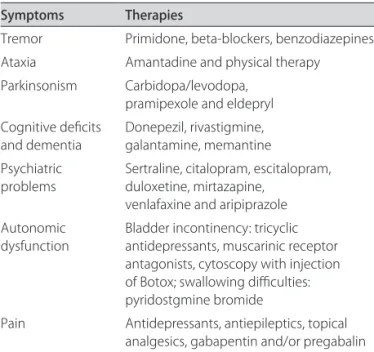
coordina-tion, parkinsonism, sleep problems, anxiety, mood alter-ations, memory problems and pain10,53,68. Some
interven-tions have produced reasonable results27,57 (Table 2).
ConClusions
he identiication of the FXTAS, a late onset-neuro-logical progressive disease without cure, afects genet-ic counseling in FXS families. Before 2001, genetgenet-ic tests to identify carriers of the premutation in these families were performed in adults to assist them about the risks of mental retardation in their ofspring. Nowadays, the de-tection of the FMR1 premutation, especially in men, has brought ethical issues, mainly the fact that it is predictive for an incurable disease, a situation akin of the screening of the HTT gene mutation for Huntington disease or the ApoE4 variant for Alzheimer disease69.
As far as we know, there are just a few reports con-cerning aspects of FXTAS in Brazil9,52,70,71. he disease has
been irst recognized by geneticists in the study of frag-ile X families. he knowledge of this relatively new syn-drome by physicians and health professionals is funda-mental for diagnosis and proper assistance to FXTAS pa-tients to be achieved. he diagnosis of FXTAS in a family might also lead to the identiication of premutation carri-er women in risk for FXS in their ofspring, or to a hcarri-ere- here-tofore unknown diagnosis of FXS in a child.
The presence of the FMR1 premutation is recom-mended to be evaluated in men and women with late-on-set intention tremor, cerebellar ataxia of unknown cause, dementia (mainly if associated to movement disorders) or MCP sign revealed by MRI. Major concern should be giv-en to symptomatic individuals with [1] familial history of
FXS or mental retardation without a diagnosis; [2] female relatives presenting premature menopause; [3] relatives with ataxia, neurological or psychiatric problems13,20,44,57,72.
he standards and clinical guidelines for FXTAS and FXS can be accessed at the American College of Medical Ge-netics web site (http://www.acmg.net/Pages/ACMG_ Activities/stds-2002/fx.htm)73.
REFEREnCEs
Hagerman RJ, Leehey M, Heinrichs W, et al. Intention tremor, Parkinsonism, 1.
and generalized brain atrophy in male carriers of fragile X. Neurology 2001; 57:127-130.
Hagerman PJ, Hagerman RJ. The fragile-X premutation: a maturing per-2.
spective. Am J Hum Genet 2004;74:805-816.
Miller G. Biomedical research. Fragile X’s unwelcome relative. Science 3.
2006;312:518-521.
Jacquemont S, Hagerman RJ, Hagerman PJ, Leehey MA. Fragile-X syn-4.
drome and fragile X-associated tremor/ataxia syndrome: two faces of FMR1. Lancet Neurol 2007;6:45-55.
Jacquemont S, Hagerman RJ, Leehey M, et al. Fragile X premutation trem-5.
or/ataxia syndrome: molecular, clinical, and neuroimaging correlates. Am J Hum Genet 2003;72:869-878.
Amiri K, Hagerman RJ, Hagerman PJ. Fragile X-associated tremor/ataxia 6.
syndrome: an aging face of the fragile X gene. Arch Neurol 2008;65:19-25. Allingham-Hawkins DJ, Babul-Hirji R, Chitayat D, et al. Fragile X premutation 7.
is a significant risk factor for premature ovarian failure: the International Collaborative POF in Fragile X study-preliminary data. Am J Med Genet 1999;83:322-325.
Costa SS, Fonseca AM, Bagnoli VR, Vianna-Morgante AM. The
8. FMR1
premu-tation as a cause of premature ovarian failure in Brazilian women. Genet Mol Biol 2006;29:423-428.
Capelli LP, Goncalves MR, Kok F, et al. Fragile X-associated tremor/atax-9.
ia syndrome: intrafamilial variability and the size of the FMR1 premutation CGG repeat. Mov Disord 2007;22:866-870.
Jacquemont S, Farzin F, Hall D, et al. Aging in individuals with the
10. FMR1
mutation. Am J Ment Retard 2004;109:154-164.
Rogers C, Partington MW, Turner GM. Tremor, ataxia and dementia in old-11.
er men may indicate a carrier of the fragile X syndrome. Clin Genet 2003; 64:54-56.
Bacalman S, Farzin F, Bourgeois JA, et al. Psychiatric phenotype of the frag-12.
ile X-associated tremor/ataxia syndrome (FXTAS) in males: newly described fronto-subcortical dementia. J Clin Psychiatry 2006;67:87-94.
Bourgeois JA, Cogswell JB, Hessl D, et al. Cognitive, anxiety and mood dis-13.
orders in the fragile X-associated tremor/ataxia syndrome. Gen Hosp Psy-chiatry 2007;29:349-356.
Grigsby J, Brega AG, Engle K, et al. Cognitive proile of fragile X premuta-14.
tion carriers with and without fragile X-associated tremor/ataxia syndrome. Neuropsychology 2008;22:48-60.
Seritan AL, Nguyen DV, Farias ST, et al. Dementia in fragile X-associated 15.
tremor/ataxia syndrome (FXTAS): comparison with Alzheimer’s disease. Am J Med Genet B 2008;147:1138-1144.
Hall DA, Howard K, Hagerman R, Leehey MA. Parkinsonism in
16. FMR1
pre-mutation carriers may be indistinguishable from Parkinson disease. Parkin-sonism Relat Disord 2009;15:156-159.
Hagerman RJ, Cofey SM, Maselli R, et al. Neuropathy as a presenting fea-17.
ture in fragile X-associated tremor/ataxia syndrome. Am J Med Genet A 2007;143:2256-2260.
Grigsby J, Brega AG, Jacquemont S, et al. Impairment in the cognitive func-18.
tioning of men with fragile X-associated tremor/ataxia syndrome (FXTAS). J Neurol Sci 2006;248:227-233.
Leehey MA, Berry-Kravis E, Min SJ, et al. Progression of tremor and ataxia in 19.
male carriers of the FMR1 premutation. Mov Disord 2007;22:203-206. Hall DA, Berry-Kravis E, Jacquemont S, et al. Initial diagnoses given to per-20.
sons with the fragile X associated tremor/ataxia syndrome (FXTAS). Neurol-ogy 2005;65:299-301.
Brunberg JA, Jacquemont S, Hagerman RJ, et al. Fragile X premutation car-21.
riers: characteristic MR imaging indings of adult male patients with pro-gressive cerebellar and cognitive dysfunction. Am J Neuroradiol 2002; 23:1757-1766.
Table 2. Therapeutic interventions in FXTAS patients.
symptoms Therapies
Tremor Primidone, beta-blockers, benzodiazepines Ataxia Amantadine and physical therapy
Parkinsonism Carbidopa/levodopa, pramipexole and eldepryl Cognitive deicits
and dementia Donepezil, rivastigmine, galantamine, memantine Psychiatric
problems
Sertraline, citalopram, escitalopram, duloxetine, mirtazapine,
venlafaxine and aripiprazole Autonomic
dysfunction Bladder incontinency: tricyclic antidepressants, muscarinic receptor antagonists, cytoscopy with injection of Botox; swallowing diiculties: pyridostgmine bromide
Pain Antidepressants, antiepileptics, topical analgesics, gabapentin and/or pregabalin
Loesch DZ, Litewka L, Brotchie P, Huggins RM, Tassone F, Cook M. Magnetic 22.
resonance imaging study in older fragile X premutation male carriers. Ann Neurol 2005;58:326-330.
Greco CM, Berman RF, Martin RM, et al. Neuropathology of fragile X-associ-23.
ated tremor/ataxia syndrome (FXTAS). Brain 2006;129:243-255.
Greco CM, Hagerman RJ, Tassone F, et al. Neuronal intranuclear inclusions 24.
in a new cerebellar tremor/ataxia syndrome among fragile X carriers. Brain 2002;125:1760-1771.
Gokden M, Al-Hinti JT, Harik SI. Peripheral nervous system pathology 25.
in fragile X tremor/ataxia syndrome (FXTAS). Neuropathology 2009;29: 280-284.
Cofey SM, Cook K, Tartaglia N, et al. Expanded clinical phenotype of wom-26.
en with the FMR1 premutation. Am J Med Genet A 2008;146:1009-1016. Hagerman RJ, Hall DA, Coffey S, et al. Treatment of fragile X-associated 27.
tremor ataxia syndrome (FXTAS) and related neurological problems. Clin Interv Aging 2008;3:251-262.
Tassone F, Hagerman RJ, Taylor AK, Gane LW, Godfrey TE, Hagerman PJ. El-28.
evated levels of FMR1 mRNA in carrier males: a new mechanism of involve-ment in the fragile-X syndrome. Am J Hum Genet 2000;66:6-15.
Mankodi A, Thornton CA. Myotonic syndromes. Curr Opin Neurol 2002;15: 29.
545-552.
Primerano B, Tassone F, Hagerman RJ, Hagerman P, Amaldi F, Bagni C. Re-30.
duced FMR1 mRNA translation eiciency in fragile X patients with premu-tations. RNA 2002;8:1482-1488.
Tassone F, Iwahashi C, Hagerman PJ.
31. FMR1 RNA within the intranuclear
in-clusions of fragile X-associated tremor/ataxia syndrome (FXTAS). RNA Biol 2004;1:103-105.
Garcia-Arocena D, Iwahashi CK, Won N, et al. Induction of inclusion for-32.
mation and disruption of lamin A/C structure by premutation CGG-repeat RNA in human cultured neural cells. Hum Mol Genet 2005;14:3661-3671. Iwahashi CK, Yasui DH, An HJ, et al. Protein composition of the intranuclear 33.
inclusions of FXTAS. Brain 2006;129:256-271.
Jin P, Duan R, Qurashi A, et al. Pur alpha binds to rCGG repeats and modu-34.
lates repeat-mediated neurodegenerationin a Drosophila model of fragile X tremor/ataxia syndrome. Neuron 2007;55:556-564.
Sofola OA, Jin P, Qin Y, et al. RNA-binding proteins hnRNP A2/B1 and CUG-35.
BP1 suppress fragile X CGG premutation repeat-induced neurodegenera-tion in a Drosophila model of FXTAS. Neuron 2007;55:565-571.
Handa V, Goldwater D, Stiles D, et al. Long CGG-repeat tracts are toxic to 36.
human cells: implications for carriers of Fragile X premutation alleles. FEBS Lett 2005;579:2702-2708.
Oostra BA, Willemsen R. A fragile balance:
37. FMR1 expression levels. Hum
Mol Genet 2003;12:249-257.
Willemsen R, Mientjes E, Oostra BA. FXTAS: a progressive neurologic syn-38.
drome associated with Fragile X premutation. Curr Neurol Neurosci Rep 2005;5:405-410.
Hagerman RJ. Lessons from fragile X regarding neurobiology, autism, and 39.
neurodegeneration. J Dev Behav Pediatr 2006;27:63-74. Willemsen R, Hoogeveen-Westerveld M, Reis S, et al. The
40. FMR1 CGG
re-peat mouse displays ubiquitin-positive intranuclear neuronal inclusions; implications for the cerebellar tremor/ataxia syndrome. Hum Mol Genet 2003;12:949-959.
Van Dam D, Errijgers V, Kooy RF, et al. Cognitive decline, neuromotor and 41.
behavioural disturbances in a mouse model for fragile-X-associated trem-or/ataxia syndrome (FXTAS). Behav Brain Res 2005;162:233-239.
Jin P, Zarnescu DC, Zhang F, et al. RNA-mediated neurodegeneration 42.
caused by the fragile X premutation rCGG repeats in Drosophila. Neuron 2003;39:739-747.
Shan G, Xu S, Jin P. FXTAS: a bad RNA and a hope for a cure. Expert Opin 43.
Biol Ther 2008;8:249-253.
Kamm C, Gasser T. The variable phenotype of FXTAS: a common cause of 44.
“idiopathic” disorders. Neurology 2005;65:190-191.
Storey E, Billimoria P. Increased T2 signal in the middle cerebellar pedun-45.
cles on MRI is not speciic for fragile X premutation syndrome. J Clin Neu-rosci 2005;12:42-43.
Mothersead PK, Conrad K, Hagerman RJ, Greco CM, Hessl D, Tassone F. 46.
GRAND ROUNDS: an atypical progressive dementia in a male carrier of the fragile X premutation: an example of fragile X-associated tremor/ataxia syndrome. Appl Neuropsychol 2005;12:169-178.
Hagerman PJ, Hagerman RJ. Fragile X-associated tremor/ataxia syndrome 47.
(FXTAS). Ment Retard Dev Disabil Res Rev 2004;10:25-30.
Van Esch H. The Fragile X premutation: new insights and clinical conse-48.
quences. Eur J Med Genet 2006;49:1-8.
Cohen S, Masyn K, Adams J, et al. Molecular and imaging correlates of 49.
the fragile X-associated tremor/ataxia syndrome. Neurology 2006;67: 1426-1431.
Loesch DZ, Litewka L, Churchyard A, Gould E, Tassone F, Cook M. Tremor/ 50.
ataxia syndrome and fragile X premutation: diagnostic caveats. J Clin Neu-rosci 2007;14:245-248.
Grigsby J, Leehey MA, Jacquemont S, et al. Cognitive impairment in a 65-51.
year-old male with the fragile X-associated tremor-ataxia syndrome (FX-TAS). Cogn Behav Neurol 2006;19:165-171.
Gonçalves MR, Capelli LP, Nitrini R, et al. Atypical clinical course of FX-52.
TAS: rapidly progressive dementia as the major symptom. Neurology 2007;68:1864-1866.
Hagerman PJ, Hagerman RJ. Fragile X-associated tremor/ataxia syndrome-53.
an older face of the fragile X gene. Nat Clin Pract Neurol 2007;3:107-112. Cornish KM, Li L, Kogan CS, et al. Age-dependent cognitive changes in car-54.
riers of the fragile X syndrome. Cortex 2008;44:628-636.
Loesch DZ, Cook M, Litewka L, et al. A low symptomatic form of neurode-55.
generation in younger carriers of the FMR1 premutation, manifesting typi-cal radiologitypi-cal changes. J Med Genet 2008;45:179-181.
Jacquemont S, Hagerman RJ, Leehey MA, et al. Penetrance of the fragile 56.
X-associated tremor/ataxia syndrome in a premutation carrier population. JAMA 2004;291:460-469.
Berry-Kravis E, Abrams L, Cofey SM, et al. Fragile X-associated tremor/atax-57.
ia syndrome: clinical features, genetics, and testing guidelines. Mov Disord 2007;22:2018-2030.
Jacquemont S, Orrico A, Galli L, et al. Spastic paraparesis, cerebellar ataxia, 58.
and intention tremor: a severe variant of FXTAS? J Med Genet 2005;42:14. Jacquemont S, Leehey MA, Hagerman RJ, Beckett LA, Hagerman PJ. Size 59.
bias of fragile X premutation alleles in late-onset movement disorders. J Med Genet 2006;43:804-809.
Baba Y, Uitti RJ. Fragile X-associated tremor/ataxia syndrome and move-60.
ments disorders. Curr Opin Neurol 2005;18:393-398.
Hall DA, Hagerman RJ, Hagerman PJ, Jacquemont S, Leehey MA. Preva-61.
lence of FMR1 repeat expansions in movement disorders. A systematic re-view. Neuroepidemiology 2006;26:151-155.
Berry-Kravis E, Lewin F, Wuu J, et al. Tremor and ataxia in fragile X premuta-62.
tion carriers: blinded videotape study. Ann Neurol 2003;53:616-623. Loesch DZ, Churchyard A, Brotchie P, Marot M, Tassone F. Evidence for, and 63.
a spectrum of, neurological involvement in carriers of the fragile X pre-mu-tation: FXTAS and beyond. Clin Genet 2005;67:412-417.
Grigsby J, Brega AG, Leehey MA, et al. Impairment of executive cognitive 64.
functioning in males with fragile X-associated tremor/ataxia syndrome. Mov Disord 2007;22:645-650.
Tassone F, Adams J, Berry-Kravis EM, et al. CGG repeat length correlates with 65.
age of onset of motor signs of the fragile X-associated tremor/ataxia syn-drome (FXTAS). Am J Med Genet B Neuropsychiatr Genet 2007;144:566-569. Leehey MA, Berry-Kravis E, Goetz CG, et al.
66. FMR1 CGG repeat length
predicts motor dysfunction in premutation carriers. Neurology 2008;70: 1397-1402.
Dombrowski C, Levesque S, Morel ML, Rouillard P, Morgan K, Rousseau F. 67.
Premutation and intermediate-size FMR1 alleles in 10572 males from the general population: loss of an AGG interruption is a late event in the gen-eration of fragile X syndrome alleles. Hum Mol Genet 2002;11:371-378. Hall DA, Berry-Kravis E, Hagerman RJ, Hagerman PJ, Rice CD, Leehey MA. 68.
Symptomatic treatment in the fragile X-associated tremor/ataxia syn-drome. Mov Disord 2006;21:1741-1744.
McConkie-Rosell A, Finucane B, Cronister A, Abrams L, Bennett RL, Petters-69.
en BJ. Genetic counseling for fragile x syndrome: updated recommenda-tions of the national society of genetic counselors. J Genet Couns 2005; 14:249-270.
Reis AH, Ferreira AC, Gomes KB, et al. Frequency of
70. FMR1 premutation in
individuals with ataxia and/or tremor and/or Parkinsonism. Genet Mol Res 2008;7:74-84.
Nitrini R, Gonçalves MRR, Capelli LP et al. Dementia in fragile X-associated 71.
tremor/ataxia syndrome. Dement Neuropsychol 2010;4:79-83.
McConkie-Rosell A, Abrams L, Finucane B, et al. Recommendations from 72.
multi-disciplinary focus groups on cascade testing and genetic counseling for fragile X-associated disorders. J Genet Couns 2007;16:593-606. Elaine B, Spector EB, Kronquist K. Technical standards and guidelines for frag-73.