International Laser Center, Ilkovicova 3, 812 19, Slovak Republic Pharmaceutical Faculty Comenius University, Kalinciakova 8, 832 32 Bratislava, Slovak Republic Mailing address: Ljuba Bacharova, MD, PhD, MBA - International Laser Center -Ilkovicova 3 - 812 19 Bratislava - Slovak Republic - E-mail: [email protected] Received for publication in October 23, 2001
Accepted in November 28, 2001
Objective - Evaluation of the performance of the QRS voltage-duration product (VDP) for detection of left ven-tricular hypertrophy (LVH) in spontaneously hyperten-sive rats (SHR).
Methods - Orthogonal electrocardiograms (ECG) were recorded in male SHR at the age of 12 and 20 weeks, when systolic blood pressure (sBP) reached the average values of 165±3 mmHg and 195±12 mmHg, respectively. Age- and sex- matched normotensive Wistar Kyoto (WKY) rats were used as controls. VDP was calculated as a pro-duct of maximum QRS spatial vector magnitude and QRS duration. Left ventricular mass (LVM) was weighed after rats were sacrificed.
Results - LVM in SHR at 12 and 20 weeks of age (0.86±0.05 g and 1.05±0.07 g, respectively) was significantly higher as compared with that in WKY (0.65±0.07 g and 0.70±0.02 g). The increase in LVM closely correlated with the sBP increase. VDP did not reflect the increase in LVM in SHR. VDP was lower in SHR as compared with that in WKY, and the difference was significant at the age of 20 weeks (18.2mVms compared with 10.7mVms, p<0.01). On the contrary, a signifi-cant increase in the VDP was observed in the control WKY at the age of 20 weeks without changes in LVM. The changes in VDP were influenced mainly by the changes in QRSmax.
Conclusion - LVM was not the major determinant of QRS voltage changes and consequently of the VDP. These data point to the importance of the nonspatial determinants of the recorded QRS voltage in terms of the solid angle theory.
Key words: left ventricular hypertrophy, electrocardio-graphy, QRS voltage-duration product, spon-taneously hypertensive rat
Arq Bras Cardiol, volume 79 (nº 2), 143-8, 2002
Ljuba Bacharova, Jan Kyselovic, Jan Klimas
Bratislava - Slovak Republic
QRS Voltage-Duration Product in the Identification of Left
Ventricular Hypertrophy in Spontaneously Hypertensive Rats
Electrocardiographic signs of left ventricular hyper-trophy (ECG-LVH) are a powerful independent predictors of cardiovascular morbidity and mortality. Based on 36 years of follow-up in the Framingham study, ECG-LVH was found to increase the risk of coronary events about 3-fold to 5-fold, strokes 6-fold, and heart failure about 14-fold 1. The
electrocardiographic criteria based on the increased QRS voltage -the voltage criteria - are highly specific for LVH detection. ECG is an easily applicable, clinically relevant method that, together with its low cost, represents additional advanta-ges. On the other hand, its main limitation is the high number of false negatives resulting in poor sensitivity of the volta-ge criteria. Therefore, a continuous effort is devoted to im-proving the performance of ECG criteria in LVH detection.
The simple product of QRS duration and voltage, as an approximation of the time-duration area under the QRS com-plex, has been shown to enhance the sensitivity of the ECG identification of left ventricular hypertrophy as defined at autopsy 2, as well as of increased left ventricular mass
detec-ted by echocardiography in living subjects 3. The Cornell
product has been reported to provide low variability of per-formance between definitions of hypertrophy in terms of the different upper normal limits used 4. Use of
voltage-dura-tion products mitigates the negative impact of increased BMI on the prevalence of LVH, and it has been suggested that the voltage-duration products may be the most accura-te conventional ECG method for deaccura-tecting anatomic LVH, independent of body habitus 5,6.
Similar results have also been reported by others. The Cornell voltage duration product exhibited the greatest sen-sitivity for both sexes (39% in men and 51% in women at 95% specificity). The Cornell voltage duration product ad-justed for body mass index and age offers significant impro-vement for the detection of echocardiographically determi-ned LVH in all but lean men 7.
men. At a matched 98% specificity (the corresponding ove-rall sensitivity of the combined Cornell product or Sokolow-Lyon criteria) is reported to be 68% at a specificity of 96.6%. The spontaneously hypertensive rat (SHR) is regar-ded as a reliable model of human essential hypertension 8,9.
SHRs have, within each colony, uniform polygenic disposi-tion and excitatory factors, which produce uniform changes in the indirect and direct effects on the cardiovascular sys-tem. This model also provides good control of variables like age and duration of hypertension. The lack of interindivi-dual variation is one of the major advantages of the SHR 10.
Furthermore, the SHR is used as a realistic model of left ventricular hypertrophy, because of the gradual onset of systemic pressure overload that occurs. LVH in SHR deve-lops naturally without any invasive, chemical, or pharmaco-logical interventions, and proceeds chronically. Although in clinical studies the inconsistency of results has necessi-tated consideration of many extracardial factors, such as ge-netic variations, the unknown duration of hypertension, in-terindividual variability due to race, sex, or variability due to body habitus, in the experimental model of SHR these varia-bles are well controlled.
The aim of this study was to assess the performance of the voltage-duration product as a parameter of LVH detecti-on in the experimental model of spdetecti-ontaneously hypertensi-ve rats in the early stage of hypertension and LVH dehypertensi-velop- develop-ment.
Methods
Spontaneously hypertensive rats were used as an ex-perimental model of left ventricular hypertrophy due to hy-pertension. Two groups of male SHR at the age of 12 and 20 weeks were examined. Age- and sex-matched Wistar Kyoto rats (WKY) were used as controls. Each group consisted of 7 rats randomly selected from a large population of SHR and of control animals, respectively (both animal groups from Anlab, Prague, Czech Republic).
Arterial systolic blood pressure (sBP) was measured by the tail-cuff method in conscious animals prewarmed to 35° C in thermostatic cages. Measurements were repeated several times, and 3 values after stabilization were averaged. At the age of 12 weeks, systolic blood pressure reached the average value of 165±3 mmHg, and then at the age of 20 weeks, the sBP increased to 195±12 mmHg. The sBP values in WKY control groups were within normal limits (122±8 mmHg and 130±4 mmHg, respectively).
Orthogonal electrocardiograms of the Frank lead sys-tem were recorded in thiopental anesthesia (Thiopental, VUAB, Czech Republic, 45 mg/kg, i. p.) using the electrocar-diograph 3NEK-1, GDR. Needle electrodes were used. The center of the chest electrodes was 1.5 cm from the xiphoid process on the sternum. The legs were fixed in the ventral position by elastic cords.
The maximum deflections of QRS complex were mea-sured manually. All calculations were made on the average of 5 QRS complexes. These values were taken as X, Y,
Z components of the maximum spatial QRS vector magnitu-de (QRSmax). The QRSmax was calculated using the formu-la: QRS max = x2+y2+z2
The QRS duration (QRSdur) was measured from the earliest onset of QRS complex to the lowest point of the S wave in any of the orthogonal leads, in records taken with the paper speed of 200 mm/sec.
The voltage-duration product (VDP) was calculated as the product of QRSmax and QRS duration.
After ECG recording, the animals were sacrificed and the left ventricular mass was weighted. Two parameters were used as measures of anatomical left ventricular hyper-trophy: left ventricular mass (LVM) and left ventricular mass to body weight ratio (LVM/BW).
Groups of animals were compared using the Mann-Whitney U-test. P<0.05 was accepted as significant. The statistical analysis was performed using StatGraphics for Windows, version 5, microcomputer software package (Sta-tistical Graphics Co. Rockville, USA, 1991).
This study was approved by the Ethics Committee of the Pharmaceutical Faculty of the Comenius University in
Bratislava.
Results
The spontaneously hypertensive rats showed a pro-gressive rise in systolic blood pressure. Arterial systolic blood pressure, left ventricular mass, and left ventricular mass to body weight ratio were significantly greater in SHR than in WKY, as shown in table I. Significant hypertrophy was found in SHR in terms of absolute left ventricular mass as well as of left ventricular mass relative to body weight. The LVM in SHR (0.86±0.05 g and 1.05±0.07 g, respectively) were significantly higher as compared with that in to WKY (0.65±0.07 g and 0.70±0.02 g, p<0.001). The increase in LVM significantly correlated with the sBP increase both in WKY (r = 0.6797, p<0.01) and in SHR (r = 0.7257, p<0.01).
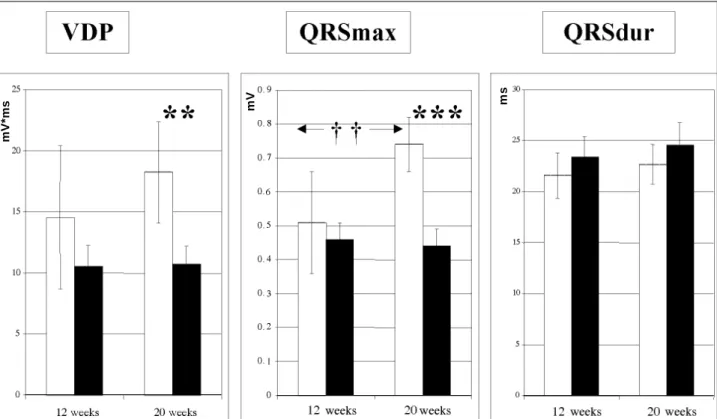
Values of the voltage-duration product and of its indi-vidual components, QRSmax and QRS duration, in WKY and SHR are presented in figure 1.
The voltage-duration product was lower in SHR as compared with that in WKY, and the difference was
statis-Table I - Systolic blood pressure (sBP), left ventricular mass (LVM) and left ventricular mass to body weight ratio (LVM/BW) in normotensive
WKY rats (WKY) and spontaneously hypertensive rats (SHR).
WKY WKY SHR SHR
12 w 20 w 12 w 20 w
n 7 7 7 7
sBP 124 ± 8 130 ± 4 165 ± 3*** 195 ± 12*** [mmHg]
LVM [g] 0.65 ± 0.07 0.7 ± 0.02 0.86 ± 0.05*** 1.05 ± 0.07*** LVM/BW 2.13 ± 0.15 1.96 ± 0.08 2.96 ± 0.15*** 3.03 ± 0.15*** [g/kg]
tically significant at the age of 20 weeks (10.73 mVms in SHR compared with 18.23 mVms in WKY, p<0.01). The correla-tions between VDP and LVM and/or sBP were not signifi-cant in either WKY or in SHR.
QRSmax in SHR did not follow either the increase in sBP, LVM, or LVM/BW. The QRSmax values in SHR did not differ from those of WKY at the age of 12 weeks (0.59±0.14 mV versus 0.46±0.05 mV), and they were even lower in SHR at the age of 20 weeks (0.74±0.08 mV versus 0.44±0.05 mV, p<0.001). QRSmax correlated significantly with LVM only in WKY (r=0.6082, p<0.05), but they did not correlate in SHR (r= -0.1135). The correlation between QRSmax and sBP was not significant either in WKY or in SHR.
The QRS duration tended to be higher in SHR and in-creased with increasing age. However, this increase was not statistically significant. The correlations between QRSd and LVM and/or sBP were not significant either in WKY or in SHR.
Discussion
The main findings of this study were incongruent rela-tions between the changes in LVM and VDP in SHR and WKY at the age of 12 and 20 weeks, namely the increase in VDP in WKY without changes in LVM, and lower values of VDP in SHR in spite of the significant increase in sBP, LVM, and LVM/BW. These findings were predominantly influen-ced by the QRSmax changes.
QRS voltage and left ventricular hypertrophy - A sig-nificant increase in QRSmax of about 45% in normotensive WKY rats was found during the follow-up period, while neither the LVM nor the LVM/BW were changed signifi-cantly. In rats, the period from 12 to 20 weeks refers to the period of adolescence and early adulthood. An LVM-inde-pendent increase in QRS amplitude in the period of adoles-cence and early adulthood has been documented both in experimental and clinical studies 11-16. The mechanism of
this increase in QRS voltage in healthy normotensive ado-lescents and young adults is not clear. Because WKY are genetically homogenous and do not develop hypertension, this increase in QRS voltage cannot be considered an early premorbid sign of hypertension potentially developing in later adulthood. The increase in QRSmax was not associa-ted with parameters under study characterizing hypertro-phy (sBP, LVM, LVM/BW); therefore, it cannot be attribu-ted to the increase in LVM or to the progression of hyper-trophy. However, we had to consider this increase while in-terpreting the comparison with age-matched SHR the more that this increase was in direct contrast to the QRS changes found in SHR in this study.
By contrast, the QRSmax in SHR did not change du-ring the follow-up period, in spite of the significant pro-gression of hypertension and left ventricular hypertrophy characterized by the significant increase in sBP, LVM, and the LVM/BW ratio. Additionally, the QRSmax values in SHR were significantly lower compared to with those in the age-matched WKY rats, and this difference was
Fig. 1 - Changes in voltage-duration product (VDP), maximum spatial QRS vector magnitude (QRSmax), and QRS duration (QRSdur) in normotensive WKY rats (stripped columns) and spontaneously hypertensive rats (black columns) at the age of 12 and 20 weeks. Average values ± SD are presented. Statistically significant difference WKY vs SHR: ** = p<0.01, *** = p<0.001; statistically significant difference WKY 12 weeks vs WKY 20 weeks: †† = p<0.01.
mV*ms
enhanced in the 20-week-old SHRs compared with that in the 12-week-old SHRs.
The finding of no significant change in QRSmax in SHR is of particular interest, because, according to the clas-sical hypothesis, an increased QRS voltage should be ex-pected as a consequence of the “enhanced electrical domi-nance” of the increased mass of the left ventricle. The vol-tage criteria are considered the most specific clinical findings for ECG diagnostics of LVH. In experimental studies, ho-wever, no consistency exists in the manner in which QRS amplitude has been affected by induced hypertrophy. Some studies have found the QRS voltage to be significantly in-creased 17-19, others have found a nonsignificant trend of
in-crease in QRS amplitude 20, whereas some others have
found the amplitude to be decreased in SHR compared with that in normotensive rats 21-23. The high number of so-called
false negative ECG results and low sensitivity of ECG voltage criteria in clinical diagnostics is also well documented 24-27.
In our previous works 28-30, we introduced the term
“re-lative voltage deficit” to assign ECG findings where QRS voltage is lower than expected according to the increase in LVM in LVH. We hypothesized that a relative voltage deficit is conditioned by changes in electrogenesis in left ventricu-lar hypertrophy.
In the present study, the rats were examined at the ages of 12 and 20 weeks. At this age in SHR, the heart is known to be appreciably hypertrophied and heart failure can be practically excluded, because it does not occur until about 18 months of age 8,31. However, also at this age of animals
and in the relatively early period of hypertension and LVH, we observed a relative voltage deficit in SHR. We assume that it reflects the changes in active and passive electrical properties of myocardium during pathological hypertrophic growth of the left ventricle.
Additionally in this study, we found no significant correlation between QRSmax and LVM in SHR in contrast to the significant correlation between QRSmax and LVM in normotensive WKY rats. Similar results, ie, no significant correlation between QRS amplitude and LVM in SHR, were reported even in studies where a significant increase in the QRS amplitude in SHR was observed. Yamori et al 17 have
shown that the magnitude of the maximum spatial QRS vec-tor was significantly related to blood pressure, but not to histometrical findings, such as heart weight, left ventricular weight, or the thickening of the left ventricular wall. Simi-larly, Snoeck et al 18 found no significant correlation
betwe-en QRS max and heart weight and QRSmax and left vbetwe-entricu- ventricu-lar thicknes. It follows that the mass of the hypertrophied left ventricle has not been the major determinant of the re-corded QRS amplitude, that the increased mass of the hyper-trophied left ventricle has not resulted in the “electrical do-minance” of the left ventricle and consequently in increased QRS amplitude.
Increased QTS voltage in LVH is theoretically attribu-ted to the increased size of the electrical activation bounda-ry according to the solid angle theobounda-ry 32. However, the solid
angle theory considers not only the spatial determinants
(the size of the solid angle depending on the size of the acti-vation boundary), but the nonspatial determinants as well: transmembrane voltage differences and conductivity. It se-ems that the changes in nonspatial factors could be those additional factors, which could counterbalance the influen-ce of the size of LV on the resultant QRS voltage and contri-bute to the relative voltage deficit.
QRS duration and left ventricular hypertrophy - In this study, the QRSd values in SHR tended to be higher com-pared with those in WKY, but this difference was not statis-tically significant, and the QRSd values both in WKY and SHR were higher at the 20th week compared with those at the
12th week, but the difference was not statistically significant.
The published data on the association between QRS duration and LVH in SHR are not consistent. Yamori et al 17
found a significant prolongation in QRS duration in stroke-prone SHR compared with that in WKY at the age of 18-24.5 weeks. Snoeck et al 18 observed a prolongation in QRS
dura-tion in SHR. At 3 months (12 weeks), a slight but significant increase was already observed, and at 12 months (84 weeks), a significant difference was noticed. Similar results, ie, in-crease in QRS duration with age in SHR were reported by Mueller-Peedinghaus et al 33. Ohtaka 20 reported
significan-tly prolonged QRS duration in SHR compared with that in WKY at the age of 5 months (20 weeks). Dunn at al 34 also
re-ported progressively increased QRS duration with progres-sive left ventricular hypertrophy in SHR. However, this in-crease was statistically significant only in the oldest age group >76 weeks. In younger age groups (8-12, 26-51, 51-76 weeks), the difference between SHR and WKY was not sta-tistically significant. On the other hand, Hodgkin et al 21 did
not find differences in the QRS duration between SHR and WKY at the age of 9-14 weeks.
In humans, the prolongation of QRS complex duration is regularly listed among electrocardiographic signs of LVH. QRS duration has also been found to correlate with left ven-tricular mass 35-37. However, the prolonged QRS complex is
not a specific finding for LVH and is considered supporting evidence in the presence of increased voltage 38.
Changes in QRS duration in LVH may be attributed to the increased muscle mass itself, ie, to the longer time requi-red to activate the increased mass of myocardium 39.
Addi-tionally, changes in active and passive electrical properties of myocardium in LVH have been reported, such as conduc-tion velocity, intracellular resistivity, gap juncconduc-tion organiza-tion, resistance, and the content of connexin43 40-48. It can be
suggested that these changes are involved in the changes in QRS duration in LVH. These changes are extensively stu-died mainly in relation to their role in arrhythmogenesis. Ho-wever, in terms of the solid angle theory, we can speculate that they can also be involved in the voltage changes in the QRS complex and counterbalance the influence of the in-creased mass.
In this study, the nonsignificant increase in QRSdur did not significantly influence the VDP and did not balance the opposite changes of QRS voltage.
this study are in direct contrast with findings of clinical stu-dies that report good performance of VDP in the detection of LVH 2-7. In this study, the voltage-duration product in
SHR did not reflect the increase in LVM at the age of 12 to 20 weeks. On the contrary, we observed a significant increase in VDP in control normotensive WKY rats without changes in LVM.
The difference in findings can be partly attributed to differences in the study designs and patient selection between our study and published reports from other clinical studies. In our study, the hypertrophy was studied in spon-taneously hypertensive rats, ie, in a diagnostically well-de-fined group of experimental animals. The experiment was controlled for age, sex, and therapy. LVH was defined by the increase in sBP, LVM, and the LVM/BW ratio. In the clinical studies, the discriminative parameter between control and LVH groups was the only parameter, the increased LVM in-dex. In the study of Molloy et al 2, both control and LVH
groups contained a variety of cardiovascular pathology. In another study 3, the normal control group included also an
unknown proportion of patients with mild hypertension, and on the other hand, the LVH group contained an unk-nown proportion of “normotensive patients,” healthy subjects perhaps? The clinical studies were not controlled for age, sex, and therapy.
The included variety of pathology and the absence of the control for age, sex, and therapy implies that authors ha-ve not considered the changes of actiha-ve and passiha-ve elec-trical properties in terms in the solid angle theory, namely the nonspatial determinants influencing the voltage of re-corded electrocardiogram.
This is also reflected in the inconsistency in the appli-cation of the solid angle theory when discussing their result. In the case of the QRS voltage, the solid angle theory is used for argumentation, but only the spatial determinants and the increased QRS voltage is attributed to the increased size of the electrical activation boundary, ie, to the spatial determinants. However, this is not a complete citation, be-cause the part of the nonspatial determinants is not mentio-ned. However, next, in the case of QRS prolongation, evi-dence for changed active and passive electrical properties is quoted. Paradoxically, these changes in conductivity are not considered in terms of the nonspatial determinants of the recorded voltage according to the solid angle theory.
In our previous works 28-30, we repeatedly stressed the
importance of nonspatial determinants of QRS voltage in LVH. We introduced the term “relative voltage deficit” for so-called false negative ECG results to stress that the enlar-ged LV in LVH are not strong generators of a cardio-electric field as is expected according to their mass. And we introdu-ced a parameter for the quantification of the relative voltage deficit - the specific potential of the myocardium.
Limitations of the study - The present study has cer-tain limitations inherent to the model of SHR used. Another limitation is the small number of experimental animals; howe-ver, the changes were consistent across groups.
Conclusion - In this study, the voltage-duration pro-duct did not reflect the increase in LVM in SHR at the age of 12 to 20 weeks, and, on the other hand, the increase in VDP in normotensive control WKY was not associated with the increase in LVM. In other words, the LVM was not the major determinant of the QRS voltage and consequently VDP. These findings focus attention on to the importance of the nonspatial determinants of the recorded QRS voltage in terms of the solid angle theory.
The clinical implications aim at the re-evaluation of the role of ECG in LVH diagnostics, especially in the case of the so-called false negative results and at the differentiation between the anatomical size of the heart as the source of the cardiac electric field and its electrogenetic properties. The alternative explanation for the so-called false negative ECG results in LVH is the relative voltage deficit, related to chan-ges in active and passive electrical properties of the hyper-trophied myocardium. The term relative voltage deficit re-fers to discrepancies in actual cases as indicating deviations from the “ideal” state. The changes in the relative QRS vol-tage in different svol-tages of LVH should also be taken into ac-count. A potential exists for studying the relative voltage deficit and its diagnostic and prognostic usefulness in the frame of diagnostics of LVH, of diffuse changes in the myo-cardium, in cardiovascular risk assessment, and for the evaluation of the effects of therapy.
Acknowledgements
This study was supported, in part, by the grant 1/ 7189/20 from The Science Grant Agency (VEGA), Slovak Republic.
References
1. Kannel WB. Epidemiology of cardiac hypertrophy. In: Sheridan DJ, editor. Left ventricular hypertrophy. London: Churchill Livingstone, 1998: 1-10. 2. Molloy TJ, Okin PM, Deverex RB, Kligfield P. Electrocardiographic detection
of left ventricular hypertrophy by the simple QRS voltage-duration product. J Am Coll Cardiol 1992; 20: 1180-6.
3. Okin PM, Roman MJ, Devereux RB, Kligfield P. Electrocardiographic identifi-cation of increased left ventricular mass by simple voltage-duration products. J Am Coll Cardiol 25; 1995: 417-23.
4. Okin PM, Roman MJ, Devereux RB, Kligfield P. Electrocardiographic
identifi-cation of left ventricular hypertrophy: test performance in relation to definition of hypertrophy and presence of obesity. J Am Coll Cardiol 1996; 27: 124-31. 5. Okin PM, Jern S, Devereux RB, Kjeldsen SE, Dahloef B, fot the LIFE Study
Group. Effect of obesity on electrocardiographic left ventricular hypertrophy in hypertensive patients: the Losartan Intervention For Endpoint (LIFE) Re-duction in Hypertension Study. Hypertension 2000; 35: 13-8.
7. Norman JE Jr, Levy D. Adjustment of ECG left ventricular hypertrophy criteria for body mass index and age improves classification accuracy: the effect of hyper-tension and obesity. J Electrocardiol 1996; 29(suppl): 241-7.
8. Doggrell S, Brown L. Rats model of hypertension, cardiac hypertrophy and failu-re. Cardiovasc Res 1998; 39: 89-105.
9. Pfeffer MA, Frolich ED. Hemodynamic and myocardial function in young and old normotensive rats. Circ Res 1973; 32-33: 1-28.
10. Lindpaintner K, Kreutz R, Ganten D. Genetic variation in hypertensive and ‘control’ strains: what are we controlling for anyway? Hypertension 1992; 19: 428-30.
11. Osborne BE. The electrocardiogram of the rat. In: Budden R, Detweiler DK, Zbinden G, editors. The Rat Electrocardiogram in Pharmacology and Toxicology. Oxford: Pergamon Press, 1981: 15-27.
12. Simonson E. Differentiation between normal and abnormal in electrocardiogra-phy. St. Louis: C.V. Mosby Co, 1961: 86.
13. Macfarlane PW, Edenbrandt L, Pahlm O. 12-Lead Vectorcardiography. Oxford: Butterworth-Heinemann, 1995: 54.
14. Bayes de Luna A. Clinical electrocardiography. Mount Kisco, NY: Futura Publ. Co., 1993: 102.
15. Bernadic M, Hulin I, Filipova S, Popperova E, Michalik D. Posturalne zmeny v ortogonalnom elektrokardiograme u zdravych adolescentov (Postural changes in the orthogonal electrocardiogram in healthy adolescents). Bratisl Lek Listy 1981; 76: 423-41. (in Slovak, summary in English).
16. Filipova S, Hulin I, Bernadic M. ECG mapping of the developmental changes of the ventricular activation in puberty and adolescence. In: Ruttkay-Nedecky I, Macfarlane PW, editors. Electrocardiology ’83. Amsterdam: Excerpta Medica, 1984: 68-71.
17. Yamori YM, Nara Y. Vectorcardiographic study of left ventricular hypertrophy in spontaneously hypertensive rats. Jpn Circ J 1976; 40: 1315-29.
18. Snoeck J, Wittesaele W, Vanagt E, Vrints C. Evolution of left ventricular hyper-trophy and orthogonal - vectorcardiographic parameters in SHR. Jpn Heart J 1982; 23(Suppl): 477-9.
19. Tsutsumi T, Sekiya S, Osada H, Harumi K, Miyazawa T, Sato S. Vectorcardiogram with McFee-Parungao lead system in spontaneously hypertensive rats. Jpn Circ J 1985; 49: 1159-66.
20. Ohtaka M. Vectorcardiographical and pathological approach to the relationship between cardiac hypertrophy and coronary arteriosclerosis in spontaneously hypertensive rats (SHR). Jpn Circ J 1980; 44: 283-93.
21. Hodgkin BC, Nelson CV, Angelakos ET. Cardiac electrical resultant dipole mo-ment of spontaneously hypertensive rats. Am J Physiol 1981; 241 (Heart Circ Physiol 10): H541- H6.
22. Roschevsky MP, Barabanova VV, Gagiev NG, et al. Experimental investigation of cardiac electric filed. In: Schubert E, editor. Electrocardiology ’87. Berlin: Akademie-Verlag, 1988: 229-31.
23. Roschevsky MP, Barabanova VV, Gagiev NG, et al. Electric field of the rat heart in spontaneous hypertension. Sechenov Physiological Journal of the USSR 1988; 74: 1140-8, (in Russian, summary in English).
24. Romhilt DW, Bove KE, Norris RJ, et al. A critical appraisal of the electrocardio-graphic criteria for the diagnosis of left ventricular hypertrophy. Circulation 1969; 40: 185-95.
25. Reichek N, Devereux RB. Left ventricular hypertrophy: relationship of anatomic, echocardiographic and electrocardiographic findings. Circulation 1981; 63: 1391-8. 26. Casale PN, Devereux RB, Kligfield P, et al. Electrocardiographic detection of left ventricular hypertrophy: development and prospective validation of improved criteria. J Am Coll Cardiol 1985; 6: 572–80.
27. Kimura M, Matsushita S, Nakahara K-I, Myakawa A, Kuramoto K. Evaluation of electrocardiographic criteria for left ventricular hypertrophy based on anatomi-cal comparison. J Electrocardiol 1987; 20: 369-74.
28. Bacharova L, Melotova J, Sedlakova K. The “specific potential” as a parameter of myocardial changes in left ventricular hypertrophy. In: Abel H, editor.
Electro-cardiology 1988. Amsterdam: Elsevier Science Publisher, Excerpta Medica, 1989: 195-8.
29. Bacharova L. Reasoning for introducing a new parameter for assessment of myo-cardial status - the specific potential of myocardium. In: Cohen ME, Hudson DL, editors. Comparative Approaches to Medical Reasoning. Singapore: World Scientific Publ Co., 1995: 217–41.
30. Bacharova L. Effect of left ventricular hypertrophy on the cardiac electrical field: The concept of the specific potential of myocardium. Exp Clin Cardiol 1998; 3: 128-33. 31. Brooksby P, Levi AJ, Jones JV. The electrophysiological characteristics of hy-pertrophied ventricular myocytes from the spontaneously hypertensive rat. J Hy-pertension 1993; 11: 611-22.
32. Holland RP, Arnsdorf MF. Solid angle theory and the electrocardiogram” physio-logic and quantitative interpretation. Prog Cardiovasc Dis 1977; 19: 431- 57. 33. Mueller-Peedinghaus R, Kuehl UG, Buschmann G. Comparison of ECG and
morphological parameters in male and female spontaneously hypertensive rats (SHR). In: Budden R, Detweiler DK, Zbinden G, editors. The Rat Electrocardio-gram in Pharmacology and Toxicology. Oxford: Pergamon Press, 1981: 145-54. 34. Dunn FG, Pfeffer MA, Frolich ED. ECG alterations with progressive left ventricular hypertrophy in spontaneous hypertension. Clin Exp Hypertension 1978; 1: 67-86. 35. Vine DL, Finchum RN, Dodge HT, Bancroft WH Jr, Hurst DC. Comparison of the vectorcardiogram with the electrocardiogram in the prediction of left ventricular size. Circulation 1971; 43: 547-58.
36. Holt JH Jr, Barnard ACL, Lynn MS. A study of the human heart as a multiple di-pole electrical source. II. Diagnosis and quantification of left ventricular hyper-trophy. Circulation 1969; 40: 697-710.
37. Dunn RA, Pipberger HV, Holt JH Jr, Barnard ACL, Pipberger HA. Performance of conventional orthogonal and multiple-dipole electrocardiograms in estima-ting left ventricular muscle mass. Circulation 1979; 60: 1350-3.
38. Chou T-Ch. Electrocardiography in clinical practice. Adult and pediatric. 4th ed.
Philadelphia: W.B. Saunders Co., 1996: 40.
39. Uhley HN, Proctor J. Study of the transmembrane action potential, electrogram, electrocardiogram and vectorcardiogram of rats with left ventricular hypertro-phy. Am J Cardiol 1961; 7: 211-7.
40. Fry CH, Carey P, Mundy AR, Sheridan DJ. Altered conduction in left ventricular hypertrophy. In: Sheridan J, editor. Left ventricular hypertrophy. London: Churchill Livingstone, 1998: 113-20.
41. Toyoshima H, Park Y-D, Ishikawa, et al. Effect of ventricular hypertrophy on conduction velocity of activation front in the ventricular myocardium. Am J Cardiol 1982; 49: 1938-45.
42. Winterton SJ, Turner MA, O’Gorman DJ, Flores NA, Sheridan DJ. Hypertrophy causes delayed conduction in human and guinea pig myocardium: accentuation during ischaemic perfusion. Cardiovasc Res 1994; 23: 47-54.
43. Cooklin M, Wallis WRJ, Sheridan DJ, Fry CH. Changes in cell-to-cell electrical coupling associated with left ventricular hypertrophy. Circ Res 1997; 80: 765-71. 44. McIntyre H, Fry CH. Abnormal action potential propagation in isolated human hypertrophied left ventricular myocardium. J Cardiovasc Electrophysiol 1997; 8: 887-94.
45. Carey PA, Cooklin M, Sheridan DJ, Fry CH. Estimation of gap-junction resis-tance in hypertrophied and hypoxic guinea pig myocardium. J Physiol 1997; 504: 96-7P.
46. Peters NS, Green CR, Poole-Wilson PA, Severs NJ. Reduced content of conne-xin43 gap junctions in ventricular myocardium from hypertrophied and ischae-mic human hearts. Circulation 1993; 88: 864-75.
47. Goldfine SM, Walcott B, Brink PR, Magid NM, Borer JS. Myocardial conne-xin43 expression in left ventricular hypertrophy resulting from aortic regurgita-tion. Cardiovasc Pathol 1999; 8: 1-6.