ORIGINAL ARTICLE
Amitriptyline, clomipramine, and maprotiline attenuate the
inflammatory response by inhibiting neutrophil migration
and mast cell degranulation
Jose´ Alves Gurgel,
1Roberto Ce´sar Pereira Lima-Ju´nior,
1Cristiano Oliveira Rabelo,
1Breno Bezerra
Gomes Pinho Pessoa,
1Gerly Anne Castro Brito,
2Ronaldo Albuquerque Ribeiro
1,31Department of Physiology and Pharmacology, School of Medicine, Universidade Federal do Ceara´ (UFC), Fortaleza, CE, Brazil.2Department
of Morphology, School of Medicine, UFC, Fortaleza, CE, Brazil.3Department of Clinical Oncology, Instituto do Caˆncer do Ceara´, Fortaleza, CE, Brazil.
Objective: Despite the recognized anti-inflammatory potential of heterocyclic antidepressants, the mechanisms concerning their modulating effects are not completely known. Thus, we evaluated the anti-inflammatory effect of amitriptyline, clomipramine, and maprotiline and the possible modulating properties of these drugs on neutrophil migration and mast cell degranulation.
Methods:The hind paw edema and air-pouch models of inflammation were used. Male Wistar rats were treated with saline, amitriptyline, clomipramine or maprotiline (10, 30, or 90 mg/kg, per os [p.o.]) 1 h before the injection of carrageenan (300mg/0.1 mL/paw) or dextran (500mg/0.1 mL/paw). Then, edema formation was measured hourly. Neutrophil migration to carrageenan (500mg/pouch) andN -formyl-methionyl-leucyl-phenylalanine (fMLP) (10-6M/mL/pouch) was also investigated in 6-day-old
air-pouch cavities. Compound 48/80-induced mast cell degranulation was assessed in the mesenteric tissues of antidepressant-treated rats.
Results:All tested antidepressants prevented both carrageenan- and dextran-induced edema. The anti-inflammatory effect of these drugs partially depends on the modulation of neutrophil migration, since they significantly counteracted the chemotactic response of both carrageenan and fMLP (p,
0.01). Furthermore, amitriptyline, clomipramine and maprotiline inhibited compound 48/80-induced mast cell degranulation (p,0.001).
Conclusions: These results suggest an important anti-inflammatory role of heterocyclic antidepressants, which is dependent on the modulation of neutrophil migration and mast cell stabilization.
Keywords: Antidepressant agents; inflammation; neutrophil; mast cells; rats
Introduction
Heterocyclic antidepressants are widely used to treat a number of medical disorders, such as depression, social phobia, generalized anxiety, panic, obsessive-compul-sive, and eating disorders. In addition to their pharmaco-logical action on the reuptake inhibition of serotonin and norepinephrine, variable interactions with receptors, such as H1 histamine receptors, muscarinic receptors, anda -adrenergic receptors, have been reported.1
Several studies have suggested a potential analgesic activity of antidepressants independent of their effects on mood.2-6 Furthermore, it has been reported that hetero-cyclic antidepressants are able to modulate the immune system.7-9 In addition, a clear reciprocal effect between inflammatory mediators and development of depression
is even more evident.10-12Since these reports, there has been growing research interest in the acute and chronic anti-inflammatory potential of these drugs.8,13-16
Current studies on the anti-inflammatory effects of cyclic antidepressants are mainly based on the model of carrageenan-induced paw edema,8,13-16 and consider-able progress has been achieved in this area of research. However, further investigation regarding the mechanisms involved in the anti-inflammatory activity of heterocyclic antidepressants is still needed. Therefore, we aimed to study the effect of amitriptyline, clomipramine, and maproti-line in different animal models of inflammation and to investigate the modulating properties of these drugs on neutrophil migration and mast cell degranulation.
Methods
Animals
Male Wistar rats (180-200 g) were obtained from the local animal breeding facility of the School of Medicine, Universidade Federal do Ceara´ (UFC), and divided into experimental groups (n=6/group). The animals Correspondence: Roberto Ce´sar Pereira Lima Ju´nior, Departamento
de Fisiologia e Farmacologia, Faculdade de Medicina, Universidade Federal do Ceara´, Rua Cel. Nunes de Melo, 1315, Rodolfo Teo´filo, CEP 60430-270, Fortaleza, CE, Brazil.
E-mail: [email protected]
Submitted Aug 27 2012, accepted Jan 07 2013.
were kept in a temperature-controlled room with free access to food and water, under 12/12h dark-light cycles, and were deprived of food 18 h previous to experiments. The local Ethics Committee for Animal Experimentation approved the study protocol, which strictly followed the NIH guidelines for care and use of laboratory animals.
Chemicals
Amitriptyline (PRODOME, Sa˜o Paulo, Brazil, 25 mg tablet), clomipramine (Novartis, Sa˜o Paulo, Brazil, 10 mg tablet), and maprotiline (Novartis, Sa˜o Paulo, Brazil, 75 mg tablet) were used. Carrageenan, dextran 70, and N-formyl-methionyl-leucyl-phenylalanine (fMLP) were purchased from Sigma Chemicals (St. Louis, MO, USA). All drugs were dissolved in sterile saline solution.
Carrageenan- and dextran-induced paw edema
Animals were treated with saline (10 mL/kg), amitriptyline (10, 30, or 90 mg/kg, per os [p.o.]), clomipramine (10, 30, or 90 mg/kg, p.o.), or maprotiline (10, 30, or 90 mg/kg, p.o.) 1 h before the stimulus injection. Paw edema was induced by sub-plantar injection of carrageenan (300mg/ 0.1 mL/paw) or dextran (500 mg/0.1 mL/paw). Control group animals received the same volume of sterile saline (0.1 mL/paw). Paw volume was measured by plethysmo-metry (Ugo Basile 7140 water plethysmometer) immedi-ately before (basal volume) and at 1, 2, 3, and 4 h after carrageenan or dextran administration. Results were expressed as paw volume variation (mL), calculated by subtracting basal paw volume from the corresponding plethysmometer readings.
In vivo neutrophil migration induced by carrageenan or fMLP in air-pouch cavities
Six-day-old rat skin air pouches were produced as described by Ribeiro et al.17Briefly, the backs of the rats were shaved and 20 mL of sterile air injected subcuta-neously. Three days later, 10 mL of sterile air were again injected to maintain pouch patency. Six days after the initial air injection, the pouches were used. Vehicle (sterile saline, 1 mL/pouch), carrageenan (500 mg/pouch), or fMLP (10-6M/mL/pouch) were injected into the 6-day-old air pouches of rats previously treated with saline (10 mL/ kg), amitriptyline (90 mg/kg, p.o.), clomipramine (90 mg/ kg, p.o.), or maprotiline (40 mg/kg, p.o.).
Collection of exudates
Six hours after injection of the chemotactic stimulus into the air pouches, the animals were killed and the air pouches were washed by injection of 5 or 10 mL of phosphate-buffered saline (PBS) containing 5 U/mL of heparin. Cell counting was performed as described by Ribeiro et al.17The results were reported as the number
of neutrophils x 106/mL exudate.
Mast cell degranulation in mesenteric tissue
Animals were given saline (10 mL/kg), amitriptyline (90 mg/kg, p.o.), clomipramine (90 mg/kg, p.o.), or maproti-line (40 mg/kg, p.o.) 1 h before euthanasia. After euthanasia, mesenteric tissues were carefully collected from the respective groups and placed into individual Petri dishes containing Ringer-Locke solution (10 mL). Mast cell degranulation was induced by tissue incubation with compound 48/80 (final concentration, 0.8mg/mL) for 30 min. Hydrated tissue sections were immersed in a 0.1% toluidine blue solution (in 0.9% sodium chloride) for 60 s, followed by extensive rinsing in deionized water as described by Oliveira et al.18The percentage of degranu-lated mast cells per tissue section was then determined.
Statistical analysis
Data were analyzed by one-way or two-way ANOVA followed by Bonferroni’s test as appropriate. Values were expressed as mean6 standard error of the mean. The level of significance was set at p,0.05.
Results
Anti-inflammatory effect of different heterocyclic
antidepressants in carrageenan and dextran-induced paw edema
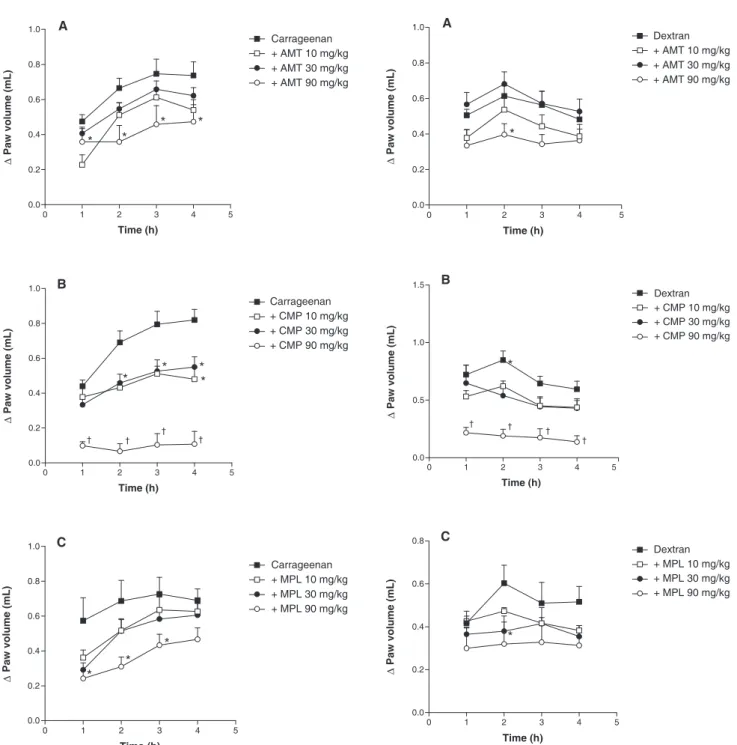
As demonstrated in Figures 1 and 2 respectively, the intraplantar injection of carrageenan or dextran induced marked paw edema, which peaked 3 h (carrageenan) and 2 h (dextran) after the stimulus injection. Administration of amitriptyline (Figures 1A and 2A), clomipramine (Figures 1B and 2B), and maprotiline (Figures 1C and 2C) significantly prevented the development of edema (p ,
0.01) at the highest doses tested (90 mg/kg). The most prominent effect was seen with clomipramine, which also inhibited edema formation at the dose of 30 mg/kg (p ,
0.05). Two-way ANOVA revealed a significant main effect for treatment (amitriptyline: F3,60 = 2.99, p , 0.05;
clomipramine: F3,60 = 25.57, p , 0.0001; maprotiline:
F3,60= 3.47, p = 0.0352) and time (amitriptyline: F3,60=
43.25, p , 0.0001; clomipramine: F3,60 = 25.55, p ,
0.0001; maprotiline: F3,60 = 40.96, p , 0.0001) in the
carrageenan model. This was also observed for the dextran model of inflammation regarding treatment (amitriptyline: F3,60 = 3.082, p , 0.001; clomipramine:
F3,54 = 7.69, p = 0.0016; maprotiline: F3,60= 1.61, p =
0.1603) and time (amitriptyline: F3,60= 13.70, p,0.0001;
clomipramine: F3,54 = 11.98, p , 0.0001; maprotiline:
F3,60= 2.67, p,0.05).
Anti-inflammatory effect of heterocyclic antidepressants partially depends on the modulation of neutrophil migration
amitriptyline (90 mg/kg), clomipramine (90 mg/kg), and maprotiline (40 mg/kg) significantly counteracted the chemotactic response of both carrageenan and fMLP (p,0.01) (Figures 3A and B).
Mast cell degranulation is inhibited by heterocyclic antidepressants
As observed in Figures 4 and 5, in vitro incubation of mesenteric tissues with compound 48/80 significantly Figure 2 Effect of heterocyclic antidepressants on dextran-induced paw edema in rats. Amitriptyline (A), clomipramine (B), and maprotiline (C) (10, 30 and 90 mg/kg, per os [p.o.]) and saline (10 mL/kg, p.o.) were administered 1 h before dextran (500 mg/0.1 mL/paw) injection. Edema formation (mL) was then measured hourly up to 4 h post-dextran injection and subtracted from basal paw volume. Data expressed as mean 6 standard error of the mean (n=6,
* p , 0.05 and { p
, 0.01 vs. dextran group). AMT = amitriptyline; CMP = clomipramine; MPL = maprotiline.
Figure 1 Effect of heterocyclic antidepressants on carra-geenan-induced paw edema in rats. Amitriptyline (A), clomi-pramine (B), and maprotiline (C) (10, 30, and 90 mg/kg, per os [p.o.]) and saline (10 mL/kg, p.o.) were administered 1 h before carrageenan (300 mg/0.1 mL/paw) injection. Edema formation (mL) was then measured hourly up to 4 h post-carrageenan injection and subtracted from basal paw volume. Data expressed as mean 6 standard error of the mean (n=6,*p,0.05 and{p
induced a notable mast cell degranulation (Figures 4B and C) when compared with tissues incubated with saline (Figures 4A and B, p,0.001). Furthermore, this effect was prevented (p,0.001) when animals were previously treated with amitriptyline (90 mg/kg, Figures 4E and F), clomipramine (90 mg/kg, Figures 4G and H), and maprotiline (40 mg/kg, Figures 4I and J). The percentage of degranulated cells is expressed in Figure 5.
Discussion
In the present study, we demonstrated that the hetero-cyclic antidepressants amitriptyline, clomipramine, and maprotiline exert anti-inflammatory effects by a mast cell-dependent mechanism and by inhibition of neutrophil migration. These observations were achieved by the classic protocols of carrageenan and dextran-induced paw edema, neutrophil migration in the 6-day-old rat air pouch, and mast cell degranulation in the rat mesentery.
In previous studies, the doses of amitriptyline, maproti-line, and clomipramine used to test their potential anti-inflammatory effects ranged from 5 to 80 mg/kg.4,8,13-16In all cases, these agents were given intraperitoneally, which partially explains the lower doses injected. In general, long-term treatment of patients with antidepres-sants involves oral administration. Therefore, in order to better mimic the clinical settings, gavage was used in our study as the preferential route of administration for the antidepressants tested. In addition, the oral route commonly requires higher doses of drugs due to several reasons, including lower bioavailability and erratic absorption.
Several published articles report the inhibitory effect of antidepressants on edema formation due to intraplantar injection of carrageenan.8,13-16 Despite progress regard-ing the mechanisms involved in the anti-inflammatory effect of these drugs, some questions remain to be Figure 4 Effect of heterocyclic antidepressants on mast cell degranulation. Animals were killed 1 h per os (p.o.) after treatment with amitriptyline (90 mg/kg), clomipramine (90 mg/kg), maprotiline (40 mg/kg), or saline (10 mL/kg, p.o.) and the mesenteric tissue was harvested. The tissue collected was incubated with compound 48/80 (0.8 mg/mL) and stained with 0.1% toluidine blue solution. A, C, E, G and I represent 100x magnification; B, D, F, H and J represent 400x magnification. Saline (A and B), compound 48/80 (C and D), amitriptyline + compound 48/80 (E and F), clomipramine + compound 48/80 (G and H), maprotiline + compound 48/80 (I and J).
answered. For instance, which inflammatory cells would be involved in the anti-edematogenic effect of antide-pressants? Do all antidepressant drugs share the same anti-inflammatory mechanism?
It is well known that the edematogenic effects of carrageenan and dextran occur through different path-ways.19 A biphasic inflammatory response due to carrageenan injection has been suggested,20 with the
participation of several inflammatory mediators, including prostaglandins, bradykinin, and serotonin,21 cytokine
production by resident macrophages, and neutrophil migration to the lesion site.21,22 On the other hand, dextran-induced edema is chiefly a result of mast cell degranulation. Therefore, the use of various experimental approaches is essential to better determine the mechan-ism through which anti-inflammatory substances produce their effects.
In our study, we demonstrated the protective effect of different antidepressants on both the carrageenan and dextran models of rat paw edema, suggesting that the function of both neutrophils and mast cells might be modulated by these drugs. Regarding carrageenan, our findings are in accordance with other studies.8,13-16 However, to the best of our knowledge, this is the first report of a protective effect of the tested drugs against dextran-induced edema.
It has been well established that polymorphonuclear (PMN) leukocyte infiltration plays an important role in the inflammation induced by carrageenan in the hind paw model. Additionally, taking into consideration that anti-depressants are potent inhibitors of edema formation in that animal model, we decided to test the hypothesis of an effect of these drugs on neutrophil recruitment. For that purpose, we used the air-pouch model. The rat air pouch is a cavity that differs from others, such as the peritoneum, by its absence of mast cells.23We intended
to investigate whether the tested antidepressant drugs would still produce an anti-inflammatory response in the absence of these cells.
We demonstrated that the effects of both carrageenan and the direct chemotactic factor fMLP were markedly inhibited by amitriptyline, clomipramine, and maprotiline. Several other studies have already stated the anti-inflammatory effect of antidepressants. Sacerdote et al.9 showed that clomipramine was able to block human neutrophil chemotaxis in vitro. The same authors also demonstrated a similar modulating effect on macro-phages in vivo.24 These authors attributed that activity over inflammatory cells to the cyclic chemical structure of clomipramine, noting that other non-cyclic antidepressant drugs, such as fluoxetine and fluvoxamine, do not modify cell migration. Sadeghi et al.16further showed that both local and intracerebroventricular administration of ami-triptyline elicits a marked reduction in the infiltration of PMN leukocytes into the carrageenan-treated paws, according to pathological examination and the activity of myeloperoxidase in the inflamed paw tissues. These findings were corroborated by Vismari et al.8by intravital microscopy, further showing the involvement of a 1-adrenoceptors in the anti-inflammatory effects of ami-triptyline. In addition, Hajhashemi et al.25 revealed that systemic administration of maprotiline reduces the development of carrageenan-induced paw edema in the rat. Maprotiline is also effective in decreasing edema when it is injected at the time of or after inducing inflammation.15
The participation of preformed mast cell products, such as serotonin and histamine, is the main mechanism involved in the short-lived edematogenic response elicited by dextran injection.19 In our study, all of the
tested antidepressants had a protective effect against dextran-induced edema. Lo et al.19demonstrated that the accumulation of protein-free filtrates induced by dextran is not affected by treatment with indomethacin, whereas the infiltration of plasma protein and neutrophils in response to carrageenan is inhibited, suggesting the involvement of different mediators. Taking into considera-tion the participaconsidera-tion of mast cells in dextran-induced edema, we assessed the possible effect of cyclic antidepressants on these cells. We observed a prominent effect of all drugs tested on preventing mast cell degranulation in the rat mesentery.
The mechanism through which tricyclic antidepres-sants can inhibit mast cell secretion was investigated by Clemons et al.26These authors suggested a reduction of intracellular calcium ion levels due to amitriptyline and prochlorperazine treatment. However, the modulating effect of antidepressants on mast cells seems to vary depending on the drug.27 As we showed in the present paper, an effect on mast cells might be a characteristic of most heterocyclic antidepressants.
In our opinion, some mechanistic aspects concerning the anti-inflammatory activity of antidepressants at the molecular level have yet to be elucidated. These aspects include their effects on cytokine release, the modulation of inflammatory pathways regulated by these mediators, Figure 5 Effect of heterocyclic antidepressants on mast cell
and, further, how leukocyte trafficking is affected both in acute and in chronic inflammation.
In summary, the results of the present study provide evidence of the modulating effect of heterocyclic anti-depressants on neutrophil migration and on mast cell stabilization. These findings might have an implication for the treatment of several inflammatory conditions, includ-ing allergic diseases.
Acknowledgements
We are grateful to Maria Silvandira Freire and Karina Felismino da Silva Santos for their technical assistance. This work was supported by Conselho Nacional de Desenvolvimento Cientı´fico e Tecnolo´gico (CNPq), Coordenac¸a˜o de Aperfeic¸oamento de Pessoal de Nı´vel Superior (CAPES), and Fundac¸a˜o Cearense de Apoio ao Desenvolvimento Cientı´fico (FUNCAP). Gerly Anne Castro Brito and Ronaldo Albuquerque Ribeiro are recipients of CNPq fellowships.
Disclosure
The authors report no conflicts of interest.
References
1 Brunton L, Parker K, Blumenthal D, Buxton I. Goodman & Gilman’s Manual of Pharmacology and Therapeutics. New York: McGraw Hill; 2008.
2 Mitra R, Jones S. Adjuvant analgesics in cancer pain: a review. Am J Hosp Palliat Care. 2012;29:70-9.
3 Magni G. The use of antidepressants in the treatment of chronic pain. A review of the current evidence. Drugs. 1991;42:730-48. 4 Bianchi M, Panerai AE. Antidepressant drugs and experimental
inflammation. Pharmacol Res. 1996;33:235-8.
5 Fishbain D. Evidence-based data on pain relief with antidepressants. Ann Med. 2000;32:305-16.
6 Vorobeychik Y, Gordin V, Mao J, Chen L. Combination therapy for neuropathic pain: a review of current evidence. CNS Drugs. 2011;25:1023-34.
7 Littrell JL. Taking the Perspective that a Depressive State Reflects Inflammation: Implications for the Use of Antidepressants. Front Psychol. 2012;3:297.
8 Vismari L, Alves GJ, Palermo-Neto J. Amitriptyline and acute inflammation: a study using intravital microscopy and the carragee-nan-induced paw edema model. Pharmacology. 2010;86:231-9. 9 Sacerdote P, Bianchi M, Panerai AE. Chlorimipramine and
nortripty-line but not fluoxetine and fluvoxamine inhibit human polymorpho-nuclear cell chemotaxis in vitro. Gen Pharmacol. 1994;25:409-12.
10 Capuron L, Hauser P, Hinze-Selch D, Miller AH, Neveu PJ. Treatment of cytokine-induced depression. Brain Behav Immun. 2002;16:575-80.
11 Corcos M, Guilbaud O, Hjalmarsson L, Chambry J, Jeammet P. Cytokines and depression: an analogic approach. Biomed Pharmacother. 2002;56:105-10.
12 Kulmatycki KM, Jamali F. Drug disease interactions: role of inflammatory mediators in depression and variability in antidepres-sant drug response. J Pharm Pharm Sci. 2006;9:292-306. 13 Bianchi M, Rossoni G, Sacerdote P, Panerai AE, Berti F. Effects of
chlomipramine and fluoxetine on subcutaneous carrageenin-induced inflammation in the rat. Inflamm Res. 1995;44:466-9.
14 Abdel-Salam OM, Nofal SM, El-Shenawy SM. Evaluation of the anti-inflammatory and anti-nociceptive effects of different antidepres-sants in the rat. Pharmacol Res. 2003;48:157-65.
15 Hajhashemi V, Sadeghi H, Minaiyan M, Movahedian A, Talebi A. Central and peripheral anti-inflammatory effects of maprotiline on carrageenan-induced paw edema in rats. Inflamm Res. 2010;59:1053-9.
16 Sadeghi H, Hajhashemi V, Minaiyan M, Movahedian A, Talebi A. A study on the mechanisms involving the anti-inflammatory effect of amitriptyline in carrageenan-induced paw edema in rats. Eur J Pharmacol. 2011;667:396-401.
17 Ribeiro RA, Flores CA, Cunha FQ, Ferreira SH. IL-8 causes in vivo neutrophil migration by a cell-dependent mechanism. Immunology. 1991;73:472-7.
18 Oliveira FA, Lima-Junior RC, Cordeiro WM, Vieira-Ju´nior GM, Chaves MH, Almeida FR, et al. Pentacyclic triterpenoids, alpha,-beta-amyrins, suppress the scratching behavior in a mouse model of pruritus. Pharmacol Biochem Behav. 2004;78:719-25.
19 Lo TN, Almeida AP, Beaven MA. Dextran and carrageenan evoke different inflammatory responses in rat with respect to composition of infiltrates and effect of indomethacin. J Pharmacol Exp Ther. 1982;221:261-7.
20 Vinegar R, Schreiber W, Hugo R. Biphasic development of carrageenin edema in rats. J Pharmacol Exp Ther. 1969;166:96-103. 21 Morris CJ. Carrageenan-induced paw edema in the rat and mouse.
Methods Mol Biol. 2003;225:115-21.
22 Cunha TM, Verri WA Jr, Schivo IR, Napimoga MH, Parada CA, Poole S, et al. Crucial role of neutrophils in the development of mechanical inflammatory hypernociception. J Leukoc Biol. 2008;83:824-32. 23 Kowanko IC, Gordon TP, Rozenbilds MA, Brooks PM,
Roberts-Thomson PJ. The subcutaneous air pouch model of synovium and the inflammatory response to heat aggregated gammaglobulin. Agents Actions. 1986;18:421-8.
24 Sacerdote P, Bianchi M, Panerai AE. In vivo and in vitro clomipramine treatment decreases the migration of macrophages in the rat. Eur J Pharmacol. 1997;319:287-90.
25 Hajhashemi V, Minaiyan M, Efthekhari M. Anti-Inflammatory activity of a selection of antidepressant drugs. IJPR. 2008;4:225-30. 26 Clemons A, Vasiadi M, Kempuraj D, Kourelis T, Vandoros G,
Theoharides TC. Amitriptyline and prochlorperazine inhibit proin-flammatory mediator release from human mast cells: possible relevance to chronic fatigue syndrome. J Clin Psychopharmacol. 2011;31:385-7.