American Journal of Biochemistry and Biotechnology 2 (1): 1-8, 2006 ISSN 1553-3468
© 2006 Science Publications
Corresponding Author: Mokhtar I. Yousef, Department of Environmental Studies, Alexandria University, Chatby 21526, P.O
P.O. BOX: 832, Alexandria, Egypt. Tel.: +203-429-5007; Fax: +203-428-57 92
Biochemical and Immunological Study on the Effects of Barley and its
Components as Hypoglycemic Agents in Diabetic Rats
1
Mokhtar I. Yousef,
2Medhat Haroun,
2Mohamed H. El-Masry
and
2Reham EA. Ateia
1
Department of Environmental Studies and
2Department of Bioscience & Technology, IGSR,
Alexandria University, Alexandria, Egypt
Abstract: The present study was carried out to investigate the hypoglycemic effect of barley (Hordeum vulgare L) and some of its components such as amino acids (L-leucine and L-glutamine) and chromium picolinate on some biochemical and immunological parameters of alloxan induced diabetic rats. Alloxan-diabetic rats were treated with barley water (10% w/v) at a dose 10 ml Kg-1 b.wt., chromium picolinate at 15 µg Kg-1 b.wt., L-leucine plus L-glutamine at 4.5 mg & 15 mg Kg-1 b.wt., and/or the combination of barley plus chromium plus L-leucine and L-glutamine at the same previous doses in the same water volume, respectively. Rats received the treatments in their drinking water for four weeks. The levels of glucose, immunoglobulin G (IgG), total lipids (TL), cholesterol, triglycerides (TG), low-density lipoprotein (LDL) and very low-density lipoprotein (VLDL) were significantly (P<0.05) increased, while high-density lipoprotein (HDL) decreased in plasma of alloxan-diabetic rats compared to control group. The activities of aspartate aminotransferase (AST), alanine aminotransferase (ALT), acid phosphatase (AcP) and alkaline phosphatase (AlP) were significantly (P<0.05) decreased in both plasma and liver of alloxan-diabetic rats. On the other hand, the activity of lactate dehydrogenase (LDH) decreased in plasma and increased in liver of alloxan-diabetic rats. Treatment of the alloxan-diabetic rats with repeated doses of any one of the three treatments alone could restore the changes of the above parameters to their normal levels after four weeks of treatment. However, treatment with the combination of all together did not show complete restoration. Furthermore, the electron microscope results were supported biochemical and immunological findings. The present results showed that barley, amino acids and chromium picolinate exerted antihyperglycemic effects and consequently may alleviate liver damage caused by alloxan-induced diabetes.
Key words: Rats, diabetes, alloxan, barley, amino acids, chromium picolinate, IgG
INTRODUCTION
The number of people diagnosed with type II diabetes mellitus is increasing at an alarming rate in western societies and has become a major health concern [1].Eastman et al. [2] demonstrated that treating type II diabetic patients with the goal of achieving normoglycemia can be estimated to cost approximately $16,000 per quality-adjusted life year gained. It is, therefore important to examine various strategies for improving glycemic control in patients with type II diabetes. With the appearance during the past few years of several new anti-diabetic agents, the task of choosing the most appropriate therapy for patients has become more complex. Efficacy, patient acceptability, side effects, and cost are important issues to be considered in developing therapeutic regimens [3].
Medicinal plants continue to provide valuable therapeutic agents, both in modern medicine and in traditional system [4-7]. Medicinal plants also offer good prospects to finding new drugs particularly against
since most of drugs are metabolized mainly by the cytochrome P450 system.
Barley, Hordeum vulgare L., Family; Germinaceae, is the most nutritious food on earth, it contains a balance of many minerals, amino acids, fibers and enzymes. It is used to support the body’s own self-healing mechanisms. The components of barley aid the body in maintaining cells in a healthy condition and work to correct abnormalities. Barley has been used as an aid in the treatment of a variety of conditions such as arthritis, digestive diseases, diabetes, skin abnormalities, weight loss, detoxifying and cancer [10]. In addition, it was postulated that the beneficial effect of barley might be explained by its high content of chromium [11].
Many studies serve to illustrate the beneficial effect of chromium in subjects consuming normal diet with normal life styles. Chromium has been shown to improve the signs and/or symptoms of diabetes in people with glucose intolerance, type I and type II, gestational and steroid induced diabetes [12-14]. Also, barley is rich with amino acids and it was reported that leucine with other amino acids can induce glycogen synthesis in muscle after exercise, thereby increasing glucose utilization. leucine in combination with L-glutamine and other amino acid acts as a non-glucose insulin secretagogue, increasing insulin secretion from diabetic pancreas [15].
Therefore, the present study aimed to investigate the hypoglycemic effect of barley and some of its components such as amino acids (leucine and L-glutamine) and chromium on some biochemical and immunological parameters of alloxan induced diabetic rats compared to control group.
MATERIALS AND METHODS
Preparation of barley water and tested compounds: Pearl barley, Hordeum vulgare L., was used in this study and it was obtained from the local markets, Alexandria, Egypt. Barley was washed in cold water and then boiled with distilled water at 10% (w/v) for about 20 minutes, then filtered through three layers of clean sterile Miracloth (Calbiochem, USA) with gentle press to obtain most of barley water. Chromium picolinate (CHROMIUM® capsules) was purchased from MEPACO Co., Cairo, Egypt, and was dissolved in distilled water at 250 µg L-1. Amino acids; L-glutamine and L-leucine; obtained from El-gomhoreya Co., Alexandria, Egypt. They were dissolved in distilled water at 75 gm and 25 gm L-1, respectively. Their combination was also prepared by dissolving chromium, L-glutamine and L-leucine in distilled water at 250 µg, 75 gm and 25 gm L-1, respectively. Barley water at a ratio of 1:25 (v/v) was added to 1 liter of the mixture.
Animals and treatment:
Forty-eight rats weighing 200-250 gm in average were obtained from Abo-Rawash farm, Egypt. Rats were housed in standard cages, where feed and water were supplied ad libitum. After two weeks of acclimation, animals were divided into two groups. The first group (8 rats) was used as control and received double distilled water as vehicle. The second group (40 rats) was injected subcutaneously (s.c.) two times with alloxan at 60 mg Kg-1 b.wt. in two successive days, and divided into five subgroups (8 rats per each) after stabilization of diabetes for 1 week. The first subgroup was kept as diabetic. The second subgroup was supplied with barley water (D+B) at 10 ml Kg-1 b.wt. Third subgroup was received chromium picolinate (D+Cr) at 15 µg Kg-1
b.wt. and fourth subgroup was supplied with L-leucine and L-glutamine (D+AA) at 4.5 mg & 15 mg Kg-1 b.wt., respectively. The fifth subgroup was administered with the combination of barley, chromium, L-leucine and L-glutamine at the same previous doses in the same water volume (D+Comb.). Animals were received the treatment in their drinking water for 4 weeks.
Enzyme assessments:
spectrophtometrically quantified. Plasma and liver lactate dehydrogenase (LDH, EC 1.1.1.27) activity was determined by the method of Cabaud and Wroblewski [18]
.
Biochemical assays:
The concentrations of glucose were determined with kits from Biosystems, S.A. Costa Brava, 30-Barcelona (Spain). Plasma concentration of total lipids also was determined according to the method of Knight et al. [19]. Plasma concentration of cholesterol and triglycerides (TG) were determined according to the methods of Carr et al. [20]. High-density lipoprotein-cholesterol (HDL-c) and low-density lipoprotein-cholesterol (LDL-c) were determined according to the methods of Warnick et al. [21]
and Bergmenyer [22], respectively. Very low-density lipoprotein-cholesterol (VLDL-c) was calculated by dividing the values of TG by factor of 5.
Immunoglobulin G measurement by ELISA:
G o a t a n t i - mo u s e immunoglobulin G (I gG ) a n t i se r u m, st a nd a r d mo u se I g G , goat anti-mouse IgG conjugated to HRP and tetramethylbenzidine we r e purchased from Sigma (Sigma-Aldrich Company Ltd., UK) and all other chemicals were supplied from BDH (VWR International Ltd., UK). Immunoglobulin G was measured using the method of Engvall [23].
Electron microscopy:
Transmission electron microscopy (TEM) was carried out on pancreas specimen taken immediately after animal scarification. The specimen was subsequently processed for electron microscopy [24, 25]. Statistical analysis:
Statistical analysis was performed using the SPSS statistical software package (Statistical Package for the Social Sciences, Salem, OR, USA). Data are presented as means with their standard errors. Normality and homogeneity of the data were confirmed before ANOVA; differences among the control, diabetic and treated groups were assessed by one-way ANOVA followed by Scheffe test to analyze specific differences between means.
RESULTS
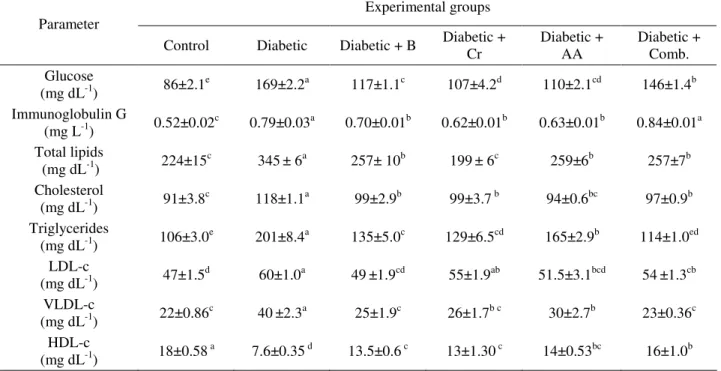
The effects of administration of barley, chromium, amino acids (L-leucine and L-glutamine) and/or their combination on plasma levels of glucose, immunoglobulin G (IgG), total lipids (TL), cholesterol, triglycerides (TG), high density lipoprotein-cholesterol (HDL-c), low density lipoprotein-cholesterol (LDL-c) and very low density lipoprotein-cholesterol (VLDL-c) are presented in Table 1. The experimentally induced-diabetes increased (P<0.05) the level of plasma glucose by 97.5% of control level (Table 1), however, treatment of alloxan-diabetic rats with barley, chromium, amino acids and/or their combination reduced their plasma
glucose levels by 69, 63, 64.5 and 86%, respectively compared with the diabetic group.
Also, in alloxan-diabetic rats, the concentrations of plasma IgG, TL, TG, cholesterol, LDL and VLDL of alloxan diabetic rats were significantly (P<0.01) increased by 52, 54, 89, 30, 28 and 82%, respectively compared to control group values, whereas HDL level of diabetic rats was significantly decreased by 42% (Table 1). While, after treatment of alloxan-diabetic rats with barley, chromium, amino acids (leucine and L-glutamine) and/or their combination, the levels of these parameters were significantly (P<0.05) decreased as compared with the mean values of diabetic group (Table 1).
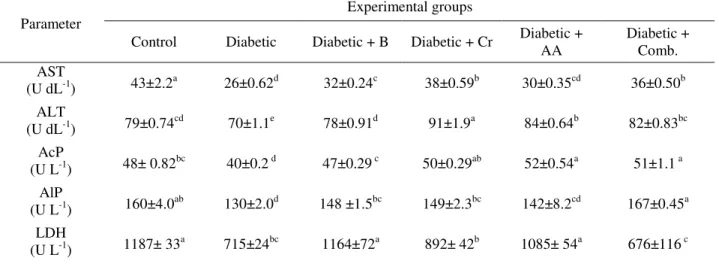
In alloxan-diabetic rats the activities of plasma AST, ALT, AlP, Acp and LDH were significantly (P<0.05) decreased by 39, 11, 17, 19 and 40%, respectively, relative to their normal levels (Table 2). In addition, the activities of AST, ALT, AlP and AcP were also significantly (P<0.05) decreased in the liver tissue of alloxan-diabetic rats by 35, 25, 8 and 41%, respectively compared to the control values (Table 3).
reticulum, while it showed a bi-nuclei cell that may be indication of bad effect of the overdose.
DISCUSSION
Barley contains many different amino acids, so the hypoglycemic effect of barley (Table 1) may be explained by its content of amino acids and/or chromium. This finding is consistent with Naismith et al. [26] and Mahdi and Naismith [11] who reported that diet-containing barley had a modulating effect on the symptoms of diabetes when compared with a starch or sucrose based diet.
The present study also showed that chromium affect the blood glucose level in alloxan-diabetic rats, and this is in agreement with the results obtained by Ravian et al. [27] and Anderson et al. [28] in patients with type I and II diabetes mellitus. Chromium is a key component of glucose tolerance factor (GTF) which enhances the action and function of insulin by increasing its binding to cells, number of receptor, and phosphorelation of receptors leading to increase insulin sensitivity [29]. The control of plasma glucose level caused by amino acids (Table 1) is supported by Vanloon et al. [15] who reported that the increase in plasma insulin concentration have been observed in rats after the infusion of free amino acids. Li et al. [30] supported these results, which found that leucine induced insulin secretion by augmenting glutaminolysis through activation of glutaminase and glutamine dehydrogenase in isolated rat islets. Also, L-glutamine a component of barley enhances insulin release acts as a non-glucose insulin secretagogue evoked by L-leucine in isolated rat pancreatic islets [31]. The combination of barley, chromium and amino acids presents an unexpected result. It reduced the plasma glucose level by lesser degree than each treatment alone (13.6% of diabetic group). This result may be explained by the high dose effect, due to addition of the excess of chromium and amino acids to already present in barley. Diabetic rats showed a significant (P<0.01) increase in the levels of plasma IgG compared to normal control group and this finding is consistent with the finding of Isomaa et al. [32]
. Treatment of alloxan-diabetic rats with barley, chromium and amino acids caused a significant decrease in the elevation of IgG compared to diabetic group. Chromium supplementation in mouse diets has been effective in reducing stress-induced losses of zinc, iron, copper and manganese in urine. The exact mechanism by which chromium enhances the immune system is not known. However, one consistent result of the studies was that chromium reduces serum cortisol levels. Glucocorticoids, which include cortisol, are known to suppress the immune [33]. Also, chromium supplementation increased proliferation of peripheral blood lymphocytes in terms of increased blastogenic activity of peripheral blood lymphocytes [34]. Change
and Mowat [35], who reported an improvement of IgM and total Immunoglobulin levels reported additional evidence on the enhancing effect of chromium on humoral immunity. Treatment of diabetic rats with amino acids showed also immunity improvement, which explained by restore the normal level of plasma IgG. The lack of dietary amino acids results in diminished protein synthesis in all tissues. One of side effects of protein underfeeding is impaired immune system and susceptibility to infections [36]. This fact may explain why amino acids improved immune system. It’s clear that barley has immune suppressive function as it contains chromium and many amino acids as source of protein. However, treatment with the combination showed significant increase in the levels of IgG compared to control group. This may reflect the over dose effect of the combination and may development of certain immunoglobulin against this trigger. Interestingly, this finding is consistent with Isomaa et al. [32] who reported that; the changes in total immunoglobulin concentrations at onset may reflect exposure to environmental triggers; such as viral infections or to (relative) insulinopenia prior to clinical disease onset.
It was reported that hypertriglyceridemia, hypercholesterolemia and reduced HDL level were commonly seen in diabetes [5, 37]. It has been suggested that either the removal of triglycerides from the circulation or its entry into the circulation or both was impaired in non-insulin-dependent diabetics [38]. The present results showed high significant increases in plasma TL, TG, cholesterol, LDL and VLDL, also a decrease in HDL level (Table 1), and this is in agreement with those found in alloxan-diabetic rats [5]. Treatment with barley, chromium and amino acids and/or their combination resulted in improvements in plasma lipid profile (Table 1).
Barley is rich in soluble fiber beta-glucan and it is contributes to lowering blood cholesterol level [39]. The mechanism involved in reduction of diabetic hypercholesterolemia by treatment of barley has yet to be elucidated although several hypotheses have been advanced. There is strong evidence that the soluble polysaccharide beta-glucan present in barley was related to hypocholesterolemic effect by many mechanisms. The soluble beta-glucan is bind bile acids in the small intestine, these bile acids are synthesized in the liver from cholesterol and secreted into the small intestine. The fiber-bile acids complex prevents bile acids from being reabsorbed from the small intestine,
enhancing the secretion of bile acids, to replace the lost acids; cholesterol is drawn from the circulation for the production of bile acids, thereby reducing the blood cholesterol levels.
Other proposed mechanism for the reduction of blood cholesterol by the fibers include, the soluble polysaccharides were fermented in the colon. This molecule is absorbed and taken to the liver where it has inhibitory effect on the activity of hydroxymethylglutaryl-CoA-reductase, thus reducing de novo cholesterol synthesis [40]. Also, tocols (tocopherols and tocotrienols) have been identified as another minor component in barley with value-added potential. Weber et al. [41] reported that tocotrienols had ability to lower serum cholesterol. Other suggestion that the hypolipidemic effect of barley may contributed to presence of some saponins. Sidhu et al. [42] reported that saponins increased the cholesterol secretion to 65.8%, and stimulated lipoprotein lipase activity and might stimulate the enzymes relating to the metabolism of lipid including cholesterol. Other studies have found that saponins in the high cholesterol diet of rats reversed the hypercholesteremia and increased both the rate of bile acid secretion and the fecal excretion of bile acids and neutral sterols [43].
Table 1: Plasma glucose, immunoglobulin G and lipid profile in control, diabetic and diabetic treated rats with barley (B), chromium (Cr), amino Acids (AA) and their combination (Comb.)
Experimental groups Parameter
Control Diabetic Diabetic + B Diabetic + Cr
Diabetic + AA
Diabetic + Comb. Glucose
(mg dL-1) 86±2.1 e
169±2.2a 117±1.1c 107±4.2d 110±2.1cd 146±1.4b Immunoglobulin G
(mg L-1) 0.52±0.02 c
0.79±0.03a 0.70±0.01b 0.62±0.01b 0.63±0.01b 0.84±0.01a Total lipids
(mg dL-1) 224±15 c
345± 6a 257± 10b 199± 6c 259±6b 257±7b Cholesterol
(mg dL-1) 91±3.8 c
118±1.1a 99±2.9b 99±3.7 b 94±0.6bc 97±0.9b Triglycerides
(mg dL-1) 106±3.0 e
201±8.4a 135±5.0c 129±6.5cd 165±2.9b 114±1.0ed LDL-c
(mg dL-1) 47±1.5 d
60±1.0a 49±1.9cd 55±1.9ab 51.5±3.1bcd 54±1.3cb VLDL-c
(mg dL-1) 22±0.86 c
40±2.3a 25±1.9c 26±1.7b c 30±2.7b 23±0.36c HDL-c
(mg dL-1) 18±0.58 a
7.6±0.35 d 13.5±0.6 c 13±1.30 c 14±0.53bc 16±1.0b Values are the means of eight rats (Mean ± SE)
Within row, means with different superscript letter (a-e) differ significantly (P<0.01).
Table 2: Assay of plasma enzyme activities in control, diabetic and diabetic treated rats with barley (B), chromium (Cr), amino Acids (AA) and their combination (Comb.)
Experimental groups Parameter
Control Diabetic Diabetic + B Diabetic + Cr Diabetic + AA
Diabetic + Comb. AST
(U dL-1) 43±2.2a 26±0.62d 32±0.24c 38±0.59b 30±0.35cd 36±0.50b
ALT
(U dL-1) 79±0.74cd 70±1.1e 78±0.91d 91±1.9a 84±0.64b 82±0.83bc
AcP
(U L-1) 48± 0.82bc 40±0.2 d 47±0.29 c 50±0.29ab 52±0.54a 51±1.1 a AlP
(U L-1) 160±4.0ab 130±2.0d 148 ±1.5bc 149±2.3bc 142±8.2cd 167±0.45a LDH
(U L-1) 1187± 33a 715±24bc 1164±72a 892± 42b 1085± 54a 676±116 c Values are the means of eight rats (Mean ± SE)
Within row, means with different superscript letter (a-e) differ significantly (P<0.01).
Table 3: Assay of liver enzyme activities in control, diabetic and diabetic treated rats with barley (B), chromium (Cr), amino Acids (AA) and their combination (Comb.)
Experimental groups Parameter
Control Diabetic Diabetic + B Diabetic + Cr Diabetic + AA Diabetic + Comb. AST*
178±3.5a 116±0.93c 113±1.7c 127±1.4b 129±1.3b 111±1.0c
ALT*
213±6.1a 160±2.8c 165±3.7bc 175±1.3b 163±2.9c 167±6.4bc
AcP*
87±1.2b 80±0.55c 82±1.5c 88± 0.90b 95±1.3a 54±0.93d
AlP*
225 ±16a 133±12d 168±7bc 183± 10bc 195±15ab 151±2cd
Values are the means of eight rats (Mean ± SE)
Within row, means with different superscript letter (a-e) differ significantly (P<0.01).
* IU mg-1: international unit, the amount of the enzyme that under defined assay conditions will catalyze 1 mole of substrate per minute, per mg protein.
Chromium and amino acids showed a significant improvement in the lipid profile of alloxan-diabetic rats (Table 1). This observation is consistent with the results of Lien et al. [44] that indicated that insulin with its stimulated biological activity due to dietary chromium could increase the lipoprotein lipase activity and eventually decrease the content of triglycerides-rich lipoproteins. It also can increase liver LDL receptors, thereby reducing the LDL content. Therefore, the hypoglycemic effect of barley may be also due to its content of chromium. Also, Stone and Vanthiel [45] reported that the hypercholesterolemic effect of dietary amino acids is associated with down regulation of hepatic LDL receptors.
The decrease in the activities of plasma and liver AST, ALT, LDH, AlP and Acp (Tables 2 and 3)
indicated that diabetes may be induced hepatic dysfunction [4,7] and impaired synthesis of enzymes themselves from its store in liver. Thus the metabolic abnormalities caused by diabetes may result in disturbance of some metabolic enzyme synthesis. Supporting our finding it has been found by Larcan et al. [46] that liver was necrotized in diabetic patients. However, treatment of alloxan diabetic groups with barley water, chromium, amino acids and/or their combination for 28 consecutive days could restore the activities of the above enzymes to their normal levels. A possible explanation for the differential effects of barley and its components on the activities of these enzymes is that the treatments may inhibit the liver damage induced by alloxan.
structure of beta-cells of alloxan-diabetic rats (Fig. 1 b) is consistent with studies of Lanzen and Paten [48] who reported that the injection of alloxan into experimental rats caused a selective specific necrosis of beta cells of the islets of Langerhans resulting in diabetes mellitus.
The recovery of β-cells of alloxan-diabetic rats treated with barley is support by the finding of Scheer [49]
, who stated that barley is used to support the body’s own self-healing mechanisms and the components of barley aid the body in maintaining cells in healthy condition and work to correct abnormalities. The promising effect of chromium on pancreatic β-cells may be explained with the fact that chromium is directly affects certain genetic processes as ribonucleic acid (RNA) synthesis [50].
The present study demonstrated that treatment of diabetic rats with barley and some of its components (chromium and amino acids) could repair liver damage and restoring pancreatic β-cells deformation. This was manifested by the biochemical and immunoassay results and electron microscope study where the hypoglycemic and hypolipidemic action of barley may be due to its contents generally and in specific to its content of chromium and/or amino acids.
REFERENCES
1. Carl, C., 2003. Novel targets and therapeutic strategies for type 2 diabetes. Trends in Endocrinology and Metabolism 14: 169-175. 2. Eastman, R.C., Javitt, J.C., Herman, W.H. and
Dasbach E.J., 1997. Model of complications of NIDDM. II. Analysis of the health benefits and cost-effectiveness of treating NIDDM with the goal of normoglycemia. Diabetic Care 20: 735-44. 3. Day, J., Blonde, L. and Guthrie, R., 2000. Factors influencing patient acceptability of diabetes treatment regimes. Clinical Diabetics 18: 61-67. 4. Mansour, H.A., Al-Sayeda A. Newairy, Yousef,
M.I. and Sheweita, S.A., 2002. Biochemical study on the effects of some Egyptian herbs in alloxan-induced diabetic rats. Toxicology 170: 221-228. 5. Newairy, A.A., Mansour,H.A., Yousef, M.I. and
Sheweita, S.A. (2002). Alterations of lipid profile in plasma and liver of diabetic rats: effect of hypoglycemic herbs. Journal of Environmental Science and Health, B37: 475-484.
6. Sheweita, S.A., Newairy, A.A., Mansour, H.A. and Yousef, M.I., 2002. Effect of some hypoglycemic herbs on the activity of phase I and II drug-metabolizing enzymes in alloxan-induced diabetic rats. Toxicology 174: 131-139.
7. Demerdash, F.M., Yousef, M.I. and Abou El-Naga, N.I., 2005. Biochemical study on the hypoglycemic effects of onion and garlic in alloxan-induced diabetic rats. Food and Chemical Toxicology 43: 57-63.
8. Day, C. 1998. Traditional plant treatments for diabetes mellitus: pharmaceutical foods. British Journal of Nutrition 80: 5-6.
9. Gray, A. M. and Flatt, P. R., 1998. Actions of traditional antidiabetic plant, Agrimony eupatoria (agrimony): effect on hyperglycemia, cellular glucose metabolism and insulin secretion. British Journal of Nutrition 80: 109- 114.
10. Khorasani, G.R., Jedel, P.E., Helm, J.H. and Kennelly, J.J., 1997. Influence of stage of maturity on yield components and chemical composition of cereal grain silages. Canadian Journal of Animal Science 77: 259-267.
11. Mahdi, G.S. and Naismith, D.J., 1991. Role of chromium in barley in modulating the symptoms
of diabetes. Annual Nutrition Metabolism 35: 65-70.
12. Cefalu, W.T., Bell-Farrow, A.D., Stegner, J. and Wang, Z.Q., 1999. Effect of chromium picolinate on insulin sensitivity in vivo. Journal of Trace Elements and Experimental Medicine 71: 84-92. 13. Jovanovic, L., Gutierrez, M. and Peterson, C.M.,
1999. Chromium supplementation for women with gestational diabetes mellitus. Journal Trace Elements and Experimental Medicine, 12: 91-97. 14. Ravina, A., Slezak, L., Mirsky, N., Bryden, N.A.
and Anderson, R.A., 1999. Reversal of corticosteroid induced diabetes with supplemental chromium. Diabetic Medicine, 16: 164-167. 15. Vanloon, I. J., Saris, W.H., Verhagen, H. and
Wagenmakersm A.J., 2000. Plasma insulin responses after ingestion of different amino acids or protein mixtures with carbohydrate. American Journal of Clinical Nutrition, 72: 96-105.
16. Principato, G.B., Asia, M.C., Talesa, V., Rosi, G. and Giovannini, E., 1985. Characterization of the soluble alkaline phosphatase from hepatopancreas of Squilla mantis L. Comparative Biochemical Physiology, B80: 801-804.
17. Moss, D.W., 1984. Methods of Enzymatic Analysis, 3rd ed., Bergmeyer, H.U. (Ed.), Verlag-Chemie. 4, 92-106.
18. Cabaud, P.C. and Wroblewski, F., 1958. Calorimetric measurement of lactate dehydrogenase activity of body fluids. Journal of Clinical Pathology, 30: 234-236.
19. Knight, J.A., Anderson, S. and Rawle, J.M., 1972. Chemical basis of the sulfo-phspho-vanillin reaction for estimating total serum lipids. Clinical Chemistry, 18: 199-202.
20. Carr, T., Andressen, C.J. and Rudel, L.L., 1993. Enzymatic determination of triglyceride, free cholesterol and total cholesterol in tissue lipid extracts. Clinical Chemistry, 26: 39–42.
22. Bergmenyer, H.U., 1985. Methods of enzymatic analysis, 3rd ed., VIII, pp. 154-160.
23. Engvall, E., 1977. Quantitative enzyme linked immumoassay (ELISA) in microbiology. Medical Biology, 55: 193-202.
24. Maunasbach, A., 1999. Biomedical Electron Microscopy. Academic Press, New York, USA. 25. Hayat, M.A., 2000. Principals and Techniques of
Electron Microscopy: Biological Applications, 4th ed., Cambridge University press, UK.
26. Naismith, D.J., Mahdi, G.S. and Shakir, N.N., 1991. Therapeutic value of barley in the management of diabetes. Annual Nutrition Metabolism, 35: 61-64.
27. Ravina, A., Slezak, L., Rubal, A. and Mirsky, N., 1995. Clinical use of the trace element chromium (III) in the treatment of diabetes mellitus. Journal of Trace Elements and Experimental Medicine, 8: 183-190.
28. Anderson, R.A., Cheng, N., Bryden, N.A. and Polansky, M.M., 1997. Elevated intakes of supplemental chromium improve glucose and insulin variables of people with type II diabetes mellitus. Diabetes, 46: 1786-1791.
29. Vincent, J.B., 1999. Elucidating a biological role for chromium at a molecular level. Accounts of Chemistry Research, 33: 304-501.
30. Li, C., Najafi, H., Daikhin, Y. and Nissim, I.B., 2003. Regulation of leucine-stimulated insulin secretion and glutamine metabolism in isolated rat islets. Journal of Biological Chemistry, 278: 2853-2858.
31. Mailaisse, W.J., Carpinelli, A.R., Lebrun, P., Herchuelz, A. and Sener A., 1981. The stimulus secretion coupling of amino acids induced insulin release. IV. One response to leucine and L-glutamine. Pflugers Archives, 391: 112-118. 32. Isomaa, B., Almgren, P., Henricsson, M.,
Taskinen, M.R., Tuomi, T., Groop, L. and Sarelin, L., 1999. Chronic complications in patients with slowly progressing autoimmune type I diabetes (LADA). Diabetic Care, 8: 1347-1353.
33. Mohamed, F.F. and Afifi, M., 2001. Role of inorganic chromium in performance and immunity in Broilers. Veterinary Medicine Journal, Giza, 49: 147-162.
34. Cerulli, J., Grabe, D.W., Guthier, I. and Malone, M., 1998. Chromium picolinate toxicity. Analytical Pharmacology, 32: 349-360.
35. Chang, X. and Mowat, D.N., 1992. Supplemental chromium for stressed and growing feeder calves. Journal of Animal Science, 70: 559-565.
36. Ingebritsen, T.S. and Cohen, P., 1983. Protein phosphatase: properties and effect on cellular regulation. Science (Wash. D.C.), 221: 331-339.
37. Colca, J.R., Dailey, C.F., Palazuk, B.J., Hillimen, R.M., Dinh, D.M., Melchior, G.W. and Spilman, C.H., 1991. Pioglitazone hydrochloridc inhibits cholesterol absorption and lowers plasma cholesterol concentrations in cholesterol–fed rats. Diabetes, 40: 1669-1674.
38. Sharma, R.D. and Raghuram, T.C. 1990. Hypoglycemic effect of fenugreek seeds in non – insulin dependent diabetic subject. Nutrition Research, 10: 731–739.
39. Wursch, P. and Pi-Synner, F.X., 1997. The Role of viscous soluble fiber in the metabolic control of diabetes. Diabetic Care, 20: 1774-1780.
40. Chen, W.L. and Anderson, J.W., 1986. Hypercholesterolemic Effects of Soluble Fibers. In Dietary Fiber: Basic and Clinical Aspects. Kritchevesky, D. and Vahouny, G.V. (Eds). Plenum press, New York.
41. Weber, F.E., Chaudhary, V.K. and Qureshi, A.A., 1991. Suppression of cholesterol biosynthesis in hypercholesterolemic subjects by tocotrienol of barley ingredients made from brewers grain. Cereal Foods World, 36: 680.
42. Sidhu, R.S., Upson, B. and Makinow, M.R., 1987. Effects of soy saponins and tigogenin cellobiosidee on intestinal uptake of cholesterol, cholate and glucose. Nutrition, 35: 615-620. 43. Sauvaire, Y., Ribes, G., Baccou, J.C. and
Loubatieres-Mariani, M.M., 1991. Implication of steroid saponins and sapogenins in the hypocholesterolemic effect of fenugreek. Lipids, 26: 191-197.
44. Lien, T.E., Horng, Y.M. and Yang, K.H., 1999. Performance, serum characteristics, carcase traits and lipid metabolism of broilers as affected by supplement of chromium picolinate. British Pollution Science, 40: 357-363.
45. Stone, B.E. and Vanthiel, D.H., 1985. Diabetes mellitus and the liver. Sem. Liver Diseases, 5: 8-28.
46. Larcan, A., Lambert, H., Laprevote-Heully, M.C. and Delorme, N., 1979. Light and electron microscopic study of hepatic lesions in the course of hyperlactatemia in diabetic patients. Diabetes Metabolism, 5: 103–112.
47. Jorns, A., Munday, R., Tiedge, M. and Lenzen, S., 1997. Comparative toxicity of alloxan, N-alkylalloxans and ninhydrin to isolated pancreatic
islets in vitro. Journal of Endocrinology, 155: 283-293. 48. Lanzen, S. and Panten, U., 1988. Alloxan: history
and mechanism of action. Diabetologia, 31: 337-342.
49. Scheer, J.F., 1997. Better Nutrition: The Color of Life. Whitaker, J. & Heali.