Comparison of APACHE II and three abbreviated APACHE II scores
for predicting outcome among emergency trauma patients
JORGE ROBERTO POLITA1,JUSSARA GOMEZ1, GILBERTO FRIEDMAN3*,SÉRGIO PINTORIBEIRO2
1 São Vicente de Paulo Hospital – University of Passo Fundo, Passo Fundo, RS, Brazil. 2 Federal University of Rio Grande do Sul – Medical School, Porto Alegre, RS, Brazil.
3 Federal University of Rio Grande do Sul – Medical School – Graduate Program in Pulmonology, Porto Alegre, RS, Brazil.
SUMMARY
Work conducted at the São Vicente de Paulo Hospital, Passo Fundo, RS, Brazil
Article received: 8/23/2013
Accepted for publication: 1/13/2014
*Correspondence:
Address: Rua Fernandes Vieira 181/601, ZIP 90035-091 Porto Alegre, RS - Brazil Phone/Fax: +55 51 3395 8223 [email protected]
http://dx.doi.org/10.1590/1806-9282.60.04.018
Conflict of interest: none
Objective: to compare the ability of the APACHE II score and three different
ab-breviated APACHE II scores: simpliied APACHE II (s-APACHE II), Rapid Acu-te Physiology score (RAPS) and Rapid Emergency Medicine score to evaluaAcu-te in--hospital mortality of trauma patients at the emergency department (ED).
Methods: retrospective analysis of a prospective cohort study. All patients’ vic-tims of trauma admitted to the ED, during a 5 months period. For all entries to the ED, APACHE II score was calculated. APACHE II system was abbreviated by excluding the laboratory data to calculate s-APACHE II score for each patient. Individual data were reanalyzed to calculate RAPS and REMS. APACHE II sco-re and its subcomponents wesco-re collected, and in-hospital mortality was asses-sed. The area under the receiver operating characteristic (AUROC) curve was used to determine the predictive value of each score.
Results: 163 patients were analyzed. In-hospital mortality rate was 10.4%. s-APA-CHE II, RAPS and REMS scores were correlated with APAs-APA-CHE II score (r2 = 0.96,
r2 = 0.82, r2 = 0.92; p < 0.0001). Scores had similar accuracy in predicting
morta-lity ([AUROC 0.777 [95% CI 0.705
to
0.838] for APACHE II, AUROC 0.788 [95% CI 0.717to
0.848] for s-APACHE II, AUROC 0.806 [95% CI 0.737to
0.864] for RAPS, AUROC 0.761 [95% CI 0.688to
0.824] for REMS.Conclusion: abbreviated APACHE II scores have similar ability to evaluate
in--hospital mortality of emergency trauma patients in comparison to APACHE II score.
Keywords: APACHE, injury severity score, trauma severity indices, trauma,
mor-tality.
I
NTRODUCTIONIllness severity scoring systems have become important tools for studying patient outcomes. Early efforts to mea-sure the eficacy of trauma centers and trauma systems assessed the rates of preventable mortality. The risk stra-tiication of trauma patients has traditionally focused on anatomic or physiologic scores speciic to trauma popu-lations. Trauma scoring systems were initially developed to triage patients in the ield and needed to be straight--forward and user friendly. There are several systems such as the triage Revised Trauma Score, Triage Score, and Trauma and Injury Severity Score (TRISS) for predicting
the severity of trauma patient’s conditions along with pa-tient outcomes.1,2
Although APACHE II score has not been validated as a speciic prognostic tool for trauma patients, several studies have shown its value to evaluate prognosis of trauma pa-tients.4-6 Criticisms of the use of APACHE II in the trauma
population have been based primarily on the poor correla-tion between APACHE II and ISS or TRISS, and the inabi-lity of APACHE II to accurately predict hospital or intensi-ve care unit length of stay.7 Importantly, the criticism has
not been based on an inability to predict death. In fact, when APACHE II has been evaluated as a predictor of clinical out-comes in trauma patients it has proven to be a useful pre-dictor, particularly those who are critically injured.4,6,8 In a
previous study we have previously shown that APACHE II is a useful score to help triage and to predict in-hospital mor-tality in 163 trauma patients both at the ED and ICU.9 On
the other hand, risk adjustment score in the emergency care would use a limited number of variables that can be easily collected at presentation, to provide an accurate prediction of an important outcome such as mortality. Not surprising, APACHE II score implementation as a routine tool to eva-luate trauma in our emergency department was abandoned during the next years. The main reason was that APACHE II score uses so many biochemical variables that turns it non--practical for a rapid evaluation of severity of disease in the
ED, although adequate in the ICU setting.
Considering this particular dificulty for implementa-tion of APACHE II in emergency scenario, we decided to reassess the data and found that the vast majority of labo-ratory data were normal or slightly altered. This inding is not surprising, because trauma acute changes of laboratory variables are not expected.1 Thus we proposed a simpliied
APACHE II version (s-APACHE II), excluding the laboratory variables to evaluate trauma patients in the ED. Early in the last decade, other scores based on APACHE II, like RAPS (Rapid Acute Physiology score) and REMS (Rapid emergency medicine score), were evaluated in the emergency room and out-hospital medical and surgical acutely ill patients.10-12
RAPS is an abbreviated version of APACHE II and includes only the physiologic variables pulse rate, blood pressure, res-piratory rate, and Glasgow Coma Scale (GCS) score.10 REMS
is an extended RAPS version and includes age, peripheral oxygen saturation and laboratory tests.13 The primary aim
of this study was to evaluate the ability of APACHE II and three abbreviated APACHE II scores (s-APACHE II, RAPS and REMS) to predict in-hospital mortality among trauma patients in the ED.
M
ETHODSStudy design: this study is a secondary analysis of a pros-pective cohort study conducted from August to
Decem-ber of 2001. The primary purpose of the study was to eva-luate the ability of APACHE II score to evaeva-luate risk of death of trauma patients both in the ED and in the ICU.
Setting: emergency room (ER) at Hospital São Vicente
de Paulo (HSVP), a regional reference hospital in Passo Fundo, RS, south of Brazil.
Ethics with study approval: this study was approved by
the ethics committee of the institution. Informed con-sent was obtained from the patient or relatives.
Patients: all trauma patients, > 12 years old, admitted for more than 24 hours.
Data collection: all data were collected prospectively re-garding demographical characteristics, origin of the pa-tient, type, nature, and topography of the trauma. Arte-rial blood was collected on admission and 24 hours later. The following parameters were recorded for all patients: age and presence of chronic diseases or immune-compro-mised, body temperature, mean arterial pressure, heart rate, respiratory rate, Glasgow Coma Scale, arterial blood gas analysis, FiO2, laboratory data (white blood cell count,
hematocrit [PCV], and serum levels of sodium, potassium, creatinine). APACHE II, RAPS and REMS scores were cal-culated as previously described.3,10,13 The s-APACHE II
score was calculated using the ive physiologic data, the age and the presence of chronic disease. The patients were followed from emergency admission to 24 hours and un-til hospital discharge and/or death.
S
TATISTICAL ANALYSISNormally distributed continuous variables were reported as mean±standard deviation (SD) and were compared using standard t-tests. Non-normally distributed varia-bles were reported as median (25-75% conidence inter-vals) and compared using Mann-Whitney test. Spearman rank correlation coeficients were used to estimate the correlation between the various severity scores. To com-pare the predictive ability of the severity scores or of the subcomponents variables to discriminate between survi-vors and non-survisurvi-vors, a computation of the area under the receiver operating characteristic (AUROC) curve was performed. Level of signiicance used was a = 0.05. Data were analyzed using a SPSS program, version 10.
R
ESULTSres (Figure 1, Table 2). Of the individual sub-components, only Glasgow Coma Scale and heart rate discriminated sur-vivors from non-sursur-vivors in the ED. Both GCS and HR had some predictive ability but lower than any score (p < 0.05).
TABLE 2 Comparison of the AUROC curves scoring systems and sub-components to predict in-hospital mortality
Variable AUROC (95% CI)
APACHE II 0.777 0.705 to 0.838
s-APACHE II 0.788 0.717 to 0.848
RAPS 0.806 0.737 to 0.864
REMS 0.761 0.688 to 0.824
Mean arterial blood pressure (0-4) 0.638 0.559 to 0.712
Heart rate (0-4) 0.650 0.571 to 0.723
Respiratory rate (0-4) 0.552 0.472 to 0.630
Chronic disease (0-5) 0.516 0.436 to 0.595
Oxygenation (0-4) 0.583 0.503 to 0.659
Peripheral oxygen saturation (0-4) 0.584 0.504 to 0.661
GCS (15 minus actual GCS) 0.691 0.614 to 0.761
GCS (RAPS and REMS 0-4) 0.623 0.543 to 0.698
Body temperature (0-4) 0.547 0.467 to 0.625
Hematocrit (0-4) 0.500 0.421 to 0.579
WBC (0-4) 0.540 0.461 to 0.619
Serum potassium (0-4) 0.536 0.456 to 0.614
Serum sodium (0-4) 0.500 0.421 to 0.579
Serum creatinine (0-4, double point score for ARF)
0.519 0.440 to 0.598
Arterial pH (0-4) 0.633 0.554 to 0.707
Age (0-6) 0.567 0.487 to 0.645
APACHE (Acute Physiology and Chronic Health Evaluation) II; s-APACHE II (simpliied APA-CHE II); RAPS (Rapid Acute Physiology Score); REMS (Rapid Emergency Medicine Score), GCS (Glasgow Coma Scale); WBC (White Blood Cells); ARF (Acute renal failure). The bold value in-dicates p<0.05.
100
80
60
40
20
Sens
itivit
y
100-Specificity 0
100 80 60 40 20 0
APACHE ll s-APACHE RAPS REMS
FIGURE 1 Receiver operating characteristic curves for APACHE
(Acute Physiology and Chronic Health Evaluation) II, s-APACHE II (simpliied APACHE II), RAPS (Rapid Acute Physiology Score) and REMS (Rapid Emergency Medicine Score) for predicting in-hospital mortality in a subset of trauma patients in the ED.
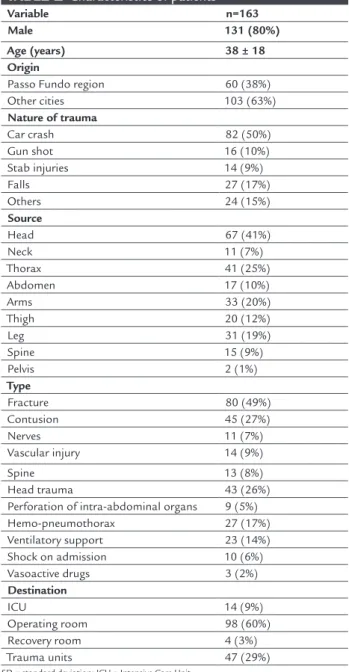
TABLE 1 Characteristics of patients
Variable n=163
Male 131 (80%)
Age (years) 38 ± 18
Origin
Passo Fundo region 60 (38%)
Other cities 103 (63%)
Nature of trauma
Car crash 82 (50%)
Gun shot 16 (10%)
Stab injuries 14 (9%)
Falls 27 (17%)
Others 24 (15%)
Source
Head 67 (41%)
Neck 11 (7%)
Thorax 41 (25%)
Abdomen 17 (10%)
Arms 33 (20%)
Thigh 20 (12%)
Leg 31 (19%)
Spine 15 (9%)
Pelvis 2 (1%)
Type
Fracture 80 (49%)
Contusion 45 (27%)
Nerves 11 (7%)
Vascular injury 14 (9%)
Spine 13 (8%)
Head trauma 43 (26%)
Perforation of intra-abdominal organs 9 (5%)
Hemo-pneumothorax 27 (17%)
Ventilatory support 23 (14%)
Shock on admission 10 (6%)
Vasoactive drugs 3 (2%)
Destination
ICU 14 (9%)
Operating room 98 (60%)
Recovery room 4 (3%)
Trauma units 47 (29%)
SD = standard deviation; ICU = Intensive Care Unit.
of admission; 163 patients inished the study. There were 17 deaths for an overall mortality of 10.4 %. Non-survivors had a signiicant greater mean APACHE II (10.7 ± 7.8 vs. 3.9 ± 4.5, p < 0.002), s-APACHE II (9.7 ± 7.6 vs. 3.2 ± 4.2, p < 0.001), RAPS (4.2 ± 3.3 vs. 1.3 ± 2.0, p < 0.001) and REMS (4.9 ± 4.1
vs. 1.5 ± 2.3, p < 0.001) scores on admission and a greater APACHE II score after 24 hour of admission (12.2 ± 8.8 vs. 3.4 ± 4.6, p < 0.001) than non-survivors.
APACHE II was strongly correlated (p < 0.0001) to s--APACHE II (R² = 0.96), REMS (R² = 0.92) and RAPS (R² =
sco-D
ISCUSSIONThe original aim of this study was to test the utility of APACHE II for prognostic in the evaluation of trauma pa-tients in the ED and 24 hours after. APACHE II showed to be a good marker for prognosis in this population, at the ED and 24 hours after. The primary objective of this data re-analysis was to compare three abbreviated APA-CHE II scores in the ED. The study showed that APAAPA-CHE II and the abbreviated APACHE II scores provide similar discriminatory power for in-hospital mortality. However we also found that only GCS and HR subcomponents were predictors of mortality.
There are many scores developed to access the seve-rity of trauma patients admitted to ED.1,14 However,
trau-ma scores were developed in different populations. The knowledge of morbidity and mortality of our popula-tion is very important for planning strategies for mana-gement of trauma patients. In this regard, the choice of a proper score has an important role to standardize the management of trauma patients. Several scores are avai-lable in medical literature, but no one ills satisfactory the needs of trauma patients, making dificult to choose a speciic score to apply in a particular population.2,4,6,15,16
We were motivated to study APACHE II score in the ED because in Brazil the irst evaluation is done in the emer-gency room and often a severe patient stayed in obser-vation for hours or days until transferred to the opera-ting room or ICU. Thus, we speculated that the application of a score in which the possibility of medi-cal complications, including the possibility of death, could be useful in the ED. Even knowing that APACHE II was designed for patients in critical care units, we thought that the application of this score could help to follow-up these patients, once this score was familiar to our Emergency and ICU staff and both settings admits not only trauma patients. Like others, we’ve demons-trated that APACHE II was useful for predicting outco-mes of trauma patients. Several studies showed that APA-CHE II score has good prognostic value even when compared to scores speciically developed to evaluate trauma patients.4,6,17 As expected APACHE II scores were
low. Low values can be explained because the patient po-pulation was young and healthy. Another explanation could be the short period between the trauma and the application of the score in the ED, in which the some physiological or laboratory acute changes are unlikely in trauma patients. However, similar low APACHE II sco-res were also observed in the ICU 24 hours later. There-fore, in spite of the lower APACHE II score in this popu-lation, compared with that one admitted in ICUs,
APACHE II appeared useful to stratify risks for trauma patients in the ED.
Nonetheless, APACHE II score is dificult to apply in the emergency due to its complexity and the emergency medical staff faced this limitation in the following years. Thus, as highlighted before, the observation that almost all laboratory values were normal or slightly altered in this population motivated us to reanalyze the data and to propose a simpliied APACHE II score similar to RAPS and REMS.10,13 The comparison between APACHE II and
those abbreviated APACHE II scores showed that in the ED and in trauma patients they are equivalent to strati-fy in-hospital mortality risk. The results of this study are comparable to other studies applying abbreviated APA-CHE II scores in general and surgical patients.4,11,12,18 Our
estimate of the AUROC for all scores was similar or even higher when compared to previous studies. Interestingly, none of these scores were applied to evaluate speciically trauma patients but general emergency patients. We must emphasize that the proposed s-APACHE II score was de-rived within our study and its performance may be simi-lar by this reason.
Evaluation of the APACHE II score sub-components reveals important information regarding the physiologic parameters that are useful for severity scoring in this po-pulation. The analysis of the sub-components showed that only GCS (APACHE II score) and HR has discrimi-nated survivors from non-survivors. Like others, GCS consistently appears as an important constituent element of these scores.4 It is expected that patients with a severe
traumatic brain injury will require admission to the ICU regardless of other injuries and will have a higher likeli-hood of subsequent mortality. Another physiologic pa-rameter used to predict mortality in several trauma sco-res systems is heart rate and commonly tachycardia is a sensitive sign of cardiovascular disarrangement. Howe-ver, heart rate and blood pressure as predictors are incon-sistent in different studies.4,13,19 One possible important
explanation is that timing and quality of out-hospital re-suscitation would inluence these variables. Additionally, the inding that only GCS and HR predicted mortality may help understand why the scores have similar discri-minatory power as both sub-components take part in each score.
limitation is the small sample size in a one single center which precincts better evaluation of the proposed sim-pliied APACHE II and the comparison between all stu-died scores. Another limitation is that patients who stu-died or were discharged prior to 24 hours were not a part of the original study cohort. It is unclear if those patients differ in a way from those in this cohort as to make our conclusions invalid. An additional limitation in the pre-sent work was that the data only reprepre-sents patients from a small region and managed in the ED of a university tea-ching hospital. We must therefore be cautious in genera-lizing the results presented here to a non-university ED. Finally, the data are now 12 years old. Changes in struc-ture and process within EDs may generate different re-sults if the study were repeated now.
C
ONCLUSIONOur study conirmed that the APACHE II score is a good prognostic marker of trauma patients in ED scenario and after 24 hours in the ICU. However, our study also conir-med that abbreviated versions of the APACHE II score sho-wed similar prognostic values at the ED for trauma patients. Better designed studies are needed to validate abbreviated APACHE II scores in the trauma population, particularly the simpliied APACHE II score proposed in this study.
R
ESUMOComparação do escore APACHE II e três escores APACHE II abreviados para predizer desfecho entre pacientes trau-matizados na emergência.
Objetivo: escore Acute Physiologic and Chronic Health Eva-luation (APACHE) II é considerado ‘‘inválido’’ e de difícil aplicação em pacientes traumatizados no departamento de emergência (DE). Objetivamos comparar a abilidade do escore APACHE II e três diferentes escores APACHE II abreviados: APACHE II simpliicado (s-APACHE II), Ra-pid Acute Physiology score (RAPS) e Rapid Emergency
Medici-ne score para avaliar a mortalidade hospitalar de
pacien-tes truamatizados no DE.
Métodos: análise retrospectiva de uma coorte
prospecti-va. Todos são pacientes vítimas de trauma admitidos no DE, durante 5 meses. Para todas as admissões, o escore APACHE II foi calculado. O escore APACHE II foi abre-viado através da exclusão dos dados de laboratório para calcular o escore s-APACHE II. Dados individuais foram reanalisados para calcular RAPS e REMS. APACHE II e seus subcomponentes foram coletados, e a mortalidade
hospitalar foi assessada. A área abaixo da curva ROC ( re-ceiver operating characteristic - AUROC) foi usada para de-terminar o valor preditivo de cada escore.
Resultados: 163 pacientes foram analisados. A taxa de
mortalidade hospitalar foi de 10,4%. s-APACHE II, RAPS e REMS escores se correlacionaram com o escore APA-CHE II (r2 = 0.96, r2 = 0.82, r2 = 0.92; p < 0.0001). Os
esco-res tiveram acurácia similar para predizer a mortalidade: ([AUROC 0,777 [95% CI 0,705
a
0,838] para APACHE II; AUROC 0,788 [95% CI 0,717a
0,848] para s-APACHE II; AUROC 0,806 [95% CI 0,737a
0,864] para RAPS; AUROC0,761 [95% CI 0,688
a
0,824] para REMS.Conclusão: escores APACHE II abreviados possuem
ha-bilidade similar para avaliar a mortalidade hospitalar de pacientes traumatizados na emergência quando compa-dos ao escore APACHE II.
Unitermos: APACHE, escala de gravidade do ferimento,
índices de gravidade do trauma, trauma, mortalidade.
R
EFERENCES1. Chawda MN, Hildebrand F, Pape HC, Giannoudis PV. Predicting outcome after multiple trauma: which scoring system? Injury. 2004;35(4):347-58. 2. Boyd CR, Tolson MA, Copes WS. Evaluating trauma care: the TRISS method.
Trauma Score and the Injury Severity Score. J Trauma. 1987;27(4):370-8. 3. Knaus WA, Draper EA, Wagner DP, Zimmerman JE. APACHE II: a severity
of disease classiication system. Crit Care Med. 1985;13(10):818-29. 4. Dossett LA, Redhage LA, Sawyer RG, May AK. Revisiting the validity of
APACHE II in the trauma ICU: improved risk stratiication in critically injured adults. Injury. 2009;40(9):993-8.
5. Liang J, Zhou Z. Application of APACHE II scoring in ICU trauma patients. Chin J Traumatol. 1998;1(1):58-60.
6. Hwang SY, Lee JH, Lee YH, Hong CK, Sung AJ, Choi YC. Comparison of the Sequential Organ Failure Assessment, Acute Physiology and Chronic Health Evaluation II scoring system, and Trauma and Injury Severity Score method for predicting the outcomes of intensive care unit trauma patients. Am J Emerg Med. 2012;30(5):749-53.
7. McAnena OJ, Moore FA, Moore EE, Mattox KL, Marx JA, Pepe P. Invalidation of the APACHE II scoring system for patients with acute trauma. J Trauma. 1992;33(4):504-6.
8. Calvete JO, Schonhorst L, Moura DM, Friedman G. Acid-base disarrangement and gastric intramucosal acidosis predict outcome from major trauma. Rev Assoc Med Bras. 2008;54(2):116-21.
9. Polita JR. Peril e escore apache II na avaliação de pacientes traumatizados atendidos na emergência do Hospital São Vicente de Paulo [dissertation]. Porto Alegre: Universidade Federal do Rio Grande so Sul; 2004. 10. Rhee KJ, Fisher CJ Jr, Willitis NH. The Rapid Acute Physiology Score. Am J
Emerg Med. 1987;5(4):278-82.
11. Olsson T, Lind L. Comparison of the rapid emergency medicine score and APACHE II in nonsurgical emergency department patients. Acad Emerg Med. 2003;10(10):1040-8.
12. Bulut M, Cebicci H, Sigirli D, Sak A, Durmus O, Top AA, et al. The comparison of modiied early warning score with rapid emergency medicine score: a prospective multicentre observational cohort study on medical and surgical patients presenting to emergency department. Emerg Med J. 2013; Apr. 6. [Epub ahead of print].
14. Bertollo S, Rodenberg H. Correlation of the RTS (Revised Trauma Score) and RAPS (Rapid Acute Physiology Score) in rotor-wing prehospital care. Air Med J. 1994;13(3):91-5.
15. Aslar AK, Kuzu MA, Elhan AH, Tanik A, Hengirmen S. Admission lactate level and the APACHE II score are the most useful predictors of prognosis following torso trauma. Injury. 2004;35(8):746-52.
16. Champion HR, Sacco WJ, Carnazzo AJ, Copes W, Fouty WJ. Trauma score. Crit Care Med. 1981;9(9):672-6.
17. Rutledge R, Fakhry S, Rutherford E, Muakkassa F, Meyer A. Comparison of APACHE II, Trauma Score, and Injury Severity Score as predictors of outcome in critically injured trauma patients. Am J Surg. 1993;166(3):244-7. 18. Olsson T, Terent A, Lind L. Rapid Emergency Medicine Score can predict
long-term mortality in nonsurgical emergency department patients. Acad Emerg Med. 2004;11(10):1008-13.