VIEIRA GD ETAL.
404 REV ASSOC MED BRAS 2015; 61(5):404-406
IMAGE IN MEDICINE
Complication of post-infectious bronchiolitis obliterans (Swyer-
-James syndrome)
C
OMPLICAÇÃO DE BRONQUIOLITE OBLITERANTE PÓS-
INFECCIOSA(S
ÍNDROME DES
WYER-J
AMES--M
ACLEOD)
GABRIELDE DEUS VIEIRA1*, ALESSANDRA YUKARI YAMAGISHI1, NATÁLIA NOGUEIRA VIEIRA1, REBEKA MAYARA MIRANDA DIAS FOGAÇA1,
THAIANNEDA CUNHA ALVES1, GISELE MEGALE BRANDÃO GURGEL AMARAL2, CAMILA MACIELDE SOUSA1
1Physician – Medical Department, Faculdade São Lucas, Porto Velho, RO, Brazil 2Pediatrician – Hospital Infantil Cosme e Damião, Porto Velho, RO, Brazil
Study conducted at Medical Department, Faculdade São Lucas, Porto Velho, RO, Brazil
Article received: 9/9/2014
Accepted for publication: 9/16/2014
*Correspondence:
Address: R. Alexandre Guimarães, 1927, Porto Velho, RO – Brazil Postal code: 76804-373 [email protected] http://dx.doi.org/10.1590/1806-9282.61.05.404
S
UMMARYSwyer-James syndrome is a complication of post-infectious bronchiolitis oblite-rans that causes inlammation and ibrosis of the bronchial walls. There are two types: asymptomatic, with most cases diagnosed in adults during routine radio-logical examinations; and symptomatic, most commonly found in children. Here, we report the case of a 6-year-old child with recurrent dyspnea since the age of 3, who showed signs and symptoms of bronchiolitis obliterans and radiological signs of bronchial wall thickening and air trapping. The clinical and radiological in-dings led to the diagnosis of Swyer-James syndrome. Treatment of this syndro-me is intended to reduce the pulmonary lesions and improve the patient’s qua-lity of life.
Keywords: bronchiolitis, lung, hyperlucent, lung diseases.
I
NTRODUCTIONBronchiolitis obliterans (BO) is a chronic obstructive pul-monary disease of the distal airway that is characterized by an inlammatory process caused by damage to the small airways. BO affects mainly male children during the irst year of life.1-3 Despite the lack of available
epide-miology, there is a high prevalence in countries within the southern hemisphere, such as Argentina, Brazil, Chile and New Zealand.4,5 There are several etiologies
men-tioned in the literature, including viral and bacterial in-fections, but the most frequent cause of BO in children is post-infectious, i.e. possibly related to Paramyxovirus morbillivirus, Bordetella pertussis, Mycobacterium tuberculosis, Mycoplasma pneumoniae, Streptococcus type B, Legionella pneu-mophila, inluenza, parainluenza, respiratory syncytial vi-rus and adenovivi-rus.5-7
One of the complications of post-infectious BO (PIBO) caused by adenovirus is Swyer-James syndrome (SJS), also known as unilateral hyperlucent lung syndrome.7,8 SJS is
deined as unilateral hyperlucency of a lobe or the entire lung due to pulmonary hypoperfusion, showing a decrea-se in the vascular network and volume of the affected lung
or lobe.9-11 Functionally, SJS is characterized by a decrease
in volume during inspiration and air trapping during ex-piration, which results from bronchiolar obstruction.12,13
Since this is a rare disease, it is important to unders-tand the overall clinical picture of SJS to exclude the dif-ferential diagnosis of other diseases that are associated with bronchiolitis. For this purpose, we hereby report the case of a patient diagnosed with SJS.
C
ASE REPORTCOMPLICATIONOFPOST-INFECTIOUSBRONCHIOLITISOBLITERANS (SWYER-JAMESSYNDROME)
REV ASSOC MED BRAS 2015; 61(5):404-406 405
FIGURE 1 Severe bulbo-duodenitis with mild diffuse bleeding.
FIGURE 2 At close inspection with narrow-band imaging (NBI), enlarged and rigid duodenal villosities are seen.
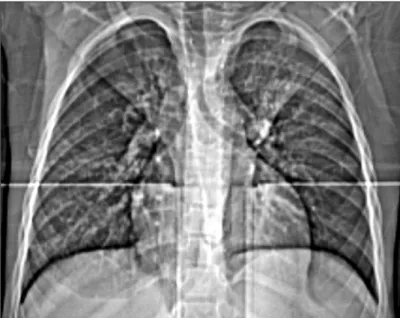
led to computed tomography (CT) of the chest, which showed marked diffuse thickening of the bronchial walls associated with air trapping areas in addition to areas of diffuse oligemia randomly distributed throughout both lungs, showing topographical signs compatible with re-levant inlammatory bronchopathy (Figure 2). Thus, the diagnosis of SJS was made through the patient’s clinical evaluation and radiological indings.
Based on this diagnosis, the patient was suggested to do the following: respiratory physiotherapy, vaccination against pneumococcal diseases and inluenza, and decrea-se their exposure to episode triggers, as well as corticos-teroid and bronchodilator use. The use of antibiotics was restricted to exacerbations only.
medicated with inhalation, antibiotics, and oxygen the-rapy. His general condition worsened and he was referred to a pediatric hospital, where symptomatic treatment was performed. The initial physical examination revealed ta-chypnea (respiratory rate, 40/min) with intercostal and subcostal retractions, nasal laring, and a lowered wishbo-ne. A subsequent lung examination detected the presence of bilateral wheezing and rales, and the remainder of the physical examination was normal. The complete blood count showed normocytic and normochromic erythrocy-tes, and leukocyte atypia. Adequate laboratory tests ruled out the diagnoses of cystic ibrosis and tuberculosis.
VIEIRA GD ETAL.
406 REV ASSOC MED BRAS 2015; 61(5):404-406
D
ISCUSSIONThe physiopathology of SJS is explained by the conse-quences of BO, which include inlammation and ibrosis of the bronchial walls that results in lumen narrowing, reduced ventilation, and vasoconstriction that leads to decreased perfusion. Fibrosis of the interalveolar septa causes obliteration of the pulmonary capillary, reducing blood low to the pulmonary artery segments and trigge-ring arterial hypoplasia.8
There are two types of SJS: asymptomatic, with most cases being diagnosed in adults during routine radiolo-gical examinations; and symptomatic, which is most com-monly found in children.13 The clinical manifestations
of SJS may vary, but typically include productive cough, dyspnea on exertion, and sometimes hemoptysis. On phy-sical examination, the patient may show hypomobility on the side affected with hypertympanism to percussion, decreased breath sounds, and occasionally crepitant ra-les.14-15 The diagnosis can be made through anamnesis
and the report of recurrent lower respiratory infections; on physical examination, changes in the respiratory sys-tem on chest radiograph reveal speciic radiological as-pects.11 The pulmonary function test can also be
perfor-med to demonstrate a ventilator change, reinforcing the existence of an obstructive airway disease.15
CT can address other data associated with the syn-drome, such as the presence of bronchiectasis and age-nesis of the pulmonary artery, which is useful in exclu-ding other differential diagnoses.11 The differential
diagnosis of SJS should include congenital disorders, na-mely agenesis or occlusion of the pulmonary artery, con-genital absence of the pectoralis major muscle, and conge-nital lobar emphysema, as well as central airway obstruction caused by foreign body aspiration or lesions inside the bronchi, lung cysts, and pneumatoceles.15,16 SJS is
cur-rently considered one of the forms of presentation of PIBO.16
There are currently few data on the treatment of pa-tients diagnosed with the Swyer-James syndrome, and most of the measures to be taken are merely supportive, to help minimize the formation of new pulmonary le-sions and improve the life quality of those patients.
R
ESUMOComplicação de bronquiolite obliterante pós-infecciosa (Sín-drome de Swyer-James-Macleod)
A síndrome de Swyer-James-Macleod é uma complicação da bronquiolite pós-infecciosa, ocasionando inlamação
e ibrose das paredes dos bronquíolos. Pode se manifes-tar de duas formas: assintomática, sendo a maioria diag-nosticada na fase adulta, quando o paciente se submete a exames radiológicos de rotina, e a forma sintomática, que é mais encontrada em crianças. Relatamos um caso de uma criança de 6 anos de idade com crises de dispneia de repetição desde os 3 anos, apresentando sinais e sin-tomas de bronquiolite obliterante e sinais radiológicos de espessamento brônquico e aprisionamento aéreo. Por meio da clínica e achados radiológicos, foi feito o diag-nóstico de síndrome de Swyer-James-Macleod. O trata-mento dessa síndrome visa a reduzir as lesões pulmona-res e a melhorar a qualidade de vida do paciente.
Palavras-chave: pulmão hipertransparente, bronquioli-te, pulmão, criança.
R
EFERENCES1. Santos RV, Rosário NA, Ried CA. Bronquiolite obliterante pós-infecciosa: aspectos clínicos e exames complementares de 48 crianças. J Bras Pneumol. 2004; 30(1):20-5.
2. Mattiello R, Mallol J, Fischer GB, Mocelin HT, Rueda B, Sarria EE. Função pulmonar de crianças e adolescentes com bronquiolite obliterante pós-infecciosa. J Bras Pneumol. 2010; 36(4):453-9.
3. Bosa VL, Mello ED, Mocelin HT, Benedetti FJ, Fischer GB. Avaliação do estado nutricional de crianças e adolescentes com bronquiolite obliterante pós-infecciosa. J Pediatr. 2008; 84(4):323-30.
4. Lino CA, Batista AKM, Soares MAD, Freitas AEH, Gomes LC, Filho JHM, et al. Bronquiolite obliterante: peril clínico e radiológico de crianças acompanhadas em ambulatório de referência. Rev Paul Pediatr. 2013; 31(1):10-6.
5. Teper A, Fischer GB, Jones MH. Sequelas respiratórias de doenças virais: do diagnóstico ao tratamento. J Pediatr, 2002; 78(Supl.2):187-94.
6. Paludo J, Mocelin HT, Benedetti FJ, Mattiello R, Sarria EE, Mello ED, et al. Balanço energético em crianças e adolescentes com bronquiolite obliterante pós-infecciosa. Rev Nutr. 2012; 25(2):219-28.
7. Champs NS, Lasmar LM, Camargos PA, Marguet C, Fischer GB, Mocelin HT. Post-infectious bronchiolitis obliterans in children. J Pediatr. 2011; 87(3):187-98.
8. Hajsadeghi Sh, Chitsazan M, Pouraliakbar HR, Jafarian Kerman SR. Swyer-James-Macleod syndrome presenting with pulmonary hipertension: case report. Iran Cardiovascular Res J. 2010; 4(3):134-8.
9. Swyer PR, James GC. A case of unilateral pulmonary emphysema. Thorax. 1953; 8:133-6.
10. Walia M, Goyal V, Jain P. Swyer-James-Macleod syndrome in a 10-year-old boy misdiagnosed as asthma. Indian J Pediatr. 2010; 77(1):709.
11. Honguero Martínez AF, Pérez Alonso D, Arnau Obrer A, López P, Sanz F, Estors Gerrero M, et al. Hemoptisis como manifestación clínica en el síndrome de Swyer-James/Macleod. Rev Patol Respir. 2007; 10(1):31-3.
12. Bernal NY, Basto RL, Salcedo BJ. Síndrome de Swyer-James: reporte de um caso. Salud, Barranquilla. 2012; 28(2):349-53.
13. Tortajada M, Gracia M, García E, Hernández R. Consideraciones diagnósticas sobre el llamado síndrome del pulmón hiperclaro unilateral (síndrome de Swyer-James o de Mc-Leod). Allergol et Immunopathol. 2004; 32(5):265-70. 14. Rosenberg NP, Pavan DA, Streher LA, Pasqualotto AC. Síndrome de
Swyer-James-MacLeod. J Pneumol. 1999; 25(1):57-60.
15. Castro A, Tome MT, Ventura M. Sindroma de Swyer-James Macleod – aspectos clínico-radiológicos a propósito de um caso clínico. Acta Med Port. 1986; 7:127-30.