VOCABULARY PERFORMANCE
IN INSTITUTIONALIZED PRESCHOOL CHILDREN
Desempenho de vocabulário em crianças
pré-escolares institucionalizadas
Andréa Regina Nunes Misquiatti(1), Patrícia Gondo Nakaguma(1),
Maria Cláudia Brito(2), Ana Gabriela Olivati(1)
(1) Departamento de Fonoaudiologia da Universidade
Esta-dual Paulista Júlio de Mesquita Filho, Marília, São Paulo, Brasil.
(2) Universidade Estadual Paulista Júlio de Mesquita Filho,
Marília, São Paulo, Brasil.
Source: Fundação de Amparo à Pesquisa do Estado de São Paulo – FAPESP
Conlict of interest: non-existent
Regarding the environment aspects, the
literature refers that the premature privation and institutionalization on the irst life months affect the
emotional, cognitive, social and neurophysiological
development of a child. However, until now only a little is known about the speciic aspects which interfere in the preschool period of these children7.
In this study, it is being highlighted, however, the institutionalization of the child as an important variable to be considered on the language devel -opment, having in sight the institutions main goal on
offering support to many aspects of the development of the children that are sheltered inside these institu -tions. In order to make the child have a domain over
the language, the quality of information that is being acquired as well as the way which the child interacts with the social environment is quite important, that in these cases is the same social environment of the institution. If a child shows bigger opportunities of interacting socially, being an active participant of this interaction, probably this child will reach the
INTRODUCTION
Every human being has a mental vocabulary which is accessed when it is intended to show, through words, an object, an action or even a fact. Learn words and use them in a correct form is an
essential aspect in language development and it is
related to the syntax acquisition, morphology and
phonology1,2.
They are mentioned in the literature as factors that possibly interfere on vocabulary acquisition, frequency and word familiarity3,4, its extensions5 as
well as the environmental insights6.
ABSTRACT
Purpose: to evaluate the vocabulary performance of institutionalized children and compare with
performance of children belonging to public and private schools. Methods: 16 children at institutional
care in shelter, of both genders, aged between 4 and 5 years and 11 months (experimental group) participated. As the control group, 32 children from public (n=16) and private (n=16) schools matched for age participated, totaling 48 participants. A Vocabulary Test (ABFW) was used, to evaluate the performance of the vocabulary. This test veriies the child’s lexical competence and the resources of signiicance used to name the target word. Statistical analysis of data was performed to analyze differences between the surveyed groups (Kruskal-Wallis). Results: it was possible to observe that
institutionalized children showed lower performance in the vocabulary test in relation the control groups, which showed no differences between them. In addition, all children showed more dificulty in the semantic ields “professions” and “places”. Conclusion: children in situations of institutional care
have underperformed vocabulary for age and below the performance of preschool children in public and private schools who reside with their families.
KEYWORDS: Vocabulary; Child Language; Child, Institutionalized; Speech, Language and Hearing
the performance of the institutionalized children and compare it with the performance of children that belong to the public and private education.
METHODS
This study was approved by the Ethical Study Committee of Universidade Estadual Paulista Júlio
de Mesquita Filho, protocol nº2121/2010. The
schools where the children of CG1 and CG2 were enrolled and people who are responsible for them were informed about the research and its goals. The principals of the institutions and the parents or people who are responsible for the children who agreed with the participation in this research signed off the Free and Enlighten Consent Term, as the resolution of the Health National Council CNS
196/96.
A transversal study was performed with 16 insti
-tutionalized children, of both genders, with ages from 4 to 5 years old and 11 months, and 32 children who came from public and private schools to make part of the control group, totalizing 48 participants. The children were divided in three groups: Experimental Group – EG (compound for 16 children of both institutions), Control Group 2 – CG1 (compound for 16 children of public school) and Control Group 2 – CG2 (compound for 16 children of private school).
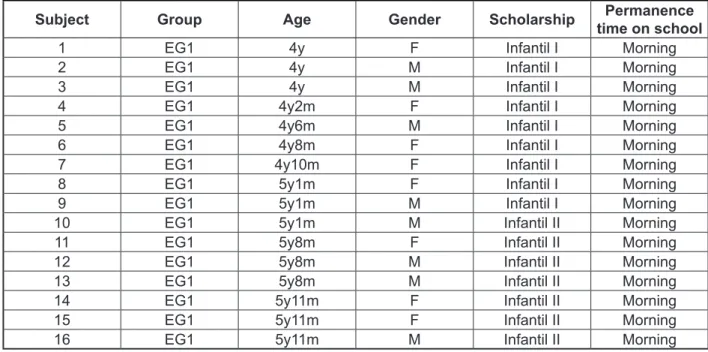
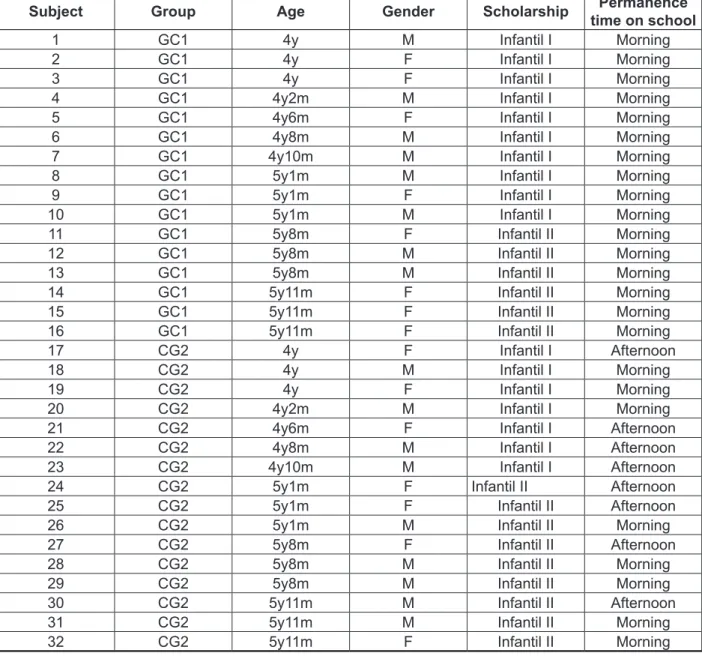
The igures below 1 and 2 show data related
to the age, gender, grade and permanence time in
school of each participant. language domain with more effectiveness instead of
those children which don´t have this opportunity and do not join actively this adult-child dialogue8.
However, it can be mentioned that many times the conditions inside the institutions are marked by high privation levels. Children can be malnourished, receive uneffective medical assistant, be unoccupied besides the quality of their interactions with the care takers is often poor9, and compromising their social
development as well as their emotional.
Receiving an appropriate intervention in more premature ages propitiate an improvement on motor development, language skills, cognition and social relations10. Considering that the institution can
propi-tiate a relations ield which can allow private and affective exchanges which are particularly important to children that are deprived from their parents11,12,
the environment quality and the institutional care
are considered quite essential to push forward their
development13,14.
Considering the child environment interference to the language, the evaluation of the vocabulary of institutionalized children needs to be systematic and recurrent. This fact is highlighted in Brazil, because there is an expressive number of children in this insti -tutionalization situation. In this perspective, studies
about the institutionalized children vocabulary may offer data which will help the comprehension of the language development and consequently for interventions in education and health about this aspect. Thus, this research had, as a goal, verify
Subject Group Age Gender Scholarship Permanence
time on school
1 EG1 4y F Infantil I Morning
2 EG1 4y M Infantil I Morning
3 EG1 4y M Infantil I Morning
4 EG1 4y2m F Infantil I Morning
5 EG1 4y6m M Infantil I Morning
6 EG1 4y8m F Infantil I Morning
7 EG1 4y10m F Infantil I Morning
8 EG1 5y1m F Infantil I Morning
9 EG1 5y1m M Infantil I Morning
10 EG1 5y1m M Infantil II Morning
11 EG1 5y8m F Infantil II Morning
12 EG1 5y8m M Infantil II Morning
13 EG1 5y8m M Infantil II Morning
14 EG1 5y11m F Infantil II Morning
15 EG1 5y11m F Infantil II Morning
16 EG1 5y11m M Infantil II Morning
Legend: EG = experimental group; y = year; m = months M = male; F = female
child education. Children of the three groups were taking the Infantil I or Infantil II grades.
The relatively small sample is due to the children
age limit, considering that in the institutions in which the researches were performed, a big part of the children showed higher age than the test which
evaluates until ages 5 and 11 months age.
Procedures
In order to have the characterization of the subjects, a quiz was specially elaborated for this study. The quiz consisted of the child data related As per criteria of inclusion to the EG, the children
should live exclusively in the institution, at least for one year, and be enrolled in Child Education Public Institutions out of the shelter. Children of EG were
inside institutional shelters and received the needed
cares of the monitors who relayed in attainment duties every eight hours, being one or two monitors to one group of 15 children. Besides that, they were allowed to go to school, trips and family visits.
The inclusion criteria for CG1 and CG2 were: children should live with at least a member of their originary family and be enrolled in institutions of
Subject Group Age Gender Scholarship Permanence
time on school
1 GC1 4y M Infantil I Morning
2 GC1 4y F Infantil I Morning
3 GC1 4y F Infantil I Morning
4 GC1 4y2m M Infantil I Morning
5 GC1 4y6m F Infantil I Morning
6 GC1 4y8m M Infantil I Morning
7 GC1 4y10m M Infantil I Morning
8 GC1 5y1m M Infantil I Morning
9 GC1 5y1m F Infantil I Morning
10 GC1 5y1m M Infantil I Morning
11 GC1 5y8m F Infantil II Morning
12 GC1 5y8m M Infantil II Morning
13 GC1 5y8m M Infantil II Morning
14 GC1 5y11m F Infantil II Morning
15 GC1 5y11m F Infantil II Morning
16 GC1 5y11m F Infantil II Morning
17 CG2 4y F Infantil I Afternoon
18 CG2 4y M Infantil I Morning
19 CG2 4y F Infantil I Morning
20 CG2 4y2m M Infantil I Morning
21 CG2 4y6m F Infantil I Afternoon
22 CG2 4y8m M Infantil I Afternoon
23 CG2 4y10m M Infantil I Afternoon
24 CG2 5y1m F Infantil II Afternoon 25 CG2 5y1m F Infantil II Afternoon
26 CG2 5y1m M Infantil II Morning
27 CG2 5y8m F Infantil II Afternoon
28 CG2 5y8m M Infantil II Morning
29 CG2 5y8m M Infantil II Morning
30 CG2 5y11m M Infantil II Afternoon
31 CG2 5y11m M Infantil II Morning
32 CG2 5y11m F Infantil II Morning
Legend: CG = control group; y = year; m = months M = male; F = female
not named before starting the next conceptual ield were represented, obeying the numeric order. The answers given by the children were transcribed in the speciic protocol. The applying time was of about 25 minutes per child. This procedure was applied in schools where there were children from CG1 and CG2. The EG data collection was performed in the same institution where the children were sheltered
inside.
The records of the answers provided by the participants were recorded in a speciic protocol of the test of vocabulary veriication. Following the analysis criteria proposed by the test authoress15,
the answers were classiied as designation of usual word (DUW), non-designation (ND) and substitution
process (SP).
Data statistical analysis was also performed in order to compare the given performance in the vocabulary test among the participant children of this study and, later on, correlate the different variable. It was applied the Kruskal-Wallis test, with the goal of verifying the possible differences between the performance of the three children groups (EG – Institution; CG1 – Public School; CG2 – Private School), with signiicance level of 5% (p>0,05).
RESULTS
The group’s performance was compared simul
-taneously, from the categories DVW (Designation by Usual Word), ND (Non-Designation) and SP (Substitution Process). Data was analyzed statisti
-cally and there were performed comparisons of EG
related to CG1 and CG2.
Data about the Designation by Usual Word
category in the three studied groups is presented
irstly (Table 1).
to: age; gender; scholarship and; permanence time
on school. The institutionalized children data were provided by the social assistant or the coordinator of each of these institutions.
A speech trail was performed with all the children to guarantee that they were not showing complaint or language changes. A questionnaire with all the students´ parents was also applied in order to identify children of possible auditive complaints. This form had questions related to the global development with
emphasis on child language and audition. Regarding
children in public and private schools, the question
-naire was applied with the parents/responsible, and in institutions with a monitor which has daily contact with the child. Children who demonstrate changes in their development were addressed to speech
evaluation.
The language test of ABFW15 was used to
evaluate the vocabulary. The goal of this vocabulary test is to verify the vocabulary competence of the child, the mechanisms used by children, related to the quantity of words and which resources of signii
-cation this child uses to try to name the target-word. The test contains analysis of the conceptual ields of clothing, animals, foods, transportation ways, furniture, jobs, places, shapes and colors, toys and
musical instruments.
During the applying of the vocabulary test, the order of presentation of the igures was sequenced according to the conceptual ields. When showing the igure, it was asked “What is this?” to all the objects, “What color is this?” to all the colors, “Which shape is that?” to all the shapes, “Which place is this?” to all the places and “Who is he/she?” to all professions. If the child was not able to name the igure in ten seconds, the next igure was shown and the question was asked again. The igures that were
Table 1 - Vocabulary performance of institutionalized children (Experimental Group) and not institutionalized (Control Group 1 and Control Group 2) in Designation of usual word.
Designation of usual word
Clothing Animals Foods Transport Furniture
Profes-sions Places Shapes Toys
Av SD Av SD Av SD Av SD Av SD Av SD Av SD Av SD Av SD
EG 56,8 14,0 75,4 13,9 55,9 19,1 70,5 16,1 66,7 7,2 29,3 9,9 21,3 14,2 65,0 26,0 55,6 15,7 CG1 72,5 13,9 93,7 8,6 72,5 11,3 87,0 5,6 77,3 11,8 51,8 15,5 51,5 18,2 93,7 9,5 81,3 22,1 CG2 77,5 13,9 97,0 5,3 77,0 6,9 86,5 6,5 81,5 7,0 56,8 16,6 55,5 18,2 97,5 5,7 88,6 15,0 p 0,001* <0,001* 0,003* <0,001* <0,001* <0,001* <0,001* <0,001* <0,001*
Legend: EG = Experimental group (institutionalized children); CG1 = Control group 1 (childrenof public school); CG2 = Control group 2 (childrenof private school); p = value; Av = Average; SD = Standard deviation; * = Statistically signiicant values (p≤0,05) – Kruskal
Table 2 - Vocabulary performance of institutionalized children (Experimental Group) and not institutionalized (Control Group 1 and Control Group 2) in not designation.
Not designation
Clothing Animals Foods Transport Furniture
Profes-sions Places Shapes Toys
Av SD Av SD Av SD Av SD Av SD Av SD Av SD Av SD Av SD
EG 1,8 4,0 4,5 6,3 17,4 16,3 6,7 6,9 7,0 6,6 10,5 9,9 16,1 17,0 11,8 14,7 13,1 15,1 CG1 1,8 5,4 0,8 2,2 9,1 10,5 0,0 0,0 6,7 8,3 11,2 15,4 7,2 12,4 4,3 7,2 6,8 9,0 CG2 3,7 8,0 1,6 3,8 6,2 6,2 1,1 3,0 4,9 5,9 6,8 10,1 8,9 10,7 1,2 5,0 6,2 10,3
p 0,679 0,078 0,085 <0,001* 0,660 0,492 0,093 0,011 0,258
Legend: EG = Experimental group (institutionalized children); CG1 = Control group 1 (childrenof public school); CG2 = Control group 2 (childrenof private school); p = value; Av = Average; SD = Standard deviation; * = Statistically signiicant values (p≤0,05) – Kruskal
--Wallis Test.
Table 3 - Vocabulary performance of institutionalized children (Experimental Group) and not institutionalized (Control Group 1 and Control Group 2) in substitution process.
Substitution process
Clothing Animals Foods Transport Furniture
Profes-sions Places Shapes Toys
Av SD Av SD Av SD Av SD Av SD Av SD Av SD Av SD Av SD
EG 41,2 11,4 20,0 12,4 26,5 15,9 22,6 11,0 26,8 7,3 60,0 10,3 62,5 18,7 23,1 16,6 31,2 16,3 CG1 25,6 12,6 5,4 8,1 18,3 7,7 12,9 5,6 15,8 8,5 36,8 11,3 41,2 17,6 1,8 4,0 11,8 22,9 CG2 18,7 10,2 1,2 2,6 16,6 8,8 12,3 5,5 13,4 5,7 36,2 20,2 35,5 14,7 1,2 3,4 5,0 9,9
p <0,001* <0,001* 0,108* 0,003 <0,001* <0,001* <0,001* <0,001* <0,001*
Legend: EG = Experimental group (institutionalized children); CG1 = Control group 1 (childrenof public school); CG2 = Control group 2 (childrenof private school); p = value; Av = Average; SD = Standard deviation; * = Statistically signiicant values (p≤0,05) – Kruskal
--Wallis Test.
On Table 3 data about the Substitution Process category in the three studied groups can be observed.
The Table 2 demonstrates the results related to
the Non-Designation category in the three studied groups.
As demonstrated on Table 1, the DVW category showed statistically signiicant values in all the evaluated ields, among the three groups of partici
-pants. The SP category (table 3) also showed values of p>0,05 in the majority of the ields, except in transportation, which was not statistically signiicant. Regarding the ND (table 2), all the ields showed non-signiicant values, except the transportation ields.
It can be mentioned that in relation to the DVW , it was observed that on conceptual ields “clothing”, “animals”, “foods”, “Furniture”, “profes
-sions”, “shapes and colors” and “toys and musical instruments”, the CG2 showed better performance
in relation to CG1, considering that only this one
showed a better performance in relation to CG2 in the “transportation ways” ield. However, there were no differences in the performance of both groups of
control.
Regarding the NDs, it was found that in the “clothing”, “animals”, “transportation” and “places” ields, the CG1 showed lower values in relation to CG2, but in the remaining ields, the ND values in relation to CG2 were higher.
Analyzing the SP, it was possible to note that CG1 also showed inferior performance in relation to CG2 in conceptual ields as “clothing”, “animals”, “foods”, “furniture”, “places”, “shapes and colors” and “toys and musical instruments”. In the “professions” ield, the CG1 showed a better performance, however it was not signiicant and, in the “transportation ways” ield it showed percentage equal to CG2.
and concrete. Opposite, the references of words of
actions are transitory17. It is necessary to domain the
knowledge, in order to have a good performance in the conceptual ields, professions and places, because capacities of representation and abstraction
to acquire these concepts are necessary18.
Studies which had as a goal verifying the expressive vocabulary of children with phonologic deviation, also showed that the most complex ield to children was the “places”19,20 ield. In the age
group evaluated, such conceptual ields tend to be less representative and familiar. As per another
study21, factors as familiarity and frequency of
igures that should be named make the child access the vocabulary, favoring the naming and score of the shown objects.
In the comparison between the performances of the vocabulary on the three researched groups, it was noted that in the DVW category the non-insti
-tutionalized children, which belong to particular or public schools showed better performance in all conceptual ields in comparison to institutionalized children, except in the “professions” ield, in which there were no differences.
In relation to the ND, it was possible to observe in the three studied groups, in which they made themselves more present in the conceptual ields “foods”, “furniture” and “places”, but the EG showed a higher quantity of ND. Another study19 showed
that about the ND, no other ield showed itself more complex to children of the researched groups, knowing that the majority showed desirable results in all ields. The results of this research suggested that the children of the studied groups preferred to substitute the target-word than not designating it19.
In the shown research, in SP, just the processes used by CG1 and CG2 were signiicant in relation to EG. The CG1 and CG2 groups which performed substitution process more coherent comparing themselves with the EG, meaning that they are processes that are inside of the same semantic ield.
Researchers say that the development of language and the vocabulary is extremely complex, are inluenced by the environment in which the child is inserted, by social relation established and by the particular characteristics of each human being22. The results of this study suggest that the
social environment of the institutionalized children did not favored the normal development of acqui
-sition of language and, consequently the vocabulary
acquisition.
Besides the fact that the institutionalized children are inserted in public schools, it was noted the difference in relation to the vocabulary performance of the control group. In this way, the found data in this
present research indicate that the institutionalized Summarizing, the institutionalized children
showed lower number of designations by usual words and higher number of substitution processes in relation to the two groups of control in all the researched conceptual ields, as it was possible to observe on the tables. In relation to non-designation, the EG just showed inferior percentage to the other researched groups in the “clothing” conceptual ield, but in the other ields, the EG showed higher percentage of non-designations in relation to CG1
and CG2.
Generally, the institutionalized children showed less performance when compared to the children of the other two control groups in the majority of the researched conceptual ields, and the two control groups did not show differences between
themselves.
DISCUSSION
The results of this study allowed the vocabulary performance evaluation of the pre-school children in situation of institutionalization in shelters and of children who live with their Family.
A difference between the institutionalized group and the groups who live with their Family was found and the institutionalized group showed lower averages. This result conirms the initial hypothesis that the family and the social environment played an important role in the development of vocabulary skills and semantics of children in pre-school ages.
There was no difference amongst the non-insti
-tutionalized children, which can be explained by the fact that the public school participant in this research has a high quality of education and can be considered as reference in the region. A study that aimed to compare the scholar performance between a group that lived with their family and another group of institutionalized children concluded that this last one showed lower averages. This result conirms that the family plays an important role in the scholar development of the children7,16.
The children of these three researched groups showed a big number of SP, however, it is valid to highlight that these substitutive processes were in some cases synonyms of the target-word. Like, for example, “police car” to “car”, “hairdresser” to “barber”, “soccer ield” to “stadium”, “blouse” to “coat”, “vase” to “toilet”, “police” to “guard”, “cowboy” to “farmer”.
It was observed that a big part of these children of the three groups showed dificulties in the “profes
families. Therefore, the children of institution seem to be in a less favorable social environment for the development of language in vocabulary-semantic aspects than children from control groups, who live with their families.
It was also possible to observe, that in the three researched groups, the conceptual ield where the children presented a smaller number of designations per usual word was the “professions” and “places” ields. The ields which showed better performance were “animals”, “shapes and colors” and “toys and musical instruments” ields.
The results found indicate the necessity of inves
-tigations about the different kind of environment variables which interfere in the language devel
-opment of institutionalized children and the factors of risk associated to language changes and learning of this population.
It is ratiied through the data and discussions here exposed the relevance of the performance of
the speech therapist and related areas in child
insti-tutionalization contexts, in search of better condi
-tions of assistance to this population. The Speech therapist may contribute through preventive actions
in assessment and intervention, through consulting,
mentoring programs and production of materials for educators and caregivers of these institutions, as well as evaluation of children’s language, language therapy and referral to other professionals in the cases in which such procedures may be necessary. children did not have in their familiar environments
and after that in institutional environment interaction and social relation that seem to have offered lower opportunities to the development of the language.
Other authors23,24 described that children who
stay under responsibility of a shelter institution and receive physical care relatively proper, but emotionally indifferent, can present delays in the
cognitive and emotional development. These data
corroborate the founds of this study on what is possible to note worse performance in institution
-alized children in vocabulary tests in relation to children who came from public and private schools, who live with their families.
It is valid to highlight that there are few Brazilian studies about the language evaluation of institu
-tionalized children, as the bigger part of them focus the institutionalized child related to the possible futurepsych-social disorders. It is highlighted that, these questions are very complex and would be necessary new studies to comprehend the effects of
institutionalization in the child development process.
CONCLUSION
In this study it was possible to observe that the vocabulary of pre-scholars who live in institutions is under the expectations for the age and inferior in relation to the performance of pre-scholars from public and private schools who live with their
RESUMO
Objetivo: veriicar o desempenho de vocabulário de crianças institucionalizadas e comparar com o
desempenho de crianças pertencentes à rede pública e particular de ensino. Métodos: participaram
deste estudo 16 crianças em situação de acolhimento institucional em abrigo, de ambos os gêneros, com idades entre 4 anos a 5 anos e 11 meses (grupo experimental). Para compor o grupo controle, participaram 32 crianças provenientes de escolas pública (n=16) e privada (n=16) pareadas por idade, totalizando 48 participantes. Para a veriicação do desempenho de vocabulário foi utilizado o Teste de Vocabulário – ABFW que veriica a competência lexical da criança e os recursos de signiicação utilizados para nomear a palavra alvo. Foi realizada a análise estatística dos dados a im de analisar diferenças entre os grupos pesquisados (Teste de Kruskal-Wallis). Resultados: foi possível observar
que as crianças institucionalizadas demonstraram desempenho inferior na prova de vocabulário em relação aos grupos controle, que não apresentaram grandes diferenças entre si. Cabe mencionar que todas as crianças demonstraram maior diiculdade nos campos conceituais “proissões” e “locais”.
Conclusão: crianças em situação de acolhimento institucional em abrigo possuem desempenho
vocabulário abaixo do esperado para a idade e inferior ao desempenho de pré-escolares de escolas pública e privada que residem com suas famílias.
em: http://www.mpsp.mp.br/portal/page/portal/ infanciahome_c/acolhimento_institucional/ Doutrina_abrigos/cavalcante_abrigo_para_ criancas_de_0_a_6_anos.pdf
12. Newcomb M. Social support and personal
characteristics: a developmental and interactional perspective. J Soc Clin Psychol. 1990;9:54-68.
13. Tizard B, Rees J. A comparasion of the effects of adoption, restoration to the natural mother,
and continued institutionalization on the cognitive
development of four-yearold children. Child
Development. 1974;45(1):92-9.
14. Siqueira AC, Dell’Aglio DD. O Impacto da Institucionalização na Infância e na Adolescência:
Uma Revisão de Literatura. Psicol. Soc.
2006;18(1):71-80.
15. Bei-Lopes DM. Vocabulário (Parte B). In: Andrade CRF, Bei-Lopes, DM, Fernandes FDM, Wertzner HF. ABFW: teste de linguagem infantil nas áreas de fonologia, vocabulário, luência e pragmática. 2. Ed. Rev. ampl. E atual. Barueri:
Pró-Fono; 2004. P. 33-49.
16. Dell’aglio DD, Hutz CS. Depressão e
desempenho escolar em crianças e adolescentes
institucionalizados. Psicol. Rel. Crít.
2004;17(3):341-50.
17. Bei-Lopes DM. Prova de veriicação do vocabulário: aspectos da efetividade como
instrumento diagnóstico [tese]. São Paulo: Faculdade de Medicina, Universidade de São Paulo; 2002.
18. Athayde ML, Mota HB, Mezzomo CL. Vocabulário expressivo de crianças com desenvolvimento fonológico normal e desviante. Pró-Fono R. Atual.
Cient. 2010;22(2):145-50.
19. Scheuer CI, Stivanin L, Mangilli LD. Nomeação
de iguras e a memória em crianças: efeitos fonológicos e semânticos. Pró-Fono R. Atual. Cient.
2004;16(1):49-56.
20. Mota HB, Kaminski TI, Nepomuceno MRF, Athayde ML. Alterações no vocabulário expressivo de crianças com desvio fonológico. Rev. Soc. Bras.
Fonoaudiol. 2009;14(1):41-7.
21. Gandara JP, Bei-Lopes DM. Tendências da aquisição lexical em crianças em desenvolvimento normal e crianças com Alterações Especíicas no
Desenvolvimento da Linguagem. Rev. soc. Bras. Fonoaudiol. 2010;15(2):297-304.
22. Sheridan M, Dury S, McLaughlin K, Almas, A. Early institutionalization: neurobiological consequences and genetic modiiers. Neuropsychol
Rev.2010; 20(4):414-29. REFERENCES
1. Brancalioni AR, Marini C, Cavalheiro LG,
Keske-Soares M. Desempenho em prova de vocabulário de crianças com desvio fonológico e com desenvolvimento fonológico normal. Rev
CEFAC [periódico na internet]. 2011 [acesso em 21/05/2014];13(3):428-36. Disponível em: http://
www.scielo.br/pdf/rcefac/2010nahead/122-09.pdf 2. Hage SRV, Pereira MB. Desempenho de crianças
com desenvolvimento típico de linguagem em prova
de vocabulário expressivo. Rev CEFAC [periódico na
internet]. 2006 [acesso em 21/05/2014];8(4):419-28.
Disponível em: http://www.scielo.br/scielo. php?pid=S1516-18462006000400003&script=sci_ arttext
3. German DJ, Newman RS. The impact of lexical factors on children’s word-inding errors. J Speech Lang Hear Res. 2004;47(3):624-36.
4. Gershkoff-Stowe L, Hahn ER. Fast mapping skills in the developing lexicon. J Speech Lang Hear Res.
2007;50(3):682-97.
5. Maekawa J, Storkel HL. Individual differences in the inluence of phonological characteristics on expressive vocabulary development by young
children. J Child Lang. 2006;33(3):439-59.
6. Hoff E, Naigles L. How children use input to acquire a lexicon. Child Dev. 2002;73(2):418-33. 7. Cardona JF, Manes F, Escobar J, López J, Ibáñez A. Potential consequences of abandonment in preschool-age: neuropsychological indings
in institutionalized children. Behav Neurol. 2012;25(4):291-301.
8. Borges LC, Salomão NMR. Aquisição da
Linguagem: Considerações da Perspectiva da Interação Social. Psicol. Rel. Crít.
2003;16(2):327-36.
9. Smyke EM, Koga SF, Johnson DE, Fox NA, Marshall PJ, Nelson CA et al. The caregiving context in institution – reared and family – reared infants and
toddlers in Romania. J Child Psychol Psychiatry. 2007;48:210-8.
10. Nelson III CA, Furtado EA, Fox NA, Zeanah Jr CH. Developmental eicits among institutionalized
Romanian children – and later improvements –
strengthen the case for individualized care. The deprived human brain. 2009;97(3):222.
11. Cavalcante LIC, Magalhães CMC, Pontes
FAR. Abrigo para crianças de 0 a 6 anos: um olhar sobre as diferentes concepções e suas interfaces. Rev Mal-Estar Subj [periódico na internet]. 2007
Received on: July 22, 2014
Accepted on: December 10, 2014
Mailing address:
Andréa Regina Nunes Misquiatti Av. Hygino Muzzi Filho, 737
Marília – SP – Brasil CEP: 17525-050
Caixa Postal 181
E-mail: [email protected]
23. O’Connor TG, Rutter M, Beckett C, Keaveney L, Kreppner JM. English and Romanian Adoptees Study Team The effects of global severe privation on cognitive competence: Extension and longitudinal follow-up. Child Dev. 2000;71:376-90.
24. Bazon MR, Biasoli-Alves ZMM. A transformação de monitores em educadores: uma questão de desenvolvimento. Psicol. Rel. Crít.