Original Article
Artigo Original
The use of the Frequency Modulation
System by hearing-impaired children:
benefits from the family’s perspective
O uso de Sistema de Frequência Modulada
por crianças com perda auditiva: benefício
segundo a perspectiva do familiar
Bruna da Silva Rocha1Renata Coelho Scharlach2
Keywords
Hearing Loss Family Hearing Aids Wireless Technology Patient Satisfaction
Descritores
Perda Auditiva Família Auxiliares de Audição Tecnologia Sem Fio Satisfação do Paciente
Correspondence address: Bruna da Silva Rocha Rua Orlando Silva, 220, Consolata, Cascavel (PR), Brazil, CEP: 85815-190.
E-mail: [email protected]
Received: November 28, 2016
Accepted: May 06, 2017
Study carried out at Centro de Excelência em educação e comunicação LTDA – ME, Instituto de Estudos Avançados da Audição – IEAA, São Paulo (SP), Brazil.
1 Instituto de Estudos Avançados da Audição – IEAA - São Paulo (SP), Brazil. 2 Universidade Federal de Santa Catarina – UFSC - Florianópolis (SC), Brazil.
Financial support: nothing to declare.
Conlict of interests: nothing to declare.
ABSTRACT
Purpose: To evaluate the family’s perspective of beneits of the frequency modulation (FM) system adapted to children with sensorineural hearing loss. Methods: This is a descriptive, analytical, cross-sectional study with the participation of family members of hearing-impaired children aged 6 to 15 years, users of hearing
aids and/or cochlear implants, beneited with the FM system by a hearing health service of the Uniied Health System (SUS), Brazil. The FM Listening Evaluation For Children questionnaire with 14 questions was used to evaluate the beneits of using the FM system, the characteristics of the hearing aids and/or cochlear implants,
and the brand/model of the FM system the children used. Results: Statistically signiicant differences were
found between the questionnaire responses of FM users and non-users in all situational analyses (quiet, noise,
auditory only, distance), with better learning performance and improvements and attention among FM users, from the families’ point of view. No method was used to formally evaluate such performances. Conclusion: It was observed that, according to the parents’ and guardians’ perceptions, the use of FM systems improves the performance of hearing-impaired children in various acoustic situations, with special emphasis on speech recognition in noisy environments and at increased distances from the sound source. Although used in different
contexts and situations, the FM system has brought greater beneits for the children in the school environment,
according to the respondents.
RESUMO
Objetivo: Avaliar o benefício do uso do sistema de frequência modulada (FM) adaptado em crianças com perda auditiva neurossensorial, segundo a perspectiva do familiar. Métodos: Trata-se de um estudo do tipo descritivo,
analítico de delineamento transversal. Participaram da pesquisa familiares e cuidadores de crianças de seis a 15 anos com deiciência auditiva neurossensorial, usuárias de aparelho de ampliicação sonora individual (AASI) e/ou implante coclear (IC), que foram beneiciadas pelo Sistema Único de Saúde (SUS) com o sistema FM em um serviço de saúde auditiva paranaense. Aplicou-se o questionário Avaliação do Sistema FM composto por 14 perguntas sobre o benefício do uso do FM, bem como sobre as características do AASI e/ou IC e do tipo de
sistema FM utilizado pelas crianças. Resultados: Houve diferença estatisticamente signiicante comparando as
respostas do questionário com e sem o uso do FM, para todas as situações (silêncio, ruído, apenas via auditiva,
distância), observando-se melhor desempenho e mudanças no comportamento em relação à atenção e ao aprendizado com o uso do sistema FM, segundo a percepção dos familiares. Não sendo utilizado nenhum método para avaliar formalmente tais desempenhos. Conclusão: Veriicou-se que, segundo a óptica dos pais, o uso do
INTRODUCTION
Hearing is one of the ive human senses and of great
importance for the development of human communication(1).
In early childhood, the senses have a central role in the apprehension of the exterior world and gain of experiences that will promote the child’s psychosocial development.
Normal oral language acquisition depends on the anatomical
and physiological integrity of the auditory system and hearing sensitivity, so alterations and impairments causing any type of hearing loss may affect the child’s learning process, cognitive development and social inclusion(2). Therefore, the hearing
impairment diagnosis should be performed as early as possible, preferably before the sixth month of age(3).
Currently, programs for the early detection and intervention of hearing impairment have made it possible and urgent to access the auditory environment via hearing aids. The primary aim of an early intervention program on hearing impairment is to support and encourage family members in structuring the child’s communication process(4,5). Among the guidelines given
to the family is the need for the use of hearing aids, including
the frequency modulation (FM) system(6).
The FM system functions as an invisible cable (through radio waves) connecting a microphone attached to the interlocutor/teacher with the hearing aid of the hearing-impaired individual. According to some authors, the FM system is the most important and essential educational tool ever developed for hearing-impaired children, because regardless its type
(personal, self-contained, free-ield) it is the most effective means to improve speech signal acquisition and eliminate the
effects of distance, noise and reverberation, especially in an educational environment(7).
Until the middle of 2013, this technology was affordable only to individual buyers, reaching just a small part of the population for its high cost(8). With Ordinance No. 1274(9) of June 25, 2013, the Personal Modulation Frequency System (FM) was incorporated into the Brazilian Uniied Health System
(SUS), giving hearing-impaired children and adolescents access to this technology.
Family has a fundamental role in the language development of the hearing-impaired child. In this sense, speech therapists and audiologists should advise the patient, parents and guardians about important aspects of the hearing loss condition and the use of hearing aids (HA). They should also offer emotional support, follow the patient’s progress, assure the successful use
of the ampliication system under possible operating conditions,
and organize the therapy and special training. In addition, it is important to provide guidance on the use of hearing-aid devices, such as the FM system, not only to HA and/or cochlear implant (CI) users and their families but also to educators, promoting active participation of the hearing-impaired person in the community(10).
The more involved and adapted the family, the better prognosis the child will have. This way, the family will play a key role in the process, as it is with the family that children spend most of their time, in a constant exchange and moments of interaction with their parents(11).
Moreover, it is known that children spend a considerable
amount of time at school and, in 45% of that time, they are
involved in activities in which the speech of teachers and classmates predominates. Thus, one can easily conclude that a clear reception of the message and the ability to listen to it is essential for the child’s learning process(12).
The FM Listening Evaluation For Children(13) questionnaire,
that was translate to Brazilian Portuguese(14), is a subjective
evaluation tool that provides a situational analysis of the use
and beneit of HAs and the FM system. This evaluation can
be completed by parents, teachers, audiologists or speech therapists, and it is used to evaluate a child’s performance in different auditory situations with HAs only or with HAs and FM combined.
The national and international literature provides evidence
that the use of FM is beneicial in the school environment(15). Evaluating such beneits is essential to determine its effectiveness
prior to recommending or prescribing hearing-aid devices with this technology. However, in Brazil, to date there is only
one study that reports the beneits of the FM system from the
family’s point of view(16). Internationally, there are also few studies describing the beneits of FM systems based on the
family’s opinion(13,17). It is important to know the parents’ or
guardians’ opinion about this system, and how much they perceive the advantages of using this technology in terms of the improvements in speech perception and recognition in different acoustic situations that it delivers. Considering that the family spends most of their time with the child and may have a close contact with the school and teachers, this can be an important communication channel to assist the audiologist and speech
therapist in guiding teachers about the use and beneits of the
FM system in the school environment.
Based on these considerations, the present study aimed to
evaluate the beneit of using the frequency modulation system
adapted to children with sensorineural hearing loss, taking into account the family’s view of this technology.
METHODS
This is a descriptive, analytical, cross-sectional study.
It was approved by the Research Ethics Committee, iled under
number 813.109, and was carried out in a clinic located in the State
of Paraná, Brazil, accredited by the SUS to provide services in the
Hearing Health Program of the Federal Government. The clinic delivers medium and high complexity services, covering in its entirety six regional health units. Upon authorization from the hearing health program and approval by the research ethics committee, the data collection was initiated.
The data was collected when the patients and their family attended the annual follow-up visit or during the speech therapy.
Data collection was performed by means of the FM Listening Evaluation For Children(13) questionnaire (Appendix A) in its
Brazilian Portuguese published translation(14).
This inventory is a subjective evaluation allowing a situational
analysis of the use and beneit of HAs/CIs and the FM system, which was illed out with information provided by parents or guardians. The questionnaire sought for information on the
children’s performance in different auditory situations using only HAs and/or CIs, and using HAs and/or CIs with FM. It contains
ive auditory situations, with seven listening conditions, scoring
from 1 (seldom) to 5 (usually) or NA (not applicable) the child’s behavior or performance on typical days with and without the FM system.
The questions were read out to the respondents and the
answers were written down by the researcher. The answers
obtained, as per the questionnaire authors’ instructions, were
submitted to a situational analysis considering the following
aspects: (quiet, noise, auditory only, distance), then the total
score was calculated.
Subsequently, the data were tabulated in a spreadsheet and
submitted to a descriptive and inferential statistical analysis. Wilcoxon non-parametric tests and the two-proportion z-test
were used for the analysis. The level of signiicance was set at 5% (p <0.05).
RESULTS
The children who participated in this study were 6 to 15 years
old, a mean age of 10.3 years, being 9 females (34.6%) and 17 (65.4%) males.
In terms of audiological characteristics, 21 children (81%) had symmetrical hearing loss, being 20% mild, 5% moderate,
20% moderately severe, 20% severe and 35% profound. The remaining ive children had asymmetric hearing loss, of which three (60%) had moderate loss in the best ear; one had
mild loss; and the other had severe loss. Regarding the type
of hearing aid device, 18 children (69.2%) used HAs; seven
children used CIs; and only one child used HA and CI combined. As for the FM system itself, the most common model was
Inspiro (Phonak), used by 96.2% of the children. Regarding
the period of adaptation to the FM system, it was observed that
50% of the children had been using it for less than 12 months and 50% between 12 and 24 months. Considering the daily use of FM, 80.8% of the children use it daily, and 71.4% use it 4 to 8 hours/day. Only 19.2% of the children use the system occasionally, of which 80% use it for 3 to 4 hours/day. This was
the information given by the respondents (parents and guardians)
as to questionnaire’s speciic questions.
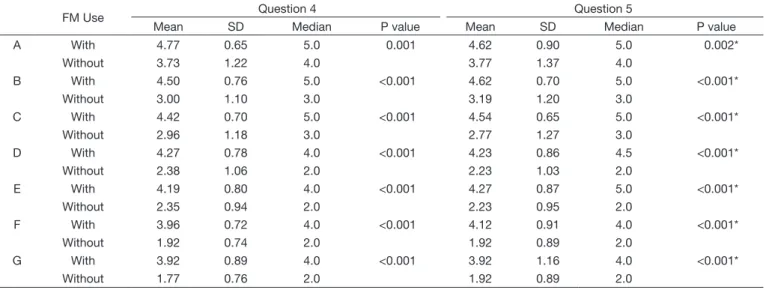
The following tables present the data analysis carried out with
the information obtained from the questionnaire. Table 1 refers
to questions 1 through 3, and Table 2 refers to questions 4 and 5, as can be observed.
The Wilcoxon statistical test showed a statistically
signiicant difference for all questions and all acoustic situations. The questionnaire score was higher among the FM users than
among non-users.
The Wilcoxon test was also used to compare the results, as shown in Table 3, of the Situational Analysis. A statistically
signiicant difference was observed between the situations with
and without FM in all scores, being the highest average scores for situations with FM. The total score presented averages of 198.7 and 118.2, respectively.
Finally, Table 4 displays the data obtained about the use of
FM and its beneits as reported by the family.
Table 1. Descriptive measures and comparative results of the FM Listening Evaluation questionnaire, according to variable ‘FM use’, for questions 1, 2 and 3 in each acoustic situation
FM Use Question 1 Question 2 Question 3
Mean SD Median P value Mean SD Median P value Mean SD Median P value A With 4.96 0.20 5.0 0.005* 4.88 0.33 5.0 0.002* 4.62 0.75 5.0 <0.001*
Without 4.19 1.17 5.0 3.92 1.26 4.5 3.15 1.32 3.0
B With 4.88 0.33 5.0 <0.001* 4.77 0.51 5.0 <0.001* 4.38 0.85 5.0 <0.001* Without 3.31 1.23 3.0 2.96 1.28 3.0 2.54 1.21 2.5
C With 4.69 0.62 5.0 <0.001* 4.50 0.51 4.5 <0.001* 4.27 0.96 5.0 <0.001* Without 3.38 1.24 4.0 2.88 1.07 3.0 2.62 1.24 2.5
D With 4.62 0.64 5.0 <0.001* 4.42 0.64 4.5 <0.001* 4.04 1.18 4.0 <0.001* Without 2.58 1.42 2.0 2.23 0.95 2.0 2.15 1.16 2.0
E With 4.73 0.53 5.0 <0.001* 4.46 0.65 5.0 <0.001* 4.15 1.16 4.5 <0.001* Without 2.96 1.34 3.0 2.23 1.11 2.5 2.12 1.14 2.0
F With 4.62 0.64 5.0 <0.001* 4.27 0.83 4.5 <0.001* 3.92 1.29 4.0 <0.001* Without 2.62 1.30 3.0 1.58 0.76 1.0 1.73 0.78 2.0
G With 4.50 0.76 5.0 <0.001* 4.12 0.91 4.0 <0.001* 3.81 1.39 4.0 <0.001* Without 2.81 1.33 3.0 1.77 0.82 2.0 1.73 0.78 2.0
*Statistically significant values (p <0.05) - Wilcoxon test
Legend: item A (In a quiet room, within 3 feet); item B (In a quiet room, at 10 feet); item C (In a noisy room, within 3 feet); item D (In a noisy room, at 10 feet); item E
The two-proportion z-test showed that the activity in which the FM system most helped the children was school activities
(80.8%), as 53.8% of them use FM in several situations (school, therapy and home). The greatest beneit observed by parents and
guardians was with regard to speech comprehension, and the major change in the child’s behavior was about their attention
span – 73.1% of the respondents stated that their children became
more attentive when they were using the FM system associated with a HA and/or CI.
DISCUSSION
The research analysis allowed observing, by comparing the auditory situations with and without FM in Tables 1 and 2, a
statistically signiicant difference between the two situations.
The use of FM proved best performance in all abilities evaluated, regardless of distance and acoustic environment. It was possible to verify that using only a HA and/or CI the
children still have great dificulties in understanding speech in
noisy environments – a fact that does not happen when using
Table 4. Characterization of the use and benefit of the FM system Activities that were most beneficial N % P value
Story-time/reading /School 21 80.8 Ref. Listening/speech therapy 2 7.7 <0.001*
At home 3 11.5 <0.001* Types of activities the FM is used for N % P-value Story-time/reading 6 23.1 0.023* Listening/speech therapy 2 7.7 <0.001* At home 4 15.4 0.004* All of the above 14 53.8 Ref. Greatest benefit(s) of the FM system N % P-value
Learning 7 26.9 0.087 Attention 6 23.1 0.044* Speech comprehension 13 50.0 Ref. Greatest change(s) in the child after FM use N % P-value
Child became more focused 19 73.1 Ref. Better speech skills 2 7.7 <0.001* More communicative 3 11.5 <0.001* Better social performance/peer interaction 2 7.7 <0.001*
*Statistically significant values (p <0.05) - Two-proportion z-test
Legend: FM = Frequency Modulation; N = Number of individuals; Ref = value
statistically different from the others
Table 2. Descriptive measures and comparative results of the FM Listening Evaluation questionnaire, according to variable ‘FM use’, for questions 4 and 5 in each acoustic situation
FM Use Question 4 Question 5
Mean SD Median P value Mean SD Median P value
A With 4.77 0.65 5.0 0.001 4.62 0.90 5.0 0.002*
Without 3.73 1.22 4.0 3.77 1.37 4.0
B With 4.50 0.76 5.0 <0.001 4.62 0.70 5.0 <0.001*
Without 3.00 1.10 3.0 3.19 1.20 3.0
C With 4.42 0.70 5.0 <0.001 4.54 0.65 5.0 <0.001*
Without 2.96 1.18 3.0 2.77 1.27 3.0
D With 4.27 0.78 4.0 <0.001 4.23 0.86 4.5 <0.001*
Without 2.38 1.06 2.0 2.23 1.03 2.0
E With 4.19 0.80 4.0 <0.001 4.27 0.87 5.0 <0.001*
Without 2.35 0.94 2.0 2.23 0.95 2.0
F With 3.96 0.72 4.0 <0.001 4.12 0.91 4.0 <0.001*
Without 1.92 0.74 2.0 1.92 0.89 2.0
G With 3.92 0.89 4.0 <0.001 3.92 1.16 4.0 <0.001*
Without 1.77 0.76 2.0 1.92 0.89 2.0
*Statistically significant values (p <0.05) - Wilcoxon test
Legend: item A (In a quiet room, within 3 feet); item B (In a quiet room, at 10 feet); item C (In a noisy room, within 3 feet); item D (In a noisy room, at 10 feet); item E
(Without visual cues); item F (From another room) e item G (Outside/in the community). Question 4: Child responds accurately to spoken directions and/or questions; Question 5: Child comprehends oral instruction & concepts. SD = Standard Deviation; FM = Frequency Modulation System
Table 3. Results (%) of the comparison with and without FM in the Situational Analysis
Situational Analysis Mean (%) Median (%) Standard Deviation Q1 Q3 N CI P value Quiet With FM 47.0 48.5 3.9 45.5 50.0 26 1.5 <0.001*
Without FM 33.8 32 8.9 26.25 39.8 26 3.4
Noise With FM 64.3 67 9.0 57 71.0 26 3.5 <0.001*
Without FM 36.2 35 9.7 30.25 41.8 26 3.7
Auditory only With FM 21.8 23 3.1 20 24.0 26 1.2 <0.001*
Without FM 11.9 12 3.8 10 13.8 26 1.5
Distance With FM 65.6 67.5 7.5 61.25 72.5 26 2.9 <0.001*
Without FM 36.3 35 9.9 30.25 41.0 26 3.8
Total score With FM 198.7 204.5 21.7 185 217.3 26 8.3 <0.001* Without FM 118.2 111.5 29.4 101.5 131.8 26 11.3
*Statistically significant values (p <0.05) - Wilcoxon test
the FM system. In another study(16) developed with school children, the questionnaire answered by parents also showed a
clear difference, with better scores for the use of FM.
It is worth noting that all children in the present study are attending school, and it is known that (competitive) environmental noise interferes with oral communication. This can cause physical, emotional and educational damage, such as changes in auditory thresholds; perception of tinnitus; fatigue resulting from the greater effort to listen and concentrate. All that can cause learning loss, since the student may partially understand the lesson or even receive the message distortedly(12). Using
the FM coupled with their hearing devices, such unfavorable listening situations in the school environment would occur less often and would also stimulate the child’s participation in school activities(15,18-20).
A signiicant difference was also observed in performance,
as can be seen in the situational analysis in Table 3. Although
all analyses were statistically signiicant (p <0.001), evidencing a better performance with the use of FM, it can be veriied that
for situations in which noise was present and/or there was an increase in the distance from the sound source, the improvement was greater than in situations of silence. In the situational analysis
of quiet, the beneit percentage observed was 13.2%, whereas in the situational analyses of noise and distance it was 28.1% and 29.3%, respectively. These results meet the real objective of the FM system, namely, the improvement of speech signal acquisition,
eliminating the limiting factors to speech comprehension, which are three: noise, distance and reverberation. In view of that, FM can be an alternative among the differentiated materials and support resources used by students with special educational needs, aiming at educational integration(21).
A normal-hearing child’s ability to recognize speech, in comparison to an adult’s ability, is mostly affected by adverse conditions such as noise and reverberation(22). Hearing impaired individuals, even using HAs or CIs, experience dificulty in
speech recognition in noisy surroundings(23). Therefore, it
should be emphasized that the FM system is the most important and indispensable educational tool ever developed for hearing impaired children(7).
It is widely known that the use of FM contributes greatly to the development of the hearing-impaired individuals as a noteworthy accessibility tool. In this way, it is important to raise resources in order to develop the necessary conditions for the inclusion of students with special needs as a premise to make them individuals of creation and production of the goods produced by society(24).
As described, the irst step in the audiologic intervention process is the use of sound ampliication for the hearing
impaired(24), and the FM system should be considered as a key
part of rehabilitation, especially for children. However, it is worth emphasizing that it is within the school environment that
the greatest beneits of the FM system are observed, since it
guarantees the best access to the information and the knowledge being conveyed directly to the auditory system. The adoption of FM by the hearing impaired is supplementary to the use of other HA devices.
According to the results of the present study, the greatest
beneit reported by the families was the improvement of the
child’s speech comprehension. As can be seen in Table 4, parents and guardians stated that, with FM, the child can understand
speech better, either at home, school or therapy, consequently the
speaker needs to repeat less often and the child understands the
message. The primary beneit of using a wireless communication
system, such as FM, is the improvement in the understanding of the teacher’s speech in a noisy environment such as the classroom, thus creating conditions favorable to learning
acquisition and consolidation for children and/or young people
with hearing loss(15,18-20).
Another relevant factor of the FM system, as observed in the data analysis in terms of behavior, was that children’s level of attention increased. It is known that only attention is not enough for the development of the teaching/learning process; other factors also contribute to the process, such as teaching strategies, the teacher’s expertise and the student’s self-commitment(21). However, it is also known that auditory attention is a prerequisite for perfect learning.
Results similar to the indings of this paper were published by
a Brazilian study in 2015. According to the authors, the greatest
beneit of FM, as described by parents and/or guardians, was
the improvement of speech recognition in all environments, especially in the school context, where children showed better learning performance(16). Other beneits reported by parents
include the fact that FM systems improve attention in noise, keep the child focused on the speaker, and give extra boost to hearing aids(13).
In the present study, of the 26 children under analysis, four did not use the FM system in school because the educational
institution did not allow them to. Even knowing about the beneit
of using oral communication that the device brings to their
children - who met the criteria required by the SUS and were beneited with the FM system - families end up complying with
the school’s decision. In a previous study, the non-use of the
device in the school environment was also veriied. The reasons
were the teachers’ fear of handling or damaging the device and lack of training to operate it, even though it was offered(16).
Although the beneits of using FM systems for the inclusion
of hearing-impaired children in regular classrooms have
been known for decades, there are scarce national scientiic
publications that can assist this process in the Brazilian reality.
This reality has changed since the issue of Ordinance 1274 of
June 25, 2013, which made it possible for children throughout
the Brazilian territory, through the SUS, to beneit from the FM
system. As a result, new studies have been published showing
the effectiveness of this accessibility equipment.
It is worth mentioning that, from the family’s perspective,
all the children in the present study had better beneits with the
use of FM rather than its non-use, and the difference in results
was signiicant.
This study sought to verify if the family, responsible for the hearing-impaired children using FM, did perceive improvements in
the hearing quality of these children in all the environments in which
heal or minimize the hearing dificulties of their children and
indeed perceived improvements in their children’s behavior and performance when using FM. However, it is necessary to provide
teachers with speciic qualiication to receive the students who
are FM users, in addition to greater dissemination and guidance to parents and/or professionals in other areas who do not know this technology. Furthermore, the opinion of parents, teachers and therapists was key to understand whether or not the use of
HA devices was beneicial to the children.
The study revealed that patients do not regularly attend the follow-up visits with the speech therapist to verify the
functioning and beneits of the HAs and FM, which made it dificult to have a greater number of participants in this study.
Moreover, it is necessary to develop more research in the area in order to measure improvements observed and reported by
family regarding understanding, attention and, consequently,
progress in the teaching/learning process.
CONCLUSION
This study veriied that, from parents’ and guardians’ points
of view, the FM system improves hearing-impaired individuals’ performance in several acoustic situations, especially in speech environments in noise and at distance from the source sound. Still according to family, although the FM system can be used in different situations, it is in the school environment that it brings
greater beneits to the children, since the improvement of the
signal-to-noise ratio helps them pay more attention, improve speech comprehension, thus facilitating the teaching/learning process.
ACKNOWLEDGEMENTS
To the Cascavel Hearing Clinic for consenting and supporting the development of this study.
REFERENCES
1. Zandavalli MB, Christmann LS, Garcez VRC. Rotina de procedimentos utilizados na seleção e adaptação de aparelhos de amplificação sonora individual em centros auditivos na cidade de Porto Alegre, Brasil – RS. Rev CEFAC. 11(Supl 1):106-15.
http://dx.doi.org/10.1590/S1516-18462009005000012.
2. Ferreira K, Moret ALM, Bevilacqua MC, Jacob RST. Tradução e adaptação de indicadores de desempenho auditivas funcionais (FAPI). J Appl Oral Sci. 2011;19(6):586-98. PMid:22230992. http://dx.doi.org/10.1590/S1678-77572011000600008.
3. Pupo AC, Balieiro CR, Figueiredo RSL. Estudo retrospectivo de crianças
e jovens com deficiência auditiva: caracterização das etiologias e quadro audiológico. Rev CEFAC. 2008;10(1):84-91. http://dx.doi.org/10.1590/
S1516-18462008000100012.
4. Martin ST, Martin LG, Pedersen HF. A collaborative approach to fitting amplification [Internet]. Houston: Audiology Online; 2001 [citado em 2016 Nov 28]. Disponível em http://www.audiologyonline.com/articles/ collaborative-approach-to-fitting-amplification-1216
5. Carney AE, Moeller MP. Treatment efficacy: hearing loss in children. J
Speech Lang Hear Res. 1998;41(1):S61-84. PMid:9493747. http://dx.doi.
org/10.1044/jslhr.4101.s61.
6. Jacob RTS, Bevilacqua MC, Molina SV, Queiroz M, Hoshii LA, Lauris JRP, et al. Sistemas de modulação de frequência em crianças deficientes
auditiva: avaliação de resultados. Rev Soc Bras Fonoaudiol.
2012;17(4):417-21. http://dx.doi.org/10.1590/S1516-80342012000400009.
7. Blasca WQ, Ferrari DV, Jacob RTS. Dispositivos Eletrônicos Aplicados à
surdez: conceitos básicos. In: Genaro KF, Lamonica DC, Bevilacqua MC,
organizadores. O processo de comunicação: contribuição para a formação de professores na inclusão de indivíduos com necessidade educacionais
especiais. São José dos Campos: Pulso; 2006. cap. 14. p. 197-213.
8. Lins FAC, Oliveira ES. A tecnologia dos sistemas de frequência modulada como recurso para a inclusão do portador de deficiência auditiva no
ensino regular. In: I Seminário ATIID - Acessibilidade, Tecnologia da
Informação e Inclusão Digital; 2001; São Paulo. Anais. São Paulo: PRODAM; 2001 [citado em 2016 Nov 28]. Disponível em http://www. prodam.sp.gov.br/multimidia/midia/cd_atiid/conteudo/ATIID2001/MR1/08/
TecnoSistFreqModuladaRecursoDA.pdf
9. Brasil. Ministério da Saúde. Portaria n°. 1.274, de 25 de junho de 2013. Inclui o Procedimento de Sistema de Frequência Modulada Pessoal (FM)
na Tabela de Procedimentos, Medicamentos, Órteses, Próteses e Materiais
Especiais (OPM) do Sistema Único de Saúde. Diário Oficial da União;
Brasília; 2013.
10. Lewis MS, Hutter M, Lilly DV, Bourdette D, Saunders J, Fausti SA.
Frequency-Modulation (FM) technology as a method for improving speech
perception in noise for individuals with multiple sclerosis. J Am Acad Audiol. 2006;17(8):605-16. PMid:16999255. http://dx.doi.org/10.3766/ jaaa.17.8.7.
11. Bevilacqua MC, Formigoni GM. Audiologia Educacional: uma opção terapêutica para a criança deficiente auditiva. Carapicuiba: Pró-Fono Departamento Editorial; 1997. 86 p.
12. Dreossi RCF, Momensohn-Santos TM. Investigação sobre o efeito do
ruído na inteligibilidade de fala de crianças da quarta série do ensino fundamental. Rev Soc Bras Fonoaudiol. 2004;9(3):136-43.
13. Gabbard SA. The use of FM Technology for infants and young children. In: Fabry D, Johnson CD, editors. I International FM Conference. Acess: achieving clear communication employng sound solutions; 2003; Chicago. Proceedings. Chicago: Cambrian Printers; 2003. p. 93-99.
14. Jacob RTS, Molina SV, Amorim RB, Bevilacqua MC, Lauris JRP, Moret ALM. FM listening evaluation for children: adaptação para a língua portuguesa. Rev Bras Educ Espec. 2010;16(3):359-73. http://dx.doi.
org/10.1590/S1413-65382010000300004.
15. Bertachini ALL, Pupo AC, Morettin M, Martinez MAN, Bevilacqua MC, Moret ALM, et al. Frequency Modulation System and speech perception in the classroom: a systematic literature review. CoDAS. 2015;27(3):292-300.
PMid:26222948.http://dx.doi.org/10.1590/2317-1782/20152014103. 16. Alves LM, Silva BR, Rocha TM, Sales CB, Celeste LC. Avaliação
da qualidade de vida em usuários do sistema de frequência modulada.
Revista Tecer. 2015;8(15):89-102. http://dx.doi.org/10.15601/1983-7631/ rt.v8n15p89-102.
17. Nguyen H, Bentler R. Optimizing FM systms: verification of device function at fitting na follow-up preserves advantages of use. ASHA Lead. 2011;16:5-6.
18. Lewis MS, Crandell CC, Valente M, Horn JE. Speech perception in noise:
directional microfones versus frequency modulation (FM systems). J Am Acad Audiol. 2004;15(6):426-39. PMid:15341224. http://dx.doi.org/10.3766/
jaaa.15.6.4.
19. Jacob RTS, Alves TKM, Moret ALM, Morettin M, Santos LG, Mondelli MFCG. Participation in regular classroom of student with hearing
loss: frequency modulation System use. CoDAS. 2014;26(4):308-14.
PMid:25211690. http://dx.doi.org/10.1590/2317-1782/201420130027. 20. Mondelli MFCG, Jacob RTS, Santos LG, Fidêncio VLD. Unilateral
malformation: adaptation of the frequency modulation system. Rev
Bras Otorrinolaringol. 2015;81(2):222-3. PMid:25697575. http://dx.doi. org/10.1016/j.bjorl.2015.01.002.
21. Souza-Jabob RT, Almeida MA, Bevilacqua MC. Uso Alternativo do
22. Stuart A. Reception thresholds for sentences in quiet, continuous noise, and interrupted noise in school-age children. J Am Acad Audiol.
2008;19(2):135-46. PMid:18669127. http://dx.doi.org/10.3766/jaaa.19.2.4.
23. Crandel C, Smaldino J. Classroom acoustics. In: Roeser RJ, Downs MP, editors. Auditory disorders in school children. 3rd ed. New York: Thieme; 1995. p. 235-60.
24. Freitas SN. Educação e Formação de Professores: experiências inclusivas implementadas em Santa Maria/RS. In: Brasil. Ministério da Educação.
Secretaria de Educação Especial. III Seminário Nacional de Formação de
Gestores e Educadores. Ensaios pedagógicos [Internet]. 2006; Brasília.
Anais. Brasília: Gráfica e Editora Ideal Ltda; 2006 [citado em 2016 Set 26]. p. 239-45. Disponível em: http://portaldoprofessor.mec.gov.br/storage/
materiais/0000013526.pdf
Authors contributions
APPENDIX A. FM LISTENING EVALUATION FOR CHILDREN
C. DeConde Johnson, Revised June 2003
Name:_______________________________________________________________Date of Birth: __________________
Completed by:_________________________________________________________Date:__________________ _______ ( ) parent ( ) audiologist ( ) teacher ( ) other - specify ______________________________________________________
Length of hearing aid usage:___________________________________________________________________________
HA brand/model:____________________________________________________________________________________
Length of FM usage:_________________________________________________________________________________ FM brand/model:____________________________________________________________________________________
( ) FM used daily ( ) Number of hours per day used________________________________________________________
( ) FM used occasionally ( ) Number of hours per week used
Please rate the following skills based on the child’s behavior or performance on typical days. Indicate if performance was obtained () with FM or () without FM (baseline).
To score, subtract any NA (not applicable) items from the total, then determine percent for total performance and for each situation.
Seldom Sometimes Usually 1. Child responds to his/her name when spoken to:
a. In a quiet room, within 3 feet 1 2 3 4 5 NA
b. In a quiet room, at 10 feet 1 2 3 4 5 NA
c. In a noisy room, within 3 feet 1 2 3 4 5 NA
d. In a noisy room, at 10 feet 1 2 3 4 5 NA
e. Without visual cues 1 2 3 4 5 NA
f. From another room 1 2 3 4 5 NA
g. Outside/in the community 1 2 3 4 5 NA
2. Child attends to person speaking:
a. In a quiet room, within 3 feet 1 2 3 4 5 NA
b. In a quiet room, at 10 feet 1 2 3 4 5 NA
c. In a noisy room, within 3 feet 1 2 3 4 5 NA
d. In a noisy room, at 10 feet 1 2 3 4 5 NA
e. Without visual cues 1 2 3 4 5 NA
f. From another room 1 2 3 4 5 NA
g. Outside/in the community 1 2 3 4 5 NA
3. Child distinguishes between words that sound alike (e.g., bay for day, sink for think, or sun for fun):
a. In a quiet room, within 3 feet 1 2 3 4 5 NA
b. In a quiet room, at 10 feet 1 2 3 4 5 NA
c. In a noisy room, within 3 feet 1 2 3 4 5 NA
d. In a noisy room, at 10 feet 1 2 3 4 5 NA
e. Without visual cues 1 2 3 4 5 NA
f. From another room 1 2 3 4 5 NA
g. Outside/in the community 1 2 3 4 5 NA
4. Child responds accurately to spoken directions and/or questions:
a. In a quiet room, within 3 feet 1 2 3 4 5 NA
b. In a quiet room, at 10 feet 1 2 3 4 5 NA
c. In a noisy room, within 3 feet 1 2 3 4 5 NA
d. In a noisy room, at 10 feet 1 2 3 4 5 NA
e. Without visual cues 1 2 3 4 5 NA
f. From another room 1 2 3 4 5 NA
5. Child comprehends oral instruction & concepts:
a. In a quiet room, within 3 feet 1 2 3 4 5 NA
b. In a quiet room, at 10 feet 1 2 3 4 5 NA
c. In a noisy room, within 3 feet 1 2 3 4 5 NA
d. In a noisy room, at 10 feet 1 2 3 4 5 NA
e. Without visual cues 1 2 3 4 5 NA
f. From another room 1 2 3 4 5 NA
g. Outside/in the community 1 2 3 4 5 NA
TOTAL SCORE: _____/(175) = ____% __with FM __without FM
Situational Analysis: Quiet (a,b) ____/(50) = ____% Noise (c,d,g) ____/(75) = ____% Auditory only (e) ____/(25) = ____% Distance (b,d,f) ____/(75) = ____%
Information on FM Use
Seldom Sometimes Usually
1. HA/FM system is easy to operate: 1 2 3 4 5 NA
2. HA/FM system has remained in good working order: 1 2 3 4 5 NA
3. HA/FM system is comfortable for child to use: 1 2 3 4 5 NA
4. Child tries to turn HA/FM system off: 1 2 3 4 5 NA
5. Feedback (whistling noise) is present with HA/FM: 1 2 3 4 5 NA
6. Indicate types of activities the FM is used for:
____ snacks ____ play ____ story-time/reading ____ playground ____ walks
____ listening/language/speech therapy ____ shopping ____ car
Other (describe) ______________________________________________________________________________________
7. For which of the above activities do you think the FM was most beneicial?
___________________________________________________________________________________________________
8. What do you think is the greatest beneit(s) of the FM system?
___________________________________________________________________________________________________
9. What do you think is the greatest challenge(s) with the FM system?
___________________________________________________________________________________________________