(1) Universidade Federal de Pernambuco - UFPE, Recife, Per-nambuco, Brasil.
(2) Curso de Fonoaudiologia da Universidade Federal de Per-nambuco - UFPE, Recife, PerPer-nambuco, Brasil.
Conlict of interest: non-existent
Despite this high prevalence, the etiology of hearing loss, in most cases, can be controlled, by promoting hearing health through preventive actions and guidance to the population4. For such, we need
the involvement of a multidisciplinary team that includes speech therapists, pediatricians, gynecolo
-gists/obstetricians, neonatologists, nurses, besides the family and community5.
Health professionals, especially nurses, who have practice founded in caring6, can act as multi
-pliers of actions to promote health and prevent several diseases in periodic visits to the population assisted by them. However, most of these profes
-sionals do not receive information regarding the importance of prevention of hearing disorders, risk factors, its identiication and diagnosis at the earliest possible of hearing loss, besides the unfamiliarity with the measures of medical and speech interven
-tions, making it dificult to appropriate support the population in identifying such changes7.
The knowledge related to hearing health by health professionals should be passed on to the population, which empowered by this knowledge can extend their care about the issue and conducting an active search of what is best for its health. This concept is consolidated with the claim that the actions of health
INTRODUCTION
Hearing is one of the senses necessary to acquire important information for human devel
-opment, especially in their language , educational and psychosocial aspects1.
This relationship between hearing and oral language development makes the diagnosis of hearing loss should be accomplished as soon as
possible2,3, in order to intervene and mitigate their
consequences, with a greater chance of success in linguistic competence, for most children.
Among the diseases possible of newborn screening, the hearing loss is highly prevalent (1 to 3:1,000), especially when compared to other diseases, such as phenylketonuria (0.07:1.000), hypothyroidism (0.17:1.000), sickle cell anemia
(0.20:1.000 )2, surveyed routinely through neonatal
screening.
HEALTH EDUCATION REGARDING TO NEWBORN
SCREENING AND HEARING: AN INTEGRATIVE REVIEW
Educação em saúde com vistas à triagem neonatal e audição:
uma revisão integrativa
Camila Padilha Barbosa(1), Silvana Maria Sobral Griz(2)
ABSTRACT
The purpose of this paper was to investigate studies regarding to health education and programs which the main topic is neonatal screening and/or hearing. It was done an integrative review, which was realized in August of 2011, with search on the Biblioteca Virtual em Saúde, from those key-words in health science: “hearing”, educational programs, health education, and neonatal screening”. It was analyzed 10 articles. The data base with the majority of articles was Medline and seven of them was classiied as evidence level of three. It could be observed that educative actions regarding to hearing health should be done as a manner to promote continuing education. The population mainly beneiciated with those actions was seen to be parents and health professionals. The educative actions give power to the public it is for, with knowledge exchange, in particular to the hearing health area.
Portuguese, English or Spanish, (b) between 2001 and 2011. To be included, studies had to have developed some form of health education and / or training, addressing the theme neonatal screening and / or hearing. A large number of articles was excluded for not meeting this criterion.
The methodology in which each educational activity or training was performed in the studies was not a selection criteria established for this review. Thus, all studies that have proposed educational activities ranging from obtaining knowledge by participating in an informal way, such as the use of printed material, formal interventions, through permanent and / or continuing education were analyzed. Dissertations and theses, publications regarding conference abstracts, proceedings, editorials, commentaries and opinions, articles on relection, projects, reports, and technical reports were excluded.
For studies selection, the inclusion criteria were applied in the search and subsequently the carefully reading of titles and abstracts of all publi
-cations located by the search strategy (N = 1495) was performed, in order to assess the suitability of inclusion criteria. When the title and summary were not enough to deine the irst selection, we sought to read the publication in full (n = 17). Then, the read of each selected article in full was performed.
To data collection was applied the validated instrument to the articles14 in order to guide the data
extraction, which includes: (a) identiication of the original article, (b) methodological characteristics of the study, (c) evaluation of the methodological rigor of measured interventions and the results found.
The step of selecting studies included meetings with the authors of the study to clarify doubts regarding the inclusion or exclusion of studies. This procedure aimed at reducing bias in selection of studies, giving it greater security. For interpretation and analysis of articles, a summary table was elaborated in order to summarize general infor
-mation about the studies. This summary table was composed of information about the title, author, year and place of publication, language, goals, results of studies (if there is a change in behavior), conclu
-sions (if make suggestions that may guide future actions) and issues such as: 1) Refers to a training and / or educational activities on the subject and neonatal screening / hearing? 2) What is the target population? 3) Place of activities performance, 4) what is the methodology of activities? 5) Evaluation of the methodology.
The articles were further classiied according to level of evidence. The evidence-based practice focuses on evidence classiication systems. education provide people the capacity of making
healthy choices, favoring the increased awareness by changes that promote improved health8. The
education in this context is an important tool in the actions of health promotion9.
Faced with the need to increase knowledge on hearing health of health professionals, some studies4,10-12 have demonstrated the need for
investment in the area of training, with regard to child’s hearing health and issues involved with this subject.
In order to guide professionals in the health area in their training activities, one can use studies such as the integrative review11. This article aims at inves
-tigating studies on health education and training that addressed the theme neonatal screening and / or hearing to identify strategies that may favor the development of future educational activities concerning to child’s hearing health.
METHODS
This integrative review, besides allowing the incorporation of evidence in a particular profes
-sional practice, aims at gathering and synthesizing research indings on a topic or speciic issues in a systematic and orderly way, contributing to deepen the knowledge about a topic11.
For its preparation, some steps were covered: (1) hypothesis deinition and objectives of the integrative review, (2) establishing criteria for inclusion and exclusion of articles and sample selection, (3) deining the information to be extracted from the selected articles, (4) review of the studies included in the integrative review, (5) the interpretation and discussion of results, (6) presenting the review11.
The collection of articles was conducted in August 2011, on the databases Literatura Latino-Americana and Caribe em Ciências da Saúde (LILACS), Scientiic Electronic Library Online (SciELO), MEDLINE (Medical Literature Analysis and Retrieval System Online) and IBECS and through the Virtual Health Library, which enables simultaneous search of relevant publications in major scientiic databases, nationally and internationally, from the same Descriptors in Health Sciences (MeSH ), ensuring the scope of the research and facilitating the operationalization of results13.
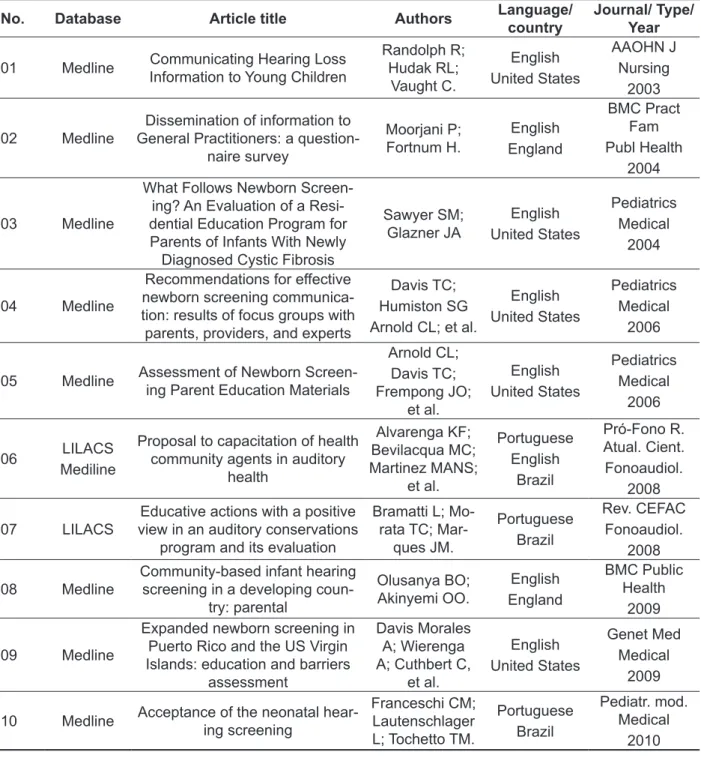
The inal sample consisted of 10 studies described in Table 1. The analysis and synthesis of the extracted data was performed descriptively, enabling to observe, count, describe and classify the data in order to gather the knowledge produced on the theme explored in the review.
hierarchically, depending on the research design, i.e. the methodological approach adopted for the study development. In this study, the categorization considered classiies the evidence in a total of six
níveis14.
Table 1 - Description of the articles included in the integrative review. Recife 2011
No. Database Article title Authors Language/
country
Journal/ Type/ Year
01 Medline Communicating Hearing Loss
Information to Young Children
Randolph R; Hudak RL;
Vaught C.
English United States
AAOHN J Nursing
2003
02 Medline
Dissemination of information to General Practitioners: a question
-naire survey
Moorjani P;
Fortnum H. EnglandEnglish
BMC Pract
Fam
Publ Health
2004
03 Medline
What Follows Newborn Screen
-ing? An Evaluation of a Resi
-dential Education Program for Parents of Infants With Newly
Diagnosed Cystic Fibrosis
Sawyer SM;
Glazner JA United StatesEnglish
Pediatrics
Medical 2004
04 Medline
Recommendations for effective newborn screening communica
-tion: results of focus groups with parents, providers, and experts
Davis TC;
Humiston SG Arnold CL; et al.
English United States
Pediatrics
Medical 2006
05 Medline Assessment of Newborn Screening Parent Education Materials
-Arnold CL;
Davis TC;
Frempong JO; et al.
English United States
Pediatrics
Medical 2006
06 LILACS
Mediline
Proposal to capacitation of health community agents in auditory
health
Alvarenga KF; Bevilacqua MC;
Martinez MANS; et al.
Portuguese English
Brazil
Pró-Fono R.
Atual. Cient.
Fonoaudiol. 2008
07 LILACS
Educative actions with a positive view in an auditory conservations
program and its evaluation
Bramatti L; Mo
-rata TC; Mar
-ques JM.
Portuguese Brazil
Rev. CEFAC Fonoaudiol.
2008
08 Medline
Community-based infant hearing
screening in a developing
coun-try: parental
Olusanya BO;
Akinyemi OO. EnglandEnglish
BMC Public
Health 2009
09 Medline
Expanded newborn screening in Puerto Rico and the US Virgin Islands: education and barriers
assessment
Davis Morales
A; Wierenga A; Cuthbert C,
et al.
English United States
Genet Med
Medical
2009
10 Medline Acceptance of the neonatal hear -ing screen-ing
Franceschi CM; Lautenschlager L; Tochetto TM.
Portuguese Brazil
Pediatr. mod.
to broaden the professional’s knowledge through actions of continuous education7.
The study 01 refers that to intervene in effective hearing health is necessary to seek alternatives to increase knowledge on the topic. The same is corroborated by studies 02, 06 and 09, when they claim that it is necessary to train professionals involved, assess the dissemination of information and evaluate such educational interventions, in order to document local needs for neonatal screening and the barriers of this process to subsequent adoption of strategies. Studies 03 and 04 recommend the involvement of health professionals in educational activities directed to parents to make them aware of the practices of newborn screening.
When it comes to the hearing health of the neonate and infant, studies17-20 state that efforts regarding
hearing health are only valid if there is awareness of professionals working on this population and their families. In the case of knowledge about children’s hearing health, the purpose is to act in promotion and prevention from pre-natal allowing initiating the process of detection, identiication, diagnosis and rehabilitation of hearing loss as early as possible21
qualiication. For such, we must increase the dialogue between health professionals and the public, since the monitoring of pregnancy to the development of children. Guidance on the hearing health yet started prenatally may bring short-term beneits, such as preventing changes and compliance to standard
procedures21,22 such as the NHS and the rescue of
families that do not return to complete the diagnostic
process23.
The NHS has been widely practiced in developed countries24 However, in the developing countries,
there is the need to explore effective alternatives to implement such programs19. It is essential to invest
in health promotion and disease prevention in health
services25 in these countries, educational initiatives
in child health hearing conducted by Community Health Agents (CHA) has been identiied as ways to prevent hearing loss. Study 06, following recommen
-dations26, described a training program on children’s
hearing health for CHA with effective results. Another aspect discussed refers to multidisci
-plinary action, important for improving the hearing health and effectiveness of child’s hearing health programs. The need to invest in awareness campaigns not only for health professionals as speech therapists and the general population is highlighted. The population most often studied in the articles was mothers/fathers (n = 04) and physi
-cians (n = 03). Campaigns aimed at users of health services should address issues relating to the importance of promotion, prevention, detection and
LITERATURE REVIEW
The term screening refers to apply a particular test to a large number of individuals in a rapid and simple manner, with high probability of identifying a disease. No neonatal screening is a diagnostic procedure, but rather a way to identify among asymptomatic individuals, those who are suspected of having the disease and requiring further more elaborated diagnostic procedures15. The health
education aims at developing in people a sense of responsibility as an individual, member of a family and a community for health, both individually and collectively. Empowerment is the process of training a person or group of people in knowledge or in practical and theoretical application of a given activity13.
In this scenario, there are challenges and perspectives in the training of health professionals in the multidisciplinary ield, irming different levels of understanding and intervention with individuals, implying distinct political, social and educational commitments13. Thus, health professionals should
be facing the reorganization of actions of health education and / or training by updates that attract everyone: population and health professionals.
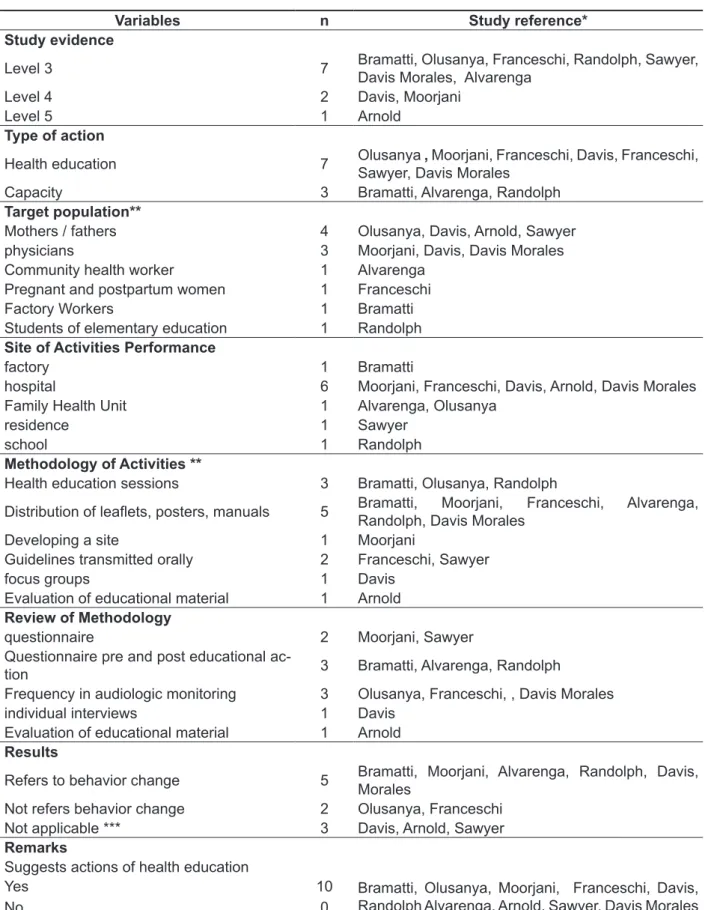
Whereas such actions should be published, this review included ten studies, characterized in Table 2. The largest number of articles (n = 09) was identiied in the Medline database, followed by the LILACS database (n = 02), with one study being common to both databases. Seven were published in international journals, written in English. Of the total, the country with highest number of publications was the United States (n = 05), followed by national journals (n = 03), two of these being published in Portuguese and one in Portuguese and English.
The period of publication of articles included encompassed the years 2003-2010. According to the methodological design of the articles, they were classiied according to strength of evidence in the levels three (n = 07), four (n = 02) and ive (n = 01). In general, the majority (n = 05) referred to health education and had more than one population beneit from the actions of health education. The theme of the studies showed different perspectives on health education and training geared towards neonatal screening and / or hearing.
The Newborn Hearing Screening Program (NHSP) is a procedure able to detect and intervene as early as possible in hearing disorders that may interfere with the life of the individual16. The beneits
Table 2 – Characterization of the articles included in this integrative review, Recife 2011
Variables n Study reference*
Study evidence
Level 3 7 Bramatti, Olusanya, Franceschi, Randolph, Sawyer,
Davis Morales, Alvarenga
Level 4 2 Davis, Moorjani
Level 5 1 Arnold
Type of action
Health education 7 Olusanya , Moorjani, Franceschi, Davis, Franceschi,
Sawyer, Davis Morales
Capacity 3 Bramatti, Alvarenga, Randolph
Target population**
Mothers / fathers 4 Olusanya, Davis, Arnold, Sawyer
physicians 3 Moorjani, Davis, Davis Morales
Community health worker 1 Alvarenga
Pregnant and postpartum women 1 Franceschi
Factory Workers 1 Bramatti
Students of elementary education 1 Randolph
Site of Activities Performance
factory 1 Bramatti
hospital 6 Moorjani, Franceschi, Davis, Arnold, Davis Morales
Family Health Unit 1 Alvarenga, Olusanya
residence 1 Sawyer
school 1 Randolph
Methodology of Activities **
Health education sessions 3 Bramatti, Olusanya, Randolph
Distribution of lealets, posters, manuals 5 Bramatti, Moorjani, Franceschi, Alvarenga,
Randolph, Davis Morales
Developing a site 1 Moorjani
Guidelines transmitted orally 2 Franceschi, Sawyer
focus groups 1 Davis
Evaluation of educational material 1 Arnold
Review of Methodology
questionnaire 2 Moorjani, Sawyer
Questionnaire pre and post educational ac
-tion 3 Bramatti, Alvarenga, Randolph
Frequency in audiologic monitoring 3 Olusanya, Franceschi, , Davis Morales
individual interviews 1 Davis
Evaluation of educational material 1 Arnold
Results
Refers to behavior change 5 Bramatti, Moorjani, Alvarenga, Randolph, Davis,
Morales
Not refers behavior change 2 Olusanya, Franceschi
Not applicable *** 3 Davis, Arnold, Sawyer
Remarks
Suggests actions of health education Yes
No
10 0
Bramatti, Olusanya, Moorjani, Franceschi, Davis, Randolph Alvarenga, Arnold, Sawyer, Davis Morales * Cited the irst author of each study. Complete references in Table 1.
to such programs, by comparing adhesion to NHS before and after guidelines. The family orientation is essential to prevent and/or reduce abandonment of the hearing assessment process, enabling parents to understand and appreciate the care that is being
performed34.
The use of appropriate educational materials can result in gains in life of the indivídual35, providing
behavior change. This change in behavior has been described in studies 01, 02, 06, 07, 09, and 10 through the distribution of brochures, posters, manuals, and conducting educational sessions on health and website development. Disclosure materials are pertinently, entitled of “educational materials” and assist communication between dyads: health professional and population, or even among health professionals36. These materials
inform and reinforce guidelines transmitted orally contributing in empowering the individual on health
care35. To prepare these educational materials is
crucial diagnostic studies that may collect opinion of parents and health professionals about infant hearing health, such as in Study 04. In addition to the diagnostic studies to manufacture these materials, it is necessary to evaluate them periodically, especially when directed to parents, as reinforced in Study 05. Finally, investigate to whom the educational material will be intended and their socioeconomic and demographic factors is essential for intelligibility and ease of use (clarity, appropriateness of language and complexity, organization and appearance). These factors may also inluence the effectiveness of NHS20 programs and actions of health education.
CONCLUSION
In this integrative review, it was found that the national and international literature is sparse when it comes to health education programs and training in the area of NHS, especially for health profes
-sionals not speech therapists, who deal directly with pregnant women, newborns, infants, postpartum and their families.
Then, it is suggested to establish a program of health education and / or training on child hearing health including the NHS and its validation to guide the actions of hearing health promotion which already include the prevention of hearing loss, having in mind that these are provided for by law as a right of every citizen. Linked to such activities, one should reinforce the need for quality educational material. In time, it underscores the need for publi
-cation / dissemination of these activities. of medical, psychological and speech therapy
intervention27. Health professionals overall need
become aware about speciic aspects of children’s hearing health to be multipliers of information to the population. All this can be made possible through educational activities and training, for example in hospitals and basic health units28,29.
Regarding the professional area of selected journals, 05 belonged to the medical journal, 02 were published in journals of speech, 02 in public health journals and 01 in occupational nursing journals. This result exposes the need for exchange of information and scientiic knowledge among different ields of knowledge, such as Speech, Medicine, Nursing, Psychology and Social Care aiming at establishing a multidisciplinary relationship and providing better service to the population30, 31.
This issue was addressed in public health journals and relected positively, because hearing loss is now considered one of the greatest public health problems, especially for the consequences that may result to human development32.
The lack of knowledge about the role of the speech therapist in the prevention of hearing loss relects the need for disclosure among multidisci
-plinary teams on the performance of these profes
-sionals, who besides searching and monitoring the hearing development, aimed at quality in compre
-hensive care to children in all steps of programs for child’s hearing health30. Health professionals can
also contribute to the education of the population, acting for the sake of their health, life quality, individually and collectively, making this pass to take an active stance against their health condition27 as
example of Study 07.
The study 08, conducted in South Africa, referred as a way of empowering the population regarding hearing, conducting educational activities on health about TAN during routine procedures, such as, at the time of vaccination. In this situation, nursing professionals can contribute greatly in the effectiveness of hearing health programs, because it is a profession already inserted into other types of newborn screening, contributing to the increased coverage and in the number of exams33.
REFERENCES
1. Garcia CFD, Isaac ML, Oliveira JAA. Emissão otoacústica evocada transitória: instrumento para detecção precoce de alterações auditivas em recém-nascidos a termo e pré-termo. Rev Bras Otorrinolaringol. 2002;68(3):344-52.
2. Joint Committee on Infant Hearing. Year 2000 Position statement: principles and guidelines for early detection and intervention programs. Pediatrics. 2000;106:798-817.
3. Joint Committee on Infant Hearing. Year 2007 Position Statement: principles and guidelines for early detection and intervention programs. Pediatrics. 2007;120(4):898-921.
4. Santos EF. Conhecimentos e práticas dos proissionais do programa Saúde da Família. [Dissertação]. Fortaleza (CE): Faculdade de Medicina, Universidade Federal do Ceará; 2004. 5. Zocoli AM, Ricchel FC, Zeigelboim BS, Marques JM. Audição: abordagem do pediatra acerca dessa temática. Rev Bras Otorrinolaringol.
2006;72(5):617-23.
6. Persegona KR, Rocha DLB, Lenardt MH, Zagonel IPS. O conhecimento político na atuação do enfermeiro. Esc Anna Nery Rev Enferm. 2009;13(3):645-50.
7. Hilú MRPB, Zeigelboim BS. O conhecimento, a valorização da triagem auditiva neonatal e a intervenção precoce da perda auditiva. Rev CEFAC. 2007;9(4):563-70.
08. Assis M. Promoção da saúde e envelhecimento: avaliação de uma experiência no ambulatório do núcleo de atenção ao idoso da UnATi/UERJ [tese]. Rio de Janeiro (RJ): Escola Nacional de Saúde Publica/Fiocruz; 2004.
09. Cervera DPP, Parreira BDM, Goulart BF. Educação em saúde: percepção dos enfermeiros da atenção básica em Uberaba (MG). Ciênc. saúde coletiva. 2011;16(1):1547-54.
10. Zepillini SL, Bonnafé MC, Pfeifer E. Detecção precoce da deiciência auditiva: um projeto de “capacitação de recursos humanos multiplicadores”. Pró-Fono. 1994;6(1):17-22.
11. Mendes KDS, Silveira RCCP, Galvão CM. Revisão integrativa: método de pesquisa para a incorporação de evidências na saúde e na Enfermagem. Texto Contexto Enferm. 2008;17(4):758-64.
12. Barreira-Nielsen, C, Futuro Neto, HA, Gattaz G. Processo de implantação de Programa de Saúde Auditiva em duas maternidades públicas. Rev. soc. bras. fonoaudiol. 2007;12(2):99-105.
13.Biblioteca Virtual de Saúde (Brasil). FIOCRUZ. Disponível em: http://regional.bvsalud.org/php/ index.php. [acesso 13 ago 2011].
14. Ursi ES, Gavão CM. Prevenção de lesões de pele no perioperatório: revisão integrativa da literatura. Rev. Latino-Am. Enfermagem.
2006;14(1):124-31.
15. Botler J, Camacho LAB, Cruz MM, George P. Triagem neonatal: o desaio de uma cobertura universal e efetiva. Ciênc. saúde coletiva. 2010; 15(2):493-508.
16. Arakawa AM, Sitta EI, Caldana ML, Sales-Peres SHC. Análise de diferentes estudos epidemiológicos em Audiologia realizados no Brasil. Rev. CEFAC.
2011;13(1):152-8.
17. Griz SMS, Silva ARA, Barbosa CP, Menezes DC, Curado NRPV, Silveira AK et al. Indicadores de risco para perda auditiva em neonatos e lactentes atendidos em um programa de triagem auditiva neonatal. Rev. CEFAC. 2011;13(2):281-91.
RESUMO
O objetivo deste trabalho foi investigar estudos sobre educação em saúde e capacitação que abor
-dassem o tema triagem neonatal e/ou audição. Trata-se de uma revisão integrativa, realizada em agosto de 2011, com busca na Biblioteca Virtual em Saúde, a partir dos Descritores em Ciências da Saúde: “Audição”, “Capacitação”, “Educação em Saúde” e “Triagem Neonatal”.A amostra inal cons
-tituiu-se por 10 estudos. A base de dados com maior número de artigos foi a Medline e a maioria dos artigos (n=07) foi classiicado com nível de evidência três. Nesta revisão integrativa, pode-se observar o quão é interessante adotar as estratégias de educação em saúde e/ou capacitação nos serviços de saúde como uma forma de educação permanente ou continuada. A população mais frequentemente estudada foi mães/pais e médicos. Ações educativas podem empoderar a população em relação à audição, englobando aspectos sobre a Triagem Auditiva Neonatal e seus procedimentos.
população usuária do Sistema Único de Saúde. Rev soc bras fonoaudiol. 2009;14(1):75-82.
28. Hilú MRPB, Zeigelboim BS. O conhecimento, a valorização da triagem auditiva neonatal e a intervenção precoce da perda auditiva. Rev CEFAC. 2007;9(4):563-70.
29. Nunes Assis F, Lima C, Souza J, Ribeiro S. A Importância da Educação para a prevenção de Doenças. Itinerarius Relectionis. 2009;2(7):1-14. 30. Maximino LP, Ferreira MV, Oliveira DT, Lamônica DAC, Feniman MR, Spinardi ACP et al. Conhecimentos, Atitudes e Práticas dos Médicos Pediatras quanto ao desenvolvimento
da comunicação oral. Revista CEFAC.
2009;11(2):267-73.
31. Linares AE, Feniman MR. O que os pediatras gostariam de saber sobre a prevenção da deiciência auditiva na infância. Pediatr Modern. 2003;39(6):187-92.
32. Fernandes JC, Nozawa MR. Estudo da efetividade de um programa de triagem auditiva neonatal universal. Ciênc. Saúde Coletiva.
2010;15(2):353-61.
33. Bertha DO. Participación del personal de enfermería en la toma de tamiz neonatal para la detección de hipotiroidismo congénito. Bol Méd
Hosp Infant Méx. 2001;58(11):755-61.
34. Zhao PJ, Shen XM, Xu ZM, Wu SH, Jin CH, Jiang F. The parents opinions on screening program regarding newborn hearing. Zhonghua Liu Xing Bing Xue Za Zhi. 2003;24(7):608-10.
35. Freitas FV, Rezende Filho LA. Modelos de
comunicación y uso de impresos en educación en salud: una pesquisa bibliográica. Interface.
2011;15(36):243-56.
36. Monteiro S, Vargas EP. Educação, comunicação e tecnologia: interfaces com o campo da saúde. Rio de Janeiro: Editora Fiocruz, 2006.
18. Griz SMS, Barbosa CP, Silva ARA, Ribeiro MA, Menezes DC. Aspectos demográicos e socioeconômicos de mães atendidas em um programa de triagem auditiva neonatal. Rev. Soc. Bras. Fonoaudiol. 2010;15(2):179-83.
19. Olusanya BO, Newton VE. Global burden of childhood hearing impairment and disease control priorities for developing countries. Lancet. 2007;369(9569):1314-7.
20. Oliveira TMT, Zanelli AC, Mainardi J. Conhecimento e atitudes das mães frente a triagem auditiva neonatal universal. Rev Fonoaudiol Brasil. 1998;1(1):18-21.
21. Levinson W, Roter D. The effects of two continuing medical education programs on communication skills of practicing primary care physicians. J Gen Intern Med. 1993;8(6):318-24.
22. Tiemens BG, Ormel J, Jenner JA, Van der Meer K, Van Os TW, Van den Brink RH et al. Training
primary-care physicians to recognize, diagnose and manage depression: does it improve patient outcomes? Psychol Med. 1999;29(4):833-45. 23. Alvarenga KF, Bevilacqua MC, Melo TM, Lopes AC, Moret ALM. Participação das famílias em Programas de Saúde Auditiva: um estudo descritivo. Rev soc bras fonoaudiol. 2011;16(1):49-53.
24. Mukari SZ, Tan KY, Abdullah A. A pilot project on hospital-based universal newborn hearing screening: lessons learned. Int J Pediatr Otorhinolaryngol.
2006;70(5):843-51.
25. Yee-Arellano HM; Leal-Garza F, Pauli-Müller K. Universal newborn hearing screening in Mexico: Results of the irst 2 years. Int J Pediatr Otorhinolaryngol. 2006;70 (11):1863-70.
26. World Health Organization (WHO): primary ear and hearing care training resource: basic, intermediate and advanced levels. Acesso em: 17 ago 2011. Disponível em: http://www.who.int/pbd/ deafness/activities/hearing_care/en/index.html. 27. Santana CJ, Scopinho PAB, Ferreira RS, Simões TC, Santos JN. Conhecimento auditivo da
Received on: May 28, 2012 Accepted on: December 19, 2012
Mailing address:
Camila Padilha Barbosa
Rua Cônego Luiz Gonzaga do Monte, 88