Objective: The aim of the study was to determine the association between weight-teasing and physical activity in students from public schools of Curitiba, Paraná (Southern Brazil).
Methods: The sample consisted of 95 students (48 boys and 47 girls) aged 12 to 14 years old. The Perception of Weight Teasing (POTS) and The Perception of Weight Teasing during Physical Activity Scale assessed the frequency of weight-teasing experienced by the participants. Accelerometers measured physical activity. BMI assessed the weight status of the participants. Pearson correlations analyzed the association between the teasing and physical activity variables at a signiicance level of 0.05.
Results: The relationship between teasing variables and physical activity was not signiicant. A large proportion of participants failed to meet the recommended levels of physical activity regardless of sex (72%), and girls were signiicantly less physically active than boys (56.3% of boys and 89.4% of girls; p<0.01).
Conclusions: Some participants were targets of weight-teasing, but teasing was not related to physical activity. Interventions are necessary to educate middle school students about the harmful consequences of weight teasing.
Keywords: Physical activity; Adolescent; Teasing.
Objetivo: Investigar a associação entre a atividade física e a provocação referente ao peso corporal em escolares matriculados no sistema público de ensino em Curitiba, Paraná.
Métodos: A amostra foi composta por 95 escolares (48 meninos e 47 meninas) com idades entre 12 e 14 anos. Para avaliar a provocação, foram utilizadas as versões em português da Escala de Percepção de Provocação e a Escala de Percepção de Provocação Durante a Atividade Física. A atividade física foi mensurada por meio de acelerômetros. O Índice de Massa Corporal (IMC) foi utilizado para deinição do estado nutricional dos participantes. A associação entre as variáveis de provocação e de atividade física foi analisada por meio da correlação de Pearson, adotando um nível de signiicância de 0,05.
Resultados: Não foram veriicadas associações signiicativas entre as variáveis de provocação e atividade física. Foram observados valores elevados de indivíduos insuicientemente ativos (72%), com diferenças signiicativas entre os sexos (56,3% dos meninos e 89,4% das meninas, p<0,01).
Conclusões: A provocação referente ao peso é vivenciada pelos escolares avaliados e não esteve relacionada com a atividade física. Destaca‑se a importância de intervenções que incentivem a conscientização das consequências da provocação referente ao peso. Palavras‑chave: Atividade física; Adolescente; Provocação.
ABSTRACT
RESUMO
*Corresponding author. Email: [email protected] (P.I. Watanabe). aUniversidade Federal do Paraná, Curitiba, PR, Brazil.
bUniversity of Northern Iowa, Cedar Falls, IA, United States.
cUniversidade Estadual do Oeste do Paraná, Marechal Cândido Rondon, PR, Brazil.
Received on June 18, 2016; approved on October 30, 2016; available online on July 14, 2017.
ASSOCIATION BETWEEN WEIGHT-TEASING
AND PHYSICAL ACTIVITY IN ADOLESCENTS
Associação entre a provocação referente ao
peso corporal e a atividade física em adolescentes
Priscila Iumi Watanabe
a,*, Fabio Eduardo Fontana
b, Michael Pereira da Silva
a,
INTRODUCTION
Weight-teasing is a common form of bullying, defined as negative communication from an agent regarding the weight of a target person, in which elements of humor, aggressiveness and ambiguity are present.1,2 It can be
expressed through name calling, insinuations, social exclu-sion, imitations, among others.3,4 Weight-teasing is
per-ceived more frequently by overweight and female indi-viduals.6,7 Evidence indicates that provocation can affect
the psychological well-being of the targets,6,8,9 besides
being associated with the acquisition of behaviors harm-ful to health, such as eating disorders and reduced levels of physical activity.7,10-12
Greenleaf et al.13 suggest that teenagers who are
tar-gets of teasing present lower levels of self-concept and less self-efficacy to practice physical activity. In addition, weight-teasing that occurs in the context of physical activ-ity practice was inversely related to pleasure in the prac-tice of sports and low-intensity physical activity in leisure time.7 These findings suggest there is a tendency for
vic-tims of weight-teasing to prefer sedentary/isolated activi-ties rather than active/social activiactivi-ties, and also stress the importance of conducting research on this construct among Brazilian adolescents.14
To date, there is a single study published with a Brazilian sample regarding the perception of weight teasing and its association with psychological and behavioral outcomes in adolescents. Leme and Philippi15 suggest that Brazilian
ado-lescents who reported being subjected to weight teasing were more likely to present unhealthy behaviors to control weight. he present study is pioneer in approaching the association of this form of bullying with the practice of physical activity, a relevant theme considering the importance of physical activ-ity for health maintenance,16 especially among overweight and
female individuals, who, aside from being more prone to prov-ocation related to body weight,6 also seem to present lower
lev-els of physical activity.17
his study aimed at investigating the association between weight teasing, in general and during the practice of physical activity, with the variable physical activity in schoolchildren from the city of Curitiba (PR).
METHOD
he nonprobability sample consisted of adolescents of both sexes, aged between 12 and 14 years old, enrolled in the public school system of the city of Curitiba, Paraná. he schools were selected intentionally and all students in the classes that belonged to the predetermined age group were invited. A total of 146
students participated in the study; however, only 95 (48 boys and 47 girls) presented valid accelerometer data, characterizing a sample loss of approximately 34%. he power of the inal sample was calculated afterwards with the G*Power software, version 3.1, considering a 5% signiicance level. he results indicated 80% power to detect correlations with signiicance equal to or higher than 0.26.
he economic class was determined using the Brazil Economic Classiication Criteria (CCEB), which accounts for items in the respondent’s household, as well as information about the head of the household’s schooling and the presence of pub-lic services (piped water and paved street).18 For the analyses,
strata A1 and A2 were grouped in A, strata B1 and B2 in B and strata C1 and C2 in C. here were no students classiied in classes D and E.
Subject height and body mass were evaluated according to the procedures described by Tritschler for further calculation of body mass index (BMI).19 Cut-of points for this variable
followed the criteria proposed by Cole et al.20 In the present
study, participants who were overweight or obese were classi-ied in the “Overweight” group.
General weight teasing was evaluated by the Perception of Teasing Scale, which corresponds to the translated and transculturally adapted version of the Perception of Teasing Scale (POTS) for Brazilian adolescents. his questionnaire was transculturally adapted and validated for Brazilian adolescents with a rigorous process consisting of the fol-lowing stages:
1. Translation.
2. Reverse translation.
3. Review by a committee.
4. Content validity.
5. Internal consistency.
6. Good Internal Consistency (Cronbach’s α=0.87) and Reproducibility test-retest (ICC=0.98, CI=0.97-0.98).
his version is composed of ive questions:
1. People made fun of you because you were overweight.
2. People made jokes about you being too heavy.
3. People laughed at you when you tried to participate in sports because you were overweight.
4. People called you names, such as “fat”.
5. People pointed out to you because you were overweight.
considered teasing in a continuous manner analyzing the value of the score generated by the sum of the questions — in which high scores represent greater history of teasing and higher emo-tional impact — and in a dichotomous manner, classifying the report as teasing if the participant answered any question with something other than never.
he construct of weight teasing during physical activity was estimated through the test of Perception of Weight Teasing During Physical Activity, a version adapted for Brazilian ado-lescents from the Weight Criticism During Physical Activity,7
which underwent the same validation process as the Perception of Teasing Scale and also presents good internal consistency values (Cronbach’s α=0.86) and test-retest reproducibility (ICC=0.96, CI=0.94–0.99). he version in Portuguese of this instrument is composed of four questions that address the fre-quency of teasing:
1. People made fun of you when you did sports or exer-cises because you were overweight.
2. People made jokes about you being very heavy during the practice of sports or physical exercises.
3. People have insulted you with name-calling related to you being heavy when you did sports or exercise.
4. People looked at you with contempt when you wore sports-wear for exercise or sports because you were overweight.
hese questions are followed by the question “If this hap-pened, how upset were you?”. he classiication (continuous and dichotomous) followed the format used for the Perception of Teasing Scale.
Physical Activity was evaluated using the ActiGraph GT3X accelerometers (ActiGraph; Pensacola, FL) programmed to collect data and summarize them in 60-second epochs. From these data, physical activity was stipulated in a continuous way, in minutes per day spent doing moderate to vigorous physical activity, or moderate to vigorous physical activity (MVPA), by the algorithm developed by Trost et al.21 Students were instructed
to place the accelerometer on their hip, aligned with the middle axillary line, beginning the use of the devices in the morning and ending at night. his procedure was performed for seven consecutive days. he day was considered valid if it had at least 480 minutes of use. he valid week of use corresponded to at least four valid monitoring days, including at least one weekend day.22 Weekly physical activity was measured by multiplying
the daily average of physical activity by seven. Physical activity was also expressed in a dichotomous manner, classifying ado-lescents as suiciently active (≥300 minutes MVPA per week) or insuiciently active (<300 MVPA per week).23
Data collection was performed between September and November 2015, by the main researcher and a trained
team from the Center for Physical Activity and Health Studies at Universidade Federal do Paraná (CEAFS-UFPR). he self-administered questionnaires (Perception of Teasing Scale, Weight Teasing During Physical Activity and the Economic Classiication Questionnaire)7,11,18 were applied
in a reserved room. Likewise, the anthropometric measures (body mass and height) were taken in a reserved place. At the end of the collection, accelerometers were delivered to be used for one week.
All participants submitted the Informed Consent signed by the parents or guardians, authorizing their par-ticipation, and the Term of Assent (TA) duly signed by the participants. This research was approved by the Human Research Ethics Committee/UFPR, protocol number CAAE 39266214.3.0000.0102.
Mean and standard deviation were used to characterize and describe the sample. Prevalence was described by the distribution of simple and relative frequencies. Normality was veriied by the Kolmogorov Smirnov test and by the Skewness analysis, indicating non-parametric distribution of the data. Logarithmic (physical activity) and square root (teasing variables) transformations were used to normalize the data. he chi-square test was used to compare propor-tions. In order to analyze the association between weight teasing and teasing during physical activity (TDPA) with the variables of physical activity, the Pearson correlation was also adopted. he analyses were carried out using the Statistical Package for Social Sciences (SPSS), version 21.0, with a 5% signiicance level.
RESULTS
he inal sample consisted of 95 adolescents with a mean dec-imal age of 13.2±0.8 years, with boys aged 13.4 ± 0.8 years old and girls aged 12.9 ± 0.8 years old. Table 1 shows the dis-tribution of participants according to the study variables, as well as the results of the comparisons between both genders. he prevalence of overweight was a matter of concern, as well as insuiciently active participants. In addition, it is noted that teasing and TDPA are experienced by the adolescents evaluated. he results of the comparison between both genders showed signiicant diferences only regarding the physical activity vari-able (p<0.01), indicating that female adolescents were more insuiciently active.
prevalence of weight-teasing and TDPA for the total sample and for males.
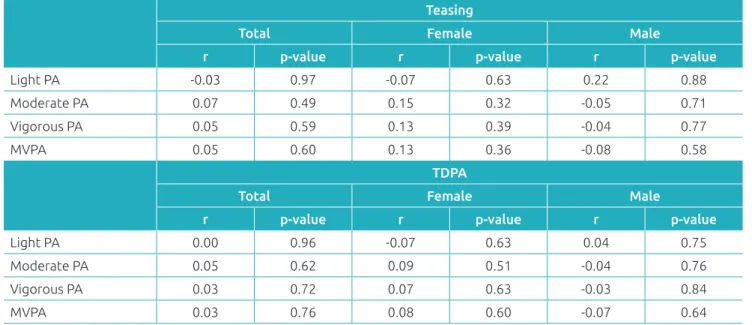
Regarding the associations, no signiicant correlations were found between the continuous variables of physical activity and the variables of weight-teasing in both sexes (Table 3). he association between weight-teasing and MVPA was weak and non-signiicant (r=0.05, p=0.60), and the same was observed for weight-teasing during physical activity (r=0.03, p=0.76).
DISCUSSION
According to the results, there were no signiicant associ-ations between teasing and TDPA with physical activity. In the statistical context, it is likely that the high percent-age of insuiciently active participants in the sample made it impossible to verify signiicant relationships between the variables. However, this may also be due to the dependence
of the presence of other factors in order for the teasing to inluence physical activity, as demonstrated in the study by Jensen and Steele,12 in which there was an inverse
relation-ship between TDPA and vigorous physical activity only among girls with high body dissatisfaction. In addition, it is possible that, for this age group, teasing is related to other behaviors and not to physical activity speciically, such as risk behaviors for weight loss and aspects related to psycho-logical well-being. Finally, it is still important to consider that, for some individuals in the present sample, provoca-tion has a positive efect on the practice of physical activity, acting as a motivating factor.
Despite the lack of studies involving Brazilian adoles-cents, research in the United States shows evidence that weight-related provocation has a negative impact on phys-ical activity, and may inluence adolescents to choose sed-entary/isolated activities rather than active/social ones.14
In 2014, a study with 1,419 schoolchildren found that
Table 1 Descriptive data and sex diferences.
Variables Total Female Male p‑value
n % n % n %
Sex 95 100 47 49.5 48 50.5
BMI
Eutrophic 70 73.7 35 74.5 35 72.9 0.86
Overweight 25 26.3 12 25.5 13 27.1
Social class
A 9 9.5 3 6.4 6 12.5 0.34
B 52 54.7 29 61.7 23 47.9
C 34 35.8 15 31.9 19 39.6
Teasing 20 21.1 9 19.1 11 22.9 0.65
TDPA 18 18.9 7 14.9 11 22.9 0.32
Insuiciently Active 69 72.6 42 89.4 27 56.3 <0.01 Results in absolute and relative frequency; BMI: body mass index; TDPA: teasing during physical activity.
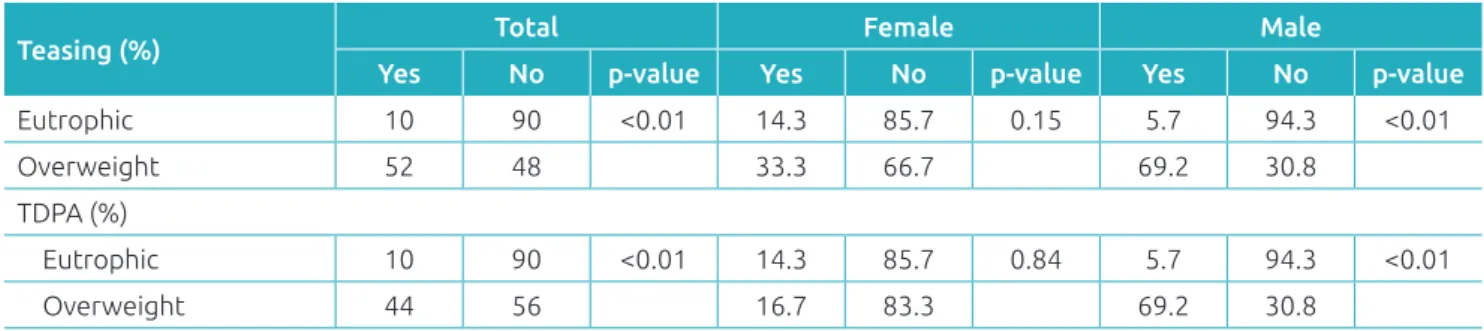
Table 2 Comparisons of proportions of adolescents who reported-weight teasing and TDPA according to body
mass index (eutrophic and overweight).
Teasing (%) Total Female Male
Yes No p‑value Yes No p‑value Yes No p‑value
Eutrophic 10 90 <0.01 14.3 85.7 0.15 5.7 94.3 <0.01
Overweight 52 48 33.3 66.7 69.2 30.8
TDPA (%)
Eutrophic 10 90 <0.01 14.3 85.7 0.84 5.7 94.3 <0.01
Overweight 44 56 16.7 83.3 69.2 30.8
weight-teasing may afect several factors related to physical activity, as the victims of teasing presented with lower lev-els of physical self-concept regarding their aerobic capac-ity, strength and lexibilcapac-ity, as well as lower self-eicacy for the practice of physical activity.13 As for TDPA, Faith et al.
found inverse and moderate associations between the cop-ing skills of the participants and the pleasure of practiccop-ing sports, perceived physical activity compared to peers and low-intensity activity during leisure time.7 Possibly, the
dif-ferent results comparing these studies and the present study stem from cultural diferences and the instruments used to evaluate physical activity, which contrasts with the objec-tivity of the accelerometer.
he literature has shown that, in addition to presenting greater risks for comorbidities,24,25 overweight individuals
sufer more frequent teasing, for a longer period of time (in years), and report higher emotional impact because of them. he prevalence of weight-teasing in Canadian adolescents was 22% for those with normal weight and 45% for those who were overweight.6 his study showed that 10% of the
group classiied as eutrophic reported teasing against 52% of the overweight group. About the teasing that occurred speciically in the context of physical activity (TDPA), the values found were 10% for eutrophic and 44% for over-weight participants. Such diference was also seen among boys. However, this did not occur for the females in the pres-ent sample. his is probably because a considerable num-ber of girls classiied as eutrophic also sufer from teasing. Possibly, they were considered overweight by colleagues,
even at normal weight, due to the thinness ideal imposed by the current culture.25
Goldfield et al. have shown that the prevalence of weight-teasing occurs more frequently among girls than boys, but this was not observed in the present study.6
This may be due to the increasing social pressure for male individuals to adhere to aesthetic standards that consider an ideal body to be that lean or muscular body.25 Thus, boys
would be targets of teasing regarding their weight just as much as girls.
hese teasing episodes are worrisome, since evidence sug-gests that being a victim of weight-teasing can cause harm-ful consequences for the psychological well-being, such as low self-esteem, depressive symptoms and body dissatis-faction.8,13 In addition, such stigmas are also related to the
acquisition of risk behaviors, such as inadequate attitudes for body weight control (use of laxatives, induction of vom-iting and dieting)15 and represent a limitation to the
prac-tice of physical activity.26
Considering that physical activity is an important factor to prevent the decline of physical and mental health,27 it is
important to investigate the relationship between the reduc-tion of physical activity in the young populareduc-tion and the weight-related teasing, even if the signs of this relationship are inconsistent. his is important, especially when studies have shown that, despite the eforts to promote an active lifestyle, a large proportion of the young population is still not active enough. his can be observed in data from 105 countries, in which 80.3% (CI 80.1–80.5) of adolescents,
Table 3 Correlation between physical activity and weight-teasing and TDPA.
Teasing
Total Female Male
r p‑value r p‑value r p‑value
Light PA -0.03 0.97 -0.07 0.63 0.22 0.88
Moderate PA 0.07 0.49 0.15 0.32 -0.05 0.71
Vigorous PA 0.05 0.59 0.13 0.39 -0.04 0.77
MVPA 0.05 0.60 0.13 0.36 -0.08 0.58
TDPA
Total Female Male
r p‑value r p‑value r p‑value
Light PA 0.00 0.96 -0.07 0.63 0.04 0.75
Moderate PA 0.05 0.62 0.09 0.51 -0.04 0.76
Vigorous PA 0.03 0.72 0.07 0.63 -0.03 0.84
MVPA 0.03 0.76 0.08 0.60 -0.07 0.64
REFERENCES
1. Shapiro JP, Baumeister RF, Kessler JW. A Three-Component Model of Children’s Teasing: Aggression, Humor, and Ambiguity. JSCP. 1991;10:459-72.
2. Land D. Teasing Apart Secondary Students’ Conceptualizations of Peer Teasing, Bullying and Sexual Harassment. Sch Psychol Int. 2003;24:147-65.
3. Pawluk CJ. Social Construction of Teasing. J Theory Soc Behav. 1989;19:145–67.
4. Kowalski RM. “I was Only Kidding!”: Victims’ and Perpetrators’ Perceptions of Teasing. Pers Soc Psychol Bull. 2000;26:231-41.
5. Losekam S, Goetzky B, Kraeling, S, Rief W, Hilbert A. Physical activity in normal-weight and overweight youth: associations with weight teasing and self‑eicacy. Obes Facts. 2010;3:239-44. 6. Goldield G, Moore C, Henderson K, Buchholz A, Obeid N,
Flament M. The relation between weight-based teasing and psychological adjustment in adolescents. Paediatr Child Health. 2010;15:283-8.
7. Faith MS, Leone MA, Ayers TS, Heo M, Pietrobelli A. Weight Criticism During Physical Activity, Coping Skills, and Reported Physical Activity in Children. Pediatrics. 2002;110:e23.
8. Eisenberg ME, Neumark-Sztainer D, Story M. Associations of weight-based teasing and emotional well-being among adolescents. Arch Pediatr Adolesc Med. 2003;157:733-8. 9. Young-Hyman D, Schlundt DG, Herman-Wenderoth L, Bozylinski
K. Obesity, appearance, and psychosocial adaptation in young African American children. J Pediatr Psychol. 2003;28:463-72.
10. Phares V, Steinberg AR, Thompson JK. Gender Diferences in Peer and Parental Inluences: Body Image Disturbance, Self-Worth, and Psychological Functioning in Preadolescent Children. J Youth Adolesc. 2004;33:421-9.
11. Thompson JK, Cattarin J, Fowler B, Fisher E. The Perception of Teasing Scale (POTS): a revision and extension of the Physical Appearance Related Teasing Scale (PARTS). J Pers Assess. 1995;65:146-57.
12. Jensen CD, Steele RG. Body dissatisfaction, weight criticism, and self-reported physical activity in preadolescent children. J Pediatr Psychol. 2009;34:822-6.
13. Greenleaf C, Petrie TA, Martin SB. Relationship of Weight-Based Teasing and Adolescents’ Psychological Well-Being. J Sch Health. 2014;84:49-55.
14. Hayden-Wade HA, Stein RI, Ghaderi A, Saelens BE, Zabinski MF, Willey DE. Prevalence, characteristics, and correlates of teasing experiences among overweight children vs. non-overweight peers. Obes Res. 2005;13:1381-92.
15. Leme AC, Philippi ST. Teasing and weight-control behaviors in adolescent girls. Rev Paul Pediatr. 2013;31:431-6.
16. Leblanc AG, Janssen I. Dose-response relationship between physical activity and dyslipidemia in youth. Can J Cardiol. 2010;26:e201-5.
17. Hallal PC, Andersen LB, Bull FC, Guthold R, Haskell W, Ekelund U, et al. Global physical activity levels: surveillance progress, pitfalls, and prospects. Lancet. 2012;380:247-57.
aged between 13 and 15 years old, do not comply with rec-ommendations for physical activity.17 In Curitiba, these
values are also alarming, being 78.4% for boys and 90.4% for girls, as found in a representative study with schoolchil-dren.28 Likewise, for our sample, the proportion of
under-activity remains high, and even higher among girls (56.3% for boys and 89.4% for girls).
Despite the sample limitations, due to the number of participants that made it impossible to use the analyses with the control of intervening variables, it is worth noting the relevance of this study, since it is the irst to investigate these variables in Brazil. In addition, this work contributes for being the irst investigation, in this subject, to measure physical activity in an objective manner, using the acceler-ometer. Further research on the subject is still required in Brazil. It is suggested that future studies investigate the rela-tionship between teasing and physical activity, considering eating behaviors as well as the moderating efect of psycho-social aspects in this relationship.
The results of the present study demonstrated that weight-teasing and TDPA are also experienced by adoles-cents from Curitiba, Paraná. Unlike previous studies, no sig-niicant diferences were observed between the proportions of boys and girls sufering from weight-teasing and TDPA, indi-cating that this is a problem that afects both sexes. here is still high prevalence of insuiciently active adolescents, espe-cially among females. hus, it is important to emphasize the importance of interventions aimed at raising awareness for the harmful aspects of weight-related provocation. It is also worth noting the need for further research on the subject to understand the relationship between physical activity and weight-teasing in Brazilian adolescents.
Funding
his study did not receive funding.
Conflict of interests
© 2017 Sociedade de Pediatria de São Paulo. Published by Zeppelini Publishers. This is an open access article under the CC BY license (http://creativecommons.org/licenses/by/4.0/). 18. Associação Brasileira de Empresas de Pesquisa [homepage
on the Internet]. Critério de classiicação econômica Brasil 2014 [cited 2014 Oct 12]. Available from: http://www.abep. org/new/criterioBrasil.aspx
19. Tritschler K. Medida e avaliação em educação física e esportes de Barrow & McGee. 5th ed. São Paulo: Manole; 2003.
20. Cole TJ, Bellizzi MC, Flegal KM, Dietz WH. Establishing a standard definition for child overweight and obesity worldwide: international survey. BMJ. 2000;320:1240-3.
21. Trost SG, Loprinzi PD, Moore R, Pfeifer KA. Comparison of accelerometer cut points for predicting activity intensity in youth. Med Sci Sports Exerc. 2011;43:1360-8.
22. Corder K, Ekelund U, Steele RM, Wareham NJ, Brage S. Assessment of physical activity in youth. J Appl Physiol (1985). 2008;105:977-87.
23. World Health Organization [homepage on the Internet]. Global Recommendations on Physical Activity for Health. Geneva: WHO [cited 2014 Oct 15]. Available from: http://www.who. int/dietphysicalactivity/factsheet_recommendations/en/
24. World Health Organization [homepage on the Internet]. Global status report on noncommunicable diseases. World Health Organization [cited 2015 Dec 20]. Available from: http://www.who.int/nmh/publications/ncd_ report2010/en/
25. Santana ML, Silva RD, Assis AM, Raich RM, Machado ME, Pinto E, et al. Factors associated with body image dissatisfaction among adolescents in public schools students in Salvador, Brazil. Nutr Hosp. 2013;28:747-55.
26. Bauer KW, Yang YW, Austin SB. “How can we stay healthy when you’re throwing all of this in front of us?” Findings from focus groups and interviews in middle schools on environmental inluences on nutrition and physical activity. Health Educ Behav. 2004;31:34-46.
27. Reiner M, Niermann C, Jekauc D, Woll A. Long-term health beneits of physical activity‑‑a systematic review of longitudinal studies. BMC Public Health. 2013;13:813.