DOI: http://dx.doi.org/10.5007/1980-0037.2017v19n1p50
1 Federal University of Santa Cata-rina. Graduate Program in Physical Education. Florianópolis, SC, Brazil. 2 University of Pernambuco. Asso-ciated Graduate Program in Physical Education UPE / UFPB. Recife PE. Brazil.
3 Federal Institute of Education, Science and Technology of Santa Ca-tarina. Bilingual Campus of Palhoça, SC. Brazil.
Received: 10 October 2016
Accepted: 14 February 2017
Relationship between physical activity
and BMI with level of motor coordination
performance in schoolchildren
Relação entre atividade física e IMC com o nível de
desempenho motor coordenado de crianças em idade
escolar
Carla Menêses Hardman1 Rildo de Souza Wanderley Júnior2 Elusa Santina Antunes de Oliveira3 Mauro Virgílio Gomes de Barros1-2
Abstract – International studies have shown that motor coordination was inversely
associ-ated with adiposity, and directly associassoci-ated with other health outcomes. However, there are few national studies addressing this issue and the results are divergent. he aim of this study was to analyse the relationship between physical activity and body mass index (BMI) with the level of motor coordination performance in children. his cross-sectional study was performed with children aged 5-7 years old. he level of motor performance was evaluated by normative data of the motor quotients assessed by KTK test. BMI was calculated by body weight and height. he level of physical activity was assessed by a questionnaire applied by interviewers with parents. Statistical analysis was performed by Spearman and Pearson test, and multiple linear regression. he sample included 665 children with mean age of 6.29 (± 0.75) years old, and 52.6% were male. It was veriied which total motor quotient (TMQ) was directly related to physical activity score (0.096; p = 0.013) and inversely related to BMI (-0.284; p<0.001). he relationship between BMI and TMQ was moderated by family income. BMI was inversely related to the level of motor performance, and the score of physical activity was directly related to the level of motor performance in children in a higher family income.
Key words: Body mass index; Child; Motor activity; Motor skills.
Resumo – Achados de estudos internacionais evidenciam que a coordenação motora está
coor-INTRODUCTION
Poor coordinative performance can afect the acquisition of motor skills and overall child development. In this regard, motor coordination has been included as a topic of discussion in diferent areas of research. Recently, there has been an increasing interest of researchers on the relationship between levels of physical activity and adiposity with motor coordination
in children1-2.
Synthesis studies have shown that motor coordination is inversely related to body mass index and directly related to cardiorespiratory
capac-ity and musculoskeletal itness in children and adolescents3-4. Similarly,
longitudinal5-6 and cross-sectional studies7-8 have indicated that motor
coordination is directly related to the level of physical activity and par-ticipation in sports activities.
In the national context, there are few studies addressing this theme and the results are divergent. For example, it was found that the level of
physical activity9, participation in sports activities10 and body mass
in-dex11-12 were not related to motor coordination. On the other hand, other
studies have identiied that motor coordination was positively associated
with the level of physical activity11, participation in sports activities13 and
negatively associated to body weight status10,13. In addition, most of these
studies were conducted in the southern and southeastern regions of the country and were conducted in small and non-representative samples of the populations investigated.
In view of the above, the aim of this study was to analyse the rela-tionship between physical activity and body mass index with the level of motor coordination performance in schoolchildren. he analysis of the relationship between physical activity and adiposity with motor coordina-tion constitutes a relevant research proposal, which can subsidise in the planning of interventions focusing on children at school age.
METHODOLOGICAL PROCEDURES
his is a cross-sectional epidemiological study from a research project titled “Longitudinal Study of Health and Wellbeing of Children in Preschool” (ELOS-Pre). he target population of this study was pre-school children (3 to 5 years old) enrolled in public and private schools in the area cov-ered by the Regional Education Management of Recife, PE. he project was approved by the Ethics Committee for Research with Humans of the University of Pernambuco (CAAE: 0096.0.097.000-10). Parents or legal guardians of participating children signed the Free and Informed Consent Form.
toler-able error of four percentage points; and, (e) efect size of the pre-established sampling at 1.5 due to the cluster sampling resource. In order to deal with possible losses and refusals during follow-up, the minimum sample size, initially estimated in 890 subjects, was increased by 20%, resulting in a sample of 1,068 children. he sample calculation was carried out using a strategy adopted in cross-sectional studies to obtain a representative and accurate sample. Subsequently, sample dimensioning was used to determine the statistical power with the sample size reached in the irst follow-up.
he sample selection was performed using the single-stage cluster sampling procedure, considering the school as the sample unit. All schools with pre-school classes were considered eligible for inclusion in the study. Based on data provided by the Recife Department Education, the number of pre-school students enrolled in the year prior to ield collection was estimated at 49,038, distributed in 782 schools. Considering an average number of 38.5 children enrolled in each school and in order to achieve the desired sample size (n = 1,068), it was established that data collection would be performed in 28 schools.
In order to ensure representativeness of the target population, the proportionality of children in the schools according to type (public or private) and their distribution in the six political-administrative regions of the city of Recife was adopted as stratiication criterion. Considering size, schools were classiied as: “small size”, those with fewer than 50 children enrolled; “medium-sized”, those with 50 to 199 students; and “large size”, those with a number equal to or greater than 200 children enrolled in early childhood education.
he present study was carried out with children aged 5-7 years who participated in the second evaluation of the ELOS-Pre project. In this evaluation, conducted during the period from August to November 2012, it was intended to analyse all children who had been evaluated at baseline and remained to reside in Recife. For the location of children, telephone contact was made with parents in order to identify the schools in which the children were enrolled. At each school, data collection time lasted at least ive days in order to ensure that children who missed one or more days of classes could be located and included in the study. In addition, school stafs were asked to obtain up-to-date information on children who were trans-ferred to other schools. Finally, in cases where children were not located using strategies mentioned above, home visits were made. Data collection teams were composed of undergraduate and graduate students. All the ield collection was directly supervised by researchers involved in the project.
platforms). he Total Motor Quotient (TMQ ) was also used, which results from the sum of the scores obtained in each of the tasks. In addition, the normative values derived from the reference tables of the Kiphard and
Schilling study14 were used to analyse the motor quotients of the KTK tasks.
he applicability of this instrument and the quality of data have been
pointed out in several studies8,15. In the present study, intraclass
correla-tion coeicients ranged from 0.70 to 0.94 in the intra-rater assessment and ranged from 0.59 to 0.81 in the inter-rater evaluation. he application of this battery took an average 20 minutes per child and all performed the tasks barefoot. he implementation protocol and the other information on the KTK application are available at the following electronic address: http://www.gpesupe.org/downloads.php?categoria=Manuais
he body mass and height measurements were collected to calculate the body mass index (BMI). Body mass was obtained using G.Tech® portable digital scale (model Glass 6), previously calibrated, with a variation of 0.1 kg and capacity up to 150 kg. Height was evaluated by portable Welmy® stadiometer with support base (model II), with an accuracy of 0.5 cm. he BMI [body mass (kg) / height (m) ²] was calculated for each child. hree measurements were performed for each child, and the mean value of measurements was adopted as the inal measure. he results of the pilot study indicated that the intra-class correlation coeicients of body mass and height measurements were greater than 0.95.
he level of physical activity was measured by parents reporting the time spent by children on games and playing outdoor in the three periods of the day (morning, afternoon and night), both on a typical weekday and weekend. he questionnaire applied was the translation of the inventory to estimate the time spent in games and playing outdoor proposed by
Bur-dette et al.16. In the pilot study conducted by Oliveira et al.17, the inventory
showed good reproducibility indicators with Spearman correlations equal to or greater than 0.83 (p <0.01).
he time reported by parents in each of these six reference periods was recorded considering ive numerical scores and respective response catego-ries: 0 minutes (0); 1-15 minutes (1); 16-30 minutes (2); 31-60 minutes (3); and more than 60 minutes (4). hus, for each child, parents reported six estimates of time spent on physical activities typical for their age, three related to the day of the week and three related to a typical weekend day. hen, a global score was calculated, expressing the child’s level of physical activity ([week: 3 reference periods x 4 (maximum score per period) x 5 days = 60 points; weekend: 3 periods x 4 (maximum score per period) x 2 days = 24 points]), with variation from 0 (insuiciently active) to 84 points (active).
To obtain this information it was used the ELOS-Pre questionnaire applied through a face-to-face interview with parents or legal guardians of children, available for consultation at the site link: http://www.gpesupe. org/downloads.php. he instrument was previously tested and the results of the pilot study indicated that the instrument is practical and relatively
demographic and behavioural variables it was obtained by the questionnaire that presented test-retest consistency coeicients above 0.8517. he time of application of the questionnaire ranged from 8 to 15 minutes.
Data tabulation was performed in the EpiData Entry software, version 3.1, using automatic controls of amplitude and consistency in data entry. A second data entry was conducted in order to check and control data qual-ity. Data analysis was performed using the STATA software, version 10. Descriptive statistics (frequency distribution, central tendency and dispersion measures) were used to describe the variables. he normality of continuous variables was analysed using the Kolmogorov-Smirnov test. In addition, independent and dependent variables, confounding factors (sex, age, family income, prematurity and birth weight) were included in the analysis and were treated as covariates. Binary categorical covariates were coded for dummy variables.
To verify signiicant diferences in motor quotients between boys and girls, the T-Test for independent samples and the Mann-Whitney U-Test were performed. he correlation tests of Spearman and Pearson were used to verify the relation between physical activity score and BMI with the motor quotients of the KTK.
Multivariate analysis was performed by multiple linear regression adopting the backwards selection procedure to remove variables from the model. It was adopted as a statistical criterion for the permanence of vari-ables in the model those presented p-values <0.20. Interaction tests were conducted to verify the need for stratiication of analyses by inclusion in the analyses a variable that expressing the interaction among factors (e.g., physical activity score * Sex). Variance Inlation Factor (VIF) values were used as criteria for the analysis of the absence of collinearity, as well as the F values as a criterion to identify if the variables maintained in the inal regression model are linearly related to the total motor quotient. he homoscedasticity condition was tested using the Breusch-Pagan-Godfrey Test (BPG) to analyse the variance of residues. he signiicance level for all tests performed was set at p-value<0.05.
RESULTS
In 2012, 700 children were identiied, representing 67.3% (n=1,040) from the baseline (2010). However, 35 children did not complete the motor coordination test. herefore, the inal sample consisted of 665 children (retention rate = 63.9%) aged 5-7 years old (mean = 6.29, SD = 0.75), and 52.6% (n = 350) were male.
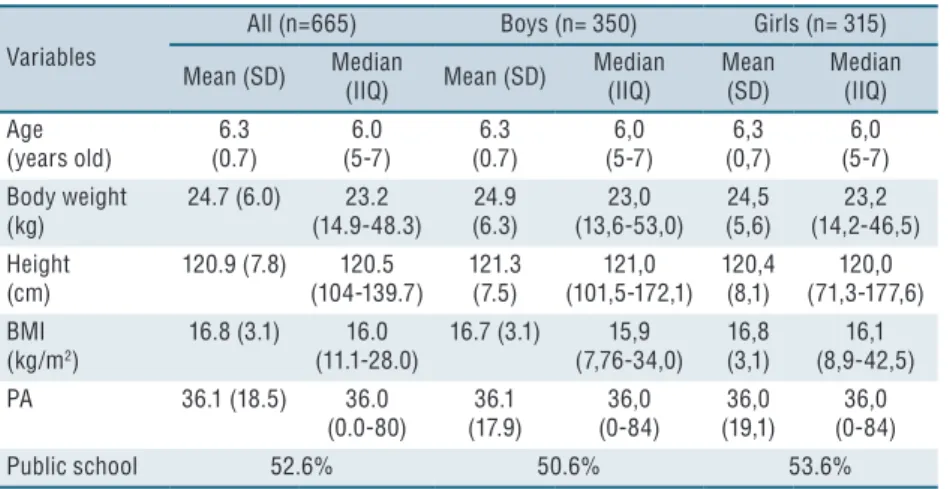
Table 1. Description of demographic, anthropometric and physical activity variables stratified by sex Variables
All (n=665) Boys (n= 350) Girls (n= 315)
Mean (SD) Median
(IIQ) Mean (SD)
Median (IIQ) Mean (SD) Median (IIQ) Age (years old) 6.3 (0.7) 6.0 (5-7) 6.3 (0.7) 6,0 (5-7) 6,3 (0,7) 6,0 (5-7) Body weight (kg)
24.7 (6.0) 23.2 (14.9-48.3) 24.9 (6.3) 23,0 (13,6-53,0) 24,5 (5,6) 23,2 (14,2-46,5) Height (cm)
120.9 (7.8) 120.5 (104-139.7) 121.3 (7.5) 121,0 (101,5-172,1) 120,4 (8,1) 120,0 (71,3-177,6) BMI
(kg/m2)
16.8 (3.1) 16.0 (11.1-28.0)
16.7 (3.1) 15,9 (7,76-34,0)
16,8 (3,1)
16,1 (8,9-42,5)
PA 36.1 (18.5) 36.0
(0.0-80) 36.1 (17.9) 36,0 (0-84) 36,0 (19,1) 36,0 (0-84)
Public school 52.6% 50.6% 53.6%
SD = standard deviation; IIQ = Interquartile range; PA = physical activity.
It was found that the mean and median age, body weight, height, BMI values and the score of physical activity were similar between boys and girls. In addition, it was observed that the proportion of children enrolled in public schools was higher in girls compared to boys.
Table 2 shows the descriptive measures of motor quotients, which express the level of motor coordination performance considered the total sample and stratiied by sex. It was veriied that only the total score of mo-tor quotient (TMQ ) showed normal distribution. Considering the mean values of motor quotients of each task, it was identiied that children had lower performance in jumping sideways the tasks of lateral jump (QM3) and backwards balance (QM1) when compared to the other subtests that demand strength and speed (QM2), laterality and spatiotemporal struc-turing (QM4).
Table 2. Comparison of motor quotients by sex on the children enrolled in schools in the city of Recife-PE, 2012.
Variables
All Boys Girls
Mean (SD) Median (IIQ) Mean (SD) Median (IIQ) Mean (SD) Median (IIQ) p-value
MQ1 89.7 (15.9) 91.0 (54-132)
88.0 (16.2)
89.0 (54-128)
91.5 (15.4) 92.0 (57-132)
0.007*
MQ2 94.2 (17.8) 93.0
(53-146) 100.2 (16.2)
98.0 (62-146)
87.5 (17.1) 86.0 (53-143)
<0.001*
MQ3 73.1 (13.3) 72.0 (47-135)
76.3 (14.0)
75.0 (48-120)
69.6 (11.4) 69.0 (47-135)
<0.001*
MQ4 92.2 (13.4) 93.0 (53-136)
93.7 (14.3)
94.5 (54-136)
90.5 (12.1) 91.0 (53-125)
<0.001*
TMQ 83.4 (14.6) 83.0 (45-138)
86.3 (15.1)
86.5
(46-123) 80.1 (13.5) 80.0
(45-138) <0.001**
MQ1 = motor quotient in backward balance; MQ2 = motor quotient in hopping on one leg; MQ3 = motor quotient in jumping sideways; MQ4 = motor quotient in shifting platforms; TMQ: total motor quotient; SD = standard deviation; IIQ = Interquartile range.
* T-Test for the independent sample. ** Mann-Whitney U-Test.
which was higher in girls. he results have shown that girls perform bet-ter on balance tests while boys perform betbet-ter on jumping and shifting platform tests.
In addition, it was veriied that the TMQ score was directly related to the physical activity score and inversely related to BMI. In addition, it was found that the score of physical activity was directly related to motor quotients of backwards balance and jumping sideways tasks. It was also identiied that BMI was inversely related to the KTK motor quotient values, except for motor quotient of the shifting platforms task (Table 3).
Table 3. Correlation coefficients between the score of physical activity and BMI with children’s motor quotient scores. Recife-PE, 2012
Variables KTK Motor Quotients
MQ1* MQ2* MQ3* MQ4* TMQ**
PA 0.097
(p=0.013)
0.049 (p=0.205)
0.089 (p=0.021)
0.005 (p=0.893)
0.096 (p= 0.013)
BMI -0.276
(p<0.001)
-0.244 (p<0.001)
-0.161 (p<0.001)
-0.020 (p<0.614)
-0.284 (p<0.001)
* Spearman correlation test; ** Pearson’s correlation test.
Legend: KTK = KörperkoordinationsTest für Kinder; MQ1 = equilibrium motor quotient in shifting platforms; MQ2 = motor quotient in hopping on one leg; MQ3 = motor quotient in jumping sideways; MQ4 = motor quotient of shifting platform; TMQ: total motor quotient; PA = Physical Activity; BMI = Body Mass Index.
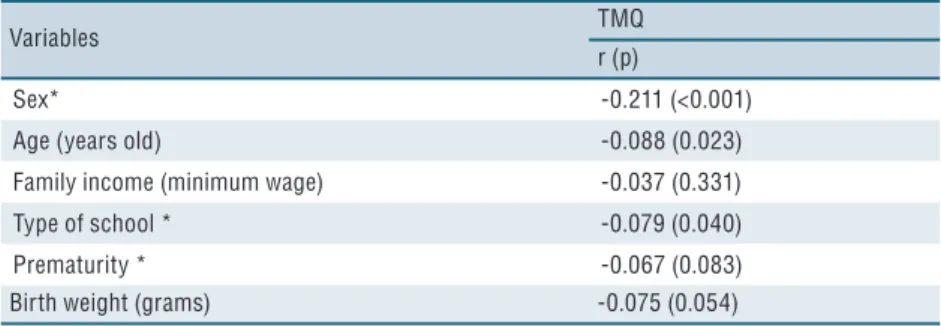
When analysing the relationship between possible confounding fac-tors and TMQ , it was identiied that gender, age and type of school were inversely related to TMQ , despite the poor magnitude of relationships. It was observed that birth weight had a borderline relationship with TMQ (Table 4).
Table 4. Pearson’s correlation coefficients and respective p-values of demographic variables, school context, and early factors with TMQ
Variables TMQ
r (p)
Sex* -0.211 (<0.001)
Age (years old) -0.088 (0.023)
Family income (minimum wage) -0.037 (0.331)
Type of school * -0.079 (0.040)
Prematurity * -0.067 (0.083)
Birth weight (grams) -0.075 (0.054)
* Dummy variable.
Legend: TMQ: Total Motor Quotient.
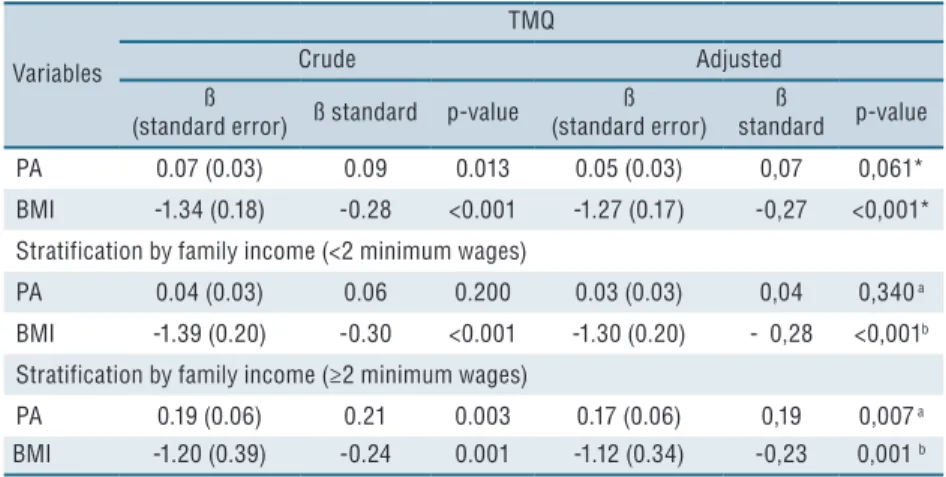
he homoscedasticity analysis of the inal model presented good quality in the estimation of the parameters analysed (p = 0.195). Although BMI remained related with TMQ , regardless of some confounding factors, family income was a moderating factor of this relationship (Table 5).
Table 5. Linear regression coefficients for analysis of the relationship between physical activity and BMI with the total score of motor quotient (TMQ).
Variables
TMQ
Crude Adjusted
ß
(standard error) ß standard p-value
ß (standard error)
ß
standard p-value
PA 0.07 (0.03) 0.09 0.013 0.05 (0.03) 0,07 0,061*
BMI -1.34 (0.18) -0.28 <0.001 -1.27 (0.17) -0,27 <0,001*
Stratification by family income (<2 minimum wages)
PA 0.04 (0.03) 0.06 0.200 0.03 (0.03) 0,04 0,340 a
BMI -1.39 (0.20) -0.30 <0.001 -1.30 (0.20) - 0,28 <0,001b
Stratification by family income (≥2 minimum wages)
PA 0.19 (0.06) 0.21 0.003 0.17 (0.06) 0,19 0,007 a
BMI -1.20 (0.39) -0.24 0.001 -1.12 (0.34) -0,23 0,001 b
* Adjusted by sex (VIF = 1.01), age (VIF = 1.17), type of school (VIF = 1.18), prematurity (VIF = 1.01), birth weight (VIF=1.01). R2 adjusted = 0.15. F = 17.01 (p value <0.001).
a Adjusted by sex (VIF = 1.01), age (VIF = 1.17), type of school (VIF = 1.18), prematurity (VIF =
1.02), birth weight (VIF=1.00), physical activity score (VIF = 1.02). R2 adjusted = 0.181. F = 15.45
(p value <0.001).
b Adjusted by sex (VIF = 1.02), age (VIF = 1.16), type of school (VIF = 1.14), prematurity (VIF = 1.04),
birth weight (VIF=1.03), BMI score (VIF = 1.04). R2 adjusted = 0.094. F = 3.81 (p value = 0.001).
DISCUSSION
he present study aimed to analyse the relationship between physical activity and BMI with the level of motor coordination performance of schoolchildren. he main indings were: boys presented better performance in motor tests when compared to girls; BMI was inversely related to the level of motor coordination performance and the physical activity was directly related to the level of motor coordination performance in children in a higher family income.
However, the indings presented here should be analysed with caution. he level of physical activity reported by parents may have been overesti-mated. Another limitation to be considered was the use of physical activity measures that do not consider activities that the children perform in the school context. It is known that for some children, school is the only op-portunity for the practice of physical activities. he fact that the present study is linked to a longitudinal study may to some extent have “selected” parents and children more likely to healthier and more active lifestyles.
Nevertheless, the study was conducted with a representative sample of school-age children. All data collection procedures were previously tested and presented good reproducibility indicators in the pilot study. he choice of speciic researchers for the application of motor tasks, the use of control strategies in the adjusted analyses for the main confounding variables and the double entry of tabulated data contributed to the internal validity of the study.
± 15.0)14, of Belgian children (96.5 ± 14.3)18 and Portuguese children (84.9
± 12.4)19. he indings of this study also revealed that the proportion of
children with impaired motor coordination (insuiciency or disorder) was similar to a study performed with children (6-7 years) of a public school
in northern Portugal18. However, it was higher in comparison to results
observed in most of the studies conducted with European children14,18,20-21.
Given the above, it was observed that the cutof points suggested by
the KTK creators14 present low values for the classiication of high
(131-145) and good coordination (116-130), as well as for coordination disor-ders (71-85) and insuiciency (56-70). Moreover, most of the studies that presented reference values for the KTK score showed mean values lower than those conducted with German children and adolescents (5-14 years), which originated the reference data of this instrument. In addition, there are no reference standards for Brazilian children.
Regarding motor performance in each KTK task, it was found that the children in the present study presented a lower performance in jumping
sideways and backwards balance tasks. Vandorpe et al.18 identiied that
Flemish children presented a lower performance in backwards balance and shifting platforms tasks.
In addition, it was identiied that, except for the backwards balance test, boys performed better on motor tests compared to girls. International studies revealed that girls performed better on balance tests while boys
per-formed better on jumping tests18,20. Deus et al.22 reported that the shifting
platforms task is the one that presents less variation in the mean values in both sexes. Some authors have reported that diferences in levels of motor coordination performance between boys and girls can be explained by the opportunities given in the family and school environment that may or may
not favour a diversiied motor repertoire23-24.
In the present study, it was found that the physical activity score was directly related to backwards balance, shifting platforms and jumping sideways motor quotients. In the adjusted analysis, it was identiied that the physical activity score was directly related to levels of motor coordination performance only in children with higher family income.
International studies have indicated that children who perform more physical activities have higher motor coeicients than those with lower
levels of physical activity8,22,25. here is also evidence that motor
coordina-tion can be considered an important condicoordina-tion for engaging in organised physical activities so that high motor competence can increase the level
of physical activity and participation in sports activities and vice versa26.
In addition, it was found that BMI was inversely related to the KTK motor quotient values, except for shifting platforms motor quotient task. hese results corroborate previous studies on the inverse relationship be-tween adiposity indicators (BMI or BF%) and TMQ values of the KTK test5,7,25,27-29. However, some of these investigations have shown weak to
moderate correlation7,27-28, while another study revealed high correlation5
In general, international studies have indicated that overweight children present lower levels of motor coordination, being more pronounced in
shift-ing platforms20 and hopping on one leg tasks5,20. his result may be partly
explained by the increased mass in the diferent body segments that lead to
ineiciency in the movement pattern4, which would prevent the child from
achieving success in certain motor tasks, especially those involving body trans-port in space, skills that involve running and jumping. According to Vandorpe
et al.18, hopping on one leg tasks, besides requiring dynamic coordination,
require other physical properties such as strength, resistance and explosion.
In addition, Stodden et al.26 presented a conceptual model about the
relationship between motor competence, physical activity and obesity. Based on this model, the authors propose that levels of physical activity may increase or decrease the risk of obesity, and consequently, altered body composition will inluence motor competence, predicting a feedback efect. hey also reported that these relationships are inluenced by other contextual factors (environment, family, socioeconomic status, culture, nutrition, self-eicacy, etc.), which afect the opportunity for an individual to be physically active and have good motor coordination.
CONCLUSION
he present study showed that BMI was inversely related to the level of motor coordination performance and the score of physical activity was directly related to motor coordination in children in a higher family in-come. he indings of this investigation provide important information regarding the relationships between physical activity and overweight with motor coordination in children. he understanding of the relationships between these variables may help Physical Education’s teachers to plan their classes and guide the actions developed by other professionals outside the school environment.
In addition, considering that this is a topic that needs to be addressed more depth by researchers due to its complexity and importance, some sug-gestions have been presented for future research. Further longitudinal and experimental studies are needed in order to better clarify the relationship between these variables. Researchers should also consider the reciprocal causal relationship between these variables over time in their research and interventions. In addition, they should analyse the inluence of other possible confounding factors on the relationship between these variables, such as perceived motor competence, physical itness, sexual maturation, and type, amount, and intensity of physical activities performed in and out of school.
Acknowledgments
REFERENCES
1. Robinson LE, Stodden DF, Barnett LM, Lopes VP, Logan SW, Rodrigues LP, et al. Motor competence and its efect on positive developmental trajectories of health. Sports Med 2016; 45(9):1273-84.
2. Logan SW, Robinson LE, Wilson AE, Lucas WA. Getting the fundamentals of movement: a meta-analysis of the efectiveness of motor skill interventions in children. Child Care Health Dev 2011; 38(3): 305-15.
3. Luz LGO, Seabra AFT, Santos R, Padez C, Ferreira JP, Coelho-e-Silva MJ. Associação entre IMC e teste de coordenação corporal para crianças (KTK): uma meta-análise. Rev Bras Med Esporte 2015;21(3):230-5.
4. Cattuzzo MT, Santos Henrique R, Ré AH, Oliveira IS, Melo, BM, Sousa Moura M, et al. Motor competence and health related physical itness in youth: a systematic review. J Sci Med Sport 2016;19(2):123-9.
5. D’Hondt E, Deforche B, Gentier I, De Bourdeaudhuij I, Vaeyens R, Philippaerts R, et al. A longitudinal analysis of gross motor coordination in overweight and obese children versus normal-weight peers. Int J Obesity 2013;37(1):61-7.
6. Lopes VP, Rodrigues LP, Maia JA, Malina RM. Motor coordination as predic-tor of physical activity in childhood. Scand J Med Sci Sports 2011; 21(5):663-9.
7. Morrison KM, Bugge A, El Naaman B, Eisenmann JC, Pferifer KA, Andersen LB. Inter-relationships among physical activity, body fat, and motor performance in 6- to 8-year-old Danish children. Pediatr Exerc Sci 2012; 24(2):199-209.
8. Vandorpe B, Vandendriessche J, Vaeyens R, Pion J, Matthys S, Lefevre J, et al. Relationship between sports participation and the level of motor coordination in childhood: a longitudinal approach. J Sci Med Sport 2012; 15(3): 220-5.
9. Sá CSC, Carvalho B, Mazzitelli C. Equilíbrio e coordenação motora em escolares praticantes e não praticantes de atividades física e/ou lúdica extra-escolar. Rev Neurociên 2014; 22(1):29-36.
10. Pelozin, F, Folle A, Collet C, Botti M, Nascimento JV. Nível de coordenação motora de escolares de 09 a 11 anos da rede estadual de ensino da cidade de Florianópolis/ SC. Rev Mackenzie Educ Fís Esporte 2009; 8(2):123-32.
11. Spessato BC, Gabbard C, Valentini NC. he role of motor competence and body mass index in children’s activity levels in physical education classes. J Teach Phys Educ 2013; 32(2):118-30.
12. Catenassi FZ, Marques I, Bastos CB, Bassi L, Roque ERV, Gerage AM. Relação entre índice de massa corporal e habilidade motora grossa em crianças de quatro a seis anos. Rev Bras Med Esporte 2007; 13(4): 227-30.
13. Collet C, Folle A, Pelozin, F, Botti M, Nascimento JV. Nível de coordenação motora de escolares da rede estadual da cidade de Florianópolis. Motriz 2008; 14(4): 373-80.
14. Kiphard EJ, Schilling F. Köperkoordinationstest für kinder: KTK. Manual. Weinheim: Beltz Test, 2007.
15. Cools, W. Martelaer KD, Samaey C, Andries. Movement skill assessment of typi-cally developing preschool children: a review of seven movement skill assessment tools. J Sports Sci Med 2009; 8(2):154-68.
16. Burdette HL et al. Parental report of outdoor playtime as a measure of physical activity in preschool-aged children. Arch Pediatr Adolesc Med 2004;158(4):353-7.
17. Oliveira NKR, Lima RA, Mélo EM, Santos CM, Barros SSH, Barros MVG. Reprodutibilidade de questionário para medida da atividade física e comportamento sedentário em crianças pré-escolares. Rev Bras Ativ Fis Saude 2011; 16(3):228-33.
18. Vandorpe B, Vandendriessche J, Lefevre J, Pion J, Vaeyens R, Matthys S, et al. he Körperkoordinations Test für Kinder: reference values and suitability for 6-12-year-old children in Flanders. Scand J Med Sci Sports 2011; 21(3):378-88.
CORRESPONDING AUTHOR
Carla Menêses Hardman Rua Arnóbio Marques, 310, Santo Amaro, Recife-PE, Brasil. CEP: 50100-130.
Email: [email protected]
20. D’Hondt E, Gentier I, Deforche B, Tanghe A, De Bourdeaudhuij I, Lenoir M. Weight loss and improved gross motor coordination in children as a result of multidisciplinary residential obesity treatment. Obesity 2011; 19(10):1999-2005.
21. Olesen L, Kristensen PL, Ried-Larsen M, Grøntved A, Froberg K. Physical activ-ity and motor skills in children attending 43 preschools: a cross-sectional study. BMC Pediatrics 2014; 14(229): 1-11.
22. Deus RKBC, Bustamante A, Lopes VP, Seabra AT, Silva RMG, Maia JAR. Modelação longitudinal dos níveis de coordenação motora de crianças dos seis aos 10 anos de idade da Região Autônoma dos Açores, Portugal. Rev Bras Educ Fís Esporte 2010; 24(2):259-73.
23. Valdivia AB, Cartagena LC, Sarria NE, Seabra TIS, Teixeira AF, Silva RMG, et al. Coordinación motora: inluencia de la edad, sexo, estatus socio-económico y niveles de adiposidad en niños peruanos. Rev Bras Cineantropom Desempenho Hum 2008; 10(1):25-34.
24. Lopes VP, Maia JAR, Silva RG, Seabra A, Morais FP. Estudo do nível de desen-volvimento da coordenação motora da população escolar (6 a 10 anos de idade) da Região Autônoma dos Açores. Rev Port Ciên Desp 2003; 3(1): 47-60.
25. Graf C, Koch B, Kretschmann-Kandel E, Falkowski G, Christ H, Coburger S, et al. Correlation between BMI, leisure habits and motor abilities in childhood (CHILT-project). Int J Obes Relat Metab Disord 2004; 28(1):22-26.
26. Stodden DF, Goodway JD, Langendorferr SJ, Roberton MA, Rudisill ME, Garcia C, et al. A developmental perspective on the role of motor skill competence in physical activity: an emergent relationship. Quest 2008; 60(2):290-306.
27. D’Hondt, Deforche B, Gentier I, Verstuyf J, Vaeyens R, De Bourdeaudhuij I, et al. A longitudinal study of gross motor coordination and weight status in children. Obesity 2014; 22(6):1505-11.
28. Melo MM, Lopes VP. Associação entre o índice de massa corporal e a coordenação motora em crianças. Rev Bras Educ Fís Esporte 2013; 27(1):7-13.