2013 Sept.-Oct.;21(5):1104-11 www.eerp.usp.br/rlae
Corresponding Author: Juliana da Costa Fernandes Av. Itaóca, 1908 Travessa Guadalajara, 26 Bairro: Bonsucesso
Juliana da Costa Fernandes
2Luciana Fernandes Portela
3Lúcia Rotenberg
3Rosane Harter Griep
41 Supported by Fogarty International Center, Award Number D43TW000640 and by Fundação Carlos Chagas Filho de Amparo à Pesquisa do Estado do Rio de Janeiro (FAPERJ), process # E-26/111.554/2008.
2 Student of specialization in Health Public, Instituto Oswaldo Cruz, Fundação Oswaldo Cruz (FIOCRUZ), Rio de Janeiro, RJ, Brazil. 3 PhD, Researcher, Instituto Oswaldo Cruz, Fundação Oswaldo Cruz (FIOCRUZ), Rio de Janeiro, RJ, Brazil.
4 PhD, Adjunct Professor, Instituto Oswaldo Cruz, Fundação Oswaldo Cruz (FIOCRUZ), Rio de Janeiro, RJ, Brazil.
Objective: to analyse the differences between genders in the description in the professional,
domestic and total work hours and assess its association with health-related behaviour among
nurses. Methods: this is a transversal study carried out in 18 different public hospitals in the
municipality of Rio de Janeiro. The data collection procedure was based on questionnaires. All
nurses working with assistance were considered eligible (n=2,279). Results: men and women
showed significant differences in relation to working hours. The female group showed longer
domestic and total work hours when compared to the group of men. In contrast, the number of
hours spent on professional work was higher among men. For the women, both the professional
hours and total work hours were often associated with excessive consumption of fried food and
also coffee, lack of physical exercise and also the greater occurrence of overweight and obesity.
Conclusion: both the professional hours and the domestic work hours need to be taken into
account in studies about health, self-care and also the care provided within the context of nursing
workers, particularly among women. The results add weight to the need for actions for health
promotion in this occupational group and the importance of assessing the impact of long working
hours on the health of workers.
Descriptors: Nurses, Male; Work Hours; Life Style; Health; Self Care.
Introduction
Among the transformations that have occurred
over the last few decades in the labour market, we
mention the increase in the number of hours worked,
a phenomenon that has been observed in several
countries(1-2). The long working hours have a negative
effect both on professional life and also on the social
and family life of the individuals affected (1, 3)
. Dificulties
in social relationships and personal activities(1,3), as
also the lack of time for leisure pursuits and health
care, are often mentioned as being related to long
working hours(1,3-4)
. Thus, long working hours have been associated to several illnesses and symptoms, including
bouts of depression, high blood pressure, muscular and
skeletal problems, gastrointestinal disorders, stress
and fatigue(4-5), and have also been linked to behaviour
patterns that are inappropriate for good health, such as
a greater consumption of alcohol, cigarette smoking,
reduction in the quantity of physical exercise, and an
inadequate standard of sleep or other sleep disorders(5-6) . The regulation of the working hours in the nursing
profession in Brazil occurs by legislation that sets the
weekly working hours at between thirty and forty
hours per week(7). In hospitals, the working hours are
organised on a shift system, with 12 hours of continuous
work and then either 36 or 60 hours off(3,5) .These
working hours make it possible to it in more than one professional employment, which is often relected in
extremely long and tiring professional working stints(5,8).
Together with these factors, the prevalence of females
in these professions(1,3,8)means a need to also weigh
in the domestic workload and also its interaction with
professional employment when assessing the impact
that the working hours have on health, as shown in other
studies(3,5,8)
. However, when considering the work within the context of the nursing profession, it is important
to stress that the inluence of the long working hours
affects not only the health of the nursing professionals
but also the standard of the nursing care(1).
In Brazil, there are few studies that appraise the
association between long professional and domestic
work hours and the health aspects within the nursing
profession(1,3,9). In relation to the work provided by the
nurses, it is important to consider the aspects related
to the complexity of the assigned responsibilities of
these professionals in the systematic organisation of
the work, that requires concentration, alertness, quick
action, quality in carrying out the tasks, both planned
and unexpected, management of work shift, leadership
and also supervision of the general nursing work, among
other tasks(2,5). Another shortage in specialised literature
is related to the assessment of gender differences in the
association between work hours and health aspects.
Thus, the aims of the presented study were to
analyse gender differences in the professional and
domestic work hours, and also to appraise their
association with behaviour patterns related to health
among nurses at major hospitals in the city of Rio de
Janeiro.
Methods
The presented article uses data from the Study
of Nurses’ Health. This is an epidemiological sectional
study, carried out in the eighteen most important public
hospitals in the municipality of Rio de Janeiro, Brazil, with
the data collection having been executed between 2010
and 2011. All nurses working in nursing care in these
hospitals were invited to participate in the research. Out
of the total universe of 3,904 eligible subjects, 3,229
(82.7% of the total) decided to join the study. For the
analyses of the present study, we only considered the
data for those individual subjects who said that their
professional working hours corresponded to the usual
number of hours worked. The inal population had 2,279
workers.
The collection of data was based on a
multidimensional questionnaire illed in by the worker
himself or herself, including information about social and
demographical characteristics, professional and domestic
work, and general issues about health. The instrument
for collection was drawn up based on previous studies
with nursing teams(1,3) and improved through ive rounds
of pre-tests with some 30 nurses. A team of trained
professionals was responsible for inviting the workers
to participate in the study, explaining the voluntary
character of their participation in this research and also
for reading the free and informed consent form. After
signing the consent form, the questionnaire was handed
over to the participant and then a date was set for the
return thereof. Data collection was performed between
March 2010 and December 2011.
The exposure variables were professional work
hours, domestic work hours and total work hours,
calculated by adding the number of hours dedicated
to professional work and to domestic work. The
Rev. Latino-Am. Enfermagem 2013 Sept.-Oct.;21(5):.
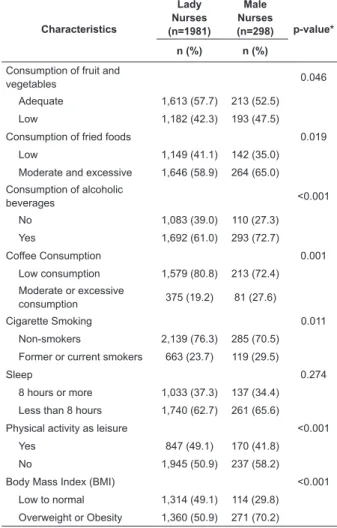
Table 1 – description of nurses at public hospitals in
the Municipality of Rio de Janeiro, according to
health-related behaviour patterns, by gender. Rio de Janeiro,
RJ, Brazil, 2012.
Table 2 – Distribution of the nurses in public hospitals
of the Municipality of Rio de Janeiro, according to the
average length of professional, domestic, and total work
hours, by gender. Rio de Janeiro, RJ, Brazil, 2012
*Pearson chi-square test(10)
Characteristics
Lady Nurses (n=1981)
Male Nurses
(n=298) p-value*
n (%) n (%)
Consumption of fruit and
vegetables 0.046
Adequate 1,613 (57.7) 213 (52.5)
Low 1,182 (42.3) 193 (47.5)
Consumption of fried foods 0.019
Low 1,149 (41.1) 142 (35.0)
Moderate and excessive 1,646 (58.9) 264 (65.0)
Consumption of alcoholic
beverages <0.001
No 1,083 (39.0) 110 (27.3)
Yes 1,692 (61.0) 293 (72.7)
Coffee Consumption 0.001
Low consumption 1,579 (80.8) 213 (72.4)
Moderate or excessive
consumption 375 (19.2) 81 (27.6)
Cigarette Smoking 0.011
Non-smokers 2,139 (76.3) 285 (70.5)
Former or current smokers 663 (23.7) 119 (29.5)
Sleep 0.274
8 hours or more 1,033 (37.3) 137 (34.4)
Less than 8 hours 1,740 (62.7) 261 (65.6)
Physical activity as leisure <0.001
Yes 847 (49.1) 170 (41.8)
No 1,945 (50.9) 237 (58.2)
Body Mass Index (BMI) <0.001
Low to normal 1,314 (49.1) 114 (29.8)
Overweight or Obesity 1,360 (50.9) 271 (70.2)
Weekly number of hours worked
Lady Nurses (n=1,981)
Male Nurses
(n=298) p-value*
Mean (SD) Mean (SD)
Professional 55.8 (20.6) 61.4 (21.6) <0.001
Domestic 21.4 (17.7) 12.7 (12.0) <0.001
Total (professional + domestic)
77.1 (24.5) 73.7 (23.2) 0.035
of hours dedicated to professional activities during
the week immediately preceding the illing-in of the
questionnaire, using the cut-off point of 40 hours of
work per week, which is the limit set by the legislation
that regulates the nursing profession in Brazil(7) . In the case of domestic and total work hours, the cut-off points
used represent the median of the distribution, calculated
separately for each gender. In this way, different cut-off
values were adopted for men and women. In the case
of women, we considered 17h and 76h for domestic and
total work hours, while for the men the values here used
were 10h and 72h respectively.
The outcome of interest is characterised by
behaviours and variables related to health: consumption
of fried foods (low: never/up to 3 times a month, or
excessive: 1 to 7 times a week); consumption of fruit
and vegetables (appropriate: 1 to 7 times a week, or
insuficient: never/up to 3 times a month); body mass
index (BMI), which is based on the self-reported weight
and height (ideal: ≤ 24.9, or overweight/obese: ≥25.0);
physical exercise (yes or no), smoking (non-smokers or
smokers/former smokers); sleep pattern (≥ 8h or <8h
per night) and coffee consumption (low consumption or
moderate/excessive consumption: ≥200 ml).
The association between the exposure variables
and outcomes was tested through multivariate logistic
regression analysis, with results presented as odds
ratio and respective conidence intervals of 95%(10). The
results of the regression refer to the crude association
between the exposure to long work times and the
outcome variables, and to the association adjusted by
potential confounders, such as: income, age, marital
status, work schedules, type of contract, and also the
educational level.
This study was approved by the Ethics Committee
of the Oswaldo Cruz Foundation (472/08) and also by
the hospitals where the research has been carried out.
Results
Data analysis referred to a total of 1,981 (87.3%)
women and 298 men. Compared to the female nurses,
the male nurses showed less healthy habits: they did
less physical exercise as a leisure activity, reported
being smokers more often, and also mentioned greater
consumption of alcoholic beverages, coffee and fried
foods, lower consumption of fruit and vegetables.
Besides, they were more often classiied as overweight
and obese (Table 1).
The men reported longer professional work hours
than women, but in the case of domestic work hours,
the igure reported by female nurses is 9 hours longer than that for male nurses (p < 0.001). Thus, the time
dedicated to domestic chores and to professional work
can be relected in the longer total work hours for women
Table 3 - Association between domestic, professional and total work hours related to health, among nurses at public
hospitals of the municipality of Rio de Janeiro, crude and adjusted odds ratios (OR) and respective conidence
intervals at 95% (CI95%). Rio de Janeiro, RJ, Brazil, 2012
*Adjusted for age, marital status, type of contract, work schedule, educational level and income.
Outcome variables
Exposure Variables
Domestic Working Hours Professional Working Hours Total Working Hours
CR (CI95%) CRaj* (CI95%) CR (CI95%) CRaj* (CI95%) CR (CI95%) CRaj* (CI95%)
Consumption of fruit and vegetables
Adequate 1 1 1 1 1 1
Excessive 0.76 (0.64-0.89) 0.89 (0.75-1.07) 1.25 (1.00-1.55) 1.14 (0.90 1.44) 0.88 (0.72-1.21) 0.96 (0.78-1.18)
Consumption of fried foods
Low 1 1 1 1 1 1
Moderate/Excessive 0.88 (0.74-1.03) 1.01 (0.84-1.20) 1.53 (1.23- 1.90) 1.36 (1.08-1.70) 1.21 (0.99-1.07) 1.25 (1.02-1.53)
Consumption of alcoholic beverages
No 1 1 1 1 1 1
Yes 0.92 (0.78-1.09) 0.92 (0.77-1.10) 1.08 (0.87-1.34) 1.13 (0.90-1.41) 0.95 (0.78-1.16) 0.96 (0.78-1.18)
Coffee Consumption
None / Low consumption 1 1 1 1 1 1
Moderate or High 1.19 (0.93-1.52) 1.05 (0.81-1.31) 1.52 (1.13-1.87) 1.80 (1.32-2.45) 1.45 (1.13-1.89) 1.41 (1.09-1.83)
Smoking
Non-Smoker 1 1 1 1 1 1
Smoker or ex-smoker 1.23 (1.01-1.49) 1.00 (0.81-1.24) 0.90 (0.70-1.15) 1,22 (0.93-1.60) 1.08 (0.86-1.36) 1.10 (0.86-1.40)
Sleep
Over 8 hours 1 1 1 1 1 1
Up to 8 hours 1.16 (0.98-1.38) 1.04 (0.87-1.25) 1.18 (0.95-1.47) 1.30 (1.03-1.64) 1.27 (1.03-1.55) 1.28 (1.03-1.58)
Physical Activity
Yes 1 1 1 1 1 1
No 1.24 (1.03-1.48) 1.17 (0.98-1.44) 1.34 (1.00-1.68) 1.36 (1.07-1.72) 1.36 (1.10-1.68) 1.35 (1.08-1.69)
Body Mass Index (BMI)
Ideal 1 1 1 1 1 1
Overweight or obesity 1.47 (1.24-1.74) 1.17 (0.97-1.40) 1.05 (0.85-1.31) 1.26 (1.00-1.59) 1.59 (1.30-1.93) 1.51 (1.23-1.87)
In Table 3, we see the crude and adjusted
associations in the women’s group. No signiicant
associations have been detected between the domestic
work hours and the assessed outcomes in the adjusted
analysis. Both the professional and the total working
hours have been strongly linked to the moderate or
excessive consumption of fried foods, the moderate
to high consumption of coffee, the lack of physical
exercise, the greater occurrence of overweight or
obesity, and shorter sleeping time, after adjustments for
confounders.
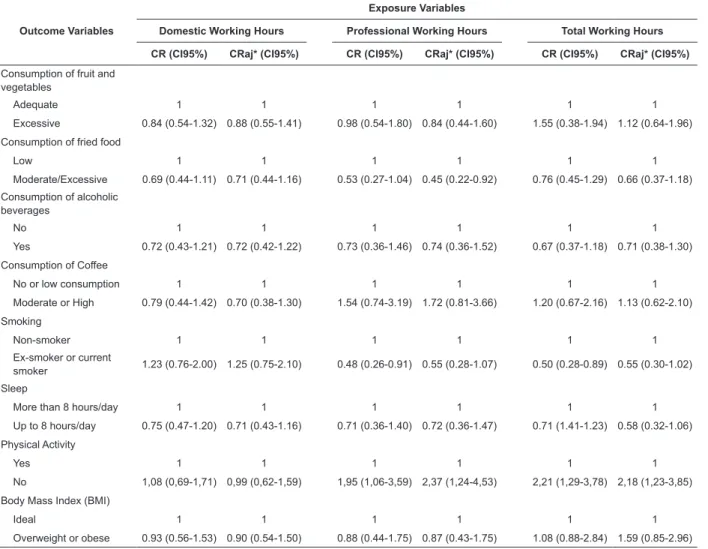
Among men, few associations were detected between
work hours and the outcomes of interest. The only variable
to be signiicantly associated to the professional and to
total work hours has been the lack of physical activities.
The chance of not taking any physical exercise is about
twice among those considered as having extensive
professional and total work hours (respectively OR=2.37;
CI95%=1.24-4.53 and OR=2.18; CI95%=1.23-3.85). In
addition, among the men who have reported an extensive
total of work hours, a lower consumption of fried foods
Rev. Latino-Am. Enfermagem 2013 Sept.-Oct.;21(5):.
Table 4 – Association between domestic, professional and total work hours and health-related behaviour among
nurses in public hospitals in the municipality of Rio de Janeiro, crude and adjusted odds ratios (ORs) and respective
conidence intervals at 95% (CI95%), Rio de Janeiro, RJ, Brazil, 2012
*Adjusted by age, marital status, type of employment relationship, work schedule, educational level and income.
Outcome Variables
Exposure Variables
Domestic Working Hours Professional Working Hours Total Working Hours
CR (CI95%) CRaj* (CI95%) CR (CI95%) CRaj* (CI95%) CR (CI95%) CRaj* (CI95%)
Consumption of fruit and vegetables
Adequate 1 1 1 1 1 1
Excessive 0.84 (0.54-1.32) 0.88 (0.55-1.41) 0.98 (0.54-1.80) 0.84 (0.44-1.60) 1.55 (0.38-1.94) 1.12 (0.64-1.96)
Consumption of fried food
Low 1 1 1 1 1 1
Moderate/Excessive 0.69 (0.44-1.11) 0.71 (0.44-1.16) 0.53 (0.27-1.04) 0.45 (0.22-0.92) 0.76 (0.45-1.29) 0.66 (0.37-1.18)
Consumption of alcoholic beverages
No 1 1 1 1 1 1
Yes 0.72 (0.43-1.21) 0.72 (0.42-1.22) 0.73 (0.36-1.46) 0.74 (0.36-1.52) 0.67 (0.37-1.18) 0.71 (0.38-1.30)
Consumption of Coffee
No or low consumption 1 1 1 1 1 1
Moderate or High 0.79 (0.44-1.42) 0.70 (0.38-1.30) 1.54 (0.74-3.19) 1.72 (0.81-3.66) 1.20 (0.67-2.16) 1.13 (0.62-2.10)
Smoking
Non-smoker 1 1 1 1 1 1
Ex-smoker or current
smoker 1.23 (0.76-2.00) 1.25 (0.75-2.10) 0.48 (0.26-0.91) 0.55 (0.28-1.07) 0.50 (0.28-0.89) 0.55 (0.30-1.02)
Sleep
More than 8 hours/day 1 1 1 1 1 1
Up to 8 hours/day 0.75 (0.47-1.20) 0.71 (0.43-1.16) 0.71 (0.36-1.40) 0.72 (0.36-1.47) 0.71 (1.41-1.23) 0.58 (0.32-1.06)
Physical Activity
Yes 1 1 1 1 1 1
No 1,08 (0,69-1,71) 0,99 (0,62-1,59) 1,95 (1,06-3,59) 2,37 (1,24-4,53) 2,21 (1,29-3,78) 2,18 (1,23-3,85)
Body Mass Index (BMI)
Ideal 1 1 1 1 1 1
Overweight or obese 0.93 (0.56-1.53) 0.90 (0.54-1.50) 0.88 (0.44-1.75) 0.87 (0.43-1.75) 1.08 (0.88-2.84) 1.59 (0.85-2.96)
Discussion
The results revealed differences between the
genders, showing that groups with speciic characteristics
are set up. Even though the professional work hours
are longer for men, the women have longer domestic
work hours and also longer total work hours. For the
female group, both the professional and the total work
hours show themselves to be signiicantly associated to
the health-related behaviour patterns that have been
appraised. Compared to the nurses that have had less
professional and total work hours, those with longer
time periods spent working are more likely not to carry
out physical exercise as a leisure pursuit, on a regular
basis. In addition, those with long professional work
weeks have a lower consumption of fried food, when
compared to those with less working hours.
in the health area with a strong presence of the distaff
gender, being considered as a kind of “female ghetto”(11),
as well as the lexible structure of working hours, which
makes it possible to conciliate with working at home. It
is also possible to establish a relationship with the social
growth of these women, as for this group work becomes
a source of income and also a kind of life activity that is
both personal and professional(1,3,12-13).
Akin to the results shown by another study with
nursing teams(8), it was also observed that men worked
more in relation to remunerated work, when compared
to women. However, the total work hours of men is
less, due to reduced responsibilities in domestic work
as split between them. On studying the impact of work
on the female group, domestic working hours should
be weighed in as an important factor, as even with this
the tasks in the home(1,3,8). Some studies(8,14) show that
the overload generated by double exposure to work
(domestic work and professional employment) has been
associated with factors that could be harmful for the
health of the workers. However, domestic work may not
be seen as damage or something arduous to carry out,
and can actually be a source of pleasure for some women,
as it results in more time spent with the family and
would be a certain compensation for negative aspects of
professional employment(15). The female workers in the
nursing ield carry out extensive activities in the labour
environment and this results in longer professional work
hours and even the accumulation of two jobs to ensure
a better salary(3,8,13). It is thus possible to perceive the
inluence of the place of work and also the organisation
thereof, with direct or indirect action upon the psychic
and physical maladjustments of the worker, which can
be converted into the failure to comply with the basic
needs of professionals, and may also be a factor that
contributes to the lack of self-care(13), which could in
turn explain the impact that the working hours within
the female segment of the population has on such
behaviour patterns. Another important item to consider
is that often the women are the only breadwinner in the
family(11) and hence become much more demanding in
compliance and dedication at their professional activities,
so as to meet all the needs of their dependants.
The scarcity of free time could explain the lack of
physical exercise. The results from some studies(3,16-17)
show that nursing professionals ascribe the lack of
physical activities to lack of time, which conirms the indings of the present article.
The association between high consumption
of fried foods and long work hours in the feminine
group is coherent to what has been observed in other
studies(17-18). The consumption of this food could also
arise from the changes that are enforced by changes
to the work routine, together with the habit of eating
outside the home, the growth in the consumption of fast
food, and also the easy availability thereof(18-19).
However, among the men the association was
the inverse of that for women, with longer work hours
being associated to a lower intake of fried foods. This
result matches what is commonly found in specialised
literature(17-18). It is possible that, for the men in this
sample, the most appropriate nutrition (with lower
consumption of fried foods) is a relection of the feminine
care that they receive at home. There are no records of
this association in specialised literature. Let’s suppose
that feminine domestic work, which includes house care
and also family care(1,3,8,19-20), favours the quality of the
food of these workers who are subjected to long hours
of professional work. This behaviour pattern, without
a shadow of doubt, warrants qualitative studies which
could help to understand this relationship´.
The lack of the practice of physical exercise as
leisure and also inappropriate nutrition may have been
relected in the high percentages of cases of overweight
or obesity in the group, particularly among women, with
the results being similar to those described in another
study on nursing professionals(15)
. In addition, some studies(20-22) consider other important factors in relation
to overweight and obesity in the female group: the age
bracket of the population, characterised in this study as
being of middle age, which generates an impact on the
metabolism(21), the condition of already having borne
children(20), marital status(22) and hormonal phenomena
such as the climacteric and the menopause(21).
In the years leading up to the menopause,
women tend to gain an extra 0.8 kg/year, and after the
menopause this rise may correspond to 20% of total
bodily fat(21). However, the greatest proneness to weight
gain after the menopause seems not to be due only to
lack of oestrogen, but mainly the ingestion of food with
energy content in excess of the needs of women in this
age bracket, through the slowing of basal metabolism
and also the greater likelihood of sedentarism, arising
from the aging process itself.
In the two groups studied, there was no signiicant
association between smoking and the working hours.
This aspect can be related to the high educational level of
the groups as studied here (all with at least a University
Degree) and also their awareness of the harm caused by
cigarettes, together with anti-smoking campaigns that
have been massive over the last few years in Brazil, and
also the prohibition of smoking in closed places (23).
The relation between short periods of sleep and
long professional hours among nurses has already been
seen in other studies(1,3) which assign this result to the
working hours and also the unavailability of suficient
days for days off and rest. The results could also have
been inluenced by the dedication to domestic chores(1)
in terms of less available time for rest.
In Brazilian culture, the consumption of coffee is
normal, especially in work environments, as a form of
social interaction. It has been observed that women
with long stints of professional or total work hours
tend to show an exaggerated consumption of coffee, a
phenomenon which could be explained by the properties
Rev. Latino-Am. Enfermagem 2013 Sept.-Oct.;21(5):.
activities in a satisfactory manner. The consumption of
coffee, in moderate doses, could favour cognitive and
psychomotor development, which is also necessary to
be able to work long hours in a labour environment that
needs maximum attention with a minimum of errors(24) . However, high doses could cause negative experiences
in the users, such as tachycardia, palpitations, insomnia
and anxiety(24).
Despite the importance and the scope of the
present study among nurses, some limitations must
be mentioned here, including the sectional design of
the study, which does not allow the establishment of
time relationships between the behaviour patterns as
assessed and working hours. In addition, the conidence
intervals with low precision could have been affected by
the size of the male population, which in many cases has
not allowed the establishment of statistical associations,
even though there has been the observation of high
punctual association estimates. The male nurses are
characterised as an unusual group of workers, when
it comes to working hours, and this means that the
generalisation of the indings of this study shall be
made with caution. However, it is possible that in other
professions aspects of long work hours have a similar
inluence on health-related behaviour patterns, as
previously discussed.
Conclusion
The results revealed long work hours among
both male and female nurses. Here we highlight the
association between professional and total work hours
and health-related behaviour patterns in the female
group, which can be a result of the accumulation of
functions both in private and professional life, which
can lead to greater exposure to factors presenting a
risk to health, and also less time for health care. Thus,
it is suggested that people who are subjected to long
work hours, with strong dedication to professional and
domestic work, have less time available and also less
motivation for self-care. Therefore, the consideration
of types of work hours in the studies which assess
health aspects, self-care and care provided to others is
particularly relevant in the context of nursing workers,
particularly in the female group, due to domestic work
overload.
In short, the results stress the need for actions
to promote health among nurses, within the context
of public hospitals, and also the importance of studies
that assess the impact of long work hours on workers’
health. In addition, studies of this nature shall be
encouraged, deepened and publicised, so that they may
be foundations for the enactment of legislation which
favours the general health of workers and also the care
that is provided.
References
1. Silva AA, Rotenberg L, Fischer FM. Jornadas de
trabalho na enfermagem: entre necessidades individuais
e condições de trabalho. Rev Saúde Pública. [periódico
na Internet]. 2011 [acesso 5 jun
2012];45(6);1117-26. Disponível em: http://www.scielo.br/pdf/rsp/v45
n6/2314.pdf.
2. Elias MA, Navarro VL. The relation between work,
health and living conditions: negativity and positivity
in nursing work at a teaching hospital. Rev. Latino-Am.
Enfermagem. 2006;14(4):517-25.
3. Portela LF, Rotenberg L, Wasissmann W. Health, sleep
and lack of time: relations to domestic and paid work in
nurses. Rev Saúde Pública. 2005;39(5):802-8.
4. Shields M. Long working hours and health. Health
Reports Autumn. 1999;11(2):33-48.
5. Silva AP, Souza JMP, F Borges FNS, Fischer FM.
Health-related quality of life and working conditions
among nursing providers. Rev Saúde Pública.
2010;44(4):718-25.
6. Spuergeon A, Harrington JM, Cooper CL. Health and
safety problems associated with long working hours: a
review of the current position. Occup Environm Med.
1997;54:367-75.
7. Decreto nº 94.406, de 08 de junho de 1987 (BR).
Dispõe sobre a Regulamentação da Lei nº 7.498, de
25 de junho de 1986, que dispõe sobre o exercício da
Enfermagem, e dá outras providências. Diário Oficial
da União [periódico na Internet]. [acesso 30 abr
2012]. Disponível em: http://www.coren-ba.com.br/
index.php?view=article&catid=23%3Adecretos&id=1
02%3Adecreto-no-94406&format=pdf&option=com_
content&Itemid=56.
8. Rotenberg L, Portela LF, Banks B, Griep RH, Fischer
FM, Landsbergis P. A gender approach to work ability
and its relationship to professional and domestic work
hours among nursing personnel. Appl Ergonomics.
2008;39.646-652.
9. Grosch JW, Caruso CC, Rosa RR, Sauter SC.
[Long Hours of Work in the U.S.: Associations With
Demographic and Organizational Characteristics,
Psychosocial Working Conditions, and Health]. Am J
Received: July 20th 2012
Accepted: July 12th 2013 10. Motulsky H. Instituitve Viostatistic. Oxford: Oxford
University Press; 1995. 386 p.
11. Bruschini MCA. Trabalho e Gênero no Brasil nos últimos
dez anos. Cad Pesqui. [periódico na Internet].2005
[acesso 25 jun 2012];37(32). Disponível em: http://
www.scielo.br/pdf/cp/v37n132/a0337132.pdf.
12. Padilha MICS, Vafhetti HH, Brodersen,G. Gênero e
Enfermagem:uma análise reflexiva. Rev Enferm UERJ.
[periódico na Internet]. 2006 [acesso 25 jun 2012];
14(2):292-300. Disponível em: http://repositorio.furg.
br:8080/jspui/bitstream/1/1572/1/G%C3%AAnero%20
e%20enfermagem-%20uma%20an%C3%A1lise%20
reflexiva.pdf.
13. Baggio MA, Formaggio FM. Trabalho, Cotidiano e o
Profissional de Enfermagem: o significado do descuidado de
si. Cogitare Enferm. [periódico na Internet]. 2008 [acesso
26 jun 2012];jan/mar;13(1):67-74. Disponível em:
http://ojs.c3sl.ufpr.br/ojs2/index.php/cogitare/article/
viewFile/11954/8435.
14. Krantz G, Ostergan PO. [Double exposure. The
combined impact of domestic responsibilites and job
strain on common symptoms in employed Swedish
women]. Eur J Public Health. 2001;11(4):413-9.Inglês.
15. Hibbard JH, Pope CR. Effect of domestic and
occupational roles on morbidity and mortaliy. Soc Sci
Med. 1991;32(7):805-11. Inglês.
16. Nascimento LC, Mendes IJM. Health profile of
workers in a Teaching Health Center. Rev. Latino-Am.
Enfermagem. jul-ago 2002;10(4):502-8.
17. Maia CO, Goldmeier S, Moraes MA, Boaz MB, Azzolin
K. Fatores de risco modificáveis para doença arterial
coronariana nos trabalhadores de enfermagem. Acta
Paul Enferm. [periódico na Internet]. 2007 [acesso 28
jun 2012], 2007;20(2):138-42. Disponível em: http://
www.scielo.br/pdf/ape/v20n2/a05v20n2.pdf.
18. Silva RM, Back CLC, Magnago TSBS, Carmagnani
MIS, Tavares JP, Prestes FC. Trabalho noturno e a
repercussão na saúde dos Enfermeiros. Esc Anna Nery
[internet]. 2011; [acesso 30 jun 2012]; 15 (2):270-6.
Disponível em: http://www.scielo.br/pdf/ean/v15n2/
v15n2a08.pdf.
19. Palma RFM, Barbieri P, Damião R, Polleto J, Chaim
R, Gimeno SG, et al.Fatores associados ao consumo de
frutas, verduras e legumes em Nipo-Brasileiros. Rev
Bras Epidemiol. [periódico na Internet]. 2009 [acesso
24 jun 2012];12(3);436/45. Disponível em :http://
www.scielosp.org/pdf/rbepid/v12n3/12.pdf.
20. Fonseca MJM, Chor D, Valente J G. Hábitos alimentares
entre funcionários de banco estatal: padrão de consumo
alimentar. Cad Saúde Pública. [periódico na Internet].
1999 [acesso 6 jul 2012],15(1);29-39. Disponível em:
http://www.scielosp.org/scielo.php?script=sci_arttext
&pid=S0102-311X1999000100004&lng=pt.
21. De Lorenzi DRS, Basso E, Fagundes PO, Sacioloto
B. Prevalência de sobrepeso e obesidade no climatério.
Rev Bras Ginecol Obstet. [periódico na Internet]. 2005
[acesso 25 jun 2012];27(8):479-84.Disponível em:
http://www.scielo.br/pdf/rbgo/v27n8/26759.pdf.
22. Andreto LM, Souza AI, Figueirosa JN, Filho JEC.
Fatores associados ao ganho ponderal excessivo em
gestantes atendidas em um serviço público de pré-natal
na cidade de Recife, Pernambuco, Brasil. Cad Saúde
Pública. [periódico na Internet]. 2006 [acessado em 26
jun 2012]; 22(11): 2401-9. Disponível em: http://www.
scielo.br/pdf/csp/v22n11/14.pdf.
23. Echer IC, Correa APA, Lucena, AF, Ferreia SAL,
Knorst MM. Prevalence of Smoking Among Employees
of a University Hospital. Rev. Latino-Am. Enfermagem.
[periódico na Internet]. jan-fev 2011;19(1):179-86.
24. Alves R, Casal S, Oliveira B. Benefícios do
café na saúde: mito ou realidade?. Quím Nova.