RESUMEN
Objeivo: Fue ideniicar la vulnerabilidad programáica de las Unidades Básicas de Salud con la atención a las ETS/VIH/SIDA. Método: Es un estudio descripivo con un abordaje cuanitaivo llevado a cabo en el Municipio de San Pablo. Fue uilizado un formulario online (el FormSUS) con los
gerentes de las 442 Unidades Básicas de Salud del Municipio de San Pablo. Parici -paran en el estudio 74.2% de los gerentes, estos 53.6% eran enfermeros. Resultados: Se destaca la vulnerabilidad programáica de las Unidades Básicas de Salud en rela -ción a algunos elementos de la infraestruc -tura, acciones de prevención, tratamiento, prenatal y la integración entre los servicios en la atención a las ETS/VIH/SIDA. Conclu
-sión: Para efecividad de la integralidad en el enfrentamiento de la HIV/SIDA en la atención básica es necesario considerar la vulnerabilidad programáica, y mucho más inversiones y reorganización de los servi -cios en un diálogo con los agentes sociales implicados (usuarios, equipo mulidiscipli -nario, gerentes, y otros).
DESCRIPTORES
Enfermedades de transmisión sexual Síndrome de inmunodeiciencia adquirida Vulnerabilidad en salud
Integralidad en salud Atención Primaria de Salud Enfermería en salud pública
RESUMO
Objeivo: Ideniicar a vulnerabilidade programáica às DST/HIV/aids na Atenção Básica para o enfrentamento do HIV/Aids. Método: Estudo descriivo, com aborda -gem quanitaiva, realizado no Município de São Paulo (MSP). Uilizou-se formulário
online (FormSUS), com gerentes das
442 Unidades Básicas de Saúde (UBS) do MSP. Pariciparam do estudo 74,2% geren -tes, dos quais 53,6% eram enfermeiros. Resultados: Destaca-se a vulnerabilidade programáica nas UBS com relação a al -guns itens de infraestrutura, ações de pre -venção, de tratamento, no pré-natal e de integração entre os serviços na atenção às DST/HIV/aids. Conclusão: Para a efeivação da integralidade no enfrentamento do HIV/ aids na Atenção Básica é necessário atentar para a vulnerabilidade programáica, além de mais invesimentos e reorganização dos serviços, num diálogo com os atores sociais envolvidos (usuários, equipe muliprois -sional, gerentes, gestores, entre outros).
DESCRITORES
Doenças sexualmente transmissíveis Síndrome da imunodeiciência adquirida Vulnerabilidade em saúde
Integralidade em saúde Atenção Primária à Saúde Enfermagem em saúde pública
ABSTRACT
This study aimed to idenify programmaic vulnerability to STDs/HIV/AIDS in primary health centers (PHCs). This is a descrip -ive and quanita-ive study carried out in the city of São Paulo. An online survey was applied (FormSUS plaform), involving administrators from 442 PHCs in the city, with responses received from 328 of them (74.2%), of which 53.6% were nurses. At -tenion was raised in relaion to program -maic vulnerability in the PHCs regarding certain items of infrastructure, prevenion, treatment, prenatal care and integraion among services on STDs/HIV/AIDS care. It was concluded that in order to reach comprehensiveness of acions for HIV/ AIDS in primary health care, it is necessary to consider programmaic vulnerability, in addiion to more investment and reor -ganizaion of services in a dialogue with the stakeholders (users, mulidisciplinary teams, and managers, among others).
DESCRIPTORS
Sexually transmited diseases Acquired immunodeiciency syndrome Health vulnerability
Comprehensiveness in health Primary health care
Public health nursing
Comprehensiveness and programmatic
vulnerability to STDS/HIV/AIDS in
primary care
*Luciane Ferreira do Val1, Lucia Yasuko Izumi Nichiata2
A INTEGRALIDADE E A VULNERABILIDADE PROGRAMÁTICA ÀS DST/HIV/AIDS NA ATENÇÃO BÁSICA
LA INTEGRALIDAD Y VULNERABILIDAD PROGRAMÁTICA DE LAS ETS/VIH/SIDA EN LA ATENCIÓN BÁSICA
* Extracted from the work “Vulnerabilidade ao HIV/aids: contribuição da pesquisa-ação no aprimoramento das ações de prevenção na Atenção Básica”, 1st Exhibition of works of the Nursing graduate program, School of Nursing, University of São Paulo, 2013. 1 Student of the post-doctorate program, School of
Nursing, University of São Paulo, São Paulo, SP, Brazil. 2 Associate Professor, Department of Collective Health Nursing, School of Nursing, University of São
DOI: 10.1590/S0080-623420140000600021
O
riginal
a
INTRODUCTION
The year 2014 marks the 33rd year since American scienists reported the irst occurrence of a disease that later came to be known as acquired immunodeiciency syndrome (AIDS).
In the period from 1980 through June 2012 in the city of São Paulo, there were reports of 81,300 cases of AIDS,
58,554 in males and 22,746 in females(1). AIDS occurrenc
-es have been decreasing since 1997 as r-esult of the intro
-ducion of the highly acive aniretroviral therapy (HAART)
treatment in 1996, decreasing the viral load in AIDS car
-riers and helping the decrease in virus transmission(2).
Despite this relaive control, one of the challenges when
confroning HIV/AIDS is to carry out expansion of preven
-ion and early diagnosis ac-ions in health services. Primary health centers (PHCs) carry out decentralized prevenive acions to confront the HIV/AIDS epidemic in Brazil. In the
past, such acions were limited to reference services. Pri
-mary care has been developing acions focused on con
-froning HIV/AIDS on diferent levels and qualiies and it also points to great challenges in the development of said
acions. Among those acions is the increase in early diag
-nosis, since more than half of the people with a conirmed disease already present immunological deterioraion at
the ime of diagnosis. In addiion to that problem, oth
-ers related to prolonged treatment are of noice, such as non-adherence to treatment with ARV drugs, which may lead to the virus resising the drugs and even to failure of treatment in many cases. Other strategies to confront the
epidemic are the improvement of acions against tubercu
-losis/HIV coinfecion and integraion of health services(3).
PHCs improve comprehensiveness of care(4). They are
considered special places for care, both when performing
their tradiional role or as Family Health Strategies (Estra
-tégias Saúde da família). However, implemening compre
-hensiveness on primary care is one of the great challenges in confroning STDs/HIV/AIDS.
Comprehensiveness has a set of characterisics, which
include the health system, its insituions and the organi
-zaion of desirable pracices, as well as the challenge of building jusice, democracy and efecive health access through various technological densiies, knowledge and pracices, according to the necessiies of each individual,
in a supporive manner(5).
Comprehensiveness, when it comes to organizing pracices, aims to end divisions between public health and medical assistance, and between prevenive and
healing (curaive) acions. It is also where users’ neces
-siies are not reduced to the technical knowledge of health professionals(5).
The principle of comprehensiveness in the organiza
-ion of primary health services demands horizontal health pracices from programs that were previously verical.
However, teams at health centers no longer base care on the medical approach and on speciic programs from the
Brazilian Ministry of Health, but rather on the epidemio
-logical approach, in other words, ofering services to ex
-clusively treat the diseases of a populaion(5).
Considering the history of the city of São Paulo in con
-froning HIV/AIDS and lack of knowledge regarding the organizaion of the PHCs concerning HIV/AIDS care, this
study had as its objecive the ideniicaion of signs of pro
-grammaic vulnerability (PV) to STDs/HIV/AIDS on primary health in the city of São Paulo to confront HIV/AIDS.
METHOD
It is a descripive, exploratory study whose reference is
the concept of vulnerability, regarding its programmaic as
-pect(6-7), in other words, the condiions of structure, dynam
-ics, organizaion and operaionalizaion of acions for con
-froning HIV/AIDS, in this case in primary health services.
The concept of vulnerability includes a set of collec
-ive contexts that are interconnected and that enable a higher exposure to or lower protecion against HIV/AIDS. It is diferent from the concept of risk, which is central to epidemiological studies. The operaionalizaion of vulnerability makes it possible to objecively, ethically and poliically evaluate the life condiions of individuals
and groups that are exposed to the problem and the ele
-ments that support the construcion of real alternaives
to confront this problem. It is understood that a per
-son’s disease is determined by a set of condiions that are not limited just to the person’s behavior and to the biological aspects of the infecion. The person is in an
economic, cultural and socio-poliical context of avail
-ability of healthcare services that may reinforce protec
-ion against the disease(8-9).
The study’s subjects were the administrators of the PHCs linked to the São Paulo Municipal Secretary of Health
(Secretaria Municipal de Saúde de São Paulo). The instru
-ment used in data gathering was based on two forms: the
irst one called Monitoring of the decentralizaion pro
-cesses of acions on STDs/AIDS in primary care, developed by the Reference Center for Treatment of STDs/AIDS, SP,
of the São Paulo State Secretary of Health(10), and the sec
-ond one called Evaluaion for the improvement of quality
of the Family Health Strategy (EIQ)(11).
An online form was created on the FormSUS plaform. It had 51 quesions and was sent to the administrators of 442 PHCs in the period from April to September 2011. The analysis of comprehensiveness in HIV/AIDS care in the
PHCs was guided by ive signs of programmaic vulnerabili
-ty: a) Infrastructure for the performance of prevenive and care acions in STDs/HIV/AIDS, composed of 16 items; b)
Responses for the necessiies of STDs/HIV/AIDS care, com
regarding STDs/HIV/AIDS care, composed of 11 items; d) Prevenive acions regarding STDs/HIV/AIDS, composed of 10 items; and e) Integraion of acions among PHCs, STD/ Aids Reference Center CRT/SAE for HIV/STDs/AIDS and
maternity hospitals, composed of 8 items(12).
The responses were classiied as meets and does not
meet the item criteria according to recommendaions
from the Brazilian Ministry of Health, the São Paulo State Secretary of Health and the Municipal Secretary of Health,
awarding them respecive values of 1 and 0. A cut-of per
-centage of 80% was considered for each analyzed item. To analyze the data, we used the Staisical Package for the Social Sciences (SPSS), version 19, in which data were
presented descripively in charts and graphs including ab
-solute (number) and relaive (%) frequency.
The project was approved by the Research Ethics Com
-mitee of the School of Nursing (EEUSP), process number 783/2006, and by the Research Ethics Commitee of the
São Paulo Municipal Secretary of Health, under the num
-ber 366/2009, CAAE 0174.0162.000-09.
RESULTS
Paricipants in the study were 328 (74.2%) administra
-tors of PHCs of the city of São Paulo; of these, 176 (53.6%) were nurses.
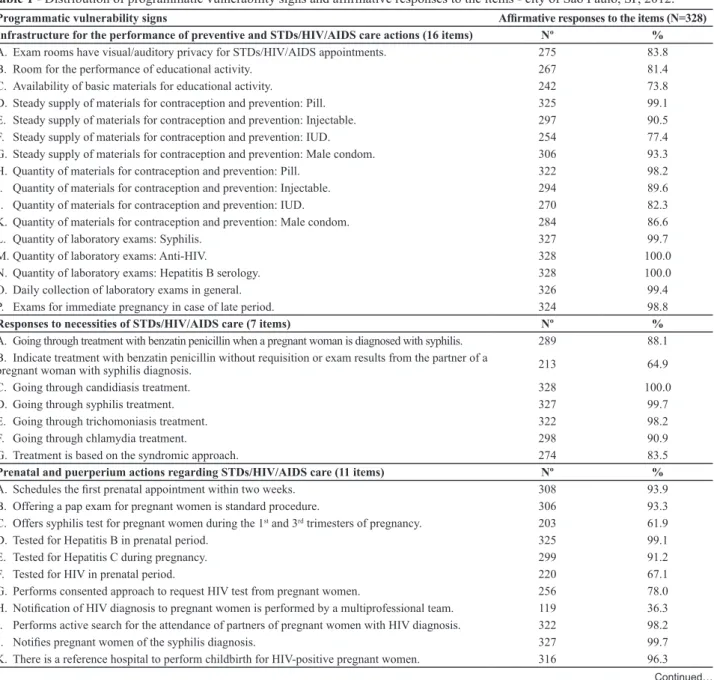
Despite the fact that the PHCs in the study met most of the evaluated item criteria, it was possible to idenify programmaic vulnerability in primary care for STDs/HIV/ AIDS (table 1).
Table 1 - Distribution of programmatic vulnerability signs and afirmative responses to the items - city of São Paulo, SP, 2012.
Programmatic vulnerability signs Afirmative responses to the items (N=328)
Infrastructure for the performance of preventive and STDs/HIV/AIDS care actions (16 items) Nº %
A. Exam rooms have visual/auditory privacy for STDs/HIV/AIDS appointments. 275 83.8
B. Room for the performance of educational activity. 267 81.4
C. Availability of basic materials for educational activity. 242 73.8
D. Steady supply of materials for contraception and prevention: Pill. 325 99.1
E. Steady supply of materials for contraception and prevention: Injectable. 297 90.5
F. Steady supply of materials for contraception and prevention: IUD. 254 77.4
G. Steady supply of materials for contraception and prevention: Male condom. 306 93.3
H. Quantity of materials for contraception and prevention: Pill. 322 98.2
I. Quantity of materials for contraception and prevention: Injectable. 294 89.6
J. Quantity of materials for contraception and prevention: IUD. 270 82.3
K. Quantity of materials for contraception and prevention: Male condom. 284 86.6
L. Quantity of laboratory exams: Syphilis. 327 99.7
M. Quantity of laboratory exams: Anti-HIV. 328 100.0
N. Quantity of laboratory exams: Hepatitis B serology. 328 100.0
O. Daily collection of laboratory exams in general. 326 99.4
P. Exams for immediate pregnancy in case of late period. 324 98.8
Responses to necessities of STDs/HIV/AIDS care (7 items) Nº %
A. Going through treatment with benzatin penicillin when a pregnant woman is diagnosed with syphilis. 289 88.1
B. Indicate treatment with benzatin penicillin without requisition or exam results from the partner of a
pregnant woman with syphilis diagnosis. 213 64.9
C. Going through candidiasis treatment. 328 100.0
D. Going through syphilis treatment. 327 99.7
E. Going through trichomoniasis treatment. 322 98.2
F. Going through chlamydia treatment. 298 90.9
G. Treatment is based on the syndromic approach. 274 83.5
Prenatal and puerperium actions regarding STDs/HIV/AIDS care (11 items) Nº %
A. Schedules the irst prenatal appointment within two weeks. 308 93.9
B. Offering a pap exam for pregnant women is standard procedure. 306 93.3
C. Offers syphilis test for pregnant women during the 1st and 3rd trimesters of pregnancy. 203 61.9
D. Tested for Hepatitis B in prenatal period. 325 99.1
E. Tested for Hepatitis C during pregnancy. 299 91.2
F. Tested for HIV in prenatal period. 220 67.1
G. Performs consented approach to request HIV test from pregnant women. 256 78.0
H. Notiication of HIV diagnosis to pregnant women is performed by a multiprofessional team. 119 36.3
I. Performs active search for the attendance of partners of pregnant women with HIV diagnosis. 322 98.2
J. Notiies pregnant women of the syphilis diagnosis. 327 99.7
In table 1, in the secion Infrastructure for the perfor
-mance of prevenive and STDs/HIV/AIDS care acions, it was noted that there are 86 (26.2%) PHCs that do not have basic materials for educaional aciviies and 74 (22.6%) that do not have a steady supply of materials for contracepion and prevenion, such as the intrauterine device (IUD).
With regard to Responses to necessiies of STDs/HIV/
AIDS care, 115 (35.1%) of the PHCs do not indicate treat
-ment with benzain penicillin for the partners of pregnant women diagnosed with syphilis without exam requisiions or results, contrary to what is recommended.
In Prenatal and puerperium acions regarding care for STDs/HIV/AIDS, it was noted that 125 (38.1%) of the PHCs do not ofer syphilis tests for pregnant women in the irst and third trimesters of pregnancy; 108 (32.9%) do not perform HIV tests in the prenatal period; 72 (22%) do not perform consented approach to request HIV tests from the pregnant women; and in 209 (63.7%) the noiicaion to pregnant women of HIV diagnosis is not performed by a muliprofessional team.
In the part for Prevenive acions regarding STDs/HIV/
AIDS, professionals are not adequately trained for syn
-dromic approach care in 160 (48.8%) of the PHCs. In 209
(63.7%), professionals are not adequately trained to per
-form counseling when ofering HIV tests. In 146 (44.5%),
it is not the muliprofessional team that records noiica
-ions of posiive exams for the detecion of syphilis. Coun
-seling for HIV tests is not performed in 293 (89.3%) of the PHCs; in 202 (61.6%), the average response ime for the results of posiive HIV tests was more than seven days;
and in 77% (23.5%), there are no consented approaches when requisiioning the HIV tests.
Among the signs, there is one that concerns integra
-ion of ac-ions between UBS, CRT/SAE on HIV/STDs/AIDS
and maternity hospitals, which refers to the communica
-ion from primary care toward other centers (both refer
-ence services of care for HIV/AIDS and monitoring servic
-es). This was the one with the lowest percentage of PHCs that claimed to perform acions in that respect. There is no return of informaion to the center ater the referral of pregnant women to STDs/AIDS reference services in 104 (31.7%), and regarding childbirth, 89 (27.1%) show no stream of reference/counter-reference of paients referred to STDs/AIDS specialized centers in 235 (71.9%) PHCs.
DISCUSSION
A fact that draws atenion when analyzing program
-maic vulnerability in PHCs in the city of São Paulo is that nurses are administrators in many of them. Historically, nurses have performed management and coordinaion duies in health centers, work ields and nursing teams
in Brazil(13). Management is an important tool for nurses
to promote in mulidisciplinary teams a thinking process
and review of their pracice in order to (re)organize ser
-vice with commitment to health care, not just performing
fragmented acions or isolated procedures(14).
Because of implementaion of the Brazilian Uniied Health System and consequent decentralizaion of health services (decisions are closer to the local sphere and to
…Continuation
Programmatic vulnerability signs Afirmative responses to the items (N=328)
Preventive actions regarding STDs/HIV/AIDS (10 items) Nº %
A. Professionals trained to perform syndromic approach care for STDs. 168 51.2
B. Professionals trained to perform counseling when offering HIV test. 119 36.3
C. Performs action for the attendance of the partner in case of STD. 319 97.3
D. Performs action for the attendance of the partner in speciic case of HIV. 319 97.3
E. Performs active search for users who carry STDs when they do not come to the center. 318 97.0
F. Multiprofessional team records notiications of positive exams for the detection of syphilis. 182 55.5
G. Performs HIV test for the general population any day of the week. 304 92.6
H. Performs counseling for the HIV exam. 35 10.7
I. The average response time for the results of positive HIV exams to the center is up to seven days. 126 38.4
J. Performs consented approach when requesting HIV exam. 251 76.5
Integration of actions between UBS, CRT/SAE on HIV/STDs/AIDS and maternity hospitals (8 items) Nº %
A. There is a continuous stream of notiications for congenital syphilis in the maternity hospital. 295 89.9
B. Notiies pregnant women of the HIV diagnosis. 313 95.4
C. Provides referral forms and registers appointments on the STDs/AIDS CRT and SAE reference
services for pregnant women diagnosed with HIV. 206 62.8
D. Information is sent back to the center after referring pregnant women to reference services for
STDs/AIDS CRT and SAE. 224 68.3
E. Information is sent back to the center regarding childbirth of referred pregnant women with HIV. 239 72.9
F. Makes an appointment with the reference service for STDs/AIDS when there is a positive
result for HIV. 205 62.5
G. There is a stream of references/counter-references for patients referred to special treatment ser
-vices for STDs/AIDS. 93 28.4
It is known that one obstacle to eliminaing congeni
-tal syphilis is diiculty in treaing the partner of the diag
-nosed pregnant woman. In the state of São Paulo it is esi
-mated that only 14% of partners of pregnant women with syphilis are adequately treated, which indicates problems related to prenatal care quality(20).
As for Prenatal and puerperium acions regarding
STDs/HIV/AIDS care, it was veriied that there are chal
-lenges to be overcome, especially related to the ofer of ani-HIV tesing and syphilis tesing in the irst and third trimester of pregnancy.
In fact, that is a problem in many places. In the study
Resultado do estudo seninela-parturiente,(21) it was veri
-ied that only 14.1% of parturient women who received care in the 150 maternity hospitals of the Brazilian Uniied
Health System were tested twice for syphilis during preg
-nancy, as recommended, and that there is low coverage for the second prenatal syphilis test, which shows that the recommendaions of the Brazilian Ministry of Health are not being followed.
In a study regarding coverage for ani-HIV tesing dur
-ing pregnancy, interviews with 435 women from ive mu
-nicipaliies of the northwestern part of the state of Paraná,
Brazil, revealed coverage of 89.6%, which is far from ide
-al—coverage should be 100%. In another study, the result was only coverage of 48.4% for pregnant women in ive Family PHCs in the city of Cuité, state of Paraíba, Brazil(23).
Another challenge is the counseling of the pregnant woman before and ater the ani-HIV test by members of the muliprofessional team. Counseling must be carried out with the objecive of humanizaion, at the moment of communicaing informaion regarding results, be they negaive or posiive. In a study conducted with nurses in prenatal appointments in three Family Health Strategies centers in Fortaleza, state of Ceará, it was discussed that
in care there is a prevalence of an I-THIS relaionship be
-tween professionals and users, in other words, a
subject-object relaion, instead of I-YOU, subject-subject relaion
-ship. This happens because of work demands that are measured quanitaively in terms of producivity, result in fast and mechanical appointments, without the possibility
of ofering humanized care(24).
In the city of São Paulo, any professional trained for coun
-seling can request HIV and syphilis exams (ordinance number
2,703, December 20, 2003)(25). However, some of the city’s
PHCs have not incorporated this request in their pracices, so the tests are performed without the adequate approach.
Tesing has been increasing in Brazil, but without of
-fering of counseling, without due atenion to people’s independent decisions, and with inequaliies regarding
educaional level, region and ethnicity(26).
On the item Prevenive acions regarding STDs/HIV/AIDS,
it was noiced that there was a big problem with receiving service users), it is necessary that PHC managers have
new knowledge and skills. Comprehensiveness as the guide of administraive acivity and insigator of changes in the dominant medical care model must be built on the basis of dialog between training and work, construcion of knowledge, relaion of theory and pracice and a search
for relecion on health acions(14).
Concerning the organizaion of pracices for STDs/HIV/ AIDS care in PHCs, administrators and mulidisciplinary
teams may be bringers of change to realize comprehen
-siveness. Health comprehensiveness is thought of as a
light beam(15), subject to the same physical phenomena,
such as properies of relecion, refracion or absorpion, suggesing that the bringers return to their staring place
if they are relected when trying to pass through an obsta
-cle. Therefore, the second ime, they break barriers and cross spaces, even if they sufer a coeicient of refracion and delecion. The bringers of comprehensiveness would thus break barriers when construcing new ways of doing/ acing in daily pracice.
Nurses as administrators and mulidisciplinary teams
as bringers of change respond to the necessiies of treat
-ment, perform prenatal and puerperium acions in rela
-ion to STD care and take part in ac-ions with reference
services for STDs/HIV/AIDS when they implement pre
-venive and care acions for STDs/HIV/AIDS. Even if they someimes face hardships passing through obstacles,
translated as PVs, these bringers of change, enlightened
by comprehensiveness, have the power to build new ways of doing/acing in the daily services pracice. Thus, new
insituional arrangements, focused on users, may be pro
-duced when their vulnerabiliies and potenials are con
-sidered and ciizens’ rights are respected, as guided by the principle of comprehensiveness.
Analysis of signs of programmaic vulnerability (PV)
in HIV/AIDS care in PHCs of São Paulo’s Secretary of Mu
-nicipal Health showed challenges that must be overcome. It is important to note that the concept of PV includes a sense that there is power to overcome the condiions that lead to vulnerability; therefore, the relaion vulnerability/
emancipaion is dialecically deined. There is vulnerabil
-ity in the same measure that there are condiions to con
-front the situaion.
In relaion to Infrastructure for the performance of pre
-venive and STDs/HIV/AIDS care acions, the study showed that there are not enough educaional materials and other prevenion materials such as IUDs in the researched PHCs.
This problem was ideniied in other studies(16-17).
In Responses to necessiies of STDs/HIV/AIDS care, it is noted that most of the PHCs do not perform the benzain penicillin treatment on the partners of pregnant women with a syphilis diagnosis, even without the results of the laboratory exam, as deined by ordinance number 3,161,
results of HIV tests within seven days. According to admin
-istrators of the PHCs of 30 municipaliies of the state of São Paulo, one study found that in 28.1% (n = 305) of the PHCs there was a delay of up to 15 days in receiving syphilis, HIV and Hepaiis B exam results; in 7.1% (n = 263) around 16 to
30 days; and in 3.2% (n = 340) more than 31 days(18).
The labs have complex issues that make it diicult to establish a stream of care for users of PHCs, such as: lack
of regulaion and supervision of third-party labs; frag
-mentaion of exam types among many lab; performance of exams that are condiioned to the operaional capacity of the kits; and restricive quotas for the performance of
exams, among others(18).
On Integraion of acions between PHCs, CRT/SAE on HIV/STDs/AIDS and maternity hospitals, there is one of the
criical issues to be confronted, which deals with the ref
-erence and counter-ref-erence stream from PHCs to other centers in the care network. It is a sign of fragmentaion in health care. Other studies have shown that the reference and counter-reference system have been a problem for
muliprofessional teams, since the mid-1980s, indepen
-dent of the level of care (primary, secondary or teriary), the event or the relevant disease.(27-28).
Comprehensiveness in care has not been materialized because decentralizaion and regionalism prevented the integraion process in services at diferent care levels and
the formaion of healthcare networks. There is an imbal
-ance in the number of PHCs for the number of inhabitants; the service network at the second and third levels is not
suicient; the same applies to human resources, as profes
-sionals are not trained for aciviies that demand speciic
qualiicaions; and there are operaional problems in infor
-maion systems. All of these factors, among others, result in
resource fragmentaion and detachment from atenion to
the health necessiies of the populaion(29).
Comprehensiveness requires that PHCs be closely linked to other health services, in order to ofer all types of healthcare services (including referrals to other services), making their responsibility clear both for users and teams. The later, in addiion to knowing how to idenify user problems (funcional, organic and social), must ofer and
recognize necessiies for care and prevenive services(30).
CONCLUSION
The study reached its objecive of idenifying signs of
programmaic vulnerability (PV) to STDs/HIV/AIDS in pri
-mary care in the city of São Paulo. In addiion, it ideniied that most PHC administrators are nurses and, therefore, how important it is for these professionals to unite sci
-eniic knowledge, poliical competence and the ethical
sense of care in order to adequately manage PHCs to con
-front HIV/AIDS.
For the materializaion of comprehensiveness in STDs/ HIV/AIDS care in primary care, investments and service reorganizaion are essenial, taking the PVs into account in a dialog with the stakeholders (users, muliprofessional teams, administrators, and managers among others).
Technological advances, especially related to treat
-ment of STDs/HIV/AIDS, are no subsitutes for the search for improvement in acions at the programmaic level of primary care; on the contrary, they reinforce the need
for their own incorporaion in PHCs because of their geo
-graphically central posiion in coordinaion with other centers in the service network.
REFERENCES
1. Boleim Epidemiológico de AIDS, HIV e DST do Município de São Paulo. Secretaria Municipal da Saúde, Coordenação de Vigilância em Saúde, São Paulo. 2012;15(16).
2. Boleim Epidemiológico de AIDS, HIV/DST e Hepaites B e C do Município de São Paulo. Secretaria Municipal da Saúde, Coordenação de Vigilância em Saúde, São Paulo. 2011;15(14).
3. Paula IA, Guibu IA. DST/aids e rede básica: uma integração necessária. São Paulo: Secretária de Estado da Saúde; 2007.
4. Brêtas ACP, Pereira AL. Gestão em unidades básicas de saúde. In: Harada MJCS, organizador. Gestão em enfermagem: ferramenta para práica segura. São Caetano do Sul (SP): Yendis; 2011. p. 377-83.
5. Matos RA. Os senidos da integralidade: algumas relexões acerca de valores que merecem ser defendidos. In: Pinheiro R, Matos RA, organizadores. Os senidos da integralidade na atenção e no cuidado à saúde. 8ª ed. Rio de Janeiro: CEPESC/ IMS/UERJ/ABRASCO; 2009. p. 43-68.
6. Mann J, Tarantola DJM, Neter T. Como avaliar a vulnerabilidade à infecção pelo HIV e aids. Rio de Janeiro: Relume-Dumará; 1993. A Aids no mundo; p. 275-300.
7. Nichiata LYI, Bertolozzi MR, Gryschek ALFPL, Araújo NVDL, Barbosa MCPF, Ciosak SI, et al. The potenial of the concept of vulnerability in understanding transmissible diseases. Rev Esc Enferm USP [Internet]. 2011 [cited 2012 Feb 07];45(n. spe 2):1769-73. Available from: htp://www.scielo.br/pdf/ reeusp/v45nspe2/en_23.pdf
9. Ayres JRCM, Paiva V, França Junior I. From natural history of disease to vulnerability: changing concepts and pracices in contemporary public health. In: Parker P, Sommer M, organizadores. Routledge handbook in global public health. Abingon: Oxon: Taylor & Francis; 2011. p. 98-107.
10. São Paulo (Estado). Secretaria de Estado da Saúde; Centro de Referência e Treinamento em DST/AIDS. Programa Estadual DST/Aids. Monitoramento da Atenção Básica [Internet]. São Paulo; 2011 [citado 2012 fev. 07]. Disponível em: htp://formsus.datasus.gov.br/site/formulario.php?id_ aplicacao=2557
11. Brasil. Ministério da Saúde; Secretaria de Atenção à Saúde, Departamento de Atenção Básica. Autoavaliação para a Melhoria do Acesso e Qualidade da Atenção Básica: AMAQ-AB [Internet]. Brasília; 2012 [citado 2012 jul. 22]. Disponível em: htp://dab.saude.gov.br/sistemas/amaq/
12. Val LF, Nichiata LYI. A integralidade na atenção às DST/HIV/ AIDS: a vulnerabilidade programáica em unidades de saúde. Saarbrücken, Alemanha: Novas Edições Acadêmicas; 2014.
13. Alves M, Penna CMM, Brito MJM. Peril dos gerentes de unidades básicas de saúde. Rev Bras Enferm. 2004;57(4):441-6.
14. Kawata LS, Mishima SM, Chirelli MQ, Pereira MJB. O trabalho coidiano da enfermeira na saúde da família: uilização de ferramentas da gestão. Texto Contexto Enferm. 2009;18(2):313-20.
15. Santos AM, Assis MMA. Da fragmentação à integralidade: construindo e (des) construindo a práica de saúde bucal no Programa de Saúde da Família (PSF) de Alagoinhas, BA. Ciênc Saúde Coleiva. 2006;11(1):53-61.
16. Souza FO. Avaliação normaiva das ações de testagem e aconselhamento para HIV em Unidades Básicas do Município de Manaus/AM [dissertação]. Manaus: Escola Nacional de Saúde Pública, Fundação Oswaldo Cruz; 2006.
17. Ferraz DAS. Avaliação da implantação das ações de prevenção das DST/aids numa Unidade de Saúde da Família [dissertação]. São Paulo: Faculdade de Medicina, Universidade de São Paulo; 2008.
18. Bersusa AAS, Gonçalves DA, Guibu IA, Paula IA. Entendendo a realidade dos serviços: análise dos resultados. In: Paula IA, Guibu IA, organizadores. DST/aids e rede básica: uma integração necessária. São Paulo: Secretaria de Estado da Saúde; 2007. p. 34-50.
19. Brasil. Ministério da Saúde. Portaria nº 3.161, de 27 de dezembro de 2011. Dispõe sobre a administração da penicilina nas unidades de Atenção Básica à Saúde, no âmbito do Sistema Único de Saúde (SUS). Diário Oicial da União, Brasília, 28 dez. 2011. Seção 1, p. 54.
20. São Paulo (Estado). Secretaria de Estado da Saúde; Centro de Referência e Treinamento DST/AIDS. Programa Estadual DST/Aids. Implantação do pré-natal do homem [Internet]. São Paulo; 2012 [citado 2014 mar. 13]. Disponível em:
htp://www.saude.sp.gov.br/centro-de-referencia-e-treinamento-dstaids-sp/acoes-programaicas/ implantacao-do-pre-natal-do-homem
21. Szwarcwald CL, Barbosa Junior A, Miranda AE, Paz LC. Resultados do Estudo Seninela-parturiente, 2006: desaios para o controle da síilis congênita no Brasil. DST J Bras Doenças Sex Transm. 2007;19(3-4):128-33.
22. Misuta NM, Soares DA, Souza RKT, Matsuo T, Andrade SM. Sorologia ani-HIV e aconselhamento pré-teste em gestantes na região noroeste do Paraná, Brasil. Rev Bras Saúde Mater Infant. 2008;8(2):197-205.
23. Matos SD, Bapista RS, França ISX, Medeiros FAL, Brito VRS. Conhecimento das gestantes atendidas nos serviços de pré-natal acerca do teste ani - HIV. Rev RENE. 2009;10(2):122-30.
24. Araújo MAL, Farias FLR, Rodrigues AVB. Aconselhamento pós-teste ani-HIV: análise a luz de uma teoria humanísica de Enfermagem. Esc Anna Nery Rev Enferm. 2006;10(3):425-31.
25. São Paulo (Cidade). Secretaria Municipal da Saúde. Programa Municipal de DST/AIDS de São Paulo. Eliminação da transmissão verical do HIV/aids e da síilis. São Paulo; 2010.
26. Paiva V, Pupo LR, Barbosa R. O direito à prevenção e os desaios da redução da vulnerabilidade ao HIV no Brasil. Rev Saúde Pública. 2006;40 Supl:109-19.
27. Juliani CMCM, Ciampone MHT. Organização do sistema de referência e contra-referência no contexto do Sistema Único de Saúde: a percepção de enfermeiros. Rev Esc Enferm USP. 1999;33(4):323-33.
28. Maeda ST. Gestão da referência e contra referência na atenção ao ciclo gravídico puerperal: a realidade do Distrito de Saúde do Butantã [tese doutorado]. São Paulo: Escola de Enfermagem, Universidade de São Paulo; 2002.
29. Saito RXS. Integralidade a perspeciva da integração dos serviços para formação de redes de atenção: estudo de caso em uma região de saúde do município de São Paulo, Brasil [tese doutorado]. São Paulo: Escola de Enfermagem, Universidade de São Paulo; 2010.
30. Starield B. Atenção primária: equilíbrio entre necessidades de saúde, serviços e tecnologia. Brasília: UNESCO/Ministério da Saúde; 2002.
Acknowledgements