RESUmo
Estudo descriivo que objeivou analisar o tempo decorrido entre a percepção dos sintomas da tuberculose (TB) e a primeira busca por serviço de saúde segundo ca
-racterísicas dos doentes com TB em São José do Rio Preto – SP. Entrevistaram-se 97 doentes com TB uilizando instrumento es
-truturado. Ideniicou-se atraso do doente pela mediana do tempo entre a percepção dos sintomas e busca por atendimento (> 15 dias). Calculou-se a razão de prevalên
-cia para ideniicar variáveis relacionadas ao atraso. Houve atraso entre: doentes do sexo masculino, com 18 a 29 e 50 a 59 anos, baixa escolaridade, maior renda fa
-miliar, casos pulmonares, não coinfectados com HIV, sintomas fracos, consumidores de bebidas alcoólicas e tabaco, que não reali
-zavam controle prevenivo de saúde e pro
-curavam o serviço de saúde mais próximo do domicílio. O reconhecimento do peril dos usuários na busca por atendimento é primordial para deinir estratégias que fa
-voreçam a uilização dos serviços em mo
-mento oportuno.
DEScRiToRES Tuberculose Diagnósico tardio
Acesso aos Serviços de Saúde
Aceitação pelo paciente de cuidados de saúde
Delay in seeking initial care
for Tuberculosis Diagnosis
*O
riginal
a
r
ticle
AbSTRAcT
Descripive study, which aimed to analyze the ime between the percepion of TB symptoms onset and the irst search for health services, according to TB paient characterisics in São José do Rio Preto - SP. 97 TB paients in treatment were in
-terviewed with a structured instrument. The delay was ideniied by the median ime between the percepion of TB symp
-tom’s onset and the paients demand for care (> 15 days). To idenify the variables related to delay the prevalence raio were calculated. There was a delay seeking care among: male paients, aged 18 to 29 and 50 to 59 years, lower educaion and higher family income, pulmonary cases without HIV co-infecion, presening milder symp
-toms, users of alcoholic beverages and to
-bacco, those who did not perform preven
-ive health control, and who sought health services closer to home. The recogniion of users’ proiles in the search for care is para
-mount for deining strategies that favor the use of services in a imely manner.
DEScRiPToRS Tuberculosis Delayed diagnosis
Health Services Accessibility Paient acceptance of health care
RESUmEn
Estudio descripivo objeivando analizar el iempo transcurrido entre la percepción de los primeros síntomas de tuberculosis (TB) y la búsqueda de una primera consulta en servicios de salud, según caracterísicas de los enfermos de TB en São José de Rio Pre
-to-SP. Fueron entrevistados 97 enfermos de TB, uilizándose instrumento estructu
-rado. Se ideniicó atraso del enfermo por la mediana de iempo entre percepción de síntomas y búsqueda de atención (>15 días). Se calculó la razón prevalente para ideniicar variables relacionadas al atraso. Exisió atraso entre: enfermos masculinos, con 18 a 29 y 50 a 59 años, baja escolari
-zación, mayor renta familiar, casos pulmo
-nares, no coinfectados con HIV, síntomas débiles, consumidores de alcohol y tabaco, sin control sanitario prevenivo, buscando servicio de salud próximo al domicilio. El reconocimiento del peril de pacientes bus
-cando atención es primordial para deinir estrategias que favorezcan la uilización de los servicios en el momento oportuno.
DEScRiPToRES Tuberculosis Diagnósico tardío
Accesibilidad a los Servicios de Salud Aceptación de la Atención de Salud
Anneliese Domingues Wysocki1, maria Amélia Zanon Ponce2, beatriz Estuque Scatolin3, Rubia Laine de Paula Andrade4, Silvia Helena Figueiredo Vendramini5, Antonio Rufino Netto6, Tereza cristina Scatena Villa7
AtrAso nA procurA pelo primeiro Atendimento pArA o diAgnóstico dA tuberculose
demorA en lA búsquedA de lA primerA consultA pArA el diAgnóstico de lA tuberculosis
*extracted from the dissertation “tuberculose: tempo decorrido entre o início dos sintomas e a procura pelo serviço de saúde em são José do rio preto”, program of maternal child and public Health, school of nursing of ribeirão preto, university of são paulo, 2011. 1nurse. master of Health sciences. doctoral student, graduate interdisciplinary program in nursing, school of nursing of ribeirão preto, university of são paulo. ribeirão preto, sp, brazil. [email protected] 2nurse. doctoral student, graduate program in maternal child and public Health nursing, school of nursing of ribeirão preto, university of são paulo.
inTRoDUcTion
The control of tuberculosis (TB) provides, among its principal aciviies, the eliminaion of the infecions source in the community as a fundamental aspect for decreas
-ing morbidity and mortality and interrup-ing the chain of transmission of this disease(1). In the year 2009, the glob
-al TB incidence was 140 cases per 100,000 inhabitants, while in Brazil 71,700 new cases were reported, with an esimated incidence of 45 cases per 100,000 inhabitants, leading the country to occupy 19th place in the ranking of 22 countries with the highest incidence of TB, and the 13th highest number of bacillipherous cases(1).
Studies have shown that high rates of TB incidence and prevalence are the result not only of the condiions that en
-able vulnerability to the illness, but also the delay in making the disease diagnosis(2-5). Therefore, early diagnosis appears
as a challenge considering the diiculies related both to the organizaion of health services, as the precariousness of integraion of priority acions and the uilizaion of frag
-mented pracices that limit the access to services ofered in health(6), as well as sociocultural, economic and geographic
aspects intrinsic to the TB paients that de
-termine the search, the uilizaion and the acceptance of care provided. These issues are seen as possible obstacles to the efec
-iveness of programs and health services since the results of the health indicators are obtained from the moment that the services are accessible and the users accept, uilize and give coninuity to this assistance(3).
Once the importance of the contribuion of the paients to TB diagnosis delay, inter
-naional studies(3,5) have been atemping to
uncover the aspects that contribute to the delayed uilizaion of health services and that, therefore, are characterized as a barrier to obtaining imely diagnosis. Aspects related
to the paient’s knowledge about the disease, the distance between home and the health facility, costs related to trans
-portaion, inability to miss work and commitments, as well as saisfacion with the health care services provided, and the search for alternaives care are ideniied as determi
-nants for access to diagnosis of the disease(3,5). In Brazil, how
-ever, litle is known about the behavioral aspects intrinsic to the TB paient and the aspects that inluence the search for care and obtaining diagnosics, as well as the ime spent in this process. Using the descriptors delayed diagnosis and tu
-berculosis, 79 studies were ideniied in a systemaic search in the Virtual Health Library (VHL) without specifying the year of publicaion. Of these, however, only three were con
-ducted in Brazil and only one of these analyzed the aspects related to the TB diagnosis delay in seeking health care ater percepion of the symptoms of disease(2,7-8).
Due to the burden of TB as a public health problem and the importance of early diagnosis as one of the condiions for its control, this study aimed to analyze the ime between the percepion of TB symptom’s onset and the irst search
for health services according to sociodemographic, clinical, economic and behavioral TB paients characterisics.
mETHoD
Epidemiological cross secional study conducted in the city of São José do Rio Preto – SP – Brazil in 2009. In the menioned year, the municipal TB care network was regionalized in ive health districts. At the primary care level, the municipality had 13 Basic Health Units (BHU), 11 Family Health Units (FHU) and ive Emergency Care Units (ECU). At the secondary level, there was a Regional Spe
-cialty Clinic (NGA-60) with the Tuberculosis Control Pro
-gram (TCP) and the Outpaient Aids Clinic. There were six hospitals in the teriary level.
The TB suspects entrance for diagnosis in the municipal health care could be at any point of care and, once diag
-nosed, paients and communicants were referred to primary care services for their case management. At this care level, the TB paient is followed by a minimum team of general
-ist professionals (physician, nurse and auxiliary / technical nurse) who worked with technical support ofered by the specialized team of TCP. The monitoring of the TB cases that required more atenion, such as paients with medicines intoxicaion, atypical mycobacteria and muli-drug resistence (MDR) was conducted directly by the specialist teams of the TCP and the out
-paient AIDS clinic (coinfected).
It is worth highlighing the important role of nurses in the management of TB cases in the municipality, as the professional that assumes the care coordinaion with other health services and maintains the bond with the users, promoing their paricipaion in their treatment.
The study populaion consisted of TB paients under treatment in the municipality during the period of Novem
-ber 2008 to Novem-ber 2009. During this period, 135 paients registered in São Paulo State TB informaion system (TB-WEB) were in treatment; however, only 110 met the inclusion cri
-teria of the study. Those excluded were: 12 paients younger than 18 years, three inmates, two psychiatric paients and eight with diagnosic change. Nine paients refused to par
-icipate in the research, and one was unable to respond. A total of 100 paients were interviewed, however the inal study populaion consisted in 97 subjects: two of them could not inform the ime involved between the percepion of the TB symptoms onset and the search for the irst consultaion, and one did not inform the irst health service sought.
Data were collected throught primary sources (inter
-views) and secondary sources (medical records consults and the TB-Web informaion system) in the period of July to December of 2009. A structured data collecion instru
-ment was used for the interviews to retrieve the course of the paient from the moment he perceived the TB symp
-studies have shown that high rates of tb incidence and prevalence are the result not only of the conditions that enable
toms onset unil the search for the irst health services consultaion. Interviews occurred in paients’ homes or in the health services where they were followed.
For data analysis, the ime (days) between TB paients realized their symptoms and the search for a irst health care was labeled as the variable ime of the paient. It is empha
-sized that this informaion related to the paient’s seeking care, based on their health status self-assessment, which does not mean that the symptoms started exactly when the paient took the iniiaive to search for health services.
Then, due to the fact that there was no consensual deiniion of the appropriate ime for TB paients seeking care ater realizing the symptoms of the disease(3), in this
study, we deined paient delay in seeking care throught one cutof point for the variable ime of the paient. This cutof point was the median ime and delay was deined as more than 15 days, forming two groups: with and with
-out delay (dependent variables). We decided to use the median because the distribuion of the values related to paients’ responses to the variable ime was asymmetri
-cal, enabling the interference of outliers.
The prevalence raio (PR) (Figure 1) was calculated to idenify which categories of the selected independent variables were associated with paient delay in seeking care. The irst category of each variable was standardized as the numerator. We constructed conidence intervals (95% CI), adoping a signiicance level of 5%.
Figure 1 - Proposed schema for calculaing the prevalence raio, according to the delay in seeking the irst health service and paient proile variables - São José do Rio Preto, 2009.
The variables chosen for analyzing paient delay were the following TB paients characterisics: sociodemo
-graphic and economic (gender, age range, marital status, educaion, household income, employment status), medi
-cal (clini-cal form of the disease, type of case, TB/HIV co-infecion, percepion about TB symptom intensity), and behavioral (tobacco and alcohol consumpion, engaging in prevenive acions (before TB), demand health servic
-es closer to home (before TB), irst health service sought at the TB symptoms onset, knowledge about TB before diagnosis).
It is emphasized that informaion about the intensity of the TB symptoms and knowledge about TB before di
-agnosis were obtained from the paients’ percepion with
predetermined categories of responses (mild to strong symptoms, and poor to saisfactory knowledge); other benchmarking measures were not used.
The project was approved by the Ethics Commitee of the Faculty of Medicine of São José do Rio Preto according to the protocol #7081/2008.
RESULTS
The median ime between the percepion of TB symp
-toms and the search for the irst consultaion in a health service was 15 days, with an interquarile interval of 4-45 days (Figure 2). In some cases the paients were observed to have exceeded 90 days.
Figure 2 - Time (days) between the perception of TB symptoms and the search for the irst consultation in a health service - São José do Rio Preto, 2009.
Delay in seeking the first health service
Category 1
Category 2
a+b
c+d
a
c + d a + b
c PR =
V
ariable of patients
profile
YES (>15 days) NO(<15 days)
Delay (category 1) No delay (category 2)
Delay (category 2) No delay (category 2)
ab
cd
TOTAL
25% - 75% = 5; 45 = 0; 90 outiliers extremes 15
-30 0 30 60 90 120 150 180 210 240 270 300 330 360 390
Ti
me (days) between the
perception of
TB symptoms
and the search for th
There was a predominance of males, who present
-ed greater delay in searching for the first consultation. Eighteen-29 years old patients had a greater delay when compared to all age ranges, except for patients whose age was between 50 and 59 years old. Unmar
-ried patients delayed to search their first consultation,
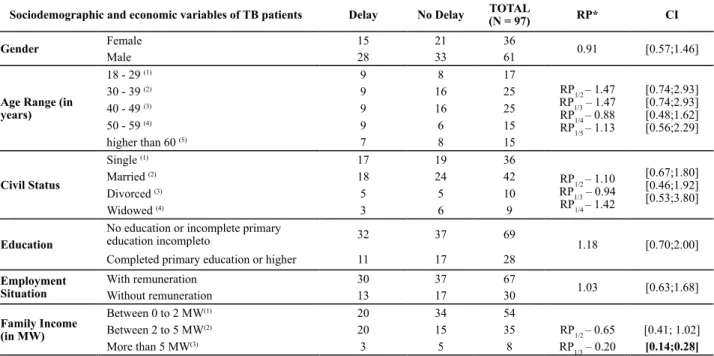
compared to those married and widowed and with lower education. A statistically significant difference was found between family income and delay in seek
-ing care, and the TB patients who had family incomes greater than five minimum wages (MW) had a greater delay (Table 1).
Table 1 – Prevalence ratio of delay in seeking care according to sociodemographic and economic variables of TB patients – São José do Rio Preto, 2009
Sociodemographic and economic variables of TB patients Delay No Delay TOTAL
(N = 97) RP* CI
Gender Female 15 21 36 0.91 [0.57;1.46]
Male 28 33 61
Age Range (in years)
18 - 29 (1) 9 8 17
RP1/2 – 1.47
RP1/3 – 1.47 RP1/4 – 0.88 RP1/5 – 1.13
[0.74;2.93] [0.74;2.93] [0.48;1.62] [0.56;2.29] 30 - 39 (2) 9 16 25
40 - 49 (3) 9 16 25
50 - 59 (4) 9 6 15
higher than 60 (5) 7 8 15
Civil Status
Single (1) 17 19 36
RP1/2 – 1.10
RP1/3 – 0.94
RP1/4 – 1.42
[0.67;1.80] [0.46;1.92] [0.53;3.80] Married (2) 18 24 42
Divorced (3) 5 5 10
Widowed (4) 3 6 9 Education
No education or incomplete primary
education incompleto 32 37 69
1.18 [0.70;2.00]
Completed primary education or higher 11 17 28
Employment Situation
With remuneration 30 37 67
1.03 [0.63;1.68]
Without remuneration 13 17 30
Family Income (in MW)
Between 0 to 2 MW(1) 20 34 54
Between 2 to 5 MW(2) 20 15 35 RP
1/2 – 0.65 [0.41; 1.02]
More than 5 MW(3) 3 5 8 RP
1/3 – 0.20 [0.14;0.28]
*rp1/n equates to prevalence ratio between category 1 in relation to category n, with n ranging from 2 to 5. mW – minimum wage
Table 2 - Prevalence ratio of the delay in seeking care according to clinical variables in TB patients - São José do Rio Preto, 2009
Clinical variables of TB patients Delay No Delay TOTAL(N=97) RP* CI
Clinical Form of TB Pulmonary 36 43 79 1.17 [0.63;2.19]
Extrapulmonary 7 11 18
Type of Cases New Case 39 51 90 0.76 [0.38;1.50]
Recurrence / retreatment 4 3 7
TB/HIV Coinfection Yes 6 11 17 0.76 [0.38;1.51]
No 37 43 80
Perception about TB symptoms
Strong 30 41 71
0.85 [0.53;1.35]
Weak 13 13 26
*rp1/n equates to prevalence ratio between category 1 in relation to category n, with n ranging from 2 to 5.
Table 3 - Prevalence ratio of the delay in seeking care according to behavioral variables of TB patients - São José do Rio Preto, 2009
Behavioral variables of TB patients Delay No Delay TOTAL
(N = 97) RP* CI
Consumed alcoholic beverages Yes 33 38 71 1,21 [0,70;2,09]
No 10 16 26
Tobacco Use Yes 35 24 59 1,19 [0,81;1,74]
No 19 19 38
Envolved in preventive actions before TB
Yes 30 41 71
0,85 [0,53;1,35]
No 13 13 26
Procured health services close to home
Yes 35 40 75
1,28 [0,70;2,35]
No 8 14 22
Knowledge about TB before the diagnosis
Satisfactory 14 16 30
1,08 [0,67;1,73]
Precarious 29 38 67
Initial health service procured when perceived TB symptoms
Basic care (1) 14 15 29
RP1/2 – 1,01 RP1/3 – 1,61
[0,62;1,63] [0,75;3,47]
Urgent care(2) 23 25 48
Paients with pulmonary TB, classiied as recurrent, not coinfected with HIV and with weak symptoms had a greater delay in seeking health services (Table 2).
Those TB paients who reported consuming alcoholic beverages and tobacco, who did not paricipate in pre
-venive health control, who sought health services closer to home before TB and who reported having adequate knowledge about TB delayed more in searching care, es
-pecially those who chose to seek the primary health ser
-vices (Table 3).
DiScUSSion
The prevalence of TB in males in this study pointed to a greater male suscepibility to the disease and relected the lifestyle habits and the ability of women to be more careful with their health than men. In this sense, it was veriied that the presence of the men in the health ser
-vices was predominantly linked to reason for the illness(9),
which reveals the roles assumed socially by men and women and the diferences in expressing and perceiving the need to search for care. Although the male gender as
-sumes greater role in the proile of TB morbidity and mor
-tality, men delayed their search for health care services more than women. About this aspect, diferences exist in the literature showing that the expression of gender is di
-verse within each country: the same result was obtained in India(5); in Colombia, there was no diference in the ime
of seeking care between men and women(10) but, in Tan
-zania(4), by reasons related to cultural aspects incurred in
the absence of autonomy and access to inancial resourc
-es, women delayed to seek TB diagnosis. Another aspect to be considered referred to the predominance of delay among 18-29 years old paients, which revealed the ten
-dency of these individuals support economically the fam
-ily and also the inluence of the health services opening hours in the patern of seeking care behavior(7,11). More
-over, data from the literature have reairmed the higher probability for individuals with advanced age to seek out more doctor visits due to the involvement of chronic and degeneraive illnesses that need more monitoring(12).
However, in this study 50 to 59 years old paients took more ime to seek care and it can be explained by the co
-existence of other diseases that could have masked the TB symptoms, making complex the percepion of the disease. Furthermore, TB symptoms are oten atributed to other diseases related to the respiratory system, contribuing to the worsening of the delay of the clinical diagnosis(7,12-13).
In this study, the delay in seeking care may have been inluenced by the predominance of paients with low educaional levels, which is consistent with other ind
-ings that related grade levels to lack of knowledge and self-perceived health status, and the search for care linked to worsening of the clinical status(4-5,14). The existence of a
possible link between levels of educaion and income is also noteworthy, since there was a greater search for care
among individuals with lower income and more years of schooling(12). Therefore, we do not discard the possibility
of interacion between the characterisics of the proile of paients in the deiniion of ime in searching for the irst consultaion.
In this study, the possibility that TB paients have un
-dervalued the symptoms of the disease corroborated with the severity perceived of the symptoms for the demand for health services(13-15). The fact that one of the irst symp
-toms of pulmonary TB(5) (cough) iniially presented in a
milder manner(7,16) and be considered as a consequence
of smoking(17) could remove the suspicion of TB or other
severe disease among paients, leading them to not feel the need to search care in a health facility. The delay in seeking care among TB paients who consumed alcohol concurs with other studies(5,18) and may be related to poor
percepion about their health, as well as the lack of habit of seeking medical care.
The high frequency of alcoholism and smoking among TB paients and their inluence on outbreaks and aggrava
-ion of the clinical disease(7) raises the necessity of health
professionals quesioning users about these behavioral characterisics and being sensiized about other charac
-terisics related to paient delay in seeking care shown by this study, favoring the suspicion of respiratory symptoms and decreasing the delay in obtaining the diagnosis and iniiaion of treatment among paients.
In São José do Rio Preto, the TB paients failure in search for rouine or prevenive care, as well as the prox
-imity of health services, were not determinants in seek
-ing treatment in less ime among the TB paients, as also found in another study(6), revealing that, ater the percep
-ion of a problem / necessity, the search for care occurs due to the credibility atributed to health services and the bond with the professionals of certain health care services. Thus, the regular use of a service can relect the existence of a gateway to the health system for each new need / problem(19), regardless the geographical distance
between paients’ home and the health service.
In the same way, the fear of a new TB diagnosis, as well as a bad experience and possible dissaisfacion with previously received care may have led paients who were in relapse or retreatment to postpone seeking care. Therefore, evaluaion of paient saisfacion regarding the care ofered in the health services is paramount, since it reveals the way in which the user has received care. If the user is saisied with his atendance, he returns to the ser
-vice because it is a reference for the resoluion of prob
-lems / needs, ensuring longitudinality of care in each new need for perceived health. In order to facilitate the access and the use of health services, intersectoral acions to improve the work organizaion and informaion low be
-tween the diferent levels of care is very important. In ad
There was a quick search for health services among paients with HIV coinfecion, probably because they pos
-sess a bond and already perform constant health checks in a reference service for people living with HIV/aids in the city. Furthermore, these individuals knew their immuno
-suppression status and manifested symptoms of TB more severely. Contrary to this result, the literature reveals greater delay in seeking a diagnosis among coinfected pa
-ients(14), which may be related to fear of being diagnosed
with TB and the presence of signs and symptoms common to both diseases, such as weight loss, which can inluence the percepion of changes in their health.
TB paients who reported having adequate knowledge about the disease had a greater delay in seeking health services. For a beter analysis of this relaionship, we would need to use a more appropriate tool to measure knowledge of TB paients, encompassing aspects of symp
-tomatology, transmission and consequences of late diag
-nosis and treatment.
With regard to the preference of most TB paients for Emergency Care Units, it is emphasized that, in Bra
-zil, there is a policy to encourage the construcion of new units, which contributes to the persistent use of these services. Diicult access, assumpion of inability and lack of conidence in the resoluion of the problem, and in
-existence of vacancies for obtaining care in primary care services are possible causes that can induce the direct de
-mand for the Emergency Care Units, corroboraing with the delay found among paients who sought primary ser
-vices within this study. Such behavior is not conducive to organizaion of the demand and the care of chronic condi
-ions such as TB, since Emergency Care units do not have a role in care coordinaion(7,13,21-22).
In this sense, independent of the type of health care searched, the iniiaive to seek assistance is shown to be strongly linked to the bond, the saisfacion with care pro
-vided, and the conidence in the experience and the ca
-pacity of the health team members(19-20). Seeking care can
occur in more or less ime due to geographical, poliical, economic, social and anthropological reasons from the context of the individual(7,12,15).
Among the limitaions of this study, there was pa
-ient recall bias about the onset and ideniicaion of the symptoms of TB. It is noteworthy that the interviews were made possible through a partnership with the services and support of local health teams in locaing paients and scheduling the interviews.
concLUSion
The late searching behavior for care can be consid
-ered serious from an epidemiological point of view since it provides a greater disseminaion and worsening of the disease.
In this sense, this study contributes to the ideniicaion of a proile of users who delayed seeking care, subsidizing health teams to recognize this and to deine strategies that emphasize the demysiicaion of TB in the community, early self-percepion of disease symptoms, reducing bar
-riers of access to care, and strengthening the bond with health care workers in order to favor the search for care among paients in less ime, making a imely diagnosis.
It is important to highlight that some of the paients characterisics that delayed in seeking care transcend the health sector, making intersectoral operaions imperaive for TB control.
REFEREncES
1. World Health Organizaion (WHO). Global Tuberculosis Con
-trol: surveillance, planning, inancing. Geneva; 2010.
2. Maciel ELN, Golub JE, Peres RL, Hadad DJ, Fávero JL, Molino LP, et al. Delay in diagnosis of pulmonary tuberculosis at a primary health clinic in Vitoria, Brazil. Int J Tuberc Lung Dis. 2010;14(11):1403-10.
3. Sreeramareddy CT, Panduru KV, Menten J, Ende JVD. Time delays in diagnosis of pulmonary tuberculosis: a systemaic review of literature. BMC Infect Dis. 2009;9(1):91-101.
4. Minanga SG, Mutayoba BK, Kahwa A, Kimaro G, Mtandu R, Ngadaya E, et al. The magnitude and factors responsible for delay in tuberculosis management in Dar es salaam, Tanzania. BMC Health Serv Res. 2008;8:158.
5. Rajeswari R, Chandrasekaran V, Suhadev M, Sivasubramani
-am S, Sudha G, Renu G. Factors associated with paient and health system delays in the diagnosis of tuberculosis in South India. Int J tuberc Lung Dis. 2002;6(9):789-95.
6. Monroe AA, Gonzalez RIC, Palha PF, Sassaki CM, Ruino-Neto A, Vendramini SHF, et al. Involvement of health primary care teams in the control of tuberculosis. Rev Esc Enferm USP. 2008;42(2):262-67.
7. Job JRPP, Gozzano JOA, Bernardes Júnior OR, Garcia RH, Mir
-alhes OJC, Miranda MAP. Informações que antecederam o di
440
Rev Esc Enferm USP Delay in seeking initial care for Tuberculosis8. Machado ACFT, Stefen RE, Oxlade O, Menzies D, Kritski A, Tra
-jman A. Fatores associados ao atraso no diagnósico da tuber
-culose pulmonar no estado do Rio de Janeiro. J Bras Pneumol. 2011;37(4):512-20.
9. Gomes R, Nascimento EF, Araújo FC. Por que os homens bus
-cam menos os serviços de saúde do que as mulheres? As ex
-plicações de homens com baixa escolaridade e homens com ensino superior. Cad Saúde Pública. 2007;23(3):565-74.
10. Cáceres-Manrique FM, Orozco-Vargas LC. Demora en el di
-agnósico de tuberculosis pulmonar en una región de Co
-lombia. Rev Salud Pública. 2008;10(1):94-104.
11. Eastwood SV, Hill PC. A gender focused qualitaive study of
barriers to accessing tuberculosis in The Gambia, West Af
-rica. Int J Tuberc Lung Dis. 2004;8(1):70-5.
12. Mendoza-Sassi R, Béria JU, Barros AJD. Outpaient health service uilizaion and associated factors: a populaion-based study. Rev Saúde Pública. 2003;37(3):372-78.
13. Maior ML, Guerra RL, Cailleaux-Cezar M, Conde MB. Tempo entre o início dos sintomas e o tratamento de tuberculose pulmonar em um município com elevada incidência da doença. J Bras Pneumol. 2012;38(2):202-9.
14. Mesin MM, Newell JN, Walley JD, Gessessew A, Madeley
RJ. Delayed consultaion among pulmonary tuberculosis pa
-ients: a cross secional study of 10 DOTS districts of Ethio
-pia. BMC Public Health. 2009;9:53.
15. Mendoza-Sassi R, Béria JU, Fiori N, Bortoloto A. Prevalência de sinais e sintomas, fatores sociodemográicos associados e aitude frente aos sintomas em um centro urbano no Sul do Brasil. Rev Panam Salud Pública. 2006;20(1):22-8.
16. Nogueira JA, Ruino Neto A, Monroe AA, Gonzales RIC,
Villa TCS. Busca aiva de sintomáicos respiratórios no con
-trole da tuberculose na percepção do agente de saúde. Rev Eletr Enferm [Internet] 2007[ citado 2011 ago. 19];9(1):106-18. Disponível em: htp://www.fen.ufg.br/revista/v9/n1/ v9n1a08.htm
17. Basnet R, Hinderaker SG, Enarson D, Malla P, Morkve O. Delay in the diagnosis of tuberculosis in Nepal. BMC Public Health. 2006;9:236-45.
18. Van Der Werf MJ, Chechulin Y, Yegorova OB, Marcinuk T,
Stopolyanskiy A, Voloschuk V, et al. Health care seeking be
-haviour for tuberculosis symptoms in Kiev City, Ukraine. Int J Tuberc Lung Dis. 2006;10(4):390-5.
19. Ramos DD, Lima MADS. Acesso e acolhimento aos usuários em uma unidade de saúde de Porto Alegre, Rio Grande do Sul, Brasil. Cad Saúde Pública. 2003;19(1):27-34.
20. Ponce MAZ, Vendramini SHF, Santos MR, Santos MLSG,
Scatena LM, Villa TCS. Vínculo proissional/doente no trata
-mento da tuberculose: desempenho da atenção básica em município do interior paulista. Rev Laino Am Enferm. 2011;19(5):1222-9.
21. Oliveira LH, Matos RA, Souza AIS. Cidadãos peregrinos: os “usuários” do SUS e os signiicados de sua demanda a prontos-socorros e hospitais no contexto de um processo de reorientação do modelo assistencial. Ciênc Saúde Coleiva. 2009;14(5): 1929-38.
22. Marques GQ, Lima MAD. Demandas de usuários a um ser
-viço de pronto atendimento e seu acolhimento ao sistema de saúde. Rev Laino Am Enferm. 2007;15(1):13-9.
Acknowledgements
Aline Ale Beraldo, Profª Drª Aline Aparecida Monroe, Gabriela Tavares Magnabosco, Profª Drª Lucia Marina Scatena, Profª Drª Maria de Lourdes Sperli Geraldes Santos, Maria Eugênia Firmino Brune, Reinaldo Antônio da Silva
Sobrinho, Drª Maria Rita de Cássia Oliveira Cury, Tiemi Arakawa.