RESUmo
O presente estudo analisou a relação entre percepção de estresse, sintomas
depres-sivos e autoesima em idosos com e sem queixa subjeiva de compromeimento
de memória. Foram incluídos 204 idosos (104 sem e 100 com queixa de memória)
avaliados a parir do instrumento Memory
Assessment Complain Quesionnaire (MAC--Q). O protocolo de estudo incluiu a Escala de Estresse Percebido (EEP), a Escala de De-pressão Geriátrica (GDS) e a Escala de
Auto-esima de Rosenberg (EAE). Os idosos com queixa de compromeimento apresentaram escores signiicaivamente maiores na EEP e
GDS e menores na EAE (p < 0.001). Foi
ob-servada correlação negaiva entre o escore
do MAC-Q e EPP (p < 0.001) e EAE (p = 0.01).
A análise de regressão mulivariada idenii -cou somente o estresse como fator preditor
da queixa subjeiva de memória. Esses da
-dos sugerem que a percepção de estresse
e os sintomas depressivos estão associados com a queixa de memória em idosos.
dEScRitoRES
Idoso
Envelhecimento
Estresse psicológico
Memória
Subjective memory complain in healthy elderly:
influence of depressive symptoms, perceived
stress and self-esteem
O
riginal
a
r
ticle
AbStRAct
The current study analyzed the relaionship
between perceived stress, depressive symptoms and self-esteem in elderly with
and without subjecive memory complain.
Two-hundred four elderly were included
(104 without and 100 with subjecive memory complain) assesse using the
Me-mory Assessment Complain Quesionnaire
(MAC-Q). The study protocol was compo-sed by the Perceived Stress Scale (PSS), the Geriatric Depression Scale (GDS) and
the Self-Esteem Scale of Rosenberg (SES). The elderly with subjecive memory com
-plain showed higher PSS and GDS scores (p
< 0.001) and lower SES scores (p = 0.045).
Negaive correlaion was observed betwe -en MAC-Q and PSS (p < 0.001) and GDS (p =
0.01). Muliple regression analysis showed predictor efect of perceived stress in the subjecive memory complain. These in
-dings suggest that the perceived stress and
depressive symptoms are associated with
subjecive memory complain in elderly.
dEScRiPtoRS Aged
Aging
Stress, psychological
Memory
RESUmEn
La presente invesigación analizó la cor -relación entre estrés percibido, síntomas
depresivos y autoesima en ancianos con y sin queja subjeiva de memoria. Fueron
incluidos 204 ancianos (104 sin y 100 con
queja subjeiva de memoria) evaluados ui -lizando el instrumento Memory Assessment
Complain Quesionnaire (MAC-Q). El pro-cedimiento del estudio incluyó la Escala de Estrés (EEP), Escala de Depresión Geriátrica
(GDS) y la Escala de Autoesima de Rosen
-berg (EAE). Los ancianos con queja subjeiva de memoria presentaron puntuaciones sig
-niicaivamente mayores en la EEP y GDS y
menores en la EAE (p < 0,001). Fue
observa-da correlación negaiva entre la puntuación
de MAC-Q e EEP (p< 0,001) y EAE (p = 0,01).
Modelo de regresión múliple ideniicó solo el estrés como factor predicivo de que
-ja subjeiva de memoria. Estos resultados sugieren que la percepción del estrés y los
síntomas depresivos están correlacionados con la queja de memoria en ancianos.
dEScRiPtoRES
Anciano Envejecimiento
Estrés psicológico
Memoria
Aline talita dos Santos1, Deyse Demarco Leyendecker2, Ana Lucia Siqueira Costa3,
Juliana nery de Souza-talarico4
Queixa subjetiva de comprometimento da memória em idosos saudáveis: influência de sintomas depressivos, percepção de estresse e autoestima
Queja subjetiva de memória em ancianos sanos: influencia de sintomas depresivos, percepción de estrÉs Y autoestima
intRodUction
The tradiional, negaive concepion of the aging pro -cess is characterized by the progressive decline and dei -cit of abiliies of the human body. This understanding has been deconstructed lately. Emerging evidence point out that the well-being and the posiive percepion of the pro -cess stand out as relevant protecive factors against the aging efects and the way the human system funcions(1).
The aging process is approached under muliple per -specives. This heterogeneity has drawn the atenion of several researchers, who have atempted to idenify even -tual factors that may compromise it. The absence of com-plaints about memory deicits, together with the mainte -nance of the cogniive performance, has been considered as one of the successful aging indicators(1). However,
al-though a signiicant number of elderly individuals does not present an objecive deicit of memory that can be docu -mented by neuropsychological tests, they very oten com -plain about their mnemonic development in aciviies of daily living. These individuals comprise a relevant invesi -gaive group, as the subjecive memory mal
-funcion complaint is capable of anicipaing possible demenia processes(2). Elderly
indi-viduals who enjoy a normal cogniive perfor -mance, and yet subjecively complain about memory deicit, may develop Alzheimer’s disease two years following a clinical follow-up(3). These data reveal the importance of
this group toward idenifying individuals who may be vulnerable to demenia.
The explanaions regarding subjecive memory complaints in the absence of iden-iied mnemonic deicit evidenced by neu -ropsychological tests remain considerably
inconclusive. Some authors airm that subjecive memory complaints is more associated with a depressive seing, or even to personality traits, rather than to a real deicit of memory(4-6). Others, on their turn, counterclaim that in spite of the correlaion a complaint may have with emo -ional factors, it should not be merely treated as an emo -ional manifestaion, but as a subclinical deicit whose slight alteraions on convenional neuropsychological tests are not sensiive enough for its ideniicaion(7).
Whether or not a mere complaint evolves to a cogni -ive deicit, the possibility of idenifying the factors relat -ed to the percepion of elderly individuals with impair-ed memory should be taken into account, as a complaint rep-resents a dissaisfacion towards their abiliies. This sta -tus in itself is capable of damaging the well-being and the quality of life of these individuals.
One of the not least studied factors about subjec-ive memory complaints in elderly individuals is stress. Although the associaion between memory deicit and higher stress levels - more speciically increased stress
hormones - is extensively covered in literature(8-9), its
manifestaion in elderly individuals who present this com -plaint is very scarce. A speciic literature research pre -sented only one study aimed to analyze the relaionship between corisol (major stress hormone) and subjecive memory complaints in individuals. The study also ideni -ied that elderly individuals who presented memory dei -cits complaints had atypical corisol secreion standards throughout the day(10). Hence, the invesigaion of stress should encompass both the components of its behavioral nature and its own percepion. The isolated analysis of neuroendocrine variaions does not necessarily relect on the individual’s percepion of being stressed.
The use of a psychodynamic acion, such as therapeu -ic commun-icaion (guide, inform, support, comfort or meet the paient’s basic needs), is one of the tools nurses have available in the care protocol. This tool can be em-ployed against chronic stress, a prevalent feature in aged populaions(11). In this way, the ideniicaion of groups of
individuals vulnerable to stress can ground future invesi -gaions on the inluence of management acions toward the development and maintenance of the cogniive abiliies of elderly individuals.
In the light of these consideraions, this present study aimed to analyze the correla-ion between stress percepcorrela-ion and emo -ional factors - depressive symptoms and self-esteem - in elderly individuals with and without memory deicit complaints. Our hypothesis is that elderly individuals with memory complaints present greater stress percepion, more depressive symptoms and lower self-esteem.
mEtHod
Place and period
This study was performed at the Medical Outpaient Clinic of the University of São Paulo University Hospital (USP-UH), where elderly individuals received periodical follow-up for the treatment and control of arterial hyper-tension, between January and November 2011.
Paricipants
Inclusion criteria were as follows: age between 60 and 82 years; men and women; preserved cogniive funcions and funcional capaciies; lack of diagnosis of any neuro -logic, neurodegeneraive or psychiatric disease; literate pa -ients; living in the São Paulo Metro Area; registered clients of the USP-UH Medical Outpaient Clinic; and no record in psychiatric clinic or unit other than the medical outpaient clinic. Exclusion criteria were: admitance reports in the six month-period prior to the study; illiterate or presening any sensory impairments (as these factors would render the applicaion of the instruments impossible).
elderly individuals who enjoy a normal cognitive performance,
and yet subjectively complain about memory deicit, may develop alzheimer’s disease two years following a clinical
Paricipants were randomly selected from the elec -tronic databank of the UH-USP Medical Outpaient Clinic, thus producing a databank with 1,902 individuals. In order to obtain a minimum sample of 200 paients, in compli -ance with the previously calculated sample size(18), the
Ex-cel® Program employed by the study randomly selected 408 paients, who were then invited by phone to take part in the research: 126 paients refused to paricipate; 46 pa -ients did not meet the inclusion criteria; 9 pa-ients did not show up. The remaining 229 paients were assessed: 5 were excluded, as their scores were lower than the mini-mum score determined the Mini Mental State Examina-ion (MMSE) addressing the educaExamina-ion variable(12); 20
pa-ients were excluded for presening scores higher than the minimum score set by the Geriatric Depression Scale(13).
Thus, the inal sample consisted of 204 elderly individuals. Procedure and instruments
A data collecion protocol composed of the following assessment instruments was elaborated for:
• Depression symptoms: this brief version of the Ge-riatric Depression Scale (GDS)(13) is comprised of 15 items related to the presence of depressive mood, anhedonia, atenion diiculies, sleep disorders, eaing disorders, slowed thinking, agitaion, feelings of uselessness, and suicidal ideas. The quesions present only two possible alternaives (yes = 1 score; no = 0). Scores range from 0 through 15. Scores ≥ 6 suggest depressive disorders.
• Stress percepion: The Perceived Stress Scale (PSS) (14) is comprised of 14 quesions intended to check out how much unpredictable, uncontrollable and overloaded re-spondents perceive their lives are. Each item presents al-ternaives ranging from zero through four (0 = never; 1 = al -most never; 2 = someimes; 3 = al-most always; 4 = always). The scores of the quesions with posiive connotaions (4, 5, 6, 7, 9, 10 and 13) are reversely summed up (0 = 4; 1 = 3; 2 = 2; 3 = 1; and 4 = 0); remaining items present negaive connotaion and are directly summed up. The total value of the scale is comprehended by the sum of scores related to all 14 quesions; scores may range from zero through 56.
• Self-esteem: The Rosenberg’s Self-Esteem Scale (RSES)(15) is comprised of ten closed-end quesions; an
-swer choices are as follows: totally agree; agree; disagree; totally disagree. Each item score ranges from 1 to 4. The higher the score, the higher the self-esteem level.
• Subjecive memory complaints (SMC): The Memory Complaint Quesionnaire (MAC-Q)(16-17) is composed of 6
quesions related to the funcion of the memory in acivi -ies of daily living. The total score ranges from 7 to 35; the higher the score, the more intense is the memory-related complaint. Scores ≥ 25 indicate age-related memory deicit.
All subjects were submited to the data collecion protocol only once and divided in two groups, according to the memory complaint: without SMC (score < 25) and with SMC (score ≥ 25).
The study was approved by the Research Ethics Com -mitee of the University of São Paulo School of Nursing
(CEP-EEUSP 994/2010) and the Research Ethics Commit -tee of the University of São Paulo University Hospital (CEP-HU/USP 1130/11). All paricipants signed the Free and Informed Consent Form.
Staisical analysis
All data were analyzed in accordance with their nor-mal distribuion. In order to test the diference hypothesis between the groups (with SMC versus without SMC), the study applied the t-Student and the MannWhitney tests aiming to compare social-demographic variables (age, educaion and income), overall cogniive performance (MMSE scores), and the GDS, PSS and RSES scores. For the analysis of the associaion between emoional fac -tors (depression, stress and self-esteem) and the memory deicit subjecive complaint, the study employed the Pear -son’s correlaion coeicient and the mulivariate regres -sion analysis. The mulivariate regres-sion model was run in the stepwise mode (p > 0.1 for removal). Scores based on the addressed emoional factors were considered in -dependent variables and MAC-Q scores were considered as dependent variables. The analyses were carried out by means of the SPSS staisical sotware version 14, and the adopted signiicance level was 5%.
RESULTS
Social-demographic characterizaion and overall cognii -ve performance
Considering the 204 paricipants, 104 presented MAC-Q scores < 25, and were therefore classiied as without SMC; the remaining 100 paricipants presented scores ≥ 25 and were consequently classiied as with SMC. Both groups were predominantly comprised of female parici -pants: 80 (83.2%) elderly individuals in the group without SMC and 76 (76.0%) in the group with SMC (p = 0.877). Both groups also displayed similar sociodemographic characterisics concerning mean age, educaion and in -come (p ≥ 0.144) (Table 1).
No signiicant diference was observed in the MMSE performance between the groups without SMC (mean= 27.7 ± 1.4) and with SMC (average = 27.8 ± 1.6; p = 0.846).
Table 1 – Social-demographic characterization of the groups -
São Paulo, 2011
Without SMC (n =104) mean (±SD*)
With SMC (n =100)
mean (±SD*) p – value**
Age (years) 68.3 ± 6.9 67.4 ± 5.7 0.366
Education (years) 9.4 ± 4.6 8.5 ± 4.4 0.144
Family income (R$) 1.911.2 ± 1.142.4 1.938.4 ± 1.242.6 0.871
* sd = standard deviation ** t-student test
* p < 0.05. bars indicate standard error. t-student test. the mann-Whitney test was applied to the rses.
Figure 1 – Averages among scores obtained in the
depressi-ve symptoms (GDS), stress perception (PSS) and self-esteem (RSES) instruments in complainers and non-complainers about
memory deicit - São Paulo, 2011.
Associaion between Subjecive Memory Complaint and emoional factors
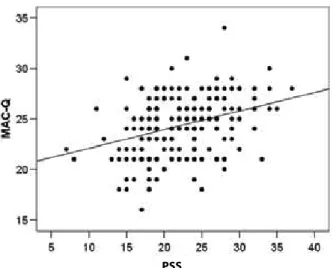
A signiicant posiive correlaion was found between the MAC-Q and GDS scores (r = 0.238; p = 0.001) and PSS (r = 0.321; p < 0.001). The more intense the memory dei -cit complaint, the clearer the depression symptoms and stress percepion. The mulivariate regression analysis model, having the MAC-Q scores as dependent variable and the GDS and PSS scores as independent variables, showed a predicive efect of stress regarding the intensity of the memory deicit complaint (β = 0.321; p < 0.001). El -derly individuals with higher stress levels presented more intense memory deicit complaints (Figure 2).
Figure 2 – Positive correlation between stress perception and
subjective memory deicit complaint - São Paulo, 2011
diScUSSion
The present study found a staisically signiicant cor -relaion between SMC and emoional factors (depressive symptoms, stress percepion and self-esteem) in a sample comprised of 204 healthy elderly individuals. This result corroborates other indings from previous works, in which factors such as anxiety and depression are associated with more intense memory deicit complaints(4-6,18).
A relevant inding of this research, however, was the existence of a signiicant associaion between stress per -cepion and subjecive memory deicit complaint. Elderly individuals with SMC showed higher scores in the per -ceived stress instrument compared to elderly individuals without SMC. Addiionally, the study also veriied that the higher the stress level, the higher the SMC. These indings are quite important, as several studies indicate higher con -centraions of corisol and lower memory performance in healthy elderly individuals and individuals with pathologic cogniive deicit(8,19-20).
Healthy elderly individuals displaying increased cori -sol concentraions throughout a six year-period presented memory performance reducion. On the other hand, el -derly individuals who presented stable levels of corisol showed stable performance throughout the ime(9).
Fur-thermore, elderly individuals diagnosed with the Alzheim -er’s disease and who presented higher concentraions of corisol rapidly evolved to advanced stages of the disease comparing with paients showing lower concentraions of the hormone(20). Taking into account the evidence that the
stress level is capable of decreasing memory performanc -es, the inding of this present study points out that the stress reported by the paricipants with memory deicit complaint can contribute to worsen performance due to the efects resulted from the prolonged exposure to cori -sol. Overstressed elderly individuals may present memory deicit in their daily life, and therefore are likely to com -plain more frequently, even when neuropsychological test results do not detect any degree of deicit.
Hence, stress might be ideniied as one of the factors associated with the gradual memory deicit process seen in elderly individuals. The study shows that the predicive efect of stress in the intensity of the memory deicit com -plaint stands for such interpretaion. On the other hand, the posiive correlaion of data allows for another pos -sible interpretaion: the greater the memory deicit, the higher the stress. In other words, the memory funcion -ing percepion may be a stress-related factor guided by the fear of developing demenia. These individuals would then feel overstressed. This interpretaion is endorsed by a study in which elderly individuals presening light cog -niive deicit and higher concentraions of corisol also displayed higher percepion of stress and more frequent memory deicit complaints(21). These authors believe that
the memory deicit percepion in some elderly individuals may consitute a stressing factor capable of unleash high -0
5 10 15 20 25 30 35
Gd s pss rses
without smc
*
*
*
escor
e
with smc
er volumes of corisol and increase stress percepion com -pared with other elderly individuals who do not present such percepion in their daily aciviies(21).
Notwithstand-ing, although these indings may support the invesigaion of such associaion in longitudinal studies, no cause-efect correlaion can be sustained, as these are considered to be cross-secional studies.
Addiionally, this study has also revealed that elderly individuals with subjecive memory deicit complaints dis -played more depression symptoms and lower self-esteem than elderly individuals without SMC. Literature interpre-taions on the correlaion between SMC and emoional factors or personality traits remain considerably inconclu-sive. Some authors argue that the memory deicit com -plaint is in fact associated with a downgrade of the mem -ory due to a subclinical stage of depression; in this case, the complaint would be secondary to depression(4). Other authors defend the fact that such complaint is much more associated with the afecive status of individuals or their personality traits than with a real cogniive deicit(6). More
afecively depressed individuals who usually refer to neg -aive feelings concerning their abiliies are more likely to report memory funcioning diiculies on their daily ac -iviies(22).
Although the present study has shown a clear correla -ion between depressive symptoms and SMC, the muli -variate regression analysis did not show a predicive pow -er of depressive symptoms and self-esteem levels in SMC, suggesing that these factors do not inluence the inten -sity of the complaint. Some studies reveal that the Major Depressive Disorder is associated with the worst level of cogniive performance and more intense complaints con -cerning memory performances(5). Nevertheless, the
pres-ent indings showed that the observed correlaions did
not display any tendency toward depression, as elderly in-dividuals who presented medical diagnosis for depression or scores that suggested depression in the GDS scale were not included in the analysis.
Although the stress, the depressive symptoms and the self-esteem were found to be either the cause or the ef-fect of memory performance complaints, and regardless the evolvement of the damage toward a demenia status or otherwise, persistent complaints about the malfunc-ion of the memory can compromise both the well-being of the aged person and the quality of his aging process. In the nursing ield, this evidence opens way to the need of taking memory deicit complaints into account in clini -cal or care-based assessments, as elderly individuals with SMC may present higher stress levels and become more vulnerable to the development of stress-related diseases.
Although the present study has allowed for some in -terpretaions, longitudinal studies including neuroendo -crine stress markers, as well as cogniive assessments, may complement achieved evidence.
CONCLUSION
The indings of this present study showed a signiicant associaion between SMC, stress percepion, depressive symptoms and self-esteem. Elderly individuals who pre-sented SMC showed up higher stress levels, more depres -sive symptoms and lower self-esteem in comparison with elderly individuals without SMC. However, the stress vari-able was the only one to show a predicive efect in the presence of SMC, suggesing that daily stressing factors can contribute to increase the amount of memory deicit complaints.
REFEREncES
1. Lupien SJ, Wan N. Successful ageing: from cell to self. Philos
Trans R Soc Lond B Biol Sci. 2004;359(1449)1413-26.
2. Dik MG, Jonker C, Comijs HC, Bouter LM, Twisk JWR, Van Kamp GJ, et al. Memory complaints and APOE-epsilon4
accel-erate cogniive decline in cogniive normal elderly. Neurology.
2001;57(12):2217-22.
3. Jonker C, Geerlings MI, Schmand B. Are memory complaints
predicive for demenia? A review of clinical and populaion
based studies. Int J Geriatr Psychiatry. 2000;15(11):983-91.
4. Bolla KI, Lindgren KN, Bonaccorsy C, Bleecker ML. Memory com
-plaints in older adults. Fact or icion? Arch Neurol. 1991;48(1):61-4.
5. Grut M, Jorm AF, Fraiglioni L, Forsell Y, Viitanen M, Winblad
B. Memory complaints of elderly people in a populaion sur
-vey: variaion according to demenia stage and depression. J
Am Geriatr Soc. 1993;41(12):1295-300.
6. Hanninen T, Reinikainen KJ, Helkala EL, Koivisto K, Mykkänen
L, Laakso M, et al. Subjecive memory complaints and per -sonality traits in normal elderly subjects. J Am Geriatr Soc. 1994;42(1):1-4.
7. Schmand B, Jonker C, Geerlings MI, Lindeboom J. Subjecive memory complaints in the elderly: depressive symptoms and
future demenia. Br J Psychiatry. 1997;171: 373-6.
8. Lupien SJ, De Leon M, De Sani S, Convit A, Tarshish C, Nair
NPV, et al. Corisol levels during human aging predict hip
-pocampal atrophy and memory deicits. Nat Neurosci.
1998;1(1):69-73.
9. Lupien SJ, Lecours AR, Schwartz G, Sharma S, Meaney MJ,
Nair NPV. Longitudinal study of basal corisol levels in healthy elderly subjects: evidence for subgroups. Neurobiol Aging.
10. Fiocco AJ, Wan N, Weekes N, Pim H, Lupien SJ. Diurnal
cy-cle of salivary corisol in older adult men and women with subjecive complaints of memory deicits and/or depres
-sive symptoms: relaion to cogniive funcioning. Stress.
2006;9(3):143-52.
11. Souza-Talarico JN, Caramelli P, Nitrini R, Chaves EC. Stress
symptoms and coping strategies in healthy elderly subjects. Rev Esc Enf USP 2009;43(4):801-7. htp://www.scielo.br/
pdf/reeusp/v43n4/en_a10v43n4.pdf
12. Brucki SMD, Nitrini R, Caramelli P, Bertolucci PH. Okamoto
IH. Sugestões para o uso do Mini-Exame do Estado Mental no Brasil. Arq Neuro Psiquiatr. 2003;61(3B):777-81.
13. Almeida OP, Almeida SA. Coniabilidade da versão brasileira da Escala de Depressão em Geriatria (GDS) versão reduzida.
Arq Neuropsiquiatr. 1999;57(2B):421-6.
14. Lut CDB, Sanches SO, Mazo GZ, Andrade A. Versão brasileira da escala de estresse percebido: tradução e validação para
idosos. Rev Saúde Pública. 2007;41(4):606-15.
15. Avanci JQ, Assis SG, Santos NC, Oliveira RVC. Adaptação
transcultural da Escala de Auto-Esima para adolescentes. Psicol Relex Crit. 2007;20(3):397-405.
16. Crook TH 3rd, Feher EP, Larrabee GJ. Assessment of memory
complaint in age-associated memory impairment: the MAC-Q. Int Psychogeriatr. 1992;4(2):165-75.
17. Matos P, Lino V, Rizo L, Alfano A, Araújo C, Raggio R. Mem -ory complaints and test performance in healthy elderly per-sons. Arq Neuropsiquiatr. 2003;61(4):920-4.
18. Paulo DLV, Yassuda MS. Queixas de memória de idosos e
sua relação com escolaridade, desempenho cogniivo e sintomas de depressão e ansiedade. Rev Psiquiatr Clin.
2010;37(1):23-6.
19. Souza-Talarico JN, Chaves EC, Lupien SJ, Nitrini R, Caramelli
P. Relaionship between corisol levels and memory perfor -mance may be modulated by the presence or absence of
cogniive impairment: evidence from healthy elderly, mild cogniive impairment and Alzheimer’s disease subjects. J Al -zheimers Dis. 2010;19(3):839-48.
20. Csernansky JG, Dong H, Fagan AM, Wang L, Xiong C, Holtz-
Man DM, et al. Plasma corisol and progression of de
-menia in subjects with Alzheimer-Type. Am J Psychiatry.
2006;163(12):2164-9.
21. Souza-Talarico JN, Chaves EC, Nitrini R, Caramelli P. Chronic
stress is associated with high corisol levels and emoional coping mechanisms in amnesic mild cogniive impairment. Dement Geriatr Cogn Disord. 2009;28(5):465-70.
22. Comijs HC, Deeg DJ, Dik MG, Twisk JW, Jonker C. Memory
complaints; the associaion with psycho-afecive and health problems and the role of personality characterisics: a 6-year follow-up study. J Afect Disord. 2002;72(2):157-65.