The front door of the Ribeirão Preto Health
System for diagnosing tuberculosis
*O
riginal
a
r
ticle
A portA de entrAdA pArA o diAgnóstico dA tuberculose no sistemA de sAúde de ribeirão preto/sp
puertA de entrAdA pArA el diAgnóstico de tuberculosis en el sistemA de sAlud de ribeirão
* derived from the thesis “Acesso ao diagnóstico de tuberculose nos serviços de saúde do município de ribeirão preto – sp (2006-2007)”, school of nursing of ribeirão preto, university of são paulo, 2009. 1 phd of the public Health nursing post-graduate program of the school of nursing of ribeirão preto, university of são paulo. ribeirão preto, sp, brazil. [email protected] 2 ph.d. professor of the maternal-infant and public Health department of the school of nursing of ribeirão preto, university of são paulo. ribeirão preto, sp, brazil. [email protected] 3 Full professor of the department of social medicine
of the Faculty of Medicine of Ribeirao Preto, University of São Paulo. Ribeirão Preto, SP, Brazil. [email protected] 4 Adjunct professor of the triangulo mineiro Federal university. uberaba, mg, brazil. [email protected] 5 Associate professor of the school of nursing of ribeirao preto, university of são
RESUmo
O primeiro contato do doente de tuberculose (TB) com o sistema de saúde se dá na porta de entrada, e é fundamental para o acesso ao diagnósico. Objeivou-se ideniicar e anali-sar a porta de entrada no sistema de saúde de Ribeirão Preto para o diagnósico da TB. Baseou-se em um instrumento do Primary Care Assessment Tool, adaptado para a TB no Brasil. Realizou-se entrevista estruturada com 100 doentes de TB diagnosicados entre Junho de 2006 e Julho de 2007. Destes, 61% chegaram ao local de diagnósico por enca-minhamento e apenas 29% se apresentaram espontaneamente; 66% procuraram por ser-viços de atenção primária, 34% por serser-viços de nível secundário e terciário. Ademais, 89% foram diagnosicados em serviços públicos e destes, 44% foram diagnosicados nos pron-to-atendimentos. Além disso, 88% foram diagnosicados fora de sua área de abran-gência. Apesar dos doentes terem procura-do atendimento na atenção primária e mais próximo de suas residências, o diagnósico se deu na atenção secundária e terciária.
dEScRiToRES Tuberculose Diagnósico
Acesso aos Serviços de Saúde Atenção Primária à Saúde Enfermagem em saúde pública AbSTRAcT
The irst contact of TB (tuberculosis) pa-ients with the health system occurs at the front door and is essenial to access to di-agnosis. The objecive of this study was to idenify and analyze paients’ irst contact with the health system for TB diagnosis in Ribeirão Preto. The study was based on an instrument of the Primary Care Assessment Tool, adapted for TB care in Brazil. Struc-ture interviews were conducted with 100 TB paients diagnosed between June 2006 and July 2007. Of all paients, 61% were re-ferred to the diagnosis place and only 29% sought the service spontaneously; 66% sought for primary care services, and 34% for secondary and teriary services. Public services diagnosed 89% of all cases, 44% of which were diagnosed in emergency services. A total 88% of paients were not from the area covered by the service. Al-though paients have sought for primary care services, close to their houses, the di-agnosis occurred in secondary and teriary health care.
dEScRiPToRS Tuberculosis Diagnosis
Health Services Accessibility Primary Health Care Public health nursing
RESUmEn
El primer contacto del enfermo de tubercu -losis (TB) con el sistema de salud acontece en la puerta de entrada y es fundamental para acceder al diagnósico. Se objeivó ideniicar y analizar la entrada al sistema de salud de Ribeirão Preto para diagnósico de TB. Se usó un instrumento del Primary Care Assessment Tool, adaptado para TB en Brasil. Se realizó entrevista estructura-da con 100 pacientes de TB diagnosica-dos entre junio/2006 y julio/2007. 61% de los enfermos llegó al lugar de diagnósico por derivación, apenas 29% se presentó espontáneamente. 66% solicitó servicios primarios, 34% procuraron servicios secun-darios y terciarios. 89% fue diagnosicado en servicios públicos, de ellos, 44% fue diagnosicado en los servicios de urgencia. 88% fue diagnosicado fuera del área ur-bana correspondiente. A pesar de que los enfermos buscaron atención en el servicio de urgencias más próximo a sus domicilios, el diagnósico se dio en atención secunda-ria y terciasecunda-ria.
dEScRiPToRES Tuberculosis Diagnósico
Accesibilidad a los Servicios de Salud Atención Primaria de Salud Enfermería em salud pública
mayra Fernanda de oliveira1, Ricardo Alexandre Arcêncio2, Antonio Rufino-Netto3, Lúcia marina
inTRodUcTion
Tuberculosis represents a major health problem in developing countries(1). Brazil occupies the 18th place,
re-garding incidence of the disease, among the 22 countries
responsible for 80% of the global tuberculosis burden. The country has 92,000 new TB cases per year, with an inci-dence of 48 cases per 100,000 inhabitants and a preva-lence of 60 cases per 100,000 inhabitants. Infecious cases reach 49,000 per year, muli-drug resistant strains repre-sent 0.9% of the cases and the number of deaths from the disease is 8.4 thousand per year, represening a mortality rate of 4.4 per 100,000 people(2). The report by the World Health Organizaion (WHO) notes that, in 2007, Brazil presented a case detecion rate of 78%, within the estab-lished target, however, the cure rate of acive tuberculo-sis was 73%, below the assigned target(2). The cure rate of TB is closely linked to the delay in the diagnosis of the cases of the disease. Some ime ago the WHO indicated
that the problem persists not because of the forms of di -agnosis and treatment of the disease, but because of the
way the health services are organized to detect and treat
TB cases(3). The increase in the delay in the
performance of the diagnosic test and inii-aion of the treatment leads to an increased risk of disease transmission, especially in urban environments, and this condiion of the healthcare services reduces the chance of a cure for the TB paient. Factors related to the paient and the health services can contribute to this delay in the performance of the TB diagnosis and many of these are interlinked to the organizaion of the health services, whether public or private(4-5). Stud-ies carried out in diferent places such as Shanghai, Spain, Hong Kong and Brazil have
shown that some of these factors are related to the kind of health service sought by the TB paient, the type of ser-vice that performs the diagnosis and the diagnosic tools employed by the healthcare service (4,6).
The theoreical framework that guided the discussions of this study was the Primary Healthcare (PHC) and one of its atributes, the Point of Entry proposed by Starield(7). According to the author PHC can be deined as the level of care of the health system that funcions as Point of Entry for all the health needs of the people. Primary healthcare addresses the most common problems of the community, ofering services of promoion, prevenion, cure and re-habilitaion. It is responsible for coordinaing, organizing and raionalizing the use of all resources, both basic and specialized, aimed at the promoion, maintenance and improvement of health(7).
The irst contact of the TB paient with the health system is crucial to ensure access to the disease diagnosis, with this occurring at the point of entry of the system. Although the concept of the point of entry is not clearly deined, it is
com-prehended as the place or the professional being sought as a
irst point of care for each new health problem perceived, it is the site of irst contact within the health system(7). In Brazil the Naional Policy of Primary Health Care (NPPHC) estab-lished that the Primary Healthcare (PHC) services, represent-ed by the Basic Health Units (BHUs) and the Family Health Units (FHUs) should assume this funcion(8).
The present study aimed to analyze the point of entry of the TB paient in the access to the diagnosis in the mu-nicipality of Ribeirão Preto - SP.
obJEcTiVE
To idenify and analyze the point of entry into the health system of Ribeirão Preto for the diagnosis of TB.
mETHod
This study is part of the mulicenter project Evaluaion of the organizaional dimensions and performance of the primary healthcare services in tuberculosis control in re
-gions of Brazil and is a prospecive epidemio-logical survey. It was developed between July
and August 2007 in Ribeirão Preto, a munici
-pality with 547,417 inhabitants, 189 new TB cases in the year, and an incidence coeicient of 34.5 cases per 100,000 inhabitants. The cure rate was 78.7% and Directly Observed Therapy coverage reached 77.7%. The TB Control Program (TCP) is developed in ive health districts (North, South, East, West and Central), with permanent, but not exclusive teams. The diagnosis of TB can be accom-plished at any care point of the municipality and other TB control acions (medical and nursing consul-taions, monitoring of the case, distribuion of medicaion, control of transmiters and DOT) are performed by the TCP. During the period of data collecion, 133 paients were in treatment. A convenience sample was selected of 100 paients, over 18 years of age, residing in the municipal-ity, and not in the prison system. The research was con-ducted on the basis of the adaptaion of a component instrument of the Primary Care Assessment Tool (PCAT), developed and validated to assess the criical aspects of primary healthcare(7). This instrument was adapted and validated for Primary Healthcare in Brazil(9) and adapted
for TB care(10). Seven variables were used, related to the point of entry of the TB paient into the health system, namely: manner of presentaion at diagnosis, frequency of demand for primary healthcare service before the di-agnosis; demand for emergency unit/hospital before the
diagnosis; demand for the health unit near to the resi
-dence; demand for the public or private health service; type of health service where the diagnosis was performed ; diagnosis performed within or outside the catchment
The irst contact of the
tuberculosis patient with the health system
is crucial to ensure access to the disease
area. The instrument was divided into two parts, with the irst part containing socio-demographic informaion and the addresses of the paients and the second part having quesions related to the point of entry. Data from the irst part of the instrument were collected from the TB infor-maion system TB-WEB and to collect the data from the second part, interviews were conducted with the paients. The interviewees answered each item using a Likert scale ranging from one to ive. The authors created an indicator for each quesion and it corresponds to the average value obtained by summing all the answers of the interviewees and dividing by the total of respondents.
The data were arranged in a data entry table using the sotware Staisica 7.0 from StatSot. To idenify the health services of the catchment area of the paient georeferenc-ing of the addresses was performed for the TB paients who paricipated in the study and for the health services of the municipality of Ribeirão Preto, including the PHUs, District Basic Health Centers (DBHCs), Basic Health Units (BHU), Fam-ily Health Units (FHUs), reference outpaient clinics (ROs) and public hospitals. A descripive analysis of the variables was performed, with construcion of graphs of the relaive and absolute frequency. The project was approved by the ethics commitee of the School of Nursing of Ribeirão Preto - Uni-versity of São Paulo, under protocol No. 0762/2007. The in-terviews were only conducted ater the reading and signing of the terms of consent by the interviewees.
RESULTS
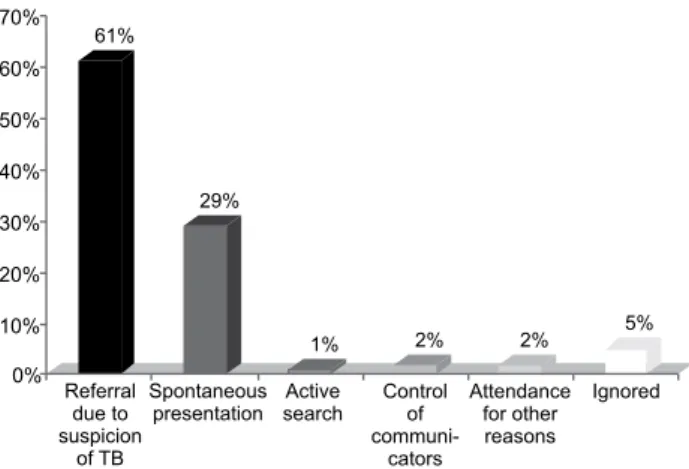
Figure 1 shows how the paients came to the health ser-vice that performed the TB diagnosis. It is observed that the majority of TB paients (61%) arrived at the site of diagnosis through referral by other health services or health profes-sionals due to suspicion of the disease. Only 29% of the pa-ients presented themselves spontaneously to the service that performed the diagnosis. The case inding for respira-tory symptomaics was litle emphasized, because only 3% of the paients were diagnosed in this way.
Figure 2 demonstrates the types of health services sought by the TB paients as the point of entry into the system, when the symptoms of the disease began. The authors observed that most of the paients (66%) sought primary healthcare services as a point of entry as recom-mended by NPPHC, but there was sill a large percentage (34%) that sought secondary and teriary level services (emergency units and hospitals).
61%
29%
1% 2% 2% 5%
0% 10% 20% 30% 40% 50% 60% 70%
Referral due to suspicion
of TB
Spontaneous presentation
Active search
Control of
communi-cators
Attendance for other reasons
Ignored
Figure 1 - Distribution of the TB diagnosed patients according to the form of presentation for the diagnosis - Ribeirão Preto -
0% 10% 20% 30% 40% 50% 60% 70%
Never Almost never Always
Hospital or EU PHU
66%
28%
3% 6%
31% 66%
Figure 2 - Distribution of the patients according the frequency with which they sought health services when the TB symptoms began - Ribeirão Preto - 2006-2007
Figure 3 presents the frequency with which the pa-ients sought health services in their area of catchment at the moment of irst contact when the TB symptoms began. Of the paients interviewed, 59% always sought health services in their area, i.e. the closest to their resi-dence, and 38%, a considerable percentage, never sought the services closest to their residence.
0% 10% 20% 30% 40% 50% 60%
Never Almost never
Sometimes Always 38%
1% 2%
59%
Figure 3 - Distribution of the TB patients according to the
fre-quency with which they sought a health unit in their area of cove-rage for the diagnosis of the disease - Ribeirao Preto - 2006-2007
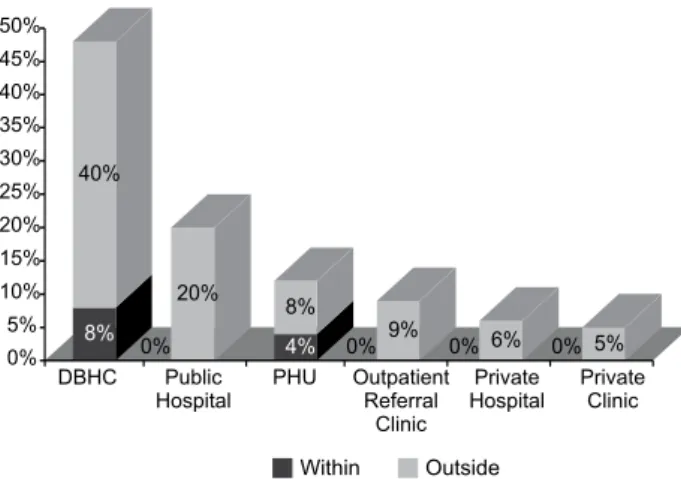
and 44% were diagnosed in emergency units of the DBHCs (DBHC–EU) and 4% in the primary healthcare units of the DBHCs. A total of 20% were diagnosed in public hospitals and 12% in PHUs. The outpaient referral clinics were re-sponsible for the diagnosis of 9% of the paients. The diag-noses of the paients were conducted primarily in second-ary and terisecond-ary level units (DBHC-EU), outpaient referral clinics and hospitals), totaling 73% of all the diagnoses performed. The primary healthcare service was less rep-resentaive in the diagnosis of the TB cases studied, with a total of only 16% of the cases. Concerning the locaion of the health services, 88% of the paients were diagnosed in services outside their area of catchment and only 12% were diagnosed in the services closest to their residence.
8% 40%
0% 20%
4% 8%
0% 9% 0% 6% 0% 5% 0%
5% 10% 15% 20% 25% 30% 35% 40% 45% 50%
DBHC Public Hospital
PHU Outpatient Referral
Clinic
Private Hospital
Private Clinic
Within Outside
Figure 4 - Distribution of the TB patients according to area of catchment (within or outside) and place of diagnosis - Ribeirão Preto - 2006-2007
diScUSSion
Figure 1 shows how the paients presented them-selves to the health services that had diagnosed the TB. According to the data 61% of the paients were referred from other health services. This means that these pa-ients had sought health services with symptoms of TB, however the health professionals referred them to other services for the performance of the diagnosis, contrary to the principle of decentralizaion of TB acions of the
NPPHC(8). This could be due to quanitaive and qualitaive
deiciencies in human resources in the primary healthcare service, to the overload of duies, and to the inadequate training of the health professionals to deal with TB(11). For the preparaion of the health professionals it is neces-sary to implement concrete acions in the universiies and medical schools, with enough ime for teaching theory and pracice in the ield, and through the collaboraion of specialist physicians and scieniic socieies. Addiionally, this preparaion should occur coninuously through train-ing programs. However, the diiculty that exists in this training program is highlighted due to the impossibility of the paricipaion of most of the health professionals, who oten cannot be allowed to leave their sectors because
of the limited availability of human resources. The lack of opportunity to conduct training for the health profes-sionals leaves them unprepared for the management of TB and for atending to the naional protocols of diagno-sis and monitoring of the paients(12). A study conducted in Ribeirão Preto highlighted the decentralizaion of the TCP acions as a strengthening force that would facilitate access for the TB paients to the health services(13). How-ever, other authors point out that decentralizaion may bring risks, such as the lack of accountability on the part
of health professionals(14).
Regarding the types of health services sought by the TB paients as a point of entry into the health system, shown in Figure 2, it was observed that the majority of pa-ients (66%) always sought primary healthcare services to obtain their irst consultaion. However there was a con-siderable percentage of paients (31%) who sought sec-ondary or teriary services (emergency unit or hospital) for obtaining the irst consultaion for the diagnosis of TB. The selecion of the paients according to the searching for emergency units or hospitals is based on past experi-ence with certain health services and on cultural aspects. Many paients believe that hospitals and emergency units (EU) are sites that have beter infrastructures to diagnose and treat health problems and therefore they rely more on such services. For others the preference for the hospi-tals and the EU arises from the restricted hours of opera-ion of the primary healthcare services(15).
Figure 3 shows that a sizable percentage (38%) of the paients preferred to seek health services more distant from their domiciles or outside of their coverage area. This may be related to the fact that the paients sought hospi-tals or EUs in order to be treated. One factor that can lead paients to search for more distant services is the sigma of the disease. Paients are afraid of being discovered as having TB and of acquaintances knowing of their health problem. TB is sill a disease that causes embarrassment to paients, because people do not understand its mode of transmission and because it has a strong link with HIV(16).
in-cenives to control TB and not suspecing TB due to the socio-economic characterisics of the paients who use
them(1,5).
Professionals from the private health sector have dii-culty in recognizing TB. There is sill a very strong associa-ion between TB and poverty, and as most paients who seek the private health services have a stable inancial situaion few physicians believe in the possibility of TB(1). There is a need for integraion between the public and pri-vate sectors, promoing in the later the divulgaion and correct applicaion of the TB control measures, improving access to the diagnosis for the populaion assisted in this sector, since it represents an increasingly frequent point of entry of the TB paients. Also in Figure 4, the paricipa-ion of the diferent levels of healthcare in the diagnosis of TB can be observed. The igure shows that the high-est paricipaion, in relaion to the public sector, was by the secondary care services represented by the emer-gency units and outpaient referral clinics and by the ter-iary care services, represented by the hospitals, which if added together represent 73% of the paients diagnosed. The PHUs and the FHUs represented only 16% of the di-agnoses performed. Another result ideniied in Figure 4 was that 88% of the paients were diagnosed in health services located outside their area of catchment, only in 12% did the diagnosis occur within the area of coverage. This shows that many paients are diagnosed in the sec-ondary and teriary healthcare levels, since these services are not point of entry references and oten require that the paient be referred to them by a primary healthcare service. According to the NPPHC, TB should be one of the prioriies in the PHC services, and the paients should be diagnosed at this level of care due to these services being the closest to the populaion.
The results showed, through igures 2, 3 and 4 togeth-er, that the majority of the paients sought assistance in primary healthcare services when they started feeling ill (66%), but the minority of the paients were diagnosed by the primary healthcare services (16%). In addiion, the majority of the paients sought assistance in the ser-vice of their coverage area, the nearest to their residence (59%), but only 12% were diagnosed within their catch-ment area. This means that even though the paients had sought atendance in the primary healthcare and the one closest to their residences, the resolvability was in fact made in the secondary and/or teriary healthcare servic-es, and in services outside their areas of coverage. These data show that signiicant quaniies of paients are not being diagnosed by the primary healthcare services, but by the emergency services and hospitals. These services, by the very logic of the operaion, must have the
easi-est access compared to the others, due to their hours of
funcioning and because they do not require pre-booked appointments for treatment of the paient, thus provid-ing a fast service(18). In a study conducted in Spain it was found that a factor related to a longer delay in the TB
di-agnosis was the fact that the symptomaic paient sought primary healthcare units which were not prepared for the performance of the diagnosis of the disease. In the same study, the fact that the paient with TB symptoms sought the hospital for care represented a decrease in the ime between the onset of the symptoms and the diagnosis of
the disease(5).
The primary healthcare services are based, in most cases, on spontaneous demand, a model in which the individual with Tuberculosis is expected to seek health service if they perceive any sign or symptom of the
dis-ease(19). However, in the space of ime between the per-cepion of the symptoms and the diagnosis, many factors may intervene, meaning that the paient may remain longer without treatment, worsening their condiion and spreading the disease in the community(20). Oten, when the symptoms are perceived, the paient is already in a more advanced stage of the disease and, when seeking healthcare, ends up being hospitalized, where the TB will
then be diagnosed(21). It is believed that many cases of
tu-berculosis remain undiagnosed, either because there is
a lack of access to health services even with Directly Ob-served Therapy(22-23), or due to the fact that the health pro -fessionals are inatenive to respiratory symptomaics(13). This demonstrates the fragmented care model, which overesimates the specialty, not paying atenion to the is-sues of health promoion and prevenion of disease, valo-rizing only the curaive acions(12). Due to the failures in the case inding process and diagnosis of TB cases, many paients are not diagnosed in the early phases of the dis-ease and are referred in a more advanced phase, neces-sitaing hospitalizaion due to poor general health status and to cachexia, which makes the local hospitals sites of increasingly more frequent access to the diagnosis(21).
concLUSion
REFEREncES
1. Habibullah S, Sadiq A, Anwar T, Sheikh MA. Diagnosis de-lay in tuberculosis and its consequences. Pak J Med Sci Q. 2004;20(3):266-9.
2. World Health Organizaion (WHO). Tuberculosis control: sur-veillance, planning, inancing. WHO Report 2009. Geneva; 2009.
3. World Health Organizaion (WHO). What is dots? A guide to understanding the WHO-recommended TB control strategy known as DOTS. Geneva; 1999.
4. Leung ECC, Leung CC, Tam CM. Delayed presentaion and treatment of newly diagnosed pulmonary tuberculosis pa-ients in Hong Kong. Hong Kong Med J. 2007;13(3):221-7.
5. Díez M, Bleda MJ, Alcaide J, Castells C, Cardenal JI, Domín-guez A, et al. Determinants of health system delay among conirmed tuberculosis cases in Spain. Eur J Public Health. 2005;15(4):343-9.
6. Santos MAPS, Albuquerque MFPM, Ximenes RAA, Lucana-Silva NLCL, Braga C, Campelo ARL, et al. Risk factors for treat-ment delay in pulmonary tuberculosis in Recife, Brazil. BMC Public Health. 2005;5(25):1-8.
7. Starield B. Atençãoprimária: equilíbrio entre necessidades de saúde, serviços e tecnologia. Brasília: UNESCO; 2002.
8. Brasil. Ministério da Saúde. Secretaria de Atenção Básica. De-partamento de Atenção Básica. Políica Nacional de Atenção Básica. Brasília; 2007.
9. Macinko J, Almeida C. Validação de uma metodologia de aval-iação rápida das caracterísicas organizacionais e do desem-penho dos serviços de atenção básica do Sistema Único de Saúde em nível local. Brasília: OMS/OPAS; 2006.
10. Villa TCS, Ruino-Neto A. Quesionário para avaliação de desempenho de serviços de atenção básica no controle da tuberculose no Brasil. J Bras Pneumol. 2009;35(6):610-2.
11. Monroe AA, Cardozo-Gonzales RI, Palha PF, Sassaki CM, Ruf-ino-Neto A, Vendramini SHF, et al. Envolvimento de equi-pes da Atenção Básica à Saúde no controle da tuberculose. Rev Esc Enferm USP. 2008;42(2):262-7.
12. Oliveira MF, Cardozo Gonzales RI, Villa TCS, Ruino Neto A. Search for Respiratory Symptomaic (RS) in DOTS implemen-taion in São Paulo State (2005). In: Ruino Neto A, Villa TCS. Tuberculosis treatment: dots implementaion in some regions of Brazil background and regional features. Brasília: OPAS; 2007. p. 93-102.
13. Muniz JN, Palha PF, Monroe AA, Cardozo-Gonzales RI, Ruf-ino-Neto A, Villa TCS. A incorporação da busca aiva de sintomáicos respiratórios para o controle da tuberculose na práica do agente comunitários. Ciênc Saúde Coleiva. 2005;10(2):315-21.
14. Frieden TR, Driver CR. Tuberculosis control: past 10 years and the future progress.Int J Tuberc Lung Dis. 2003;83(1):82-5.
15. Liefooghe R, Baliddawa JB, Kipruto EM, Vermeira C, Mun-ynck AOD. From their all perspecives: a Kenya communi-ty’s percepion of tuberculosis. Trop Med Int Health. 1997; 2(8):809-21.
16. Ensor T, Cooper S. Overcoming barriers to health service access: inluencing the demand side. Health Policy Plan. 2004;19(2):69-79.
17. Long NH, Johansson E, Lönnroth K, Eriksson B, Winkvist A, Diwan VK. Longer delays in tuberculosis diagnosis among women in Vietnam.Int J Tuberc Lung Dis. 1999;3(5):388-93.
18. Fekete MC. Estudo da acessibilidade na avaliação dos Ser-viços de Saúde: texto de apoio da unidade 1 [Internet]. Brasília: OPAS; 1997 [citado 2009 jun. 15]. Disponível em: htp://www.opas.org.br/rh/publicacoes/textos_apoio/ pub06U1T1.pdf
19. Teixeira CF, Paim JS, VilasBoas AL. SUS: modelos assistenci-ais e vigilância da saúde. In: Teixeira CF, organizadora. Pro-moção e vigilância da saúde. Salvador: ISC; 2000. p. 23-52.
20. Silva MD. Fatores associados à demora para o início do trata-mento da tuberculose pulmonar em Cuiabá-MT [disserta-ção]. Cuiabá: Universidade Federal do Mato Grosso; 2002.
21. Galesi VMN. Mortalidade por tuberculose no Município de São Paulo, análise de uma década, 1986 a 1995 [disserta-ção]. São Paulo: Faculdade de Saúde Pública, Universidade de São Paulo; 1999.
22. Villa TCS, Assis EG, Oliveira MF, Arcêncio RA, Cardozo-Gon-zales RI, Palha PF. Cobertura do tratamento diretamente observado (DOTS) da tuberculose no Estado de São Paulo (1998 a 2004). Rev Esc Enferm USP. 2008;42(1):98-104.