! & Rev Saúde Pública 2004;38(Supl):38-46 www.fsp.usp.br/rsp
Shiftworking families: parents’ working
schedule and sleep patterns of adolescents
attending school in two shifts
Biserka Radoševic-Vidacek and Adrijana Košcec
Institute for Medical Research and Occupational Health. Zagreb, Croatia
Presented at the XVI International Symposium on Night and Shiftwork, November 2003. Santos, SP, Brazil. This work was supported by the Croatian Ministry of Science and Technology (Grant 0022007, principal investigator Biserka Radoševic-Vidacek, Ph.D.).
Received on 15/3/2004. Approved on 27/9/2004. Correspondence to:
Biserka Radoševic-Vidacek
Institute for Medical Research and Occupational Health
Ksaverska cesta 2, PO BOX 291, HR-10 001 Zagreb
E-mail: [email protected] Keywords
Shift work. Parents. Adolescent, physiology. Sleep, physiology. Work hours.
D escritores
Trabalho em turnos. Pais. Adolescente, fisiologia. Sono, fisiologia. Jornada de trabalho.
Abstract
Objective
To explore whether parents’ engagement in shift work affects the sleep habits of their adolescent children who attend school in two shifts.
Methods
The data were drawn from an extensive survey of sleep and daytime functioning of adolescents attending school one week in the morning and the other in the afternoon. The participants were 1,386 elementary and high school students (11-18 years old) whose parents were both employed. The data were analyzed using MANOVA, with parents’ work schedule, adolescents’ gender and type of school as between-subject factors.
Results
Parents’ working schedule significantly affected the sleep patterns of high school adolescents. When attending school in the morning, adolescents whose parents were both day workers woke up somewhat later than adolescents with one shiftworking parent. In addition, they slept longer than adolescents whose parents were both shift workers. On weekends, adolescents whose parents both worked during the day went to bed earlier than adolescents whose parents were both shiftworkers. They also had smaller bedtime delay on weekends with respect to both morning and afternoon shifts than adolescents for whom one or both parents worked shifts. A significant interaction between parents’ working schedule, adolescents’ gender and type of school was found for sleep extension on weekends after afternoon shift school.
Conclusions
Parental involvement in shift work has negative effects on the sleep of high school adolescents. It contributes to earlier wake-up time and shorter sleep in a week when adolescents attend school in the morning, as well as to greater bedtime irregularity.
Resumo
Objetivo
Investigar se a ocupação de pais com o trabalho em turnos interfere nos hábitos de sono dos filhos adolescentes que freqüentam a escola em dois períodos distintos.
Métodos
INTRODUCTION
In many countries the sleep habits of adolescents are characterized by bedtime delay, insufficient sleep during the school week and inconsistent sleep pat-terns between the school week and weekends.2 Such habits emerge primarily as a result of an adolescent tendency to stay up late, their sleep need (which is not reduced in comparison to pre-adolescents) and the constraints of the early school start time.
The National Sleep Foundation7 (2000) advises parents to encourage and help adolescents to estab-lish and maintain a consistent sleep-wake schedule appropriate for their age; to provide an environment supportive to healthy sleep regarding light, music, use of television, computer, and telephone; to adjust schedules of various out-of-school activities to allow enough sleep; and to be good role models who prac-tice good sleep habits. The data for actual parental control of adolescents’ bedtime and wake-up time are limited and differ between countries.2,4,5,12 A com-parison of adolescents (ages 10-11, 12-13 and high school) in the USA showed that parental control of bedtime on school nights was less frequent for high school adolescents than younger groups of adoles-cents.2 At the same time, control of wake-up time, either imposed by parents or by alarm clock, was more frequent in older groups of adolescents. However, a relative increase of alarm clock use and decrease of parental control of wake-up time was observed amongst high school adolescents.2 Studies of Italian
semanas alternadas. Participaram do estudo 1.386 estudantes do ensino fundamental e médio (idades de 11-18 anos) cujos pais trabalhavam fora. Os dados foram analisados usando-se MANOVA, sendo o horário de trabalho dos pais, sexo dos adolescentes e tipo de escola os fatores intra-sujeitos.
Resultados
O horário de trabalho dos pais apresentou interferência significativa nos padrões de sono de adolescentes do ensino médio. Quando freqüentavam a escola pela manhã, os adolescentes cujos pais trabalhavam no período diurno levantavam-se um pouco mais tarde do que os adolescentes cujo pai ou mãe trabalhava em turnos. Além disso, eles dormiam mais do que os adolescentes cujos pais trabalhavam em turnos. Nos fins de semana, os adolescentes cujos pais trabalhavam no período diurno iam dormir mais cedo do que os adolescentes cujos pais trabalhavam em turnos. Também apresentaram um atraso menor no horário de dormir nos fins de semana depois da escola tanto no período da manhã quanto da tarde comparados aos adolescentes em que o pai ou a mãe ou ambos trabalhavam em turnos. Verificou-se uma interação significativa entre o horário de trabalho dos pais, sexo dos adolescentes e tipo de escola e a duração do sono nos fins de semana depois da escola no período da tarde.
Conclusões
A ocupação dos pais no trabalho em turnos exerce efeitos negativos no sono de adolescentes do ensino médio, contribuindo para um horário de levantar mais cedo e um período de sono mais curto durante a semana quando os adolescentes freqüentam a escola pela manhã, além de uma maior irregularidade na hora de dormir.
high school students5 and Taipei junior high school students4 have shown that parental control of sleep schedule decreases with age of adolescents, both for bedtime and wake-up time. In a study of Japanese junior high school adolescents12 parental control of bedtime during earlier childhood was found to at-tenuate phase shift to eveningness in adolescent boys.
The impact of shift work on the sleep of shift workers has been extensively studied. However, data on the impact of parents’ shift work on children’s develop-ment are limited.1,8,15 The hours that parents work may affect their parental time either because they are at work when children are at home or they are at home but asleep and therefore are not interacting with their children.9 Irregular and reduced sleep of shift working parents itself can increase parental stress and reduce the quality of the relationship with their children.11 Quality of time, and not the amount of time spent to-gether, appears to be an important factor for relation-ship between a shiftworking parent and a child.15 The impact of parental shiftworking on the sleep patterns of children and the issue of parents with irregular sleep schedules being role models for their children’s sleep habits have not yet been considered.
time-" Rev Saúde Pública 2004;38(Supl):38-46 www.fsp.usp.br/rsp Shiftworking families and sleep
Radoševic-Vidacek B & Košcec A
table is beneficial for adolescents with respect to ful-filment of their sleep need on the week with the after-noon shift and on weekends.10 However, the question remains whether the weekly rotating timetable and shifting sleep patterns hinder adjustment of their sleep schedule to morning shift week.
We investigated the relationship between the sleep characteristics of adolescents attending school in two shifts and the work schedules of their parents. The aim of the study was to explore whether the sleep habits of adolescents who attend school one week in the morn-ing and the other in the afternoon would differ with respect to engagement of their parents in shift work.
M ETH O D S
During October and November 2001 and 2002 a total of 2,363 elementary and high school students attending school in two shifts participated in an ex-tensive survey on sleep habits. Like the majority of Croatian students they attended school from Mon-day to FriMon-day, one week in the morning, and the fol-lowing week in the afternoon. They had weekends off. The reason why most of the schools in Croatia operate in two shifts is insufficient space to accom-modate all students at the same time. On morning shift week, classes normally took place from 8:00 to 13:00, and on the afternoon shift week from 14:00 to 19:00. Students usually had six class periods during one school day, each lasting 45 minutes.
The students were selected from a stratified sample of 12 elementary and 12 high schools in Zagreb. In order to make the sample representative for the city of Zagreb, the elementary schools were chosen on the basis of geographic location within the city, since students attended a school that was close to their homes. Four elementary schools were selected from the city centre, four from a wider urban area and four from the suburbs. Unlike elementary schools, high schools in Zagreb differ according to the educational program. Three types of high schools were selected to cover different programs, with four schools of each type. The types of schools were grammar schools, vocational schools for technical engineering and vocational schools for economics.
The recruited participants were students from 5th to 8th (final) grades of elementary schools, and from 1st to 4th (final) grades of high schools. The modal age of stu-dents in elementary school grades ranged from 11 to 14 years, and in high school grades from 15 to 18 years.
In this paper we examined only the data from stu-dents who were living at home (99%; n=2,338) with
both parents (87%; n=2,055). The sample was further restricted to students whose parents were both em-ployed (62%; n=1,466) and for whom there were no missing data on their parents’ work schedules (59%; n=1,386). Out of the final sample, 656 were elemen-tary school students with mean age 12.2 years (S.D.=1.2) and 730 were high school students with mean age 16.1 years (S.D.=1.2). There were 716 fe-males (nelementary=331, nhigh=385) and 670 males
(nelementary=325, nhigh=345).
All information regarding students and their par-ents’ working schedule were collected anonymously during a single class period using the Croatian ver-sion of the School Sleep Habits Survey (SSHS).16 The SSHS uses an extensive set of questions to examine socio-demographic characteristics, general health, sleep environment and conditions, sleep patterns, extracurricular activities and injuries. The SSHS was translated into Croatian and the questions examin-ing sleep patterns in the precedexamin-ing two weeks were adapted for the two-shift school system; that is, sepa-rate questions were introduced for the morning shift week and the afternoon shift week. However, no at-tempt was made to get separate estimates of sleep patterns on the weekend after morning shift and the weekend after afternoon shift.
Questions on bedtime and wake-up time on the morn-ing shift week, afternoon shift week and on weekends were used to assess students’ sleep patterns. The ques-tions were “At what time do you usually go to bed when your classes are in the morning/ when your classes are in the afternoon/ on weekend/?” and “At what time do you usually wake up when your classes are in the morning/ when your classes are in the afternoon/ on weekend/?” The students indicated their bedtime and wake-up time themselves. Sleep duration values were calculated from bedtimes and wake-up times for morn-ing shift, afternoon shift and weekend. Bedtime delay values were calculated for weekend with respect to morning and afternoon shifts and for afternoon shift with respect to morning shift. Sleep extension was cal-culated to assess the increase in sleep on weekend with respect to morning and afternoon shift, and on after-noon shift with respect to morning shift.
stu-dents were divided into three categories according to their parents’ working schedule. The first group com-prised the students whose both parents worked only day shift (n=555). The second group comprised the students for whom one parent worked day shift and another worked evening, night or rotating shifts (n=563). In this group there were 349 fathers and 214 mothers working non-standard hours. The third group comprised the students whose both parents worked evening, night or rotating shifts (n=268). Out of 1,099 parents working non-standard hours, 1,070 (97%) were rotating shift workers.
Parental control of bedtime and wake-up time was established by means of the questions on the main rea-son for going to bed and for waking up at usual time. There were separate questions for morning shift, after-noon shift and weekend. The possible reasons for going to bed were: “My parents have set my bedtime”, “I feel sleepy”, “I finish my homework”, “My TV shows are over”, “My brother(s) or sister(s) go to bed”, “I finish socializing”, “Other”. The possible reasons for waking up were: “Noises or my pet wakes me up”, “My alarm clock wakes me up”, “My parents or other family mem-bers wake me up”, “I need to go to the bathroom”. “I don’t know, I just wake up” and “Other”.
The data were analysed by five sets of multivariate ANOVAs with three between-subject factors: adoles-cents’ gender (female, male), type of school (elemen-tary, high) and parents’ working schedule (neither of parents working shifts, one parent working shifts, and both parents working shifts). Three MANOVAs were conducted to examine the effects of between-subject
factors on adolescents’ bedtime, wake-up time and sleep duration, separately for the school week with morning shift, for the school week with afternoon shift and for the weekend. The fourth analysis exam-ined the effects of the between-subject factors on ado-lescents’ bedtime delay on afternoon shift with re-spect to morning shift, on weekend with rere-spect to morning shift, and on weekend with respect to after-noon shift. The fifth analysis examined the effects of three between-subject factors on adolescents’ sleep extension on afternoon shift with respect to morning shift, on weekend with respect to morning shift, and on weekend with respect to afternoon shift.
RESU LTS
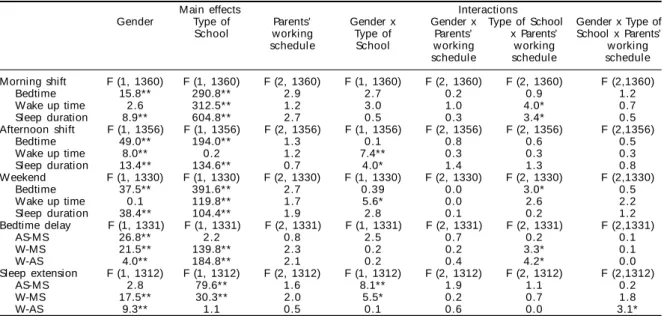
The results of the multivariate analyses of variance are presented in Table 1.
Statistically significant interactions of school type and parents’ working schedule were found for adoles-cents’ wake-up time and sleep duration on the morn-ing shift, bedtime on weekend, and bedtime delay on weekend with respect to both morning and afternoon shifts. The interactions indicated that the effect of par-ents’ working schedule on adolescpar-ents’ sleep differed between elementary and high school students (Fig-ure). The interactions were further examined by means of the simple main effects analyses performed sepa-rately for elementary and high school students. When simple main effects were statistically significant, pairwise comparisons of sleep characteristics were con-ducted between adolescents whose parents were both day workers, those with one parent working shifts and
Table 1 - The results of multivariate analyses of variance for sleep characteristics of adolescents.
Main effects Interactions
Gender Type of Parents’ Gender x Gender x Type of School Gender x Type of School w orking Type of Parents’ x Parents’ School x Parents’
schedule School w orking w orking w orking schedule schedule schedule
Morning shift F (1, 1360) F (1, 1360) F (2, 1360) F (1, 1360) F (2, 1360) F (2, 1360) F (2,1360)
Bedtime 15.8** 290.8** 2.9 2.7 0.2 0.9 1.2
Wake up time 2.6 312.5** 1.2 3.0 1.0 4.0* 0.7
Sleep duration 8.9** 604.8** 2.7 0.5 0.3 3.4* 0.5
Afternoon shift F (1, 1356) F (1, 1356) F (2, 1356) F (1, 1356) F (2, 1356) F (2, 1356) F (2,1356)
Bedtime 49.0** 194.0** 1.3 0.1 0.8 0.6 0.5
Wake up time 8.0** 0.2 1.2 7.4** 0.3 0.3 0.3
Sleep duration 13.4** 134.6** 0.7 4.0* 1.4 1.3 0.8
W eekend F (1, 1330) F (1, 1330) F (2, 1330) F (1, 1330) F (2, 1330) F (2, 1330) F (2,1330)
Bedtime 37.5** 391.6** 2.7 0.39 0.0 3.0* 0.5
Wake up time 0.1 119.8** 1.7 5.6* 0.0 2.6 2.2
Sleep duration 38.4** 104.4** 1.9 2.8 0.1 0.2 1.2
Bedtime delay F (1, 1331) F (1, 1331) F (2, 1331) F (1, 1331) F (2, 1331) F (2, 1331) F (2,1331)
AS-MS 26.8** 2.2 0.8 2.5 0.7 0.2 0.1
W-MS 21.5** 139.8** 2.3 0.2 0.2 3.3* 0.1
W-AS 4.0** 184.8** 2.1 0.2 0.4 4.2* 0.0
Sleep extension F (1, 1312) F (1, 1312) F (2, 1312) F (1, 1312) F (2, 1312) F (2, 1312) F (2,1312)
AS-MS 2.8 79.6** 1.6 8.1** 1.9 1.1 0.2
W-MS 17.5** 30.3** 2.0 5.5* 0.2 0.7 1.8
W-AS 9.3** 1.1 0.5 0.1 0.6 0.0 3.1*
*p<0.05; **p<0.01
" Rev Saúde Pública 2004;38(Supl):38-46 www.fsp.usp.br/rsp Shiftworking families and sleep
Radoševic-Vidacek B & Košcec A
those for whom both parents were shift workers. The Sidak adjustment was used for multiple comparisons.
The simple main effects analyses showed that sleep characteristics differed as a function of parents’ involve-ment in shift work only amongst high school adoles-cents. A statistically significant difference was found in the wake-up time of high school adolescents on the morning shift week (F(2/1360)=4.97, p<0.01), although the difference was small. Pairwise comparisons showed that the wake-up time differed between adolescents whose both parents were day workers (M=6:30h, S.E.=2 min) and those for whom one parent was a shift worker (M=6:24h, S.E.=2 min, p<0.05). Further, the sleep du-ration of high school adolescents on the morning shift week significantly differed as a function of parents’ engagement in shift work (F(2/1360)=5.24, p<0.01). Pairwise comparisons showed that high school adoles-cents for whom both parents were day workers slept longer (M=433 min, S.E.=4 min) than high school ado-lescents for whom both parents were shift workers (M=412 min, S.E.=6 min, p<0.01).
The high school adolescents’ bedtimes on weekends varied with their parents’ involvement in shift work
(F(2/1328)=7.85, p<0.01). The pairwise comparisons
showed that on weekends adolescents for whom both parents were day workers went to bed earlier (M=1:26h, S.E.=6 min) than adolescents for whom both parents were shift workers (M=2:03h, S.E.=9 min, p<0.01).
A significant difference was also found between high school adolescents for whom neither, one or both par-ents were shift workers in relation to bedtime delay on weekends with respect to morning shift week (F(2/
1328)=5.84, p<0.01) and after the afternoon shift week
(F(2/1325)=6.70, p<0.01). Pairwise comparisons showed
that the adolescents for whom both parents were day workers had less bedtime delay on weekends with re-spect to morning shift week (M=29 min, S.E.=5 min) than either the adolescents for whom one parent worked shifts (M=148 min, S.E.=5 min, p<0.05) or both par-ents worked shifts (M=156 min, S.E.=8 min, p<0.01). Similarly, the adolescents for whom both parents were day workers had less bedtime delay on weekends with respect to afternoon shift week (M=92 min, S.E.=4 min) than adolescents for whom one parent worked shifts (M=109 min, S.E.=5 min, p<0.05) or both parents worked shifts (M=120 min, S.E.=7 min, p<0.01).
The multivariate ANOVA showed a significant three-way interaction between adolescents’ gender, type of school and parents’ working schedule for adolescents’ sleep extension on the weekends with respect to after-noon shift week (Table 1). The interaction was ana-lysed further by means of the simple main effects
analy-ses for gender in each parents’ working schedule group within both elementary and high school students.
The analyses showed a significant simple main ef-fect of gender in the group of adolescents whose par-ents were day workers both for elementary (F(1/1317)=4.0,
Figure - Estimated marginal means for sleep characteristics of el ementary and hi gh school adol escents w hose both parents w ere day w orkers ( ), one parent w as a day worker and another a shift worker (- - - -), or both parents were shift workers (...).
Elementary school
High school
Bedtime dela
y
W
eek
end-after
noon shift
[min]
120
108
96
84
72
60
48
Bedtime dela
y
W
eek
end-mor
ning shift
[min]
156
144
132
120
108
96
84 2:00
1:30
1:00
24:30
24:00
Bedtime on
W
eek
end
[cloc
k hours]
Sleep dur
ation on mor
ning shift
[min]
510
480
450
420 6:54
6:48
6:42
6:36
6:30
6:24
W
ak
e-up time on mor
ning shift
[cloc
p<0.05) and high school adolescents (F(1/1317)=4.3, p<0.05). Female adolescents extended their sleep on the weekends with respect to afternoon shift week more than male adolescents (Elementary school:
Mfemale=38 min, S.E.=9 min, Mmale=13 min, S.E.=8
min; High school: Mfemale=29 min, S.E.=7 min; Mmale=7 min, S.E.=8 min).
In the group of adolescents for whom one parent was a shift worker, a significant simple main effect of gender was found only for high school students (F(1/
1317)=9.8, p<0.01). Female high school adolescents
extended their sleep (M=30 min, S.E.=8 min) while male adolescents shortened their sleep on the week-ends with respect to afternoon shift week (M=-4 min, S.E.=8 min). In the group of adolescents with both parents shift workers the simple main effects of gen-der were not statistically significant either for elemen-tary or high school students.
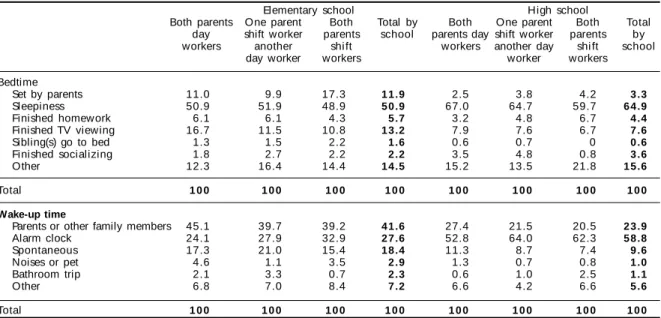
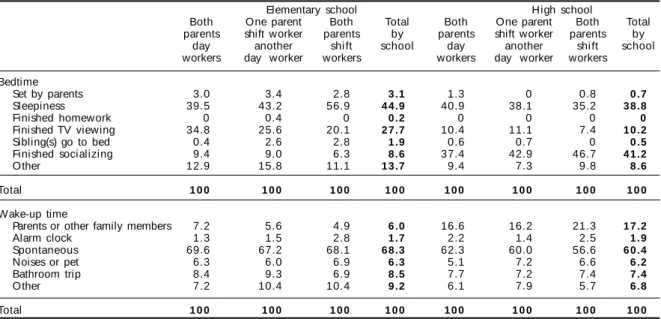
The data on the main reason for going to bed and waking up at the usual time (Tables 2-4) were ana-lysed to examine parental involvement in setting bedtime and assisting in waking up. Only a very small percentage of adolescents had their bedtimes set by parents. Elementary school adolescents were signifi-cantly more likely to report that parents set their bed-time than were high school adolescents, on school weeks (both morning and afternoon shifts) and on weekends (square=36.69, df=1, p<0.01; Chi-square=32.66, df=1, p<0.01; Chi-square=11.23, df=1, p<0.01, respectively). Parents assisted with waking up more often than they set the adolescents’ bedtime. Elementary school adolescents were more likely to report that parents or other family members woke them up during the week they attended school in the
morn-ing than were the high school students (Chi-square=49.35, df=1; p<0.01). However, the high-school students relied on another external cue for waking up on the morning shift days; that is, most of them reported using an alarm-clock (Table 2). On a week with classes in the afternoon there was no dif-ference in parental control of wake-up time between elementary and high school students. On weekends, parents were more likely to assist with waking up high school adolescents than elementary school ado-lescents (Chi-square=41.10, df=1; p<0.01).
The reports on parental control were specifically examined in the group of high school students whose wake-up time on the morning shift week and bedtime on weekend differed with respect to the work sched-ule of their parents. There was no statistically signifi-cant difference in parents’ involvement in waking up on morning shift week between adolescents for whom neither, one or both parents were shift workers (Chi-square=3.83, df=2). However, there was a significant difference in reports on the use of alarm clock with respect to parents’ involvement in shift work (Chi-square=8.54, df=2; p<0.05). High school adolescents for whom both parents were day workers were rela-tively less likely to report the use of alarm clock for waking up than were the adolescents for whom one or both parents were shift workers.
As for the reasons for going to bed on weekends, a negligible percentage of high school adolescents for whom neither or both parents were shift workers, and none of the adolescents for whom one parent was a shift worker, reported that parents set their bedtime. The differences observed in reports that finishing socializing was the main reason for going to bed on Table 2 - Percentage of students reporting each reason for going to bed and waking up on morning shift.
Elementary school High school
Both parents One parent Both Total by Both One parent Both Total day shift worker parents school parents day shift worker parents by workers another shi ft workers another day shi ft school
day worker workers worker workers
Bedtime
Set by parents 11.0 9.9 17.3 1 1 .9 2.5 3.8 4.2 3 .3
Sleepiness 50.9 51.9 48.9 5 0 .9 67.0 64.7 59.7 6 4 .9
Finished homework 6.1 6.1 4.3 5 .7 3.2 4.8 6.7 4 .4
Finished TV viewing 16.7 11.5 10.8 1 3 .2 7.9 7.6 6.7 7 .6
Sibling(s) go to bed 1.3 1.5 2.2 1 .6 0.6 0.7 0 0 .6
Finished socializing 1.8 2.7 2.2 2 .2 3.5 4.8 0.8 3 .6
Other 12.3 16.4 14.4 1 4 .5 15.2 13.5 21.8 1 5 .6
Total 1 0 0 1 0 0 1 0 0 1 0 0 1 0 0 1 0 0 1 0 0 1 0 0
Wake-up time
Parents or other family members 45.1 39.7 39.2 4 1 .6 27.4 21.5 20.5 2 3 .9
Alarm clock 24.1 27.9 32.9 2 7 .6 52.8 64.0 62.3 5 8 .8
Spontaneous 17.3 21.0 15.4 1 8 .4 11.3 8.7 7.4 9 .6
Noises or pet 4.6 1.1 3.5 2 .9 1.3 0.7 0.8 1 .0
Bathroom trip 2.1 3.3 0.7 2 .3 0.6 1.0 2.5 1 .1
Other 6.8 7.0 8.4 7 .2 6.6 4.2 6.6 5 .6
" " Rev Saúde Pública 2004;38(Supl):38-46 www.fsp.usp.br/rsp Shiftworking families and sleep
Radoševic-Vidacek B & Košcec A
weekends were not statistically significant between the adolescents for whom neither, one or both parents were shift workers (Chi-square=3.76, df=2).
D ISCU SSIO N
This study focused on the sleep habits of adoles-cents whose families differed with respect to parental engagement in shift work. Families in which both par-ents were day workers, those with only one parent working shifts, and those with both parents working shifts were studied. The majority of shiftworking par-ents worked rotating shifts. The adolescpar-ents’ school schedule was organised in weekly rotating morning and afternoon shifts and their out-of-school activi-ties did not include paid jobs.
The advantage of the study was that both mothers’ and fathers’ working schedules were considered, which enabled insight into the effects of working schedule of the family as a unit. However, the limitation of the study was that data on parents’ working schedule were collected by means of a survey that was not designed to study shift work in detail. The survey did not at-tempt to differentiate various types of shift rotations, did not attempt to find out whether the work sched-ule included work on weekends, or to obtain data on how long the parents were engaged in shift work. The students were not provided with definitions of differ-ent shift types or the range of hours that constituted a shift. This shortcoming of the study might have in-fluenced the reliability of data on parents’ working schedule, particularly amongst younger students.
Table 4 - Percentage of students reporting each reason for going to bed and waking up on weekend.
Elementary school High school
Both One parent Both Total Both One parent Both Total parents shift worker parents by parents shift worker parents by
day another shi ft school day another shi ft school workers day worker workers workers day worker workers
Bedtime
Set by parents 3.0 3.4 2.8 3 .1 1.3 0 0.8 0 .7
Sleepiness 39.5 43.2 56.9 4 4 .9 40.9 38.1 35.2 3 8 .8
Finished homework 0 0.4 0 0 .2 0 0 0 0
Finished TV viewing 34.8 25.6 20.1 2 7 .7 10.4 11.1 7.4 1 0 .2
Sibling(s) go to bed 0.4 2.6 2.8 1 .9 0.6 0.7 0 0 .5
Finished socializing 9.4 9.0 6.3 8 .6 37.4 42.9 46.7 4 1 .2
Other 12.9 15.8 11.1 1 3 .7 9.4 7.3 9.8 8 .6
Total 1 0 0 1 0 0 1 0 0 1 0 0 1 0 0 1 0 0 1 0 0 1 0 0
Wake-up time
Parents or other family members 7.2 5.6 4.9 6 .0 16.6 16.2 21.3 1 7 .2
Alarm clock 1.3 1.5 2.8 1 .7 2.2 1.4 2.5 1 .9
Spontaneous 69.6 67.2 68.1 6 8 .3 62.3 60.0 56.6 6 0 .4
Noises or pet 6.3 6.0 6.9 6 .3 5.1 7.2 6.6 6 .2
Bathroom trip 8.4 9.3 6.9 8 .5 7.7 7.2 7.4 7 .4
Other 7.2 10.4 10.4 9 .2 6.1 7.9 5.7 6 .8
Total 1 0 0 1 0 0 1 0 0 1 0 0 1 0 0 1 0 0 1 0 0 1 0 0
Table 3 - Percentage of students reporting each reason for going to bed and waking up on afternoon shift.
Elementary school High school
Both One parent Both Total Both One parent Both Total parents shift worker parents by parents shift worker parents by
day another shi ft school day another shi ft school workers day worker workers workers day worker workers
Bedtime
Set by parents 7.0 6.8 12.9 8 .2 1.9 1.4 1.7 1 .6
Sleepiness 35.1 40.0 38.8 3 8 .0 60.7 56.1 47.9 5 6 .7
Finished homework 7.0 7.9 1.4 6 .2 3.5 4.5 2.5 3 .7
Finished TV viewing 30.7 25.7 24.5 2 7 .2 14.5 15.9 21.5 1 6 .2
Sibling(s) go to bed 2.2 2.3 3.6 2 .5 1.3 1.7 0.8 1 .4
Finished socializing 5.3 4.9 6.5 5 .4 7.5 9.3 9.1 8 .5
Other 12.7 12.5 12.2 1 2 .5 10.7 11.1 16.5 1 1 .8
Total 1 0 0 1 0 0 1 0 0 1 0 0 1 0 0 1 0 0 1 0 0 1 0 0
Wake-up time
Parents or other family members 12.7 12.9 10.4 1 2 .3 11.9 13.4 13.1 1 2 .7
Alarm clock 8.5 9.2 5.6 8 .1 25.8 26.6 26.2 2 6 .2
Spontaneous 61.4 57.6 65.3 6 0 .7 43.7 40.7 38.5 4 1 .6
Noises or pet 4.2 4.1 6.3 4 .6 3.5 5.5 5.7 4 .7
Bathroom trip 5.9 5.9 4.9 5 .7 5.0 3.1 1.6 3 .7
Other 7.2 10.3 7.6 8 .6 10.1 10.7 14.8 1 1 .1
This study found significant evidence that engage-ment of one or both parents in shift work affects some sleep behaviours of high school adolescents. The sleep of high school adolescents, which gener-ally showed less healthy patterns, was additiongener-ally affected by the level of engagement of their parents in shift work. Conversely, the sleep of elementary school adolescents generally seemed to show healthier patterns, for example later wake-up times and longer sleep on the morning shift week, earlier bedtimes and smaller bedtime delays on weekends. Such sleep patterns were not affected by engage-ment of parents in shift work.
The high school adolescents whose parents were day workers woke up slightly later and slept longer on school weeks with a morning schedule, in com-parison to adolescents with one or both parents work-ing shifts. Although the effect of the parents’ engage-ment in shift work on wake-up time and sleep dura-tion of adolescents was small, it resulted in a reduc-tion in sleep, which was short due to the early school start time to begin with.
Parental presence at wake-up time may have either beneficial or negative effects for sleep, depending on circumstances. Getting up for school after reduced sleep may require more than one warning. A parent who is present after such short sleep, which is charac-teristic for the morning shift, can wake up an adoles-cent or control the effect of an alarm clock on waking up. Our results regarding external assistance in wak-ing up on mornwak-ing shift showed similar differences between elementary and high school adolescents to those reported by Carskadon2 (2002). Namely, more elementary school adolescents reported that parents woke them up, while more high school adolescents reported using an alarm clock.
In the case of later wake-up times, which were char-acteristic of the afternoon shift and weekend, parent’s presence and involvement in waking up may inter-fere with adolescent’s need to pay off sleep debt. On afternoon shift no difference between elementary and high school students was observed regarding paren-tal assistance in waking up, while on weekends par-ents were more likely to stop the sleep of high school adolescents than that of elementary school adoles-cents. Regarding the impact of parents working sched-ule on adolescents’ waking up this study indicated that parents who differed with respect to engagement in shift work did not differ in their involvement in waking up the adolescents on the morning shift week. However, in families with one or both parents work-ing shifts adolescents were more likely to use an alarm clock for waking themselves up than was the case in
families with day working parents.
Availability of many late-night arousing activities contributes to development of unhealthy sleep be-haviours in adolescence. Those activities include going out late at night, viewing television programs, using the internet, playing computer games, and text messaging on mobile phones, as well as the mere pres-ence of media appliances in rooms.13,14 These factors contribute to delay in the circadian phase preference of adolescents.3
The results of this study showed that high school adolescents whose parents were engaged in shift work went to bed later on weekends and had larger bedtime delay on weekends with respect to both morning and afternoon shifts, in comparison to adolescents whose parents were day workers. These results indicate that engagement of parents in shift work might be another factor related to late bedtimes of adolescents.
When family-work conflict is discussed in relation to parenting there is a general concern about whether duration and timing of work will make parents avail-able for their children. Mott et al6 (1965) pointed to the afternoon shift as problematic because it did not permit parents to interact with children during din-nertime and at times when children do homework, or to participate in routines involving bath and bedtime stories. However, when parental interactions with chil-dren of adolescent age are discussed, adolescents’ in-creasing need for autonomy and parents’ considera-tion for this need have to be taken into account. The question is whether parents set adolescents’ bedtime at all, and if they do so whether they are present to control pre-bedtime activities and going to bed. The data from our study indicate that high school adoles-cents barely report any parental control of their bed-time in any situation, especially on weekends. There-fore the differences in adolescents’ bedtime on week-end, which were found between shiftworking and non-shiftworking families, may not be attributed to differ-ences in actual parental control of their bedtime. We can only speculate that living in a family were shift-ing of sleep and wakefulness is frequent, and where it is “normal” to be awake at night and asleep during the daytime, facilitate irregularity of sleep patterns in adolescents. Living with shiftworking parents may exacerbate the unhealthy sleep patterns of adoles-cents through reinforcement, modelling or opportu-nities that make such sleep possible.
" $ Rev Saúde Pública 2004;38(Supl):38-46 www.fsp.usp.br/rsp Shiftworking families and sleep
Radoševic-Vidacek B & Košcec A
REFEREN CES
1. Barton J, Aldrige J, Smith P. The emotional impact of shift work on the children of shiftworkers. Scan J Work Environ Health 1998;23 Suppl 3:146-50.
2. Carskadon MA. Factors influencing sleep patterns of adolescents. In: Carskadon MA, editor. Adolescent sleep patterns: biological, social, and psychological influences. Cambridge: Cambridge University Press; 2002. p. 4-26.
3. Carskadon MA, Vieira C, Acebo C. Association betw een puberty and delayed phase preference. Sleep 1993;16:258-62.
4. Gau SF, Soong WT. Sleep problems of junior high school students in Taipei. Sleep 1995;18:667-73.
5. Giannotti F, Cortesi F. Sleep patterns and daytime function in adolescence: an epidemiological survey of an Italian high school student sample. In: Carskadon MA, editor. Adolescent sleep patterns: biological, social, and psychological influences. Cambridge: Cambridge University Press; 2002. p. 132-46.
6. Mott P, Mann F, MacLoughlin Q, Warwick D. Shiftwork: the social, psychological and physical consequences. Ann Arbor: University of Michigan Press; 1965.
7. National Sleep Foundation. Adolescents sleep needs and patterns: research report and resource guide. Washington (DC): National Sleep Foundation; 2000.
8. Phillips KR. Parent work and child well-being in low-income families. Washington (DC): The Urban Institute; 2002.
9. Presser HB. Embracing complexity: work schedules and family life in a 24/7 economy. Conference on Workforce/Workplace M ismatch: Work, Family Health and Well-Being; 2003 Jun 16-8, Washington (DC). Washington (DC); 2003.
10. Radoševic-Vidacek B, Košcec A. Sleep patterns of adolescents attending classes in two shifts. Shiftwork Int Newsl 2003;20(2):154.
11. Simon BL. Impact of shiftwork on individuals and families. Fam Soc 1990;71:342-8.
12. Takeuchi H, Inoue M, Watanabe N, Yamashita Y, Hamada M, Kadota G et al. Parental enforcement of bedtime during childhood modulates preference of Japanese junior high school students for eveningness chronotype. Chronobiol Int 2001;18:823-9.
13. Van den Bulck J. Text messaging as a cause of sleep interruption in adolescents, evidence from a cross-sectional study. J Sleep Res 2003;12:263.
14. Van den Bulck J. Television-viewing, computer game playing and internet use and self reported time to bed and time out of bed in secondary school children. Sleep 2004;27:101-4.
15. Volger A, Ernst G, Nachreiner F, Haenecke K. Common free time of family members under different shift systems. Appl Ergon 1988;19:213-8.
16. Wolfson AR, Carskadon MA. Sleep schedules and daytime functioning in adolescents. Child Dev 1998;69:875-87.
17. Wolfson AR, Carskadon MA, Acebo C, Seifer R, Fallone G, Labyak SE et al. Evidence for the validity of a sleep habits survey for adolescents. Sleep 2003;26:213-6.
be unaffected by parents’ shift work. Sleep of older adolescents, especially its regularity, seems to be affected but direct parental behaviour related to their children’s sleep could not be linked to changed sleep patterns. Given the possible limitations of surveys for estimating weekend sleep,17 more detailed diary
and actigraphy studies are needed to further explore the effect of parents’ working time and schedule on the development of their children’s sleep habits.
ACKN O W LED GEM EN TS