- 170 - Original Article
PROCEDURES AFTER EXPOSURE TO BIOLOGICAL MATERIAL IN A
SPECIALIZED CANCER HOSPITAL
Paula Batista Luize1, Silvia Rita Marin da Silva Canini2, Elucir Gir3, Silmara Elaine Malaguti Toffano4
1 M.Sc. in Health Sciences the Escola de Enfermagem de Ribeirão Preto (EERP/USP). Ribeirão Preto of the Universidade de São Paulo. São Paulo, Brazil. E-mail: [email protected]
2 Ph.D. in Nursing. Associate Professor, Department of General and Specialized Nursing, EERP/USP. Ribeirão Preto, São Paulo, Brazil. E-mail: [email protected]
3 Ph.D. in Nursing. Full Professor, Department of General and Specialized Nursing, EERP/USP. Ribeirão Preto, São Paulo, Brazil. E-mail: [email protected]
4 Ph.D. in Nursing. Professor, Universidade Federal de São João del-Rei. Divinópolis, Minas Gerais, Brazil. E-mail: silmalaguti@ yahoo.com.br
ABSTRACT: Occupational accidents involving biological material are a concern for healthcare facilities due to the severe harm they may cause to healthcare workers. This cross-sectional study’s aim was to identify the behavior reported by nursing professionals in response to biological material exposure in a cancer hospital located in São Paulo, Brazil. The population was composed of 441 professionals. The hospital’s Institutional Review Board approved the project. Of the 441 interviewed subjects, 82 (18.6%) reported exposure in the last twelve months. Note that 47 (57.3%) workers oficially reported the accident and sought specialized clinical care. The most frequently reported reason by those (72.1%) who did not follow the protocol was considering it unnecessary. Strategies intended to improve adherence of healthcare workers to the recommended protocol may improve occupational safety.
DESCRIPTORS: Exposure to biological agents. Accidents, occupational. Nursing, team. Occupational accidents registry. Therapeutical aproaches.
CONDUTAS APÓS EXPOSIÇÃO OCUPACIONAL A MATERIAL
BIOLÓGICO EM UM HOSPITAL ESPECIALIZADO EM ONCOLOGIA
RESUMO: Acidentes ocupacionais envolvendo material biológico são uma preocupação às instituições de saúde, uma vez que podem causar agravos à saúde dos proissionais. Realizou-se um estudo de corte transversal, que teve como objetivo adescrever as condutas relatadas pelos proissionais de enfermagem de um hospital especializado em oncologia do interior paulista após exposição a material biológico. A população do estudo foi composta por 441 proissionais. O projeto foi aprovado pelo Comitê de Ética em Pesquisa do referido hospital. Dos 441 sujeitos entrevistados, 82 (18,6%) referiram ter sofrido exposição nos últimos doze meses. Ressalta-se que 47 (57,3%) proissionais notiicaram o acidente oicialmente e procuraram atendimento clínico especializado. O motivo mais frequentemente relatado pelos sujeitos que não adotaram nenhuma conduta (72,1%) foi considerá-la desnecessária. Estratégias direcionadas para aumentar a adesão dos proissionais às condutas preconizadas após exposição pode contribuir para melhoria na segurança proissional. DESCRITORES: Exposição a agentes biológicos. Acidentes de trabalho. Equipe de enfermagem. Notiicação de acidentes de trabalho. Condutas terapêuticas.
CONDUCTAS DESPUÉS DE LA EXPOSICIÓN A MATERIAL BIOLÓGICO
EN UN HOSPITAL ESPECIALIZADO EN ONCOLOGÍA
RESUMEN Accidentes de trabajo con material biológico son una preocupación para las instituciones de salud. Es un estudio transversal, el objetivo fue evaluar las condutas reportadas por lo profesionales de enfermeria en un hospital especializado en oncología de São Paulo después de la exposición a material biológico. La población fue compuesta por 441 profesionales. El proyecto fue aprobado por el Comité Ético de Investigación del hospital. De los 441 entrevistados, 82 (18.6%) reportaron la exposición en los últimos doce meses. Es de destacar que 47 (57,3%) profesionales reportaron oicialmente el accidente y buscaron atención clínica especializada. La razón dada con mayor frecuencia por los sujetos que no tomaron conducta (72,1%) fue considerar la notiicación innecesaria. Las estrategias dirigidas a incrementar la adherencia a las prácticas profesionales recomendadas después de la exposición pueden contribuir a la mejora de la seguridad profesional.
DESCRIPTORES: Exposición a agentes biológicos. Accidentes ocupacionales. Grupo de enfermería. Notiicación de accidentes del trabajo. Conductas terapéuticas.
INTRODUCTION
Healthcare providers are constantly exposed to biological material such as blood and other bodily luids with the potential to transmit diverse pathogens and, consequently, severely harm their health1-2
Occupational accidents with biological mate-rial may occur through a percutaneous route, i.e., needlesticks or other sharps-related injuries, and/ or by direct contact with eye, mouth or nose mu-cosa, or by skin contact. Additionally, any contact with virus-concentrated material (research labs, virus culture, or viruses in great amounts) with-out proper protection is considered occupational exposure that requires assessment and follow-up.3
The World Health Organization estimates that more than three million accidents with bio-logical material occur among healthcare providers around the world. Of the three million accidents, two million involve exposure to the Hepatitis B virus (HBV); 900,000 involve exposure to Hepatitis C (HCV); and 170,000 involve exposure to the Hu-man Immunodeiciency Virus (HIV). As a result, there are a possible 66,000 healthcare workers in-fected with HBV, 16,000 with HCV, and 1,000 with HIV after occupational percutaneous exposure.4
The nursing staff provides direct care and, therefore, is constantly in contact with patients in different healthcare settings, making these workers more vulnerable to biological material exposure.5-8
Pre-exposure preventive measures consist of implementing standard precautions, which is the main preventive measure to avoid exposure to biological material9, in addition to reducing the use of needles or using safety syringes, and immunization against hepatitis B.4,10-11
After the occurrence of an occupational accident with biological material, pre-exposure measures establish that local care, clinical care in specialized services, is required to determine the risk of infection, and consequently, any prophy-lactic procedure necessary, in addition to report-ing the accident through Occupational Accident Reporting (OAR) forms.2 Studies have shown that despite the beneits of preventive measures, adher -ence of workers to such measures is still below the ideal level.12-13
Given the previous discussion, this study’s aim was to describe the behavior reported by nursing workers in response to biological mate-rial exposure.
METHODS
This descriptive, cross-sectional study was conducted in the Hospital de Câncer de Barretos lo-cated in the state of São Paulo, Brazil. At the time of data collection, the hospital had 518 nursing workers distributed among nurses, nursing tech-nicians and auxiliaries. The study population was composed of 441 individuals, 51 of whom refused to participate and 26 were either on sick or mater-nity leave. All the professionals were included in the study and individually interviewed because the services responsible for providing specialized clinical care and accident-reporting could not iden-tify those who did not adopt the protocol.
One instrument addressing sociodemo-graphic data, occupational aspects, characteriza-tions of the accident(s), reporting-related factors and/or care received from the Hospital Infection Control Service (HICS), was applied to collect data after ive experts performed content and apparent validation.
Data were collected from January 1st to June 30th 2011 after the researcher personally invited all the eligible participants.
The hospital’s Nursing Management autho-rized interviews to be conducted during working hours provided that the workers’ immediate su-pervisors agreed to the interviews and that inter-views did not impede or prevent the activities of the study participants. Hence, data were collected through individual interviews in a room reserved for that purpose on the hospital premises.
The Human Resources Department provided a list with the names and work sectors of nursing workers in each unit and the monthly schedule was obtained from each sector to facilitate data collection.
The nursing workers were invited to par-ticipate in the study and immediately interviewed when they consented. When the interview was not possible at the time, a different time was scheduled for the interview. There were cases in which the researcher returned to the sector several times until the professional was available.
The researcher visited the hospital daily in the morning, afternoon and at night. Only expo-sures that took place in this speciic facility were considered so that accidents that occurred in other working settings were not taken into account.
2003, and then validated to avoid typing errors. The instrument’s variables were coded and cata-loged in a codebook.
Afterwards the spreadsheet was transferred to the Statistical Package for the Social Sciences (SPSS), version 17.0 for Windows, where the database was structured and inal data manage -ment was performed, such as the creation of new variables, categorization of variables into intervals, and the grouping of variables and remaining operations included in the study. Descriptive sta-tistics were used in the data analysis.
The Institutional Review Board at Hospital de Câncer de Barretos approved the study project (Process nº. 400-2010). The individuals who agreed to participate in the study received Free and Informed Consent Forms clarifying the study’s objectives.
RESULTS
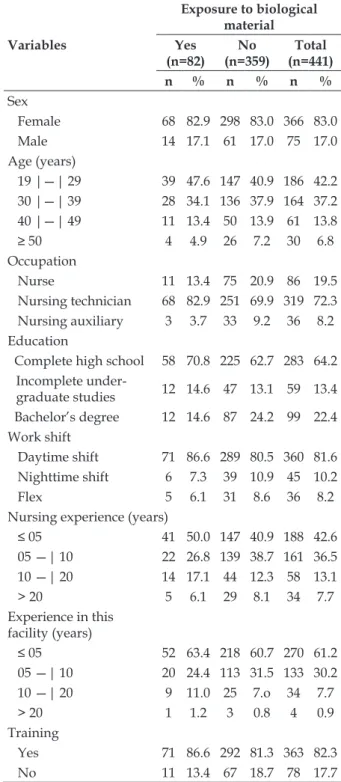
This study population was composed of 441 nursing workers: 72.3% were nursing technicians; 19.5% were nurses; and 8.2% were nursing auxil-iaries; female workers were in the majority (83%). Most were aged from 19 to 29 years old (42.2%) or from 30 to 39 years old (37.2%). Among those who experienced an accident with biological material in the last year, 71 (86.6%) reported attending train-ing programs addresstrain-ing occupational accidents with biological material.
Of the 441 interviewed workers, 82 (18.6%) reported occupational exposure to biological ma-terial in the facility in the 12 months prior to the interview. The distribution of healthcare workers who experienced an occupational accident ac-cording to sex, occupation, education, and work shift, was similar to that of the population under study (Table 1).
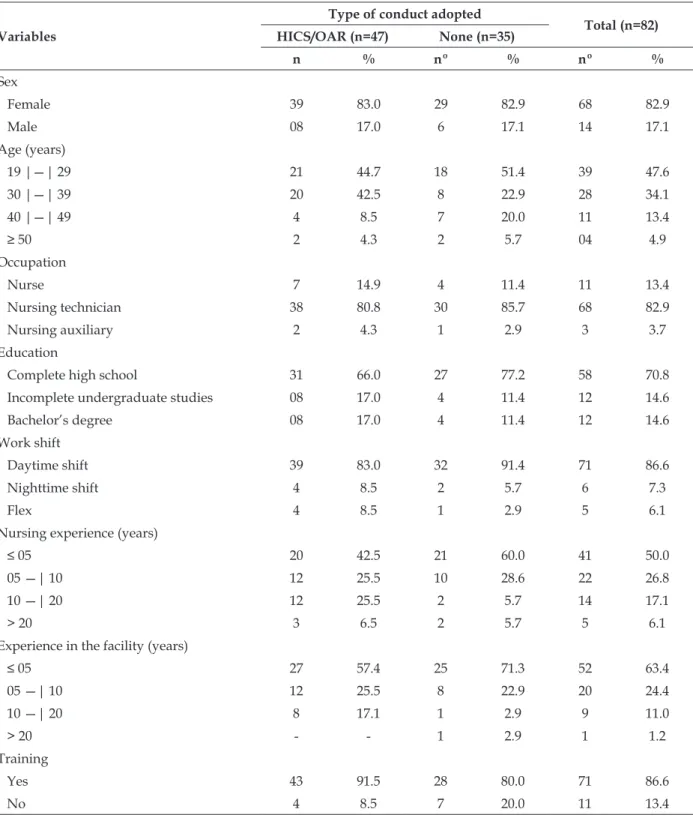
In regard to the type of procedure adopted by the nursing workers after being exposed to biologi-cal material, 47 (57.3%) reported having followed the entire protocol, that is, they sought specialized care and illed in an accident reporting form.
Among those who did not report an accident: 29 (82.9%) were women; 18 (51.4%) were aged from 19 to 29 years old; 85.7% were nursing technicians; and 77.2% had completed high school. In regard to work shift, 32 (91.4%) individuals worked during the daytime. Most (60%) of these individuals had ive or fewer years of professional experience in the nursing ield and 71.3% had worked for ive or fewer years in the facility.
Table 1 – Characterization of individuals according to the occurrence or non-occurrence of occupational accidents involving biological material and study variables. Hospital de Câncer de Barretos, Barretos, São Paulo, Brazil, 2011
Variables
Exposure to biological material Yes
(n=82)
No (n=359)
Total (n=441)
n % n % n %
Sex
Female 68 82.9 298 83.0 366 83.0
Male 14 17.1 61 17.0 75 17.0
Age (years)
19 |—| 29 39 47.6 147 40.9 186 42.2
30 |—| 39 28 34.1 136 37.9 164 37.2
40 |—| 49 11 13.4 50 13.9 61 13.8
≥ 50 4 4.9 26 7.2 30 6.8
Occupation
Nurse 11 13.4 75 20.9 86 19.5
Nursing technician 68 82.9 251 69.9 319 72.3 Nursing auxiliary 3 3.7 33 9.2 36 8.2 Education
Complete high school 58 70.8 225 62.7 283 64.2 Incomplete
under-graduate studies 12 14.6 47 13.1 59 13.4 Bachelor’s degree 12 14.6 87 24.2 99 22.4 Work shift
Daytime shift 71 86.6 289 80.5 360 81.6 Nighttime shift 6 7.3 39 10.9 45 10.2
Flex 5 6.1 31 8.6 36 8.2
Nursing experience (years)
≤ 05 41 50.0 147 40.9 188 42.6
05 —| 10 22 26.8 139 38.7 161 36.5
10 —| 20 14 17.1 44 12.3 58 13.1
> 20 5 6.1 29 8.1 34 7.7
Experience in this facility (years)
≤ 05 52 63.4 218 60.7 270 61.2
05 —| 10 20 24.4 113 31.5 133 30.2
10 —| 20 9 11.0 25 7.o 34 7.7
> 20 1 1.2 3 0.8 4 0.9
Training
Yes 71 86.6 292 81.3 363 82.3
No 11 13.4 67 18.7 78 17.7
Table 2 – Characterization of individuals who experienced occupational accidents with biological material according to the variables under study and type of procedure adopted. Hospital de Câncer de Barretos, Barretos, São Paulo, Brazil, 2011
Variables
Type of conduct adopted
Total (n=82)
HICS/OAR (n=47) None (n=35)
n % nº % nº %
Sex
Female 39 83.0 29 82.9 68 82.9
Male 08 17.0 6 17.1 14 17.1
Age (years)
19 |—| 29 21 44.7 18 51.4 39 47.6
30 |—| 39 20 42.5 8 22.9 28 34.1
40 |—| 49 4 8.5 7 20.0 11 13.4
≥ 50 2 4.3 2 5.7 04 4.9
Occupation
Nurse 7 14.9 4 11.4 11 13.4
Nursing technician 38 80.8 30 85.7 68 82.9
Nursing auxiliary 2 4.3 1 2.9 3 3.7
Education
Complete high school 31 66.0 27 77.2 58 70.8
Incomplete undergraduate studies 08 17.0 4 11.4 12 14.6
Bachelor’s degree 08 17.0 4 11.4 12 14.6
Work shift
Daytime shift 39 83.0 32 91.4 71 86.6
Nighttime shift 4 8.5 2 5.7 6 7.3
Flex 4 8.5 1 2.9 5 6.1
Nursing experience (years)
≤ 05 20 42.5 21 60.0 41 50.0
05 —| 10 12 25.5 10 28.6 22 26.8
10 —| 20 12 25.5 2 5.7 14 17.1
> 20 3 6.5 2 5.7 5 6.1
Experience in the facility (years)
≤ 05 27 57.4 25 71.3 52 63.4
05 —| 10 12 25.5 8 22.9 20 24.4
10 —| 20 8 17.1 1 2.9 9 11.0
> 20 - - 1 2.9 1 1.2
Training
Yes 43 91.5 28 80.0 71 86.6
No 4 8.5 7 20.0 11 13.4
Exposures took place in all the hospital’s sectors, with the exception of the Laborator, Nuclear Medicine and Clinical Oncology. The analysis of type of procedure adopted showed that those working in the Central Sterilizing Services (100%) and Surgical Clinic (55.6%) most
Table 3 – Distribution of individuals who experienced occupational accidents with biological material (n=82), according to the type of procedure adopted and working sector. Hospital de Câncer de Barretos, Barretos, São Paulo, Brazil, 2011
Sector
Type of procedure adopted
HICS/OAR (n=47) None (n=35) Total (n=82)
n % n % n %
Surgical clinic 4 44.4 5 55.6 9 100
Surgical center 16 53.3 14 46.7 30 100
Outpatient surgical center 1 50.0 1 50.0 2 100
Intercurrences center 2 100 - - 2 100
Sterilization center - - 4 100 4 100
Endoscopy 1 50.0 1 50.0 2 100
Hematology and Transplantation Transplante de Medula Óssea 2 50.0 2 50.0 4 100
Surgical hospitalization 4 100 - - 4 100
Clinical hospitalization 3 75.0 1 25.0 4 100
Pediatrics 1 50.0 1 50.0 2 100
Prevention 1 100 - - 1 100
Radiology 2 100 - - 2 100
Radiotherapy 1 100 - - 1 100
Palliative care 2 100 - - 2 100
Intensive Care Unit 7 53.8 6 46.2 13 100
Note there are individuals who experienced more than one incidence of exposure, totaling 127 accidents.
In regard to the type of exposure, of the 68 individuals who did not follow the protocol after
an accident, 51 (75%) experienced skin exposure, 13 (19.1%) skin and mucosa exposure, and 4 (5.9%) experienced percutaneous exposure; blood was the luid most frequently involved in the accidents, i.e., in 36 (52.9%) exposures (Table 4).
Table 4 – Distribution of occupational accidents with biological material (n=127) among nursing
workers according to the type of exposure, body luid, and type of procedure adopted, Hospital de Câncer de Barretos, Barretos, São Paulo, Brazil, 2011
Variables
Type of procedure adopted
HICS/OAR (n=59) None (n=68) Total (n=127)
n % n % n %
Type of exposure
Percutaneous 48 81.4 04 5.9 52 100
Skin and mucosa 4 6.8 13 19.1 17 100
Skin 7 11.8 51 75.0 58 100
Fluid involved in the exposure
Blood 52 88.1 36 52.9 88 100
Other bodily luid with blood 3 5.1 12 17.7 15 100
Other bodily luid without blood 4 6.8 20 29.4 24 100
The reasons presented by the nursing work-ers for not having reported the accidents and not having sought specialized care were grouped into: a) did not consider reporting to be necessary; and b) lack of knowledge.
The following were included in the category “did not consider reporting to be necessary”: “low-risk accident” and “source-patient was HIV nega-tive.” The following were grouped under “lack of
knowledge”: “I did not know how to do it”, “I did not know I should report and/or seek specialized care”, and “I did not know it was considered an accident.” Considering it unnecessary to report the accident and seek specialized clinical care was the reason most frequently reported by the 49 (72.1%) professionals who experienced occupational accidents.
proce-dure that should be adopted after an accident and only 33 (40.2%) individuals who experienced occu-pational accidents described the correct protocol; 21 (25.7%) mentioned that only seeking specialized care was necessary, while 17 (20.7%) mentioned that only completing the OAR form was necessary. Nine (11.0%) participants said that the supervisor should be notiied and two (2.4%) were not able to report the correct protocol.
DISCUSSION
This study reinforces the fact that accidents with biological material affecting nursing workers are a severe problem faced in healthcare facilities, both due to the frequency with which they occur and their severity. A similar result, a rate of 17.5% of accidents with biological material, is reported by one study conducted with nursing workers from a general hospital in the state of Paraná, Brazil14, while one study conducted in a regional hospital in Thailand reported a rate of 23.8%.15
Many factors impact the rate of accidents with biological material, among them the type of healthcare facility and type of patients under care, so that careful judgment should be used when comparing rates among facilities.
Results of other investigations also indicate that units such as surgical centers, emergency rooms, and intensive care units are the sectors with a greater predominance of exposure to biological material.16-18 One study conducted in Pelotas, state of Rio Grande do Sul, Brazil reports that high levels of stress accruing from heavy workloads may fa-vor accidents with biological material among nurs-ing professionals worknurs-ing in surgical centers.19
Even though the reporting of accidents with biological material is legally mandatory, in prac-tice not all workers do so. Studies have shown varied rates of underreporting depending on the type of exposure, profession, and policies estab-lished by healthcare facilities concerning accident reporting.20-21
Underreporting is a signiicant challenge to be faced because it hinders knowledge of the real incidence rates of occupational accidents, a factor that may relect lack of knowledge or lack of at -tention on the part of healthcare workers in regard to the severity of accidents.10
One study, conducted in a university hos-pital in the interior of São Paulo, veriied the rate of underreporting of accidents with biological material by comparing two databases. That study
reports a rate 29.92%.6 Researchers analyzed two American databases in 1997 and 1998 and esti-mated that 384,325 percutaneous accidents occur every year among healthcare providers working in hospitals, only 43.4% of which are reported.22
Therefore, even though clinical follow-up af-ter accidents with biological maaf-terial is considered an important measure to protect the victim, not reporting the accident or abandoning treatment have been found in various studies and reached considerable rates of occurrence.8,13,17
In this study, skin exposure was the exposure for which most professionals did not adopt any procedure. Even though chemoprophylaxis is not recommended when exposure involves intact skin, there is still the need to complete an OAR form.3 Studies have shown that workers have a greater inclination to dismiss or ignore protocol in cases of accidents involving the skin or mucosa.23-24
Despite the fact that accidents involving skin and mucosa are considered of low risk for the trans-mission of bloodborne pathogens, there is a report of one worker from the nursing staff who acquired HIV after having contact with blood through her eye mucosa during a venous puncture procedure.2
Assessing accidents to be of low risk was the reason alleged by the workers for not reporting exposure to biological material and not seeking specialized clinical care; other investigations cor-roborated these indings.13,25-26
One study conducted in the United States and addressing accidents with biological material also reinforces these results. It reports that the most common reason for the underreporting of accidents with biological material among health-care workers and students was considering the exposure to be unimportant.23
Other reasons presented by healthcare work-ers for the underreporting of accidents were lack of knowledge regarding the reporting procedures and lack of knowledge regarding exposure to bio-logical material protocols; these were also identi-ied by other auhors.27-28
These results lead to relection and raise questions concerning lack of knowledge or lack of awareness among workers regarding the risk of occupational exposure and the importance of specialized medical follow-up as a protective measure.
adhering to protocols concerning occupational ex-posure to biological material and avoiding making erroneous assessments of the situation.
CONCLUSION
The transmission of blood-borne pathogens to healthcare workers is a public health problem worldwide. Becoming infected by HIV, HBV, or HCV through an occupational accident with bio-logical material is a real possibility.
Underestimating risk is an important vari-able both for underreporting and for not seeking specialized clinical care and should be better investigated.
This study showed that the main reason for workers not completing Occupational Accident Reporting forms and for not seeking specialized care was considering that the exposure posed low or no risk. Most professionals who experienced accidents and did not report them had received training addressing prevention and protocols concerning occupational exposure to biological material. These indings show that training does not promote reporting since knowledge per se is not enough to encourage healthcare workers to adopt safe behavior at work.
Many workers did not pay proper attention to the risks related to accidents involving bio-logical material, often incorporating occupational accidents as components of the work routine. Therefore, working in an unhealthy or risk-laden environment may reduce the perception of work-ers concerning the need to adopt preventive mea-sures for their own protection.
This study presents some limitations. The participants were asked during the individual interview to report their exposure to biological material in the last year. It is possible that some events were not mentioned due to forgetfulness so that there is a potential bias related to a pos-sible underestimation of underreporting. Another potential limitation involves the fact that data were not compared to oficial records of both the Hospital Infection Control Service and Specialized Safety Engineering and Occupational Medicine.
This study enabled the identiication of the procedures adopted by the nursing workers in response to occupational exposure to biological material and the reasons presented for not adopt-ing the recommended procedures.
The results indicate the need for further studies that address the behavior of workers in
response to occupational accidents that expose them to the risk of being infected with blood-borne pathogens and consequent harm to health. Additionally, future studies may support the development and implementation of measures for facilities to improve nursing professionals’ adherence to protocols, conferring greater safety to these professionals.
REFERENCES
1. Brum MCB, Filho FFD, Yates ZB, Viana MCV, Chaves EBM, Trindade DM. HIV seroconversion in a health care worker who underwent postexposure prophylaxis following needlestick injury. Am J Infect Control. 2013 Mai; 41(5):471-2.
2. Lucena NO, Pereira FR, Barros FS, Silva NB, Alexandre MAA, Castilho MC, et al. Infecção pelo HIV-1 após acidente ocupacional, no Estado do Amazonas: primeiro caso documentado. Rev Soc Bras Med Trop. 2011 Set-Out; 44(5):646-7.
3. Ministério da Saúde (BR). Secretaria de Vigilância em Saúde. Programa Nacional de DST e Aids. Recomendações para terapia com antirretroviral
em adultos infectados pelo HIV.Suplemento III –
Tratamento e prevenção. Brasília (DF): MS, 2010.
4. Prüss-üstün A, Rapiti E, Hutin Y. Estimation of the global burden of disease attributable to contamina-ted sharps injuries among health-care workers. Am J Industrial Med. 2005 Dez; 48(6):482-90.
5. Butsashvili M, Kamkamidze G, Kajaia M, Morse DL, Triner W, De Hovitz J, et al. Ocupational exposure to
body luids among health care workers in Gerorgia.
Occup Med (Lond). 2012 Dez; 62(8):620-6.
6. Rampal L, Zakaria L, Sook L, Zain AM. Needle stick and sharps injuries and factors associated among health care workers in a Malaysian Hospital. European J Social Sciences. 2010 Mar; 13(3):354-62 7. Yoshikawa T1, Wada K, Lee JJ, Mitsuda T, Kidouchi
K, Kurosu H, et al. Incidence rate of needlestick and sharps injuries in 67 Japanese hospitals: a national sur-veillance study. PLoS One. 2013 Oct; 30;8(10): e77524. 8. Valim MD, Marziale MHP. Avaliação da exposição
ocupacional a material biológico em serviços de saúde. Texto Contexto Enferm. 2011; 20(esp):138-46. 9. Henderson DK. Managing occupational risks for
Hepatitis C transmission in the health care setting. Clin Microbiol Rev. 2003 Jul; 16(3):546-68.
10. Centers for disease control e prevention (CDC). Workbook for designing, Implementing and evaluating a sharps injury prevention program
[internet]. 2008 [acesso 2011 Mar 06]. Disponível
em: http://www.cdc.gov/sharpssafety/pdf/ sharpsworkbook_2008.pdf
Needlestick Safety and Prevention Act on hospital sharps injuries. Infect Control Hosp Epidemiol. 2013 Sep; 34(9):935-9.
12. Ferreira MD, Godoy VS, Facchin LT, Silveira RCCP,
Sonobe HM, Gir E, et al. Adesão dos proissionais
de saúde às precauções-padrão: uma revisão integrativa da literatura. Rev Enferm UFPE. 2009 Out-Dez; 3(4):261-8.
13. Voide C, Darling KE, Kenfak-Foguena A. Underreporting of needlestick and sharps injuries among healthcare workers in a Swiss University Hospital. Swiss Med Wkly. 2012 Feb; 142:w13523. 14. Oliveira BAC, Kluthcovsky ACGC, Kluthcovsky
FA. Estudo sobre a ocorrência de acidentes de trabalho com material biológico em proissionais
de enfermagem de um hospital. Cogitare Enferm. 2008 Abr-Jun; 13(1):194-05.
15. Honda M, Chompikul J, Rattanapan C, Wood G, Klungboonkrong S. Sharps injuries among nurses in a Thai Regional Hospital: prevalence and risk factors. Int J Occup Environ Med. 2011 Out; 2(4):215-23.
16. Chaiwarith R, Ngamsrikam T, Fupinwong S, Sirisanthana T. Occupational exposure to blood and
body luids among healthcare workers in a teaching
hospital: an experience from northern Thailand. Japanese J Infect Dis. 2013 Nov; 66(2):121-5.
17. Gomes AC, Agy LL, Malaguti SE, Canini SRMS, Cruz EDA, Gir E. Acidentes Ocupacionais com Material biológico e equipe de enfermagem de um hospital-escola. Rev Enferm UERJ. 2009 Abr-Jun; 17(2):220-3.
18. Park S, Jeong I, Huh J, Yoon Y, Lee S, Choi C. Needlestick and sharp injuries in a tertiary hospital in the Republic of Korea. Am J Infect Control. 2008 Ago; 36(6):439-43.
19. Lima ML, Oliveira CC, Rodrigues KMR. Exposição ocupacional por material biológico no Hospital
Santa Casa de Pelotas - 2004 a 2008. Rev Anna Nery.
2011Jan-Mar; 15(1):96-102.
20. Hanai MI, Mohamed AM, Kassem MS, Shawki M.
Needlestick injuries among health care workers of University of Alexandria Hospitals. East Mediterr Health J. 2011;17(1):26-35.
21. Fullerton M, Gibbons V. Needlestick injuries in a healthcare setting in New Zealand. N Z Med J. 2011;124(1335):33-9.
22. Panlilio AL, Orelien JG, Srivastava PU, Jagger J, Cohn RD, Cardo DM. Estimate of the annual number of percutaneous injuries among hospital-based healthcare workers in the United States, 1997-1998. Infect Control Hosp Epidemiol. 2004 Jul; 25(7):556-62.
23. Kessler CS, McGuinn M, Spec A, Christensen J, Baragi R, Hershow RC. Underreporting of blood and
body luid exposures among health care students
and trainees in the acute care setting: a 2007 survey. Am J Infect Control. 2011 Mar; 39(2):129-34.
24. Osborne S. Perceptions that inluence occupational
exposure reporting. AORN J. 2003 Ago; 78(2):262-72. 25. Pimenta FR, Ferreira MD, Gir E, Hayashida M,
Canini SRMS. Atendimento e seguimento clínico
especializado de profissionais de enfermagem acidentados com material biológico. Rev Esc Enferm USP. 2013 Fev; 47(1):198-204.
26. Facchin LT, Gir E, Filho AP, Hayashida M, Canini SRMS. Under-reporting of accidents involving biological material by nursing professionals at a Brazilian Emergency Hospital. Int J Occup Saf Ergon. 2013 Out; 19(4):623-9.
27. Gershon RRM, Pearson JM, Sherman MF, Samar SM, Canton AN, Stone PW. The prevalence and risk factors for percutaneous injuries in registered nurses in the home health care sector. Am J Infect Control. 2009 Set; 37(7):525-33.
28. Shiao JS, McLaws ML, Lin MH, Jagger J, Chen CJ. Chinese EPINet and recall rates for percutaneous injuries: an epidemic proportion of underreporting in the Taiwan healthcare system. J Occup Health. 2009 Fev; 51(2):132-6.
Correspondence: Paula Batista Luize Avenida Altair da Silva Bonim, 1355, 14784-347 — Jardim Soares, Barretos, SP, Brasil E-mail: [email protected]