terminality of life
Lauren Tana Comin 1, Marina Panka 2, Vilma Beltrame 3, Jovani Antônio Stefani 4, Elcio Luiz Bonamigo 5
Abstract
With the aim of analysing the percepion of cancer paients towards the end of life, a quesionnaire was applied to 100 oncologic paients, of which 85% were unaware of living will/advance direcives, 81% were unaware of the terms palliaive care and 70% were unaware of order to not reanimate. Ater clarifying the meaning of the terms used, 62% agreed to make living will/advance direcives, 82% to receive palliaive care at home and 64% to be reanimated in any situaion, but the majority (73%) disagreed with the pracice of fuility. Only 11% reported inadequacies in the communicaion of their diagnosis by the physician. The fact of having metastases elicited a broader relecion on the terminaion of life. The results allow to infer that it is necessary to encourage the discussion about terminaion of life to the populaion during paient care, as well to promote the respecive training to health professionals since the undergraduate course.
Keywords: Terminally ill. Oncology service, hospital. Palliaive care. Living wills. Resuscitaion orders.
Resumo
Percepção de pacientes oncológicos sobre terminalidade de vida
Objeivou-se analisar, por meio de pesquisa descriiva, a percepção de pacientes oncológicos diante da terminalidade da vida. Aplicou-se quesionário para 100 pacientes oncológicos, dos quais 85% desconheciam testamento vital/direivas antecipadas de vontade, 81% desconheciam cuidados paliaivos e 70% desconheciam ordem de não reanimar. Após esclarecimento sobre os termos empregados, 62% concordariam em elaborar testamento vital/direivas antecipadas de vontade, 82% concordariam em receber cuidados paliaivos no domicílio e 64% em ser reanimados em qualquer situação, mas a maioria (73%) discordou da práica de distanásia. Apenas 11% referiram inadequação na forma de comunicação de seu diagnósico pelo médico. A presença de metástases suscitou relexão mais ampla sobre terminalidade da vida. Os resultados permitem inferir que é necessário incenivar a discussão sobre terminalidade da vida na população durante a assistência aos pacientes, bem como esimular o debate sobre o assunto durante a formação de proissionais de saúde.
Palavras-chave: Doente terminal. Serviço hospitalar de oncologia. Cuidados paliaivos. Testamentos quanto à
vida. Ordens quanto à conduta (éica médica).
Resumen
Percepción de los pacientes oncológicos sobre la terminalidad de la vida
Con el in de analizar la percepción de los pacientes con cáncer frente al inal de su vida, a través de una invesigación descripiva, se aplicó un cuesionario a 100 pacientes de cáncer, entre los cuales el 85% desconocía las direcivas anicipadas de voluntad, el 81% desconocía los términos de cuidados paliaivos y el 70% desconocía la orden de no reanimar. Después de la clariicación del signiicado de los términos uilizados, el 62% estaba de acuerdo para elaborar su testamento vital/direcivas anicipadas de voluntad, el 82% para recibir los cuidados paliaivos en el hogar y el 64% para ser restablecido en cualquier situación, pero la mayoría (73%) no estuvo de acuerdo con la distanasia. Tan sólo el 11% consideró inadecuada la comunicación del diagnósico por el médico. El hecho de portar metástasis amplió la relexión sobre el inal de la vida. Los resultados muestran que es necesario fomentar la discusión del inal de la vida en la población durante la atención al paciente, y promover la respeciva formación a los profesionales de la salud desde el pregrado.
Palabras clave: Enfermo terminal. Servicio de oncología en hospital. Cuidados paliaivos. Voluntad en vida.
Órdenes de resucitación.
Aprovação CEP-Unoesc 752.502/2014
1.Graduada [email protected] – Universidade do Oeste de Santa Catarina (Unoesc). 2.Graduadamarina_panka@ hotmail.com – Unoesc 3.Doutora[email protected] – Unoesc 4.Doutor[email protected] – Unoesc 5.Doutor[email protected] – Unoesc, Joaçaba/SC, Brasil.
Correspondência
Elcio Luiz Bonamigo – Rua Treze de Maio, 122, salas 21 e 22 CEP 89600-000. Joaçaba/SC, Brasil.
Declaram não haver conlito de interesses.
R
e
s
e
a
r
c
During the terminaion of life, the paient may be faced with unusual situaions in which it is diicult to decide about health care, among which are: receiving bad news, palliaive care, advance direcives (living will), order not to reanimate and dysthanasia. In Brazil, the communicaion of bad news had a signiicant advance with the disseminaion of the Spikes Protocol, but its inserion in undergraduate educaion is recent 1.
The creaion of an area of medical acivity in palliaive care by the Conselho Federal de Medicina - CFM (Federal Council of Medicine) 2 relects the present
intenion to encourage its development with the goal to improve the care of paients that need them.
Although there is no federal law about this, the approval of CFM Resoluion 1995/2012 3 made the
acceptance by physicians of the advance direcives feasible and favored their acceptance by paients. The Carta dos Direitos dos Usuários da Saúde (Health Users’ Rights Charter) 4 assured to the paients the
right to choose the place of death, appointment of a representaive and the possibility of refusing treatment. Concerning the order not to reanimate, there is no explicit oicial guideline in Brazil, but there are ethical 5
and legal 4 norms with the goal of prevening the
pracice of dysthanasia. In this context, the importance of invesigaing the percepion of paients in relaion to diferent aspects of health care arises, especially when there is no therapeuic possibility. Thus, the goal of the present study was to describe the percepion of oncology paients in the face of several aspects of the terminality of life.
Methods
This was a cross-cuing quanitaive, applied and descripive study, in which 100 oncology paients of both genders and above the age of 18, present at the oncology sector of the Santa Terezinha University Hospital (“Hospital Universitário Santa Terezinha”, HUST) in Joaçaba, Santa Catarina, Brazil, were interviewed between August and November 2014. The type of cancer and the treatment were not relevant for the purposes of this study. The inclusion criteria included paients on cancer treatment at HUST during the study period who agreed to paricipate ater reading and understanding the informed consent form (ICF), presented by the researchers and approved by the CEP HUST / Unoesc.
The exclusion criteria were restricted to cases in which the paricipant did not have an interest in collaboraing with the research or in acceping the ICF content. Literate paients received quesionnaires to respond on their own; the quesions were read by the researchers to those who could not read, and
the answers were recorded in the assessment tool. The choice of this hospital was due to the fact that it is classiied as a high complexity service for cancer treatments in the health care network of the Sistema Único de Saúde - SUS (Uniied Health System).
This insituion is a reference service in the area for the municipaliies that comprise the macro health region in the Midwest of the State of Santa Catarina, a condiion that allowed access to paients coming from diferent municipaliies. In Santa Catarina, this macro region is composed of the midwestern, Alto Vale do Rio do Peixe and Alto Uruguai Catarinense regions, comprising 59 municipaliies and encompassing an esimated populaion of 623,446 inhabitants, according to a projecion of the Insituto Brasileiro de Geograia e Estaísica - IBGE (Brazilian Insitute of Geography and Staisics) for 2016 6.
For data collecion, a structured quesionnaire with 21 muliple choice quesions was elaborated. These quesions comprised socio-demographical data, the type of cancer, the presence of metastases and self-assessment of the quality of life ater the cancer diagnosis. Also, these encompassed the physician-patient and physician-family relationship and the knowledge of the paient on living will and advance direcives, palliaive care and order not to reanimate. The questionnaire was applied through a direct interview with paricipants in a private environment, adequately prepared for this purpose.
The staisical analysis was performed using the Microsot Excel sotware, using the chi-square test with a 95% conidence interval. Based on the results, the following staisical correlaions were invesigated: dysthanasia and advance direcives × gender, age and knowledge; place where palliaive care was received × knowledge; and a relecion on the terminality of life × presence of metastases.
Results
According to the socio-demographical data, females prevailed among the research paricipants (63%), as well as the age groups from 20 to 39 and 40 to 49 years of age (both with 44% of paricipants), followed by the group above 60 years old (12%), and the marital status “with partner” (63%). About schooling, 68% had elementary school studies, 23% had high school studies, 6% had college studies, and 3% declared to be illiterate. The predominant religion was catholic (77%), followed by evangelical (18%), spiriist (1%), protestant (1%) and others (3%). About the locaion of the cancer, the most afected organs/ tissues were the breasts (39%), followed by the
R
e
s
e
a
r
c
intesines (13%), uterus (7%), lymphomas (5%), lungs (5%), stomach (4%), prostate (4%), bladder (3%), skin (3%), cervix (2%), throat (2%), bones (2%), rectum (2%) and others (9%). Metastases were reported by 35% of the paients at the moment of the interview.
In the self-assessment on quality of life ater the cancer diagnosis, performed through a scale from 0 to 10 points, the average was 7.74 – zero meaning (poor quality of life) and ten (meaning excellent quality of life). In this self-assessment, 16% marked a grade less than or equal to 5 points and 84% marked a grade greater than 5, it is noteworthy that 32% opted by the grade 10. In what concerns the communicaion about the disease, according to 89% of the paients the physician was careful when informing the diagnosis and provided adequate explanaions to their understanding, while in the other extreme of the scale, 11% understand that the physician did not fulill these requirements.
Regarding the doctor’s atenion to the family in the diagnosis, 95% of the paients understood that they were suiciently careful and adequate, but 5% disagreed (Table 1). Faced with the hypothesis of cardiorespiratory arrest in paients with severe and terminal diseases, 64% of cancer paients stated that they wished to be reanimated in any situaion and 36% disagreed. Most of the paients (51%) had never thought that the cure was no longer possible and 49% had considered the issue, of which 31% thought about it very much or occasionally. In the terminal phase of
life, with severe and incurable disease, 27% agreed to be kept alive only by apparatus (dysthanasia) and 73% disagreed (Table 1).
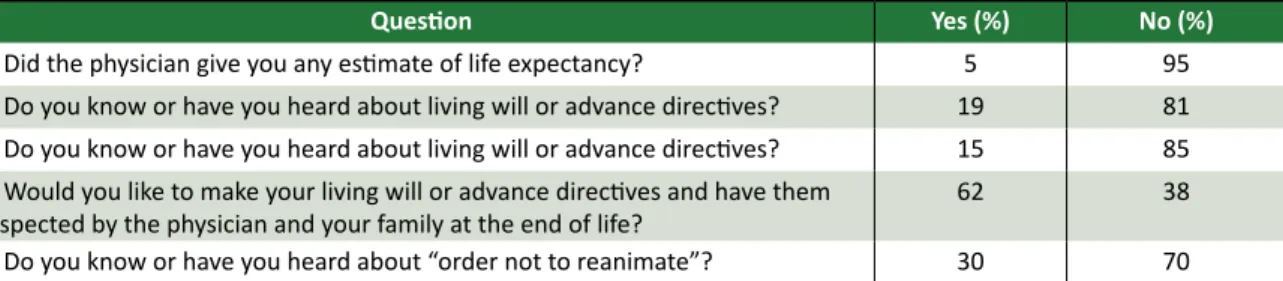
Paients were asked about four situaions that may arise during the terminaion of life. In response, 95% stated that they had not received any esimate of remaining life expectancy by the atending physician, 81% did not know about palliaive care, 85% did not know about living will or advance direcives, and 70% did not know or had heard about order not to reanimate (Table 2).
Regarding the place to receive palliaive care, 82% of the paricipants stated that they would like to be cared for at home, and 18% at a hospital. When asked about who should decide their treatment in relaion to the terminality of life, 42% of the paients would like to decide with the physician and the family, 16% would leave the decision to the physician alone, 13% would like the family and the physician to decide together, 11% would prefer to decide on their own, 7% only the family, 6% with the family and 5% with the physician. Correlaions of paients’ perception about the terminality of life were studied, which were not signiicant in relaion to gender, age, knowledge and presence of metastases (p > 0.05). However, the occurrence of metastases
led to a greater number of paients thinking about terminaion of life, and this result was very close to being signiicant (p = 0.0772).
Table 1. Percepion of oncology paients on the communicaion of diagnosis of disease without the possibility of cure
Quesion Possible answers %
1. Was the physician careful when giving you the diagnosis and did th e physician
explain about your disease ? Parially agreeFully agree
Parially disagree Fully disagree
58 31 7 4 2. Was the physician atenive to your family when giving the diagnosis? Fully agree
Parially agree Parially disagree
Fully disagree
70 25 3 2
3. In case of cardiorespiratory arrest with serious and incurable disease, would
you agree to be reanimated in any situaion? Parially agreeFully agree Parially disagree
Fully disagree
36 28 17 19 4. In a situaion of terminaion of life, with severe and incurable disease, would
you agree to be kept alive only by apparatus (dysthanasia)? Parially agreeFully agree Parially disagree
Fully disagree
12 15 32 41
5. Have you ever thought about being in a situaion in which the cure is no longer
possible? OccasionallyVery much
A litle Never
14 17 18 51
R
e
s
e
a
r
c
Discussion
Most patients were women. Due to their predominance in the populaion, breast cancers, the second most frequent in women 7, and uterus
cancer, the third most frequent, have possibly contributed to the prevalence of females. The age group over 40 years old predominated, which shows an increase in oncological diseases with age. Most of the paricipants had not relected on the possibility of having an incurable disease. However, when only paients with metastasis (35%) were analyzed, it was observed that the severity of the disease elicited more frequent relecion on the terminality of life and the result was very close to being staisically signiicant (p = 0.0772).
When paricipants were asked about their quality of life, the average grade was high (7.74). This self-assessment has a subjecive, complex and mulidimensional nature, besides containing a wide variety of internal and external condiions, deined by the individual 8. Thus, even being a cancer
paient, the disease does not prevent the paient from presening a high degree of saisfacion and well-being in their process of living. The physician was careful in giving the diagnosis and explaining about the disease in the percepion of nearly all paients.
The research participants wish to have informaion that allows them to choose alternaives and control decisions during the end of life 9.
However, one study pointed out that many would like to receive more informaion than they had received 10. The clarifications contribute for the
previous experiences of family members about death and the end of life not to have a negaive inluence in the moment of decision 11. In this study, 11% of
the paients were not saisied with the physician-paient relaionship, which is, thus, a fragility to be overcome. Talking to the family about aspects of the disease contributes for the team to understand how the experience is being lived by the paient and,
thus, for them to be able to help the paient to make decisions concerning his/her future 11.
Although with reservations about the consequences, informing the prognostic is the duty of the physician, which is clearly provided for in aricle 34 of the Code of Medical Ethics 12.
Fewer than half of the paients discussed their vital prognosis with the physician and nearly all of them (95%) did not receive an esimate of life expectancy, a fundamental condiion for planning the future in the case of a serious disease. In this context, the informaion needs to be gradual and bearable on order for communicaion to bring fewer harms than beneits. This result is in conformity with a recent mulinaional study in which interviewees were asked if they had talked to a physician or another health professional about their desires regarding the care at the end of life. There was a negaive answer from 88% of North Americans, 87% of Italians, 93% of the Japanese and 90% of the Brazilians 13.
In relation to palliative care, most of the paients stated that they did not know about them. It is inferred that in-depth discussions on issues related to the terminaion of life will contribute to greater knowledge and beter co-paricipaion of the paient in making decisions related to his life and the form of his end. On the one hand, the scope of palliaive care goes beyond the physical and biological limits of the patient, reaching its singularity and its biopsychosocial context 14; on the other hand, when
the paient and/or his/her family are not properly oriented about the consequences of the disease and the possible behaviors to minimize them, they are prevented from assuming conscious posiion in the process of death with dignity 15.
However, palliaive care has gradually grown as a concern for professionals, especially those in the area of oncology in the sense of allowing the paient to accept their pain and sufering, without adequately discussing the therapeutic options, and neglecing support to the family in maters of sufering for the loss of the loved one 14.
Table 2. Percepion of oncology paients about the terminality of life
Quesion Yes (%) No (%)
1. Did the physician give you any esimate of life expectancy? 5 95
2. Do you know or have you heard about living will or advance direcives? 19 81 3. Do you know or have you heard about living will or advance direcives? 15 85 4. Would you like to make your living will or advance direcives and have them
respected by the physician and your family at the end of life? 62 38
5. Do you know or have you heard about “order not to reanimate”? 30 70
R
e
s
e
a
r
c
Few paients (15%) were aware of the terms “living will” or “advance direcive”. The terms were considered as synonymous for the purpose of the research. However, a living will consists of the manifestaion of will over the care that the paient wishes to receive or not receive, whereas advance direcives, in addiion, include the possibility of appointment of representative and allow the manifestaion of other wills, such as organ donaion.
The inclusion of the two expressions in the same quesion allowed for bias in the result. However, an earlier study on the living will, performed with cancer patients and their companions, found similar results 16, signaling that this subject remains
restricted to the academic environment, with incipient popularizaion, distant from the public domain. Ater the explanaion of the terms, the interviewees were asked about the willingness to prepare the document and have it respected in an end-of-life situaion, and an airmaive response was obtained from the majority (62%).
There was no significant variation between genders, age and previous knowledge about the terms. In the study by Campos et al. 16, acceptance among
paients was even higher, with 9.56 points on a 0-10 scale, thus showing the desire of the paient to broadly exercise his/her autonomy. In the United States, 27% of the interviewed informed they had a writen document with record of their will; among Hispanics, however, only 11% conirmed that 17. The Brazilian
society needs to intensify the debate the terminality of life, recognizing that the living will contributes to the autonomy and digniied death of the paient 18.
The elaboraion of the living will favors the dialogue between family members, physician and patient in order to respect to the maximum the paient’s preferences about care in the end of life 19. A
naional awareness campaign on advance direcives, especially associated with the clariicaion of physicians and other health professionals, is needed to the beter understanding by families about the fulillment of paients’ wishes 20. In this context, promoing the
bioethical relecion will allow the advance direcives to be consolidated as an instrument to fulill the wishes previously expressed by the paient 21.
Regarding the order not to reanimate, 70% of the paients did not know the expression. However, ater being clariied about the meaning, most of them would agree to its use if it were in the end of life. The relecion on this theme is not frequent in the literature. A previous study, conducted in the same region, showed that 10% of the physicians did not know the term 5, showing that its approach
by medical schools is not systemaic. The lack of ethical and legal orientaion is a factor that probably contributes to the lack of knowledge in Brazil, raising the need for regulaion.
Most paients never thought that they could be in a situation where a cure was no longer possible. This shows the tendency of litle relecion about the end of life among the populaion, except when the disease gets worse, as occurred in relaion to the presence of metastases. This observaion is corroborated by the inding that the majority of paients - of those who have never heard of palliaive care - would choose to receive them if they were terminally ill, ater the interviewers clariied the term. However, it is possible that, ater responding to this quesionnaire, paricipants included death in their relecions, a fact that, among the posiive aspects, could contribute to their life planning.
A mulinaional survey has shown that death is a subject avoided by 69% of respondents in the United States, 63% in Brazil, 61% in Italy and 57% in Japan 13. However, not thinking about the end of
life can be a strategy for the individual to maintain a posiive outlook while avoiding depression. In addition, the taboo that involves the concept of death in the populaion also seems to have contributed to the little reflection among the paricipants.
Regarding decision-making at the end of life, the patients’ preference was for the joint paricipaion between doctor and family, besides the paient. In the study by Campos et al. 16 about
living will, the preference among paients was for the decision by the family, followed by that of the paient and then, the physicians. The joint decision between only the physician and the paient came in last place. Among medical students, the preference of 62% was also for the consensus among the paient, the physician and the family 21, which favors
the balance in decision-making and preserves the autonomy of the paient.
In a survey comparing the populaion of four countries, the preference of respondents for end-of-life decisions was for sharing these between the paient and the family, whereas the preference for medical-only decision ranged from 8% in the United States and 10% in Japan to 30% In Italy and 40% in Brazil 13. The result among Brazilian
respondents was higher than that found in our study (16%), revealing a new trend in relaion to the valorizaion of autonomy. Most paients would choose to receive palliaive care at home if they were terminally ill.
R
e
s
e
a
r
c
In a study by Frizzo et al. 22, performed with
medical students, the majority responded that the place of death should be decided by the paient with the family. In a survey of 50 students in the 5th year
of medical school at the Universidade Nove de Julho in São Paulo 23, 40% of the subjects answered that
the paient in end of life deserves to spend the ime that he/she has let with the family. Hospitals are places that, in general, do not give the family free access to the paient, thus hindering the freedom to express the emoional state.
In cases of patients with no therapeutic possibility, this experience of withdrawal can be traumaizing, both for paients and their families, even making the mourning process difficult 24.
Dying at home was also the preference of 71% of Americans, 61% of Italians, 55% of Japanese and 64% of Brazilians 13. In this context, it should be
noted that many home visits are made by physicians in the beginning of their careers, who only have undergraduate degrees. In a survey conducted in medical school 22,only 58.9% of the students in the
last year felt prepared for the pracice of palliaive care, showing the need for a stronger emphasis on the teaching of this subject which has recently become an area of medical acivity 2.
Most of the patients agreed to being reanimated in any situation in case of cardiorespiratory arrest. This presupposes the fact that many did not know the implicaions of an unsuccessful reanimaion. A north american study 25
showed that 79% of the patients interviewed thought that cardiorespiratory reanimaion was successful in 50% to 90% of the cases and wished to be reanimated. However, ater being informed that the rate of success is below 25% and that severe damages to the organs are frequent, only 52% sill wanted to be reanimated in any situaion, showing the importance of disseminaing informaion about the proceeding to guide the decision.
In Brazil, in a survey performed only with physicians, 93% would disagree to reanimate a family member in any situation 5, showing the value of
knowing the consequences of the proceeding. Most paients also disagreed with the possibility of been kept alive only by apparatus in a situaion that conigured dysthanasia. This result agrees with the study by Campos et al. 16, which surveyed the preference
of patients about orthothanasia, euthanasia and dysthanasia, the preference for dysthanasia being minimal: a grade of 2.07 in a scale from 1 to 10 points.
The Health Users’ Rights Charter 4, the sole
paragraph of article 41 of the Code of Medical
Ethics 12 and CFM Resoluion 1805/2006 26 are devices
that contribute greatly to protect the paient against futile and/or obstinate measures in the health care. The elaboraion of an advance direcive that contains the paient’s wishes and the designaion of a representaive can preserve the paient’s autonomy and avoid dysthanasia if this is his/her desire 18,27.
Final consideraions
Contrary to common sense, which correlates cancer with negaive implicaions on quality of life, this study showed that, even ater diagnosis, paients can present a high degree of saisfacion and well-being in their life process. Another contribuion of this study was to show that the knowledge of the meaning of the terms or expressions “order not to reanimate”, “palliaive care”, “living will” or “advance direcives” and “dysthanasia” can change the stance of paients in situaions of terminaion of life. It was undoubtedly evidenced that the lack of posiioning on these issues occurs mainly due to lack of knowledge.
The results of this work corroborate the literature discussed, indicaing a near consensus as to the best place for someone to inish their days, preferably at home, near the loved ones, also considering as most appropriate treatment that deined by the paient-doctor-family trinomial. Most paients said the doctor was careful in giving the diagnosis and informaion about cancer, in addiion to being considerate of the family and the paient. However, there was some disagreement.
In addiion, it is necessary to consider the fact that currently a signiicant porion of house calls are performed by doctors in the beginning of their careers. This points to the need and importance of improving the approach to life terminaion issues in undergraduate medical educaion. In this context, it is possible to infer that the discussions about such important subjects sill remain restricted to the academic environment and, therefore, very far from the public domain.
The importance of knowing, discussing and presening this diagnosis to the paient is fundamental to the physicians who experience this situaion in their professional pracice. This signals the need to adopt strategies to democratize this knowledge, between professionals and society, improving the access of users to public and private health systems. This acion will broaden and qualify the paient’s paricipaion in the decision-making process related to his or her life and the form of terminaion.
R
e
s
e
a
r
c
Referências
1. Bonamigo EL, Destefani AS. A dramaização como estratégia de ensino da comunicação de más noícias ao paciente durante a graduação médica. Rev. bioét. (Impr.). 2010;18(3):725-42. 2. Conselho Federal de Medicina. Resolução CFM nº 1.973, de 14 de julho de 2011. Dispõe
sobre a nova redação do Anexo II da Resolução CFM nº 1.845/08, que celebra o convênio de reconhecimento de especialidades médicas irmado entre o Conselho Federal de Medicina (CFM), a Associação Médica Brasileira (AMB) e a Comissão Nacional de Residência Médica (CNRM). Diário Oicial da União. Brasília; 1º ago 2011. Seção 1. p. 144-7.
3. Conselho Federal de Medicina. Resolução CFM nº 1.995, de 9 de agosto de 2012. Dispõe sobre as direivas antecipadas de vontade dos pacientes. [Internet]. Diário Oicial da União. Brasília; 31 ago 2012 [acesso 25 maio 2014]. p. 269-70. Disponível: htp://bit.ly/207VBbw
4. Brasil. Ministério da Saúde. Carta dos direitos dos usuários da saúde. 4ª ed. Brasília: Ministério da Saúde; 2013.
5. Putzel EL, Hilleshein KD, Bonamigo EL. Ordem de não reanimar pacientes em fase terminal sob a perspeciva de médicos. Rev. bioét. (Impr.). 2016;24(3):596-602.
6. Insituto Brasileiro de Geograia e Estaísica. Esimaivas da população residente para os municípios e para as unidades da federação brasileiros com data de referência em 1º de julho de 2016. Brasília: IBGE; 2016.
7. Insituto Nacional de Câncer. Incidência de câncer no Brasil: esimaiva 2016. [Internet]. Rio de Janeiro: Inca; 2016 [acesso 25 mar 2017]. Disponível: htp://bit.ly/29behql
8. Fleck MPA. O instrumento de avaliação de qualidade de vida da Organização Mundial da Saúde (WHOQOL-100): caracterísicas e perspecivas. Ciênc Saúde Coleiva. 2000;5(1):33-8.
9. Aspinal F, Hughes R, Dunckley M, Addington-Hall J. What is important to measure in the last months and weeks of life? A modiied nominal group study. Int J Nurs Stud. 2006;43(4):393-403. 10. Voogt E, van Leeuwen AF, Visser AP, van der Heide A, van der Maas PJ. Informaion needs of
paients with incurable cancer. Support Care Cancer. 2005;13(11):943-8.
11. Sharman M, Meert KL, Sarnaik AP. What inluences parents’ decisions to limit or withdraw life support? Pediatr Crit Care Med. 2005;6(5):513-8.
12. Conselho Federal de Medicina. Resolução CFM nº 1.931/2009. Código de éica médica. Brasília: CFM; 2010.
13. Kaiser Family Foundaion / The economist. Four-country survey on aging and end-of-life medical care. [Internet]. 2016 [acesso 29 maio 2017]. Disponível: htp://kaiserf.am/2rSbzwL
14. Cardoso G, Luengo A, Trancas B, Vieira C, Reis D. Aspectos psicológicos do doente oncológico. [Internet]. Revista do Serviço de Psiquiatria do Hospital Prof. Doutor Fernando Fonseca, EPE. 2009 [acesso 22 dez 2016];7(1):8-18. Disponível: htp://bit.ly/2sGhBB9
15. Eich M, Verdi MIM, Marins PPS. Deliberação moral em sedação paliaiva para uma equipe de cuidados paliaivos oncológicos. Rev. bioét. (Impr.). 2015;23(3):583-92.
16. Campos MO, Bonamigo EL, Stefani JA, Piccini CF, Caron R. Testamento vital: percepção de pacientes oncológicos e acompanhantes. Bioethikos. 2012;6(3):253-9.
17. Hamel L, Wu B, Brodie M. Views and experiences with end-of-life medical care in the U.S. [Internet]. Kaiser Family Foundaion. 2017 abr [acesso 29 maio 2017]. Disponível: htp://kaiserf.am/2oN4DCL 18. Moreira MADM, Costa SFG, Cunha MLDM, Zaccara AAL, Negro-Dellacqua M, Dutra F. Testamento
vital na práica médica: compreensão dos proissionais. Rev. bioét. (Impr.). 2017;25(1):168-78. 19. Nunes MI, Anjos MF. Direivas antecipadas de vontade: beneícios, obstáculos e limites. Rev.
bioét. (Impr.). 2014;22(2):241-51.
20. Dadalto L, Tupinambás U, Greco DB. Direivas antecipadas de vontade: um modelo brasileiro. Rev. bioét. (Impr.). 2013;21(3):463-76.
21. Rocha AR, Buonicore GP, Silva AC, Pithan LH, Feijó AGS. Declaração prévia de vontade do paciente terminal: relexão bioéica. Rev bioét (Impr.). 2013;21(1):84-95.
22. Frizzo K, Bertolini G, Caron R, Stefani JA, Bonamigo EL. Percepção dos acadêmicos de medicina sobre cuidados paliaivos de pacientes oncológicos terminais. Bioethikos. 2013;7(4):367-75. 23. Moraes SAF, Kairalla MC. Avaliação dos conhecimentos dos acadêmicos do curso de medicina
sobre os cuidados paliaivos em pacientes terminais. Einstein. 2010;8(2 Pt 1):162-7.
24. Paiva FCL, Almeida Júnior JJ, Damásio AC. Éica em cuidados paliaivos: concepções sobre o im da vida. Rev. bioét. (Impr.). 2014;22(3):550-60.
25. Thorevska N, Tilluckdharry L, Tickoo S, Havasi A, Amoateng-Adjepong Y, Manthous CA. Paients’ understanding of advance direcives and cardiopulmonary resuscitaion. J Crit Care. 2005;20(1):26-34.
26. Conselho Federal de Medicina. Resolução CFM nº 1.805, de 9 de novembro de 2006. Na fase terminal de enfermidades graves e incuráveis é permiido ao médico limitar ou suspender procedimentos e tratamentos que prolonguem a vida do doente, garanindo-lhe os cuidados necessários para aliviar os sintomas que levam ao sofrimento, na perspeciva de uma assistência integral, respeitada a vontade do paciente ou de seu representante legal. [Internet]. Diário Oicial da União. Brasília; 28 nov 2006 [acesso 25 maio 2014]. Seção 1. p. 169. Disponível: htp://bit.ly/1URTl3S
R
e
s
e
a
r
c
27. Stolz C, Gehlen G, Bonamigo EL, Bortoluzzi MC. Manifestação das vontades antecipadas do paciente como fator inibidor da distanásia. Rev. bioét. (Impr.). 2011;19(3):833-45.
Paricipaion of the authors
Lauren Tana Comin and Marina Panka contributed with the study design and data collecion. Vilma Beltrame and Jovani Antônio Stefani paricipated in the data analysis. Elcio Luiz Bonamigo cooperated with the study design, research development and data analysis. All authors collaborated to the wriing of the aricle.
Recebido: 14.3.2017 Revisado: 29.5.2017 Aprovado: 3.6.2017
R
e
s
e
a
r
c
Annex
Quesionnaire
1. Gender:
( ) Female ( ) Male ( ) Other
2. Age: _______
3. Marital Status:
( ) Single ( ) Married ( ) Widow(er) ( ) Separated ( ) Stable Union ( ) Other
4. Schooling ( ) Illiterate
( ) Incomplete elementary school ( ) Elementary school graduate ( ) Incomplete high school ( ) High school graduate ( ) Incomplete college ( ) College graduate
5. Profession: ______________________________________________________________________________________
6. Religion: ( ) Catholic ( ) Protestant ( ) Spiriist ( ) Evangelical ( ) Others
7. Type of cancer: ___________________________________________________________________________________
8. Are there metastases? ( ) Yes ( ) No
9. Give a grade, from 1 to 10 for your quality of life ater the diagnosis of the disease: ___
10. Do you agree that the physician was careful when giving you the news and explained about your disease at the ime of the diagnosis?
( ) Fully agree ( ) Parially agree ( ) Parially disagree ( ) Fully disagree
11. Do you agree with the statement that the doctor was atenive to you and your family? ( ) Fully agree
( ) Parially agree ( ) Parially disagree ( ) Fully disagree
12. Did the physician give you any esimate of life expectancy? ( ) Yes ( ) No
13. Do you know or have you heard about palliaive care? ( ) Yes ( ) No
14. Do you know or have you heard about living will or advance direcives? ( ) Yes ( ) No
R
e
s
e
a
r
c
15. Would you like to make your living will or advance direcives and have them respected by the physician and your family at the end of life?
( ) Yes ( ) No
16. Do you know or have you heard about “order not to reanimate”? ( ) Yes ( ) No
17. Have you ever thought about being in a situaion in which the cure is no longer possible? ( ) Very much
( ) Occasionally ( ) A litle ( ) Never
18. In this situaion. Would you like to receive care and medicaion to alleviate pain and sufering (palliaive care): ( ) At home, with the family
( ) At the hospital
( ) In another place. Where? _________________________________________________________________________
19. In this situaion, who would you like to decide about your treatment? ( ) A physician
( ) Yourself ( ) Family members ( ) You and your family ( ) You and the physician ( ) The physician and your family ( ) The physician, the family and you
20. In case of cardiorespiratory arrest (when the heart stops funcioning and the individual stops breathing, it being necessary to perform cardiac massage for the heart to start beaing again), with serious and incurable disease, would you agree to be reanimated in any situaion?
( ) Fully agree ( ) Parially agree ( ) Parially disagree ( ) Fully disagree
21. In a situaion of terminaion of life, with severe and incurable disease, would you agree to be kept alive only by apparatus (dysthanasia)?
( ) Would fully agree ( ) Would parially agree ( ) Would parially disagree ( ) Would fully disagree