Lenice de Castro Mendes VillelaI
Edna Maria RezendeI
Eliane de Freitas DrumondII
Lenice Harumi IshitaniII
Gustavo Malta Ladeira CarvalhoIII
I Departamento de Enfermagem Materno Infantil e de Saúde Pública. Escola de Enfermagem. Universidade Federal de Minas Gerais (UFMG). Belo Horizonte, MG, Brasil
II Gerência de Epidemiologia e Informação. Gerência de Vigilância em Saúde e Informação. Secretaria Municipal de Saúde de Belo Horizonte. Belo Horizonte, MG, Brasil
III Curso de Graduação em Enfermagem. Escola de Enfermagem. UFMG. Belo Horizonte, MG, Brasil
Correspondence:
Lenice de Castro Mendes Villela R. Marechal Bittencourt, 895 Ap 02 Gutierrez
30430-200 Belo Horizonte, MG, Brasil E-mail: [email protected] Received: 6/10/2011
Approved: 2/16/2012
Article available from: www.scielo.br/rsp
Use of the printed press for
qualifi cation of external causes
of death
ABSTRACT
OBJECTIVE: To supplement the information on the underlying cause of death due to external causes through using news carried in newspapers.
METHODS: This study investigated 153 deaths due to external causes among people living in Belo Horizonte, Southeastern Brazil, in 2008. A database named “press” was constructed using information from large-circulation national and state-level newspapers, and this was correlated with the database of the Brazilian mortality information system. The data were analyzed using the EpiInfo and Link-plus software. The concordance of the results was assessed using the kappa coeffi cient.
RESULTS: A total of 1,530 news items on accidents and violence were located, and 201 of these items were matched with death certifi cates in the mortality information system; 153 items referred to people living in Belo Horizonte. The main causes of death identifi ed in the databases were aggression and traffi c accidents. In the press database, aggression and traffi c accidents accounted for 86.3%, other accidents 7.8%, events of undetermined intent 4.6% and legal intervention cases 1.3%. After supplementation using the press database, there were increases in the numbers of deaths due to car accidents (220.0%) and motorcycle accidents (100.0%), which resulted in a decrease in the numbers of deaths due to indeterminate causes and unspecifi ed traffi c accidents notifi ed in the mortality information system.
CONCLUSIONS: News in newspapers has great potential for qualifying and supplementing the information on the underlying cause of death due to external causes in the mortality information system, particularly regarding deaths due to traffi c accidents.
DESCRIPTORS: Mortality Registries. External Causes. Violence. Accidents, Traffi c, mortality. Underlying Cause of Death. Information Systems. Press.
INTRODUCTION
The impact generated by accidents and violence on the health of populations in Brazil and most other countries is known mainly through analysis on mortality
data.10 External causes accounted for 13.6% of the deaths that occurred in Brazil
in 2008, according to data from the Interagency Health Information Network.a
Although interiorization of violence is observed throughout Brazil, the propor-tion of mortality due to external causes continues to be higher in state capitals
than in other cities in this country.15
The elevation and magnitude of the coeffi cients of aggression and traffi c accidents in increasing young populations are striking characteristics of the Brazilian epidemiological pattern of mortality due to external causes. The rates are extraordinarily higher among adolescents and young adults, especially among males
aged 15 to 29 years, than in the whole population.15
The cause of death is one of the most important items of information on death certifi cates, and this is fundamental for ascertaining the state of health of populations. In cases of violent or unnatural death, the death certifi cate, including the cause of death, should be furnished and fi lled out by the medical examiner
service, as determined by the Brazilian penal codeb
and guaranteed by Resolution nº 1601/00 of the
Federal Medical Council.c When the cause of death
is an injury with an external cause, the circumstance relating to the morbid event should be mentioned and selected as the underlying cause of death. The medical examiner often only mentions the nature of the inju-ries and does not make the circumstance of the death
explicit.7 To fi ll this gap, the Medical Examination
Institute (Instituto de Medicina Legal, IML) of Belo
Horizonte, Southeastern Brazil, has been conducting systematic active searches of the information on the circumstances of deaths due to external causes, since 2000. The information sources used have been medical reports on bodies sent to the Institute, reports from other professionals and requests for expert opinions and medical expert reports. However, these sources are insuffi cient to adequately qualify the informa-tion on the circumstances of deaths due to external
sources, i.e. accidents and violence.2,6,8,12,14 Because
of this, deaths due to events in which the nature was indeterminate account for 10.1% of the deaths in this municipality, which was slightly higher than the
Brazilian average of 8.7% in 2007.5 The quality of
the analyses on mortality data is compromised when a considerable proportion of the causes of death are
classifi ed as events of indeterminate cause.11,12 Some
Brazilian regions use news on accidents and violence published in large-circulation newspapers as comple-mentary sources of information on the circumstances
of the deaths.5 Information generated through news
carried in newspapers is routinely compared with the information in the Mortality Information System (MIS) in the state of Rio de Janeiro and, in some cases,
is incorporated into its database.9
The aim of the present study was to complement the information on causes of death due to external causes through using news carried in newspapers.
b Brasil. Decreto-Lei No.2848, de 7 de dezembro de 1940. Código Penal. Diario Ofi cial Uniao. 31 dez 1940:2391.
c Conselho Federal de Medicina (BR). Resolução nº 1.641. Veda a emissão, pelo médico, de Declaração de Óbito nos casos em que houve atuação de profi ssional não-médico e dá outras providências. Diario Ofi cial Uniao. 29 jul 2002;Seção 1:22.
d Ministério da Saúde (BR), Secretaria de Vigilância em Saúde, Departamento de Análise e Situação de Saúde. Viva: Vigilância de Violências e Acidentes, 2008 e 2009. Brasília: Ministério da Saúde; 2010.
METHODS
This study investigated deaths due to external causes among large-circulation newspapers in Minas Gerais during the year 2008.
An active search for all cases of accidents and violence, independent of whether these resulted in death, was conducted by reading the news carried in three state newspapers (“Estado de Minas”, “O Tempo” and “Hoje em Dia”) and one national newspaper (“Folha de S. Paulo”) every day. These sources were chosen because of their large circulation and potential coverage of such events. Each news item selected was logged in a data gathering tool named the “urgency and emergency noti-fi cation noti-fi le”, which was used in a survey on accidents and violence in Belo Horizonte in 2007, as standardized
by the Ministry of Health.d
The data recorded were the name, age, date of noti-fi cation, date and place of occurrence (municipality, district and street address), nature (accident, violence or unknown), type of occurrence and nature of the injury. The data were input to a database name “press”, which was developed within EpiInfo 2000, version 3.5.1. The circumstances of the death were obtained by means of a routine active search in the IML when necessary, followed by coding, done by technicians who were trained by the Brazilian Disease Classifi cation Center.
The probabilistic relationship (linkage) between the press database and the MIS database was ascertained using the Link-Plus software, version 2.0. The vari-ables used in this were the name, age, sex and date of death. Six groups were defi ned to assess the concor-dance between the causes of death obtained from each source, using the three-digit codes of the International Statistical Classifi cation of Diseases and Health-related
Problems, Tenth Revision (ICD-10):13 AGRES
(aggres-sion: X85 to Y09): ATRANSP (traffi c accidents: V01 to V99): AUTO (self-infl icted: X60 to X84); INTIND (indeterminate nature: Y10 to Y34); OUTRO-AC (other accidents: W00 to X59); and LEGAL (legal intervention: Y35 to Y36). The pairs that presented 95% concordance between the pairing variables were considered to be true.
not specifi ed), the means of transportation (pedestrian, bicycle, motorcycle, tricycle, car, light truck, heavy truck, bus, other means of ground transportation, transportation on water, air transportation or space transportation) and the status of the victim (driver or passenger).
The Epidat 3.1 software was used to calculate the coef-fi cient of concordance and whether the change in the underlying cause after investigation in the newspapers was signifi cant. The statistical kappa coeffi cient was used to evaluate the concordance between the databases. Kappa measures the interobserver concordance and the degree of concordance above what would be expected by chance. Its maximum value is 1, representing total concordance, while values close to or below 0 indicate complete lack of concordance, or that the concordance was exactly what would be expected by chance. Thus, the latter values represented discordance, but without
interpretation as intensity of discordance.4
This study was approved by the Research Ethics Committees of the Federal University of Minas Gerais (nº ETIC 638/08, on December 17, 2008) and of the Municipal Health Department of Belo Horizonte (nº CAAE 065.2008, on December 18, 2008).
RESULTS
According to data from the MIS, 1,853 deaths due to external causes occurred among people living in Belo Horizonte in 2008 (13.1% of the total number of deaths).
Among these, 1,530 deaths due to accidents and violence were identified; 13.1% were matched to
death certifi cates, of which 76.1% occurred in Belo Horizonte. The remainder occurred in other munici-palities in the state of Minas Gerais, or in other states.
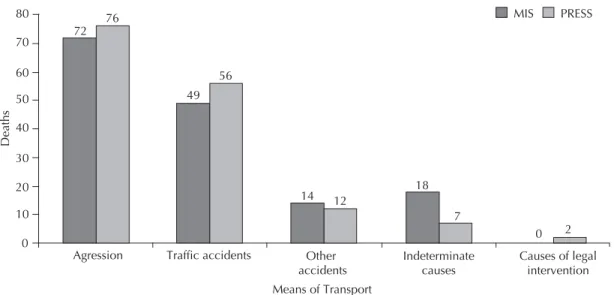
Aggression and traffi c accidents represented 79.0% of the deaths in the MIS (Figure 1). The events of indetermi-nate nature and the other accidents, such as suffocation, crushing, drowning, poisoning, intoxication and shock, among others, represented the remainder of these deaths. Aggression and traffi c accidents were responsible for 86.3% of the deaths in the press database. Other accidents presented a greater number of deaths (7.8%) than shown by the events of indeterminate nature (4.6%). It should be noted that in the MIS database, none of the deaths were registered as legal interventions, but in the press database, 1.3% of the deaths were identifi ed as this underlying cause. There was no matching of any self-infl icted death (suicide). The kappa coeffi cient was 0.80, thus indicating that there was signifi cant concordance among all the causes of violent death in the two databases.
Differences were observed after investigating the concordance of the groupings according to aggression and other accidents (Table 1). Out of the 18 deaths of indeterminate nature in the MIS, the information on 12 of them was qualifi ed after investigation: half of them were reclassifi ed as aggression, around 42.0% as traffi c accidents and 8.0% as legal intervention. It should be noted that out of these 18 deaths, 33.3% continued to be events of indeterminate nature.
There was moderate concordance between the data-bases (kappa = 0.41). There was an increase of 220.0% in the number of deaths involving cars and 100% in the number of accidents with motorcycles and bicycles
Figure 1. Principal groups of external causes of death, from the Mortality Information System and from the press. Belo Horizonte, Southeastern Brazil, 2008.
Source: Mortality Information System (MIS), Epidemiology and Information Administration, Municipal Health Department of Belo Horizonte, Southeastern Brazil.
72 76
49 56
14 12 18
7
0 2
80
70
60
50
40
30
20
10
0
Agression
Means of Transport
Deaths
Traffic accidents Other
accidents Indeterminatecauses Causes of legalintervention
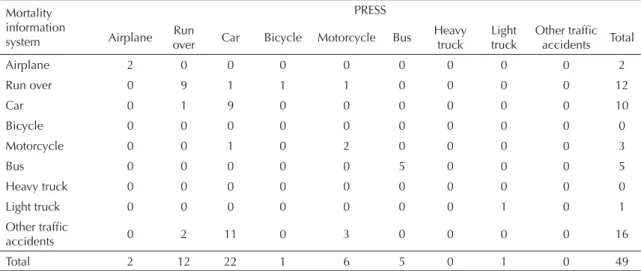
(Figure 2). The 16 deaths attributed to individuals suffering injuries in accidents with unspecifi ed vehicles (code V89.9) in the MIS could be identifi ed from the press database: 11 cases relating to cars, three to motor-cycles and two to being run over (Table 2).
DISCUSSION
Despite the significant concordance between the information from the press and the information from the MIS, the quality of the data on external causes of death in Belo Horizonte needs to be improved, even after routine investigation of deaths done at the IML. This is because of the high proportion of deaths of indeterminate nature and from unspecifi ed traffi c accidents that might be qualifi ed through news
carried in newspapers. The routine and systematic active search for information in the medical fi les at the IML was shown to be insuffi cient to qualify the circumstances of deaths due to traffi c accidents,
espe-cially with regard to their magnitude and avoidability.
Characterization of the means of transport is one of the most important factors for monitoring and prevention policies relating to traffi c accidents, along with speci-fying whether the individual was a pedestrian, cyclist, motorcyclist, driver or passenger. There is a scarcity of information on the means of transport used by the victim, in the sources consulted (incident reports, hospital referrals, information from family members and other sources). As emphasized by Baullinger et
al1 (2001), although analysis on newspapers presents
some limitations, it assists professionals through
25
20
15
10
5
0 10
22
16
12 12
3 6
5 5
2 2 1 1 0 1 0 0
Car
Motorcycle
Bus
Airplane
Heavy tr
uck
Bicylcle
Light truck
Other traffic accidents Run over
Means of Transport
Deaths
MIS PRESS
0
Source: Mortality Information System (MIS), Epidemiology and Information Administration, Municipal Health Department of Belo Horizonte, Southeastern Brazil.
Figure 2. Deaths according to means of transport, from the Mortality Information System and from the press. Belo Horizonte, Souhteastern Brazil, 2008.
Table 1. Principal groups of external causes of death, from the Mortality Information System and from the press. Belo Horizonte, Southeastern Brazil, 2008.
Mortality information system
PRESS
Aggression Traffi c accident Indeterminate nature interventionLegal Other traffi c accidents Total
Aggression 69 1 0 1 1 72
Traffi c accident 0 49 0 0 0 49
Indeterminate nature 6 5 6 1 0 18
Legal intervention 0 0 0 0 0 0
Other traffi c accidents 1 1 1 0 11 14
Total 76 56 7 2 12 153
qualifying the information on deaths and may be used as a complementary tool for surveillance.
The MIS has great potential as a source of data for analysis, with a view towards implementing and assessing public policies for reducing the numbers of violent deaths. This information system has presented large advances in the coverage and reliability of the data in Belo Horizonte and throughout Brazil. However, the importance of correctly fi lled-out data relating to referrals, medical fi les and death certifi -cates for the professionals who forward bodies to the IML, police offi cers, healthcare professionals and
medical examiners.5,6,9
A considerable proportion of the information on acci-dents or violence reported in the printed press does not form part of the matching with the MIS database, given that the newspapers may not have correctly identifi ed the victims: they may have failed to include the complete name, sex, age and street address of the accident, who the driver or passenger was and the type of vehicle involved. Another limitation is in relation to self-infl icted deaths, because these are generally not published in newspapers because of ethical, family and legal issues, and for this reason they were not qualifi ed in the study. Some external causes are practically not reported, or are left in the background when news or events of great importance for the state or the country are highlighted. This contributes towards possible quantitative losses in cross-referencing the data. Nonetheless, the interference due to data losses that were attributable to non-matching did not have an impact on the results obtained.
According to Kucinski,3 (2000) use of the press as an
investigative source can be questioned. As a means
of disseminating information to expand the public’s knowledge about given facts or events, the media may be tendentious and speculative, thus overvaluing matters that have not yet been proven or explained.
Souza et al16 (2006) emphasized that although the
printed press may use information in an uncritical and sensationalist manner, it forms an alternative resource for complementing and enriching the data on mortality due to violence and accidents, particularly for an infor-mation system with problems regarding its quality.
Construction of a database from the printed press added important information to what was registered in the MIS, thus contributing towards complementing and qualifying the underlying causes of deaths due to external causes, especially with regard to events of indeterminate nature and other unspecifi ed traffi c accidents.
The high number of newspaper news items on accidents and violence registered in this study places values on this source of information. It becomes necessary to evaluate the quality of the news carried in the printed press, its capacity to diffuse reliable information and its potential for signaling preventive actions towards reducing the numbers of accidents and violent actions. News items should be added to public policies on urban transportation and public security for facing up to violence in large urban centers.
Routine use of surveillance of news items on external causes of death reported in newspapers is important for comparing and incorporating the information in the MIS. Linkages between the healthcare services and the media may strengthen this initiative.
Table 2. Deaths according to means of transport, from the Mortality Information System and from the press. Belo Horizonte, Southeastern Brazil, 2008.
Mortality information system
PRESS
Airplane Run over Car Bicycle Motorcycle Bus Heavy truck truckLight Other traffi c accidents Total
Airplane 2 0 0 0 0 0 0 0 0 2
Run over 0 9 1 1 1 0 0 0 0 12
Car 0 1 9 0 0 0 0 0 0 10
Bicycle 0 0 0 0 0 0 0 0 0 0
Motorcycle 0 0 1 0 2 0 0 0 0 3
Bus 0 0 0 0 0 5 0 0 0 5
Heavy truck 0 0 0 0 0 0 0 0 0 0
Light truck 0 0 0 0 0 0 0 1 0 1
Other traffi c
accidents 0 2 11 0 3 0 0 0 0 16
Total 2 12 22 1 6 5 0 1 0 49
1. Baullinger J, Quan L, Bennett E, Cummings P, Williams K. Use of Washington State newspapers for submersion injury surveillance. Inj Prev. 2001;7(4):339-42. DOI:10.1136/ip.7.4.339
2. Drummond Jr M, Lira MTA, Freitas M, Nitrini TMV, Shibao K. Avaliação da qualidade das informações de mortalidade por acidentes não especifi cados e eventos com intenção indeterminada.
Rev Saude Publica. 1999;33(3):273-80.
DOI:10.1590/S0034-89101999000300008 3. Kucinski B. Jornalismo, saúde e cidadania.
Interface (Botucatu). 2000;4(6):181-6.
DOI:10.1590/S1414-32832000000100025
4. Landis JR, Koch GG. The measurement of observer agreement for categorical data. Biometrics. 1977;33(1):159-74. DOI:10.2307/2529310 5. Laurenti R, Mello Jorge MHP, Gotlieb SLD.
Informação em mortalidade: o uso das regras internacionais para a seleção da causa básica.
Rev Bras Epidemiol. 2009;12(2):195-203.
DOI:10.1590/S1415-790X2009000200009
6. Laurenti R, Mello Jorge MHP, Gotlieb SLD. O Sistema de Informações sobre Mortalidade: passado, presente e futuro. São Paulo: Centro Brasileiro de Classifi cação de Doenças; 2006. (Série Divulgação, 11).
7. Lozada EMK, Mathias TAF, Andrade SM, Aidar T. Informações sobre mortalidade por causas externas e eventos de intenção indeterminada, Paraná, Brasil, 1979 a 2005. Cad Saude Publica. 2009;25(1):223-8. DOI:10.1590/S0102-311X2009000100024
8. Matos SG, Proieitti FA, Barata RCB. Confi abilidade da informação sobre mortalidade por violência em Belo
Horizonte, MG. Rev Saude Publica. 2007;41(1):76-84. DOI:10.1590/S0034-89102007000100011
9. Mello Jorge MHP, Cascão AM, Silva RC. Acidentes e violências: um guia para o aprimoramento da qualidade de sua informação. São Paulo: Centro da OMS para a Classifi cação de Doenças em Português; 2003. (Série Divulgação, 10).
10. Mello Jorge MHP, Gawryszewki VP, Latorre MRDO. Análise dos dados de mortalidade.
Rev SaudePublica. 1997;31(Supl 4):5-25.
DOI:10.1590/S0034-89101997000500002 11. Mello Jorge MHP, Laurenti R, Gotlieb SLD. Análise
da qualidade das estatísticas vitais brasileiras: a experiência da implantação do SIM e do SINASC.
Cienc Saude Coletiva. 2007;12(3):643-54.
DOI:10.1590/S1413-81232007000300014
12. Mello Jorge MHP, Laurenti R, Di Nubila HBV. O óbito e sua investigação: refl exões sobre alguns aspectos relevantes. Rev Bras Epidemiol. 2010;13(4):561-76. DOI:10.1590/S1415-790X2010000400002
13. Organização Mundial da Saúde. CID-10/ Organização Mundial da Saúde. 2 ed. São Paulo: Edusp; 1994. 14. Santo AH. Causas mal defi nidas de morte e óbitos sem
assistência. Rev Assoc Med Bras. 2008;54(1):23-8. DOI:10.1590/S0104-42302008000100016 15. Souza ER, Lima MLC. Panorama da violência
urbana no Brasil e suas capitais. Cienc
Saude Coletiva. 2006;11(Supl):1211-22.
DOI:10.1590/S1413-81232006000500011
16. Souza NSS, Portinho BG, Barreiros MF. Acidentes de trabalho com óbito registrados em jornais no estado da Bahia. Rev Baiana Saude Publica. 2006;30(1):77-89.
REFERENCES