ISSN 1517-7076 http://www.materia.coppe.ufrj.br/sarra/artigos/artigo10900Revista Matéria, v. 12, n. 2, pp. 420 – 427, 2007
Autor Responsável:Flavio T. da Silva Data de envio: 22/08/06 Data de aceite: 08/02/07
Influence of mechanical surface treatments on the indentation
fracture toughness of glass infiltrated zirconia toughened
alumina “GI
-
ZTA” disks
Flavio T. da Silva1, Marcio A.N.Zacché1,2, Helio Salim de Amorim3 1
Universidade Federal do Rio de Janeiro, PEMM-COPPE/UFRJ Ilha do Fundão, Rio de Janeiro, RJ. CEP: 21941-972
e-mail: [email protected]
2
Universidade Veiga de Almeida, CSUVA, Praça da Bandeira, 149, Rio de Janeiro, RJ
e-mail: [email protected] 3
Universidade Federal do Rio de Janeiro, IF/UFRJ Caixa Postal 68528. 21941-972 Rio de Janeiro, RJ
e-mail: [email protected]
ABSTRACT
The main objective of this study was to evaluate the influence of mechanical surface treatments for
excess glass removal on the fracture toughness of a glass infiltrated zirconia toughened alumina “GI-ZTA” disks (In-Ceram® Zirconia). The GI-ZTA disks were submitted to three different mechanical surface treatments after glass infiltration (grinding, sandblasting and grinding/sandblasting/annealing). Fracture toughness was evaluated through indentation fracture (IF) test. Reliability of tests results was accessed through Weibull statistics. Results: Indentation fracture tests (IF) of GI-ZTA disks have shown that grinding was the surface treatment that presented the lowest KIc and reliability. An annealing treatment after grinding and sandblasting promoted an increase in KIc, mainly due to monoclinic-tetragonal reverse transformation recovering the tetragonal zirconia lost during the different mechanical surface treatments. The highest KIc values were observed after sandblasting and grinding/sandblasting/annealing. Significance: The proposed mechanical surface treatments played an important role on the metastability of tetragonal zirconia and strongly influenced the mechanical performance of GI-ZTA. Kruskhall-Wallis test indicated that KIc values of the three mechanical surface treatments were statistically distinct.
Keywords: Fracture toughness, zirconia, glass infiltrated ZTA, mechanical surface treatments.
1 INTRODUCTION
The loss or destruction of teeth due to periodontal disease, caries or trauma, have lead dentistry and engineering professionals to develop new materials and search for prosthetic treatments for the replacement of those missing teeth.
Until recently, all ceramic restorations were indicated only for single crowns and partial coverage restorations due to their low flexural strength and fracture toughness. Although the relationship between mechanical properties and their clinical performance are influenced by many factors, some of those properties have been used as initial parameters to determine the clinical potential and limitations of these materials [1].
The In-Ceram® Zirconia (Vita Zahnfabrik) is composed of α-alumina with 33wt% partially stabilized zirconia partially sintered in two steps at low temperatures (1120 and 11800C) to avoid shrinkage followed by glass infiltration at 11400C, resulting in a dense and high strength ceramic core, mainly used for replacing posterior teeth with all-ceramic restorations.
421 phase lost after grinding and sandblasting. It is also possible that other mechanisms, such as microcracking, crack bridging, crack deflection, and second-phase particles may contribute to an increase in toughening.
Mechanical tests in ceramic materials are difficult to compare. Biaxial flexure tests tend to produce higher values than three-point flexural tests mainly due to the tensile stress concentration on the edges of the three-point test samples and the relative volume under tensile stress [14, 15]. These results, some of them being conflicting, emphasizes the need of knowing the type of test used in the experiment.
The aim of this work was to investigate which type of surface treatments for molten glass removal in a commercial GI-ZTA would result in minor loss of transformable tetragonal zirconia and better mechanical performance. Fracture toughness by indentation fracture (IF) of glass infiltrated ZTA disks was evaluated after three different mechanical surface treatments named grinding, sandblasting and grinding followed by sandblasting and annealing.
2 MATERIALS AND METHODS
Thirty six ZTA disks (In-Ceram®Zirconia) disks (diameter = 25mm and width = 2.5mm) were molded by slip casting followed by partially sintered at 11800C.After partial sintering the ZTA disks were glass infiltrated at 11400C for 2 hours. After those treatments, the infiltrated ZTA disk, called GI-ZTA, was submitted to different mechanical surface treatments for excess glass removal: Grinding (group 1), sandblasting (group 2) and grinding followed by sandblasting and annealing (10000C) (group 3). In grinding, the infiltrated sample were submitted to a cylindrical diamond bur at 20,000rpm without cooling until complete glass removal . In sandblasting, the sample was positioned at an angle of 450 and 2.0cm far from
the sandblaster (alumina particles 50μm and constant pressure 3bar). Figures 1 and 2 show, respectively, the technique for excess glass removal by grinding and sandblasting.
Young modulus of GI-ZTA disk (254.9 GPa) was determined from an ultrasound non-destructive test and Vickers hardness (9.8 GPa) according to ASTM C1327-99. Fracture toughness (IF) was determined according to the equation (1) proposed by ANSTIS et al. [16], where P = load (N), c = crack length measured from the center of the Vickers indentation (mm), H= hardness (GPa), E= Young modulus (GPa) and 0.016 = Numeric factor. In order to determine crack length, samples were mirror polished with diamond paste.
KIc = 0.016 (E/H)1/2 (P/c2/3) (1)
422
Figure 1: Grinding technique for excess glass removal
Figure 2: Sandblasting technique for excess glass removal
Figure 3: An accepted radial cracks (a) and a discarded indentation due to several radial cracks (b)
Thirty indentations were selected that fulfilled those criteria. The measurements of crack length were made on an Olympus optical microscope immediately after the indentations.
423 Where Xmis the relative amount of monoclinic zirconia
,
I
m (xyz)the relative amount of monoclinic and It the relative amount of tetragonal zirconia and (xyz) the Miller indexes of a specific diffraction plane.Due to the superposition of a diffraction peak of monoclinic zirconia with a non-identified peak from the glass phase (NI), both equations (2) and (3) were merged generating equation (4).
)
111
(
)
111
(
658
,
2
)
111
(
658
,
2
t m
m
I
xI
xI
Xm
(4)3 RESULTS
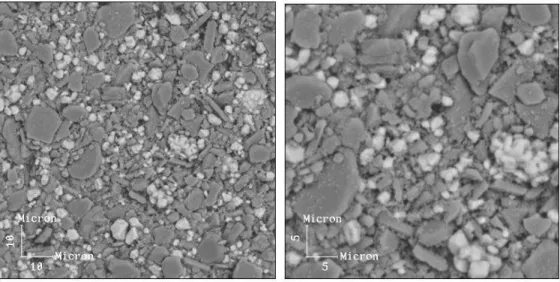
Figure 4 shows the backscattered image of ZTA disks after partial sintering. It can be seen that the particle size of zirconia is significantly lower that alumina and it form clusters in different regions of the alumina matrix. Figure 5 show the backscattered image of the GI- ZTA disks, after partial sintering followed by glass infiltration.
Figure 4: Backscattered scanning electron microscopy of a ZTA disk after partial sintering. White grains are
424
Figure 5: Backscattered scanning electron microscopy of GI-ZTA disks
before mechanical surface treatment (a) and after mechanical surface treatment (b)
It can be seen from figure 5-a that some crystal needles from the glass phase was formed at the ZTA surface, mainly due to the slow cooling of GI-ZTA after glass infiltration . Figure 5-b, show the same sample after excess glass removal by mechanical surface treatments followed by polishing.
Table 1 shows the mean, standard deviation and Kruskall-Wallis significance test of the fracture toughness of GI-ZTA disks submitted to the different mechanical surface treatments
Table 1: Mean, standard deviation and Kruskall-Wallis significance test of fracture toughness
results of GI-ZTA disks for the three different mechanical surface treatments. Different letters among groups indicate statistical difference.
SurfaceTreatments KIc Standard Deviation Significance α = 0.005
Grinding 3.50 0.63 A
Sandblasting 4.65 0.57 B
Grinding + Sandblasting + Annealing 4.76 0.64 C
The reliability of fracture toughness of GI-ZTA disks for the different mechanical surface treatments, was evaluated through Weibull statistics, in the same manner as for flexural strength data of ceramic materials. Table 2 show the apparent Weibull modulus of those distributions. Figures 3 show the Weibull distributions of the fracture toughness tests o GI-ZTA disks after different mechanical surface treatments
Table 2: Correlation coefficient and apparent Weibull modulus of the fracture toughness tests of GI-ZTA
disks submitted to different mechanical surface treatments for excess glass removal.
Surface Treatments Correlation Coefficient (R2) Apparent Weibull Modulus (m)
Grinding 0.95 15.50
Sandblasting 0.98 22.20
425
Figure 6: (a) Weibull distribution of fracture toughness of GI- ZTA disks after grinding; (b) Weibull
distribution of fracture toughness of GI- ZTA disks after sandblasting; (c) Weibull distribution of fracture toughness of GI- ZTA disks after grinding/sandblasting/annealing
4 DISCUSSION
Many studies concerning the effect of grinding on advanced ceramics had been carried out and still are being made [4, 6, 8-11, 19, 20]. It seems to be an agreement that the influence of grinding on microstructure and mechanical properties of zirconia based ceramics depend on many factors, such as: type and amount of stabilizer, processing steps, type of abrasive and degree of grinding (speed, pressure and cooling), as well as the nature and size of the surface compressive layer introduced by the grinding process.
GARCIA et al [9] reported that the influence of grinding on the toughening mechanism of zirconia based ceramics could be achieved by transformation toughening and microcracking, in which particles that were hit by the abrasive would tend to generate microcracks around themselves, deflecting cracks and in consequence increasing toughness. LUTHARDT et al [20], however, observed that deep cracks in Y-TZP introduced by grinding through CAD/CAM process far exceeded the compressive surface layer, damaging the microstructure and decreasing its mechanical properties.
426
Table 3: Quantitative phase distribution of GI-ZTA after the three different mechanical surface treatments
Mechanical Surface Treatments Monoclinic (%) Tetragonal (%)
Grinding 1.7 98.3
Sandblasting 9.0 91.0
Grinding +Sandblasting +Annealing 0.5 99.5
Based on these facts, caution should be taken when considering the effect of sandblasting on zirconia based ceramics due to differences in size of the abrasive particles and pressure employed. Under low pressure, only the zirconia particles from the surface undergoes the tetragonal-monoclinic transformation, causing the flaws and defects to be very small and not exceeding the thickness of the compressive surface layer. Otherwise, higher pressure would tend to produce larger flaws that could exceed the thickness of the compressive surface layer, decreasing its mechanical strength and not affecting the amount of monoclinic zirconia at the surface.
The mechanical strength of any brittle material is determined by two main factors: resistance to crack propagation (fracture toughness) and flaw size. Based on these observations, the results of fracture toughness (Table I) indicated that group 1 (grinding) presented the lower fracture toughness due to the high flaw density introduced by grinding. Sandblasting (group 2) presented a significantly higher toughness compared to group 1, mainly due to the shallower and more uniform cracks in comparison to grinding. Group 3 (grinding followed by sandblasting and annealing promoted an effective tetragonal-monoclinic reverse transformation mainly due to the annealing treatment. Annealing may have possibly caused crack tip healing by the glass phase.
5 CONCLUSIONS
- The mechanical surface treatments for excess glass removal played an important role on the stability of tetragonal zirconia, affecting the fracture toughness of ZTA. Although grinding did not affect significantly the relative amount of tetragonal zirconia, it introduced defects which decreased its fracture toughness;
- Sandblasting produced the smallest dispersion on KIc, although it did not present the highest KIc; this observation indicated that sandblasting introduced uniformly distributed shallow cracks which led to a higher reliability. The toughening mechanism could be explained by the great amount of monoclinic phase introduced by sandblasting;
- Grinding followed by sandblasting and annealing presented the highest KIc. In this case, annealing recovered some tetragonal zirconia lost during both surface treatments.
6 REFERENCES
[1] GUAZZATO, M., ALBAKRY, M., SWAIN, M.V., IRONSIDE, J., “Mechanical Properties of In -Ceram®Alumina and In-Ceram®Zirconia”, International Journal of Prosthodontics, v. 15, pp. 339-346, 2002.
[2] GRIFFITH, A.A., “The Phenomena of Rupture and Flow in Solids”, Philosophical Transactions of the Royal Society, v. A, n. 221, pp. 163-198, 1920, In: LAWN, B.R., “Physics of Fracture”, Journal of the American Ceramic Society, v. 66, pp. 83-91, 1983.
[3] STEVENS, R., Engineering Properties of Zirconia, Adapted from An Introduction to Zirconia, Magnesium Elektron Ltda., 1986.
[4] KOSMAC, T., OBLAK, C., JEVNIKAR, P., FUNDUK, N., MARION, L., “The Effect of Surface Grinding and Sandblasting on Flexural Strength and Reliability of Y-TZP Ceramic”, Dental Materials, v. 15, pp. 426-433, 1999.
[5] PROOS, K., SWAIN, M., STEVEN, G., “Finite Element Analysis Studies of an all Ceramic Crown on a First Premolar”, International Journal of Prosthodontics, v. 15, pp. 404-412, 2002
[6] GUPTA, T.K., “Strengthening by Surface Damage in MetasTable Tetragonal Zirconia”, Journal of the American Ceramic Society, v. 63, pp. 117, 1980.
427 [12] MATSUZAWA, M. & HORIBE, S., “Resistance Against Crack Nucleation and Propagation in Yttria Doped Tetragonal Zirconia Ceramics”, Materials Science Engeneering, v. A333, pp. 199-207, 2002. [13] MOON, WJ., ITO, T., UCHIMURA, S., SAKA,H., “Toughening of Ceramics by Dislocation Sub
-Boundaries” Materials Science and Engineering, v. A387-389, pp. 822-831, 2004
[14] HIGGS, W.A.J., LUCKSANASOMBOOL, P., HIGGS, R.J.E.D., SWAIN, M., “Evaluating Acrylic and Glass-Ionomer Cement Strength Using the Biaxial Flexure Test”, Biomaterials, v. 22, pp. 1583-1590, 2001.
[15] JEONG, S.M., PARK, S.E., LEE, H.L., “Fracture Behavior of Alumina Ceramics by Biaxial Ball-on-Three-Ball Test”, Journal of the European Ceramic Society, v. 22, pp. 1129-1135, 2002.
[16] ANSTIS, G.R., CHANTIKUL, P., LAWN, B.R., MARSHALL, D.B., “A Critical Evaluation of Indentation Techniques for Measuring Fracture Toughness: I, Direct Crack Measurements”, Journal of the American Ceramic Society, v. 64, pp. 533-538, 1981.
[17] WANG, J., GONG, J., GUAN, Z., ”Variation in the Indentation Toughness of Silicon Nitride”, Materials Letters, v. 57, pp. 643-646, 2002.
[18] GREEN, D.J., “A Technique for Introducing Surface Compression into Zirconia Ceramics”, Journal of the American Ceramic Society, pp. C-178-179, 1983.
[19] HANNINK, R., SWAIN, M., “Metastability of the Martensitic Transformation in a 12 mol% Ceria -Zirconia Alloy: I, Deformation and Fracture Observations”. Journal of the American Ceramic Society, v. 72, pp. 90-98, 1989.
[20] LUTHARDT,R. G., HOLZHÜTER, M., SANDKUHL, O., HEROLD, V., SCHNAPP, J.D.,
KUHLISCH, E., WALTER, M., “ Reliability and Properties of Ground Y-TZP- Zirconia Ceramics”, Journal of Dental Research, v. 81, pp. 487-491, 2002.
[21] GUAZZATO, M., ALBAKRY, M., RINGER, S., SWAIN, M. V., “Strength, Fracture Toughness of All
-Ceramic Materials. Part II. Zirconia Based Dental -Ceramics”, Dental Materials, v. 20, 449-456, 2004.
[22] GREGORY, G., BURGER, W., SERGO, V., “ Piezo-spectroscopy Analysis of Residual Stresses in Zirconia Toughened Alumina Ceramics: The Influence of Tetragonal-Monoclinic Transformation Journal of European Ceramic Society, pp. 401-406, 1999.