*e-mail: [email protected]
Influence of Different Surface Treatments on the Fracture
Toughness of a Commercial ZTA Dental Ceramic
Flavio Teixeira da Silvab*, Marcio Alessandro Negrelly Zacchéa,b, Helio Salim de Amorimc a
Universidade Veiga de Almeida
b
Programa de Engenharia Metalurgica e de Materiais – PEMM – COPPE/UFRJ
Universidade Federal do Rio de Janeiro, Centro de Tecnologia, Bloco F, Sala - F-210,
21941-972 Rio de Janeiro - RJ, Brazil
Rio de Janeiro - RJ, Brazil
c
Universidade Federal do Rio de Janeiro – IF/UFRJ
Received: July 5, 2006; Revised: January 8, 2007
The objective of this study was to investigate how mechanical surface treatments performed for removal of excess of molten glass, inluence the fracture toughness of a dental zirconia toughened alumina (In-Ceram®
Zirconia). Iniltrated ZTA disks were submitted to three different surface treatments (grinding, sandblasting and grinding + sandblasting + annealing). Fracture toughness was accessed through indentation strength test (IS). X ray diffraction was used to investigate the metastability of tetragonal zirconia particles under all treatments proposed. Kruskall-Wallis non-parametrical test and Weibull statistics were used to analyze the results. Grinding (group 1) introduced defects which decreased the fracture toughness and reliability, presenting the lowest KIC. On the other hand, grinding followed by sandblasting and annealing (group 3) presented the highest KIC. Sandblasting (group 2) presented the highest reliability but lower KIC compared to group 3.
Keywords: dental ceramic, fracture toughness, transformation toughening, Weibull distribution
1. Introduction
The loss or destruction of teeth due to periodontal disease, car-ies or trauma, have lead dentistry and engineering professionals to develop new materials and search for prosthetic treatments for the replacement of those missing teeth.
Until recently, all ceramic restorations were indicated only for single crowns and partial coverage restorations due to their low lexural strength and fracture toughness.
Many all ceramic systems were developed with the goal to im-prove the possible indications of metal free restorations. Among these, the zirconia based systems are the most promising for achieving the objective of substitute metalceramic restorations. The In-Ceram®
Zirconia (Vita Zahnfabrik, Bäd Sackingen – Germany) is composed of
α-alumina with 33 w% partially stabilized zirconia (12 mol% Ceria), partially sintered in two steps at low temperature (1120 and 1180 °C) to avoid shrinkage, followed by glass iniltration at 1140 °C, resulting in a dense and high strength ceramic core material, mainly used for replacing posterior teeth with all ceramic restorations. The processing steps are similar to the well known In-Ceram® Alumina technique1.
The effect of dispersed zirconia grains in an alumina matrix, increasing its mechanical properties is known as transformation toughening. When a stress is applied to the structure, zirconia grains undergo an allotropic transformation (from tetragonal to monoclinic) in the presence of a growing crack; this transformation results on an increase in volume (3-5%), that leads to a compressive stress ield opposing crack propagation. This t-m transformation by an applied stress is similar to that observed on martensitic transformation in quenched steels2-8.
Although the relationship between mechanical properties and their clinical performance are inluenced by many factors, some of
these, namely lexural strength and fracture toughness, have been used as initial parameters to determine the clinical potential and limitations of these materials2.
There is a straight relationship between strength and fracture toughness in brittle materials, where the critical defect size to initiate failure is determined by the inherent law population introduced dur-ing material processdur-ing and component manufacture3,4,9,10. In zirconia
based materials, such law population could be inluenced by surface treatments as grinding and/or sandblasting, and it may alter the rela-tionship between tetragonal and monoclinic zirconia4,5,7,11-13.
The toughening mechanism of ZTA ceramics due to surface treat-ments (grinding and/or sandblasting) is based upon the development of a compressive surface layer related to the tetragonal-monoclinic transformation and generation of microcracks6,7,9. The strengthening
of ground zirconia toughened ceramics depends, for instance, on the amount of transformed zirconia on the deepest region of the compres-sive surface layer, which increases with grinding intensity. Otherwise, severe grinding and reverse m-t transformation due to heat generation may cause cracks that could extend beyond the compressive surface layer, causing a drastic decrease in its mechanical properties3,4,8.
Moon et al.14 reported that sandblasting promotes the nucleation
of dislocations and microcracks due to the t-m transformation, and a compressive state at the surface, without any increase in tempera-ture. An annealing treatment after sandblasting may recover almost all tetragonal phase lost during this surface treatment, in such way that the recovered tetragonal zirconia grains were capable to readily transform to monoclinic under an applied stress.
Zirconia) could result in minor loss of transformable tetragonal zirco-nia and higher fracture toughness. In the present paper, the adopted fracture toughness test was the indentation strength (IS).
2. Materials and Methods
Thirty six disks of In-Ceram®Zirconia were slip casted
accord-ing to manufacture’s instructions (25 mm diameter and 2.5 mm height). Partial sintering was carried out in two steps. First step at 1120 °C for 2 hours with 6 hours drying at 120 °C. Second sintering at 1180 °C for 2 hours with a heating rate of 8 °C/minutes. At this temperature, very little densiication is achieved. Samples were then glass iniltrated for densiication at 1140 °C for 4 hours with a heating rate of 8 °C/minutes, and then allowed to cool to room temperature inside the furnace. In order to investigate the inluence of three dif-ferent mechanical surface treatment related to excess of molten glass removal after the iniltration process on ZTA disks, three groups of 12 discs were selected: grinding (group 1), sandblasting (group 2) and grinding, sandblasting and annealing (group 3). One indentation was introduced on the center of each sample through a Vickers indenter with two different loads (59 and 98 N).
In order to calculate the fracture toughness by indentation strength (IS), young modulus and hardness are needed: Young modulus was determined from a nondestructive ultra-sound test (n = 4) (Krautkram-er mod. USIP 12 with an oscilloscope Tektronics mod. TPS 420A) and Vickers hardness (n = 4) according to ASTM C1327-99. Figure 1 shows the apparatus used in the fracture toughness tests.
Fracture toughness was calculated from the equation proposed by Chantikul et al.15;
KIC = 0.59(E/H)1/2 (S
fP
1/3)3/4 (1)
where:
E - Young modulus = 255 GPa (mean), H - Vickers hardness = 9.8 GPa (mean), P = load at the moment of fracture (N), Sf stress at the mo-ment of fracture (MPa)= -2387 P (X-Y)/d2, as suggested by ASTM
F394-78, where d= sample thickness (mm), X = (1 + ν) ln (r2 / r3) + [(1 - ν)/2](r2/r3)2 and Y = (1 + ν) [ 1+ ln (r
1/r3)
2] + (1 - ν) (r
1/r3)
2
r1 – Radius of supporting circle (mm); r2 – Radius of the loading ball (mm); r3 – Radius of the sample disk (mm); and
ν - Poisson ratio = 0.23.
Statistical analysis was made using Kruskall-Wallis non-para-metrical test16,17. The cumulative probability of failure X normalized
fracture toughness plot, similar to a Weibull18 plot for lexural tests
was also accessed. This analysis was conducted in order to evaluate the reliability of iniltrated ZTA disks submitted to the three different mechanical surface treatments. The inluence of mechanical surface treatment on the tetragonal-monoclinic transformation was evaluated quantitatively by x ray diffraction. The specimens were scanned with Cu-Kα (30 KV - 20 mA) radiation and Bragg angle varying from 26 to 32.5°, at a 0.05° step and 4.0 seconds interval. It was also performed x ray diffractions of the starting powder and after sintering cycles. The fractured disks were analyzed by SEM (Jeol 5800LV).
3. Results
X ray diffraction of In-Ceram®Zirconia starting powder and of
one sample after the second sintering is shown in Figure 2. In terms of tetragonal/monoclinic zirconia content, it can be seen that tetrago-nal zirconia is the predominant phase. It is also clear that tetragotetrago-nal zirconia content increased after sintering (1180 °C), which is an evidence that the starting powder was originally milled.
The mean and standard deviation of fracture toughness by inden-tation strength (IS) are shown in Table 1. The indentation tests were
Table 1. Mean and standard deviation of fracture toughness (IS) for the three groups. Different letters indicates statistic difference among groups.
Surface treatment KIC σ Signiicance α = 0.05
Group 1 4.557 0.292 A
Group 2 4.759 0.201 B
Group 3 4.919 0.250 C
(a) (b)
Figure 1. Mechanical apparatus used in indentation strength tests of ZTA disks
10 20 30 40 50 60 70
20 30 40 50 60
2 (°)
Al2O3 (67%) + ZrO2 (33%)
Starting powder
T T
T
T A
M M
M M
M A A
A
A A A T
M A
T T
T A
A A
A A A
M M
M M A
T
Counts (4.0 seconds)
Al2O3+ ZrO2(2nd sintering 1180 °C)
5000
4000
3000
2000
1000
0 10000
8000
6000
4000
2000
0
Figure 2. X ray diffraction of In-Ceram®Zirconia starting powder and after
sintering.
only validated if the crack began at the corners of Vickers indentation. Different letters indicate statistical difference between groups.
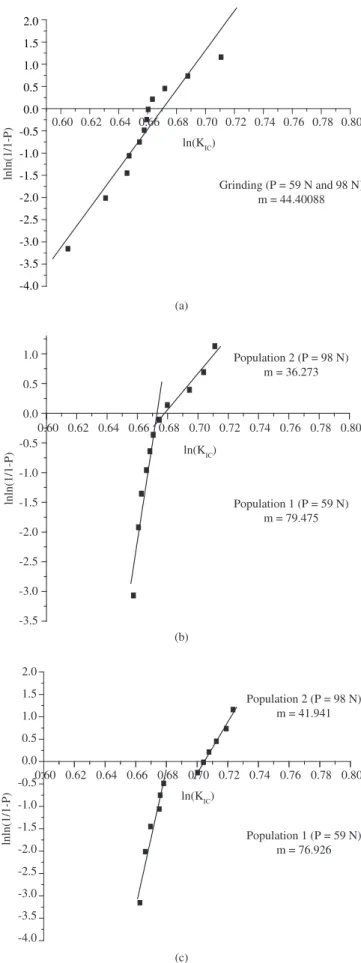
Weibull distribution of the three groups is shown in Figure 3. In grinded samples (group 1), KIC values could be represented by a straight line as expected for a normal Weibull distribution (R2 = 0.93),
multiple one, which would result in two mutually excluding defect population, each one representative of one indentation load. On group 1, this behavior was not observed, once there was no correla-tion between the indentacorrela-tion load and KIC.
From the expression of the lexural strength of a brittle material composed by two mutually excluding defect populations, a new one was developed for the Weibull distribution of KIC.
P(KIC) = π P1(KIC) + (1 – π) P2 (KIC) (2)
Considering that each population could be described by a single Weibull distribution:
P(KIC) = 1 – π exp[ – (KIC / KIC1)m1 ] – (3)(3)
(1 - π) exp[ - (KIC / KIC2)m2]
where π represents the sample fraction loaded with 59 N and 1 - π for those loaded with 98 N. KIC1, KIC2, m1 e m2 are distribution parameters, as it can be seen in Table 2.
The inluence of mechanical surface treatments on the mechanical behavior of ZTA disks were evaluated in the light of the transforma-tion toughening mechanism due to the tetragonal/monoclinic trans-formation. Figure 4 shows the x ray diffraction of a grinded (group 1) and sandblasted (group 2) sample. It can be seen an enlargement of the tetragonal (111) base peak of the grinded sample, indicating some disruption of the lattice parameters due to the grinding treatment. Figure 5 shows the x ray diffraction of one sample at two different moments: after grinding, where it can be seen some disruption of the lattice parameters represented by an enlargement of the base of the tetragonal (111) peak; and after an annealing treatment at 1000 °C for 30 minutes, where it it can be seen an increase in height and decrease in thickness of the same (111) tetragonal peak. Figure 6 shows the superposition of the x ray diffraction of a non-iniltrated sample and of the molten glass. It can be seen an overlapping of a non-identiied peak (associated to the glass iniltration process) with the (111) monoclinic peak. From the expression of the relative amount of transformed monoclinic zirconia developed by Garvie and Nicholson19 and Gregory et al.20, it was developed Equation 4,
ex-cluding the monoclinic peak (111), due to its superposition with the glass phase peak:
Xm = 2.658 x Im (111) / 2.658 x Im (111) + It (111) (4)
From Equation 4, the amounts of transformed monoclinic zirconia due to the different mechanical surface treatments were quantiied, as shown in Table 3.
4. Discussion
Many studies concerning the effect of grinding on advanced ce-ramics had been carried out and still are being made4-7,11,12. It seems
to be an agreement that the inluence of grinding on microstructure and mechanical properties of zirconia based ceramics depends on many factors, such as: type and amount of stabilizer, processing steps, type of abrasive and degree of grinding (speed, pressure and cooling), as well as the nature and size of the surface compressive layer introduced by grinding.
The results of fracture toughness tests revealed that the type of mechanical surface treatment affects the behavior of a propagating crack as shown in Table 1. Group 1 (grinding) presented the lowest KIC mainly due to the high law density and defects introduced by grinding. In fact, in order to achieve a complete removal of the exceeding molten glass from the samples surface, an aggressive grinding must be performed. So, it is expected that such stressing treatment would result in lower toughness. XRD also supports the results of mechanical performance, since the disruption of lattice parameters are evident (Figure 4 and 5).
0.60 0.62 0.64 0.66 0.68 0.70 0.72 0.74 0.76 0.78 0.80
lnln(1/1-P)
ln(KIC)
Grinding (P = 59 N and 98 N) m = 44.40088 2.0
1.5
1.0
0.5
0.0
-0.5
-1.0
-1.5
-2.0
-2.5
-3.0
-3.5
-4.0
(a)
0.60 0.62 0.64 0.66 0.68 0.70 0.72 0.74 0.76 0.78 0.80
ln(KIC)
Population 1 (P = 59 N) m = 79.475 Population 2 (P = 98 N)
m = 36.273
lnln(1/1-P)
1.0
0.5
0.0
-0.5
-1.0
-1.5
-2.0
-2.5
-3.0
-3.5
(b)
0.60 0.62 0.64 0.66 0.68 0.70 0.72 0.74 0.76 0.78 0.80
lnln(1/1-P) Population 1 (P = 59 N)
m = 76.926 ln(KIC)
Population 2 (P = 98 N) m = 41.941 2.0
1.5
1.0
0.5
0.0
-0.5
-1.0
-1.5
-2.0
-2.5
-3.0
-3.5
-4.0
(c)
Table 2. KIC and apparent Weibull modulus (m) of indentation strength tests (IS) for the different groups.
Group 1 Group 2 Group 3
π = 0.6115 π = 0.4217
KIC m KIC1 m1 KIC2 m2 KIC1 m1 KIC2 m2
4.55 44.401 4.65 79.475 5.04 36.273 4.71 76.926 5,17 41.941
Table 3. Amounts of transformed zirconia monoclinic after the three different mechanical surface treatments.
Group Sample 1 Sample 2 Mean Xm (%) Mean XT (%)
monoclinic (111) tetragonal (111) Xm (%) monoclinic (111) tetragonal (111) Xm (%)
1 29.45 4424.0 1.73 24.65 3903.0 1.65 1.69 98.31
2 67.8 2478.3 6.77 49.7 709.1 15.7 11.23 88.77
3 7.88 5091.4 0.41 9.0 4025.8 0.59 0.50 99.50
M (111)
25 26 27 28 29 30 31 32 33
0 2000 4000 6000 8000 10000 12000 14000
NI
Counts (4 seconds)
2 (°)
NI(2 = 31.85°)
M (111) Grinding (SAMPLE 03) +
thermal treatment 1000 °C - 30 minutes
T(111)
T(111)
Grinding (SAMPLE 03)
Figure 5. X ray diffractions of a single ZTA sample at two moments: after grinding and after a heat treatment. NI= non-identiied peak.
It indicates that high stress and plastic deformation are present. In this case, there was no correlation between indentation load and KIC. Weibull analysis revealed that such treatment leads to a less reliable material since both indentations were scattered within the plotted data.
On the other hand, group 2 (sandblasting) seems to be a less ag-gressive and uniform treatment, showing much less harmful effect on the lattice parameters compared to grinded samples (Figure 4), thus leading to an increase in KIC and Weibull modulus. The high amount of monoclinic zirconia (Table 3), reveals that there were nearly no heat generation during surface treatment. In the present study, pressure and particle size of abrasive followed manufacturer recommendation (50 µm at 3 bar). Guazzato et al.13 reported that a
rough and damaged surface could be observed after sandblasting, but these defects were not as large as the defects observed after grinding. In fact, Kosmak et al.4 observed that after sandblasting, the thickness
of the transformed surface layer was found to be larger than in ground samples, indicating that not only stresses, but also the locally developed temperatures during sandblasting were lower. This improvement in strength was not observed by Guazzato et al.13. They argued that the
damage on the surface and high stresses generated by the abrasive particles were only partially counteracted by the tetragonal-monoclinic
25 26 27 28 29 30 31 32 33
Counts (4.0 seconds)
2 (°) Grinding
(grupo 1)
NI (2 = 31.85°) NI
M (111) T (111)
Sandblasting (group 2) 9000
8000
7000
6000
5000
4000
3000
2000
1000
0
M (111)
Figure 4. X ray diffraction of iniltrated ZTA disks after two different me-chanical surface treatments: Grinding (group 1) and sandblasting (group 2). It can be seen an enlargement of the tetragonal base peak (111) of grinded sample indicating some disruption of the lattice parameters due to the grinding treatment. NI = non-identiied peak.
25 26 27 28 29 30 31 32 33
2 (°)
Molten glass Non-infiltated
Counts (4.0 seconds)
25000
20000
15000
10000
5000
0
T (111)
M (111)
M (111) NI
NI
transformation, resulting in strength degradation and lower Weibull modulus. Although both authors used the same abrasive (110 µm alumina particles), they used different pressures, one of them using extreme unjustiied high pressure (5 MPa – 50 bar)13, which could
be responsible for those differences. On our work, higher KIC and reliability were attained after sandblasting. Although the results from XRD are very similar to the results observed by other studies2,4,13,21,
the mechanical performance and reliability of sandblasted specimens obtained by Guazzato et al.13, revealed that not only the abrasive grit
but pressure employed on sandblasting, play an important role on the mechanical performance of zirconia ceramics. Based on these facts, caution should be taken when considering the effect of sandblasting on the mechanical properties of zirconia based ceramics. Under low pressures, only the very surface of zirconia particles undergoes the tetragonal-monoclinic transformation, causing the laws and defects to be very small, not exceeding the thickness of the compressive surface layer and yet promoting microcrack toughening. Otherwise, higher pressure would tend to produce larger laws that could exceed the thickness of the surface layer, and even promoting the pullout of some particles, thus not altering the amount of monoclinic zirconia at the surface.
Group 3 (grinding followed by sandblasting and annealing) presented the highest KIC. An annealing treatment after grinding and sandblasting may promote crack healing in the glass matrix and a partial recover of tetragonal zirconia lost during both treatments. These results were conirmed through x ray diffraction (Figure 5).
X ray diffraction of the molten glass revealed the nucleation of crystalline phases, some of these peaks with Bragg angle similar to the (111) plane of monoclinic zirconia, overestimating the amount of monoclinic zirconia (Figure 6). Due to this behavior, the suggested expressions for the quantiication of tetragonal and monoclinic zirco-nia by x ray diffraction proposed by Garvie and Nicholson19 and by
Gregory et al.20, do not express the reality. From these equations, a new
one was obtained not taking into account the (111) peak of monoclinic zirconia. Other studies2,13,21 concerning this material did not observe this
overlapping, thus leading to an overestimation of monoclinic zirconia. The Weibull distribution of group 3 shows that the heat treatment proposed was not able to anneal out all stresses and disruption intro-duced specially by grinding process. The reason is that the annealing treatment (1000 °C/5 minutes) was not able to allow such recover. It is expected that a heat treatment for a longer time (1000 °C/30 minutes) could promote a more effective monoclinic-tetragonal transformation, as it was shown in Figure 5. In addition, it is reasonable to expect that a second toughening mechanism could take place, due to some degree of crystallization of molten glass. This transformation would toughen the glass matrix in a similar way as leucite in vitroceramics.
On the fracture toughness by indentation strength (IS), the KIC from groups 2 and 3 (Figure 4), did not it on a single line as expected for a normal Weibull distribution. In spite of the small number of sam-ples of each group (n = 12), those data were plotted considering two mutually excluding defect populations. It is reasonable to assume that the two indentation loads (59 and 98 N) affected the mechanical be-havior of ZTA samples, exhibiting a rising R-curve. Other authors2,22,23
also observed that a higher indentation load overestimated KIC from (IS) tests. This behavior could be due to the following facts:
Lateral cracks could be more effective on deviating radial cracks with an increase in indentation load22. As in groups 2 and 3 the defect
population introduced by surface treatments is relatively small, on the higher load samples the critical factor for catastrophic crack propaga-tion would be ruled by the defects introduced by indentapropaga-tion.
The radial tensile stresses are 70% of the peak value directly below the applied load, decreasing to 20% or less at a small radial distance from the loading piston23,24. These observations support the
conclusion that radial cracks introduced by a higher indentation load tend to grow into a reduced tensile stress ield, leading to a certain independence of indentation load on KIC.
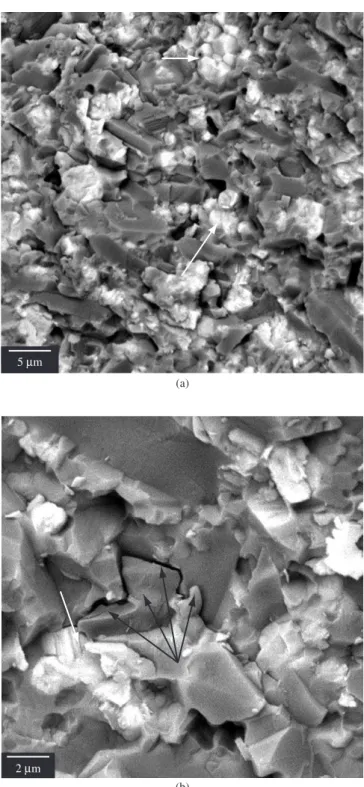
Scanning electron microscopy (SEM) of the fractured surface of the ZTA (Figure 7), shows a crack propagating through the glass matrix, contouring an alumina particle and being held by a group of zirconia particles. Some studies21 reported that depending on the
morphology of alumina particles another toughening mechanism due
5Mm
(a)
2Mm
(b)
to the anisotropic growth of alumina particles during glass iniltration would be expected.
5. Conclusions
• Iniltrated ZTA disks surface treated by grinding (group 1), presented the lowest KIC, due to the large and deep cracks introduced by grinding;
• Iniltrated ZTA disks surface treated by sandblasting (group 2) presented a KIC higher than group 1, due to the shallow and well distributed small cracks which led to a greater reliability; • Iniltrated ZTA disks surface treated by grinding followed by
sandblasting and annealing (group 3) presented the highest KIC. In this case, the heat treatment recovered some tetragonal zirconia lost during surface treatments;
• Apparent Weibull distribution of fracture toughness tests of all groups, mainly groups 2 and 3, revealed that the indentation load inluenced KIC. This could be due to the small number of samples of each group, kind of lexure test employed (biaxial lexure test) and introduction of lateral cracks which increases with indentation load. As a consequence, two mutually exclud-ing populations were observed; and
• Grinding and sandblasting may promote a toughening mecha-nism to ZTA, unless its surface compressive layer is suficient shallow. Otherwise they will promote stress concentration sites decreasing its toughness. An annealing after grinding and sandblasting may recover some tetragonal phase lost during those surface treatments.
References
1. Vita Zahnfabrik, Vita In-Ceram® Alumina instruction manual. Bad
Säkingen, Germany: Vita Zahnfabrik Edt; 2000.
2. Guazzato M, Albakry M, Swain M, Ironside. J. Mechanical properties of In-Ceram® Alumina and In-Ceram® Zirconia. Int. J. Prosthodontics.
2002; 15(4):339-346.
3. Stevens R. Engineering properties of zirconia and zirconia ceramics. From An Introduction to Zircônia, Magnesium Elektron Publication nº 113. UK, Manchester, Magnesium Elektron Ltd. Publication; 1986. p. 1-56.
4. Kosmak T, Oblak C, Jevnikar P, Funduk N, Marion L. The effect of surface grinding and sandblasting on lexural strength and reliability of Y-TZP ceramic. Dental Materials. 1999; 15(6):426-433.
5. Swain M, Hannink R. Metastability of the martensitic transformation in a 12 mol% ceria-zirconia alloy: Grinding studies. Journal of the American Ceramic Society. 1989; 72(1):1358-1364.
6. Garcia M, Page S, Llopis J. Relationship between mechanical grinding and photoluminescence of zirconia toughened alumina ceramics. Materials Science Engineering A. 2002; 325(1-2):302-306.
7. Luthardt R, Holzhüter M, Rudolph H, Herold V, Walter M. CAD/ CAM machining effects on Y-TZP zirconia. Dental Materials, 2004; 20(7):655-662.
8. Matsuzawa M, Horibe S. Resistance against crack nucleation and propa-gation in yttria doped tetragonal zirconia ceramics. Materials Science Engineering A. 2002; 333(1-2):199-207.
9. Lawn BR. Physics of Fracture. Journal of the American Ceramic Society. 1983;66(2):83-91.
10. Proos K, Swain M, Steven G. Finite element analysis studies of an all ceramic crown on a irst premolar. International Journal Prosthodontics; 2002; 15(4):404-412.
11. Green DJ. A technique for introducing surface compression into zirconia ceramics. Journal American Ceramic Society. 1983; 66:C-178-179. 12. Luthardt RG, Holzhüter M, Sandkuhl O, Herold V, Schnapp J, Kuhlisch E.
Reliability and properties of ground Y-TZP zirconia ceramics. Journal of Dental Research. 2002;81(7):487-491.
13. Guazzato M, Albakry M, Quach L, Swain MV. Inluence of surface and heat treatments on the lexural strength of a glass-iniltrated alumina/zirco-nia-reinforced dental ceramic. Dental Materials. 2005; 21(5):454-463. 14. Moon W, Ito T, Uchimura S, Saka H. Toughening of ceramics by
dis-location sub-boundaries. Materials Science and Engineering A. 2005; 387-389:837-839.
15. Chantikul P, Anstis GR, Lawn BR, Marshall DB. A critical evaluation of indentation techniques for measuring fracture toughness: II - Strength method. Journal of American Ceramic Society. 1981; 64(9):539-543. 16. Kruskal WH, Wallis WA. Use of ranks in one-criterion variance analysis.
Journal of American Statistical Association. 1952; 47(260):583-621. 17. Kruskal WH, Wallis WA. Errata to Use of ranks in one-criterion
variance analysis. Journal of American Statistical Association. 1952; 47(267):907-911.
18. Weibull WA statistical distribution function of wide application. Journal of Applied Mechanics. 1951; 18(3):293-297.
19. Garvie R, Nicholson P. Phase analysis in zirconia systems. Journal of American Ceramic Society. 1972; 55(67):303-305.
20. Gregory G, Burger W, Sergo V. Piezo-spectroscopy analysis of residual stresses in zirconia toughened alumina ceramics: The inluence of the tetragonal to monoclinic transformation. Materials Science and Engineer-ing A; 1999. 271(1):401-406.
21. Guazzato M, Albakry M, Ringer S, Swain MV. Strength, fracture tough-ness of all-ceramic materials. Part II - Zirconia based dental ceramics. Dental Materials; 2004; 20(5):449-456.
22. Sherrer S, Denry I, Wiskott HW. A comparison of three fracture tough-ness testing techniques using a dental glass and a dental ceramic. Dental Materials. 1998;14(4):246-255.
23. Higgs WAJ, Lucksanasombool P, Higgs RJED, Swain M. Evaluating acrylic and glass-ionomer cement strength using the biaxial lexure test. Biomaterials. 2001; 22(12):1583-1590.