ORIGIN
AL RESEAR
CH
Corresponding address: Bruna Ferreira Melo – Avenida Cardeal da Silva, 447, Edifício Studio Avant Garde, ap. 1206, Federação – Salvador (BA), Brazil – Zip Code: 4023-1305 – Email: [email protected] – Finance source: There was no funding from research promotion agency – Conlict of interest: None of the authors presents a conlict of interest in the execution and publication of this article. – Presentation: May 2016 – Accepted for publication: Mar. 2017 – Approved by Research Ethics Committee of the Instituto de Ciências da Saúde of Universidade Federal da Bahia on advice n. 926.102.
1Physical therapist graduated at Universidade Federal da Bahia (UFBA) – Salvador (BA), Brazil. 2Speech therapist graduated at Universidade Federal da Bahia (UFBA) – Salvador (BA), Brazil.
3Professor of the Speech Therapy program at Universidade Federal da Bahia (UFBA) – Salvador (BA), Brazil. Postdoctoral program at
the London School of Hygiene and Tropical Medicine – London, United Kingdom.
4Doctor’s degree in Public Health and professor of the Physical Therapy program at Universidade Federal da Bahia (UFBA) –
Salvador (BA), Brazil.
ABSTRACT | This study described the role of physical therapists in Cerests (Occupational Health Reference Centers in Brazil) and estimated the number of notifications of work-related musculoskeletal disorders in the country. This study was conducted with primary dada obtained from an electronic questionnaire to verify the insertion and actions performed by physical therapists in Cerests in Brazil, and with secondary data related to the notifications to SINAN between 2009 and 2013. Results: in Cerests, 71.1% had at least one physical therapist in the health team in 2015. Most physical therapists were allocated in the Southeast (37.6%) and Northeast (31.6%) regions, which were also the geographical origins of most notifications (62.3% and 26.7%, respectively). The national average insertion of these professionals in Cerests was 1.02 physical therapists per health unit. Physical therapists are present in most Cerests, and their geographical concentration corresponds to the regions with the highest proportion of cases of work-related musculoskeletal disorders. Despite the preponderance of surveillance actions in occupational health, rehabilitative actions conducted by physical therapists still coexist.
Keywords | Occupational Health; Epidemiology; Physical Therapy Modalities; Public Health Surveillance.
136
RESUMO | Neste trabalho, descreveu-se a atuação de isioterapeutas nos Centros de Referência em Saúde do Trabalhador (Cerest) do Brasil e foi estimado o volume de notiicações de distúrbios osteomusculares relacionados ao trabalho (Dort) no país. Este estudo foi conduzido com dados primários obtidos por questionário eletrônico para levantamento de inserção e de ações realizadas por isioterapeutas nos Cerest do país e dados secundários relativos à casuística das notiicações de Dort no Sistema de Informação de Agravos de Notiicação (Sinan), entre 2009 a 2013. Foi constatado que 71,1% dos Cerest tinham pelo menos um isioterapeuta na equipe em 2015. A maior parte desses proissionais estava alocada nas regiões Sudeste (37,6%) e Nordeste (31,6%), que também caracterizam-se como a origem geográica da maioria das notiicações de Dort (62,3% e 26,7 %, respectivamente). A média nacional de inserção de proissionais nos Cerest foi de 1,02 isioterapeutas por unidade. Os proissionais de isioterapia estão presentes na maioria dos Cerest, e sua concentração geográica corresponde às regiões com maior proporção de casos de Dort. Apesar da preponderância das ações de vigilância em saúde do trabalhador, ainda coexistem ações reabilitadoras exercidas por isioterapeutas.
Descritores | Saúde do Trabalhador; Epidemiologia; Modalidades de Fisioterapia; Vigilância em Saúde Pública.
Physical therapist’s performance in Cerests:
indicators of notification of work-related
musculoskeletal disorders
Atuação do isioterapeuta nos Centros de Referência em Saúde do Trabalhador:
indicadores das notiicações dos Dort
Actuación del isioterapeuta en Centros de Referência em Saúde do Trabalho do Brasil:
indicadores de las notiicaciones de Dort
RESUMEN | En este trabajo, se describió la actuación de isioterapeutas en Centros de Referência em Saúde do Trabalhador (Cerest) de Brasil y fue estimado el volumen de notiicaciones de disturbios osteomusculares relacionados al trabajo (Dort) en el país. Este estudio fue conducido con datos primarios obtenidos por cuestionario electrónico para levantamiento de inserción y de acciones realizadas por isioterapeutas en Cerest del país y datos secundarios relativos a la casuística de las notiicaciones de Dort en Sistema de Informação de Agravos de Notiicação (Sinan) entre 2009 a 2013. Fue constatado que 71,1% de los Cerest tenían por lo menos un isioterapeuta en el equipo en 2015. La mayor parte de eses proisionales estuvo alocada en las regiones
Sudeste (37,6%) y Nordeste (31,6%), que también se caracterizan como el orígen geográico de la mayoria de las notiicaciones de Dort (62,3% e 26,7 %, respectivamente). La media nacional de inserción de proisionales en Cerest fue de 1,02 isioterapeutas por unidad. Los proisionales de isioterapia están presentes en la mayoría de los Cerest y su concentración geográica corresponde a las regiones con mayor proporción de casos de Dort. Además la preponderancia de las acciones de vigilancia en salud del trabajador, aun coexisten acciones rehabilitadoras ejercidas por isioterapeutas.
Palabras clave | Salud del Trabajador; Epidemiología; Modalidades de Fisioterapia; Vigilancia en Salud Pública.
INTRODUCTION
Work-related musculoskeletal disorders (WMSDs) are a disabling problem of high relevance for public health in the scenario of occupational morbidity, representing in 2011 the second most frequent reason for granting sickness beneits in Brazil, according to the Social Security1. hese disorders are directly related to work and associated with occupational factors that are risks to occupational health2, which demands increasing attention for the implementation of practices that ensure the well-being of these individuals.
he mandatory notiication of WMSDs to the SINAN (Notiiable Diseases Information System) is linked with the occupational health surveillance strategy of the National Network of Integral Attention in Occupational Health (RENAST). his process started in 2004 and it allows for continuous estimates of these disorders detection, aiming to structure the knowledge about risk factors and their economic and social impacts3.
hus, the Occupational Health Reference Center (Cerest) develops health surveillance actions, according to the healthcare model for health promotion, prevention and protection, seeking an intersectoral organization among the areas that cover and afect the occupational health. By learning about people’s living conditions, and the environment and conditions of access to health services and actions, it is possible to improve the quality of information about the cases of disorders, such as WMSDs, aiming to provide a better planning of strategies at all healthcare levels4-6.
Today, the traditional concept of health, based on the clinical-care model, is no longer able to eiciently fulill the health demands of the population7. Physical therapy, whose training is still focused on the individual and curative model, faces the clinical conception as a structural limitation, which is often insuicient for occupation health actions.
In this context, a physical therapist, as a player in the consolidation process of surveillance actions has the challenge to understand the comprehensiveness of his skills, the knowledge of the epidemiological proile of the disorders afecting the workers, and then, add new elements for the analysis of WMSDs, allowing better conditions for the development of integral health actions.
he principles of SUS (Uniied Health System) incorporated into professional practice can provide a critical look at the demands of notiication coverage in these services2,8. Considering the insuicient number of studies on physical therapists’ work in the ield of occupational health, this study aimed to describe the insertion and actions of physical therapists in Cerests in Brazil and estimate the number of notiications of WMSDs in Brazil from 2009 to 2013.
METHODOLOGY
In an attempt to fulill the objective of this study, data collection was organized in two stages. First, primary data were collected through an electronic form sent to the institutional email of each Cerest to evaluate the physical therapist distribution in Cerests across the country and describe the action in the surveillance context. he questions were related to Cerest unit identiication, number of municipalities covered, team members, professionals involved in WMSD notiication process of the unit, as well as the characteristics of physical therapist insertion: number of physical therapists in the team; activities conducted and adoption of the International Classiication of Functioning (ICF).
Each unit was contacted from January to May 2015, using an electronic mail created especially for this study, from the invitation to participate in this study to sending the questionnaire and the informed consent form (ICF). After agreeing to participate, the form was sent to the respondent, to be illed preferably by the Cerest coordinator or physical therapist, or another team member designated by the coordinator. For Cerests that did not answer the questionnaire, the contact was by phone, previously scheduled for a speciic day and time and with the consent of the participant after presenting the ICF.
Next, to learn about the scenario of WMSD notiications in the country, SINAN database was analyzed, granted by the Ministry of Health to the CCVISAT (Collaborating Center for the Surveillance of Workplace Accidents and Diseases) of the Integrated Program of Environmental and Occupational Health (PISAT/Instituto de Saúde Coletiva/UFBA). he frequency of WMSD notiications in Brazil was obtained in the period from 2009 to 2013.
For data analysis, absolute and relative frequencies were calculated for the description of the variables of interest using Statistical Package for the Social Sciences, version 20. he physical therapist/CEREST ratio was also evaluated, considering the number of physical therapists per CEREST in a certain region of the country.
Data were organized as maps, which were produced with Adobe Photoshop CC, version 14. Charts and tables were also produced in Microsoft Excel, version 2013. his study was approved by the Research Ethics Committee of the Instituto de Ciências da Saúde da Universidade Federal da Bahia (ICS/UFBA) on December 23, 2014, protocol no. 926.102.
RESULTS
Of all 210 Cerests in the country, 12 were excluded because they were not operating until 2013, leading to 198 eligible Cerests. In total, 162 Cerests (81.8%) accepted to participate and answered the form. Most of them (n=118) illed out the electronic form sent by email, and the remaining ones (n=44) answered by telephone contact. Non-respondents were those who refused (n=11) or who could not be contacted after all attempts (n=19).
Of the total Cerests, 71.7% had at least one physical therapist in the team. Most physical therapists in Cerests were allocated in the Southeast (37.7%) and Northeast (31.6%) regions, respectively. he South region presented 13.2% of all physical therapists in the country, while the North and Central West regions had the lowest percentages of physical therapist insertion, and these regions had more Cerests with no physical therapist, that is, for each of these regions, only 8.8% of physical therapists were located there (Figure 1). When analyzing the average insertion of physical therapists, the physical therapist/Cerest ratio was estimated at 1.02 nationwide, reaching 0.83 physical therapist in the North region, while the lowest ratio was in the South region (0.55).
National Cerests’ teams mostly comprised a physician (13.9%), followed by nurses (13.9%), professionals of technical level (12.3%), and physical therapists (11.9%) (Graph 1). Of all Cerests with physical therapists, 63.7% had 1 physical therapist and 30.1% had 2 physical therapists in their teams.
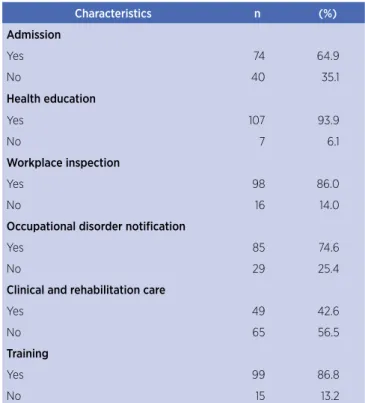
Among the activities performed by these physical therapists, actions related to occupational health surveillance were present in more than 50.0% of all Cerests; however, although the surveillance proposal is considered in most actions, many Cerests (42.6%) reported clinical care and rehabilitation activities as part of their role in the team (Table 1).
Caption
Caption Caption
Figure 1b Figure 1a
Figure 1c
20990 (62,3%)
8994 (26,7%)
1038 (6,1%)
929 (2,8%)
178 (2,1%)
63 (38,9%)
47 (16,7%)
27 (16,7%)
13 (8%)
12 (7,4%)
43 (37,6%)
36 (31,6%)
15 (13,2%)
10 (8,8%)
0 250 500 1000 km 0 250 500 1000 km
0 250 500 1000 km
Figure 1. Geographical distribution of notiications of work-related musculoskeletal disorders from 2009 to 2013 (1a), implementation of Cerests (1b) and distribution of physical therapists in Brazil (1c) by region in 2015
Physician
Nurse
Technical prof.
Physical therapist
Psychologist
Other professionals
Social worker
Speech therapist
Other professionals (higher education level)
Engineer
Occupational therapist
Odontologist
Nutritionist
13.9%
13.9%
12.3%
11.9%
10.2%
9%
7.8%
6.5%
5.9%
3.8%
2.1%
2%
0.6%
0.0 2.0 4.0 6.0 8.0 10.0 12.0 14.0 16.0
Table 1. Characterists of the work of physical therapists inserted in Cerests of the country in 2015
Characteristics n (%)
Admission
Yes 74 64.9
No 40 35.1
Health education
Yes 107 93.9
No 7 6.1
Workplace inspection
Yes 98 86.0
No 16 14.0
Occupational disorder notification
Yes 85 74.6
No 29 25.4
Clinical and rehabilitation care
Yes 49 42.6
No 65 56.5
Training
Yes 99 86.8
No 15 13.2
Table 2. Presence of ICF in surveillance practice of Cerests in Brazil in 2015
Characteristics n (%)
Knowledge of what ICF is
Yes 103 63.6
No 59 36.4
Use of ICF as a tool for WMSD classification
Yes 18 17.3
No 86 82.7
Discussion or training on ICF among the team
Yes 21 20.2
No 83 79.8
Most cases of WMSD notiications in the country in the studied period also presented a high expression in the Southeast region (62.3%), followed by the Northeast region (26.7%). hey were also signiicant in the concentration of Cerests: 38.9% in the Southeast region and 29% in the Northeast region (Figure 1). However, of all Cerests evaluated, 16.5% reported that they did not produce the mandatory notiication of WMSDs.
DISCUSSION
his study analyzed the current scenario of insertion of physical therapists in Cerests across the country
and the incorporation of surveillance actions into the practices of these professionals. A higher percentage of physical therapists and a higher concentration of Cerests were found in the Southeast and Northeast regions, respectively. hese two regions also concentrated higher estimates of WMSD notiication. However, three out of ten Cerests do not have a physical therapist in the team. he insertion of physical therapists in Cerests across the country relects the broad perception of the ield of action of physical therapy in the scope of surveillance within the SUS. he adaptation of physical therapy’s action to the consolidation of integral actions, based on the appreciation of health prevention-promotion and risk control, has been often considered in academic contexts, due to changes in curricular structures in higher education courses9.
However, the ields of physical therapy are still used in the treatment of kinetic disorders that have already been set, justiied by the historicity of the profession, which aimed to socially reintegrate debilitated individuals, while strongly supported by an academic training restricted to clinical/therapeutic perspectives10.
here is evidence that Cerest professionals may ind it diicult to understand the level of complexity of the healthcare environment they are inserted, indicated by the lack of understanding of Cerest’s proposal in SUS organization and the lack of diferentiation between Renast and Cerest, besides the dilemmas about the prioritization of care or surveillance actions in daily work11. hen, improvements are required, since training, for professionals who do not have the practice to act according to the logic of the actions for occupational health vigilance12.
he intervention of physical therapy in collective health is still a new fact2,8,9,11,13. However, the healthcare model in force in the country requires a broad view of the functional health of the population, one that relates the social dimension by admitting the legitimacy of investigation of non-biological factors, such as productive work relations and characteristics of territorialization, which directly inluence the complexity of diseases and occupational health14.
he social sphere of work incorporates into the physical therapy approach the relection of WMSD impact on occupational health. hus, a number of actions is foreseen to cover not only WMSD notiication, treatment and rehabilitation of the worker, but also organizational, sociocultural and territorial factors, to strengthen possible methods to control this disorder.
Regarding the implementation of Cerests in Brazil, an increase in the number of Cerests can be observed over the years, totaling 210 units in the country today16. he literature does not have suicient studies on the implementation of Cerests and the health surveillance process, but it has discussions about the progress and challenges of surveillance actions in the ield of occupational health. his study reinforces the importance of Cerest as an articulator of surveillance actions in the network that involves diferent levels of occupational health.
he higher concentration of doctors and nurses among the professionals in the units can be explained by the regulation that deines the presence of these professionals in the team composition, along with nursing assistants17. Although physical therapy is the third most frequent profession in Cerests, the distribution of physical therapists is not homogeneous, relecting the need for a greater incentive to incorporate a larger number of professionals. here is also a lack of other professional categories to achieve a proper team composition that relects the interdisciplinary investigation of disorders involving mandatory notiication in occupational health, taking into account the epidemiological situation of each territory.
In this perspective, a new scenario can be observed for mandatory notiication of occupational health problems. he incorporation of sentinel units into basic healthcare indicates the role assumed by these units in expanding the scope of professionals with a view to disorder notiication, thus increasing the number of notiied cases18.
he highest expressions of WMSD cases observed in the Southeast and Northeast regions relect the progress in the notiication process, directing a greater demand for notiications to control health risks. he notiication proile in the country is more related to the formal employment bonds, due to the fact that they have better access to labor rights and social security issues; it also afects workers from the various ields, with a prevalence of banking, metallurgical and industrial (assembly) workers, whose workplace favors the occurrence of functional disorders19,20.
CONCLUSION
Although physical therapists are present in most Cerests in Brazil and their geographical concentrations are in regions with the highest proportion of WMSD cases, the challenges are evident for the insertion of physical therapists in occupational health surveillance. he insertion of physical therapists in Cerests or healthcare units should be conditioned to the actions to ensure social viability of the SUS proposal, in addition to the therapeutic arsenal. In addition, the formulation of strategies that favor the increase of quality and quantity of notiications should be encouraged to obtain health information that increasingly correspond to the epidemiological demands.
REFERENCES
1. Brasil. Ministério da Previdência Social. Anuário estatístico da Previdência Social 2011. Brasília, DF: Previdência Social; 2011. [cited 2016 apr 25]. Available from: https://goo.gl/utneFk. 2. Caetano VC, Cruz DT, Silva GA, Leite ICG. O lugar ocupado
pela assistência isioterapêutica: representações sociais de trabalhadores com DORT. Fisioter Mov. 2012;25(4):767-76. doi: 10.1590/S0103-51502012000400009.
3. Scherer V, Miranda FMD, Sarquis LMM, Lacerda MR. Sinan NET: um sistema de informação à vigilância na saúde do trabalhador. Cogitare Enferm. 2007;12(3):330-7.
4. Dias EC, Hoefel MG. O desaio de implementar as ações de saúde do trabalhador no SUS: A estratégia da Renast. Cienc Saude Colet. 2005;10(4):817-28. doi: 10.1590/ S1413-81232005000400007.
5. Santana VS, Moura MCP, Soares JFS, Guedes MH. Acidentes de trabalho no Brasil: dados de notiicação do Sinan 2007-2008. Brasília, DF: Ministério da Saúde; 2009.
6. Teixeira CF, Paim JS, Villasbôas AL. SUS, modelos assistenciais e vigilância da saúde. Inf Epidemiol SUS. 1998;7(2):7-28. doi: 10.5123/S0104-16731998000200002.
7. Waltner-Toews D. The end of medicine: the beginning of health. Futures. 2000;32(7):655-7. doi: 10.1016/ S0016-3287(00)00014-8.
8. Bispo JP Júnior. Fisioterapia e saúde coletiva: desaios e novas responsabilidades proissionais. Cienc Saude Colet. 2010;15(1):1627-36.
9. Neves LMT, Aciole GG. Desaios da integralidade: revisitando as concepções sobre o papel do isioterapeuta na equipe de saúde da família. Interface (Botucatu). 2011;15(37):551-64. doi: 10.1590/S1414-32832011005000010.
10. Rodrigues RM. A isioterapia no contexto da política de saúde no Brasil: aproximações e desaios. Perspect Online. 2008;2(8):104-9.
Centros de Referência em Saúde do Trabalhador (Cerest), 2002-2007. Rev Med Minas Gerais. 2010;20(2):66-74.
12. Gómez CM. Avanços e entraves na implementação da Política Nacional de Saúde do Trabalhador. Rev Bras Saúde Ocup. 2013;38(127):11-30.
13. Faria L, Santos LAC. As proissões de saúde: uma análise crítica do cuidar. Hist Cienc Saude-Manguinhos. 2011;18(1):227-40. doi: 10.1590/S0104-59702011000500012.
14. Gomes CM, Lacaz FAC. Saúde do Trabalhador: novas-velhas questões. Cienc Saude Colet. 2005;10(4):797-807. doi: 10.1590/S1413-81232005000400002.
15. Araujo ES, Buchalla CM. Utilização da CIF em isioterapia do trabalho: uma contribuição para coleta de dados sobre funcionalidade. Acta Fisiatr. 2013;20(1):1-7. doi: 10.5935/0104-7795.20130001.
16. Brasil. Portaria nº 2.978, de 15 de dezembro de 2011. Amplia para 210 (duzentos e dez) a quantidade de Centros de Referência em Saúde do Trabalhador (Cerest) passíveis de implantação no território nacional. Diário Oicial da União, Brasília, DF, 15 dez 2011.
17. Brasil. Portaria GM/MS nº 2.437, de 7 de dezembro de 2005. Dispõe sobre a ampliação e o fortalecimento da Rede Nacional de Atenção Integral à Saúde do
Trabalhador (Renast) no Sistema Único de Saúde (SUS) e dá outras providências. Diário Oficial da União, Brasília, DF, 8 dez 2005.
18. Brasil. Portaria GM/MS nº 104, de 25 de janeiro de 2011. Deine as terminologias adotadas em legislação nacional, conforme o disposto no Regulamento Sanitário Internacional 2005 (RSI 2005), a relação de doenças, agravos e eventos em saúde pública de notiicação compulsória em todo o território nacional e estabelece luxo, critérios, responsabilidades e atribuições aos proissionais e serviços de saúde. Diário Oicial da União, Brasília, DF, 26 jan 2011.
19. Brasil. Ministério da Saúde. Lesões por esforços repetitivos (LER). Distúrbios osteomusculares relacionados ao trabalho (DORT). Brasília, DF: Ministério da Saúde; 2001. [cited 2014 aug 27]. Available from: http://bit.ly/2ras5Yo.