387
ORIGINAL ARTICLE J Bras Patol Med Lab, v. 52, n. 6, p. 387-390, December 2016
Clinical correlation between the Point-of-care testing
method and the traditional clinical laboratory
diagnosis in the measure of the lipid profile in patients
seen in medical offices
Correlação clínica entre a metodologia
Point-of-care testing
e o diagnóstico laboratorial
tradicional na dosagem do perfil lipídico de pacientes atendidos em consultórios médicos
Hermes T. Xavier1; Rogerio M. Ruiz2; Luiz Kencis Jr.2; Giovanni Melone2; William Costa2; Raffael Francisco Fraga2;
Luciano Wajman2; Marcio Krakauer2; Marileia Scartezini3
1. Universidade de São Paulo (USP), São Paulo, Brazil. 2. Consultório privado, São Paulo, Brazil. 3. Universidade Federal do Paraná (UFPR), Paraná, Brazil.
First submission on 02/08/16; last submission on 09/08/16; accepted for publication on 22/10/16; published on 20/12/16
ABSTRACT
Introduction: Elevated plasma levels of lipids are considered the main modiiable risk factor for the cardiovascular disease. The
Point-of-care testing (POCT) method provides quick results and allows anticipating diagnosis and treatment. Objective: To compare the lipid proile results obtained from both POCT and the traditional clinical laboratory. Methods: Fasting blood samples were collected from 111 patients who sought, for any reason, the private medical ofices participating on this study. Capillary whole blood samples were analyzed in CardioChek® PA (CCPA) equipment, and the serum samples were analyzed in clinical laboratories (LAB) that have internal and external quality control, with certiication. The mean values of each variable of the lipid proile obtained by CCPA and LAB were calculated. Linear regression was used to determine the existence of correlation between the two methods. Results: We observed a positive correlation between the values obtained by CCPA and LAB for all variables of the lipid proile. Our data, extracted from the routine use of CCPA in private medical ofices, supports a substantial contribution of the POCT methodology in the detection of the main cardiovascular risk factors.
Conclusion: The POCT CardioChek® PA Analyzer is an easy-to-operate tool, with adequate analytical performance and a good correlation with the results of the conventional laboratory method, therefore, considered a reliable method.
Key words: lipids; point-of-care testing; cardiovascular diseases.
INTRODUCTION
High levels of cholesterol in blood are considered the main modiiable risk factor for cardiovascular disease. A large body of scientiic evidence supports this premise by unambiguously establishing that reductions of low-density lipoprotein cholesterol (LDL-c), through lifestyle changes and/or use of medicaments have a major impact in lifetime, in reduction of cardiovascular
events and mortality(1).
The “point-of-care testing” (POCT) method is intended to provide rapid and accurate results. The evaluation of the complete
lipid proile on a single reagent strip using capillary whole blood provides results in less than two minutes. This agility allows us to anticipate the beginning of clinical treatment. For example, physicians in their ofice can identify early the individuals at risk for cardiovascular disease, monitor their therapeutic response to the medication prescribed, adjust the dose of medication, and monitor target achievement and treatment compliance(2).
Through the data obtained in this study, we aimed to evaluate the advantages of the POCT measure in comparison to the traditional methodology and its viability in the clinical routine of the medical ofices.
388
METHODS
Study design and patient selection
For this study, we recruited 111 patients who sought, for any reason, the private cardiology and endocrinology clinics participating in this study. Patients who met the inclusion and exclusion criteria after being informed by the physician about the procedures, risks, beneits and rights were considered eligible to participate in the protocol, with all their doubts clariied. All agreed to sign the informed consent form.
The study required two collections of blood samples on the same day: 1) in the ofice, through inger puncture, to collect a capillary blood drop; and 2) in the clinical analysis laboratory, in a conventional way, by venipuncture. For both samples, 8 to 12 fasting hours was required, and the interval between the two collections was less than 60 minutes.
The laboratory parameters determined were total cholesterol (TC), high-density lipoprotein cholesterol (HDL-c) and triglycerides (TG); the LDL-c values were calculated by the Friedewald formula(3)
and the POCT analyzer provided them automatically.
Diagnostic methodology
Total capillary blood samples obtained by the clinics were analyzed on CardioChek® PA (CCPA) (PTS Diagnostics, Indianapolis, USA) equipment on lipid panel test strips. The guidelines of the manufacturer’s protocol were observed and the operation of the electronic and optical parts of the analyzer was veriied with ChekMateTM at all the wavelengths used by the equipment. The lipid panel test strips were tested using the quality control of the CardioChek® Level 1 and Level 2.
The reactive strips for the lipid proile present an initial membrane that removes the red blood cells and, by the horizontal low, the plasma lipids are determined by a dry chemical reaction. TC and HDL-c evaluations use the same enzymatic reaction. HDL lipoprotein is separated from the other plasma lipoproteins in the presence of phosphotungstic acid and magnesium chloride. The HDL resulting fraction in plasma reacts with surfactants and enzymes for the determination of the cholesterol concentration. The TG measure is performed by an enzymatic colorimetric method, using lipoprotein lipase, glycerol kinase, glycerol-phosphate oxidase and peroxidase. The Cardiochek analyzer employs relectance photometry(4).
Blood samples from the venipuncture were collected and analyzed in clinical laboratories (LAB) that present internal and
Clinical correlation between the Point-of-care testing method and the traditional clinical laboratory diagnosis in the measure of the lipid proile in patients seen in medical ofices
TABLE 1 − Mean values of each variable of the lipid profile of the 111 patients,
obtained by the two methods CCPA and LAB
TC HDL-c TG LDL-c
CCPA LAB CCPA LAB CCPA LAB CCPA LAB
n 111 111 111 111
Mean values (mg/dl) 158.1 179.1 52.3 53.5 126.4 125.5 82.4 100.1
CCPA: CardioChek® PA; LAB: clinical laboratories; TC: total cholesterol; HDL-c: high-density
lipoprotein cholesterol; TG: triglycerides; LDL-c: low-density lipoprotein cholesterol.
external quality control, with certiication. The methodology for the analysis of TC, HDL-c, TG and LDL-c has the same principle as the reactive strips.
Statistical analysis
Data analysis was performed using the Microsoft Excel (2010). The mean values of each lipid proile variable obtained by CCPA and LAB were calculated. Linear regression was used to determine the existence of correlation between the two methods. Statistical signiicance was deined as p < 0.05.
RESULTS
The mean values of each variable of the lipid proile from the 111 participating patients, obtained by both CCPA and LAB methods, are presented in Table 1.
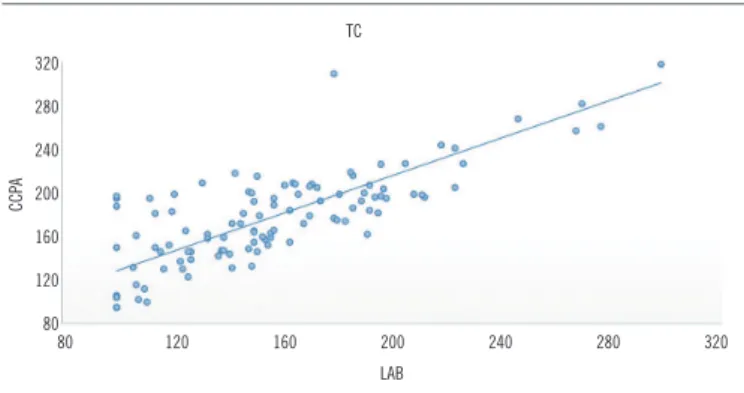
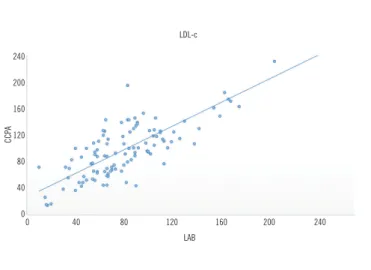
The graphs presented in Figures 1, 2, 3 and 4 demonstrate
the existence of correlation between the two methods for the variables TC, HDL-c, TG and LDL-c, respectively.
Table 2 shows the statistical data for the calculation of the
correlation coeficients (R) and the coeficient of determination
(R2) by the linear regression analysis.
FIGURE 1 −Correlation between CCPA and LAB for TC values (R = 0.796)
CCPA: CardioChek® PA; LAB: clinical laboratories; TC: total cholesterol.
80 120 160 200 240 280 320 320
280
240
200
160
120
80
CCP
A
TC
389
DISCUSSION
Our results demonstrate a positive relationship between the values obtained by the POCT methodology and the conventional laboratory for all the variables of the lipid proile, as demonstrated in a previous Brazilian study that, evaluating the clinical correlation between the CCPA and the clinical reference laboratory of the Hospital of the Universidade Federal de São Paulo, Escola Paulista de Medicina (Unifesp/EPM)(5), conirmed that the
analytical performance of this POCT equipment is suitable for use in population screening programs and as a service in healthcare systems, providing fast and reliable results. Other studies that compared the performance of CCPA with that of the conventional LAB, in different populations showed results similar to those found
in our study. Panz et al. (2005), evaluated 100 South African
patients with familial hypercholesterolemia (HF), and found a
TABLE 2 − Linear regression analysis between the two methods for
the values of each lipid profile variable
TC HDL-c TG LDL-c
Correlation coeficient (R) 0.796 0.838 0.716 0.777
Coeficient of determination (R2) 0.63 0.7 0.51 0.6
TC: total cholesterol; HDL-c: high-density lipoprotein cholesterol; TG: triglycerides; LDL-c: low-density lipoprotein cholesterol.
FIGURE 2 −Correlation between CCPA and LAB for HDL-c values (R = 0.838)
CCPA: CardioChek® PA; LAB: clinical laboratories; HDL-c: high-density lipoprotein
cholesterol.
0 20 40 60 80 100 120
120
100
80
60
40
20
0
CCP
A
HDL-c
LAB
FIGURE 3 −Correlation between CCPA and LAB for TG values (R = 0.716)
CCPA: CardioChek® PA; LAB: clinical laboratories; TG: triglycerides.
TG
0 50 100 150 200 250 300 350 400 450 450
400
350
300
250
200
150
100
50
0
CCP
A
LAB
FIGURE 4 − Correlation between CCPA and LAB for LDL-c values (R = 0.777)
CCPA: CardioChek® PA; LAB: clinical laboratories; LDL-c: low-density lipoprotein cholesterol.
LDL-c
0 40 80 120 160 200 240 240
200
160
120
80
40
0
CCP
A
LAB
signiicant correlation between the methods(6). Yang et al. (2013),
in 1,263 Chinese patients over 40 years of age demonstrated the effectiveness of CCPA in detecting the lipid levels of patients at high cerebrovascular risk(7).
Our data, extracted from the routine use of CCPA in private medical practices, supports the substantial contribution of the POCT methodology in the detection of the main cardiovascular risk factors, representing a new tool and excellent diagnostic option.
CONCLUSION
The POCT CardioChek PA analyzer is an easy-to-operate tool with adequate analytical performance and very good correlation with the results of the conventional laboratory method,
therefore reliable.
390
RESUMO
Introdução: Níveis plasmáticos elevados de lipídios são considerados como principal fator de risco modificável para a doença
cardiovascular. A metodologia Point-of-care testing (POCT) fornece resultados rápidos e permite antecipar o diagnóstico e o
tratamento. Objetivo: Comparar os resultados do perfil lipídico obtidos pelo POCT e pelo laboratório convencional. Métodos: Foram
coletadas amostras em jejum de 111 pacientes que procuraram, por qualquer motivo, os consultórios médicos privados participantes
desta pesquisa. As amostras de sangue total da punção capilar foram analisadas no equipamento CardioChek® PA (CCPA) e as de
sangue da punção venosa, coletadas e analisadas em laboratórios clínicos (LAB) que apresentam controle de qualidade interno e externo, com certificação. Os valores médios de cada variável do perfil lipídico obtidos pelo CCPA e pelo LAB foram calculados.
Regressão linear foi utilizada para determinar a existência de correlação entre os dois métodos. Resultados: Observamos correlação
positiva entre os valores obtidos pelo CCPA e pelo LAB para todas as variáveis do perfil lipídico. Nossos dados, extraídos do uso rotineiro do CCPA em consultórios médicos privados, suporta substancial contribuição da metodologia POCT na detecção dos principais
fatores de risco cardiovascular. Conclusão: O analisador POCT CCPA configura-se como uma ferramenta de fácil operação, com
performance analítica adequada e excelente correlação com os resultados do método laboratorial convencional, portanto confiáveis.
Unitermos: lipídios; testes laboratoriais remotos; doenças cardiovasculares.
REFERENCES
1. Xavier HT, Izar MC, Faria Neto, et al. V Diretriz Brasileira de Dislipidemias e Prevenção da Aterosclerose. Arq Bras Cardiol. 2013 Oct; 101(4 Suppl 1): 1-20.
2. Sociedade Brasileira de Patologia e Medicina Laboratorial. Diretriz para gestão e controle de qualidade de Testes Laboratoriais Remotos (TLR) da SBPC/ML, 2013. Available at: http://sbpc.org.br/.
3. Friedewald WT, Levy RI, Fredrickson DS. Estimation of the concentration of low-density lipoprotein cholesterol in plasma, without use of the preparative ultracentrifuge. Clin Chem. 1972; 18: 499-502.
4. The CardioChek®, CardioChek® PA and associated test strips are
covered by one or more of the following patents. Polymer Technology Systems, Inc.7736 Zionsville Rd. Indianapolis, IN 46268 EUA.
5. Ferreira CES, França CN, Correr CJ, et al. Clinical correlation between a point-of-care testing system and laboratory automation for lipid proile. Clin Chim Acta. 2015; 446(2015): 263-6.
6. Panz VR, Raal FJ, Paiker J, Immelman R, Miles H. Performance of the CardioChek™ PA point-of-care analysers compared to clinical diagnostic laboratory methods for the measurement of lipids. Cardiovasc J South Afr. 2005. 7. Yang P, Su Li NA, Zhu Y, et al. Evaluation on lipid detection of CardioChek PA blood analyzer and its application in lipid screening in high risk stroke group. CJCNN. 2013; 13(4).
CORRESPONDING AUTHOR
Hermes Toros Xavier
Avenida Ana Costa, 374, cj. 61; Gonzaga; CEP: 11060-002; Santos-SP, Brasil, e-mail: [email protected].