ORIGINAL
RES
EAR
CH
Correspondence to: Leonardo Costa – Rua Cesário Galeno, 448 – Tatuapé – CEP: 03071-100 – São Paulo (SP), Brazil – E-mail: [email protected]
Presentation: Mar. 2014 – Accepted for publication: Oct. 2014 – Financing source: none – Conflict of interests: nothing to declare. – Presentation in scientific event: VI Jornada Científica
and VIII Encontro de Iniciação, UNICID (2012) – Approval at the Research Ethics Committee nº 13585995. ABSTRACT | Although there is a wide variety of methods
and instruments aiming to assess the trunk range of motion, there is uncertainty regarding their construct validity and reproducibility. The objective of this study was to verify the construct validity and intra and inter-rater reproducibility of the goniometer, inclinometer and electrogoniometer in measuring the trunk range of motion in patients with history of low back pain. The measurement properties of reliability, agreement and construct validity were tested in 58 patients with low back pain using a test-retest design at baseline and after 24 to72 hours. All instruments showed good construct validity (r>0.60) as well as good levels of intra and inter-rater reliability with measurement errors ranging from 2.83 to 16.42 degrees. Among the assessed movements, the incli-nometer, goniometer and electrogoniometer instruments can be considered as having good levels of construct valid-ity and reproducibilvalid-ity for the assessment of trunk range of motion in patients with low back pain.
Keywords | Low Back Pain; Reproducibility of Results.
RESUMO | Apesar da grande variabilidade de métodos e ins-trumentos disponíveis para avaliar a amplitude de movimento da coluna, são escassos os métodos quantitativos precisos de mensuração. O objetivo do estudo foi verificar a reprodu-tibilidade intra e interexaminadores e a validade de construto entre as medidas de amplitude de movimento da coluna em
Reproducibility and construct validity of three
non-invasive instruments for assessing the trunk
range of motion in patients with low back pain
Reprodutibilidade e validade do construto de três instrumentos não invasivos para
a avaliação da amplitude de movimento da coluna em pacientes com dor lombar
Reproducibilidad y validad del constructo de tres instrumentos no invasivos para
evaluar la amplitud de movimiento de la columna en pacientes con dolor lumbar
Gabrielle Zoldan Ganzalez1, Lucíola da Cunha Menezes Costa1, Alessandra Narciso Garcia1,
Silvia Regina Shiwa1, Cesar Ferreira Amorim1, Leonardo Oliveira Pena Costa1,2
Study conducted at the Universidade Cidade de São Paulo (UNICID) – São Paulo (SP), Brazil.
1Masters and doctoral programs in Physical therapy, UNICID – São Paulo (SP), Brazil. 2Musculoskeletal Division, The George Institute for Global Health – Sydney (NSW), Australia.
pacientes com dor lombar, obtidas com os instrumentos goniô-metro, inclinômetro e eletrogoniômetro. A reprodutibilidade e a validade do construto dos instrumentos foram testadas em 58 pacientes com dor lombar num delineamento de tes-te-reteste, na linha de base e após 24 a 72 horas. Todos os instrumentos apresentaram boa correlação entre si (r>0,60), refletindo boa validade do construto, e obtiveram bons níveis de confiabilidades inter e intraexaminadores. Entre todos os movimentos avaliados, o inclinômetro apresentou um erro absoluto inter e intraexaminador que variou de 6,20 a 7,52 e 6,75 a 11,89 graus respectivamente; o goniômetro mostrou um erro de 3,15 a 7,85 e 2,83 a 8,06 graus, respectivamente; e o eletrogoniômetro, entre 3,27 a 16,42 e 2,72 a 8,06 graus, respectivamente. Dessa forma, todos os instrumentos utili-zados podem ser considerados com bons níveis de validade do construto e reprodutíveis para avaliação da amplitude de movimento em pacientes com dor lombar.
Descritores | Dor Lombar; Reprodutibilidade dos Testes.
INTRODUCTION
Low back pain (LBP) is a major health problem asso-ciated with disability and work absenteeism1. LBP is a
very prevalent condition, which requires high cost for treatment2. During the clinical examination of patients
with low back pain, one of the recommendations is the evaluation of range of movement (ROM) of the trunk3.
Its measurement is used to facilitate the functional assess-ment as well as to analyze the evolution of the treatassess-ment of these patients4. here are several methods3 that
quan-tify ROM such as: observation3,5, the Schober method4,6,
goniometer3, electrogoniometers3,7, inclinometer4,8 and
radiological analysis9. hese methods vary in
complex-ity of use and costs3. here are a small number of studies
on the reproducibility of these instruments in patients with low back pain10-12. Most of the existing data deals
with the measurement of ROM in healthy subjects13-15
and, although providing important information regard-ing the normative values of the measures of ROM16, they
cannot be considered generalizable to patients with low back pain.
herefore, this study aimed to: verify both reliability (relative error of measurement)17 and agreement
(abso-lute error of measurement)17 intra- and inter raters of
ROM measurements of the spine in patients with low back pain, obtained through the goniometer, inclinome-ter and electrogoniomeinclinome-ters; and to measure the construct validity (correlation between measures that measure the same construct)18 of these instruments.
METHODS
After approval by the Research Ethics Committee, 58 patients with history of low back pain were recruited. The sample size was based on the Guidelines of
health-related questionnaires18, that requires that at
least 50 participants are needed to evaluate the repro-ducibility and construct validity. Eligible subjects should be aged between 18 and 80 years, of both sexes and with history of non-speciic low back pain, (ie, pain between the 12th rib and the lower gluteal folds, with and
with-out irradiation to the lower limbs, of mechanical origin)1.
Participants were excluded if they had contraindications to physical exercise, underwent spine surgery, were preg-nant, had serious spinal pathologies or cardiorespiratory diseases. he subjects were recruited from the waiting list of the Physiotherapy Clinic of the Universidade Cidade de São Paulo (UNICID). Previously, a pilot study with 10 subjects was conducted. Data from this pilot study were not incorporated into this study.
Procedures
Eligible patients were informed about the study objec-tives and procedures. hen the volunteers were instructed to sign the informed consent. We have used the follow-ing instruments: A questionnaire containfollow-ing questions about socio-demographic and anthropometric data; Pain Numerical Rating Scale19; and the Roland Morris
Disability Questionnaire20. After assessing the patients,
we performed the ROM measurements for lexion, exten-sion and lateral bending of the spine, using the goniom-eter, the electrogoniometer and the inclinometer.
Description of measurement instruments
he Pain Numerical Rating Scale 19 evaluates pain
inten-sity through a 11-point scale, with 0 being classiied as “no pain at all” and 10 “the worst pain possible”19 in the
last 7 days.
he Roland Morris Disability Questionnaire21 is used
to analyze the disability associated with back pain. It con-sists of 24 items that describe activities in which patients
con dolor en la región lumbar, las cuales fueron obtenidas con los instrumentos goniómetro, inclinómetro y electrogoniómetro. La reproductibilidad y validad del constructo de instrumentos fueron testadas en 58 pacientes con dolor en la región lumbar en un diseño de test y re-test, en la línea de base y después de 24 a 72 horas. Todos los instrumentos presentaron buena correlación entre sí (r>0,60), lo que reflete buena validad del constructo, y tuvieron buenos niveles de confiabilidades inter- e intra-examinadores. Entre todos los movimientos evaluados, el inclinómetro presentó un error
absoluto inter- e intra-examinador que varió del 6,20 al 7,52 y 6,75 al 11,89 grados; y lo goniómetro mostró uno del 15 al 7,85 y 2,83 al 8,06 grados; y lo electrogoniómetro con uno entre 3,27 al 16,42 y 2,72 al 8,06 grados. Por lo tanto, los instrumentos aplicados pueden ser considerados con buenos niveles de validad del constructo y reproducibles para evaluación de la amplitud de movimiento en pacientes con dolor en la región lumbar.
may have diiculty in performing them due to low back pain. Higher scores mean high disability.
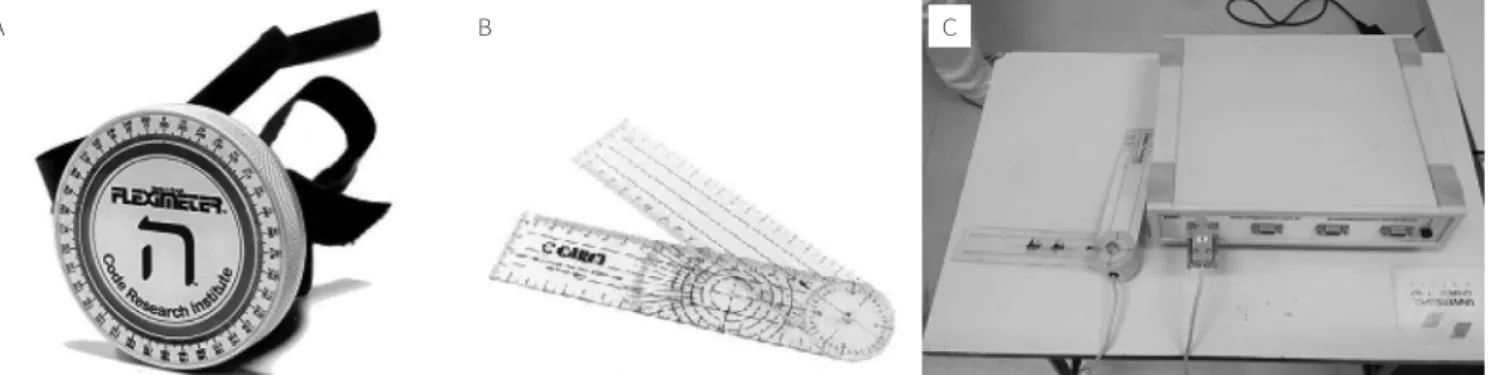
Goniometer
he goniometer22 comprises a body (rotation axis) with
two arms attached to it, one being ixed and the other movable. he measurement of the ROM is performed by direct reading of the angle between the axis of rota-tion at the end of the active ROM of the movement assessed. In this study, it was applied the goniometer of the manufacturer Carci® (Figure 1).
Inclinometer
he inclinometer23 uses the gravity upon the pointers and
luid levels to evaluate ROM23. As a tool that does not
contain joint vertices, but a self-adhesive strip (velcro) which is ixed in the joint of interest, it allows to isolate the various joint movements24. It was employed an
incli-nometer of the manufacturer Fleximeter®24 (Figure 1).
Electrogoniometer
he goniometer25 is an instrument consisted of a body
(rotation axis) with two arms attached to it, being one ixed and the other movable. he measurement of ROM is performed by the electronic reading of the angle formed in the axis of rotation through the positioning of the ixed and mobile arms at the end of the ROM evalu-ated. It was used the electrogoniometer produced by
EMG Systems® (Figure 1).
Data collection
Data collection was performed at two diferent times, by two evaluators. On the irst day, both performed the measurements independently in order to verify the
inter-rater reproducibility. On the second day (with a minimum interval of 24 hours), measurements were made only by the irst evaluator to check the intra-rater reproducibility. In order to control a possible ordering bias, all movements were randomly selected. Before the start of each collection, the evaluator reported to the one that would be responsible for collecting the initial movement, so that she could position the patient and the instruments, as well as perform the calibration of the goniometer.
Stickers were set at speciic anatomical points sug-gested by the manuals of the instruments, as follows: C7 and the midpoint between the two postero-superior iliac crest (to measure frontal plane movements) and the right side of the anterosuperior iliac crest and the axil-lary line (sagittal). he inclinometer was placed in the right axillary line at nipple height to measure the lexion and extension movements. To evaluate lateral bending, this instrument was placed in the posterior region of the midline of the body, at nipple height, directed to C7. he universal goniometer and the electrogoniometer were placed at the midpoint of the posterosuperior iliac crests for lateral bending movements. To measure the lexion and extension, the universal goniometer and the electrogoniometer were inserted into the right antero-superior iliac crest (Figure 2). When patients reached the end of the ROM, the evaluator memorized the val-ues obtained by the goniometer and inclinometer and gave a “can record” verbal command to a colleague who was processing the data on the computer.. Each move-ment was performed three times, and then the averaged was calculated.
Statistical analysis
Reproducibility is an umbrella term that encompasses two measurement properties, called reliability (relative mea-surement error) and agreement (absolute meamea-surement
Figure 1. Instruments: (A) inclinometer; (B) goniometer; (C) electrogoniomete
error)26. Reliability was assessed by intraclass correlation
coeicient (ICC, type 2,3), which was interpreted as fol-lows: less than 0.40 indicates low reliability; between 0.40 and 0.75, moderate; between 0.75 and 0.90, substantial and greater than 0.90, excellent26.
To evaluate the agreement, we used the stan-dard error of measurement (SEM) and at minimum detectable change with 90% confidence (MDC90). The SEM was calculated by dividing the standard deviation of the differences and the square root of two. MDC90 (minimal change in which a score can be interpreted as real) was calculated using the formula MDC=1.645 x √2 x SEM. The smaller the value of SEM and of MDC90, the greater is the agreement27.
We also used Bland and Altman plots. In this case, it was found that the observations of the examiners were contained within the “limits of agreement”, which was established in 1.96 times the standard deviation of the observations26.
he construct validity refers to the extent to which the values of a particular instrument correlate with other similar measures26. Construct validity was estimated
using Pearson’s correlation coeicients (r) between the instruments, provided that when p<0.30, it is consid-ered poor; 0.30≤r<0.60, moderate; and r≥0,60, good28.
For this analysis, we used the measures of the examiner 1 and was also performed a sensitive analysis, with the data from examiner 2.
RESULTS
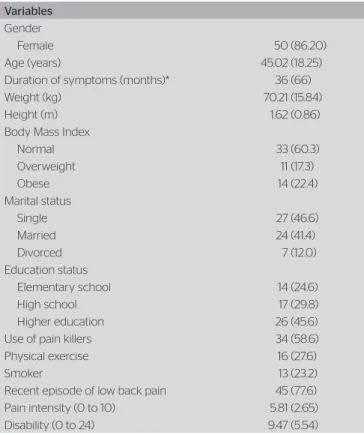
Table 1 shows the demographic and clinical characteristics of the participants. Of the 58 patients initially recruited, eight did not attend to the retest.
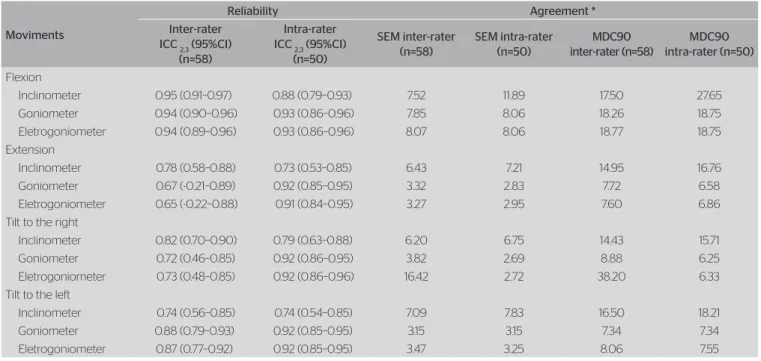
Inter-rater reliability
he inclinometer showed excellent reliability for lex-ion, substantial for extension and bending to the right and moderate for bending to the left. he goniometer demonstrated excellent reliability for lexion and bend-ing to the right, and substantial for bendbend-ing to the left. he eletrogoniometer had excellent reliability for lex-ion and bending to right and substantial for bending to the left (Table 2).
Table 1. Clinical and demographic characteristics of the study patients at baseline (n=58)
Variables
Gender
Female 50 (86.20) Age (years) 45.02 (18.25) Duration of symptoms (months)* 36 (66) Weight (kg) 70.21 (15.84) Height (m) 1.62 (0.86) Body Mass Index
Normal 33 (60.3) Overweight 11 (17.3)
Obese 14 (22.4)
Marital status
Single 27 (46.6) Married 24 (41.4) Divorced 7 (12.0) Education status
Elementary school 14 (24.6) High school 17 (29.8) Higher education 26 (45.6) Use of pain killers 34 (58.6) Physical exercise 16 (27.6)
Smoker 13 (23.2)
Recent episode of low back pain 45 (77.6) Pain intensity (0 to 10) 5.81 (2.65) Disability (0 to 24) 9.47 (5.54)
The variables were expressed as numbers and percentages. Continuous variables are presented as mean and standard deviation. *Variable expressed as median and (interquartile range)
Figure 2. Positioning of the instruments: (A) bending to the left; (B) bending to the right; (C) extension and (D) flexion
Intra-rater reliability
he inclinometer showed substantial reliability for lex-ion, moderate to extension and bending to the left and substantial for bending to the right. he goniometer and eletrogoniometer demonstrated excellent reliability for all movements. Again, the lexion movement had bet-ter reliability for the three instruments (Table 2).
Inter- and intra-raters agreement
Among all evaluated movements, the goniometer showed the lowest agreement followed by the electrogoniometer. he agreement estimates measured by Bland and Altman plots conirmed the indings of SEM and MDC, so the graphics have been omitted from this manuscript.
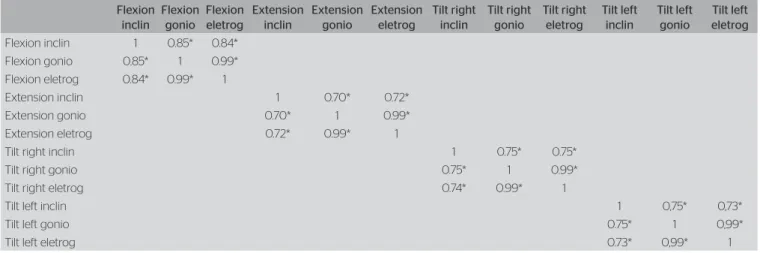
Construct validity
All instruments indicated good correlation for all movements (r>0.60 – Table 3). A secondary analysis using the data from examiner 2 showed no diferences between the correlation estimates, so this data was also omitted from this manuscript.
DISCUSSION
It was observed that all instruments have good correla-tion with each other, meaning that they are capable of
measuring the same construct, relecting good construct validity. In addition, we found that they had good levels of reliability, however, with a high absolute error of mea-surement for some movements (i.e. inter-raters bending to the right and lexion measured by the eletrogoniometer and intra-raters lexion measured by the inclinometer).
he main sources of error in measurements in this study were: verbal commands of the examiner, the performance of motor tasks by the patient and the errors inherent in the use of equipment, such as identiication of anatomi-cal structures, positioning the subjects and anatomi-calibration of the equipment. All sources of measurement errors were minimized by long periods of training and calibration of the instruments, but it is expected that they will always be present in such kinds of measurement. herefore, it can be assumed that the possibility of diferent training levels may lead to diferent reproducibility estimates.
he correlation between the goniometer and elect-rogoniometer was the highest, which means that both actually measure the same construct. Despite the other correlations being also high, the data indicate that the inclinometer does not have such a linear relationship with the other equipment.
A study on reliability and validity of the inclinometer in patients with chronic low back pain29 found a similar
result: good levels of reliability and validity for mea-suring spinal ROM for lexion (r=0.88) and extension (r=0.42). However, unlike this study, the authors used two inclinometers in an attempt to isolate the motion of the lumbar spine. If, in one hand, these authors monitored
Table 2. Reproducibility (reliability and intra- and inter- agreement)
Moviments
Reliability Agreement *
Inter-rater
ICC 2,3 (95%CI)
(n=58)
Intra-rater
ICC 2,3 (95%CI)
(n=50)
SEM inter-rater (n=58)
SEM intra-rater (n=50)
MDC90 inter-rater (n=58)
MDC90 intra-rater (n=50)
Flexion
Inclinometer 0.95 (0.91–0.97) 0.88 (0.79–0.93) 7.52 11.89 17.50 27.65 Goniometer 0.94 (0.90–0.96) 0.93 (0.86–0.96) 7.85 8.06 18.26 18.75 Eletrogoniometer 0.94 (0.89–0.96) 0.93 (0.86–0.96) 8.07 8.06 18.77 18.75 Extension
Inclinometer 0.78 (0.58–0.88) 0.73 (0.53–0.85) 6.43 7.21 14.95 16.76 Goniometer 0.67 (-0.21–0.89) 0.92 (0.85–0.95) 3.32 2.83 7.72 6.58 Eletrogoniometer 0.65 (-0.22–0.88) 0.91 (0.84–0.95) 3.27 2.95 7.60 6.86 Tilt to the right
Inclinometer 0.82 (0.70–0.90) 0.79 (0.63–0.88) 6.20 6.75 14.43 15.71 Goniometer 0.72 (0.46–0.85) 0.92 (0.86–0.95) 3.82 2.69 8.88 6.25 Eletrogoniometer 0.73 (0.48–0.85) 0.92 (0.86–0.96) 16.42 2.72 38.20 6.33 Tilt to the left
Inclinometer 0.74 (0.56–0.85) 0.74 (0.54–0.85) 7.09 7.83 16.50 18.21 Goniometer 0.88 (0.79–0.93) 0.92 (0.85–0.95) 3.15 3.15 7.34 7.34 Eletrogoniometer 0.87 (0.77–0.92) 0.92 (0.85–0.95) 3.47 3.25 8.06 7.55
the movement variations compared to this study; on the other hand, the pragmatism of these ROM measurements is potentially reduced, since physical therapists do not use more than one inclinometer in daily clinical routine.
Considering the inter-rater reliability, the same study29
concluded that the inclinometer was reliable (r=0.94), corroborating with our indings. Another study with 10 participants30, which aimed to verify the validity and
reliability of the electrogoniometer to the movements of lateral bending, found good correlation (r=0.97), which is similar to the present study. Regarding the use of the goniometer, a study13 conducted in healthy
individu-als showed an ICC of 0.85 and 0.75 for the lexion and extension, respectively.
An important inding of this study was the highest absolute error of the measurement for most of the mea-sures, for example, the inter-rater minimum detectable change for lexion was 27.65°, meaning that that a patient would need to improve at least 27.65° of lexion for this change to be considered true17. Such information may have
occurred by chance (due to the high number of statistical comparisons in this study) or because the instruments really have a high absolute error. Unfortunately, there is no published data for a direct comparison with our results.
As this study included only a sample of patients with low back pain, we believe that our results are closer to measurements performed in clinical practice, assisting in the decision making in clinical setting. Another strength of this study was that evaluators have undergone previ-ous training to the data collection. Finally, the random allocation of movements for each patient prevented the risk of ordering bias.
We did not collected pain intensity during the retest. Once the pain can inluence the ROM, we believe that this constitutes a limitation to this study. In addition, par-ticipants had high variation in body mass index, and the identiication of bone structures due to the variation may have inluenced the results. he subjects were recruited from the waiting list of the UNICID Physiotherapy Clinic thus it is possible that these patients have the same characteristics in relation to economic status, level of education and accessibility, which can characterize a possible selection bias. Finally, the evaluation of move-ments was not simultaneous, the authors were unable to isolate the intrinsic variability of movement of the intra- and inter-raters reliability.
It is recommended in clinical practice14 that the
instru-ments for measuring spinal ROM are valid and reliable, have low cost and are easy to use14. It was possible to
identify that the three instruments measure, in fact, the spinal ROM We recommend, with this study, the use of instruments with lower costs and easier handling, as the goniometer or inclinometer.
REFERENCES
1. Tulder MV. Chapter 1. European guidelines. Eur Spine J. 2006;15(2):134-5. 2. Dagenais S, Caro J, Haldeman S. A systematic review of low back pain cost of illness studies in the United States and internationally. Spine J. 20088(1):8-20.
3. Littlewood C, May S. Measurement of range of movement in the lumbar spine-what methods are valid? A systematic review. Physiotherapy. 2007;93(3):201-11.
Flexion inclin
Flexion gonio
Flexion eletrog
Extension inclin
Extension gonio
Extension eletrog
Tilt right inclin
Tilt right gonio
Tilt right eletrog
Tilt left inclin
Tilt left gonio
Tilt left eletrog
Flexion inclin 1 0.85* 0.84* Flexion gonio 0.85* 1 0.99* Flexion eletrog 0.84* 0.99* 1
Extension inclin 1 0.70* 0.72* Extension gonio 0.70* 1 0.99* Extension eletrog 0.72* 0.99* 1
Tilt right inclin 1 0.75* 0.75* Tilt right gonio 0.75* 1 0.99* Tilt right eletrog 0.74* 0.99* 1
Tilt left inclin 1 0,75* 0,73*
Tilt left gonio 0.75* 1 0,99*
Tilt left eletrog 0.73* 0,99* 1
*p<0.05; gonio: goniometer; inclin: inclinometer; eletrog: electrogoniometer. Note: only correlations for the same movements are displayed, for example bending with flexion or extension with extension
4. Ensink FB, Saur PM, Frese K, Seeger D, Hildebrandt J. Lumbar range of motion: influence of time of day and individual factors on measurements. Spine. 1996;21(11):1339-43.
5. Magee DJ. Avaliação musculoesquelética. São Paulo: Manole; 2002. 6. Schöber P. The lumbar vertebral column in backache. Munch Med
Wochenschr. 1937;84:336-8.
7. Barrett CJ, Singer KP, Day R. Assessment of combined movements of the lumbar spine in asymptomatic and low back pain subjects using a three-dimensional electromagnetic tracking system. Man Ther. 1999;4(2):94-9.
8. Ng JK, Kippers V, Richardson CA, Parnianpour M. Range of motion and lordosis of the lumbar spine: reliability of measurement and normative values. Spine. 2001;26(1):53-60.
9. Khalil JG, Nassr A, Maus TP. Physiologic imaging of the spine. Radiol Clin North Am. 2012;50(4):599-611.
10. Nattrass CL, Nitschke JE, Disler PB, Chou MJ, Ooi KT. Lumbar spine range of motion as a measure of physical and functional impairment: an investigation of validity. Clin Rehabil. 1999;13(3):211-8.
11. Nitschke JE, Nattrass CL, Disler PB, Chou MJ, Ooi KT. Reliability of the American Medical Association guides’ model for measuring spinal range of motion. Its implication for whole-person impairment rating. Spine. 1999;24(3):262-8.
12. Gillan MG, Ross JC, McLean IP, Porter RW. The natural history of trunk list, its associated disability and the influence of McKenzie management. Eur Spine J. 1998;7(6):480-3.
13. Burdett RG, Brown KE, Fall MP. Reliability and validity of four instruments for measuring lumbar spine and pelvic positions. Phys Therapy. 1986;66(5):677-84.
14. Merritt JL, McLean TJ, Erickson RP, Oford KP. Measurement of trunk flexibility in normal subjects: reproducibility of three clinical methods. Mayo Clin Proc. 1986;61(3):192-7.
15. Olson KA, Goehring MT. Intra and inter-rater reliability of a goniometric lower trunk rotation measurement. J Back Musculoskelet Rehabil. 2009;22(3):157-64.
16. Troke M, Moore AP, Maillardet FJ, Hough A, Cheek E. A new, comprehensive normative database of lumbar spine ranges of motion. Clin Rehabil. 2001;15(4):371-9.
17. de Vet HC, Terwee CB, Knol DL, Bouter LM. When to use agreement versus reliability measures. J Clin Epidemiol. 2006;59(10):1033-9. 18. Shrout PE, Fleiss JL. Intraclass correlations: uses in assessing rater
reliability. Psychological bulletin. 1979;86(2):420-8.
19. Costa LO, Maher CG, Latimer J, Ferreira PH, Ferreira ML, Pozzi GC, et al. Clinimetric testing of three self-report outcome measures for low back pain patients in Brazil: which one is the best? Spine. 2008;33(22):2459-63.
20. Costa LO, Maher CG, Latimer J, Ferreira PH, Pozzi GC, Ribeiro RN. Psychometric characteristics of the Brazilian-Portuguese versions of the Functional Rating Index and the Roland Morris Disability Questionnaire. Spine. 2007;32(17):1902-7.
21. Nusbaum L, Natour J, Ferraz MB, Goldenberg J. Translation, adaptation and validation of the Roland-Morris questionnaire--Brazil Roland-Morris. Braz J Med Biol Res. 2001;34(2):203-10.
22. Lea R, Rouge B, Gerhardt J, Oregon P. Current concepts review range of motion measurements. J Bone Joint Surg. 1995;77(5):784-98. 23. Norkin CC, White DJ. Measurement of joint motion: a guide to
goniometry: Philadelphia: FA Davis Company; 1995. 24. Pesquisa ICd. ICP software solution pack; 2008.
25. Christensen HW. Precision and accuracy of an electrogoniometer. J Manip Physiol Ther. 1999;22(1):10-4.
26. Terwee CB, Bot SD, de Boer MR, van der Windt DA, Knol DL, Dekker J, et al. Quality criteria were proposed for measurement properties of health status questionnaires. J Clin Epidemiol. 2007;60(1):34-42. 27. Ostelo RW, de Vet HC, Knol DL, van Den Brandt PA. 24-item
RolandMorris disability questionnaire was preferred out of six functional status questionnaires for post-lumbar disc surgery. J Clin Epidemiol. 2004;57(3):268-76.
28. Innes E, Straker L. Validity of work-related assessments. Work. 1999;13(2):125-52.
29. Saur PM, Ensink FB, Frese K, Seeger D, Hildebrandt J. Lumbar range of motion: reliability and validity of the inclinometer technique in the clinical measurement of trunk flexibility. Spine. 1996;21(11):1332-8. 30. Paquet N, Malouin F, Richards CL, Dionne JP, Comeau F. Validity and