Impact of Infection on the Secretory Capacity of the Male Accessory
Glands
M. Marconi, A. Pilatz, F. Wagenlehner, T. Diemer, W. Weidner
Department of Urology and Pediatric Urology, University of Giessen, Giessen, Germany
ABSTRACT
I
ntroduction: Studies that compare the impact of different infectious entities of the male reproductive tract (MRT) on the male accessory gland function are controversial.Materials and Methods: Semen analyses of 71 patients with proven infections of the MRT were compared with the results of 40 healthy non-infected volunteers. Patients were divided into 3 groups according to their diagnosis: chronic prostatitis NIH type II (n = 38), chronic epididymitis (n = 12), and chronic urethritis (n = 21).
Results: The bacteriological analysis revealed 9 different types of microorganisms, considered to be the etiological agents, isolated in different secretions, including: urine, expressed prostatic secretions, semen and urethral smears: E. Coli (n = 20), Klebsiella (n = 2), Proteus spp. (n = 1), Enterococcus (n = 20), Staphylococcus spp. (n = 1), M. tuberculosis (n = 2), N. gonorrhea (n = 8), Chlamydia tr. (n = 16) and, Ureaplasma urealyticum (n = 1). The infection group had signiicantly (p < 0.05) lower: semen volume, alpha-glucosidase, fructose, and zinc in seminal plasma and, higher pH than the control group. None of these parameters was suficiently accurate in the ROC analysis to discriminate between infected and non-infected men.
Conclusion: Proven bacterial infections of the MRT impact negatively on all the accessory gland function parameters evaluated in semen, suggesting impairment of the secretory capacity of the epididymis, seminal vesicles and prostate. These indings were associated with an infectious related signiicant increase of semen pH. None of the semen parameters evaluated can be suggested as a diagnostic tool for infection.
Key words: accessory sex organs, male; infection; semen; alpha-glucosidases; fructose; zinc Int Braz J Urol. 2009; 35: 299-309
INTRODUCTION
Infection of the male reproductive tract (MRT) is a common disease that can deteriorate the quality of spermatozoa and impair the function of the male accessory glands; for this reason it is considered one of the potentially correctable causes of male infertility (1,2). However, the physiopathology and epidemiol-ogy regarding the impact of infection on the male accessory gland function is still a matter of debate,
and the power of different exocrine function markers of the male accessory glands to discriminate between
infected/inlammated vs. non-infected/inlammated
patients have been reported with controversial results (3-6).
Male accessory glands secrete several factors such as alpha-glucosidase, fructose, prostaglandins, bicarbonate and citric acid amongst others, which are
crucial for sperm physiology. Inlammation “per se”
as possible mechanisms through which different infectious agents may impair their function. Under normal conditions the epididymis secretory factors are involved in the maturation of sperm; its function can be evaluated by the measurement of L-carnitine, glycerylphosphoryl choline and alpha-glucosidase in seminal plasma. The secretion of alpha-glucosidase is used to reliably evaluate epididymal function; however, there is no consensus regarding the impact of chronic epididymitis on the level of this marker (7,9,10). The seminal vesicles produce: fructose, ascorbic acid, ergothioneine, prostaglandins and bi-carbonate. These factors act as reducing agents and in preventing sperm agglutination (11). A deleterious effect of infection on the secretory function of the seminal vesicles, evaluated by fructose levels has
been previously reported (4); however, these ind
-ings were not conirmed by other authors (10,12).
The secretory function of the prostate gland has been widely investigated: seminal plasma pH, citric acid, gamma-glutamyl transpeptidase and zinc have been proposed as markers of its exocrine function, their concentrations are usually altered in response to
bac-terial infection and inlammation (1). However, they
are currently not recommended as diagnostic tools to
detect inlammation or infection in the MRT (5).
Since studies that evaluate the impact of infection on the male accessory gland function still remain controversial, we decided to evaluate the se-cretory function of the epididymis, seminal vesicles and the prostate, using alpha-glucosidase, fructose and zinc as parameters, in patients with chronic epididy-mitis, chronic bacterial prostatitis (CBP) and, chronic urethritis.
MATERIALS AND METHODS
Seventy-one symptomatic consecutive pa-tients (age ranges 23-62) with proven chronic infec-tions of the MRT, attending our special outpatient Department for Urological Andrology were recruited as a study group and 40 age-matched healthy volun-teers (age range 20-62), with no previous medical his-tory or evidence of andrological or urological disease and with sterile urine and semen, were enrolled as a control group. The inclusion criteria for the patients
enrolled in the study were genital pain or discomfort secondary to infection of the MRT lasting for more than 6 months, no antibiotic uptake for at least six
weeks prior the irst bacteriological evaluation and, a positive bacteriological inding in the Meares-Stamey
4-glass test. Patients with severe chronic systemic illnesses (i.e. HIV, chemotherapy), previous chronic non-infectious genitourinary diseases under treatment (i.e. benign prostatic hyperplasia under treatment with alpha-blockers or 5 alpha-reductase inhibitors) and, history of prostate biopsy, were excluded from the study. Patients were included in the study irrespective
of their fertility status and classiied into three groups
according to our diagnostic schedule (Table-1). The diagnosis of CBP was made clinically and based on microbiological tests following the consensus criteria of the NIH (13,14). The diagnosis of chronic epididymitis was performed clinically, sonographically and microbiologically according to consensus statements including search for sexually
transmitted disease microorganisms and inlamma -tory parameters in the ejaculate (peroxidase positive leukocytes, elastase) (15,16). The diagnosis of chronic urethritis was done clinically and microbiologically including the search for sexually transmitted
microor-ganisms and leukocyte counts of the irst voided urine
and in the ejaculate (peroxidase positive leukocytes, elastase) (16) (Table-1).
Categorization of CBP, Chronic Epididymitis
and Chronic Urethritis
Evaluation of patients with CBP included (17): the NIH chronic prostatitis symptom index German version (18), physical examination including digital rectal examination of the prostate, transrectal ultrasound (TRUS), the 4-glass test with search for common urinary bacteria, mycoplasma and yeasts in
all urine fractions (irst voided urine: VB1, midstream
urine: VB2, and post-prostatic massage urine: VB3) and expressed prostatic secretions (EPS), ejaculate analysis (19), polymerase chain reaction (PCR) for Chlamydia (C.) trachomatis in VB1 (Abbott, Wies-baden, Germany), and microscopic examination of VB3 for detection of Trichomonas vaginalis (20).
Table 1 – Laboratory criteria used for categorization of the infectious diseases of the male reproductive tract and
bacte-riological indings of all patients.
Prostatitis NIH Type II (N = 38)
Chronic Epididymitis (N = 12)
Chronic Urethritis (N = 21)
Diagnostic criteria Clinical signs and symptoms plustypical chronic bacte-rial prostatitis constellation: EPS and VB3 > 10 fold higher CFU/mL than VB1 and VB2.
Clinical signs and symp-toms pluseither: signiicant bacteriuria VB2 (> 104 CFU/mL), bacteriospermia (> 103 CFU/mL), and/or positive PCR to C. tracho-matis and/or N. gonorrhea in VB1.
Clinical signs and symp-toms plusevidence of ≥ 4 granulocytes per microscopic ield (1000x) in the smear of urethral discharge, or ≥ 15 granulocytes per microscopic ield (400x) in VB1 sediment, and either: C. trachomatis or N. gonorrhea positive PCR in VB1 and/or urethral smears, or presence of rel-evant bacteria, mycoplasma, or yeasts with a concentration ≥ 104 CFU/mL in the urethral smear and/or ≥ 103 CFU/mL of VB1.
Bacteriological Findings Aerobic bacteria
Enterococcus 19 1
Staphylococcus spp. 1 -
N. gonorrhea - - 8
E. coli 15 5
Klebsiella 2 -
M. tuberculosis - 21
Anaerobic bacteria
C. trachomatis - 4 12
U. urealyticum - - 12
1 History of epididymal tuberculosis. 2 > 103 CFU/mL of U. urealyticum in VB1
to consensus suggestions for evaluation of patients with epididymitis (15). The microbiological evalu-ation included PCR in VB1 for C. trachomatis and Neisseria (N.) gonorrhea, and search for common relevant bacteria in VB2 and in the ejaculate (16) (Table-1).
In patients with chronic urethritis, microbio-logical evaluation included microscopic evaluation of VB1 with cytological analysis for leukocytes (Papa-nicolaou-staining), semi quantitative culture methods
for relevant bacteria (N. gonorrhea, mycoplasmas and Candida spp.) in urethral discharge and in VB1, and PCR for C. trachomatis and N. gonorrhea (Ab-bott, Wiesbaden, Germany) in urethral smears and in
VB1. Evidence of ≥ 4 granulocytes per microscopic ield (X1000) in the urethral discharge smear, or ≥ 15 granulocytes per microscopic ield (X400) in VB1
with a concentration ≥ 104 CFU/mL in the urethral
discharge and/or ≥ 103 CFU/mL in VB1, were con-sidered criteria for diagnosis (16) (Table-1).
Detection of Microorganisms
The bacteriological analysis of the patients revealed 9 different types of infectious agents iso-lated in different MRT secretions including urine, EPS, urethral smears and semen (Table-1). The most common isolated microorganisms in all patients were Escherichia (E.) coli (n = 20) and Enterococ-cus spp. (n = 20). When the different diseases were analyzed separately, Enterococcus spp. was the most common agent isolated in patients with CBP and, in patients with chronic epididymitis, E. coli was the most prevalent. Infections due to sexually transmitted microorganisms were only detected in men suffering from chronic epididymitis and chronic urethritis. Two patients had a previous history of epididymitis due to Mycobacterium (M.) tuberculosis previously treated with antibiotics.
Ejaculate Analysis
Complete ejaculate analysis according to the
WHO standards (19) including semen volume, pH,
elastase and peroxidase positive leukocytes (PPL) determination was performed in all men (21). Levels
of α-glucosidase and fructose (total enzymatic activ -ity) at neutral pH were determined by spectrophoto-metrical methods described elsewhere (5). Zinc was assessed using a commercially available kit (Zinc Kit, Bako, Germany).
The impact of inlammation on the levels of semen volume, pH, α-glucosidase, fructose and zinc
was analyzed stratifying the patients as having an
inlammatory or non-inlammatory spermiogram ac
-cording to two well accepted criteria: PPL ≥ 1x10⁶/mL
(19) and/or elastase ≥ 230 ng/mL (21).
Statistical Analysis
Data were analyzed by the Prisma program for Windows version 5.0. Mann-Whitney U, Kruskal-Wallis and Dunn’s multiple comparison test were used to analyze the results of the ejaculate and, Receiver
Operating Characteristic Curves (ROCC-analysis)
was applied to assess the normal ranges of the seminal plasma parameters in the cases where statistical
differ-ence was found. Statistical signiicance was achieved
at p < 0.05, all reported p values are two-sided.
RESULTS
Cytomorphological Analysis of the Ejaculate
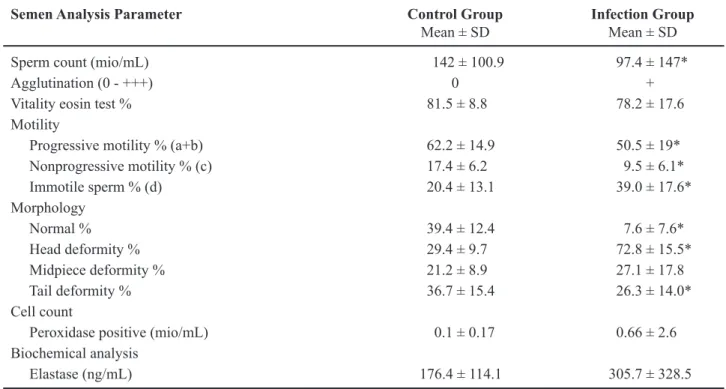
Compared with the controls, the patients
had statistically signiicantly (p < 0.05) lower sperm
concentration, % of sperm with progressive motility (a+b), % of sperm with normal morphology; and higher: % of immotile sperm, % of sperm with head deformity, and % of sperm with tail deformity. No
signiicant differences were observed in the levels
of PPL, elastase and sperm vitality between the two groups (Table-2).
Secretory Parameters of the Male Accessory
Glands
Compared to the controls, the patients had
statistically signiicantly (p < 0.05) lower (mean ± SD): semen volume (4.1 ± 1.5 vs. 2.6 ± 1.8 mL), levels of α-glucosidase (79.1 ± 56.1 vs. 54.6 ± 46.8 mU/ejaculate), levels of fructose (59.5 ± 40.4 vs. 38.1 ± 34.2 μmol/ejaculate), levels of zinc (24.1 ± 18.4 vs. 12.1 ± 14.1 U/ejaculate) and, higher pH (8.1 ± 0.4 vs. 8.3 ± 0.4) (Table-3).
We applied a ROCC analysis to quantify a
cut point to discriminate men with versus without infection using the parameters of male accessory
gland function that were signiicantly different in the
infection group (n = 71). A semen volume of 2.75 mL was found to discriminate patients from controls
with a sensitivity of 62.9% and speciicity of 90.9%,
the Area Under the Curve (AUC) was 0.77, a level
α-glucosidase of 56.1 mU/ejaculate discriminated
men with versus without infection with a sensitivity
of 73% and speciicity of 60% (AUC: 0.65), a level of fructose of 47.5 μmol/ejaculate discriminated men
with versus without infection with a sensitivity of
73% and speciicity of 60% (AUC: 0.68) and, a level
versus without infection with a sensitivity of 75.4%
and speciicity of 70% (AUC: 0.79). A semen pH of
8.15 was found to discriminate patients from controls
with a sensitivity of 58.8% and speciicity of 63.6%
(AUC: 0.67) (Figure-1).
The multiple comparison analysis between the different diagnoses, microorganisms and control group, revealed that patients with CBP had
statisti-cally signiicant (p < 0.05) lower: semen volume
(4.1 ± 1.5 vs. 2.5 ± 1.7 mL), levels of fructose (59.5 ± 40.4 vs. 37.2 ± 32.9 μmol/ejaculate), and levels of zinc (24.1 ± 18.4 vs. 10.9 ± 13.7 U/ejaculate) than the
controls. Patients with chronic urethritis had
statisti-cally signiicant (p < 0.05) lower: semen volume (4.1 ± 1.5 vs. 2.1 ± 1.1 mL) and levels of zinc (24.1 ± 18.4 vs. 13.7 ± 15.1 U/ejaculate) than the controls. Patients with chronic epididymitis had statistically signiicant (p < 0.05) lower levels of zinc (24.1 ± 18.4 vs. 13.1 ±
Table 2 – Physical and cytomorphological analysis of the ejaculate in controls (N = 40) and patients (N = 71).
Semen Analysis Parameter Control Group
Mean ± SD Infection GroupMean ± SD
Sperm count (mio/mL) 142 ± 100.9 97.4 ± 147*
Agglutination (0 - +++) 0 +
Vitality eosin test % 81.5 ± 8.8 78.2 ± 17.6
Motility
Progressive motility % (a+b) 62.2 ± 14.9 50.5 ± 19*
Nonprogressive motility % (c) 17.4 ± 6.2 9.5 ± 6.1*
Immotile sperm % (d) 20.4 ± 13.1 39.0 ± 17.6*
Morphology
Normal % 39.4 ± 12.4 7.6 ± 7.6*
Head deformity % 29.4 ± 9.7 72.8 ± 15.5*
Midpiece deformity % 21.2 ± 8.9 27.1 ± 17.8
Tail deformity % 36.7 ± 15.4 26.3 ± 14.0*
Cell count
Peroxidase positive (mio/mL) 0.1 ± 0.17 0.66 ± 2.6
Biochemical analysis
Elastase (ng/mL) 176.4 ± 114.1 305.7 ± 328.5
*Signiicant statistical difference in the control group (p < 0.05, Mann-Whitney U test).
Table 3 – Comparison of the different secretory parameters of the male accessory glands between the controls and
pa-tients.
Biochemical Analysis Control Group
Mean ± SD Infection GroupMean ± SD
Volume (mL) 4.1 ± 1.5 2.6 ± 1.8*
pH 8.1 ± 0.4 8.3 ± 0.4*
Alpha-glucosidase (mU/ejaculate) 79.1 ± 56.1 54.6 ± 46.8*
Fructose (µmol/ejaculate) 59.5 ± 40.4 38.1 ± 34.2*
Zinc (U/ejaculate) 24.1 ± 18.4 12.1 ± 14.1*
14.2 U/ejaculate) than the controls. Patients infected
with E. coli had statistically signiicant (p < 0.05) lower levels of fructose (59.5 ± 40.4 vs. 23.9 ± 18.4 μmol/ejaculate), lower levels of zinc (24.6 ± 18.4 vs. 6.3 ± 7.2 U/ejaculate), reduced semen volume (4.1 ± 1.5 vs. 2.2 ± 1.4 mL), and higher pH (8.1 ± 0.4 vs. 8.5 ± 0.4) compared to the control group. Patients
infected with N. gonorrhea presented statistically
signiicant (p < 0.05) lower semen volume (4.1 ± 1.5 vs. 1.8 ± 1.2 mL) and lower levels of zinc (24.6 ± 18.4 vs. 8.0 ± 8.5 U/ejaculate) than the control group. No other signiicant differences between the patients and
the controls were observed considering all the other
speciic diagnoses and microorganisms evaluated. The subgroup of patients with inlammatory
signs in the spermiogram according to two criteria:
PPL ≥ 1x10⁶/mL (19) and/or elastase ≥ 230 ng/mL
(21) (n = 36), demonstrated also a signiicant decrease
in the levels of semen volume, alpha-glucosidase, fructose and zinc compared to the controls and, higher values of semen pH (data not shown). The sensitivity
and speciicity of these parameters to diagnose MRT infection in patients with inlammatory signs in the
ejaculate were; semen volume: cut point 2.75 mL,
sensitivity 63.2%, speciicity 90.9%, AUC 0.79; se
-men pH: cut point 8.15, sensitivity 61.1%, speciicity
63.6%, AUC 0.70; alpha-glucosidase cut point 56.1
mU/ejaculate, sensitivity of 73% speciicity of 60%, AUC: 0.65; fructose: cut point: 47.5 μmol/ejaculate, sensitivity of 73%, speciicity of 60%, AUC: 0.68;
zinc: cut point 10.7 U/ejaculate, sensitivity 83%,
speciicity 80%, AUC 0.88.
COMMENTS
In the clinical setting MRT infection has a questionable effect on the fertility prognosis. What seems to be clear is that the different factors secreted by the male accessory glands are crucial for normal conception, since sperm retrieved directly from the epididymis or the testis are unable to fertilize the
egg without the assistance of artiicial reproduction
techniques (22). Taking this fact into account, it is interesting to analyze the effect of different infectious entities of MRT and their etiologic agents on the secre-tory function of the male accessory glands. Mainly
two questions need to be answered, irst if the different
diseases and microorganisms can cause obstruction of the seminal pathways and by that means deteriorate the normal composition of the ejaculate; and second if they are related to any intrinsic impairment of the secretory function of the epididymis, seminal vesicles and prostate.
The fact that all patients included in the study
group had proven MRT infectious diseases deined according to well accepted consensus deinitions,
allowed us to accurately identify the origin of the MRT infection. Moreover, in previous reports semen
cultures identify signiicant bacteriospermia in only
50% of semen specimens from men with CBP, thus
ejaculate culture is not yet recommended for the irst
line of diagnostic management in men with suspected
CBP (23). The microbiological indings in our study
group are in agreement with previous reports (1); N. gonorrhea and C. trachomatis are the most frequent in-fectious agents isolated patients with chronic urethritis. In patients with CBP, Enterococcus and E. coli were, as expected, the more frequent microbiological agents isolated. Finally, it is interesting that in patients con-sulting for chronic epididymitis, the microbiological
indings gave similar results to those found in cases of
acute epididymitis (15), suggesting that under special conditions the epididymis may act as a reservoir of bacteria in the male reproductive tract.
In our series of patients, we did not ind any
azoospermic patients, although, the levels of alpha-glucosidase, fructose, zinc and sperm concentration
were signiicantly lower in the infection group com -pared to the control group. Also, there were no
con-clusive indings indicating a total obstruction of the MRT at any level. This fact conirms that obstruction
is not an important cause of impairment of the male accessory gland function in an infectious setting and although infection has been previously mentioned in the literature as common cause of obstruction of the
MRT (2), our indings and more recent studies (6,20) seem to conirm that it is a rare occurrence in patients with demonstrated MRT infection and inlammation.
Analyzing the secretory function of the epi-didymis we found that men with MRT infectious
dis-eases (n = 71) had signiicantly lower concentration of α-glucosidase. However, in the multivariate analysis no signiicant differences were found in the levels of this marker between any speciic diagnosis and the
controls, even in patients with chronic epididymitis.
Moreover, no speciic bacteria had a signiicant impact
on its level. Although Cooper and co-workers (10)
found a signiicant decrease in the level of
alpha-glucosidase in patients with acute epididymitis; in patients with chronic epididymitis previous reports suggest that the impact on secretory function of the
epididymis is not signiicant (9). We propose that our series of patients relect that the secretion of alpha-glu
-cosidase is signiicantly decreased in cases of chronic
infections of the MRT; however, this decrease is not as pronounced compared to the decrease observed in the levels of others markers, i.e. zinc.
The function of the seminal vesicles can be accurately determined by the level of fructose in seminal plasma, questionable since these glands produce the majority of the semen volume, this pa-rameter may also be used as indirect indicator of its function. When discussing the literature, the impact of infection on the secretory function of the seminal vesicles remains controversial. Comhaire and co-workers (4), in agreement with our results, found a negative impact of infection on the fructose level, but concluded that the measurement of its concentration was not useful for discriminating between infected and non-infected patients due to its low sensitivity and
speciicity. Vicari and co-workers (24) demonstrated
that patients with prostate-vesiculo-epididymitis had
signiicantly lower seminal fructose levels than those patients with prostatitis alone. On the other hand, Bezold and co-workers (12) did not ind a signiicant
management of epididymo-orchitis for patients with epididymitis (15). Using these diagnostic procedures and criteria to manage our patients, we found a nega-tive impact of infection for the MRT on the fructose level. In contrast, if we had considered the fact that the seminal vesicles produce approximately 80% of the ejaculate volume, a decrease in this parameter would indicate at least in part, that the secretory functions of these glands were impaired, most probably secondary to an intrinsic damage rather than to obstruction, since azoospermia was not found in any patient indicating
a normal passage of seminal luid to the colliculus. The negative effect of infection and inlammation on
semen volume has been previously described (25,26).
Although semen volume was signiicantly lower in our patients, the low sensitivity and speciicity in the ROCC analysis prevents us from suggesting it as a
diagnostic tool to detect MRT infection.
Secretory dysfunction of the prostate gland is
a common inding in patients with documented pros
-tatitis. Our previously reported research (5) found, that the levels of gamma-GT were signiicantly decreased in patients with inlammatory chronic prostatitis/chronic
pelvic pain syndrome (CP/CPPS); however, it cannot be
recommended as a diagnostic tool for inlammation due to its low sensitivity and speciicity. In this new study
group, including only patients with documented infection,
the levels of zinc, identiied as prostatic secretory mark
-ers were signiicantly lower. These indings agree with
previous reports demonstrating lower levels of zinc in the seminal plasma of patients with MRT infection (27). However, again the power of this marker to discriminate infected from non-infected patients (sensitivity 43.6%,
speciicity 75%) was low.
Although, a zinc-rich diet can slightly in-crease the concentration of this element in the prostate gland (28); there is no conclusive evidence that this therapy can increase the zinc concentration in semen, making the rationale of this therapy unclear.
Semen pH is determined by the acid secre-tions of the prostate and the alkaline secresecre-tions of the seminal vesicles. In vitro, external pH is an important factor in the regulation of sperm physiology. An acid pH contributes to maintain a non-capacitated state preventing premature acrosomal reaction (29). Higher levels of semen pH in patients with MRT infection
have been reported in the literature and could relect,
at least in part, a secretory dysfunction of the prostate due to lower levels of citric acid in semen (30). The importance of semen pH in fertility prognosis of these patients is not clear. However, from a diagnostic point of view semen pH can not be recommended as a tool to discriminate infected from non-infected patients,
due to its low sensitivity and speciicity.
Nevertheless, all the evaluated parameters of the secretory function of the accessory glands were
signiicantly altered in patients with concomitant infection and inlammation of the MRT (n = 36) compared to controls. In the ROCC analysis the sensitivity and speciicity of these factors to detect infection was not signiicantly increased, when com -pared to the whole infection group analysis (n = 71)
and were not signiicant when inlammatory activity
was considered.
Finally, a constellation that includes inlam
-matory signs in the spermiogram (PPL ≥ 1x10⁶/mL
and/or elastase ≥ 230 ng/mL), of low semen volume,
elevated semen pH and low levels of alpha-glucosi-dase, fructose and zinc could indicate the presence of
an infection; however, the sensitivity and speciicity
of these parameters, prevents their application as a diagnostic tool for the detection of MRT infection.
CONCLUSIONS
Infection of the male reproductive tract
sig-niicantly decreases the levels of semen volume, al -pha-glucosidase, fructose and zinc in seminal plasma suggesting impairment of the secretory function of the epididymis, seminal vesicles and prostate. Due to
their low sensitivity and speciicity these parameters
can not be recommended as a diagnostic tool to detect
MRT infection. Although semen pH is signiicantly
increased in patients with infection of the male
repro-ductive tract, its sensitivity and speciicity to detect
infection are low.
ACKNOWLEDGEMENTS
M. Marconi, M.D. is a fellow in “Clinical Androl
-ogy” and received a scholarship from MIDEPLAN,
CONFLICT OF INTEREST
None declared.
REFERENCES
1. Weidner W, Krause W, Ludwig M: Relevance of male accessory gland infection for subsequent fertility with special focus on prostatitis. Hum Reprod Update. 1999; 5: 421-32.
2. World Health Organization: WHO Manual for the Stan-dardized Investigation, Diagnosis and Management of the Infertile Male. Cambridge University Press. 2000; 2nd Ed.
3. Eggert-Kruse W, Zwick EM, Batschulat K, Rohr G, Armbruster FP, Petzoldt D, et al.: Are zinc levels in seminal plasma associated with seminal leukocytes and other determinants of semen quality? Fertil Steril. 2002; 77: 260-9.
4. Comhaire FH, Vermeulen L, Pieters O: Study of the accuracy of physical and biochemical markers in se-men to detect infectious dysfunction of the accessory sex glands. J Androl. 1989; 10: 50-3.
5. Ludwig M, Vidal A, Diemer T, Pabst W, Failing K, Weidner W: Seminal secretory capacity of the male accessory sex glands in chronic pelvic pain syndrome (CPPS)/chronic prostatitis with special focus on the new prostatitis classiication. Eur Urol. 2002; 42: 24-8. 6. Weidner W, Wagenlehner FM, Marconi M, Pilatz A,
Pantke KH, Diemer T: Acute bacterial prostatitis and chronic prostatitis/chronic pelvic pain syndrome: andro-logical implications. Andrologia. 2008; 40: 105-12. 7. Mahmoud AM, Geslevich J, Kint J, Depuydt C, Huysse
L, Zalata A, et al.: Seminal plasma alpha-glucosidase activity and male infertility. Hum Reprod. 1998; 13: 591-5.
8. Dohle GR: Inlammatory-associated obstructions of the male reproductive tract. Andrologia. 2003; 35: 321-4.
9. Wolff H, Bezold G, Zebhauser M, Meurer M: Impact of clinically silent inlammation on male genital tract organs as relected by biochemical markers in semen. J Androl. 1991; 12: 331-4.
10. Cooper TG, Weidner W, Nieschlag E: The inluence of inlammation of the human male genital tract on secretion of the seminal markers alpha-glucosidase, glycerophosphocholine, carnitine, fructose and citric acid. Int J Androl. 1990; 13: 329-36.
11. Okamura N, Tajima Y, Ishikawa H, Yoshii S, Koiso K, Sugita Y: Lowered levels of bicarbonate in seminal
plasma cause the poor sperm motility in human infer-tile patients. Fertil Steril. 1986; 45: 265-72.
12. Bezold G, Politch JA, Kiviat NB, Kuypers JM, Wolff H, Anderson DJ: Prevalence of sexually transmissible pathogens in semen from asymptomatic male infertil-ity patients with and without leukocytospermia. Fertil Steril. 2007; 87: 1087-97.
13. Krieger JN, Nyberg L Jr, Nickel JC: NIH consensus deinition and classiication of prostatitis. JAMA. 1999; 282: 236-7.
14. Schaeffer AJ, Anderson RU, Krieger JN, Lobel B, Naber K, Nakagawa M, Nickel JC, Nyberg L, Weidner W: The Assessment And Management Of Male Pelvic Pain Syndrome Including Prostatitis. In: Mc Connel J, Abrams P, Denis L, Khoury S, Roehrsom C (eds.), Male Lower Urinary Tract Dysfunction. Evaluation and Management6th International Consultation in Prostate Cancer and Prostate Diseases. Health Publica-tions, Paris. 2006; pp. 343-385.
15. Horner PJ; European Branch of the International Union against Sexually Transmitted Infection and the Europe-an Ofice of the World Health OrgEurope-anization: EuropeEurope-an guideline for the management of epididymo-orchitis and syndromic management of acute scrotal swelling. Int J STD AIDS. 2001; (12 Suppl 3): 88-93.
16. Schiefer HG: Microbiology of male urethroadnexitis: diagnostic procedures and criteria for aetiologic clas-siication. Andrologia. 1998; (30 Suppl 1): 7-13. 17. Weidner W, Anderson RU: Evaluation of acute and
chronic bacterial prostatitis and diagnostic man-agement of chronic prostatitis/chronic pelvic pain syndrome with special reference to infection/inlam-mation. Int J Antimicrob Agents. 2008; (31 Suppl 1): S91-5.
18. Schneider H, Brähler E, Ludwig M, Hochreiter W, Collins MF, Eremenco S, et al.: Two-year experience with the German-translated version of the NIH-CPSI in patients with CP/CPPS. Urology. 2004; 63: 1027-30.
19. World Health Organization Laboratory Manual for the Examination of Human Semen and Semen-Cervi-cal Mucus Interaction. Cambridge University Press, Cambridge. 1999; 4th ed.
20. Ludwig M, Vidal A, Diemer T, Pabst W, Failing K, Weidner W: Chronic prostatitis/chronic pelvic pain pyndrome): seminal markers of inlammation. World J Urol. 2003; 21: 82-5.
EDITORIAL COMMENT
Male accessory gland infection (MAGI) is a syndrome which includes clinical symptoms
of inlammation of the prostate gland, the seminal
vesicles, the ductus deferens and the epididymis. There is not a clear discrimination against the term prostatis, glandulitis vesicalis or epididymitis. There
is also not a clear classiication of MAGI as formu -lated for prostatitis, although it is likely that different types of MAGI in terms of infectious and non-infec-tious causes also exist.
22. Diemer T, Schroeder-Printzen I, Weidner W: Surgical sperm retrieval. Urologe A. 2007; 46: 789-98. 23. Weidner W, Wagenlehner FM, Marconi M, Pilatz
A, Pantke KH, Diemer T: Acute bacterial prostatitis and chronic prostatitis/chronic pelvic pain syndrome: andrological implications. Andrologia. 2008; 40: 105-12.
24. Vicari E, La Vignera S, Castiglione R, Calogero AE: Sperm parameter abnormalities, low seminal fructose and reactive oxygen species overproduction do not discriminate patients with unilateral or bilateral post-infectious inlammatory prostato-vesiculo-epididymi-tis. J Endocrinol Invest. 2006; 29: 18-25.
25. Sanocka-Maciejewska D, Ciupinska M, Kurpisz M: Bacterial infection and semen quality. J Reprod Im-munol. 2005; 67: 51-6.
26. Engeler DS, Hauri D, John H: Impact of prostatitis NIH IIIB (prostatodynia) on ejaculate parameters. Eur Urol. 2003; 44: 546-8.
27. Wang Y, Kang L, Hou Y, Wu X, Chen J, Han X: Micro -elements in seminal plasma of infertile men infected with Ureaplasma urealyticum. Biol Trace Elem Res. 2005; 105: 11-8.
28. Cortesi M, Fridman E, Volkov A, Shilstein SSh, Chechik R, Breskin A, et al.: Clinical assessment of the cancer diagnostic value of prostatic zinc: a com-prehensive needle-biopsy study. Prostate. 2008; 68: 994-1006.
29. Parrish JJ, Susko-Parrish JL, First NL: Capacitation of bovine sperm by heparin: inhibitory effect of glucose and role of intracellular pH. Biol Reprod. 1989; 41: 683-99.
30. Comhaire FH, Vermeulen L, Pieters O: Study of the accuracy of physical and biochemical markers in se-men to detect infectious dysfunction of the accessory sex glands. J Androl. 1989; 10: 50-3.
Accepted after revision: January 20, 2009
Correspondence address: Dr. Wolfgang Weidner
Dept of Urology & Pediatric Urology Justus-Liebig-Universität Giessen Rudolf-Buchheim-Strasse 7 Giessen, 35385, Germany Fax: + 49 0641 99-44509
E-mail: [email protected]
Usually MAGI is caused by infectious agents spreading from the urethra via prostate gland, seminal vesicles, ductus deferens, and epididymis. The frequency of a changeover from urethritis to MAGI is unknown. Infections by viral agents are to date hypothetical.
well as to dysfunctions of the male accessory glands, which leads to decreased seminal concentrations of citric acid, phosphatase, fructose concentration, zinc and alpha-glutamyltransferase.
In general, however, the impact of MAGI on semen composition and sperm function, possibly rel-evant for male fertility, is low and vice versa, none of
the dysfunctions can be considered suitable for the diagnosis of MAGI. The paper clearly shows that the diagnosis of MAGI on the basis of semen analysis
is dificult and that the diagnosis of prostatitis and
epididymitis is more reliably performed by means of
an examination of prostatic luid and imaging proce -dures.
Dr. Walter Krause
Dept. Dermatology & AllergologyUniversity Hospital, Philipp University Marburg, Germany