Escola Anna Nery 21(4) 2017
Adherence to diabetes mellitus care at three levels of health care
Adesão ao cuidado em diabetes mellitus nos três níveis de atenção à saúde
La adhesión a la atención en la diabetes mellitus en tres niveles de atención de la salud
Jackline Duran Souza1 Marcelo Henrique Barbosa Bapista1 Danielle dos Santos Gomides1 Ana Emilia Pace1
1. Escola de Enfermagem de Ribeirão Preto, Universidade de São Paulo. Ribeirão Preto, São Paulo, Brazil
Corresponding author:
Ana Emilia Pace. E-mail: [email protected]
Submited on 03/07/2017. Accepted on 08/06/2017.
DOI: 10.1590/2177-9465-EAN-2017-0045
A
bstrActObjective: To evaluate adherence to self-care among people with diabetes mellitus cared for at the three levels of health care.
Method: Quantitative, descriptive, cross-sectional study addressing a sample of 143 people from a city in the interior of São Paulo, Brazil from primary (45), secondary (48) and tertiary (50) units. Adherence to self-care was assessed using the "The Summary of Diabetes Self-Care Activities Measure" and "Measurement of Treatment Adherence". Results: Adherence to exercises, blood
glucose monitoring, shoe inspection, and the use of insulin difered between units; better results were obtained for those in
tertiary care. Conclusion: The results indicate a need for greater investment in the initial phase of treatment to improve self-care adherence. Implications for practice: The study enabled identifying the proile of individuals in terms of self-care adherence and supporting the planning of nursing interventions in diabetes mellitus.
Keywords: Medication adherence; Self-care; Diabetes Mellitus; Nursing Care.
r
esumoObjetivo: Avaliar a adesão ao cuidado à doença em pessoas com diabetes mellitus, atendidas nos três níveis de atenção à saúde. Método: Estudo quantitativo, descritivo, transversal, em amostra de 143 pessoas de um município do interior paulista, provenientes das unidades de atenção primária (45), secundária (48) e terciária (50). A adesão ao cuidado foi avaliada por meio do "Questionário de Atividades de Autocuidado com o Diabetes" e o "Teste de Medida da Adesão ao Tratamento". Resultados: A adesão para a atividade física, monitorização da glicemia capilar, inspeção dos calçados e uso de insulina diferiu entre as unidades, com melhores resultados na atenção terciária. Conclusão: Os resultados indicam a necessidade de maiores investimentos na fase inicial do tratamento para melhorar a adesão. Implicações para a prática: O estudo possibilitou identiicar o peril da adesão ao cuidado à doença e subsidiar o planejamento das intervenções de enfermagem, na atenção em diabetes mellitus. Palavras-chave: Adesão à Medicação; Autocuidado; Diabetes Mellitus; Cuidados de Enfermagem.
r
esumenObjetivo: Evaluar la adherencia al cuidado de personas con diabetes mellitus asistidas en tres niveles de atención a la salud.
Método: Estudio cuantitativo, descriptivo, transversal, muestra de 143 personas de un municipio de São Paulo, provenientes de
unidad atención primaria (45), secundaria (48) y terciaria (50). Se evaluó la adherencia utilizando el "Cuestionario de Actividades de Autocuidado con la Diabetes" y la "Prueba de Medición de Adherencia al Tratamiento". Resultados: La adherencia a la actividad
física, monitoreo de la glucosa capilar, inspección del calzado y uso de insulina diirieron entre las unidades; mejores resultados
en la atención terciaria. Conclusión: Se necesita una mayor inversión en el tratamiento precoz para mejorar la adherencia a los cuidados personales. Implicaciones para la práctica: Fue posible identiicar el peril de la adhesión al cuidado a la enfermedad,
y subsidiar la planiicación de las intervenciones de enfermería en la atención en diabetes mellitus.
Palabras clave: Adherencia a la Medicación; Autocuidado; Diabetes Mellitus; Cuidados de Enfermería.
INTRODUCTION
Non-communicable diseases, such as heart diseases,
cancer, diabetes, respiratory diseases and neuropsychiatric illnesses are a major health problem in Brazil and account for a high number of deaths before the age of 70 years old and a loss of quality of life.1
Diabetes Mellitus (DM) is highlighted in this study due to its growing prevalence rates in the country, estimated at 14.3 million people, and high mortality, with 130,700 deaths, i.e., more than half the number of deaths caused by DM in Central and South America.2
Once the disease is established, the prevention of compli-cations is based on glycemic control, through a treatment that includes healthy eating, exercises, blood glucose monitoring, maintaining the integrity of skin on the feet and function, medi-cation, and quitting smoking.3,4 In this context, we highlight that treatment adherence is essential to preventing complications.
In the international literature, discussion of adherence is denominated by compliance or adherence, but these
denomi-nations present diferent concepts. Compliance means one me -rely complies with medical recommendations, while adherence refers to the active, voluntary and collaborative participation of an individual in implementing the behaviors necessary to reach therapeutic results, participation in the establishment of goals, and treatment plannning.5
The term adherence, adesão in Portuguese, was adopted in this study. It is believed, within this concept, that demographic, social and psychological factors related to healthcare workers, to the health system and the disease, may interfere with it.5
Among these factors, the aging process and the clinical progression of DM may increase the susceptibility or accelerate comorbidities, which in turn, increases the therapeutic regimen's complexity and favors low adherence.6 An individual with DM may adhere to one self-care activity but not to others.5
The Brazilian literature reports a tendency of improved rates of medication adherence, regardless of the level of health care,6,7,8,9,10, but worse adherence rates concerning self-care activities like exercises,8 foot care7, and a healthy diet.7,8,10
In summary, the rates of medication adherence reported by studies are sometimes higher and sometimes similar among studies, regardless of the level of care at which individuals are monitored. Adherence to diet and exercise, however, is low, even though these are the behaviors indicated as the primary measures to control DM.6,7,8,11
Due to the importance of actions to support or strengthen treatment adherence at the time of diagnosis in order to prevent or delay associated morbidities, and also over the course of treatment to control such comorbidities, the assumption is that
the proile of treatment adherence for individuals with DM in the diferent phases of the disease may be investigated at the diferent levels of health care, considering that the clinical cha -racteristics that guide the care provided at each level represent the progression of the disease.
In order to verify whether treatment adherence changes according to the clinical progression of the disease, this study's objective was to identify treatment adherence among people with DM2 receiving outpatient care at the three levels of care.
METHOD
Descriptive, cross-sectional study with quantitative appro-ach developed in outpatient units from a city in the interior of São Paulo, Brazil, corresponding to the three levels of care of the Brazilian Health System (SUS), that is, Primary Health Care (PHC) Unit, Secondary Health Care (SHC) Unit, and Tertiary Health Care (THC) unit.
Inclusion criteria included people diagnosed with DM2 at least one year prior, of either sex, aged at least 30 years old, and in outpatient follow-up. Those attending primary and secondary care units were selected through consultation of their medical
iles at the time of the pre-consultation, when they were invited to participate in the study and received clariication regarding
the study's objectives. Free and informed consent forms were read out loud, two copies of which were then signed by those who consented.
Data from the participants of a tertiary unit were collected from the database of a previous descriptive study, the objective of which was to characterize self-care activities in a sample com-posed of 218 adults with DM, undergoing outpatient follow-up in a tertiary care unit.8 A total of 50 individuals were drawn from this database using the Statistical Package for the Social
Sciences, stratiied according to sex and age, in a way the inal
sample would represent the whole database, composing this study's sample.
The variables included in this study were: sociodemographic and clinical variables (duration of diagnosis, body mass index), laboratorial exams (glycated hemoglobin - HbA1c) and treatment adherence (self-care activities and medication adherence). The parameters established by the Brazilian Diabetes Society4 were considered when assessing the laboratorial exams, which considers HbA1c >7% to be altered.
Self-care activities were assessed using the translated ver-sion adapted for Brazil3 of "The Summary of Diabetes Self-care Activities Measure (SDSCA)".12 This questionnaire addresses six domains: general diet, speciic diet, physical activity, blood
glucose monitoring, foot care, and medication, in addition to three items assessing smoking. The questions ask which care activities were performed by people with DM in the respective domains in the last seven days, that is, the answers range from
zero to seven days/week. There are two items in the Speciic
Diet domain (2.2 and 2.3) with inverted scores (0 = 7, 1 = 6, 2 = 5, 3 = 4, 4 = 3, 5 = 2, 6 = 1 and 7 = 0).3
Escola Anna Nery 21(4) 2017 The Brazilian version of the "Measurement of Treatment
Adherence (MTA)"13, which was based on the Morisky Test14 and allows adherence to oral anti-diabetic drugs and insulin to be assessed separately,15 was applied.
The MTA contains a Likert scale composed of seven ques-tions, each with six answer opques-tions, ranging from "one" = always to "six" = never. The total score is an average of the scores obtained
for all questions; the higher the score, the greater the adherence.14 An instrument speciically developed to collect sociode -mographic and clinical data was used. Laboratorial data were
collected from the participants' medical iles and the results of
exams performed the closest to the date of the interview, within three months before or after the interview, were used. Data were collected from December 2013 to June 2014.
Data were double entered into an Excel spread sheet and processed in the Statistical Package for the Social Science
(version 21.0). Numerical variables were presented using central
tendency (mean and median) and variability measures (standard deviation - SD, and minimum and maximum values).
To verify whether there were diferences in the results con -cerning self-care and medication adherence between the three levels of health care, the Kruskal-Wallis test was used and a
signiicance level of 5% was established.
The study was approved by the Institutional Review Board at
the University of São Paulo at Ribeirão Preto, College of Nursing (report No. 469.583/2013).
RESULTS
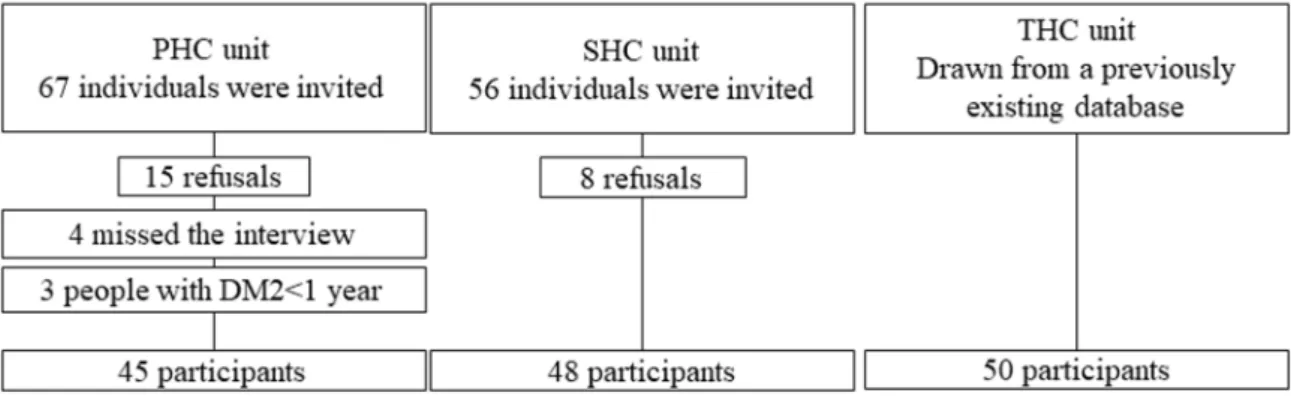
A total of 123 people were invited from among those cared for in the primary and secondary health units. Twenty-three out of the 123 refused to participate because they did not perceive any
beneits from the study, did not have time, were physically indis -posed, or had already participated in other studies addressing DM. Four did not attend the interview on the scheduled date even after having consented, and three were not included because their diagnosis had been established less than a year ago.
Therefore, the number of participants in these units was 93, which added to the 50 individuals from the tertiary unit, totaled
143 people: 45 individuals were from the PHC unit, 48 from the SHC unit, and 50 were from the THC unit (Figure 1).
The following stand out in the sample's sociodemographic characterization: mean age of approximately 60 years old and higher frequencies among females, and for the category "married/ stable relationship" at all three levels of care. Low education was also a common characteristic among the health units, the means of which decreased from PHC unit to THC and SHT units (Table 1). Among the clinical variables, average time since diagnosis increased from the PHC unit to the SHC and THU units and insulin use also increased from PHC unit to the SHC and THC units, while the use of oral antidiabetic agents was reported by approximately
40% of the participants in the three diferent health units (Table 1).
The mean body mass index (BMI) of the participants in the three units indicated obesity, while the results concerning HbA1c were close to normal parameters among the participants from the PHC and SHC units, though those in the THC unit presented
altered HbA1c. Note that it was not possible to obtain information
regarding this last variable from all those receiving care in the PHC (n = 17) and SHC units (n = 29) because this information
was not available in the medical iles (Table 1).
The three groups obtained similar means in the General Diet domain (p > 0.05). The Physical Activity domain presented dife -rences in the three levels of care, though all the units presented a low mean for days in all activities (p < 0.05). A diference was
observed between groups in terms of Blood Glucose Monitoring (p < 0.05); the THC unit presented the highest score, followed by
the SHC and PHC units (Table 2).
The units presented no diferences (p > 0.05) concerning the
items addressed in the Speciic Diet and Medication domains.
The lowest means were obtained in the item concerning the
in-gestion of fat-laden foods contained in the Speciic Diet domain;
the worst score was obtained by the SHC unit, followed by the PHC and THC units. Better results were obtained by all three levels of care in the Medication domain, though the item insulin use stood out: the SCH unit presented a minimum of zero days/
week, which was not observed in the PHC and the THC; and for the oral antidiabetic agents item; the three units presented a
minimum of zero days/week (Table 3).
Variables
Mean (SD*) or Number (%)
Median (interval)
PHC
n = 45
aSHC
n = 48
bTHC
n = 50
cPHC
SHC
SHC
Sex
Male
10
(22.2)
(41.7)
20
(54.0)
27
Female
(77.8)
35
(58.3)
28
(46.0)
23
Age (complete years)
66.5
(12.5)
(9.5)
62.5
60.80
(8.6)
(35-91)
67
(36-79)
62.5
(41-78)
60
Origin
Ribeirão Preto
(97.8)
44
(97.9)
47
(22.0)
11
Ribeirão Preto region
(2.2)
01
(2.1)
01
(58.0)
29
Other ciies in the state of São Paulo
(14.0)
07
Ciies in other states
(6.0)
03
Marital status
Single (a)
(8.9)
04
(08.3)
04
(6.0)
03
Married/Stable relaionship
(51.1)
23
(52.1)
25
(74.0)
37
Separated/Divorced
(13.3)
06
(12.5)
06
(10.0)
05
Widowed
12
(26.7)
(27.1)
13
(10.0)
05
Schooling (number of years)
4.1
(3.5)
(4.4)
6.4
(3.6)
4.8
(0-12)
04
(0-17)
05
(0-15)
04
Occupaion
Working
(13.3)
06
(45.8)
22
(16.0)
08
Reired with a paid job
(8.9)
04
(00.0)
00
(0.0)
00
Reired/Pensioner
(37.8)
17
(31.3)
15
(64.0)
32
Homemaker, no paid job
(37.8)
17
(20.8)
10
(12.0)
06
Unemployed/on sick leave
(2.2)
01
(2.1)
01
(8.0)
04
Mean family income
1,622.4
(977.8)
(1,454.4)
2,176.2
(1,796.9)
1.884,3
Body mass index (Kg/m
2)
31.2
(5.7)
(5.5)
31.9
32.3
(5.2)
(22.65-47.3)
30.4
(20.21-47.2)
31.1
(22.6-46.4)
32.4
Systolic blood pressure (mmhg)
137.2
(19.8)
(19.9)
134
137.72
(20.9)
(100-180)
140
(100-180)
130
(87-187)
134.5
Diastolic blood pressure (mmhg)
84.5
(12.5)
79.91
(13.0)
(12.3)
74.9
(60-110)
80
(60-120)
80
(46-105)
73
Duraion of diagnosis (years)
(6.8)
8.8
(8.8)
12.1
15.1
(7.3)
(1-30)
07
(1-36)
10
(2-30)
15
HbA1c (%)
6.75
(1.27)
(1.2)
6.64
9.73
(2.0)
Escola Anna Nery 21(4) 2017
Table 2.
Self-care aciviies presented by the sample concerning General Diet, Physical Acivity, and Blood Glucose
Monitoring domains from the SDSCA, Ribeirão Preto, SP, Brazil 2017.
SDSCA domains
Mean (SD)
Median (minimum - maximum)
p
-value
PHC
SHC
THC
PHC
SHC
THC
General diet (2 items)
4.11 (2.41) 3.80 (2.30) 4.15 (2.44) 3.50 (0-7)
3.50 (0-7)
3.50 (0-7)
0.33
Physical Acivity (2 items)
2.90 (3.08) 1.60 (2.40) 3.40 (2.73) 2.00 (0-7)
0.00 (0-7)
3.30 (0-7)
0.00
Glucose Monitoring (2 items)
1.54 (2.59) 2.40 (2.90) 3.93 (2.70) 0.00 (0-7)
1.00 (0-7)
4.00 (0-7)
0.00
Staisical signiicance p < 0.05 concerning the Kruskal-Wallis test.
Table 3.
Self-care aciviies presented by the sample in the domains Speciic Diet, Foot Care, and Medicaion addressed
in the SDSCA, Ribeirão Preto, SP, Brazil 2017.
SDSCA items
Mean (Standard -Deviaion)
Median (minimum - maximum)
p
-value
PHC
n = 45
aSHC
n = 48
bTHC
n = 50
cPHC
SHC
THC
1 - Ingesion of ive or more porions of fruits
and/or vegetables
(2.75)
4.42
(2.69)
4.35
(3.03)
3.90
(0-7)
5.00
(0-7)
5.00
(0-7)
4.00
> 0.05
2 - Ingesion of fat-laden foods
(2.89)
3.40
(2.53)
3.29
(2.72)
2.52
(0-7)
3.00
(0-7)
4.00
(0-7)
1.00
> 0.05
3 - Ingesion of sweets
(1.86)
5.93
(1.83)
5.68
(1.50)
6.20
(0-7)
7.00
(0-7)
6.00
(0-7)
7.00
> 0.05
4 - Inspect feet
(3.35)
3.06
(3.33)
4.25
(3.36)
4.16
(0-7)
1.00
(0-7)
7.00
(0-7)
7.00
> 0.05
5 - Inspect inside of shoes
(3.47)
4.06
(3.29)
2.77
(3.26)
4.56
(0-7)
7.00
(0-7)
0.00
(0-7)
7.00
0.01
6 - Dry between toes
(2.52)
5.82
(2.59)
5.85
(1.97)
6.36
(0-7)
7.00
(0-7)
7.00
(0-7)
7.00
> 0.05
7 - Take insulin injecions as recommended
(0.00)
7.00
(1.97)
6.41
(0.00)
7.00
(7-7)
7.00
(0-7)
7.00
(7-7)
7.00
0.048
8 - Take the prescribed number of DM pills
(1.08)
6.80
(1.49)
6.60
(1.12)
6.78
(0-7)
7.00
(0-7)
7.00
(0-7)
7.00
> 0.05
Staisical signiicance p < 0.05 in the Kruskal-Wallis test.
a In PHC unit: Item 7 n = 05 and item 08 n = 42;
b In SHC unit: Items 2 and 4 n = 47, item 4 n = 24 and item 8 n = 38;
c In UATS: Item 7 n = 44 and item 8 n = 41.
Table 4.
Adherence to medicaion presented by the sample of three health units, Ribeirão Preto, SP, Brazil 2017.
Variables
Mean (standard-deviaion)
Median (minimum - maximum)
n
PHC
n
SHC
n
THC
PHC
SHC
THC
Adherence to insulin
08
(0.33)
5.60
24
(0.48)
5.48
44
(0.47)
5.68
(5.00-6.00)
5.64
(4.29-6.00)
5.57
(3.71-6.00)
5.86
Adherence to oral
anidiabeics
42
(0.38)
5.61
37
(0.54)
5.59
40
(0.67)
5.66
(4.43-6.00)
5.71
(3.43-6.00)
5.86
(2.43-6.00)
5.86
The Inspect inside shoes for foreign objects from the Foot
Care domain presented diferences in the mean frequencies of
the units under study (p < 0.05), with a higher score in the THC unit, followed by the PHC and SHC units (Table 3).
In regard to speciic adherence to medication (insulin and
DISCUSSION
The sociodemographic characteristics of the sample portray
the proile of the population cared for by the SUS in the units
included in this study, that is, low education and low income. There is also a greater frequency of female individuals aged ap-proximately 60 years old in the three units, which is similar to data reported in other descriptive studies conducted in Brazil11,16,17,18. The analysis of clinical data shows that the mean BMI found for all the units indicates obesity. One Brazilian cross-sectional study, the objective of which was to analyze treatment adherence in a sample of 417 people with DM2, aged 62.5 old on average (SD = 11.7), reports a mean BMI equal to 29.3 (SD = 5.3) Kg/ m2 and the analysis of frequency revealed that 299 (79.1%) in-dividuals presented an altered result12. Another Brazilian study conducted with 60 people with DM2, which investigated adhe-rence to medication, reports that four (6.7%) people presented
BMI within normal parameters; 20 (33.3%) were overweight;
and 36 (60%) were obese.18 In this context, actions to promote weight control should be implemented at all levels of health care because it is a risk factor for cardiovascular complications, which
can afect glycemic control.4,19,20
A national study that described the annual progression of the prevalence of excessive weight and obesity in the adult popula-tion of capitals in the 26 Brazilian states and the Federal District between 2006 and 2012 shows that excessive weight in the adult population increased from 43.2% in 2006 to 51% in 2012, while obesity increased from 11.6% to 17.4% in the same period.21
In regard to the laboratory exams, the highest HbA1c, i.e., above the parameters recommended to control the disease, were found in the THC unit, while the HbA1c presented by the PHC and SHC units were within normal parameters. The analysis of laboratory exams can be used to assess adherence to both
medication and non-medication treatments, as both inluence
glycemic control.4
The duration of the diagnosis, associated with poor mana-gement, may be related to chronic complications from DM. The average time of the disease, except for the PHC unit, is longer than 10 years, and glycemic control assessed through HbA1c is above the ideal in the THC unit.4
Similar behaviors concerning adherence to self-care are
found among the groups for the items: Ingestion of ive or more
portions of fruits and/or vegetables, Ingestion of fat-laden foods, Ingestion of sweets, Inspect feet, Dry between toes, and Take the prescribed number of pills.
Self-care activities that did not difer between the three
levels of health care should be carefully analyzed, especially due to low adherence in regard to these activities, except for "ingestion of sweets", "dry the space between toes" and "take the prescribed number of pills", adherence regarding these
activities was considered good. Note that assessing adherence
using a self-report instrument may lead to bias, as people may check the answer they deem to be the most appropriate, rather than the most accurate one.
In regard to the items of the Speciic Diet domain, the means concerning the ingestion of ive or more portions of fruits and/ or vegetables in the last seven days were less than ive in the
three health care units. The minimum amount recommended
for the ingestion of fruits and vegetables is ive portions daily.19 The item concerning eating fat-laden foods also obtained low means in the three units, indicating a high frequency of foods like red meat, whole milk and its derivatives in the last seven days. Similar results were reported by a study conducted in Greece addressing a sample of 117 people with DM2, who presented sociodemographic characteristics similar to those reported in this study.22
A cross-sectional study conducted in 13 PHC units in the city of Maceió, CE, Brazil addressing a sample of 225 individuals with high blood pressure and/or DM reports that socioeconomic situ-ation is an important factor in accessing a healthy diet in terms of quantity and quality.23 Note that the samples from all three levels of care presented low educational levels and low family income, factors that may have contributed to greater consumption of fat--laden foods and less than the recommended amount of fruits. The document published by the Ministry of Health reports a decrease in the consumption of fat-laden foods when individuals have more than 12 years of education.19 Inadequate diets may be related to low educational level, a condition found in this study sample (means below 6.6 years of education) and similar to that reported by Brazilian studies.6,7
In regard to the item assessing the ingestion of sweets, the average scores obtained by the PHC and SHC unit were similar, indicating less tendency to consume sweets over the course of a week. The THC unit obtained a slightly higher score.
Self-care behaviors analyzed by domain show a diference
between the groups (p < 0.05) for the practice of physical activity and glucose monitoring. Self-care activities related to physical activities obtained higher scores in the THC unit and lower scores in the SHC unit. The practice of 30 minutes of physical activity,
ive days a week, is recommended for glycemic control.4 This mean was not found in the units, indicating that the practice of physical activity among the study's participants is less than what is recommended. Information that corroborate these results is reported in other studies.8,10
In regard to the Blood Glucose Monitoring domain, the PHC and SHC units obtained means less than those obtained by the THC unit. These means may be explained by the fact that the use of insulin is less frequent in the two units when compared to
the THC unit. One Indian study reports indings similar to those
found in this study because it was conducted in a THC unit where 76.6% of the participants monitored their blood glucose daily.24 The item Inspect shoes for foreign objects, which is from
the Foot Care domain, presented a diference; that is, a greater
Escola Anna Nery 21(4) 2017 though it does not present an important diference, was the item
in the Inspect Feet domain with the highest mean, a result also reported in another study.8 Therefore, the participants show they have the habit of taking care of their feet, but education regarding
speciic care needs to be continually reinforced.
It is believed that the diference found in the item Take insulin
injections as recommended may be attributed to a shorter dura-tion of diagnosis in the PHC unit, or even due to better glycemic control. The protocol of the Ministry of Health for DM recommen-ds the initial treatment for the disease to include a healthy diet and the practice of exercise, and if no improvement is observed after three months from the point when a change of habits was implemented, oral antidiabetic agents should be initiated as monotherapy. Lack of glycemic control requires oral antidiabetic agents, and in situations where there is poor glycemic control, insulin is indicated.4,21
The participants from the THC unit obtained high scores for
medication adherence; however, the mean HbA1c was 9.73%
(SD = 2.05). These participants also obtained low scores in the
items Ingestion of ive or more portions of fruits and/or vegetables,
Ingestion of fat-laden foods, and in the Physical Activity domain, which reinforces the importance of non-medication therapy.
A Brazilian cross-sectional study that used the MTA, a Food Frequency Questionnaire, and the International Physical Activity Questionnaire (the short IPAQ), does not report association between HbA1c and medication adherence (p = 0.80), diet (p = 0.685), or physical activity (p = 0.124). In this last study, ho-wever, 98.3% did not adhere to diet plan, 41.9%, did not adhere to physical activity, and 15.8% did not adhere to their medication, and HbA1c were altered in 75.1% of the participants.11
The same was observed in a cross-sectional study with 218 people undergoing outpatient treatment, which also used the SDSCA and aimed to assess self-care activities related to DM and verify associations with sociodemographic and clinical data. It reports good adherence to medication with a mean of approximately six days/week for the use of medications and worse adherence in items concerning physical activity, with means close to two days/week, while the mean result of HbA1c was 9.5 (SD = 2.0)%.8
A cross-sectional study conducted in India, including 290 people with DM2 in a tertiary hospital, used the English version of SDSCA and reports that 43.4% performed physical activities daily, while 17.6% exercised daily. In regard to medication, 60.5% use oral antidiabetic agents daily and 66.9% received insulin shots daily.24
The results found in this study and reported by both Brazi-lian and international studies reinforce the need for patients to adhere to the three pillars of DM treatment, i.e., healthy diet, the practice of exercises, and medication, to achieve good glycemic control.8,11,24 An individual with DM may adhere to one self-care activity but not to others, as reported in the aforementioned stu-dies, however, the literature presents DM treatment as a tripod composed of medication, exercise and healthy diet, on which success depends.
The assessment of the medication adherence variable shows that the results indicate there are individuals in all three levels of
health care with behavior that relects medication adherence, as
other Brazilian studies show.8,10 One study validating the MTA oral antidiabetic agents and MTA insulin, which was developed with 90 individuals with DM2, reports a mean for adherence-to--insulin of 5.60 (SD = 0.45) and 5.60 for the use of oral antidiabetic agents (SD = 0.45).15 The study by Arrelias et al. (2015)11, which also used MTA in the version in which adherence to both insulin and oral antidiabetic agents is assessed, reports high scores of medication adherence: 84.2% of adherence and 15.8% of non--adherence. The study conducted by Stilli et al. (2015)18, in turn, which used the Brief Medication Questionnaire that classiies
people as adherent, probably adherent, probably poorly adhe-rent, and poorly adheadhe-rent, in a sample of 60 people, reports that 15 (25.0%) were adherent, 13 (21.7%) were probably adherent, 18 (30%) were probably poorly adherent, and 14 (23.3) were poorly adherent.
CONCLUSION
The sample from the three units presented similar results concerning high ingestion of fat-laden foods, low frequency of physical activity, and poor glycemic monitoring, which are
es-sential to properly controlling the disease; that is, the participants
obtained low scores for the instrument used to assess self-care activities, while the self-care activities that presented the highest scores were Ingestion of sweets, Dry between toes, and
Medi-cation; that is, greater adherence was found in these activities.
The THC unit presented some activities that obtained mean scores higher than those obtained in other activities, such as foot care and blood glucose monitoring, probably due to the need for insulin caused by poor glycemic control, evidenced by the greater
percentage of HbA1c. The main diferences found between the
three units may be related to the time since diagnosis and type of treatment. Even though glycemic monitoring is slightly better in the THC unit, all three units presented poor adherence to this item, probably because this study's participants have DM2 rather that type 1. Socioeconomic conditions may also hinder access to information and other resources that are essential for self-care.
The study also allowed relection on the importance of being
aware of the individuality of each participant in order to direct the care plan to his/her needs and also the need for further studies to identify motivational factors and barriers to the implementation of self-care activities.
In the complex sphere of self-care management, having knowledge of the therapeutic behavior of people with DM2 allows one to monitor treatment progression in order to implement new health care strategies whenever necessary.
The main limitation of this study is the fact that the partici-pants had to recall the self-care activities they had implemented in the last week.
ACKNOWLEDGEMENTS
To the National Council for Science and Technological Development (CNPq; Scientiic Initiation Scholarship). To the São Paulo Research Foundation (FAPESP; Research Support
- Regular, process 2011/08937-6).
REFERENCES
1. Ministério da Saúde (BR). Pesquisa Nacional de Saúde 2013: Percepção do estado de saúde, estilos de vida e doenças crônicas; Grandes Regiões e Unidades da Federação. [Internet]. Rio de Janeiro; 2014 [cited 2016 Nov 5]. 105 p. Available from: ftp://ftp.ibge.gov.br/ PNS/2013/pns2013.pdf
2. International Diabetes Federation. Diabetes Atlas. [Internet]. 7th ed.
2015 [cited 2016 Nov 5]. Available from: http://www.diabetesatlas.org/
3. Michels MJ, Coral MHC, Sakae TM, Damas TB, Furlanetto LM. Questionário de Atividades de Autocuidado com o Diabetes: tradução, adaptação e avaliação das propriedades psicométricas. Arq Bras
Endocrinol Metab [internet]. 2010 Oct; [cited 2016 Nov 5];
54(7):644-51. Available from: http://www.scielo.br/scielo.php?script=sci_ar ttext&pid=S0004-27302010000700009 DOI: 10.1590/S0004-27302010000700009
4. Sociedade Brasileira de Diabetes - SBD. Diretrizes da Sociedade
Brasileira de Diabetes. 2016; [cited 2016 Nov 5]. Available from: http://
bibliofarma.com/diretrizes-sbd-2015-2016/
5. Delamater AM. Improving patient adherence. Clin Diabetes [Internet].
2006 Apr; [cited 2015 Apr 15]; 24(2):71-7. Available from: https://doi.
org/10.2337/diaclin.24.2.71
6. Rezende Neta DS, Silva ARV, Silva GRF. Adherence to foot self-care
in diabetes mellitus patients. Rev Bras Enferm [Internet]. 2015 Jan/
Feb; [cited 2016 Nov 10]; 68(1):111-6. Available from: http://www.
scielo.br/scielo.php?pid=S0034-71672015000100111&script=sci_ arttext&tlng=en DOI: 10.1590/0034-7167.2015680115p
7. Faria HTG, Santos MA, Arrelias CCA, Rodrigues FFL, Gonela JT, Teixeira CRS, et al. Adherence to diabetes mellitus treatments in
Family Health Strategy Units. Rev Esc Enferm USP [Internet]. 2014 Apr; [cited 2016 Nov 10]; 48(2):257-63. Available from: http://www.scielo.br/
scielo.php?script=sci_arttext&pid=S0080-62342014000200257 DOI: 10.1590/S0080-623420140000200009
8. Coelho ACM, Villas Boas LCG, Gomides DS, Foss-Freitas MC,
Pace AE. Self-care activities and their relationship to metabolic and clinical control of people with diabetes mellitus. Texto Contexto
Enferm [Internet]. 2015 Jul/Sep; [cited 2016 Nov 10];
24(3):697-705. Available from: http://www.scielo.br/scielo.php?script=sci_ar ttext&pid=S0104-07072015000300697 DOI: 10.1590/0104-07072015000660014
9. Villas Boas LCG, Foss-Freitas MC, Pace AE. Adherence of people with
type 2 diabetes mellitus to drug treatment. Rev Bras Enferm [Internet].
2014 mar/abr; [cited 2016 Out 10]; 67(2): 268-73. Available from: http://
www.scielo.br/pdf/reben/v67n2/0034-7167-reben-67-02-0268.pdf
10. Gomides DS, Villas Boas LCG, Coelho ACM, Pace AE. Self-care of
people with diabetes mellitus who have lower limb complications.
Acta Paul Enferm [Internet]. 2013; [cited 2016 Nov 10];
26(3):289-93. Available from: http://www.scielo.br/scielo.php?pid=S0103-21002013000300014&script=sci_arttext&tlng=en DOI: 10.1590/ S0103-21002013000300014
11. Arrelias CCA, Faria HTG, Teixeira CRS, Santos MA, Zanetti ML. Adherence to diabetes mellitus treatment and sociodemographic, clinical and metabolic control variables. Acta Paul Enferm [Internet]. 2015
Jul/Aug; [cited 2016 Nov 10]; 28(4):315-22. Available from: http://www.
scielo.br/scielo.php?pid=S0103-21002015000400005&script=sci_ arttext&tlng=en DOI: 10.1590/1982-0194201500054
12. Toobert DJ, Hampson SE, Glasgow RE. The Summary of Diabetes Self-Care Activities Measure: Results from 7 studies and a revised scale.
Diabetes Care [Internet]. 2000 Jul; [cited 2016 Nov 10]; 23(7):943-50.
Available from: https://www.ncbi.nlm.nih.gov/pubmed/?term=The+Su mmary+of+Diabetes+Self- Care+Activities+Measure%3A+Results+fr om+7+studies+and+a+revised+scale
13. Delgado AB, Lima ML. Contributo para a validação concorrente de uma medida de adesão aos tratamentos. Psic Saúde Doenças
[Internet]. 2001 Nov; [cited 2016 Nov 10]; 2(2):81-100. Available
from: http://www.scielo.mec.pt/scielo.php?script=sci_arttext&pid =S1645-00862001000200006
14. Morisky DE, Green LW, Levine DM. Concurrent and predictive validity of a self-reported measure of medication adherence. Med Care [Internet].
1986 Jan; [cited 2016 Nov 10]; 24(1):67-74. Available from: https://www.
ncbi.nlm.nih.gov/pubmed/3945130
15. Villas Boas LCG, Lima MLSAP, Pace AE. Adherence to treatment
for diabetes mellitus: validation of instruments for oral antidiabetics
and insulin. Rev Latino Am Enferm [Internet]. 2014 Jan/Feb; [cited 2016 Nov 10]; 22(1):11-8. Available from: http://www.scielo.br/
scielo.php?script=sci_arttext&pid=S0104-11692014000100011DOI: 10.1590/0104-1169.3155.2386
16. Zanetti ML, Arrelias CCA, Franco RC, Santos MA, Rodrigues FFL, Faria HTG. Adesão às recomendações nutricionais e variáveis sociodemográficas em pacientes com diabetes mellitus. Rev
Esc Enferm USP [Internet]. 2015 Jul/Aug; [cited 2016 Nov 10];
49(4):619-25. Available from: www.scielo.br/scielo.php?script=sci_ arttext&pid=S0080-62342015000400619&lng=en&nrm=iso
17. Augusto MC, Nitsche MJ, Parada CMGL, Zanetti ML, Carvalhaes MA.
Evaluation of the Capillary Blood Glucose Self-monitoring Program. Rev
Latino Am Enferm [Internet]. 2014 Oct; [cited 2016 Nov 10]; 22(5):801-9.
Available from: https://www.ncbi.nlm.nih.gov/pubmed/25493676 18. Istilli PT, Pereira MCA, Teixeira CRS, Zanetti ML, Becker TAC, Marques
JVP. Treatment adherence to oral glucose-lowering agents in people
with diabetes: Using the Brief Medication Questionnaire. J Diabetes
Nurs [internet]. 2015; [cited 2016 Nov 10]; 19(9):340-8. Available from:
http://www.diabetesonthenet.com/journal-content/view/treatment- adherence-to-oral-glucose-lowering-agents-in-people-with-diabetes-using-the-brief-medication-questionnaire
19. Ministério da Saúde (BR). VIGITEL: Vigilância de fatores de risco e
proteção para doenças crônicas por inquérito telefônico. [Internet].
Brasil: Ministério da Saúde, Agência Nacional de Saúde Suplementar. Brasília (DF): Ministério da Saúde; 2015. [cited 2016 Nov 10]. Available
from: http://bvsms.saude.gov.br/bvs/publicacoes/vigitel_brasil_2014. pdf
20. American Diabetes Association. Standards of Medical Care in Diabetes.
Diabetes Care [Internet]. 2015 Jan; [cited 2016 Nov 5]; 38(Suppl
1):S20-S80. Available from: http://care.diabetesjournals.org/content/ suppl/2014/12/23/38.Supplement_1.DC1/January_Supplement_ Combined_Final.6-99.pdf
21. Malta DC, Andrade SC, Claro RM, Bernal RT, Monteiro CA. Trends in prevalence of overweight and obesity in adults in 26 Brazilian state capitals and the Federal District from 2006 to 2012. Rev Bras Epidemiol
[Internet]. 2014; [cited 2017 Jul 23]; 17 Suppl 1:267-76. Available from:
https://www.ncbi.nlm.nih.gov/pubmed/25054269 DOI: 10.1590/1809-4503201400050021
22. Chourdakis M, Kontogiannis V, Malachas K, Pliakas T, Kritis A.
Self-care behaviors of adults with type 2 diabetes mellitus in Greece. J
Community Health [Internet]. 2014 Oct; [cited 2016 Nov 10];
39(5):972-9. Available from: https://www.ncbi.nlm.nih.gov/pubmed/24519180. DOI: 10.1007/s10900-014-9841-y
23. Vasconcelos SML, Torres NCP, Silva PMC, Santos TMP, Silva JVL,
Escola Anna Nery 21(4) 2017 [Internet]. 2015 Jan/Feb; [cited 2017 May 5]; 28(2):114-21. Available
from: http://www.onlineijcs.org/sumario/28/pdf/v28n2a06.pdf
24. Rajasekharan D, Kulkarni V, Unnikrishnan B, Kumar N, Holla R, Thapar
R. Self-Care Activities Among Patients with Diabetes Attending a Tertiary Care Hospital in Mangalore Karnataka, India. Ann Med Health Sci Res
[Internet]. 2015 Jan/Feb; [cited 2016 Nov 10]; 5(1):59-64. Available from:
https://www.ncbi.nlm.nih.gov/pubmed/25745579 DOI: 10.4103/2141-9248.149791
25. Bakker K, Apelqvist J, Lipsky BA, Van Netten JJ; International Working
Group on the Diabetic Foot.. The 2015 International Working Group on the Diabetic Foot guidance documents on prevention and management of foot problems in diabetes: development of na evidence-based global
consensus. Diabetes Metab Res Rev [Internet]. 2016 Jan; [cited 2017 Jul 23]; 32 Suppl 1:2-6. Available from: https://www.ncbi.nlm.nih.gov/