Institutional links to cope with school violence:
an exploratory study
Vínculos institucionais para o enfrentamento da violência escolar: um estudo exploratório
Vínculos institucionales para el afrontamiento de la violencia escolar: un estudio exploratorio
Maria das Graças Carvalho Ferriani1
Diene Monique Carlos1
Andressa Janerini Oliveira1
Michelly Rodrigues Esteves1
José Eurípedes Marins1
1. Universidade de São Paulo.
Ribeirão Preto, SP, Brasil.
Corresponding author: Diene Monique Carlos. E-mail: [email protected]
Submited on 11/29/2016. Accepted on 04/19/2017.
DOI: 10.1590/2177-9465-EAN-2016-0347
A
bstrActObjective: Identify and analyze the institutional links of secondary schools to cope with school violence. Methods: Qualitative, descriptive and exploratory study, based on the concept of social network. Twelve secondary school administrators and
coordinators were interviewed. The links established between the schools and other institutions were mapped using minimum
maps of social institutional external network and semi-structured interviews. Data were analyzed through thematic content
analysis. Results: The category "Mapping institutional links" showed important deiciencies in the institutional links between
the studied schools and other sectors to cope with school violence. Conclusion: In methodological terms, the study considers social and institutional networks to cope with contemporaneous phenomena and presents important contributions to nursing,
warning to current health needs of adolescents.
Keywords: Violence; Social network; School health; Nursing.
r
esumoObjetivo: Identiicar e analisar os vínculos institucionais das escolas estaduais de ensino médio para o enfrentamento da
violência escolar. Metodologia: Pesquisa de abordagem qualitativa, descritiva e exploratória, ancorada pelo conceito de rede social. Foram entrevistados 12 diretores e coordenadores pedagógicos de escolas estaduais de ensino médio. Os vínculos estabelecidos entre a escola e outras instituições foram mapeados empregando-se o Mapa Mínimo da Rede Social Institucional Externa e entrevistas semiestruturadas. Os dados foram analisados por meio da análise de conteúdo, modalidade temática.
Resultados: A categoria "Mapeando os vínculos institucionais" desvelou importantes fragilidades nos vínculos institucionais entre
as escolas estudadas e os demais setores para o enfrentamento da violência escolar. Conclusão: O estudo metodologicamente
se direciona para o olhar em rede e outras diretrizes cientíicas para o enfrentamento dos fenômenos contemporâneos, e traz contribuições importantes para a Enfermagem no sentido de alertar para as atuais demandas de saúde dos adolescentes.
Palavras-chave: Violência; Rede social; Saúde escolar; Enfermagem.
r
esumenObjetivo: Identiicar y analizar los vínculos institucionales de las escuelas estaduales secundarias para el afrontamiento de
la violencia escolar. Metodología: Investigación cualitativa, descriptiva y exploratoria, basado en el concepto de la red social. Se entrevistaron doce directores y coordinadores. Los vínculos que se establecen entre la escuela y otras instituciones fueron identiicados empleando el Mapa Mínimo de la Red Social Institucional Externa y entrevistas semiestructuradas. Los datos fueron analizados mediante el análisis de contenido, modalidad temática. Resultados: La categoría "Mapeo de los Vínculos
Institucionales" ha dado a conocer las debilidades importantes en los vínculos institucionales entre las escuelas y otros sectores para afrontar la violencia escolar. Conclusión: El estudio metodológicamente se dirige a mirar a la red y otras directrices cientíicas para hacer frente a los fenómenos contemporáneos, y aporta importantes contribuciones a la enfermería con el in de que identiique las necesidades actuales de la salud de los adolescentes.
INTRODUCTION
Accidents and violence are the main public health problem among adolescents aged between 10 and 19 years old, as indicated by the World Health Organization (WHO). These are the major causes of worldwide morbidity and mortality in this population, which presents uneven distribution and higher rates in underdeveloped and developing countries.1 The WHO
identiies three types of violence, according to the relationship between the victim and the author: self-inlicted, collective and interpersonal. Interpersonal violence can take place in the community environment, in which the school stands out due to the characteristics of adolescence.1
School violence is expressed in a more explicit perspective of violence, such as aggression between individuals, and in the symbolic violence that occurs by means of rules, norms and cultural habits of an unequal society.2 The latest National
Survey on Students' Health (PeNSE, as per its acronym in Portuguese) showed that situations of violence experienced by adolescents have become worse. According to the PeNSE, one of ten adolescents reported feeling unsafe commuting between home and school and at school, with a higher percentage among adolescents of public schools, which are usually located in places of risk, with high rates of violence in their surrounding areas.3 School violence appears as a paradoxical problem, since school institutions should provide protection and security to adolescents, ensuring a healthy environment of individual and collective achievements and assertion to these actors.3
The WHO proposes an ecological model to understand violence, based on the evidence that no single factor can explain a greater risk to or greater protection from interpersonal violence for some people or groups. This phenomenon results from the interaction of multiple factors at individual, relational, community and social levels,1 requiring coordinated actions
and interventions among diferent care levels that consider the aspects mentioned above. The concept of social network has been considered as a new process in opposition to traditional approaches of public policies, which are based on fragmented, punctual and compensatory actions, generating simpliied and segmented interventions in the face of complex phenomena.4,5 Networks are types of social organization, for both the society and the State, which involve an intense low of information and are structured through cooperation of autonomous units.6 The concept of network has the following characteristics: recognition of the existence and importance of the other; awareness of the actions of the other; mutual collaboration; cooperation through sharing of knowledge, actions and powers; and association with common goals and projects.4
Thus, the concept of social network is strongly associated with the current legal and scientiic mechanisms to cope with
school violence involving adolescents and with concepts of prevention of violence and promotion of a culture of peace. This is an emerging theme in health and nursing, due to the importance of the school institution in the life of adolescents and the serious violent incidents that occur in it involving these actors. It should be noted that adolescence is a key period in human development that enables the implementation of actions that will promote a healthy adult life.3,5
Considering that building a social network can provide a new role for the school nowadays and new mechanisms to cope with school violence, the aim of this study was to identify and analyze the institutional links of public secondary schools to cope with school violence.
METHOD
Study design
This is a qualitative, descriptive and exploratory study. This approach allows to study plural social relationships experienced in the contemporaneous world, recognizing the perspectives of all participants involved in a certain phenomenon, and respecting their diversities and singularities. The particular, local and temporal context is important for a concrete and historical description of knowledge and practice systems.7
The methodological approach was based on the concept of social network.4,6
Study site
The study site was the West District of the municipality of Ribeirão Preto, in the state of São Paulo, Brazil, which has around 141,998 inhabitants, representing 22% of the total population of the municipality in 2014. This district had 18 public health units, one district basic health unit, 8 basic health units, and 9 family health units, as well as 9 public secondary and elementary schools with approximately 4,100 students. Each school had one general administrator and 2 coordinators, one coordinator for high school and one for elementary school.
Data collection and analysis
Elementary education coordinators and administrators from 6 public schools located in the West District of the municipality of Ribeirão Preto, São Paulo, were interviewed, totaling 12 social actors, called heads. All guests accepted to participate in the study once its objectives were explained and the researcher that would perform data collection was introduced.
collection techniques and conducted a pilot study before data collection. The schools were identiied by letters A-F, according to the sequence of data collection. Minimum maps helped evaluate which institutions constituted the external network of the school and the quality of the links established between the school and these institutions.6 They were performed on A4 papers with the participants, and their construction took approximately 30 minutes.
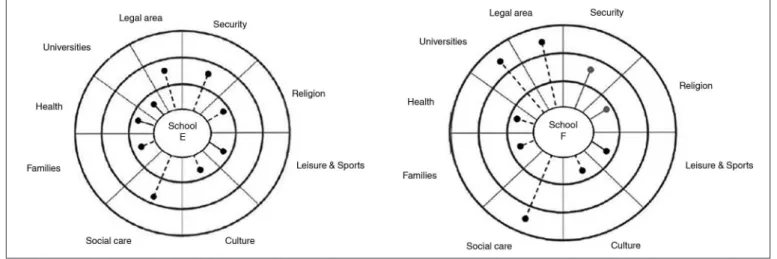
Quadrants were created to analyze the minimum maps of social institutional external network, which represented the various sectors that constituted the institution, according to the speciicity of each situation. The quality of the links in each sector, department or secretariat, was classiied into three levels, represented graphically by means of lines: (i) signiicant links - continuous black line; (ii) fragile links - dotted black line; (iii) broken or nonexistent links - continuous gray line. The graphical representation of the map, at the personal and institutional levels, allows to identify the quality of the links and their distribution across the quadrants.7 The parameters obtained in the analysis of the maps are: size, density, distribution/composition, dispersion, homogeneity/heterogeneity.6
To complement data collection, semi-structured interviews were conducted using a script containing the following open-ended questions related to the quadrants of the map in construction: (a) Is the school an environment that can ofer adequate security to all students? (b) Do you think there is integration between the family and the school? (c) How do you evaluate the relevance of the collective eforts from various sectors aiming to cope with school violence? The interviews, which took about one hour, were recorded in MP3 with the permission of the participants, and transcribed in full. Data were analyzed according to the method of thematic content analysis.8 The following criteria were set up for this method operationalization: pre-analysis, material exploration, and treatment of results. A comprehensive reading of the documents (map images and interview reports) was conducted to identify core ideas, from which thematic nuclei were organized. This study presents only the category "Mapping the network". Then, the relationships among data, legal provisions and the literature that addresses school violence were established. It should be noted that, besides performing a speciic analysis of the minimum maps observing the criteria mentioned above, the collected information was analyzed together with the interview data.
Ethical aspects
The study protocol was approved by the Research Ethics Committee of the Ribeirão Preto College of Nursing at the University of São Paulo, on February 12, 2014, under protocol no. 528.246. Consent was requested from the participants by signing of free and informed consent forms.
RESULTS
Characterization of infrastructure surrounding
the schools
School A was close to and kept a partnership with an important university, and on weekends, it had a partnership with a non-governmental organization (NGO). The district was created recently, and it was urbanized, but it had poor infrastructure, and simple and poorly maintained houses and no leisure areas for the population. Schools B and C were located in neighborhoods close to downtown, which had better commercial infrastructure, basic health units, and homes in better condition. Schools D, E
and F were located in peripheral districts, farther from downtown, with stores, and old and poorly maintained houses. The area surrounding these schools had poor lighting. School D had classes at night as well, and it was located near an unlit square; with poor lighting as a factor favoring violence.
After analyzing data from minimum maps and interviews, the category "Mapping the institutional links" was created, and it is presented below.
Mapping the institutional links
Although they are inserted in diferent areas and contexts, the schools have some characteristics in common, such as expanded network, with links in all quadrants, as illustrated in Figures 1 to 3. For a better understanding of the results obtained, each quadrant of the map will be presented separately below. In terms of SECURITY, the administrators of all schools classiied the students' security as internal and external security, the irst provided by the school in its internal environment, and the second provided by the military police in patrol activities near the school. External security was considered fragile by the heads of schools A, B, C and D, signiicant by the heads of school E, and nonexistent by the heads of school F. The predominance of fragile links showed that there was no homogeneity in the provision of this type of service to the schools analyzed in this study.
The links with RELIGION were classiied as nonexistent by the heads of schools A, C, D and F, and as fragile by the heads of the other schools. The heads of all six schools reported that the institutions did not provide religious education because they considered the school a secular institution; they also reported they did not have the help of religious groups from the local community. Despite this direct evaluation of the links with religiosity, the heads reported the presence of students whose families had religious values and noticed that these students had a diferent ethical behavior, acting more respectfully, even when the family's contact with religion was minor.
Figure 1. Minimum maps of social insituional external network of Schools A and B. Ribeirão Preto, 2014.
Figure 2. Minimum maps of social insituional external network of Schools C and D. Ribeirão Preto, 2014.
Figure 3. Minimum maps of social insituional external network of Schools E and F. Ribeirão Preto, 2014.
other schools developed only internal cultural projects, without the help of other institutions. Sports activities were limited to physical education classes, and leisure activities were limited to some tours promoted by the schools. The heads of school A
reported that the institution opened on Saturdays for the "Family
In relation to SOCIAL CARE, the only body mentioned by the heads of the schools was the Guardianship Council, and all links were considered fragile or nonexistent. In cases of violence involving students, the heads of all six schools participating in this study reported that they irst informed the student's parents and/or guardians of the event and requested their presence. When the resources used by the school were not efective, the heads contacted the Guardianship Council. In general, dissatisfaction was reported in relation to the service provided by this body, as indicated by the excerpts below:
Very slow... very slow... leaving much to be desired. (school A, 2014)
[...] we contacted the Guardianship Council.... in fact, I went there in person to present the cases. (school A, 2014)
Regarding SOCIAL CARE, the heads of the schools were dissatisied because they were obliged to receive students who had committed serious acts of violence. In particular, they claimed the professionals working in the schools were not prepared to deal with these students, and that they were not informed in advance by the judge that they would receive such students in their units.
[...] totally. Very far from the school. When we see a social worker here it's because the judge has sent a student back to school. He doesn't even give a notice to the school. He doesn't ask how the student's learning is going, about scores... nothing. We have no feedback here. (school C, 2014)
Regarding the LEGAL area, the heads of all schools considered the links were nonexistent or fragile. The main complaint was the lack of dialog of the prosecution with the heads of the schools. In some cases, the students returned to school after a court order, but without the prosecution's prior contact with the head of the school or supervision of the situation.
The heads of schools A, B, D and E reported signiicant
links with the HEALTH services provided by basic health units or projects developed by public and private universities located in the municipality:
Health becomes signiicant because of these projects...
which I guess bring a lot of information about health to them [...] information that they don't have in classes... and as it comes in the form of conversation, focused, I think it
is very signiicant. (school B, 2014)
Schools C and F reported fragile links with the health services, characterized by non-continuity of the actions performed and lack of professionals in the area, considered essential aspects in the evaluated context:
[...] I would say the relation with health care is fragile. (...) that health in school, I guess, the whole school (...) should have a psychologist, a nurse... in the school. (school C, 2014)
This study showed the schools had partnerships with UNIVERSITIES in health-related projects, particularly in the areas of nursing, nutrition and psychology. The links varied, with prevalence of fragile links, as the participants reported temporary presence of the university in the school, short-term projects, and that the themes addressed were distant from the school's reality:
[...] very distant. There are few projects here. Sometimes there are health trainees who want to develop projects, but these are distant from the school's reality. They seem to
live in a totally diferent world. And I think that the research
developed in the university is very distant from the reality, really distant. (school C, 2014)
The heads of schools A, C, D, E and F classiied the link with FAMILY as fragile, and the heads of school B classiied it as
nonexistent. The reports of participants highlighted these issues:
[...] it doesn't enhance the student's education, it doesn't enhance the student's wellbeing, it doesn't contribute to the student's wellbeing... (school D, 2014)
The heads of all schools repeated the information above, each using one's own particularities and diferent words, and concluded that the distance from the family increased with the student's age. Total absence of family participation was reported in some cases where the parents or guardians did not show up when required due to acts involving the court:
We've had some cases in which you call the father and
say: "Your son was in a ight, he's giving us a hard time
at school...", and the father says: "I don't care... call the police!...", and he hangs up. (school D, 2014)
DISCUSSION
Historically and in social terms, schools are designed to fully train individuals on scientiic, cultural, technical, personal and citizenship knowledge. School is one's irst social group, besides the family, and in this environment the concepts of citizenship, group experience, feeling of belonging and living with diferences and frustrations will be developed.3,9 Given the current contexts and experiences of children and adolescents, which is not the scope of this study, school violence has become a relevant problem in the agenda of education, health and other sectors of child and adolescent protection.
The analysis of the minimum maps of social institutional external network of schools A to F showed low density of school networks, with many fragile links and few significant links. Regarding distribution and composition, the most signiicant links were in health relations, and important gaps were identiied, due to fragile links or absence of concrete institutional links in other sectors, especially in family links. Although the links with the sports/leisure and culture sectors were signiicant in some schools, the interviews indicated only punctual actions, performed only by the school, without an efective partnership with other services in these areas.
The high dispersion of the links on the maps indicated that the geographical distance between the schools and other sectors/institutions generated very fragile links. Finally, the maps showed a homogeneous network, focused on signiicant links with few sectors, not allowing a dialog with other institutions and sectors that are required to cope with complex phenomena, such as school violence.
The complex phenomenon of violence requires constant attention, permanent work, involvement of various social sectors and the support of the State. To make it happen, it is important to consider a polyocular view of this phenomenon, that is, a view that contextualizes, gathers, encompasses and globalizes the information to build relevant and complex knowledge of the reality. For this purpose, it is necessary to consider an object of study in its context. However, it is important to point out that the proposed contextualization is not juxtaposition, but the unveiling of the numerous relationships that constitute and allow to work in a network and perceive "the mutual relations and the reciprocal inluences between the parts and the whole in a complex world".10
Based on these concepts, the links and relationships expressed by the participants will be discussed in order to understand the gaps or possibilities to cope with school violence.
Security-related actions should be developed through public policies. It is understood that security, represented symbolically by the civil and military police, is part of a network to cope with school violence, but not the only one. Media vehicles usually support this conception of using police and penitentiary policies as a response to school violence issues, disregarding the investments in social
Although schools were conceived as secular environments, the heads of schools conirmed that the presence of religious values in the family environment has a positive impact on the student's behavior at school; the literature reinforces that religion is a social network that supports the families of adolescents, improving even parental involvement.12
As discussed above, school violence has its factors associated with broader contexts. According to the literature, the sectors of culture, sports and leisure are efective means to ight violence. Through strategies and actions in these areas focused on a culture of peace and more positive aspects of human relations, students can build knowledge and skills as citizens who are aware of their rights and duties.5,13 One way to ight school violence is to keep a dialog between teachers and students, aiming to involve them in discussion groups, identify sources of violence, and build a friendly and trustworthy relationship among school heads, teachers and students. Hence, students will be given a voice, making part of the construction of a more afectionate and less violent environment, with the insertion of the concepts of citizenship, coexistence and culture.5,14 The literature reports that young adolescents value the rules of coexistence, request the discussion of topics related to school violence, and claim for more monitoring, more teachers in schools and stronger dialog with teachers.15
The fragility of the network when coping with school violence is evident in the area of social care. A recent Australian study highlighted that although child protection services and domestic violence care services address common situations, they had fragmented and segregated philosophies and operationalization.16 The heads interviewed in this study reported a weak relationship between the school and the Guardianship Council, conirming the indings in the literature.17 A recent study shows that this relationship is reciprocal: guardianship counselors did not mention the joint work with health and education services, sectors considered as pillars of public policies focused on children and adolescents.18 The lack of follow-up and referral of situations of vulnerability experienced by this population reinforces the distance from the legal area.17
and interinstitutional actions connecting them. A recent study that analyzed the perception of school heads on the intersectoral actions in the PSE, showed that despite having knowledge of the intersectoral work, in practice the students and the school do not participate in the prioritization and planning of the actions.19 The school context becomes a privileged environment to promote health through actions that encourage self-care and social and community participation to discuss health, illnesses and care.5
The literature is comprehensive when addressing the beneits of programs and projects focused on school health, developed in partnership with universities; this partnership represents one of the main areas for several graduate courses to be included in the university curriculum.20 However, the insertion has occurred
in a fragmented way, by professional area, making it diicult to identify gaps and possible strategies to eliminate problems that are similar to those described by participants in this study, such as non-continuity of actions.
The increasing absence of the family in the school environment has been associated with the growth of school violence.21 The family environment is one of the main factors
that inluence the behavior of students, and the more welcoming and protective the family environment, the less frequent the expressions of violence in school.22 In addition, the physical space
and geographical location of the school have a direct inluence on violence rates. The likelihood of episodes of violence in the school is greater when the area surrounding the school has a violent environment, for instance, with drug traicking, gangs, robberies and enticement of children and adolescents.3
CONCLUSIONS AND IMPACT ON THE
PRACTICE
This study showed important fragility in the institutional links between the studied schools and the other sectors to cope with school violence. This aspect is aggravated by the weak or non-existent link between the school and the family, which represents the immediate context of insertion of adolescents. Despite the limitations mainly related to the non-generalization of data, this study methodologically addresses the current scientiic guidelines identiied to cope with contemporaneous phenomena, such as the perspective in network, and the results obtained are in agreement with the literature of this ield.
In addition, this study has important contributions to nursing, for its important role in management, care, teaching and research, and for the interdisciplinary team, taking into consideration the current demands of adolescent health: (1) development of joint actions with schools in an interdisciplinary and intersectoral perspective, based on concepts of primary care and the PSE; (2) development of strategies to bring the family closer to the life context of adolescents, especially in the school environment; (3) development of programs with other sectors to promote
adolescent health, with "extramural" actions, involving prevention of or coping with experienced situations of violence, and the promotion of a culture of peace. Further studies are recommended for an in-depth analysis of this theme in the perspective of other actors, such as adolescents and their families, using participatory methodologies.
ACKNOWLEDGEMENTS
The authors thank the National Council for Technological and Scientiic Development (CNPq) for the scientiic initiation scholarship provided for the period of Jan. 1, 2014 to Dec. 31, 2014.
REFERENCES
1. Word Health Organization. Global status report on violence prevention [Internet]. Geneva: World Health Organization; 2014. 2 p. [cited 2016 Feb 16]. Available from: http://www.who.int/violence_injury_prevention/ violence/status_report/global_status_violence_prevention.pdf 2. Stelko-Pereira AC, Williams LCA. Reflexões sobre o conceito de
violência escolar e a busca por uma deinição abrangente. Temas Psicol. [Internet]. 2010; [cited 2016 Jan 17]; 18(1):45-55. Available from: http://pepsic.bvsalud.org/scielo.php?script=sci_arttext&pid=S1413-389X2010000100005&lng=pt
3. Malta DC, Mascarenhas MDM, Dias AR, Prado RR, Lima CM, Silva MMA, et al. Situations of violence experienced by students in the state capitals and the Federal District: results from the National Adolescent School-based Health Survey (PeNSE 2012). Rev Bras Epidemiol. [Internet] 2014; [cited 2015 Jun 16]; 17(Suppl.1):158-71. Available from: http://www.scielo.br/scielo.php?script=sci_arttext&pid=S1415-790X2 014000500158&lng=pt&nrm=iso. http://dx.doi.org/10.1590/1809-4503201400050013
4. Mendes EV. Health care networks. Ciênc Saúde Coletiva [Internet]. 2010; [cited 2015 Nov 17]; 15(5):2297-305. Available from: http://www.scielo. br/scielo.php?script=sci_arttext&pid=S1413-81232010000500005&ln g=en&nrm=iso. http://dx.doi.org/10.1590/S1413-81232010000500005 5. Kothari A, Sibbald SL, Wathen CN. Evaluation of partnerships in a
transnational family violence prevention network using an integrated knowledge translation and exchange model: a mixed methods study. Health Res Policy Syst. [Internet]. 2014; [cited 2015 Nov 17]; 12:25. Available from: http://health-policy-systems.biomedcentral.com/ articles/10.1186/1478-4505-12-25
6. Ude W. Enfrentamento da violência sexual infantojuvenil e construção de redes sociais: produção de indicadores e possibilidades de intervenção. In: Cunha EP, Silva EM, Giovanetti MAC. Enfrentamento à violência sexual infantojuvenil: expansão do PAIR em Minas Gerais. Belo Horizonte: UFMG; 2008. p. 30-60.
7. Flick U. An Introduction to Qualitative Research. 4th ed. London: Sage; 2009. 528 p.
8. Bardin L. Análise de conteúdo. 4ª ed. Lisboa: Edições 70; 2011. 280 p. 9. Vieira LJES, Abreu CAP, Valdês MTM, Oliveira EN, Ferreira RC, Catrib AMF. Violência na escola pública: relatos de professores. Rev Bras Promoç Saúde [Internet]. 2010; [cited 2015 nov 17]; 23(1):34-42. Available from: http://ojs.unifor.br/index.php/RBPS/article/ view/1169/2290
10. Morin E. Ensinar a Viver: manifesto para mudar a Educação. Porto Alegre: Sulina; 2015. 183 p.
12. Becker APS, Maestri TP, Bobato ST. Impacto da religiosidade na relação entre pais e ilhos adolescentes. Arq Bras Psicol [Internet]. 2015; [cited 2016 Mar 9]; 67(1):84-98. Available from: http:// pepsic.bvsalud.org/scielo.php?script=sci_arttext&pid=S1809-52672015000100007&lng=pt
13. Guimarães MRV. A educação física no enfrentamento da violência em uma escola da rede municipal de ensino de Pelotas/RS. Encontro Rev Psicol [Internet]. 2011; [cited 2016 Jan 16]; 14(21):25-35. Available from: http://www.pgsskroton.com.br/seer/index.php/renc/article/ view/2492/2386
14. Monteiro EMLM, Brandão Neto W, Lima LS, Aquino JM, Gontijo DT, Pereira BO. Culture Circles in adolescent empowerment for the prevention of violence. Int J Adolesc Youth [Internet]. 2015; [cited 2016 Jan 12]; 20(2):167-84. Available from: http://dx.doi.org/10.1080/02673 843.2014.992028
15. Silva EB, Costa MC, Santos M, Janh AC. School violence in the view of adolescents: possibilities for its confrontation. Cogitare Enferm [Internet]. 2014; [cited 2016 Jan 12]; 19(1):18-25. Available from: http:// ojs.c3sl.ufpr.br/ojs/index.php/cogitare/article/view/35926/22406 16. Zannettino L, McLaren H. Domestic violence and child protection:
towards a collaborative approach across the two service sectors. Child Fam Soc Work [Internet]. 2014; [cited 2016 Feb 16]; 19(4):421-31. Available from: http://onlinelibrary.wiley.com/doi/10.1111/cfs.12037/ pdf
17. Martins CBG, Jorge MHPM. Department of Justice decision regarding cases of violence against children and teenagers. Acta Paul Enferm [Internet]. 2009 Dec; [cited 2017 Jan 24]; 22(6):800-7. Available from: http://www.scielo.br/scielo.php?script=sci_arttext&pid=S0103-21002009000600012&lng=en. http://dx.doi.org/10.1590/S0103-21002009000600012
18. Deslandes SF, Campos DS. Guardianship Councilors' views on the efectiveness of the existing network in providing full protection to children and teenagers in situations of sexual violence. Ciênc Saúde Coletiva [Internet]. 2015; [cited 2016 Jan 17]; 20(7):2173-82. Available from: http://www.scielo.br/scielo.php?script=sci_arttext&pid=S1413-81232015000702173&lng=en. http://dx.doi.org/10.1590/1413-81232015207.13812014
19. Ferreira IRC, Moysés SJ, França BHS, Carvalho ML, Moysés ST. Percepções de gestores locais sobre a intersetorialidade no Programa Saúde na Escola. Rev Bras Educ [Internet]. 2014; [cited 2017 Jan 24]; 19(56):61-76. Available from: http://www.scielo.br/scielo. php?script=sci_arttext&pid=S1413-24782014000100004&lng=en&nr m=iso. http://dx.doi.org/10.1590/S1413-24782014000100004 20. Gomes AM, Santos MS, Finger D, Zanittini A, Franceschi VE, Souza
JB, et al. Reletindo sobre as práticas de educação em saúde com crianças e adolescentes no espaço escolar: um relato de extensão. Rev Conexão UEPG [Internet]. 2015; [cited 2016 Jan 15]; 11(3):332-41. Available from: http://177.101.17.124/index.php/conexao/article/ view/7592/4808
21. Souza KOJ. Violência em escolas públicas e a promoção da saúde: relatos e diálogos com alunos e professores. Rev Bras Promoç Saúde [Internet]. 2012; [cited 2015 Jun 15]; 25(1):71-9. Available from: http://ojs.unifor.br/index.php/RBPS/article/view/2213. http://dx.doi. org/10.5020/2213