ISSN 0104-6632 Printed in Brazil
Vol. 19, No. 03, pp. 335 - 242, July - September 2002
Brazilian Journal
of Chemical
Engineering
CONVERSION OF
n
-BUTANE TO
iso
-BUTENE
ON GALLIUM/HZSM-5 CATALYSTS
S.M.Gheno and E.A.Urquieta-González*
Departamento de Engenharia Química, Universidade Federal de São Carlos, Cx. P. 676, CEP 13565-905, São Fone (16) 260-8264, Fax (16) 260-8266, Carlos - SP, Brazil.
E-mail: [email protected]
(Received: January 3, 2001 ; Accepted: August 10, 2002)
Abstract - The conversion of n-butane to iso-butene on gallium/HZSM-5 catalysts at 350ºC and WHSV=2.5h8-1 was studied. The catalysts were prepared by ion exchange from a Ga(NO3)2 solution and
further submitted to calcination in air at 530ºC. TEM analysis with an EDAX detector and TPR-H2 data
showed that after calcination the Ga species were present mainly as Ga2O3, which are reduced to Ga2O at
temperatures near 610ºC. The specific acid activity (SAA) of the catalysts increased with the increase in aluminum content in the zeolite, and for a fixed Si/Al ratio, the SAA increased with Ga content. Values for specific hydro/dehydrogenation activity (SH/DHA) were significantly higher than those for SAA, indicating that the catalytic process is controlled by the kinetics on acid sites. Moreover, the production of iso-butene with a selectivity higher than 25% was a evidence that in gallium/HZSM-5-based catalysts the rate of the hydrogenation reaction is lower than that of the dehydrogenation reaction; this behavior confirmed the dehydrogenation nature of gallium species, thereby showing great promise for iso-butene production.
Keywords: n-butane, iso-butene, MTBE, gallium/ZSM-5, dehydrogenation, isomerization.
INTRODUCTION
Since 1970, the petroleum industry has introduced several modifications into the composition of gasoline (Seddon, 1992). The objective has been to enhance the octane number and the minimize emissions of pollutants in the exhaust gases of automotive vehicles. One of the most important changes has been the addition of oxygenated organic compounds, such as methyl tert-buthyl ether (MTBE), tert-amil-methyl ether (TAME), ethanol, methanol, etc. Of these additives, MTBE has been the most commonly used; therefore, great efforts have been made to maximize its production. The most frequently utilized process for the commercial production of MTBE is the conversion of iso-butene and methanol on acid catalysts (Naber, 1994).Thus, the manufacture of MTBE is strongly dependent on iso-butene production, which is possible by the following processes:
(a) typical n-butene isomerization using acid catalysts and mainly acid zeolites (Butler and Nicolaides, 1993; Cheng and Ponec, 1994; Seo et al., 1997);
(b) conversion of n-butane to iso-butene, involving dehydrogenation/isomerization steps on bifunctional catalysts (Giannetto et al., 1994), with a strongly dehydrogenation metallic function associated with strong acid sites such as those found in H/zeolites. This process, though not sufficiently studied, is the most attractive as it allows production of iso-butene in only one step.
EXPERIMENTAL
Preparation of the Catalysts
Na-ZSM-5 zeolites with Si/Al ratios of 18, 28 and 38 were synthesized under hydrothermal conditions using the procedure utilized by Batista (1997). The acid forms of the zeolites (H-ZSM-5) were obtained at room temperature by ion exchange in a HCl diluted solution (0.1 mol/L). The gallium-based H-ZSM-5 catalysts were obtained by ion exchange at
90ºC using a Ga(NO3)3 solution (0.05 mol/L;
Aldrich). After the ion exchange the catalysts were filtered, washed with deionized water, dried at 105ºC
during 4 hours and calcined during 10 hours at 530ºC
under air flow (20cm3/min.g). The catalysts are
referred to as Ga(x)/HZ(y), where x is the gallium content in the catalyst (% w/w) and y the Si/Al ratio of the zeolite. The bulk chemical composition obtained by atomic absorption spectroscopy and the unit cell composition of the zeolites are show in Table 1.
Characterization
(a)X-ray Diffraction (XRD)
The X-ray powder diffraction patterns of the zeolites in the angular range of 3 to 40º(2θ) were recorded in a
Rigaku diffractometer using monochromated Cuκα
radiation generated at 30kV and 10mA. The scanning speed used was 2º(2θ)/min.
(b) Scanning Electronic Microscopy (SEM)
The Na-ZSM-5 micrographs were obtained in a Zeiss – DSM 960 scanning electron microscope operated at 30 kV and 75 mA.
(c) Transmission Electron Microscopy (TEM)
The micrographs of the Ga(1.0)/HZ(28) sample were obtained on a Phillips CM-120 transmission electron microscopy with a EDAX CM-120 detection unit. A mechanism with a high cryogenic vacuum and a beryllium window with a thickness of 7 µm was utilized. The incident beam in the sample area analyzed was 20 – 30 nm in diameter and the contact time, 100 s.
(d) Temperature-Programmed Reduction of Hydrogen (TPR-H2)
The TPR analysis of 100 mg of each calcined Ga-ZSM-5 catalyst was carried out in a Micromeritics
pulse chemisorb 2705 from room temperature to 1000 ºC (heating rate of 10 ºC/min), using a gas flow of 40 cm3/min.g with 5% H2 (v/v in N2). The reduced
Ga species were calculated from hydrogen consumption in accordance with the following reaction:
Ga2O3 + 2H2 → Ga2O + 2H2O
Catalytic Activity
The n-butane conversion was carried out in a fixed bed reactor operated under steady state
conditions at 350ºC and atmospheric pressure. The
feed stream was a mixture of nitrogen and n-butane at a molar ratio of 9, which results for n-butane in a
WHSV= 2.5 h-1. Concerning with the results of
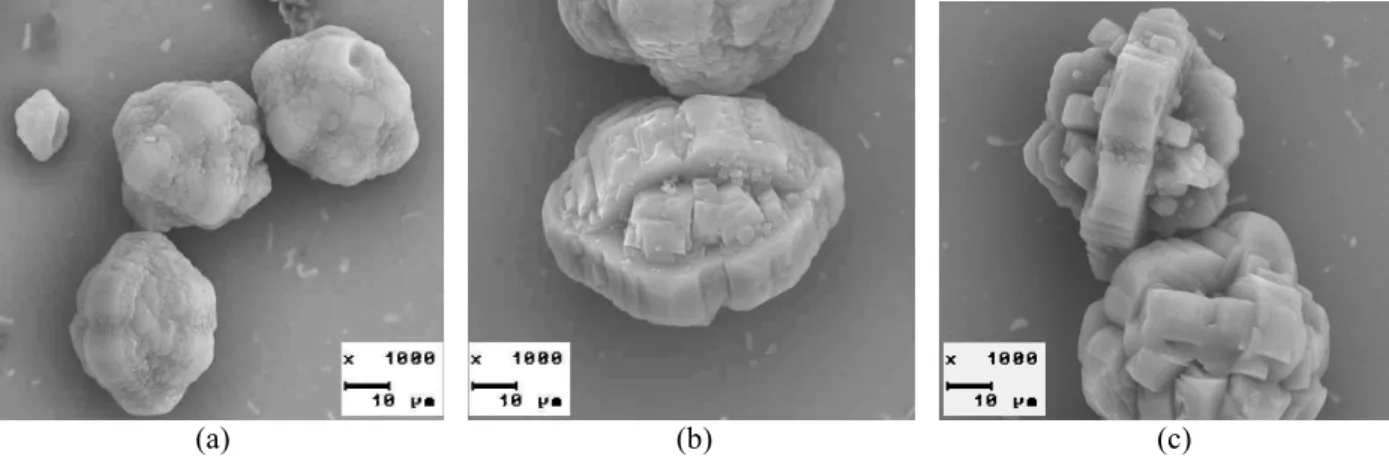
scanning electron microscopy (see Figure 2), the metal exchanged zeolites have particle size lower
than 100 µm, resulting in relations of high bed to
particle size much higher than 10 and of diameter of the reactor to particle size higher than 16. The values pointed are considered the minimal necessary to minimize the external and internal diffusion effects, the dispersion and the axial and radial temperature gradients in porous catalysts (Zotin, J. L., 2001). Another condition adopted to minimize these transport phenomena effects was the dilution of n-butane in nitrogen flow as commented above (Smith, J. S., 1981).
The products were analyzed by gas chromatography using a VARIAN 3400 chromatograph with an FID detector and a capillary column with an internal diameter of 0.25 mm and a length of 50 m. Before the reaction the catalysts were activated in situ at 530ºC
under H2 flow (160 cm3/min) during 8 h. After
reduction of the gallium species, the reactor was cooled to the reaction temperature.
RESULTS AND DISCUSSION
Characterization
The TEM micrographs of the calcined Ga(1.0)/HZ(28) sample, which is 1.06% gallium and has a ratio of Ga/Al=0.268 (Table 1), are shown in Figure 3. Particles can be seen on the catalyst surface, these are visible in both micrographs, the clear field image (Figure 3a) and the dark field
image (Figure 3b). In situ chemical analysis of the
particles by EDAX and X-ray diffraction confirmed
that they are composed of Ga2O3, which is seen as
little aggregates or thin sheets, located principally on the external surface of the zeolite crystals.
The TPR-H2 curves of Ga(1.0)/HZ(18), (28) and
(38) catalysts (Figure 4) showed that all the samples
had one reduction peak near 610ºC, which has been
attributed to the reduction of Ga2O3 to Ga2O (Brabec
et al., 1998). The Ga(1.0)/HZ(18) sample, the
catalyst with the highest aluminum content, showed
an additional reduction peak at around 350ºC, which
was attributed in the case of this sample, having the highest number of exchangeable sites, to the
reduction of the reminiscent not oxidized Ga3+
cations compensating the negative charge of the zeolite. This peak was also observed by Brabec et al. (1998) in the TPR profile of a modified boralite by gallium solid state ion exchange. The
Ga(1.0)/HZ(18) sample also showed the highest H2
consumption, indicating greater ability to reduce
Ga2O3 in catalysts with higher numbers of protonic
sites. This result was also evidenced by Joly (1991), Kanazirev et al. (1992) and Guisnet et al. (1992), who suggested that the presence of acid sites promotes Ga2O3 reduction.
Table 1: Characteristics of the prepared Ga-HZSM-5 catalysts after ion exchange.
Sample Si/Al gGa/gzeolite Exchange(%) Ga/Al Unit cell
Ga(1.0)/HZ(18) 18 0.0109 50.0 0.183 H2.53Ga0.84Al5.02Si90.91O192 Ga(1.0)/HZ(28) 28 0.0106 75.0 0.268 H0.83Ga0.83Al3.31Si92.70O192 Ga(1.0)/HZ(38) 38 0.0108 98.0 0.376 H0.05Ga0.80Al2.46Si93.54O192 Ga(0.5)/HZ(18) 18 0.0048 25.0 0.092 H3.76Ga0.42Al5.02Si90.91O192 Ga(0.5)/HZ(28) 28 0.0054 38.0 0.135 H2.05Ga0.42Al3.31Si92.70O192 Ga(0.5)/HZ(38) 38 0.0052 52.0 0.189 H1.18Ga0.43Al2.46Si93.54O192 Ga(0.1)/HZ(18) 18 0.0007 3.5 0.018 H4.84Ga0.06Al5.02Si90.91O192 Ga(0.1)/HZ(28) 28 0.0010 7.0 0.027 H3.08Ga0.08Al3.31Si92.70O192 Ga(0.1)/HZ(38) 38 0.0009 9.0 0.038 H2.24Ga0.07Al2.46Si93.54O192
(a) (b) (c)
Figure 2: SEM micrographs of the synthesized zeolites: (a) Na-ZSM-5(18); (b) Na-ZSM-5(28); (c) Na-ZSM-5(38).
(a) (b)
Figure 3: TEM micrographs of the calcined Ga(1.0)/HZ(28) sample: (a) clear field image and (b) obscure field image.
n-Butane Conversion
At 350ºC and WHSV=2.5h-1, the conversion of
n-butane on Ga(x)/HZ(y) generated principally iso-butane and iso-butene. For the most active samples, a low production level of the C3 and C5 fractions was
also detected. On Ga/H-ZSM-5 catalysts, the occurrence of the classic bifunctional process can be expected. This process involves the participation of hydrogenation/dehydrogenation sites and acid sites (Giannetto, 1985; Giannetto et al., 1995) in the following steps: a) dehydrogenation of n-butane to butenes on gallium species; b) isomerization of n-butenes to iso-butene on acid sites and c) hydrogenation of the olefins formed on metallic sites. The isomerization of n-butenes can occur via monomolecular or bimolecular mechanisms (Mériaudeau et al., 1997; Guisnet et al., 1997); in the first one, n-butene is selectively transformed into iso-butene, involving the formation of a highly unstable primary carbenium ion and one protonated ciclopropane. Despite the fact that the monomolecular mechanism involves this unstable intermediate, on depending of the type of zeolite, it can not be always completely discarded; however, on HMFI and HFER zeolites this occurrence has not been important, therefore indicating that the most probable occurring mechanism is the bimolecular
one, which elucidates the formation of iso-C4,
iso-C4=, and C3 and C5 fractions in the products
(Mériaudeau et al., 1997; Guisnet et al., 1997). The bimolecular mechanism, which is more rapid than the monomolecular one, occurs by the sequence dimerization, isomerization and cracking, involving secondary and tertiary carbenium ions and the protonated ciclopropane (Mériaudeau et al., 1997).
The n-butane conversion (Figure 5) was strongly influenced by the presence of acid sites and hydro/dehydrogenation species:
a) independent of gallium content, higher levels of conversion were obtained on catalysts with higher aluminum contents:
Ga(x)/HZ(18)>>Ga(x)/HZ(28)>Ga(x)/HZ(38);
b) for a constant Si/Al ratio, propane conversion increased with an increase in gallium content:
Ga(1.0)/HZ(y)> Ga(0.5)/HZ(y)>Ga(0.1)/HZ(y).
For low Ga/Al ratios (Table 1), it can be expected that the number of dehydrogenation sites is not sufficient to supply intermediate olefins to all active acid sites responsible for the isomerization step. However, because the isomerization reaction is the rate-determining step (Runstraat, A. van de, 1997), an increase in the density of acid sites will favor the bifunctional catalytic process.
Specific Acid Activity (SAA)
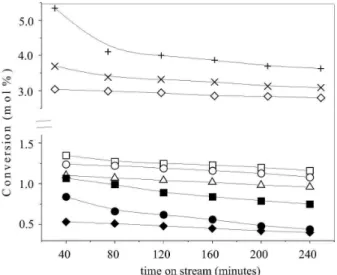
The SAA (Figure 6), calculated as a ratio of the mol number of the converted propane to the mol number of aluminum in the catalyst, showed behavior similar to that in the conversion shown in Figure 5. In this manner, for a particular Si/Al ratio, the SAA increased with an increase in gallium content. This indicates that to obtain higher acid activity, a higher concentration of olefins, and therefore a higher number of dehydrogenation sites, is necessary.
Figure 6: Specific acid activity (SAA) on HZ(18)/Ga(%): (+) 1.0; (x) 0.5; (²) 0.1. HZ(28)/Ga(%): (¨) 1.0; (O) 0.5; (∆) 0.1. HZ(38)/Ga(%): (n) 1.0; (l) 0.5; (u) 0.1.
Table 2: Specific hydro/dehydrogenation activity (SH/DHA) on Ga(x)/HZ(y) catalysts in the conversion of n-butane at 350 ºC and WHSV: 2.5 h-1.
AEH/HD
Time Ga(x)/HZ(18) Ga(x)/HZ(28) Ga(x)/HZ(38)
(min) x=1.0 x=0.5 x=0.1 x=1.0 X=0.5 x=0.1 x=1.0 x=0.5 x=0.1
40 5.51 7.81 31.96 1.40 3.05 14.2 1.35 2.18 6.83 80 4.63 7.27 26.22 1.26 3.00 13.1 1.26 1.69 6.55 120 4.60 7.15 24.86 1.24 2.95 12.8 1.21 1.52 6.01 160 4.49 7.10 24.04 1.13 2.84 12.6 1.18 1.47 6.01 200 4.38 6.94 23.22 1.07 2.73 12.0 1.15 1.20 5.46 240 4.16 6.83 22.67 0.99 2.62 11.7 1.10 1.14 5.19
Table 3: Selectivity (%) for iso-butane and for iso-butene in the conversion of n-butane at 350 ºC and WHSV=2.5 h-1.
Sample
Ga(1.0)/HZ(18) Ga(1.0)/HZ(28) Ga(1.0)/HZ(38)
Conversion* 5.3 1.3 1.1
C3 6.1 ** **
Iso-butane 66.5 57.2 54.7 Iso-butene 27.4 42.8 45.3
C5 ** ** **
Ga(0.5)/HZ(18) Ga(0,5)/HZ(28) Ga(0,5)/HZ(38)
Conversion* 3.7 1.3 0.8
C3 5.3 ** **
Iso-butane 69.7 59.7 57.9 Iso-butene 25.5 40.3 42.1
C5 ** ** **
Ga(0.1)/HZ(18) Ga(0.1)/HZ(28) Ga(0.1)/HZ(38)
Conversion* 3.04 1.1 0.6
C3 ** ** **
Iso-butane 76.5 63.8 61.3 Iso-butene 23.5 36.2 38.7
C5 ** ** **
Specific Hydro/Dehydrogenation Activity (SH/DHA)
The values of SH/DHA are shown in Table 2. These values were calculated as the ratio of the mol number of dehydrogenated n-butane + the mol number of hydrogenated olefins to the mol number of effectively reduced Ga2O3 species. For a constant
Si/Al ratio, it can be seen in Table 2 that a decrease in the gallium content of the catalyst resulted in an increase in SH/DHA, where the SH/DHA values were significantly higher than those obtained for SAA (Figure 6), thereby providing evidence that the kinetics of the bifunctional process is controlled by the reaction occurring on acid sites (Runstraat, A. van de, 1997). In samples having the same gallium content, it was observed that the SH/DHA value was higher for those having lower Al/Si ratios. Taking into consideration that the reaction on acid sites occurs through a bimolecular mechanism involving dimerization/isomerization/cracking, a higher number of these sites will favor this process, resulting in a higher consumption of dehydrogenated compounds.
Selectivity for iso-Butane and for iso-Butene
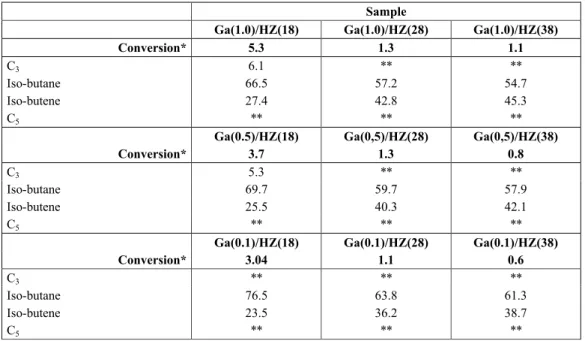
Table 3 shows the selectivity for different products generated during the conversion of n-butane
on Ga(x)/HZ(y) catalysts at 350 ºC and WHSV=2.5
h-1. As noted above, iso-butane and iso-butene were
the principal products, providing evidence of the
formation of a dimer intermediate C8
+
with further isomerization and cracking to form iso-butene. Part of the iso-butene formed again reacted on metallic sites to form iso-butane, thus explaining its presence in the product stream. However, the presence of iso-butene in proportions between 23 and 45% indicates that in gallium/HZSM-5 catalysts the rate of the hydrogenation reaction is lower than that of the dehydrogenation reaction, thus confirming the dehydrogenation characteristics of the gallium species (Montes and Giannetto, 1995). It can also be observed in Table 3 that for a fixed Si/Al ratio the selectivity for iso-butane and for iso-butene are very similar, independent of gallium content, whereas an increase in the Si/Al ratio results in an enhancement of selectivity for iso-butene. This behavior can be explained by the decrease in the density of acid sites, which reduces the occurrence of the bimolecular mechanism and enhances the participation of the monomolecular mechanism, which is more selective for iso-butene formation (Mériaudeau et al., 1997).
CONCLUSION
After calcination at 530 ºC the Ga/HZSM-5
catalysts obtained by ion exchange had the extra-structural Ga2O3 crystalline phase, which is reduced
to Ga2O near 610ºC. The conversion of n-butane on
these catalysts generated mainly butane and iso-butene due to the bimolecular mechanism involving
formation of a dimer intermediate, the C8+ tertiary
carbenium ion and its isomerization and cracking. An increase in the conversion and in the specific acid activity (SAA) occurred with the increase in aluminum content in the zeolite, and for a constant Si/Al ratio, both types of activity increased with the increase in gallium content in the catalyst. The specific hydro/dehydrogenant activities obtained (SH/DHA), with values significantly higher than the SAA, and the production of iso-butene with a selectivity higher than 25% were evidence that in the gallium/HZSM-5-based catalysts the rate of the hydrogenation reaction is lower than that of the dehydrogenation reaction. This behavior confirmed the dehydrogenation nature of gallium species, thereby showing great promise for iso-butene production.
ACKNOWLEDGMENTS
The authors are thankful for the financial support provided by FAPESP (grant 97/00317-0) and for the M.Sc. scholarship granted by CNPq to Simoni Maria Gheno (PPG-EQ/UFSCar).
REFERENCES
Batista, M. S., Desproporcionamento de Etilbenzeno sobre Zeólitas, M.Sc. Thesis, Universidade Federal de São Carlos, São Carlos, SP, Brasil (1997).
Brabec, L., Jeschke, M., Klik, R., Nováková, L., Freude, D., Bosácek, V. and Meusinger, J., Appl. Catal., 167, 309-320 (1998).
Butler, A. C. and Nicolaides, C. P., Catal. Today, 18, p. 443 (1993).
Cheng, Z. X. and Ponec, V., J. Catal., 148, 607-616 (1994).
Giannetto, G., Thesis, Université de Poitiers, France (1985).
Giannetto, G., Monque, R. and Galiasso, R., Catal. Rev. Sc. Eng., 36(2), p. 271 (1994).
Giannetto, G., Montes, A., Monque, R. and Prada,
Moleculares, D. Cardoso, E. A. Urquieta-Gonzalez and L. S. Jahn (eds.), Universidade Federal de São Carlos, São Carlos, SP, Brasil, 259-281 (1995).
Guisnet, M., Gnep, N. S. and Alario, F., Appl. Catal. A: General, 89, 1-30 (1992).
Guisnet, M., Andy, P., Gnep, N. S., Travers, C. and Benazzi, E., In Progress in Zeolite and Microporous Materials, Stud. Surf. Sci. and Catal., H. Chon, S.-K. Ihm and Y. S. Uh (eds.), Elsevier, Amsterdam, Vol. 105, 1365-1372 (1997).
Joly, J. F., Appl. Catal. A: General, 79, 249-263 (1991).
Kanazirev, V., Prince, G. L. and Tyuliev, G., Zeolites, 12(7), 846-850 (1992).
Mériaudeau, P., Anh Vu, T., Le Ngoc, H. and Naccache, C., In Progress in Zeolite and Microporous Materials, Stud. Surf. Sci. and Catal., H. Chon, S.-K. Ihm and Y. S. Uh (eds.), Elsevier, Amsterdam, Vol. 105, 1373-1379 (1997).
Montes, A. and Giannetto, G., In 2º Curso
Iberoamericano sobre Peneiras Moleculares, D. Cardoso, E. A. Urquieta-Gonzalez and L. S. Jahn (eds.), Universidade Federal de São Carlos, São Carlos, SP, Brasil, 295-310 (1995).
Naber, J. E., Jong, K. P., Stork, W. H. J., Kuipers, H. P. C. E. and Post, M. F. M., In Zeolite and Related Microporous Materials, Stud. Surf. Sci. and Catal., J. Weitkamp, H. G. Karge, H. Pfeifer and W. Hölderich (eds.), Elsevier, Amsterdam, Vol. 84, 2197-2219 (1994).
Runstraat A. van de., Stobbelaar, P. J., Grondelle, J. van, Anderson, B. G., Ijzendoorn L. J. van and Santen R. A. van, In Progress in Zeolite and Microporous Materials, Stud. Surf. Sci. and Catal., H. Chon, S.-K. Ihm and Y. S. Uh (eds.), Elsevier, Amsterdam, Vol. 105, 1253-1260 (1997).
Seddon, D., Catal. Today, 15, 1-21 (1992).
Smith, J. M., Chemical Engineering Kinetics, 3rd
edition, McGraw Hill, Tokyo, p. 537 (1981). Seo, G., Jeong, H. S., Lee, J. M. and Ahn, B. J., In
Progress in Zeolite and Microporous Materials, Stud. Surf. Sci. and Catal., H. Chon, S.-K. Ihm and Y. S. Uh (eds.), Elsevier, Amsterdam, Vol. 105, 1431-1438 (1997).
Zotin, J. L., Caracterização de Catalisadores por
Reações Modelo, In 2o Curso Iberoamericano