Original Article
ROLE OF M ODIFIED EPLEY’S M ANEUVER AND BRANDT-DAROFF
EXERCI SES IN TREATM EN T OF POSTERIOR CAN AL BPPV:
A COM PARATIVE STUDY
Devangi S. Desai *
1,
Amruta S. Chauhan
2, M aharshi N. Trivedi
2.
* 1 Sr. lect urer, Pioneer Physiot herapy College, Vadodara Gujarat , India.
2 Lect urer, Pioneer Physiot herapy College, Vadodara Gujarat , India.
Background: Benign paroxysm al posit ional vert igo (BPPV) defined by Dix and Hallpike is one of t he m ost
com m on disorders causing vert igo.BPPV is m ore prevalent in adult s and in w om en.BPPV m ost ly develops in t he
post erior sem icir cular canal. The m ain sym pt om of BPPV is ver t igo induced by a change in head posit ion w it h respect t o gravit y. The Dix-Hallpike t est is t he m ost com m only used t est t o confirm t he diagnosis of post er ior canal BPPV. Treat m ent opt ions for post erior canal BPPV are Epley’s m aneuver, Liberat ory m aneuver and Brandt-Daroff exercises. In m odified epley’s m aneuver few m odif icat ions w ere done in or iginal epley’s m aneuver w it hout affect ing out com e.
Objective: To assess effect iveness of m odified epley’s m aneuver as w ell as com binat ion of m odified epley’s m aneuver w it h Brandt -Darof f exercise in pat ient s w it h post erior canal BPPV and t o com pare bot h t reat m ent prot ocols.
M et hodology:All pat ient s w ere exam ined by Dix-Hallpike t est (D-H Test ) and t hose suffering f rom post er ior canal BPPV and fulfilling inclusion crit eria w ere taken up for t he st udy. Total t hirt y five pat ient s t ook part in t his st udy on a volunt ary basis aft er signing consent for m . The pat ient s w er e random ly assigned t o t w o gr oups. In group 1, com binat ion of m odified epley’s m aneuver and Brandt-Darof f exercise w ere given and in group 2 only m odified epley’s m aneuver w as given. All pat ient s w ere reexam ined aft er 1 w eek of t reat m ent and w ere asked t o com e f or f ollow up af t er 1 m ont h. In follow up visit s response t o Dix – Hallpike m aneuver and Dizziness Handicap Invent or y(DHI) w er e assessed as out com e m easur es.
Results: Dat a collect ed t hrough t his st udy show ed highly significant im provem ent in DHI score and response t o D-H t est w hen int ragroup com parison is m ade in bot h t he groups af t er 1 w eek and 1 m ont h of t reat m ent at 1% level of significance. When int ergroup com par ison is m ade w e found bet t er im pr ovem ent in group 2 aft er 1 w eek and in group 1 aft er 1 m ont h of t reat m ent .
Conclusion: The conclusion of t he st udy is t hat bot h t reat m ent appr oaches ar e eff ect ive in reducing sym pt om s and im pr oving independence level but com bined approaches can give bet t er result .
KEY W ORDS: Canalit h reposit ioning m aneuver, vert igo, nystagm us, DHI, Dix-Hallpi ke t est .
ABSTRACT
INTRODUCTION
Address for correspondence: Dr. Devangi S. Desai, Sr. lect urer, Pioneer Physiot herapy College, Nr. N.H. – 8, Ajwa nimeta road, At & post . Sayajipura, Vadodara-390019, Gujarat , India.
E-M ail: [email protected]
DOI: ht t p:/ / dx.doi.org/10.16965/ ijpr.2015.137
Quick Response code
Access this Article online
International Journal of Physiotherapy and Research
ISSN 2321- 1822
w w w.ijm hr.org/ ijpr.htm l
DOI: 10.16965/ ijpr.2015.137
Received: 27-04-2015 Peer Review : 27-04-2015 Revised: None
Accept ed: 12-05-2015 Published (O): 11-06-2015 Published (P): 11-06-2015
Benign paroxysm al posit ional vert igo (BPPV) defined by Dix and Hallpike [1], is one of t he most common disorders causing vert igo [2,3] in
adult s and fort unately, is a very simple disorder
t o m anage.[4,5] The cause of BPPV is m ost ly
t rauma, infect ion, and aging. Idiopat hic BPPV is more prevalent in adult s and in w omen, w it h w omen t o men rat ion of 2:1 [6,7].
Schu k n ech t , p r op o sed t he t heo r y o f cupulolit hiasis in w hich degenerat ive debris from t he ut ricle adhere t o t he cupula, making t he ampulla gravit y sensit ive. A second t heory, canal i t h i asi s, w as p r o p osed b y Hal l an d colleagues in w hich t he degenerat ive debris is f l oat i ng f r eel y i n t h e en d o ly m p h o f t h e sem icircular canal [5,8]. BPPV can be caused eit her by canalit hiasis or by cupulolit hiasis.
M ovement of t he head causes t hese ot olit hs t o inappropriat ely t rigger t he recept or s in t he sem icircular canals and send false signals t o t he brain, causing vert igo and nyst agmus [9]. Post erior canal BPPV has been said t o account for 60-90% of all BPPV cases [10,11].
The main sympt om of BPPV is vert igo induced by a change in head posit ion w it h respect t o gravit y. Pat ient s t ypically develop vert igo w hen get t ing out of bed, rolling over in bed, t ilt ing t h eir head back, or bend ing f or w ar d. The sympt oms of BPPV may vary among pat ient s, and m ay manifest w it h nonspecific dizziness, p ost u ral i n st ab i l i t y, li ght h ead edn ess, an d
nausea [12,13]. The vert igo in BPPV is t ypically
int ermit t ent and posit ioning dependent , w hich usually resolves w it hin 30 seconds in post erior canal BPPV [1].
The Dix-Hallpike test [1] is t he most commonly used t est t o confirm t he diagnosis of post erior canal BPPV. In t his t est , t he pat ient ’s head is t urned 45 degrees horizont ally t ow ards t he af fect ed side w hile t he pat ient is in sit t ing posit ion (fig-1). The pat ient t hen quickly lies dow n w it h t he head hanging over t he edge of t he t reat ment t able approximat ely 30 degrees below horizont al (fig-2). The exam iner asks w het her t he pat ient has vert igo and observes f or n yst agm u s. Righ t p o st er i or can al involvement produces upbeat ing and right w ard t orsional nyst agmus during right Dix-Hallpike t est .
Treat ment opt ions for posterior canal BPPV are Epley ’s m aneuver, Liberat ory maneuver and Brandt -Daroff exercises. Epley has int roduced a procedure in w hich t he post er ior canal is rot at ed backw ards close t o it s planar orient
a-t ion, a-t hus direca-t ing foreign maa-t erial oua-t of a-t he canal int o t he ut ricle [14].
There are m any st udies on effect of epley ’s m aneuver for t he t reat m ent of BPPV. Lit t le at t ent ion has been given t o t he comparison of modified epley’s maneuver w ith modified epley’s m aneuver and Brandt Daroff exercise so t he need of t he st udy is t o find out t he effect iveness of each prot ocol and to compare bot h protocols.
M ETERIALS AND M ETHODS
St udy has conduct ed at t he Physiot her apy depart ment of Pioneer Physiot herapy College, Vadodara, Gujarat , India, St udy design adopted for this study w as Prospect ive longitudinal follow up st udy.
Inclusion Cr it er ia f or t he st udy is t hat t he diagnosis of BPPV of t he post erior canal w as b ased on t he p r esence of f ol l o w i n g charact erist ic of paroxysmal nyst agmus on D-H t est :
1. Lat ency vert igo and nyst agmus begin one or more seconds aft er head is t ilt ed t ow ards t he affect ed ear. 2. Observat ion of an up beat ing t orsional nyst agmus (fast phase of t he superior pole beat ing t ow ards t he underm ost ear) or mixed vert ical- t orsional nystagmus. 3. Vert igo and nyst agmus last ing less t han 60 seconds.
The exclusion crit eria, w hich w ill be det ect ed t hrough the clinical history, physical examinat ion and neuroimaging are:
1. Previous or current diagnoses of labyrint hine diseases such as M énière’s disease, labyrint hit is or vest ibular neuronit is. 2. Cont raindicat ions t o canalit h repositioning procedures: cervical spinal st enosis, severe kyphoscoliosis, limit ed cervical mobilit y, Dow n syndrome, advanced rheumat oid ar t hr it is, cer v ical r ad icul op at hi es, Paget ’s disease, morbid obesit y, ankylosing spondylit is, severe lum bar dysf unct ion and spinal cor d injuries. 3. Disorders of cent ral nervous syst em 4. Pat ient refusal t o part icipate in t he st udy. 5. Ot h er cau ses w h i ch m ay h i nd er t h e u n der st an d in g of t h e o b j ect iv es an d m et h o d ol o gy o f t h e t r i al (l an gu age, l o w educat ional level, and so on).
inclu-sion criteria w ere taken up for t he st udy. Total t hirt y five pat ient s t ook part in t his st udy on a volunt ary basis aft er signing consent form. This st udy w as approved by t he Inst it ut ional Et hical Commit t ee of our inst it ut ion. All t he subject s w ere assessed as per t he evaluat ion form at before st art ing t reat ment . The procedure w as explained t o all t he subject s.
The pat ient s w ere random ly assigned t o t w o groups. No subject s received medication, special inst ruct ions about sleeping posit ion, or mast oid vibrat ion during t reat ment . All pat ient s w ere reexamined aft er 1 week of t reat ment and were asked t o come for follow up after 1 mont h of t reat ment . In follow up visit s response t o Dix – Hallpike m aneuver and Dizziness Handicap Invent or y (DHI) w er e assessed as out com e measures.
In group 1, pat ient s underw ent 1 repet it ion of t he modified Epley’s maneuver in one session once a w eek and Brandt -Daroff exercise t hree t imes a day for one w eek. Then t hey cont inued Br andt -Darof f exercise t w o t im es a day f or remaining 3 w eeks.
Pat ient s in group 2 underw ent 3 repet it ions of t he modified Epley’s maneuver in one session once a w eek and, in case of failure or incomplet e remission of t he symptoms, t he same maneuver w as repeat ed.
The pat ient s w ere asked t o keep t he eyes open t o w at ch t he nyst agm us. The m aneuver w as performed in t he follow ing st eps.
During t he modified Epley’s maneuver [14],
· The pat ient first is moved from sit t ing int o t he Dix-Hallpike posit ion t ow ard t he side of t he affect ed ear and t hen remains in t hat posit ion for 30 seconds. Then t he head (labyrint h) is shift ed t o t he next posit ion (fig – 1, 2).
· The second phase of t he t reat ment is t o rot at e t he pat ient ’s head slow ly t hrough m oderat e extension of the neck t ow ard t he unaffected side so t he head is below hor izont al. Again, t he pat ient st ays in t he new posit ion unt il t he nyst agmus st ops. If t here is no nyst agmus, t he posit ion is m aint ained for approxim at ely 30 seconds (fig – 3).
· The patient is then rolled to a side-lying posit ion w it h t he head t urned 45 degrees dow n (t ow ard
t he floor) and kept in t hat posit ion for 30 seconds (fig – 4).
· Finally, keeping t he head deviated t oward t he unaffect ed side and pit ched dow n, t he pat ient slowly sit s up. Some patient s experience vert igo short ly after ret urning t o the seat ed posit ion (fig 5).
Fig. 1 Fig. 2
Fig. 3 Fig. 4
Fig. 5 Fig. 6
Fig. 7 Fig. 8
Brandt – Daroff exercise is performed as follows:
· The pat ient first sit s over t he edge of t he t able and t urns his or her head 45 degrees t ow ard t he unaffect ed side and t hen is moved rapidly int o t he affect ed side-lying and st ays t here for 30 seconds (fig - 6, 7).
· The pat ient t hen slow ly ret urns t o st art ing posit ion maint aining head rot at ion unt il sit t ing upright.
30 seconds, t urns his or her head 45 degrees in t he opposit e direct ion and t hen moves rapidly int o the mirror-image posit ion on t he ot her side, st ays t here for 30 seconds, and t hen sit s up (fig – 8).
· The pat ient t hen repeat s t he ent ire maneuver for 10 t imes.
RESULTS
In t his st udy 35 pat ient s suffering from post erior can al BPPV w er e sel ect ed an d r an d om l y assi gned t o t w o gr o u p s. Then ph y sical rehabilit at ion w as st art ed depending on t he p at i ent s’ d i st r i b ut i o n. All p at i ent s w er e r eexam i ned af t er 1 w eek and 1 m ont h of t reat ment . In follow up visit s response t o Dix – Hallpike m aneuver and Dizziness Handicap Invent ory were assessed as out come measures.
Response t o Dix-Hallpike m aneuver becam e negat ive in 77.77% and 94.4% of pat ient s in group 1w hereas in group 2 it became negat ive in 82.35% and 88.23% of pat ient s aft er 1 w eek and 1 mont h of t reat ment respect ively.
Result of DHI score show ed highly significant improvement in both the groups when intragroup comparison is made aft er 1 w eek and 1 mont h of t reat ment at 1% level of significance (t able-1,2,3,4)
Table 1: Com parison of DHI score in pat ient s w it h BPPV in group 1 (n = 18).
At 17 degrees of freedom , t he obser ved ‘t ’ value is 8.56 w hich is suggest ive of st at ist ically highly significant (p<0.001) im provem ent in DHI score af t er 1 w eek of physical r ehabilit at ion.
Table 2: Com parison of DHI score in pat ient s w it h BPPV in group 1 (n = 18).
At 17 degr ees of freedom , t he observed ‘t ’ value is 12.33 w hich is suggest ive of st at ist ically highly significant (p<0.001) im provem ent in DHI score aft er 1 m ont h of physical r ehabilit at ion.
Table 3: Com parison of DHI score in pat ient s w it h BPPV in group 2 (n = 17).
Pre Physical Rehabilitation M ean ± SD
Post 1 wk of Rehabilitation
M ean ± SD t value p value Results
58.35 ± 12.39 37.50 ± 3.69 8.16 < 0.001 Highly Significant
At 16 degrees of freedom , t he obser ved ‘t ’ value is 8.16 w hich is suggest ive of st at ist ically highly significant (p<0.001) im provem ent in DHI score af t er 1 w eek of physical r ehabilit at ion.
Table 4: Com parison of DHI score in pat ient s w it h BPPV in group 2 (n = 17).
At 16 degrees of freedom, t he observed ‘t ’ value is 7.96 w hich is suggest ive of st at ist ically highly significant (p<0.001) improvement in DHI score aft er 1 mont h of physical rehabilit at ion.
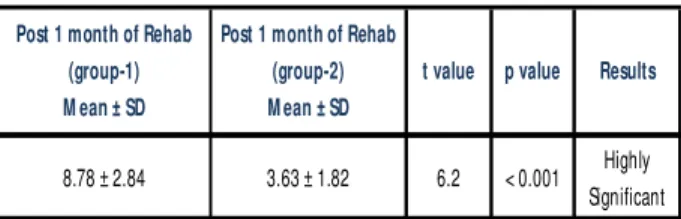
When comparison is made bet w een t he groups aft er 1 w eek of treatment, group 2 show ed more im pr ovem en t t han gr oup 1 at 5% level of signif icance(t able 5) and af t er 1 m ont h of t reat ment , group 1 showed superior result t han group 2 at 1% level of significance (t able 6).
Table 5: Com par ison of DHI score post 1 w k of t reat m ent in group 1 & group 2.
8.78 ± 2.84 3.63 ± 1.82 6.2 < 0.001 Highly
Significant
t value p value Results Post 1 month of Rehab
(group-1) M ean ± SD
Post 1 month of Rehab (group-2) M ean ± SD
13.67 ± 6.44 20.00 ± 9.80 -2.25 < 0.05 Significant
Post 1 wk of Rehabilitation (group-2)
M ean ± SD Post 1 wk of Rehabilitation
(group-1)
Mean ± SD
t value p value Results
At 33 degrees of f reedom , t he observed ‘t ’ value is -2.25 w hich is suggest ive of st at ist ically significant (p<0.05) im provem ent in DHI score aft er 1 w eek of physical reha-bilit at ion in bot h groups
Table 6: Com parison of DHI score post 1 m ont h of t reat m ent in group 1 & group 2.
At 33 degrees of freedom , t he obser ved ‘t ’ value is 6.20 w hich is suggest ive of st at ist ically highly significant (p<0.001) im provem ent in DHI score aft er 1 m ont h of physical rehabilit at ion in bot h groups.
Pre Physical Rehabilit ation
M ean ± SD
Post 1 w k of Rehabilit ation
M ean ± SD
t value p value Results
53.22 ± 10.65 39.53 ± 4.93 8.56 < 0.001 Hi ghl y
Signi fi cant
Post 1 wk of Physical Rehabilit ation
M ean ± SD
Post 1 month of
Rehabilitation M ean ± SD t value p value Results
39.56 ± 4.78 30.82 ± 2.92 12.33 < 0.001 Highly Significant
Post 1 w k of Physical Rehabilit at ion
M ean ± SD
Post 1 mont h of Rehabilitat ion
M ean ± SD
t value p value Result s
DISCUSSION
In t his st udy 13 pat ient s w ere male and 22 w ere f em al e so her e w e also f o u n d f em al e predominance as in ot her st udies. The rat io of female t o male is 1.69 : 1 in t his st udy. The range of age w as 35–72 years w hile t he mean age of t he pat ient s in group 1 w as 51.17 ± 9.35years w hereas in group 2 it w as 53.18 ± 11.33 years.
Data collect ed t hrough t his st udy showed highly signif i cant im pr ovem ent in DHI scor e and r esp o nse t o D-H t est w h en i n t r agr ou p comparison is made in bot h t he groups aft er 1 w eek an d 1 m on t h o f t r eat m en t so b ot h t reat ment approaches are effect ive.
In t his st udy w hen int ergroup com parison is made w e found more improvement in group 2 aft er 1 w eek of t reat ment but it w as bet t er in group 1 after 1 month of treat ment so combined approach will be more beneficial to t he pat ient s.
M any r esearch ers suggest ed t h at Ep l ey ’s maneuver (canalit h reposit ioning maneuver) is effective in reducing vertigo and response t o the Dix-Hallpike manoeuvre [15-21].
Premedicat ion, post ural rest rict ion and use of mast oid oscillat or during maneuver are part of original epley’s maneuver. In this st udy they were not used to save the time and make t he procedure easier w i t h ou t af f ect i ng ou t co m e so i t i s considered as modified epley’s maneuver. Even t here are m any researches support ing t hese modificat ions.
According t o a recent m et a-analysis of t he m odified Epley ’s maneuver for PC-BPPV, t he t reat ment demonst rat ed a sympt om improve-ment rate four t imes greater, and a nystagmus r esolut ion r at e five t im es gr eat er t han t he placebo group [22].
Brandt - Daroff exercise demonst rat es superior t reat ment out comes compared w it h placebo
[23].How ever, many researchers found
Brandt-Daroff exercises t o be less effect ive t han Epley’s m aneuver in producing com plet e sym pt om resolut ion [23,24,25,26].
Amor Dorado [27] compared Epley t reat ment versus Brandt -Daroff exercises and found an 80.5% resolut ion rat e in t he Epley group versus 25% resolut ion in t he Brandt -Daroff exercises group aft er seven days. There w as no difference
in resolut ion aft er one mont h.
Few researchers [28,29] found t hat CRP plus a home program does not improve t he out come. But , in our st udy w e f ound com binat ion of modified epley’s maneuver w it h brandt daroff exer ci se t o be m or e ef f ect ive in r ed uci ng sym pt om s and making pat ient independent . Tanimot o [30] et al and Chang [31] also found similar result s.
Lim it at ion of t he St udy: Sm all sam ple size, Limit ed t ime follow up (1 mont h), Qualit y of life w as not assessed.
CONCLUSION
The con cl usi o n o f t h e st u dy i s t h at b ot h t reat ment approaches are effect ive in reducing sym pt oms and improving independence level but combined approaches can give bet t er result so modified epley’s maneuver should be applied 3 t imes in one session along w it h brandt - daroff exercise as home exercise.
ABBREVIATIONS
BPPV – Benign Paroxysmal Posit ional Vert igo DHI - Dizziness Handicap Invent ory
D-H TEST – Dix-Hall Pike Test
CRP – Canalit h Reposit ioning M aneuver
ACKNOW LEDGEM ENT
We are t hankful t o st aff and m anagement of Pio neer Phy si ot herapy col lege, Vado dara, Gujarat , India for t heir support . We w ould like t o t h an k al l m y p at i ent s f o r t h ei r act i v e participat ion in this study, w hich w ould not have been possible w it hout t hem. We acknow ledge t he great help received from t he scholars w hose art icles cit ed and included in references of t his m anuscript . We are also grateful t o aut hors/ edit ors/ publishers of all t hose art icles, journals and books from w here t he lit erat ure for t his art icle has been review ed and discussed. We are grateful t o IJPR edit orial board members and IJPR t eam of review ers w ho have helped to bring qualit y t o t his manuscript .
Conflicts of interest: None
REFERENCES
[2]. Hot son JR, et al. Acut e vest ibular syndrom e. N Engl J M ed. 1998;339:680–685.
[3] . Furm an JM , Cass SP. Benign paroxysm al posit ional ver t igo. N Engl J M ed. 1999;341:1590–1596. [ 4] . Fr oehling DA, et al: Benign posit ional ver t igo:
incidence an d pr o gnosi s in a pop ulat ionbased study in Olmst ed county, M innesota. M ayo Clin Proc 1991;66:596.
[5] . Schuknecht HF. Cupulolit hiasis. Arch Ot olaryngol 1969;90:765.
[ 6] . Von Brever n M , et al. Epidem iology of benign par oxysm al posit ional vert igo: a populat ion based st udy. J Neurol Neurosurg Psychiat ry. 2007;78:710– 715.
[7] . Baloh RW, et al. Benign posit ional vert igo: clinical and oculographic feat ures in 240 cases. Neurology. 1987;37:371–378.
[8]. Hall SF, et al: The m echanism of benign paroxysm al posit ional vert igo. J Ot olaryngol 1979;8:151. [9] . José Luis Ballve M or eno, et al. Eff ect iveness of t he
Epley’s maneuver performed in prim ary care to t reat p o st e r i o r can al BPPV: st u d y p r o t o co l f o r a random ized cont rolled t rial Tr ials. 2014;15:179 [10] . Parnes LS, et al. Diagnosis and m anagem ent of
b en i gn p ar o xysm al p o si t i o n al v er t i go CM AJ. 2003;169:681–693.
[11]. M oon SY, et al. Clinical charact erist ics of benign p ar o xy sm al p o si t i o n al v e r t i go i n Ko r e a: a m ult icent er st udy. J Korean M ed Sci. 2006;21:539– 543.
[12]. Blatt PJ, et al. The effect of t he canalit h repositioning m an eu ver on r eso lvi ng p o st u r al i nst ab il i t y i n pat ient s w it h BPPV. Am J Ot ol. 2000;21:356–363. [ 13 ] . Gi aco m i n i PG, et al . Lo n g-t e r m p o st u r al
abno r m alit ies in benign par oxysm al posit i onal ve r t i go . ORL J Ot o r h i n o l ar yn go l Rel at Sp e c. 2002;64:237–241.
[14]. Epley JM . The canalit h reposit ioning procedure: for t reat m ent of benign paroxysm al posit ional vert igo. Ot olaryngol Head Neck Surg 1992;107:399-404. [15]. Pam es IS, Pr ice-Jones RG. Part icle reposit ioning
m an eu ver f o r BPPV. An n Ool Rh in o l Lar yn go l 1993;102:325-31.
[16]. Blakley BW. A random ized, cont rolled assessm ent o f t h e can al i t h r e p o si t i o n i n g m an e u v er. Ot olaryngol Head Neck Surg 1994;110:391-6. [17]. Yim tae K, et al. A random ized t rial of t he canalit h
r ep o si t i o n i n g p r o ce d u r e . Lar y n go sco p e . 2003;113:828–832.
[18]. Cohen HS, Kim ball KT. Effect iveness of t r eat m ent s f or BPPV of t he post er ior canal. Ot ol Neur ot ol. 2005;26:1034–1040.
[ 19] . Fr oehling DA, et al. The canalit h r eposit ioning procedure for t he t r eat m ent of benign paroxysm al posit ional vert igo: a r andom ized cont rolled t rial. M ayo Clin Pr oc. 2000;75:695–700.
[ 20] . Lynn S, et al. Random ized t r ial of t he canalit h reposit ioning procedure. Ot olaryngol Head Neck Sur g. 1995;113:712–270.
[ 21 ] .Hel en S. Co h e n , Ed D, OTR an d Hal e h San gi -Haghpeykar, Ph Canalit h Reposit ioning Variat ions f o r Ben i gn Par o xy sm al Po si t i o n al Ve r t i go Otolaryngol Head Neck Surg. Sep 2010; 143(3): 405– 412.
[ 22 ] . Hi l t o n M P, Pi n d e r DK. Th e Ep l e y ( can al i t h reposit ioning) m anoeuvr e for benign paroxysm al posit ional vert igo. Cochrane Database of Syst ematic Review s 2014, Issue 12. Ar t . No.: CD003162. [23]. Sot o Varela A, et al. Benign paroxysm al ver t igo: a
com parat ive prospect ive st udy of t he eff icacy of Brandt and Dar off exercises, Sem ont and Epley m an o eu vr e. Revu e d e Lar yn go l o gi e Ot o l o gi e Rhinologie 2001;122:179–83.
[24]. Cohen HS, Kim ball KT. Effect iveness of t r eat m ent s f or BPPV of t he post er ior canal. Ot ol Neur ot ol. 2005;26:1034–1040.
[ 25] .Fife TD, et al. Pract ice param et er : t herapies for benign paroxysm al posit ional vert igo: report of t he Qualit y St andards Subcom m it t ee of t he Am erican Academy of Neurology. Neurology. 2008; 70:2067– 2074.
[26]. Haripriya S, et al. Com par ison of Epley M aneuver an d Br an d t - Dar o f f Exer ci ses o n Sh o r t - Ter m Post er i or Can al Beni gn Par oxysm al Posit io nal Ver t igo - Relat ed Qualit y of Life Indian Journal of Physiot herapy and Occupat ional Ther apy 2014, 8(3): 109-113.
[ 27] .Am o r -Dor ado JC, et al . Par t i cle r ep osi t io n in g m an e u ver ve r su s Br an d t -Dar o f f e xer ci se f o r t r eat m ent of unilat er al idiopat hic BPPV of t he p o st e r i o r sem i ci r cu l ar can al : a r an d o m i ze d prospect ive clinical t rial w it h short - and long-t erm out com e. Ot ology & Neurot ology 2012;33:1401–7. [28] . Helm inski JO, Janssen I, Hain TC. Daily exer cise does not prevent recurrence of benign paroxysm al positional vertigo. Otol Neurot ol. 2008;29:976–981. [ 29] . Helm inski JO, Janssen I, Kot aspouikis D, et al. St r at egi e s t o p r ev en t r e cu r r e n ce o f b en i gn paroxysm al posit ional ver t igo. Ot olar yngol Head Neck Surg. 2005;131:344–438.
[30]. Tanim ot o H, Doi K, Katata K, Nibu K-i. Self-t reat ment f or benign par oxysm al posit ional ver t igo of t he p o st e r i o r se m i ci r cu l ar can al . Ne u r o l o gy. 2005;65:1299–1300.
[31]. Chang W, et al. Balance im provem ent in pat ient s w it h benign paroxysm al posit ional vert igo. Clinical Rehabilit at ion 2008;22(4):338–47.
How t o cite t his article: Devangi S. Desai, Am ruta S. Chauhan, M aharshi N. Trivedi. ROLE OF M ODIFIED