Physical Therapy for Posterior and Horizontal
Canal Benign Paroxysmal Positional Vertigo:
Long-term Effect and Recurrence: A Systematic
Review
Daniele Leite Rodrigues
1Alleluia Lima Losno Ledesma
2Carlos Augusto Pires de Oliveira
3Fayez Bahamad Júnior
31Health Science, Universidade de Brasília, Brasília, DF, Brazil 2Neonatology Unit, Hospital Regional de Sobradinho, Secretaria de
Estado de Saúde do Distrito Federal, Sobradinho, DF, Brazil 3Department of Otolaryngology, Medical School, Universidade de
Brasília, Brasília, DF, Brazil
Int Arch Otorhinolaryngol 2018;22:455–459.
Address for correspondence Daniele Leite Rodrigues, Physiotherapist, Ciências da Saúde, Universidade de Brasília, L2 Sul, Quadra 603/4, Lote 23, CEP 70200-640, Brasília, DF, 70910-900, Brazil
(e-mail: [email protected]).
Introduction
Among the peripheral vestibular disorders, benign paroxys-mal positional vertigo (BPPV) is the most common. Benign paroxysmal positional vertigo is characterized by episodes of vertigo roundabout when the head is moved.1According to Parnes and Agrawal (2003), 42% of vertigo cases diagnosed in primary care health services are due to BPPV, affecting especially women and the elderly. Although happening suddenly and unexpectedly, such a sense of vertigo has no progressive characteristic.2
Benign paroxysmal positional vertigo can happen through two different mechanisms: thefirst is known as canalithiasis,
in which degenerative debris (otoconia fragments) of the utricle are circulating freely in the endolymph of the semi-circular canals of the labyrinth;3 the second mechanism, cupulolithiasis, proposes that these same degenerative deb-ris are not circulating in the canals but adhered to the cupula of the posterior canal, making it more sensitive to gravity.4 The diagnosis of BPPV is clinical and is done mainly through maneuvers that determine what canal and what type of BPPV patients present. Among them, there is the Dix-Hallpike, described in 1952, which evaluates the anterior and posterior canals and is considered as the gold standard for the diagnosis of BPPV. If it is positive, the person evaluated presents vertigo and nystagmus.5When the affected canal is
Keywords
►
benign paroxysmal
positional vertigo
►
vertigo
►
idiopathic recurrent
vertigo
►
rehabilitation
Abstract
Introduction
Benign paroxysmal positional vertigo (BPPV) is the most common cause
of vertigo, and it is characterized by episodes of vertigo roundabout when the head is
moved. A systematic review was performed using the most important scienti
fi
c
databases. This review included studies published in English in the last ten years,
performed in adults, with emphasis on the diagnosis and treatment of BPPV.
Objective
To investigate the long-term effectiveness of vestibular rehabilitation (VR)
in patients with BPPV and the rate of recurrence of symptoms.
Data Synthesis
A total of 38 studies were identi
fi
ed, of which only 12 met the
inclusion criteria. The majority of the studies stated that VR is effective in decreasing
the symptoms, with a short-term ef
fi
cacy of 84.7%, and 89.2% in the long term in the
reviewed studies.
Conclusion
Valuable studies show the bene
fi
cial effects of the maneuvers for the
treatment of BPPV and their long-term effectiveness. This strengthens the conclusion
that this treatment is effective in resolving symptoms and decreasing recurrences.
received January 29, 2017 accepted June 4, 2017 published online August 28, 2017
DOIhttps://doi.org/ 10.1055/s-0037-1604345. ISSN 1809-9777.
Copyright © 2018 by Thieme Revinter Publicações Ltda, Rio de Janeiro, Brazil THIEME
lateral, the best maneuver is the Roll test. The onset of vertigo and nystagmus will also happen in positive cases.6
Treatment success depends on identifying and specifying the type of BPPV and canal involved. Formerly, it was believed that only the posterior semicircular canal was involved in this type of dysfunction. However, it is now known that the anterior and lateral semicircular canals may also be involved, although less frequently.7
Several forms of therapeutic interventions for this disorder are described in the literature, but there are three basic treatments as follows: canalith repositioning, Brandt-Daroff liberation exercises and Brandt-Daroff habituation exercises, used according to the diagnosis established in the evaluation.8 In addition, some patients with BPPV have complaints associated with balance problems, which can last for hours or days after an episode, and feeling of dizziness orflotation.8In such cases, it is necessary to evaluate the patients’postural stability in order to develop a better possible treatment plan. Among the balance tests, there is the Romberg, and a varia-tion called the sensitized Romberg, in which the patient must stand on one foot, with eyes closed on an unstable surface, which distorts the somatosensory feedback.9
The goal of this work is to demonstrate that there are benefits to the patients with BPPV treated with vestibular rehabilitation technique, which has been shown to abolish the symptoms of roundabout vertigo and imbalance.
The objective of this systematic review is to investigate the long-term effectiveness of vestibular rehabilitation and the rate of recurrence of symptoms in patients with BPPV.
Review of the Literature
Searches were conducted in the databases PubMed and LILACS, using the extracted descriptors of Medical Subject Headings (MeSH) that characterized the theme: BPPV AND canalith repositioning maneuver AND benign recurrent ver-tigo AND vestibular rehabilitation.
The criteria for the selection of the studies were: articles in English; published in the last 10 years; clinical studies in adults with emphasis on the diagnosis and treatment of BPPV. We excluded studies that included patients with neurologic diseases, negative Dix-Hallpike and Roll tests and those with the use of drugs that can inhibit and stimulate vestibular function, or used to compare or complement treatment with vestibular rehabilitation (maneuver of re-positioning and liberation).
• Evaluation of studies
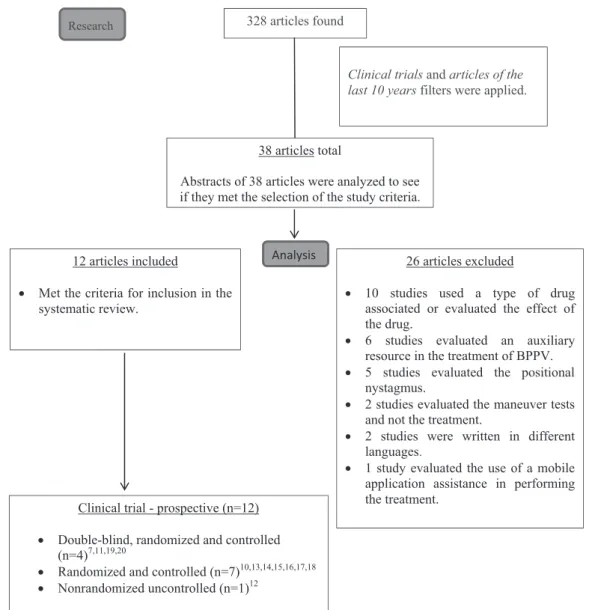
The summaries of 38 articles that fulfilled the search criteria of the survey were reviewed, and 12 studies were included in the study according the selection criteria.►Fig. 1 shows theflow diagram for inclusion.
• Epidemiology data
This review found 12 studies investigating the effects of vestibular rehabilitation (repositioning maneuvers and canalith liberation) in resolving symptoms of vertigo and
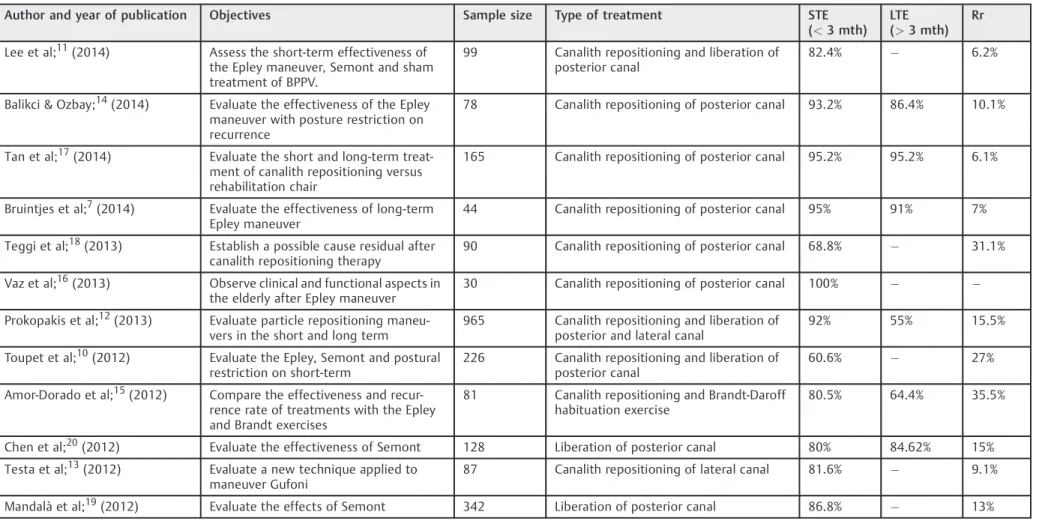
nystagmus in patients with BPPV caused by canalithiasis or cupulolithiasis involving the three semicircular canals (►Table 1). In all studies the diagnosis of BPPV is based on the clinical history and the occurrence of nystagmus triggered by the Dix-Hallpike test or Roll test. The sample included 2,335 participants of which 1,414 were women (60.5%) and 921 were men (39.5%), and their ages ranged from 20–88 years old.
• Treatment
Five studies investigated the efficacy of the Epley man-euver; two, the effectiveness of Semont; two compared the Epley and Semont maneuvers to treat posterior canal; one study compared the performance of the Brandt and Epley maneuvers; one study investigated the effects of the Gufoni maneuver and one study assessed the effects of the Epley and Barbecue maneuvers in posterior and lateral canal BPPV (►Table 2). All trials included the positive conversion to a Dix-Hallpike negative test as a measure of outcome and treatment evaluation. Information on the therapeutic man-euvers used for BPPV were provided in all articles.
Articles reporting the effects of the Epley maneuver in the short term stated that 91% of participants felt improvement of symptoms with one to three therapy maneuvers. In this re-search, after each Epley or sham maneuver, the Dix-Hallpike test was repeated. If necessary, a therapeutic maneuver (Epley as well as sham maneuver) was repeated up to two times on the same day. Therefore, 95% of the patients reported complete resolution of symptoms in the long term at the end of follow-up.7 When comparing the Epley and Semont maneuvers in the resolution of patients’complaints, the results were similar, with no statistical significance (success rate in treating 48% of patients with only one Semont maneuver, and 40% with one Epley maneuver - p<0.01).10 However, Lee et al11 showed that 63.9% of the sample had an improvement in the symptoms with up to 2 maneuvers, a rate higher than those of the Semont and the sham groups, which, with the same amount of maneuvers, had 37.5% and 38.7% of patients with resolution of symptoms respectively. In relation to the recurrence rate, it was lower in the group treated with the Epley maneuver, which had no patient with recurrent ver-tigo and nystagmus one week after treatment; while there were 3 cases of recurrence with the Semont maneuver.11
For the horizontal canal, the intervention with the Gufoni and Barbecue maneuvers proved highly effective, with 92 and 93% treatment success rates, respectively.12,13Testa et al, in their study, revealed that there is no difference between the Gufoni and the modified Gufoni maneuvers.13
About the recurrence of vertigo, 50% of the analyzed studies assessed the effects of the maneuvers in the long term (3 months to 1 year), reaching rates of 89.2% recovery of patients and decreased relapse. Bruintjes et al and Prokopakis et al had similar results; in thefirst study, 91% of treatment success rate (20/22 patients) was observed during the 12-month follow-up, while the group that underwent sham maneuver showed 46% (p¼0.001). In the second study, there
(p<0.001). In another follow-up, recurrence was found in 3 (8.1%) of the 37 patients in the restriction group and 2 (5.4%) of the 37 patients in the unrestricted group (p>0.05). A late recurrence occurred in 5 (13.5%) of the 37 patients in the restriction and non-restriction groups (p>0.05).14Tan et al presented a recurrence rate of 6.1% in the group that used the maneuver, and wanted to emphasize the presence of secondary symptoms, including transient nausea and sweating (p<0.05). Amor-Dorado et al observed a recurrence rate of 35.5% at 48 months using the Brandt-Daroff exercise and the Epley maneuver to treat the posterior canal (p¼0.62). Good long-term results show a decrease in the
rate of recurrence with this treatment.7,12,14–17
In all these studies, no additional resources were used, such as postural restriction, which had effective influence on the resolution of symptoms or decreased recurrence.14,18–20 We can highlight the study by Prokopakis et al, which included 965 patients followed up in the short and long term. The study showed a higher short-term effectiveness, with 92% success rate and warned that there may be recurrence in 7 to 55% of the cases long term, especially in the elderly. Vaz
et al showed an additional benefit to the treatment by analyzing the effects of the maneuver and also the functional aspects of postural balance in elderly individuals and found that the symptoms of postural instability (p¼0.006),
nau-sea, vomiting (p¼0.021) and tinnitus (p¼0.003) also
im-proved after the maneuver.
Discussion
The sample was characterized by individuals aged between 20 and 88 years, and females predominated in this study, representing 60.5% of the sample. According to Parnes, Agrawal and Atlas,2BPPV is more common in women and seniors over 60 years old, who may present, at this age, other comorbidities.
The investigation of the effects of the various maneuvers was performed to identify the effectiveness and the effects of each one of them in semicircular canals and the mechanisms involved, specifically, because, according to Herdamn et al, accurate diagnosis and choice of appropriate maneuver are crucial to the success of the treatment.7
328 articles found
Clinical trials and articles of the last 10 years filters were applied.
38 articles total
Abstracts of 38 articles were analyzed to see if they met the selection of the study criteria.
12 articles included
• Met the criteria for inclusion in the systematic review.
26 articles excluded
• 10 studies used a type of drug associated or evaluated the effect of the drug.
• 6 studies evaluated an auxiliary resource in the treatment of BPPV. • 5 studies evaluated the positional
nystagmus.
• 2 studies evaluated the maneuver tests and not the treatment.
• 2 studies were written in different languages.
• 1 study evaluated the use of a mobile application assistance in performing the treatment.
Analysis Research
Clinical trial - prospective (n=12)
• Double-blind, randomized and controlled (n=4)7,11,19,20
• Randomized and controlled (n=7)10,13,14,15,16,17,18 • Nonrandomized uncontrolled (n=1)12
Fig. 1 Diagram showing the selection and type of study used in the review.
Table 1 Analysis of the articles included, taking into account the author and year of publication, sample size, objectives and type of treatment
Author and year of publication Objectives Sample size Type of treatment STE (<3 mth)
LTE (>3 mth)
Rr
Lee et al;11(2014) Assess the short-term effectiveness of
the Epley maneuver, Semont and sham treatment of BPPV.
99 Canalith repositioning and liberation of
posterior canal
82.4% 6.2%
Balikci & Ozbay;14(2014) Evaluate the effectiveness of the Epley maneuver with posture restriction on recurrence
78 Canalith repositioning of posterior canal 93.2% 86.4% 10.1%
Tan et al;17(2014) Evaluate the short and long-term
treat-ment of canalith repositioning versus rehabilitation chair
165 Canalith repositioning of posterior canal 95.2% 95.2% 6.1%
Bruintjes et al;7(2014) Evaluate the effectiveness of long-term
Epley maneuver
44 Canalith repositioning of posterior canal 95% 91% 7%
Teggi et al;18(2013) Establish a possible cause residual after
canalith repositioning therapy
90 Canalith repositioning of posterior canal 68.8% 31.1%
Vaz et al;16(2013) Observe clinical and functional aspects in
the elderly after Epley maneuver
30 Canalith repositioning of posterior canal 100%
Prokopakis et al;12(2013) Evaluate particle repositioning maneu-vers in the short and long term
965 Canalith repositioning and liberation of
posterior and lateral canal
92% 55% 15.5%
Toupet et al;10(2012) Evaluate the Epley, Semont and postural
restriction on short-term
226 Canalith repositioning and liberation of
posterior canal
60.6% 27%
Amor-Dorado et al;15(2012) Compare the effectiveness and recur-rence rate of treatments with the Epley and Brandt exercises
81 Canalith repositioning and Brandt-Daroff
habituation exercise
80.5% 64.4% 35.5%
Chen et al;20(2012) Evaluate the effectiveness of Semont 128 Liberation of posterior canal 80% 84.62% 15%
Testa et al;13(2012) Evaluate a new technique applied to
maneuver Gufoni
87 Canalith repositioning of lateral canal 81.6% 9.1%
Mandalà et al;19(2012) Evaluate the effects of Semont 342 Liberation of posterior canal 86.8% 13%
Abbreviations: LTE, long-term effectiveness; mth, months; Rr, rate of recurrence; STE, short-term effectiveness.
Internatio
nal
A
rc
hives
o
f
O
to
rhino
lar
yng
o
lo
gy
V
o
l.
22
N
o
.
4
/20
1
8
Ph
ysical
Therap
y
for
P
o
sterior
a
nd
Horiz
o
ntal
Canal
B
PPV
R
o
drigues
e
t
a
All studies were prospective and were carried from their monitoring of patients and the effects of therapy for a given period. In this way, the articles with a long-term analy-sis7,12,14,17,20 have greater relevance because they could evaluate the success of therapy in a longer period of time, because, although it cannot prevent recurrence, therapy demonstrates good results. Among the studies, 11 of them are randomized, controlled, and only one was not rando-mized and controlled. In the latter, it was possible to visua-lize the effect of the therapy in a larger group (965 patients) and different realities, since it was multicenter, showing significant results and success with a small rate of recurrence that was prevalent in the elderly. The fact that the studies are quite homogeneous in many respects makes it possible to compare and combine the results and data found.
The beneficial effects of the maneuvers were significant in the treatment of BPPV in all studies, and the reduction of the rate of recurrence was identified in the studies that accom-panied the long-term efficacy of the treatment and recur-rence rate. What proves the importance of using this treatment.11,16
Final Comments
The benefits of vestibular rehabilitation in the treatment of patients with BPPV are already known from the literature, but it is also important to highlight their short and long-term effects. Moreover, it is an effective, reliable and non-invasive therapeutic approach, which leads to consider it as an important treatment option.
In this review, we could demonstrate the beneficial results of the maneuvers for the treatment of BPPV and their long-term effects. This strengthens the conclusion that this treat-ment is effective in resolving symptoms.
References
1 Brandt T, Daroff RB. Physical therapy for benign paroxysmal
positional vertigo. Arch Otolaryngol 1980;106(08):484–485
2 Parnes LS, Agrawal SK, Atlas J. Diagnosis and management of
benign paroxysmal positional vertigo (BPPV). CMAJ 2003;
169(07):681–693
3 Hall SF, Ruby RR, McClure JA. The mechanics of benign paroxysmal
vertigo. J Otolaryngol 1979;8(02):151–158
4 Schuknecht HF. Cupulolithiasis. Arch Otolaryngol 1969;90(06):
765–778
5 Silva AL, Marinho MR, Gouveia FM, Silva JG, Ferreira AdeS, Cal R.
Benign Paroxysmal Positional Vertigo: comparison of two recent international guidelines. Rev Bras Otorrinolaringol (Engl Ed)
2011;77(02):191–200
6 Teixeira LJ, Machado JNP. Manobras para o tratamento da
verti-gem posicional paroxística benigna: revisão sistemática da
lit-eratura. Rev Bras Otorrinolaringol (Engl Ed) 2006;72:130–139
7 Bruintjes TD, Companjen J, van der Zaag-Loonen HJ, van Benthem
PP. A randomised sham-controlled trial to assess the long-term effect of the Epley manoeuvre for treatment of posterior canal benign paroxysmal positional vertigo. Clin Otolaryngol 2014;
39(01):39–44
8 Burlamaqui JC, de Campos CAH, Mesquita Neto O. Manobra de
Epley para Vertigem Postural Paroxística Benigna: revisão siste-mática. Acta Otorrinolaringol 2006;24(01):38:45
9 Herdman SJ, Tusa RJ. Evaluation and Management of the patients
with BPPV. In: Herdman SJ. Vestibular Rehabilitation. Philadelphia:
Contemporary Perspectives in Rehabilitation; 2002;3:493–497
10 Toupet M, Ferrary E, Bozorg Grayeli A. Effect of repositioning
maneuver type and postmaneuver restrictions on vertigo and
dizziness in benign positional paroxysmal vertigo.–. Sci World J
2012;162:123–126
11 Lee JD, Shim DB, Park HJ, et al. A multicenter randomized
double-blind study: comparison of the Epley, Semont, and sham man-euvers for the treatment of posterior canal benign paroxysmal
positional vertigo. Audiol Neurootol 2014;19(05):336–341
12 Prokopakis E, Vlastos IM, Tsagournisakis M, Christodoulou P,
Kawauchi H, Velegrakis G. Canalith repositioning procedures among 965 patients with benign paroxysmal positional vertigo.
Audiol Neurootol 2013;18(02):83–88
13 Testa D, Castaldo G, De Santis C, Trusio A, Motta G. Treatment of
horizontal canal benign paroxysmal positional vertigo: a new
rehabilitation technique.–. Sci World J 2012;160:475–478
14 Balikci HH, Ozbay I. Effects of postural restriction after modified
Epley maneuver on recurrence of benign paroxysmal positional
vertigo. Auris Nasus Larynx 2014;41(05):428–431
15 Amor-Dorado JC, Barreira-Fernández MP, Aran-Gonzalez I,
Casar-iego-Vales E, Llorca J, González-Gay MA. Particle repositioning maneuver versus Brandt-Daroff exercise for treatment of uni-lateral idiopathic BPPV of the posterior semicircular canal: a randomized prospective clinical trial with short- and long-term
outcome. Otol Neurotol 2012;33(08):1401–1407
16 Vaz DP, Gazzola JM, Lança SM, Dorigueto RS, Kasse CA. Clinical and
functional aspects of body balance in elderly subjects with benign paroxysmal positional vertigo. Rev Bras Otorrinolaringol (Engl Ed)
2013;79(02):150–157
17 Tan J, Yu D, Feng Y, et al. Comparative study of the efficacy of the
canalith repositioning procedure versus the vertigo treatment
and rehabilitation chair. Acta Otolaryngol 2014;134(07):704–708
18 Teggi R, Quaglieri S, Gatti O, Benazzo M, Bussi M. Residual
dizziness after successful repositioning maneuvers for idiopathic benign paroxysmal positional vertigo. ORL J Otorhinolaryngol
Relat Spec 2013;75(02):74–81
19 Mandalà M, Santoro GP, Asprella Libonati G, et al. Double-blind
randomized trial on short-term efficacy of the Semont maneuver for the treatment of posterior canal benign paroxysmal positional
vertigo. J Neurol 2012;259(05):882–885
20 Chen Y, Zhuang J, Zhang L, et al. Short-term efficacy of Semont
maneuver for benign paroxysmal positional vertigo: a
double-blind randomized trial. Otol Neurotol 2012;33(07):1127–1130
Table 2 Distribution of articles according to strategy
Epley Epley and
Semont
Semont Brandt and
Epley
Gufoni Barbecue and
Epley
Strategy Effectiveness Comparison Effectiveness Comparison Effectiveness Effectiveness
Number of articles 5 2 2 1 1 1