O R I G I N A L A R T I C L E UDC: 004::616.1-07-036 DOI: 10.2298/VSP1403285B
A novel framework for fluid/structure interaction in rapid
subject-specific simulations of blood flow in coronary artery bifurcations
Nova platforma za brzo simuliranje interakcije fluida i strukture pri strujanju
krvi kroz realne geometrije bifurkacija koronarne arterije
Milan Blagojeviü*, Aleksandar Nikoliü*, Miroslav Živkoviü*, Milorad Živkoviü†, Goran Stankoviü†
* Faculty of Engineering, University of Kragujevac, Kragujevac, Serbia; †Faculty of Medicine, University of Belgrade, Belgrade, Serbia
Abstract
Background/Aim. Practical difficulties, particularly long model development time, have limited the types and appli-cability of computational fluid dynamics simulations in nu-merical modeling of blood flow in serial manner. In these simulations, the most revealing flow parameters are the en-dothelial shear stress distribution and oscillatory shear in-dex. The aim of this study was analyze their role in the di-agnosis of the occurrence and prognosis of plaque devel-opment in coronary artery bifurcations. Methods. We de-veloped a novel modeling technique for rapid cardiovascular hemodynamic simulations taking into account interactions between fluid domain (blood) and solid domain (artery wall). Two numerical models that represent the observed subdomains of an arbitrary patient-specific coronary artery bifurcation were created using multi-slice computed tomog-raphy (MSCT) coronagtomog-raphy and ultrasound measurements of blood velocity. Coronary flow using an in-house finite element solver PAK-FS was solved. Results. Overall be-havior of coronary artery bifurcation during one cardiac cycle is described by: velocity, pressure, endothelial shear stress, os-cillatory shear index, stress in arterial wall and nodal dis-placements. The places where (a) endothelial shear stress is less than 1.5, and (b) oscillatory shear index is very small (close or equal to 0) are prone to plaque genesis.Conclusion.
Finite element simulation of Áuid–structure interaction was used to investigate patient-specific Áow dynamics and wall mechanics at coronary artery bifurcations. Simulation model revealed that lateral walls of the main branch and lateral walls distal to the carina are exposed to low endothelial shear stress which is a predilection site for development of atherosclero-sis. This conclusion is confirmed by the low values of oscil-latory shear index in those places.
Key words:
models, theoretical; computer simulation; coronary vessels; blood flow velocity; atherosclerosis; risk factors.
Apstrakt
Uvod/Cilj. Praktiÿne poteškoýe, posebno dugo vreme raz-voja modela, ograniÿavaju tipove i primenljivost raÿunske di-namike fluida u numeriÿkom modeliranju strujanja krvi za veýi broj bolesnika. U ovim simulacijama, parametri strujanja koji najviše pokazuju su endotelijski smicajni napon i oscilujuýi smicajni indeks. Cilj rada bio je da se analizira njihova uloga u dijagnozi i prognoziranju razvoja plaka na raÿvama (bifurkaci-jama) koronarnih arterija. Metode. Razvili smo novu tehniku kompjuterskog modeliranja za potrebe brzih kardiovaskular-nih hemodinamiÿkih simulacija uzimajuýi u obzir interakcije izmeĀu domena fluida (krv) i domena strukture (arterijskog zi-da). Generisana su dva numeriÿka modela koja predstavljaju posmatrane poddomene bifurkacije koronarne arterije sluÿajno izabranog bolesnika, korišýenjem multi-slajsne kompjuterizo-vane tomografije (MSCT) koronarografije i ultrazvuÿnog me-renja brzine strujanja krvi. Simulacija koronarnog strujanja je izvršena korišýenjem sopstvenog softvera PAK-FS. Rezultati.
Sveukupno ponašanje strujanja krvi u bifurkacijama koronar-nih arterija je opisano preko sledeýih parametara: brzina, priti-sak, endotelijski smicajni napon, oscilujuýi smicajni indeks, na-pon na zidu arterije i ÿvorna pomeranja. Mesta gde je (a) en-dotelijski smicajni napon manji od 1,5 i (b) oscilujuýi smicajni indeks veoma mali (blizak ili jednak 0) su sklona razvoju plaka.
Zakljuÿak. Simulacija interakcije fluida-strukture metodom konaÿnih elemenata je korišýena da se ispitaju dinamika struja-nja krvi i mehaniÿke karakteristike zida bifurkacije koronarne arterije sluÿajno izabranog bolesnika. U numeriÿkom modelu je otkriveno da lateralni zidovi glavne grane i lateralni zidovi distalno od karine imaju nizak endotelijski smicajni napon što je preduslov za razvoj ateroskleroze na tim mestima. Ovaj za-kljuÿak je potvrĀen i niskim vrednostima oscilatornog smicaj-nog indeksa na istim mestima.
Kljuÿne reÿi:
Introduction
Bifurcation sites of human arteries are among the most frequent locations affected by atherosclerosis, being involved in up to 20% of percutaneous interventions. Several studies on the distribution of atherosclerotic plaques in human arte-rial systems have shown that atherosclerosis occurs pre-dominantly at branching locations of the vascular tree where the arteries have relatively complex geometry that result in disturbed blood flow behavior 1–2. In these regions, complex hemodynamic conditions prevail and local flow disturbances dictate the localization and progression of atheroma. Endo-thelial shear stress (ESS), as the main local flow-related fac-tor, was investigated for the first time on computational fluid dynamics models of carotid and coronary bifurcation 3 and distal abdominal aortas 4 based on autopsy material. Those studies demonstrated that areas with low ESS correlate with atherosclerotic plaque development confirmed at autopsy 5. In addition, several in vivo experiments on animal models confirmed proatherogenic effects of low ESS 6. Recently human in vivo studies of arterial models derived from multi-slice computed tomography (MSCT) or intravascular ultra-sound demonstrated the role of low ESS in the initiation and progression of atherosclerosis and arterial remodeling 7. Ac-cording to ESS spatial distribution plaques are more preva-lent in low ESS areas, lateral walls of the main vessel and side branches, while they are less common in the flow di-vider or carina, which is characterized by high ESS 8. Recent basic research studies have shed light on the precise path-ways by which low ESS leads to atherosclerosis 5.
Over the years, mathematical modeling has become complementary to experimental testing in predicting the biomechanical behavior and investigating clinical problems
9, 10
. Finite element analysis allows us to repeat numerical ex-periments changing some parameters, thus analyzing the effect and influence of a single component within the observed phe-nomenon 11, 12. While multiphysics problems, particularly fluid–structure interaction (FSI) problems, are too complex to solve analytically, computational simulations have become a useful tool in studying blood flow in the cardiovascular sys-tem. Coupled problems require software to analyze the fluid domain (blood) and the solid domains (artery wall).
There are many reports in which the arterial wall is ob-served as rigid. Some papers report that wall deformation caused by interaction between the blood flow and artery wall changes the hemodynamic forces acting on the arterial wall compared to the rigid wall simulation 13, 14. Rigid wall simu-lations overvalue the magnitude and the distribution of ESS on the arterial wall 14, 15.
The aim of this study was to present a new computa-tional framework for rapid modeling, considering a fluid structure interaction, and calculation of ESS and oscillatory shear index (OSI) of atherosclerotic plaque free coronary ar-tery bifurcation obtained from MSCT, as well as to prove if specific bifurcation segments (lateral walls of main vessel, side branch lateral walls) correlate with low ESS and discuss the influence of this local hemodynamics conditions for po-tential plaque formation.
Methods
Definition of ESS and flow characteristics
ESS is the component of stress coplanar with an endo-thelial surface caused by the friction of the flowing blood and the arterial wall. ESS is expressed in units of force per unit area (1 N/m2 = 1 Pascal [Pa] =10 dyne/cm2) 16, 17.
In relatively straight segments of the artery, ESS is pul-satile and unidirectional and varies within a range of 1.5 to 3 Pa (physiological ESS) throughout the cardiac cycle and yields a positive time-average 18, 19. In contrast, in arteries with geometrically irregular regions, and disturbed laminar flow, pulsatile flow causes low and/or oscillatory ESS. Low ESS may be unidirectional at any point, but has a periodi-cally fluctuating magnitude in a considerably low time-average (less than 1–1.5 Pa) 18–20. Low ESS usually appears at the inner segments of curvatures and upstream of steno-sis16. Oscillatory ESS is described by changes in both direc-tions (bidirectional) and magnitude between systole and di-astole, with a result of very low time-average, commonly close to 0 18, 19. Oscillatory ESS qualifies predominantly downstream of stenosis, at the bifurcation lateral walls, and in the area of branch points 3, 19, 21–22.
The OSI is a dimensionless index that describes the variation of ESS at the arterial wall during the cardiac cycle taking into account only the changes of ESS direction 23. At the places where ESS have extreme changes the value of this index is 0.5. As opposed, at the places where ESS have no changes the value of this index is 0.
Numerical simulation was performed on one model of plaque-free coronary artery bifurcation based on MSCT coronary angiography.
Fluid-structure interaction governing equations
Fluid and structure occupy different subdomains, thus their system of equations can be set-up individually within their subdomains. The governing equations for the fluid do-main are based on the Navier-Stokes equations and the equation of continuity 24. These equations can be expressed in the matrix form as:
f vv vp v
x
M V K V K P F
(1)0
T vpK V
(2) where fM is the mass matrix, vv
K is the convective matrix,
vp
K is the matrix of pressure gradient, v
F is the vector of
external forces. The vectors
x
Vand V represent the accel-eration and velocity of fluid. A discrete system of equations for the dynamics of solids is:
s
MU CU KU F
(3)where
M
is the constant mass matrix,C
is the constantand
U U U
, ,
are the vectors of acceleration, velocity and displacement, respectively. A detailed explanation of vari-ables in the equations 1–3 is available in 24–26.Among others, we calculate the distribution of OSI and ESS in the desired number of discrete time instants within the cardiac cycle. ESS was calculated based on the equation:
t
t t
ij
wall
v
n
W
P
w
w
(4)where
W
ij are the components of endothelial shear stress,P
is the dynamic viscosity,
v
t is the tangential velocity andn
is the direction of a unit vector normal to the wall at the mo-ment
t
.The OSI was calculated based on equation:
0
0
1
1 1
2 1
T
s
T
s dt T OSI
dt T
§ ·
¨ ¸
¨ ¸
¨ ¸
¨ ¸
¨ ¸
¨ ¸
© ¹
³
³
t
t
(5)
where tsis the surface shear vector, defined as:
s
t t t n n (6)
and t is the shear vector, defined as:
t ı n (7)
In the equation (7) ı is the stress tensor.
Simulation code
The two main approaches for the numerical simulation of fluid–structure interaction problems are: (a) monolithic approach (strong coupling), and (b) partitioned approach (weak coupling). The monolithic approach involves the de-velopment of new software, while the partitioned approach uses the existing software to solve new classes of problems. The software PAK-FS is developed by coupling existing computational solid dynamics (CSD) software PAK-S and computational fluid dynamics (CFD) software PAK-F the using partitioned approach 27. The algorithm of developed code is shown in Figure 1. This algorithm partially separates the used solvers in space. As boundary conditions the CFD program uses the current geometry of the interface and the velocity of the interface nodes. This information is obtained from the CSD program for solving the solids. On the other hand, loads from the fluid domain obtained using the CFD program is transmitted to CSD program.
Model generation
The finite element method requires the physical domain in which the problem is discretized. To date, the methodolo-gies to characterize local shear stress distribution and other hemodynamic parameters in circulation have been used for research purposes only, because no tools are available to
provide this information in a routine manner. Artery bifurca-tions may have a very complicated configuration 28. Lately, the trend and need is patient-specific modeling 29, 30. It is very challenging to generate quality hexahedral meshes for com-plicated structures 31. The hexahedral mesh quality has a sig-nificant role in the simulation by the finite element method 32. This is very important in CFD, where numerical errors become visible in the flow field. During generating procedures and developing software for the creation of the finite element model the authors have sought to satisfy all the listed constraints.
The original images, comprising MSCT image data of the human coronary artery bifurcation, were acquired from patients of Clinical Center of Serbia using a CT750HD scan-ner (Discovery, Gescan-neral Electric) 33. Image segmentation and geometry identification of the blood vessels were made in the software Mimics (Figure 2).
Structured mesh generation is the most appropriate method for discretizing domains. It produces a body fitted mesh, exactly describing domain’s boundaries and hence boundary conditions can be accurately modeled. Application of structured mesh for complex arterial geometries is very difficult or infeasible. Hence, the entire computational model
Fig. 1 – Global algorithm of software PAK-FS. The labeled part of the algorithm takes into account the interaction be-tween blood and arterial wall. Omitting this part of the al-gorithm, the calculation of hemodynamics parameters in-side the lumen is reduced to the case when the arterial wall
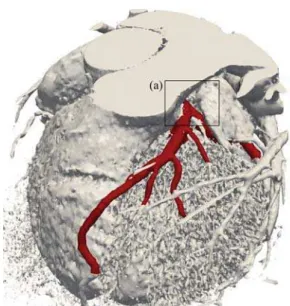
Fig. 2 – Volumetric model obtained from the original mul-tislice computed tomography (MSCT) data. The left coro-nary artery is marked in red. The modeled segment of plaque free coronary artery bifurcation is marked with (a).
is subdivided into the number of small blocks 34. Blocks are generated around a volumetric model (Figure 3a). This to-pology of building blocks is used to generate the finite ele-ment mesh of real patient-specific bifurcation of coronary artery using structured mesh techniques (Figures 3b and 3c). Blocks are then linked together to produce finite element mesh describing arterial lumen. The described method is im-plemented in in-house rapid mesh generator STL2FEM. The two obtained computational models are generated in less than an hour.
Fig. 3 – Multiblock approach implemented in a rapid mesh generator stl2fem: (a) topology of building blocks, (b) com-putational model before mapping to the real model, and (c) computational model. Blocks [bold lines in (a)] are repre-sented by 8-node hexahedrons, described by vertices and
edges.
Quadratic 8-node isoparametric elements are generated using transfinite interpolation without smoothing 35. The solid domain is modeled by linear 4-node quadrilateral (shell) elements. The solutions were obtained using 20,237 elements and 21,848 nodes for lumen while arterial wall contains 2,303 elements and 2,344 nodes (Figure 4).
Fig. 4 – Finite element models of (a) arterial lumen and (b) arterial wall of the studied patient’s coronary bifurcation. The numerical models exactly fit in the real coronary artery
bifurcation.
Initial and boundary conditions
According to Perktold et al. 36, 37, blood is approximated as an incompressible Newtonian fluid with the density of 1,050 kg/m3 and a dynamic viscosity of 0.003675 Pas. Blood vessel walls are modeled with a linearly elastic material with the Poisson’s ratio of 0.49, the wall density of 1100 kg/m3, and the uniform wall thickness of 0.8 mm. One cardiac cycle (0.89 s) is simulated in 20 steps with the time step size of 44.49 ms. The maximal diastolic flow velocity in the inlet is 23 cm/s. The velocity profile used for simulating pulsatile flow is shown in Figure 5. For fluid–structure interface, small displacements of the vessel wall are assumed, while the lumen mesh is fixed 12.
Fig. 5 – Maximal velocity profile in one human’s cardiac cy-cle. When viewed in cross-section plane, velocity is increased gradually. Velocity profile is parabolic: the value of velocity near to the arterial wall is equal to 0, and value at the center of the vessel’s cross section has a maximum value. The
ob-tained ultrasound measurement of the flow rate gives the amount of blood that elapses through the vessel’s cross
sec-tion in the time unit. The maximal velocity value is deter-mined on the basis of equality of volumetric flows through vessel’s cross section calculated based on the maximal and
mean velocities.
Results
Endothelial shear stress in some steps is shown in Fig-ure 6. The calculated values of ESS through the cardiac cycle were from the lowest 0.03 Pa to 3.3 Pa. Low ESS was
pres-ent in specific bifurcation segmpres-ents: main branch lateral wall, lateral wall distal to carina, and lateral carina wall. In this segments ESS values were in the range from 0.03 Pa (in lateral wall distal to carina at the beginning of the cycle) to 0.8 (at the main branch lateral wall). Consequently, for spe-cific segments: ESS of main branch lateral wall 0.07–0.8 Pa, carina lateral wall was 0.04–0.37 Pa and lateral wall distal to carina 0.03–0.3) (Figure 7). In contrast, the highest ESS was
at the main branch anterior wall. A more complete picture of hemodynamic conditions inside the lumen gives the OSI in-dex (Figure 8). In specific low ESS bifurcation segments OSI index is 0 or close to 0. Areas with high values (up to 0.5) of this index are characterized by changes in the ESS direction. On the other hand, the places where this index is very small (close or equal to 0) are disposed to plaque genesis.
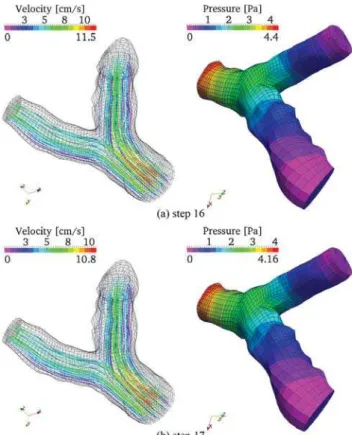
The overall picture of hemodynamic conditions pre-vailing coronary artery complements streamlines and pres-sure field in the blood (Figure 9), and the equivalent stress in the arterial wall (Figure 10).
Fig. 8 – Oscillatory shear index: segments with low endothe-lial share stress (ESS) correlate with oscillatory share index (OSI) index O or close to O. In the areas with the OSI index value of 0 or close to 0 ESS is unchanged in the direction
within the cardiac cycle.
Discussion
The main findings of our study are as follows: simula-tions of fluid–structure interaction can be used in serial man-ner to investigate patient-specific hemodynamics conditions at the coronary artery bifurcation; CFD coronary artery model reveals that the lateral walls of the main branch and lateral walls distal to the carina are exposed to low ESS which is a predilection site for development of atherosclero-sis; thanks to a novel algorithm that we implement, hard-ware- and time-consuming procedures for the surface recon-struction and computed aided design (CAD) modeling are now completely skipped.
The benefits of applying this procedure in clinical prac-tice are presented on the basis of the numerical results.
Fig. 6 – Endothelial shear stress in some steps of the cardiac cycle: lateral walls of the main branch, carina lateral walls and lateral walls distal to the carina are exposed to low endothelial share stress (ESS). The arrows indicate low ESS areas.
Fig. 7 – Magnitude of endothelial share stress (ESS) throughout the cardiac cycle at specific bifurcation segments
CFD is currently being used as a means of enhancing our understanding fluid flow in arteries, while CSD is used to calculate associated vessel wall forces. In this paper we presented a computational framework for FSI simulation. Making new solvers to simultaneously solve FSI is very dif-ficult and time-consuming task. To successfully solve such interdisciplinary problems, CFD and CSD software that
al-ready exists are coupled. The multiblock approach embedded in in-house software STL2FEM is used for mesh generation. It is a very effective tool for generating computational meshes for complex geometries such as artery bifurcations in biomechanics and engineering. This approach dramatically speeds up the process of generating patient-specific finite element bifurcation models with minimum errors in the
nu-Fig. 9 – Streamlines and pressure in (a) step 16 and (b) step 17 of the cardiac cycle.
Fig. 10 – Equivalent (Plate top Von Misses) stress in the coronary artery wall: (a) step 16 and (b) step 17. This stress is the response of the arterial wall material to local hemodynamic conditions. Higher values of effective stress indicate higher strain in the arterial wall and vice versa. It depends on the material characteristics of the arterial wall. Calcified lesions and
merical solution. The methodology was applied to a vascular patient-specific model of coronary artery bifurcation includ-ing elastic wall modelinclud-ing in simulations. Previous considera-tions indicate that developed computational frame gives use-ful inputs to cardiologists. Thanks to the obtained results, cardiologists are set in the role of decision makers. They have a clear view of blood flow through a coronary artery bi-furcation, so they can suggest optimal treatment strategies.
ESS is one of the most essential factors influencing en-dothelial structure and function, and it is the main local flow related factor responsible for coronary atherosclerotic plaque formation and progression 2, 5. A CFD model of plaque free coronary bifurcation reveals that the lateral walls of the main branch, and the lateral walls distal to the carina are exposed to low ESS. Thanks to the clear picture of this parameter be-havior during the cardiac cycle, it is possible to predict the positions that are suspectible to plaque with a high probabil-ity. Using this facts, formation and progression of atheroscle-rotic, a plaque can be predicted. This low ESS specific bifur-cation segment has higher probability for plaque develop-ment. In contrast ESS in the carina region is higher and this area is less likely to develop plaque.
According to several recent studies, low ESS promote atherosclerosis with several mechanisms: through nitric ox-ide (NO)-dependent athero-protection, increased low-density lipoprotein cholesterol uptake, sustain increase in oxidative stress, inflammation and smooth muscle cell proliferation and migration 5, 20.
Better understanding a complex dynamic interplay be-tween local flow conditions and the plaque formation and progression in bifurcations may express areas of angio-graphic interest 8. Plaque distribution may provide a useful information for appropriate technique selection in treatment of complex bifurcation lesions. It gives the operator a chance consider to protection of the side branch with additional wire or to decide in advance between one and two stent tech-niques. It is also valuable knowledge for future stent designs.
We presented a model of plaque-free coronary artery, but this methodology may be applicable in different clinical and angiographic circumstances. This analysis takes into ac-count only kinematic and dynamic effects. Calcifications on the wall and other disorders are not included in the model because based on current knowledge it was not possible to predict the extent of calcification deposition in relationship with fluid behavior. However, the presence of calcification is possible to simulate in future studies by changing character-istics of the arterial wall at calcification place.
Examining ESS in a diseased coronary artery may en-able identification of the initial stages of plaques that poten-tially evolve a high-risk lesion.
Thanks to rapid modeling, this methodology not only allows characterization of arterial plaque at a single point in time but, also allows prognostic insight into how plaques evolve over time 38. If it were possible to recognize in vivo plaques that were expected to develop features of rupture prone lesions, specific interventions could be performed to avoid adverse cardiac event.
Conclusion
Rapid modeling of patient-specific artery bifurcation opens new avenues in the investigation of the role of ESS in the natural history of atherosclerosis and in future we hope it will be a powerful tool in everyday medical practice in the decision making process for every single patient.
Acknowledgements
A part of this research was supported by the Ministry of Education, Science and Technological Development, Re-public of Serbia, Grants TR32036 – Software development for solving coupled multiphysics problems and OI175082 – Non-invasive and invasive diagnostic and percutaneous treatment of the stenosis of blood vessels branch.
R E F E R E N C E S
1. Zarins CK, Giddens DP, Bharadvaj BK, Sottiurai VS, Mabon RF, Glagov S. Carotid bifurcation atherosclerosis. Quantitative cor-relation of plaque localization with flow velocity profiles and wall shear stress. Circ Res 1983; 53(4): 502î14.
2. Nakazawa G, Yazdani SK, Finn AV, Vorpahl M, Kolodgie FD, Virmani R. Pathological findings at bifurcation lesions: the im-pact of flow distribution on atherosclerosis and arterial healing after stent implantation. J Am Coll Cardiol 2010; 55(16): 1679î87.
3. Ku DN, Giddens DP, Zarins CK, Glagov S. Pulsatile flow and atherosclerosis in the human carotid bifurcation. Positive cor-relation between plaque location and low oscillating shear stress. Arteriosclerosis 1985; 5(3): 293î302.
4. Moore JE, Xu C, Glagov S, Zarins CK, Ku DN. Fluid wall shear stress measurements in a model of the human abdominal aorta: oscillatory behavior and relationship to atherosclerosis. Atherosclerosis 1994; 110(2): 225î40.
5. Chatzizisis YS, Coskun AU, Jonas M, Edelman ER, Feldman CL, Stone PH. Role of endothelial shear stress in the natural history of coronary atherosclerosis and vascular remodeling:
molecu-lar, cellumolecu-lar, and vascular behavior. J Am Coll Cardiol 2007; 49(25): 2379î93.
6. Gambillara V, Chambaz C, Montorzi G, Roy S, Stergiopulos N, Si-lacci P. Plaque-prone hemodynamics impair endothelial func-tion in pig carotid arteries. Am J Physiol Heart Circ Physiol 2006; 290(6): H2320î8.
7. Samady H, Eshtehardi P, McDaniel MC, Suo J, Dhawan SS, Maynard C, et al. Coronary artery wall shear stress is associated with progression and transformation of atherosclerotic plaque and arterial remodeling in patients with coronary artery dis-ease. Circulation 2011; 124(7): 779î88.
8. Giannoglou GD, Antoniadis AP, Koskinas KC, Chatzizisis YS. Flow and atherosclerosis in coronary bifurcations. EuroInter-vention 2010; 6(Suppl J): J16î23.
9. Kung EO, Les AS, Figueroa AC, Medina F, Arcaute K, Wicker RB, et al. In vitro validation of finite element analysis of blood flow in deformable models. Ann Biomed Eng 2011; 39(7): 1947î60.
analy-sis of five internal fixation modalities. Vojnosanit Pregl 2011; 68(10): 867î71. (Serbian)
11.Marişnas M, Kuzborska Z. Influence of load magnitude and du-ration on the relationship between human arterial blood pres-sure and flow rate. Acta Bioeng Biomech 2011; 13(2): 67î72. 12.Kim H, Vignon-Clementel I, Figueroa C, Jansen K, Taylor C.
Devel-oping computational methods for three-dimensional finite element simulations of coronary blood flow. Finite Elem Anal Des 2010; 46(6): 514î25.
13.Torii R, Oshima M, Kobayashi T, Takagi K, Tezduyar TE. Com-puter modeling of cardiovascular fluid-structure interactions with the deforming-spatial-domain/stabilized space-time for-mulation. Comput Methods Appl Mech Eng 2006; 195: 1885– 95.
14.Bazilevs Y, Hsu MC, Zhang Y, Wang W, Liang X, Kvamsdal T, et al. A fully-coupled fluid-structure interaction simulation of cerebral aneurysms. Comput Mech 2010; 46(1): 3î16. 15.Weydahl ES, Moore JE. Dynamic curvature strongly affects wall
shear rates in a coronary artery bifurcation model. J Biomech 2001; 34(9): 1189î96.
16.Nichols WW, Orourke MF. McDonalds blood flow in arteries: Theoretica, experimental and clinical principles. 5th ed. Lon-don: A Hodder Arnold Publicatio; 2005.
17.Slager CJ, Wentzel JJ, Gijsen FJ, Schuurbiers JC, Wal AC, Steen AF, et al. The role of shear stress in the generation of rupture-prone vulnerable plaques. Nat Clin Pract Cardiovasc Med 2005; 2(8): 401î7.
18.Malek AM, Alper SL, Izumo S. Hemodynamic shear stress and its role in atherosclerosis. JAMA 1999; 282(21): 2035î42. 19.Gimbrone MA, Topper JN, Nagel T, Anderson KR, Garcia-Cardeña
G. Endothelial dysfunction, hemodynamic forces, and athero-genesis. Ann N Y Acad Sci 2000; 902: 230î9; discussion 9î40.
20.Stone PH, Coskun AU, Kinlay S, Clark ME, Sonka M, Wahle A, et al. Effect of endothelial shear stress on the progression of coronary artery disease, vascular remodeling, and in-stent re-stenosis in humans: in vivo 6-month follow-up study. Circula-tion 2003; 108(4): 438î44.
21.Ku DN. Blood flow in arteries. Annu Rev Fluid Mech 1997; 29(1): 399î434.
22.Soulis JV, Giannoglou GD, Chatzizisis YS, Farmakis TM, Gian-nakoulas GA, Parcharidis GE, et al. Spatial and phasic oscillation of non-Newtonian wall shear stress in human left coronary artery bifurcation: an insight to atherogenesis. Coron Artery Dis 2006; 17(4): 351î8.
23.Younis HF, Kaazempur-Mofrad MR, Chan RC, Isasi AG, Hinton DP, Chau AH, et al. Hemodynamics and wall mechanics in human carotid bifurcation and its consequences for athero-genesis: investigation of inter-individual variation. Biomech Model Mechanobiol 2004; 3(1): 17î32.
24.Kojiý M, Filipoviý N, Stojanoviý B, Kojiý N. Computer Modeling in Bioengineering: Theoretical background, examples and soft-ware. Chichester: John Wiley & Sons; 2008.
25.Bathe K. Finite element procedures in engineering analysis. Englewood Cliffs, NJ: Prentice Hall; 1996.
26.Kojic M, Slavkovic R, Zivkovic M, Grujovic N. The finite element method: Linear analysis. Kragujevac: Faculty of Mechanical Engineering of Kragujevac; 1998. (Serbian)
27.Živkoviý M. Department: Department for applied mechanics and automatic control. Kragujevac: Faculty of Engineering, University of Kragujevac; 2004.
28. Zhao SZ, Ariff B, Long Q, Hughes AD, Thom SA, Stanton AV, Xu XY. Inter-individual variations in wall shear stress and me-chanical stress distributions at the carotid artery bifurcation of healthy humans. J Biomech 2002; 35(10): 1367î77.
29.Soulis JV, Farmakis TM, Giannoglou GD, Louridas GE. Wall shear stress in normal left coronary artery tree. J Biomech 2006; 39(4): 742î9.
30.Nguyen KT, Clark CD, Chancellor TJ, Papavassiliou DV. Carotid geometry effects on blood flow and on risk for vascular dis-ease. J Biomech 2008; 41(1): 11î9.
31.Goubergrits L, Affeld K, Fernandez-Brittoy J, Falcon L. Investiga-tion of geometry and atherosclerosis in the human carotid bi-furcations. J Mech Med Biol 2003; 3(1): 31î48.
32. Zhang YJ, Bajaj C. Adaptive and quality quadrilat-eral/hexahedral meshing from volumetric data. Comput Methods Appl Mech Engrg 2006; 195: 942î60.
33. de Santis G, de Beule M, van Canneyt K, Segers P, Verdonck P, Ver-hegghe B. Full-hexahedral structured meshing for image-based computational vascular modeling. Med Eng Phys 2011; 33(10): 1318î25.
34.Shirsat A, Gupta S, Shevare GR. Generation of multi-block to-pology for discretisation of three-dimensional domains. Com-put Graph 1999; 23(1): 45î57.
35. Yuan C, Yih N. A transfinite interpolation method of grid generation based on multipoints. J Sci Comp 1998; 13(1): 105î14.
36. Perktold K, Resch M, Florian H. Pulsatile non-Newtonian flow characteristics in a three-dimensional human carotid bifurca-tion model. J Biomech Eng 1991; 113(4): 464î75.
37.Perktold K, Resch M, Peter RO. Three-dimensional numerical analysis of pulsatile flow and wall shear stress in the carotid artery bifurcation. J Biomech 1991; 24(6): 409î20.
38. Stone PH, Feldman CL. In vivo assessment of the risk profile of evolving individual coronary plaques: a step closer. Circula-tion 2011; 124(7): 763î5.