The Brazilian Journal of
INFECTIOUS DISEASES
w w w . e l s e v i e r . c o m / l o c a t e / b j i d
Original article
Comparison of clinical characteristics between
healthcare-associated pneumonia and community-acquired
pneumonia in patients admitted to secondary hospitals
Jong Hoo Lee
a, Yee Hyung Kim
b,∗aDepartment of Pulmonary and Critical Care Medicine, Jeju National University Hospital, School of Medicine, Jeju National University,
Jeju, Korea
bKyung Hee University Hospital at Gangdong, School of Medicine, Kyung Hee University, Seoul, Korea
a r t i c l e
i n f o
Article history:
Received 11 February 2012 Accepted 4 April 2012
Keywords: Health care Pneumonia Antibiotics Mortality Resistance
a b s t r a c t
Background:Since healthcare-associated pneumonia (HCAP) is heterogeneous, clinical char-acteristics and outcomes are different from region to region. There can also be differences between HCAP patients hospitalized in secondary or tertiary hospitals. This study aimed to evaluate the clinical characteristics of HCAP patients admitted into secondary community hospitals.
Methods:This was a retrospective study conducted in patients with HCAP or community-acquired pneumonia (CAP) hospitalized in two secondary hospitals between March 2009 and January 2011.
Results:Of a total of 303 patients, 96 (31.7%) had HCAP. 42 patients (43.7%) resided in a nursing home or long-term care facility, 36 (37.5%) were hospitalized in an acute care hospital for ≥2 days within 90 days, ten received outpatient intravenous therapy, and eight attended a hospital clinic or dialysis center. HCAP patients were older. The rates of patients with CURB-65 scores of 3 or more (22.9% vs. 9.1%; p = 0.001) and PSI class IV or more (82.2% vs. 34.7%; p < 0.001) were higher in the HCAP group. Drug-resistant pathogens were more frequently detected in the HCAP group (23.9% vs. 0.4%; p < 0.001). However,Streptococcus pneumoniae was the most common pathogen in both groups. The rates of antibiotic change, use of inappropriate antibiotics, and failure of initial antibiotic therapy in the HCAP group were significantly higher. Although the overall survival rate of the HCAP group was significantly lower (82.3% vs. 96.8%; p < 0.001), multivariate analyses failed to show that HCAP itself was a prognostic factor for mortality (p = 0.826). Only PSI class IV or more was associated with increased mortality (p = 0.005).
Conclusions: HCAP should be distinguished from CAP because of the different clinical fea-tures. However, the current definition of HCAP does not appear to be a prognostic for death. In addition, the use of broad-spectrum antibiotics for HCAP should be reassessed because S. pneumoniaewas most frequently identified even in HCAP patients.
© 2012 Elsevier Editora Ltda. All rights reserved.
∗ Corresponding author at:Kyung Hee University Hospital at Gangdong, School of Medicine, Kyung Hee University, 149, Sangil-dong,
Gangdong-gu, Seoul 134-727, Korea.
E-mail address:[email protected](Y. Hyung Kim).
Introduction
Pneumonia was traditionally classified as either community-acquired pneumonia (CAP) or hospital-community-acquired pneumonia (HAP), but in 2005 the American Thoracic Society (ATS) and the Infectious Diseases Society of America (IDSA) introduced
the concept of healthcare-associated pneumonia (HCAP).1
ATS/IDSA guidelines state that patients with HCAP should receive broad-spectrum empirical antimicrobial therapy directed at multidrug-resistant (MDR) pathogens associated
with healthcare settings.1This treatment strategy from the
ATS/IDSA guidelines is based on the epidemiology and
clin-ical outcomes of HCAP.2,3 That is, MDR bacteria such as
methicillin-resistant Staphylococcus aureus (MRSA) or
Pseu-domonas aeruginosaare isolated more frequently in patients with HCAP and the mortality rates associated with HCAP are significantly higher than for CAP in some reports.2,4,5 There-fore, treatment strategies based on this distinction between HCAP and CAP are thought to be very important as guides to the treatment of patients with pneumonia.
However, this concept has been controversial. The British Thoracic Society (BTS) guidelines state that there is no dif-ference in the distribution of causative pathogens between patients with HCAP and elderly patients with CAP, although
its definitions of HCAP are somewhat different.6 A recent
prospective UK cohort study demonstrated that the increased mortality in HCAP according to the 2005 ATS/IDSA definitions was primarily related to underlying patient-related factors
rather than the presence of antibiotic-resistant pathogens.7
This study did not establish a clear indication to change cur-rent prescribing practices in a UK cohort. A study from Europe has shown that the microbiological and mortality data of patients with nursing home-acquired pneumonia (the largest subgroup of HCAP) are more similar to the data of those with
CAP.8 The reason for these varying results among studies
may be that HCAP itself is heterogeneous and the regions or countries where studies were performed had different compo-sitions of HCAP subgroups and different healthcare systems.
In Korea, there are limited data and no guidelines focus-ing on HCAP.9,10Given that all of the studies were conducted in tertiary referral hospitals with over 1,000 beds and included relatively small numbers of patients residing in nursing homes or long-term care facilities (less than 10%), the results are likely to be biased towards more severe pneumonia or specific sub-groups. Therefore, it is necessary to collect and evaluate data regarding patients with HCAP admitted to secondary commu-nity hospitals. This study aimed to clarify the differences in the clinical characteristics of patients with HCAP and CAP hos-pitalized in secondary hospitals. Also, the clinical utility of HCAP as a prognostic factor was investigated.
Material and methods
Study design
This study was performed at the Kyung Hee University Hospi-tal at Gangdong (a 600-bed hospiHospi-tal in Seoul, South Korea) and at the Jeju National University Hospital (a 540-bed hospital in Jeju, South Korea). These hospitals are classified as secondary
community hospitals according to the Korean healthcare sys-tem.
Patients diagnosed with CAP (CAP group) or HCAP (HCAP group) who were hospitalized in these hospitals between March, 2009 and January, 2011 were evaluated. Clinical characteristics, comorbidities, severity, identified pathogens, antibiotic therapy and clinical outcomes were compared between the two groups. The severity of pneumonia in each group was determined using the CURB-65 (confusion, urea nitrogen, respiratory rate, blood pressure, age≥65 years) score and the PSI (Pnemonia Severity Index). The study protocol was approved by the Ethical Review Committee of the two institutions. Informed consent was waived because of the ret-rospective nature of the study.
Categorization of pneumonia
Pneumonia was defined as the presence of a new infiltrate on the chest radiography plus at least one of the following: fever (temperature≥38.0◦ C) or hypothermia (temperature < 35.0◦ C); new-onset cough with or without sputum production; pleuritic chest pain; dyspnea; or altered breath sounds on
auscultation.11 Multi-lobar involvement was defined as the
presence of pneumonic infiltrates in two or more lobes on chest radiograph or computed tomography.
According to the 2005 ATS/IDSA guidelines,1the risk factors for HCAP include hospitalization for two days or more in the preceding 90 days, residence in a nursing home or extended care facility, home wound care, chronic dialysis within 30 days, and family member with MDR pathogens. In accordance with the guidelines, the HCAP group of this study included patients with any of the following: 1) residence in a nursing home or long-term care facility; 2) recent history of hospitalization in an acute care hospital for≥2 days in the past 90 days; 3) recent outpatient intravenous therapy (such as antibiotic therapy or chemotherapy) or wound care within the past 30 days; 4) atten-dance at a hospital clinic or dialysis center in the last 30 days.1 CAP was defined as a diagnosis of pneumonia in patients who did not meet any of the criteria for HCAP.
Microbiology
Microorganisms in samples obtained from sputum, tracheal aspirate, bronchial alveolar lavage fluid, or blood were investi-gated. Sputum was defined as adequate when > 25 neutrophils and < 10 squamous epithelial cells seen under low-power field. For Mycoplasma pneumoniaeor Chlamydia pneumoniae, serum samples were evaluated. Serum samples in which particle agglutination antibody titers were > 320, or that were proven to have a four-fold or greater increase of antibody titers in
paired sera, were regarded as positive. BinaxNOW® (Binax
Inc. – Maine, USA) was routinely used to detect urinary
antigens for Streptococcus pneumoniae. Seeplex® RV7
detec-tion (Seegene, Inc. – Seoul, Korea) for respiratory viruses including influenza A/B virus, parainfluenzavirus, adenovirus, rhinovirus, metapneumovirus, respiratory syncytial virus and
BinaxNOW® Legionella Urinary Antigen Test (Binax, Inc. –
Maine, USA) for Legionella pneumophila serogroup 1 were
determined using the disc diffusion method, and drug-resistant pathogens were defined as having resistance to two or more different classes of antimicrobial drugs.
Evaluation for clinical outcomes
Inappropriate antibiotic therapy was defined if the empirical antibiotics were not effective against the identified pathogens based on in vitro susceptibility testing. Initial treatment fail-ure was defined as death during initial treatment or change of antibiotics from initial agents to another regimen after 48 hours due to clinical instability. Intensive care unit (ICU) admission, need for mechanical ventilation, length of antibi-otic therapy, length of hospital stay, and three- and 30-day in-hospital mortality rates were also compared between groups. The duration of overall survival (OS) was calculated as the time interval between admission and death due to any cause or last clinical contact.
Statistical analysis
Data are presented as number (%) or median (range) unless otherwise stated. Continuous variables were compared using Student’s t-test for normally distributed variables and the Mann-Whitney U test for non-normally distributed variables. A univariate analysis was carried out using the chi-square test or Fisher’s exact test for categorical data. The duration of OS was analyzed using the Kaplan-Meier method. The differences in OS were assessed using the log-rank test and multivari-ate Cox proportional hazards regression models were fit to assess associations between patient characteristics and time to death. p-values < 0.05 were considered statistically signifi-cant. Analyses were performed using the Statistical Package for the Social Sciences (SPSS) network version 18.0 (SPSS – Chicago, IL).
Results
Clinical characteristics
A total of 303 patients (189 patients at Kyung Hee University Hospital at Gangdong and 114 patients at Jeju National Univer-sity Hospital) were evaluated during the study period. There were 96 patients (31.7%) with HCAP and 207 (68.3%) with CAP. The median age of the HCAP group was 76 years (interquartile range (IQR) 69-82) and that of CAP group was 65 years (IQR 51-76), showing a statistically significant difference between the two groups (p < 0.001). In the HCAP group, 42 patients (43.7%) resided in a nursing home or long-term care facility in the last 90 days, 36 patients (37.5%) were hospitalized in an acute care hospital for≥2 days in the last 90 days, 10 patients (10.4%) received outpatient intravenous therapy within the past 30 days, and 8 patients (8.3%) attended a hospital clinic or dialysis center in the last 30 days.
The baseline clinical features of the two groups are presented inTable 1. Comorbidities, such as malignancy, car-diovascular disease, renal disease, diabetes mellitus, chronic lung disease, and central nervous system disorders were sig-nificantly more frequent in the HCAP group than in the CAP
group. The rate of patients with two or more comorbidities was higher in the HCAP group than in the CAP group (55.2% vs. 21.2%; p < 0.001). The HCAP group had worse clinical parame-ters such as confusion, respiratory failure, and septic shock at onset than the CAP group. As a result, the rate of ICU admis-sion and need for mechanical ventilation were significantly higher in the HCAP group. PSI and CURB-65 scores were also higher in the HCAP group. The rates of patients with CURB-65 scores of 3 or more (22.9% vs. 9.1%; p = 0.001) and PSI class IV or more (82.2% vs. 34.7%; p < 0.001) were higher in the HCAP group.
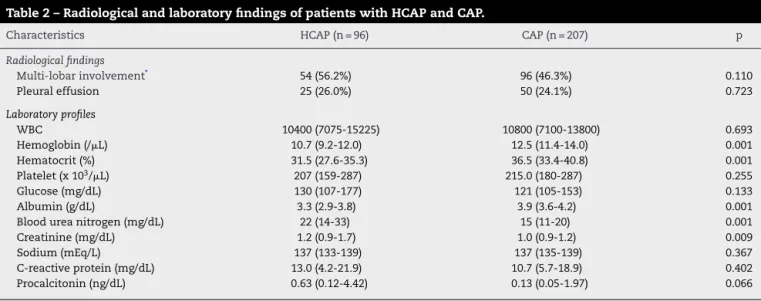
A CT scan of the lungs was obtained within three days of hospitalization for 176 patients (58.0%), including 54 (54.6%) in the HCAP group and 122 (58.9%) in the CAP group. The rates of multi-lobar involvement and pleural effusions between both groups were not significantly different (Table 2). The labo-ratory profiles including hemoglobin, hematocrit, albumin, blood urea nitrogen, and creatinine were worse in the HCAP group. The HCAP group showed a trend for higher PCT level compared with that of the CAP group (p = 0.066).
Microbiological etiology
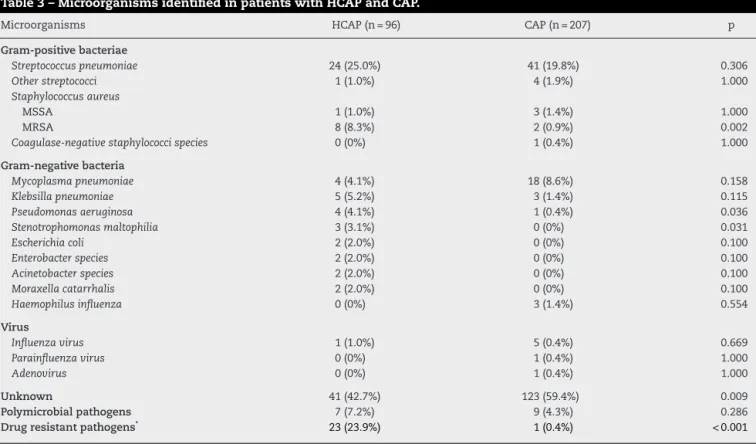
Table 3shows the distribution of pathogens for HCAP and CAP. An etiological diagnosis was possible for 55 patients (57.3%) in the HCAP group and 84 patients (40.6%) in the CAP group. Strep-tococcus pneumoniaewas the pathogen isolated most frequently in both groups. However, the second most common pathogens
were MRSA in the HCAP group andMycoplasma pneumoniaein
the CAP group.
Drug-resistant pathogens were more frequently isolated in the HCAP group (23.9% vs. 0.4%; p < 0.001). MRSA,Pseudomonas aeruginosaandStenotrophomonas maltophiliawere isolated more frequently in the HCAP group than in the CAP group.
Clinical outcomes
Table 4shows the initial antimicrobial regimens. More than 75% of all patients received combination therapy. Anti-pseudomonal and/or anti-MRSA agents were used more frequently in the HCAP group (66.6% vs. 3.8%, p < 0.001; 4.1% vs. 0.4%, p = 0.036, respectively). Although the duration of antibi-otic administration was similar for both groups (14 vs. 14 days; p = 0.607), the rates of antibiotic change (43.7% vs. 20.7%; p < 0.001), use of inappropriate antibiotics (23.9% vs. 5.7%; p < 0.001), and failure of initial antibiotic therapy (36.4% vs. 12.0%; p < 0.001) were significantly higher in the HCAP group (Table 5). Although the in-hospital mortality rate at three days was similar between the two groups, the HCAP group was hos-pitalized longer (p = 0.001) and showed a higher in-hospital mortality rate at 30 days than the CAP group (p = 0.001).
Survival
The three- and 30-day overall cumulative survival rates for all patients with pneumonia were 97.6% and 90.7%, respectively (Table 6). Notably, the OS rate of the HCAP group was signif-icantly lower than that of the CAP group (OS rates: 82.3% vs. 96.8%, p < 0.001,Fig. 1).
Table 1 – Baseline clinical features of patients with HCAP and CAP.
Characteristics HCAP (n = 96) CAP (n = 207) p
Age (years) 76 (69-82) 65 (51-76) < 0.001
Male 66 (68.7%) 131 (63.2%) 0.198
Smoking history 48 (50%) 98 (47.3%) 0.667
Comorbidity
Malignancy 20 (20.8%) 18 (8.6%) 0.003
Liver disease 7 (7.2%) 17 (8.2%) 0.782
Cardiovascular disease 17 (17.7%) 11 (5.3%) < 0.001
Renal disease 16 (16.6%) 11 (5.3%) < 0.001
Diabetes mellitus 33 (34.3%) 42 (20.2%) 0.008
Steroid medications 3 (3.1%) 3 (1.4%) 0.385
Chronic lung disease 30 (31.2%) 40 (19.3%) 0.022
Central nervous system disorders 50 (52.0%) 27 (13.0%) < 0.001
Autoimmune disease 3 (3.1%) 5 (2.4%) 0.711
Two or more comorbidities 53 (55.2%) 44 (21.2%) < 0.001
Use of antibiotics within the previous 90 days 37 (38.5%) 9 (4.3%) < 0.001
Clinical parameters
Confusion 34 (35.4%) 13 (6.2%) < 0.001
Respiratory failure* 44 (45.8%) 54 (26.0%) < 0.001
Septic shock at onset 23 (23.9%) 21 (10.1%) 0.001
ICU admission 26 (27.0%) 23 (11.1%) < 0.001
Need for mechanical ventilation 15 (15.6%) 13 (6.2%) 0.009
Indices for pneumonia severity
CURB-65 score 2 (1-3) 1 (0-2) < 0.001
CURB-65 score≥3 22 (22.9%) 19 (9.1%) 0.001
PSI score 121 (95-148) 79 (55-107) < 0.001
PSI class IV and V 79 (82.2%) 72 (34.7%) < 0.001
Data are presented as number (%).
HCAP, healthcare-associated pneumonia; CAP, community-acquired pneumonia; ICU, intensive care unit. ∗
Respiratory failure was defined when the PaO2was 60 mmHg or less or when the PaO2/FiO2ratio was 300 mmHg or less.
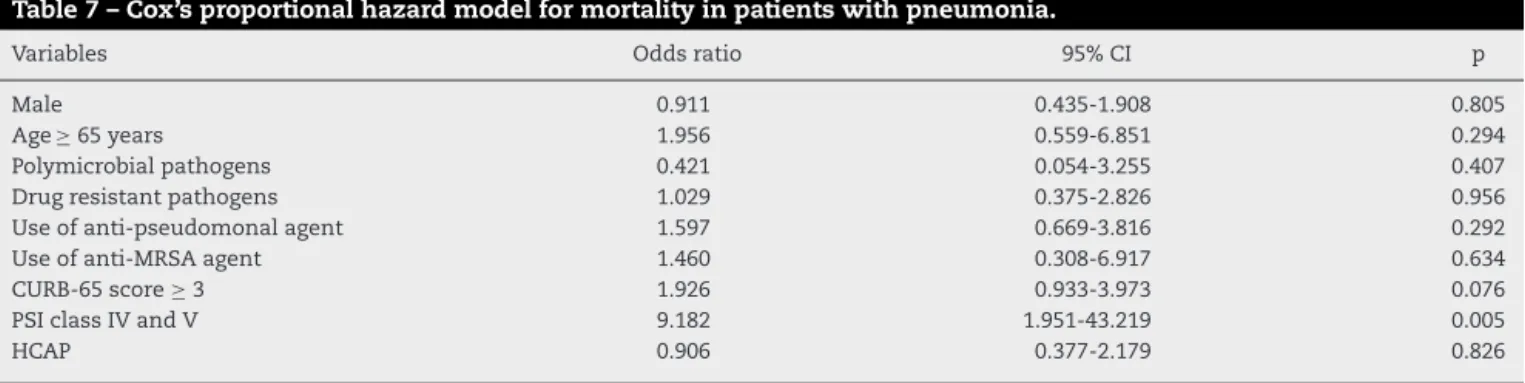
anti-MRSA agents, CURB-65 score, PSI class, and designation of HCAP in univariate analysis. However, a multivari-ate Cox proportional hazards model for time to death showed that only PSI class IV or more was indepen-dently associated with increased mortality in patients
diagnosed with pneumonia (OR: 9.182, 95% CI: 1.951-43.219, p = 0.005) (Table 7). Otherwise, male gender, age,
polymicro-bial pathogens, drug-resistant pathogens, CURB-65 score ≥
3, and HCAP diagnosis were not significantly associated with survival.
Table 2 – Radiological and laboratory findings of patients with HCAP and CAP.
Characteristics HCAP (n = 96) CAP (n = 207) p
Radiological findings
Multi-lobar involvement* 54 (56.2%) 96 (46.3%) 0.110
Pleural effusion 25 (26.0%) 50 (24.1%) 0.723
Laboratory profiles
WBC 10400 (7075-15225) 10800 (7100-13800) 0.693
Hemoglobin (/L) 10.7 (9.2-12.0) 12.5 (11.4-14.0) 0.001
Hematocrit (%) 31.5 (27.6-35.3) 36.5 (33.4-40.8) 0.001
Platelet (x 103/L) 207 (159-287) 215.0 (180-287) 0.255
Glucose (mg/dL) 130 (107-177) 121 (105-153) 0.133
Albumin (g/dL) 3.3 (2.9-3.8) 3.9 (3.6-4.2) 0.001
Blood urea nitrogen (mg/dL) 22 (14-33) 15 (11-20) 0.001
Creatinine (mg/dL) 1.2 (0.9-1.7) 1.0 (0.9-1.2) 0.009
Sodium (mEq/L) 137 (133-139) 137 (135-139) 0.367
C-reactive protein (mg/dL) 13.0 (4.2-21.9) 10.7 (5.7-18.9) 0.402
Procalcitonin (ng/dL) 0.63 (0.12-4.42) 0.13 (0.05-1.97) 0.066
Data are presented as median (interquatile range) or number (%).
HCAP, healthcare-associated pneumonia; CAP, community-acquired pneumonia; WBC, white blood cell.
∗ Multi-lobar involvement was defined as the presence of pneumonic infiltrates in two or more lobes on chest radiograph or computed
Table 3 – Microorganisms identified in patients with HCAP and CAP.
Microorganisms HCAP (n = 96) CAP (n = 207) p
Gram-positive bacteriae
Streptococcus pneumoniae 24 (25.0%) 41 (19.8%) 0.306
Other streptococci 1 (1.0%) 4 (1.9%) 1.000
Staphylococcus aureus
MSSA 1 (1.0%) 3 (1.4%) 1.000
MRSA 8 (8.3%) 2 (0.9%) 0.002
Coagulase-negative staphylococci species 0 (0%) 1 (0.4%) 1.000
Gram-negative bacteria
Mycoplasma pneumoniae 4 (4.1%) 18 (8.6%) 0.158
Klebsilla pneumoniae 5 (5.2%) 3 (1.4%) 0.115
Pseudomonas aeruginosa 4 (4.1%) 1 (0.4%) 0.036
Stenotrophomonas maltophilia 3 (3.1%) 0 (0%) 0.031
Escherichia coli 2 (2.0%) 0 (0%) 0.100
Enterobacter species 2 (2.0%) 0 (0%) 0.100
Acinetobacter species 2 (2.0%) 0 (0%) 0.100
Moraxella catarrhalis 2 (2.0%) 0 (0%) 0.100
Haemophilus influenza 0 (0%) 3 (1.4%) 0.554
Virus
Influenza virus 1 (1.0%) 5 (0.4%) 0.669
Parainfluenza virus 0 (0%) 1 (0.4%) 1.000
Adenovirus 0 (0%) 1 (0.4%) 1.000
Unknown 41 (42.7%) 123 (59.4%) 0.009
Polymicrobial pathogens 7 (7.2%) 9 (4.3%) 0.286
Drug resistant pathogens* 23 (23.9%) 1 (0.4%) < 0.001
Data are presented as number (%).
HCAP, healthcare-associated pneumonia; CAP, community-acquired pneumonia; MSSA, methicillin-sensitiveStaphylococcus aureus; MRSA, methicillin-resistantStaphylococcus aureus.
∗ Drug resistant pathogens were defined as having resistance to two or more different classes of antimicrobial drugs.
Discussion
Data published shortly after the establishment of the 2005 ATS/IDSA guidelines demonstrated that the spectrum of
microorganisms found in HCAP was more similar to HAP than
CAP.2In particular, data from the United States has
contin-ued to confirm this finding. Thereafter, several major studies have investigated differences in the clinical characteristics of
patients with HCAP and CAP.5,7,9,12–14 The findings of some
Table 4 – Initial antibiotic treatment.
Treatment regimens HCAP (n = 96) CAP (n = 207) p
Monotherapy 19 (19.7%) 49 (23.6%) 0.451
Combination therapy 77 (80.2%) 158 (76.3%) 0.451
Use of anti-pseudomonal agent 64 (66.6%) 8 (3.8%) < 0.001
Use of anti-MRSA agent 4 (4.1%) 1 (0.4%) 0.036
Data are presented as number (%).
HCAP, healthcare-associated pneumonia; CAP, community-acquired pneumonia; MRSA, methicillin-resistantStaphylococcus aureus.
Table 5 – Clinical outcomes of patients with HCAP and CAP.
Clinical outcomes HCAP (n = 96) CAP (n = 207) p
Duration of antibiotic therapy (days) 14 (11-18) 14 (11-17) 0.607 Change of antibiotics 42 (43.7%) 43 (20.7%) < 0.001 Use of inappropriate antibiotics 23 (23.9%) 12 (5.7%) < 0.001 Failure of initial antibiotic therapy 35 (36.4%) 25 (12.0%) < 0.001 Length of hospital stay (days) 12 (8-19) 8 (5-11) 0.001 3-day in-hospital mortality rate 3 (3.1%) 4 (1.9%) 0.683 30-day in-hospital mortality rate 17 (17.7%) 11 (5.3%) 0.001
Data are presented as number (%).
Table 6 – Univariate analysis for overall survival.
No Overall cumulative survival
Mean survival (days)
3-day survival 30-day survival p
Total group 303 462 97.6% 90.7%
Gender 0.525
Male 196 476 97.4% 90.3%
Female 107 436 98.1% 91.5%
Age < 0.001
≥65 years 192 408 96.8% 86.4%
< 65 years 111 555 99.0% 98.1%
Polymicrobial pathogens 1.000
Yes 16 515 100% 100%
No 287 459 97.5% 90.2%
Drug resistant pathogens 0.103
Yes 26 428 100% 84.6%
No 277 465 97.4% 91.3%
Use of anti-pseudomonal agent < 0.001
Yes 72 208 94.4% 77.7%
No 231 504 98.7% 93.0%
Use of anti-MRSA agent 0.045
Yes 5 160 100% 60%
No 298 438 97.6% 91.2%
CURB-65 score < 0.001
≥3 41 271 98.8% 63.4%
< 3 262 492 98.4% 95.0%
PSI class < 0.001
≥IV 151 361 95.3% 82.1%
< IV 152 563 100% 99.3%
Pneumonia type < 0.001
HCAP 96 332 96.8% 82.3%
CAP 207 552 98.0% 94.7%
HCAP, healthcare-associated pneumonia; CAP, community-acquired pneumonia; MRSA, methicillin-resistantStaphylococcus aureus.
recent studies have been different from those of previous stud-ies. Therefore, some authors or experts are now questioning whether the ATS/IDSA definition of HCAP should be refined or abandoned.15The differences in the results of these studies can be explained by differences in the subgroups of patients with HCAP and in the healthcare systems of each country.
As of 2011, a large scale, multi-center cohort study in Korea had not been performed to evaluate the clinical characteristics
of HCAP. Two single-center studies were conducted in tertiary
referral centers that have over 1,500 beds.9,16 These
stud-ies included a high proportion of patients who had received chemotherapy or who had a recent hospitalization, while the rate of patients residing in nursing homes was low. This patient distribution is a result of the distinct features of ter-tiary referral hospitals according to the healthcare system of Korea. Thus, the results of these studies cannot explain the
Table 7 – Cox’s proportional hazard model for mortality in patients with pneumonia.
Variables Odds ratio 95% CI p
Male 0.911 0.435-1.908 0.805
Age≥65 years 1.956 0.559-6.851 0.294
Polymicrobial pathogens 0.421 0.054-3.255 0.407
Drug resistant pathogens 1.029 0.375-2.826 0.956
Use of anti-pseudomonal agent 1.597 0.669-3.816 0.292
Use of anti-MRSA agent 1.460 0.308-6.917 0.634
CURB-65 score≥3 1.926 0.933-3.973 0.076
PSI class IV and V 9.182 1.951-43.219 0.005
HCAP 0.906 0.377-2.179 0.826
100
80
60
40
Percent survival 20
0
0 50
Days
100
CAP
HCAP
Fig. 1 – Overall survival of healthcare-associated pneumonia and CAP groups.
general characteristics of patients with HCAP in Korea because they are likely to be biased toward more severe pneumonia or specific subgroups.
The average age of the population in Korea as well as in Western countries is increasing. The population above 65 years of age in Korea will be as high as 14.3% in 2019.17This demographic feature will lead to increased numbers of the elderly residing in long-term care facilities such as nursing homes. The proportion of elderly patients with pneumonia continues to increase. Most of the elderly patients with pneu-monia, either CAP or HCAP, will be hospitalized in secondary community hospitals because there are many more secondary hospitals in Korea than tertiary referral hospitals. The clini-cal features of patients admitted to secondary hospitals may be different from those admitted to tertiary referral hospitals. Therefore, it is important to analyze the clinical features of patients with HCAP admitted to secondary hospitals in given a region or country.
This is the first study that was performed at two secondary hospitals in Korea. The present study showed that approxi-mately 30% of the patients with pneumonia hospitalized in a secondary hospital in Korea were diagnosed with HCAP. In terms of subgroups of HCAP, 43.7% of the patients in this study resided in a nursing home or long-term care facility, while only 10.4% had received outpatient IV therapy such as chemother-apy. This finding has epidemiological significance because the composition of the subgroups in this study was different from those of previous Korean studies.9,16A possible reason for this finding is that HCAP itself is heterogeneous, and subgroups of HCAP can have individual clinical features.
In terms of microbiology, the most commonly identified
microorganism in HCAP was Streptococcus pneumoniae, the
most common bacteria of CAP. This result was also different from the results of previous Korean studies.9,16 In contrast,
MRSA and Gram-negative bacteriae such asP. aeruginosawere
isolated more frequently in the HCAP group. After the estab-lishment of the 2005 ATS/IDSA guidelines for HCAP in Korea, many Korean physicians have included anti-pseudomonal and/or anti-MRSA agents into initial regimens to treat patients with HCAP. In the present study, anti-pseudomonal agents were administered to 66.6% of the patients in the HCAP group, compared with 3.8% of the patients in the CAP group (p < 0.001). These results provide meaningful information.
First, since there are microbiological differences between HCAP and CAP, clinicians caring for patients with HCAP should always consider drug resistant pathogens. Second, empirical
regimens to cover resistant pathogens such as P. aeruginosa
can be unnecessary in many patients with HCAP admitted into
secondary hospitals. AlthoughP. aeruginosawas isolated more
frequently in HCAP group, its rate was low (4.1%) in our study. However, clinicians prescribed anti-pseudomonal agents to fight this organism in 66.6% of patients with HCAP. Predictive rules thought to accurately identify HCAP patients who are likely to have or not have drug-resistant pathogens should be developed. Further analyses of the subgroups of HCAP may be necessary for this purpose.
In addition to drug resistant pathogens, higher rates of inappropriate antibiotics, of failure of initial antibiotic ther-apy, and of 30-day mortality were observed in the HCAP group. However, multivariate analyses showed that HCAP itself was not a risk factor for mortality, and that severity indices of pneumonia such as the PSI were much more predictive of mortality. This finding underlies the fact that the current HCAP definition as a category of pneumonia, as some authors emphasize, may not be useful. However, this result may be due to the composition of the HCAP subgroups. The possibil-ity that a specific subgroup would be a risk factor for death cannot be ruled out.
The present study has several limitations. First, since this study had a relatively small number of patients with HCAP and was performed retrospectively at two secondary Korean hospitals, it should be interpreted with caution, and its find-ings cannot be considered to be consistent with those of other secondary hospitals. A nationwide cohort study should be per-formed to overcome these limitations. Second, the ATS/IDSA 2005 guidelines recommend semi-quantitative or quantitative culture in patients with HCAP to identify causative microor-ganisms. However, semi-quantitative or quantitative cultures were not performed for most of the patients. Therefore, the microorganisms identified could be oropharyngeal colonizers and may not have been the definite causes of pneumonia, since sputum culture may not always distinguish between colonization and true infection despite adequate sputum col-lection. In spite of the limitations described above, the present study showed meaningful data regarding patients with HCAP hospitalized in secondary hospitals in Korea.
In summary, the clinical characteristics of patients with HCAP admitted into secondary hospitals in Korea are differ-ent from those with CAP. However, the currdiffer-ent HCAP definition seems not to be associated with in-hospital mortality. In
addi-tion, because drug-sensitiveS. pneumoniawas identified most
frequently in patients with HCAP, the use of antibiotics with extensive spectrum as recommended by the ATS/IDSA guide-lines should be reassessed in the healthcare system of Korea, although patients with HCAP were more likely to receive inap-propriate initial antibiotics. Also, a nationwide cohort study is needed to establish proper guidelines regarding HCAP.
Conflict of interest
Acknowledgements
Jong Hoo Lee collected and analyzed all clinical data, and made a draft of the manuscript. Yee Hyung Kim (correspond-ing author) planned this study, reviewed data, and revised the manuscript. This work was supported by a research grant from Jeju National University Hospital, Jeju, Korea.
r e f e r e n c e s
1. American Thoracic Society; Infectious Diseases Society of America. Guidelines for the management of adults with hospital-acquired, ventilator-associated, and
healthcare-associated pneumonia. Am J Respir Crit Care Med. 2005;171:388–416.
2. Kollef MH, Shorr A, Tabak YP, Gupta V, Liu LZ, Johannes RS. Epidemiology and outcomes of health-care-associated pneumonia: results from a large US database of culture-positive pneumonia. Chest. 2005;128:3854–62. 3. Muder RR. Pneumonia in residents of long-term care
facilities: epidemiology, etiology, management, and prevention. Am J Med. 1998;105:319–30.
4. Zilberberg MD, Shorr AF, Micek ST, Mody SH, Kollef MH. Antimicrobial therapy escalation and hospital mortality among patients with health-care-associated pneumonia: a single-center experience. Chest. 2008;134:963–8.
5. Carratalà J, Mykietiuk A, Fernández-Sabé N, et al. Health care-associated pneumonia requiring hospital admission: epidemiology, antibiotic therapy, and clinical outcomes. Arch Intern Med. 2007;167:1393–9.
6. Lim WS, Baudouin SV, George RC, et al. BTS guidelines for the management of community acquired pneumonia in adults: update 2009. Thorax. 2009;64 Suppl. 3:iii1–55.
7. Chalmers JD, Taylor JK, Singanayagam A, et al. Epidemiology, antibiotic therapy, and clinical outcomes in health
care-associated pneumonia: a UK cohort study. Clin Infect Dis. 2011;53:107–13.
8. Polverino E, Dambrava P, Cilloniz C, et al. Nursing home-acquired pneumonia: a 10 year single-centre experience. Thorax. 2010;65:354–9.
9. Park HK, Song JU, Um SW, et al. Clinical characteristics of health care-associated pneumonia in a Korean teaching hospital. Respir Med. 2010;104:1729–35.
10. Jung JY, Park MS, Kim YS, et al. Healthcare-associated pneumonia among hospitalized patients in a Korean tertiary hospital. BMC Infect Dis. 2011;11:61.
11. Carratalà J, Fernández-Sabé N, Ortega L, et al. Outpatient care compared with hospitalization for community-acquired pneumonia: a randomized trial in low-risk patients. Ann Intern Med. 2005;142:165–72.
12. Shindo Y, Sato S, Maruyama E, et al. Health-care-associated pneumonia among hospitalized patients in a Japanese community hospital. Chest. 2009;135:633–40.
13. Maruyama T, Niederman MS, Kobayashi T, et al. A prospective comparison of nursing home-acquired pneumonia with hospital-acquired pneumonia in non-intubated elderly. Respir Med. 2008;102:1287–95.
14. Venditti M, Falcone M, Corrao S, Licata G, Serra P. Outcomes of patients hospitalized with community-acquired, health care-associated, and hospital-acquired pneumonia. Ann Intern Med. 2009;150:19–26.
15. Polverino E, Torres A. Current perspective of the HCAP problem: is it CAP or is it HAP? Semin Respir Crit Care Med. 2009;30:239–48.
16. Jeon EJ, Cho SG, Shin JW, et al. The difference in clinical presentations between healthcare-associated and community-acquired pneumonia in university-affiliated hospital in Korea. Yonsei Med J. 2011;52:282–7.
17. Statistics in the elderly in Korea. 2010. [cited 27 Dec 2011]. Available from:http://kostat.go.kr/portal/