COPPER AND ZINC QUANTIFICATION IN
CONTAMINATED SOIL AS EVALUATED BY CHEMICAL
EXTRACTANTS
Maria Ligia de Souza Silva1; Anderson Ricardo Trevizam2; Godofredo César Vitti3*
1
USP/ESALQ - Programa de Pós-Graduação em Solos e Nutrição de Plantas. 2
USP/CENA - Programa de Pós-Graduação em Ciências, C.P. 96 - 13400-970 Piracicaba, SP - Brasil. 3
USP/ESALQ - Depto. Ciência do Solo, C.P. 09 - 13418-900 - Piracicaba, SP - Brasil. *Corresponding author <[email protected]>
ABSTRACT: Trace elements are potentially toxic to the environment. Their toxicity in soils relies on their type of chemical associations. Hence it is important to determine the chemical form they occur in the soils in order to assess their quantities. The objective the present work was to evaluate the possibility of using the concentrations of Cu and Zn in different soil fractions and the total concentration as predictors of their quantification by comparing the classical extractants DTPA, Mehlich-1 and HCl. Comparisons were made also with the concentrations of absorbed by rice and soybean in contaminated soil. Seven soil samples with a different degree of contamination were studied using a randomized experimental design, with four replicates. By using an ICP-OES we analyzed the concentrations of Cu and Zn in the diagnostic leafs, at the end of the cycle (LCE) and several of its content in the soil: available extracted with the DTPA, Mehlich-1 and HCl extractants, soluble+exchangeable contents, bound to organic matter, to oxides and the total content. For both, soybean and rice, the concentrations of Cu and Zn extracted from the sequential extraction was found to be correlated with the concentration in LCE. For soybean, Zn concentration extracted with DTPA was correlated with the total concentration, while Cu concentration extracted with three extractors, DTPA, Mehlich-1 and HCl, correlated with the total concentration, probably due to the high concentration of Cu and Zn in this soil. For rice, both Cu and Zn concentration as extracted by the three extracting solutions correlated with the concentration of all the fractions and with the total concentration
Key words: DTPA, HCl, crops, Mehlich-1, sequential extraction
QUANTIFICAÇÃO DE COBRE E ZINCO AVALIADOS POR
EXTRATORES QUÍMICOS EM SOLO CONTAMINADO
RESUMO:Os elementos traços são potencialmente tóxicos para o meio ambiente. Estas toxicidades
dependem de suas associações químicas. Por isso a determinação da forma química
destes elementos no solo é importante para quantificá-lo. O objetivo do presente trabalho foi
avaliar a possibilidade de se utilizar teores de Cu e Zn nas diferentes frações do solo para prognosticar suas disponibilidades. Para isso, compararam-se as mesmas com soluções extratoras clássicas, como DTPA, Mehlich-1 e HCl, e com teores absorvidos por plantas de arroz e soja em materiais de solos contaminados. Foram estudadas sete amostras de solos com diferentes graus de contaminação empregando delineamento experimental inteiramente casualizado, com quatro repetições. Utilizando a técnica de ICP-OES, foram avaliados teores de Cu e Zn em folha diagnóstico e folha em final de ciclo (LCE) e no solo: teores disponíveis utilizando as soluções extratoras DTPA, Mehlich-1 e HCl, teores nas frações de solo solúvel+trocável, ligados à matéria orgânica e ligados a óxidos e o teor total. Para a soja e arroz, os teores de Cu e Zn extraídos do fracionamento correlacionaram significativamente com os teores obtidos na LCE. Para a soja, os teores de Zn extraídos com DTPA apresentaram alta correlação com os teores totais, enquanto que os teores de Cu extraídos pelos três extratores, DTPA, Mehlich-1 e HCl, correlacionaram com o teor total, provavelmente devido aos altos teores de Cu e Zn neste solo. Para o arroz, os teores de Cu e Zn extraídos pelas três soluções correlacionaram com teores em todas as frações e com o teor total.
INTRODUCTION
Soil contamination by trace elements is a prob-lem frequently observed in developing countries (Mendes et al., 2006). Contaminated soils can hinder the development of many plant, species as well as soil microorganisms (Paiva et al., 2002).
Trace elements in soils may be parted accord-ing to their geochemical forms, which can be selectively extracted using proper reagents. Each method employs a group of reagents that should specifically interact with the geochemical forms (Tessier et al., 1979; Amaral Sobrinho et al., 1997). The information thus gained will be useful for the evaluation of the phytoavailability, phy-totoxicity, dynamics and transformations of the trace elements among their chemical forms as found in con-taminated soils (Costa et al., 2002). The sequential ex-traction (SE) methods have been used in order to iden-tify the structures in which those elements are associ-ated (Amaral Sobrinho et al., 1997).
In spite of the long time required to perform a SE, these methods have the advantage of being useful to make inferences on the origin, occurrence forms, bioavailability, flow, mobility and transport of trace ele-ments (Tessier et al., 1979). By the use of SE methods it is possible to detect the trace elements both in their relatively more labile chemical forms (soluble, exchange-able and linked to the carbonates), and in their more stable forms and also the ones with smaller mobility and/ or bioavailability (linked to oxides of Fe or of Mn, linked to the organic matter of the soil; Silva, 1999a).
The availability of trace elements can be evalu-ated by means of chemical extraction followed by cor-relation analysis with the amount of the element ac-cumulated (or concentrated) in the plant tissues (Abreu et al., 2002).
Complexant agents allow removing elements linked to organic radicals and carbonates, easily ex-tracting the labile forms without dissolving the non-labile (Abreu et al., 1997). Acid extractors extract amounts close to the total due to their dissolving power of the mineral structures retaining trace elements in the soil (Taylor et al., 1993; Roca & Pomares, 1991). Among the extractors normally used to study the phytodisponibility, stands out the complexant DTPA and the acid solutions HCl 0.1 mol L–1 and Mehlich-1
(Anjos & Mattiazzo, 2001; Oliveira, 2000).
The objective the present work was to evalu-ate the possibility of using the concentrations of Cu and Zn in different soil fractions and their total con-centration in the soil as predictors of their quantifica-tion by comparing them with classical extractors and with the concentrations absorved by rice and soybean in contaminated soil.
MATERIAL AND METHODS
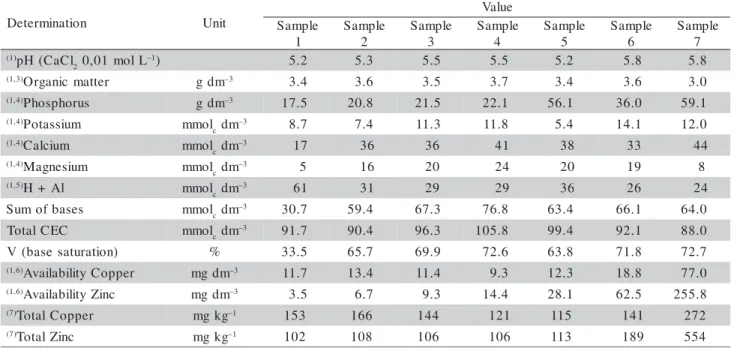
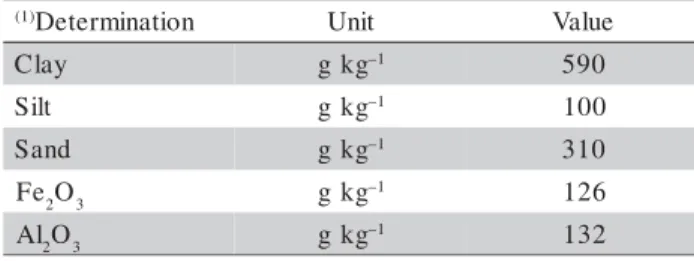
The soil used had been accidentally contami-nated presenting high levels of trace elements (Table 1). Samples of a Typic Hapludox were colleted in Paulínia, São Paulo state, Brazil (22°45’ S, 47°09’ W) (Table 2). Samples were taken at a 0–20 cm depth in
n o i t a n i m r e t e
D Unit
e u l a V e l p m a S 1 e l p m a S 2 e l p m a S 3 e l p m a S 4 e l p m a S 5 e l p m a S 6 e l p m a S 7 ) 1
( pH(CaCl
20,01molL 1
–) 5.2 5.3 5.5 5.5 5.2 5.8 5.8
) 3 , 1
( Organicmatter gdm–3 3.4 3.6 3.5 3.7 3.4 3.6 3.0
) 4 , 1
( Phosphorus gdm–3 17.5 20.8 21.5 22.1 56.1 36.0 59.1
) 4 , 1
( Potassium mmol
c dm 3
– 8.7 7.4 11.3 11.8 5.4 14.1 12.0
) 4 , 1
( Calcium mmol
c dm 3
– 17 36 36 41 38 33 44
) 4 , 1
( Magnesium mmol
c dm 3
– 5 16 20 24 20 19 8
) 5 , 1
( H+Al mmol
c dm 3
– 61 31 29 29 36 26 24
s e s a b f o m u
S mmolc dm–3 30.7 59.4 67.3 76.8 63.4 66.1 64.0
C E C l a t o
T mmolc dm–3 91.7 90.4 96.3 105.8 99.4 92.1 88.0
) n o i t a r u t a s e s a b (
V % 33.5 65.7 69.9 72.6 63.8 71.8 72.7
) 6 , 1
( AvailabilityCopper mgdm–3 11.7 13.4 11.4 9.3 12.3 18.8 77.0
) 6 , 1
( AvailabilityZinc mgdm–3 3.5 6.7 9.3 14.4 28.1 62.5 255.8
) 7
( TotalCopper mgkg–1 153 166 144 121 115 141 272
) 7
( TotalZinc mgkg–1 102 108 106 106 113 189 554
Table 1- Chemical characterization of the soil samples.
(1)Raij et al. (2001); (2)Abreu & Andrade (2001); (3)colorimetric assay; (4)ion exchange resin; (5)calcium acetate 1 mol L–1; (6) DTPA at pH 7.3; (7) HCl/HNO
seven different points following a 100 m interval, start-ing from the source of pollution. They were air dried sieved (5 mm) and stored. Soil samples were placed in 5 dm–3 capacity pots. Irrigation was done in a way
not to exceed the maximum of 70% and minimum of 40% of the maximum water retention capacity, by daily weighting the pots.
The experiments were conducted in a green-house, in Piracicaba, SP, Brazil from November, 2004 to April, 2005. The plant species used were rice (Oriza
sativa L. cv. IAC 202) and soybean (Glycine max L.
cv. BRS 133). Fertilization with NPK was done ac-cording to each crop need A randomized experimental design was used, in a factorial scheme 7 × 2 (seven soil samples and two plants species), with four repli-cates, performing a total of 56 experimental units.
Ten seeds were sown in each pot on Novem-ber 25, 2004, both for rice and soybeans. Germina-tion began on the 28th day. Plants were thinned to four
per pot on December 11, 2004. The diagnostic leaves were collected following Malavolta et al. (1997). For rice, the leaf Y (immediately below the newest uncoiled leaf) was collected in the middle of the tilling period, 50 days after sowing. For soybean, the first ripe leaf starting from the tip of the branch was collected, at the end of the flowering period (on the 69th day after
sowing). The samples were stored in paper bags and dried. Thereafter, the plants were grown until matu-ration and cut close to the soil surface. The colleted material was washed in running water and rinsed in distilled water. Afterwards, they were dried in an aer-ated stove (temperature maintained between 60–70ºC), weighed and crushed in a Wiley mill. Digestion was done in an open system, using a slight modification of the method described by Oliva et al. (2003).
The available concentrations of Cu and Zn in soil samples were extracted by solutions of Mehlich-1 (HCl 0.05 mol L–1 + H
2SO4 0.0125 mol L
–1; Silva,
1999b), HCl 0.1 mol L–1 (Wear & Sommer, 1947) and
DTPA at pH 7.3 (Lindsay & Norvell, 1978).
The sequential extraction for Cu and Zn in each soil fraction after plant cultivation was per-formed according to Ahnstrom & Parker (1999),
ex-cept for the carbonate phase, since carbonates is known to be present in very small concentrations in this soil. 2 g samples of were crushed in a porcelain mortar with the aim of mixing the components and make easy the extractors action. All extractions were carried out in 50 mL centrifuge tubes. To extract Cu and Zn from the fraction 1 (soluble + exchangeable (S/Ex)), 15 mL of Sr(NO3)2 0.1 mol L–1 was added to
the tubes, agitating it for 2 h at low speed. Afterwards, samples were centrifuged (2,500 rpm for 10 minutes). The supernatant was filtered (with quantitative blue strip paper) to 50 mL volumetric flasks. This proce-dure was repeated three times. For the extraction from fraction 2 (linked the organic matter (OM)), 5 mL of 5% NaOCl was used (with pH adjusted to 8.5 with concentrated HNO3). Tubes were placed in a water bath (90–95 °C)for 30 minutes under slow agitation. After this time, the samples were centrifuged (2,500 rpm during 10 minutes) and the supernatant filtered (quantitative blue strip paper) and collected in 50 mL volumetric flasks. This procedure was repeated until the organic matter was destroyed, that is, when foam was no longer present.
For the extraction from fraction 3 ( oxide tied (Ox)), 20 mL of a solution containing 0.2 mol L–1
ox-alic acid +0.2 mol L–1 NH
4 oxalate + 0.1 mol L
–1
ascor-bic acid (adjusted to pH 3.0with NH4OH) was added. The tubes were placed in a water bath (90–95°C)for 30 minutes under slow agitation. Afterwards, the samples were centrifuged (2,500 rpm for 10 minutes) and the supernatant was again filtered with quantita-tive blue strip paper filter and collected in 100 mL volu-metric balloon. This procedure was repeated until the color of the soil turned gray (without iron) and the su-pernatant turned yellowish. At the end of each extrac-tion phase (fracextrac-tions 1, 2 and 3), the soil samples were washed with 5 mL of NaCl 0.1 mol L–1, centrifuged
at 2,500 rpm for 10 minutes, and the supernatant added to the one already got from the respective fraction. Afterwards, 1 mL of concentrated HNO3 was added, and the volume was completed with distilled water to 50 mL, 50 mL and 100 mL for the extracts from the fractions 1, 2 and 3, respectively.
The extraction of the total (T) concentration of Cu and Zn from the soil samples was done with aqua regia (HCl/HNO3 3:1) in a microwave oven, ac-cording to Nieuwenhuize et al. (1991). The concen-trations of Cu and Zn in the extracts were analyzed by an inductively coupled plasma optical emission spectrometer (ICP-OES).
The data on the concentration of Cu and Zn extracted form the fractions S/Ex, OM, Ox, and the T concentration were submitted to linear correlation analysis with the data obtained from the Mehlich-1, HCl
) 1
( Determination Unit Value
y a l
C gkg–1 590
t l i
S gkg–1 100
d n a
S gkg–1 310
e
F 2O3 gkg–1 126
l
A2O3 gkg–1 132
Table 2 - Particle size, iron and aluminum oxides content in the studied soil.
0.1 mol L–1 and DTPA, extraction methods, as well
as with the data obtained from the extractions in the leaf diagnosis (DL) and in the leaf end of cycle (LCE) separately from both rice and soybean. The linear cor-relation was calculated using SAS for Windows ver-sion 6.12 (SAS, 1985).
RESULTS AND DISCUSSION
Soybean
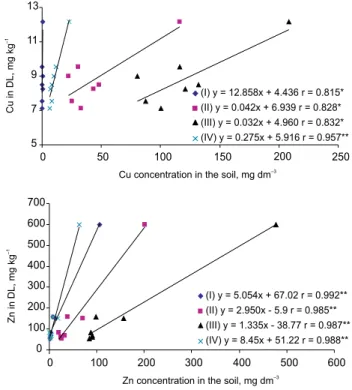
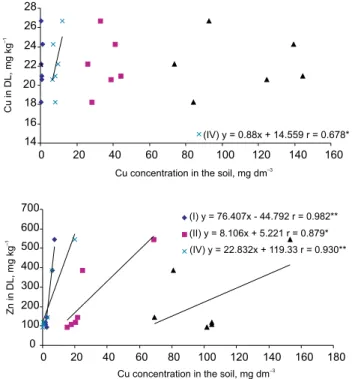
The sequential extraction method has been used in an attempt to evaluate the relationship between the bioavailable fraction of the metal in the soil and the metal content in the plant (Zhang et al., 1998; Buanuam et al., 2005). The concentrations Cu and Zn extracted from the fraction S/Ex, linked to OM and OX, and the T concentration were highly and positively correlated with the concentrations obtained in DL and LCE (Fig-ures 1 and 2). Only the concentration S/Ex of Cu was not correlated with the concentration in LCE. Possi-bly, this was due to presence of Zn in high concen-trations. High activities of Zn+2 in the soil solution may
inhibit the Cu+2 uptake (Alloway, 1995). The T
con-centration in the soil is not considered to be a reliable parameter to predict phytoavailability (Zhang et al., 1998). However, it can be noticed in this study when the soil is contaminated with high concentrations of
trace elements, the total concentration is well corre-lated with the concentrations in plants (DL and LCE). Both Cu and Zn have high affinity for the organic mat-ter. Gomes et al. (1997) reported that Cu reacts with the groups COOH and OH - phenol, simultaneously, forming highly stable chemical complexes.
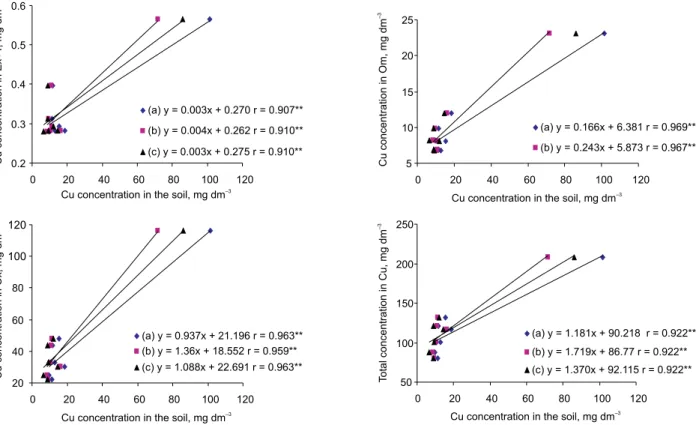
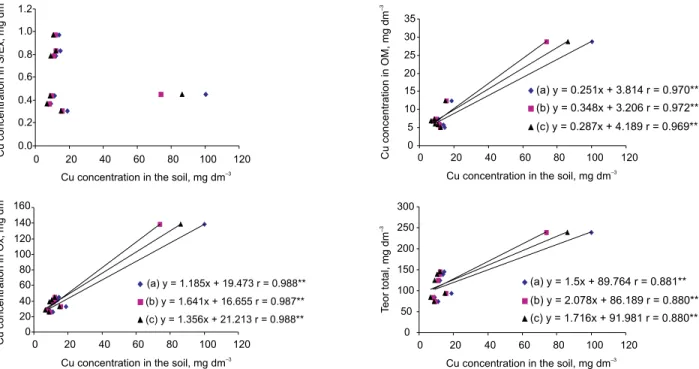
The concentrations obtained in the sequential extraction (from the fractions S/Ex, linked to OM and Ox) and the T concentration were highly correlated with the available concentrations extracted by the meth-ods Mehlich-1, DTPA and HCl 0.1 mol L–1, both for
Cu and Zn (p < 0.01; Figures 3 and 4). Such a result
can be explained by the elevated concentrations of Cu and Zn in the studied soil. It is possible that in a soil with low concentrations of Cu and Zn, for example 0.8 mg dm–3 to Cu and 1.2 mg dm–3 to Zn extracts by
DTPA (Raij et al., 1997), the same results will not be obtained. Zhang et al. (1998) did not obtain significant correlations among the concentrations uptake by the plants and the concentrations obtained in the fractions in soils with standard concentrations of Cu and Zn.
The acid extractors such as Mehlich-1 and HCl 0.1 mol L–1 extract the trace elements mainly by
dis-solving the clay minerals. The amount extracted will depend on the acid solution concentration, on the time of extraction and on the solution/soil ratio. The acids extract amounts close to the total concentration due
Figure 1 - Linear correlations among Cu and Zn concentrations in the leaves at the end of the cycle (LEC) of soybean and soluble/exchangeable concentrations (I), linked to oxides (II) total concentrations (III) and linked the organic matter (IV) (**significant to the 1%; *significant to the 5%).
Figure 3 - Linear correlations among soluble/exchangeable concentrations (S/Ex), linked the organic matter (OM), linked to oxides (Ox) and total concentrations (T) and extracted available concentrations for the solutions Mehlich-1 (a), DTPA (b) and HCl 0.1 mol L–1(c), after the cultivation of soybean (**significant to the 1%; *significant to the 5%).
to their dissolving power, (even when partially) (Tay-lor et al., 1993; Roca & Pomares, 1991). Chelant so-lutions act by combining with metallic ions thereby forming soluble complexes, and reducing the ionic ac-tivity in soil solution. Consequently, the ions are des-orbed from the surface of the soil solids to reestab-lish the solution ionic equilibrium (Abreu et al., 2002). Ure (1991) considers that the sequential extraction acts in the soil through chemical reagents, or solvents, de-nominated extractors, specifically to extract elements linked or associated with the clay fraction. Perhaps, for that reason, there was a positive correlation among the concentrations obtained for the fractions of the soil with the obtained with the extractors, Mehlich-1 and HCl 0.1 mol L–1 (acids) and DTPA (chelating agents).
Rice
The concentration of Cu and Zn in LCE were correlated to the ones extracted by the sequential ex-traction method (Figure 5), except for Cu extracted from the S/Ex fraction. Such correlation was not ob-tained being probably influenced by Zn concentrations in the soil or unavailable forms of Cu in the soil. The amount of metals absorbed is affected by many fac-tors and it is difficult to determine the relationship be-tween plant uptake and the metal fractions in the soil with simple correlation analysis (Zhang et al., 1998). Cu concentrations in DL were correlated only with the
concentration obtained in OM. Zn concentration in DL were significantly correlated with the concentrations obtained from all the fractions, but not with T concen-tration (Figure 6). Perhaps the adsorption is the main process to be considered to understand the availability of Cu and Zn, being indicative of the solubility and mo-bility of those elements and the consequent availamo-bility for the plants (Nascimento & Fontes, 2004).
Zhang et al. (1998) correlating the concentra-tions of Cu and Zn obtained in the different parts of the corn with the concentrations of Cu and Zn in the fractions of the soil (exchangeable, bound to oxide or organic matter) did not obtain significant correlation. The concentrations of Zn in the corn roots presented significant correlation with the fraction bound to ox-ides of Fe-Mn.
Usually, the total amount of trace elements is a parameter used for to control soil pollution (Camargo et al., 2000). As already mentioned, the T concentra-tion of traces elements in the soil is not a reliable pa-rameter to express their plant availability. Contrary to what was observed for soybean, there was no corre-lation between the concentrations in DL and T for rice. Obata (1995) observed Cu concentrations in rice from 5 to 20 mg kg–1. The excess of Cu in the soil cause
damage to the plant only when the soluble concentra-tion of this element goes beyond 125 mg dm–3. For
Zn, the normal concentration in rice varies from 30
Figure 5 - Linear correlations among Cu and Zn concentrations in the leaves at the end (LEC) of the rice cycle and soluble/ exchangeable concentrations (I), linked to oxides (II), total concentrations (III) and linked the organic matter (IV) (**significant to the 1%; *significant to the 5%).
to 100 mg kg–1, indicating that this species is relatively
tolerant to its excess (Obata, 1995). If toxicity occurs, it appears in the form of a decrease in the height of the plant and in the tiller number (Obata, 1995).
The absorption of Cu by the plants do not cor-relate very well with the concentrations of Cu in the
soil and/or with amounts extracted by the several ex-tractors due to its inconstant chemical activity in soil solutions (Alloway, 1995). Both for Cu and Zn the “available” concentrations extracted by Mehlich-1, HCl and DTPA had highly significant correlations (p < 0.01)
with the concentrations extracted by sequential
extrac-Figure 7 - Linear correlations among soluble/exchangeable concentrations (S/Ex), linked the organic matter (OM), linked to oxides (Ox) and total concentrations (T) and extracted available concentrations for the solutions Mehlich-1 (a), DTPA (b) and HCl 0.1mol L–1 (c), after the cultivation of rice (**significant to the 1%; *significant to the 5%).
tors in all the fractions (S/EX, linked to OM and Ox) and the T concentration, except for the Cu concen-tration from the S/Ex fraction (Figures 7 and 8).
A great number of factors influence the avail-ability and sorption of trace elements in the soil, such as the characteristics of the colloids (clay minerals, oxides and organic matter), pH, ionic concentration of the solution, presence of cations and organic and inorganic ligands (Ross, 1994). Considering that in this study the soil has high concentrations of Cu and Zn, it is plausible that concentrations linked to Ox, the T concentrations correlated with the “available” concentrations extracted by the solutions, since great part of Cu and Zn is soluble or quickly available in the soil. Furthermore, the concentrations of Zn ac-cessed by the extractors Mehlich-1, DTPA and HCl 0.1 mol L–1 had highly significant correlations with
the concentrations in the fractions S/EX and linked to OM, which are potential reservoirs of those ele-ments for the plants. These extractors possess ap-propriate capacity of extraction of the most available forms (Shuman, 1988). Trace elements linked to Ox are not available to plants (Shuman, 1988). However, when a soil exhibits high levels of trace elements, this could not be observed, probably because the reac-tions of adsorption-desorption tend to be faster, caused by the competition among ions for the sur-faces adsorbents (Harter, 1991).
In trace elements bioavailability studies of contaminated soil, is generally accepted that trace el-ements bioavailability in soils depends on many fac-tors. These factors are not completely understood and simple relationships are seldom found in natural soil systems between the plant trace elements levels and the total amount of the trace elements concentrations in soil. In some investigations, correlations between specific trace elements fractions and plant trace ele-ments contents were found. For example, in soils that had been amended with composted or liquid sewage sludge it was found that Zn in exchangeable and ox-ide fractions had a strong correlation with Zn in the leaves of barley (Hordeum vulgar). A simple
relation-ship existed between Co in the exchangeable frac-tion and the Co concentrafrac-tion in winter wheat (
Triti-cum aestivum L.) and alfalfa (Medicago sativa L.)
while the adsorption of Ni, Cu and Pb by plants could be predicted by a stepwise multiple regression pro-cedure. These studies show the possibility for using sequential extraction data to evaluate the correlation between trace elements in soil and plant uptake. Therefore, the relationship between plant uptake of trace elements and the trace elements concentration in some fractions was also investigated (Buanuam et al., 2005).
CONCLUSIONS
For the soybean, both Cu and Zn concentra-tions in LCE and DL are derived from the fracconcentra-tions bound to the OM, to Ox and the T contents. How-ever, for rice, Zn concentrations in LCE and DL seems to be derived from the S/Ex, OM and Ox fractions, while Cu concentration in LEC were derived from the OM, Ox fractions and T contents.
The DTPA, HCl 0.1 mol L–1 and Mehlich-1
extractors, under this soil condition, after the cultiva-tion of both cultures, extracted Cu and Zn from the OM, Ox fractions and T concentration.
REFERENCES
ABREU, C.A.; ABREU, M.F.; SOARES, L.H.; ANDRADE, J.C. The effects of the DTPA extraction conditions on the determination of micronutrients in Brazilian soils. Communications in Soil Science and Plant Analysis, v.28, p.1-11, 1997.
ABREU, C.A.; ABREU, M.F.; BERTON, R.S. Análise química de solos para metais pesados. Tópicos Ciência do Solo, v.2, p.1-48, 2002.
ABREU, C.A.; ANDRADE, J.C. Determinação de cobre, ferro, manganês, zinco, cádmio, cromo, níquel e chumbo em solos usando a solução de DTPA em pH 7,3. In: RAIJ, B. van; ANDRADE, J.C.; CANTARELLA, H.; QUAGGIO, J.A. (Ed.) Análise química para avaliação da fertilidade de solos tropicais. Campinas: Instituto Agronômico, 2001. cap.16, p.240-250.
AHNSTROM, Z.S.; PARKER, D.R. Development and assessment of a sequential extraction procedure for the fractionation of soil cadmium. Soil Science Society of America Journal, v.63, p.1650-1658, 1999.
ALLOWAY, B.J. Heavy metals in soils. 2 ed. London: Blackie Academic & Professional, 1995. 368p.
AMARAL SOBRINHO, N.M.B.; VELLOSO, A.C.X.; OLIVEIRA, C. Solubilidade de metais pesados em solo tratado com resíduo siderúrgico. Revista Brasileira de Ciência do Solo, v.21, p.9-16, 1997.
ANJOS, A.R.M.; MATTIAZZO, M.E. Extratores para Cd, Cu, Cr, Mn, Ni, Pb e Zn em Latossolos tratados com biossólido e cultivados com milho. Scientia Agricola, v.58, p.337-344, 2001.
BUANUAM, J.; SHIOWATANA, J.; PONGSAKUL, P. Fractionation and elemental association of Zn, Cd and Pb in soils contaminated by Zn minings using a continuous-flow sequential extraction.
Journal of Environmental Monitoring, v.7, p.778-784,
2005.
CAMARGO, O.A.; MONIZ, A.C.; JORGE, J.A.; VALADARES, J.M.S. Métodos de análise química, mineralógica e física de solos do Instituto Agronômico. Campinas: Instituto Agronômico, 1986. 94p.
CAMARGO, M.S.; ANJOS, A.R.M.; ROSSI, C.; MALAVOLTA, E. Adubação fosfatada e metais pesados em latossolo cultivado com arroz. Scientia Agricola, v.57, p.513-518, 2000. COSTA, A.C.S.; ALMEIDA, V.C.; LENZI, E.; NOVAKI, J.
Determinação de cobre, alumínio e ferro em solos derivados do basalto através de extrações seqüenciais. Química Nova, v.25, p.548-552, 2002.
HARTER, R.D. Micronutrient adsorption-desorption reactions in soils. In: MORTVERDT, J.J.; COX, F.R.; SHUMAN, L.M.; WELCH, R.M. (Ed.) Micronutrients in the agriculture. Madison: Soil Science Society of America, 1991. p.59-88. LINDSAY, W.L.; NORVELL, W.A. Development of a DTPA soil
test for zinc, iron, manganese and copper. Soil Science Society of American Journal, v.42, p.421-428, 1978.
MALAVOLTA, E.; VITTI, G.C.; OLIVEIRA, S.A. Avaliação do estado nutricional das plantas: princípios e aplicações. 2 ed. Piracicaba: POTAFOS, 1997. 319p.
MENDES, A.M.S.; DUDA, G.P.; NASCIMENTO, C.W.A.; SILVA, M.O. Bioavailability of cadmium and lead in a soil amended with phosphorus fertilizers. Scientia Agricola, v.63, p.328-332, 2006.
NASCIMENTO, C.W.A; FONTES, R.L.F. Correlação entre características de Latossolos e parâmetros de equações de adsorção de cobre e zinco. Revista Brasileira de Ciencia do Solo, v.28, p.965-971, 2004.
NIEUWENHUIZE, J.; POLEY-VOS, C.H.; AKKER, A.H. van den; DELFT, W. van. Comparison of microwave and conventional extraction techniques for the determinations of metals in soil, sediment and sludge sample by atomic spectrometry. The Analyst, v.116, p.347-351, 1991.
OBATA, H. Micro essential elements. In: MATSUO, T.; KUMAZAWA, K.; ISHII, R.; ISHIHARA, K.; HIRATA, H. (Ed.) Science of the rice plant. Tokyo: Food and Agriculture Policy Research Center, 1995. cap.2, p.420-433.
OLIVA, S.R.; RAITIO, H.; MINGORANCE, M.D. Comparison of two wet digestion procedures for multi-element analysis of plant samples. Communications in Soil Science and Plant Analysis, v.34, p.2913-2923, 2003.
OLIVEIRA, F.C. Disposição de lodo de esgoto e composto de lixo num Latossolo Vermelho-amarelo cultivado com cana-de-açúcar. Piracicaba: USP/ESALQ, 2000. 247p. (Doutorado).
PAIVA, H.N.; CARVALHO, J.G.; SIQUEIRA, J.D.; CORRÊA, J.B.D. Teor, conteúdo e índice de translocação de nutrientes em mudas de cedro (Cedrela fissilis vell.) submetidas a doses crescentes de
zinco. Ciência Florestal, v.13, p.1-10, 2002.
RAIJ, B. van; QUAGGIO, J.A.; CANTARELLA, H.; ABREU, C.A. Os métodos de análise química do sistema IAC de análise de solo no contexto nacional. In: RAIJ, B. van; ANDRADE, J.C.; CANTARELLA, H.; QUAGGIO, J.A. (Ed.) Análise química para avaliação da fertilidade de solos tropicais. Campinas: Instituto Agronômico, 2001. cap.17, p.251-261.
RAIJ, B. van; CANTARELA, H.; QUAGGIO, J.A.; FURLANI, A.M.C. (Ed.) Recomendações de adubação e calagem para o Estado de São Paulo. 2. ed. Campinas: Instituto Agronômico, 1997. 285p.
ROCA, J.; POMARES, F. Prediction of available heavy metals by six chemical extractants in a sewage sludge-amended soil. Communications in Soil Science and Plant Analysis, v.22, p.2119-2136, 1991.
ROSS, S.M. Retention, transformation and mobility of toxic metals in soil-plant systems. In: ROSS, S.M. (Ed.) Toxic metals in soil-plant systems. Chichester: John Wiley, p.63-152, 1994. SAS INSTITUTE. SAS user’s guide: statistics. 5 ed. Carey; SAS
Institute, 1985.
SHUMAN, L.M. Effect of phosphorus level on extractable micronutrients and their distribution among soil fractions. Soil Science of America Journal, v.52, p.136-141, 1988. SILVA, F.A.M. Fracionamento e biodisponibilidade de metais para
o feijoeiro (Pahseolus vulgaris L.) em solos tratados com pó de forno de aciaria elétrica. Lavras: UFL, 1999a. 80p. (Mestrado). SILVA, F.C. Manual de análises químicas de solos, plantas e
fertilizantes. Brasília: Embrapa, 1999b. 370p.
TAYLOR, R.W.; IBEABUCHI, I.O.; SISTANI, K.R.; SHUFORD, J.W. Heavy metal concentration in forage and extractabilility from some acid mine spoils. Water, Air and Soil Pollution, v.68, p.363-372, 1993.
TESSIER, A.; CAMPBELL, P.G.C.; BISSON, M. Sequential extraction procedure for the speciation of particulate trace metals. Analytical Chemistry, v.51, p.844-851, 1979. URE, A.M. Trace elements in soil, soils extracts in solution.
Microchymica Acta, v.2, p.49-57, 1991.
ZHANG, T.; SHAN, X.; LI, F. Comparison of two sequential extraction procedures for speciation analysis of metals in soils and plant availability. Communication in Soil Science and Plant Analysis, v.29, p.1023-1034, 1998.
WEAR, J.I.; SOMMER, A.L. Acid-extractable zinc of soils in relation to the occurrence of zinc deficiency symptoms of corns: a method of analysis. Soil Science Society of America Proceedings, v.12, p.143-144, 1947.