354 Rev Bras Med Esporte – Vol. 17, No 5 – Set/Out, 2011
Relationship Between Oxygen Uptake Kinetics
and the Running Strategy on a 10 Km Race
Mayara Vieira Damasceno1 Rômulo Cássio de Moraes Bertuzzi2 Flavio de Oliveira Pires2
Carlos Rafaell Correia de Oliveira1 Ronaldo Vilela Barros2
João Fernando Laurito Gagliardi2 Maria Augusta Peduti Dal Molin Kiss2 Adriano Eduardo Lima-Silva1
1. Research Group in
SportsSciences. Nutrition College, Federal University of Alagoas – Maceió, AL.
2. Laboratory of Energetic determinants of SportsPerformance. Physical Education and Sport School, Universiy of São Paulo – São Paulo, SP.
Mailing address:
Faculdade de Nutrição – Universidade Federal de Alagoas (UFAL)
Avenida Lorival Melo Mota, S/N – Campus A.C. Simões, Tabuleiro do Martins – 57072-970 – Maceió, AL, Brazil. E-mail: [email protected]
ABSTRACT
This study examined the influence of the O2 kinetics on the running strategy adopted during
a 10km running race in runners with different performance levels. Twenty-one runners (28.5 ± 5.3 years; 17.6 ± 7.3 cm; 66.3 ± 9.3 kg) performed 1) a test with increments of 1.2 km.h-1 every 3 min until
exhaustion; 2) one 6-min test of constant velocity at 9 km.h-1 for determination of O
2 kinetics and;
3) a 10 km time trial simulation. The subjects were divided into two groups, Moderated Performance (MP) and Low Perfomance (LP), based on the 10-km running performance. Mean velocity (MP= 16.9 ± 0.8 vs BP= 14.9 ± 1 km.h-1) on the 10km race was significantly different (p<0.05) between
groups. There were no differences (p>0.05) between groups in any kinetics parameters analyzed. However, the O2 increase amplitude (A1 parameter) was inversely correlated with mean velocity (r= -0.48, p < 0.05) and with the partial velocities on time trial (r between -0.44 and -0.48, p < 0.05), except for the last session (r=-0.19, p > 0.05). In conclusion, the correlation of A1 parameter with the partial velocities suggests an influence of running economy on the strategy adopted during the 10 km time trial.
Keywords: athletic performance, pulmonary gas exchange, physical exertion.
INTRODUCTION
In events of medium and long duration(1-5), the strategy applied usually applied by the athletes
is based on a faster exit, followed by gradual decrease in the mean distance of the event, and final acceleration. It is believed that this fast exit may favor aerobic performance during the event due to acceleration in the kinetics of the oxygen consumption ( O2). Draper et al.(6) showed that in
different running strategy situations, the one which reached higher percentages of O2max was the strategy which had faster exit in the first 200m. Kilding et al.(7) showed that lower values of the
time constant (τ), which is a parameter which describes the O2 response time when in a given exercise, were negatively correlated with the initial velocities of 800, 1,500 and 3,000m events. In fact, Bishop et al.(8) demonstrated that making an athlete perform a fast exit produces higher
O2 values in the initial moments of a two-minute test in a kayak ergometer, when compared to a strategy where velocity is kept constant from the beginning of the event (even pacing). These researchers(7,8) suggested that this higher consumption after a fast exit would be related to higher
rates of phosphoocreatine breaks in the beginning of the event. Similarly, other studies(1,9,10) observed that the O
2 increases more rapidly in the beginning of
the test at the fast exit condition when compared to the even pacing. When comparing the O2
response in running events with different durations, Duffield et al.(10) observed that the faster exit
velocity would be related to lower τ values. These findings confimr the hypothesis that a faster exit would be directly related to the O2 temporal response. Additionally, some authors(9,10) suggest
that this fast exit may favor performance both in high-intensity and short duration activities(9) and
in middle-distance events(10).
Among the main factors which affect the O2 kinetics, we highlight the training status(7,11,12).
In a study, Phillips et al.(11) demonstrated that immediately after 30 days of aerobic training, the
individuals presented decrease in τ, lower blood lactate concentrations, higher mitochondrial po-tential and higher O2peak. Thus, it can be speculated that athletes with higher performance level for having lower O2 response time, would be Abel to impose a faster rhythm in the beginning of the event, when compared to the less trained ones.
In fact, Lima-Silva et al.(3) demonstrated that athletes with higher performance level adopted
running strategy with faster exit in a 10km event, reaching the highest velocities right in the begin-ning of the race (fast-start), while runners with lower level adopted a more conservative strategy, with discreet initial increase and not different from the subsequent velocities of the event. Thus, considering the previously highlighted relationship between the O2 kinetics and running strategy,
ORIGINAL ARTICLE
355
Rev Bras Med Esporte – Vol. 17, No 5 – Set/Out, 2011
ning period at 9km∙h-1. This velocity was chosen for representing
the moderate domain for all subjects, since it is below the lactate threshold(17).
In order to keep velocity constant, the subjects received sound signs through an amplified sound system. These signs determined the necessary rhythm to complete 20-meter dis-tances. The gas exchanges were measured breath after breath in the entire test (Cosmed K4b2, Roma, Italy).
10km running test
During the 10km event simulation, water was offered ad
li-bitum. The subjects were told to complete the event as fast as
possible, as if they were in a competition event. Verbal stimuli were given during the entire event. The times were recorded at every 400 meters and the velocity mean of each one these distances was calculated.
Data analysis
The event was divided in three phases: 1) initial (0-1.200m); 2) intermediate (1,200-9,200m); and 3) final (9,200-10.000m). The velocity mean of these distances was calculated and compared between groups, as well as within the same group.
To analyze the O2 kinetics, the O2 values of the constant load test were interpolated at every 5s, according to Slawinski et al.(18), and the curve monoexponentially adjusted by the
equa-tion below:
O2(t) = A0 + A1 + (1 - e-(t- δ) /τ)
Where O2 (t) is the oxygen consumption in a given time (t); A0 is the oxygen consumption of the baseline (rest); A1 is the O2; increase amplitude, δ is the delay time; and τ is the time constant.
The monoexponential adjustment was chosen due to the con-stant load test has been performed below the lactate threshold (9km.h-1) for all subjects in both groups, according to suggestion
by Özyener et al.(19).
STATISTICAL ANALYSIS
The data distribution was verified by the Shapiro-Wilk test. The Student’s t test for independent measurements was used to compare the descriptive, physiological and performance variables between the two groups. Factorial ANOVA (group x distance), with repeated measurements in the second factor was used for analysis of the running strategy. Subsequently, the isolate effect of the distance was separately investigated within each group using ANOVA with repeated measurements, followed by the Bonferroni post-hoc test. The Pearson correlation coefficient was calculated to determine the possible associations between the velocity partials and the kinetic parameters. The data were presented as mean and standard deviation and the significance level adopted was 5% (p < 0.05).
RESULTS
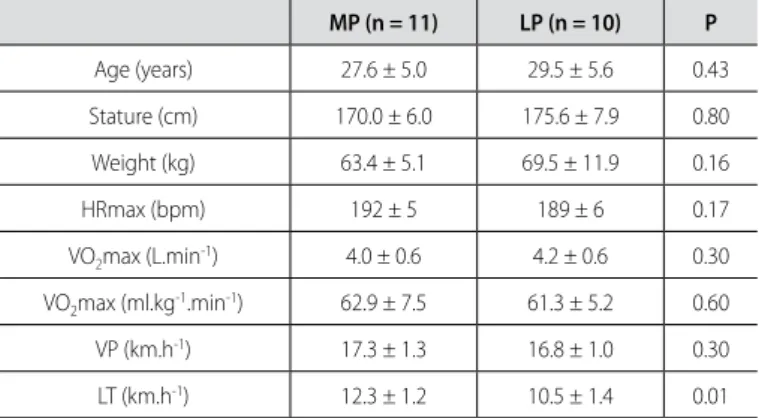
The groups’ characteristics are presented in table 1. There were not significant differences between groups for the age, stature and weight variables, nor for the HRmax, O2max, relative O2max and VP (P > 0.05).However, the LT was significantly higher in the MPgroup than in the LPgroup (P < 0.05).
Mean velocity and time in the 10km event were significantly it seems reasonable to suppose that the most trained group had
been able to reach higher velocities at the beginning of the event due to lower τ. However, until the present moment, no study has analyzed the correlation between the O2 temporal response and the faster exit during a 10km event.
Thus, the aim of this study was to examine the relationship between the O2 kinetic response and the running strategy adopted in a 10km event by runners with different performan-ce levels. The hypothesis of the present study is that, in more trained runners, the τ would be lower, which could be directly related to higher exit velocity in a 10km event.
MATERIALS AND METHODS
Subjects
Twenty-one long-distance runners (28.5 ± 5.3 years; 172.6 ± 7.3cm; 66.3 ± 9.3kg; 62.1 ± 6.4ml/kg/min), of regional and na-tional level, participated in this study. The subjects were divided in two groups: moderate performance (MP, n = 11) and low per-formance (LP, n = 10). The athletes who presented event time lower than the group mean (37.8 minutes) were considered MP, while the athletes with higher time, LP. All volunteers signed the Free and Clarified Consent Form containing the description of all risks and benefits of the experimental procedures. The study was approved by the Ethics Committee of the Physical Education and Sports School of the University of São Paulo (USP).
Experimental outlining
The participants were at the laboratory in three different occa-sions, being each one separated by a minimum of 48 hours. Each participant completed: 1) one maximum incremental test for de-termination of the O2max and peak velocity; 2) one submaximal
constant test on a tracking field in 9km.h-1 velocity for
determina-tion of the O2 kinetics and 3) one simulation of a 10km event on tracking field for analysis of the running strategy. The tests performed on the track were conducted at the same day period, with similar wind and temperature conditions (19 to 22ºC).
Incremental test
After three-minute warm-up at 6km.h-1, the velocity was
increased in 1.2km.h-1 at every three minutes, until voluntary
exhaustion(13). The treadmill was kept with 1% of inclination to
simulate the running on track(14). The O
2 was measured breath
after breath during the entire test (K4b2, Cosmed, Roma, Italy).
The gas analyzer was calibrated before each test according to the manufacturer’s specifications (instructions manual of the K4b2).
Heart rate (HR) was continuously measured using a cardiofre-quencimeter (Polar Vantage NV, Kempele, Finland).
The O2max was identified as the highest value reached
during the last stage of the incremental test(3). The highest
veloc-ity reached during a complete stage in the test was recorded as the velocity peak (VP)(15). The HR
max was determined as the
high-est value recorded at the end of the last stage of the incremental test. The lactate threshold (LT) was determined for each subject as the running velocity associated with the first increase sign in the blood lactate above 1mmol.L-1(16).
Constant velocity test
run-356 Rev Bras Med Esporte – Vol. 17, No 5 – Set/Out, 2011
different between groups (p < 0.001). Mean velocity in the MP group was 16.9 ± 0.8km.h-1, while in the LPgroup it was 14.9 ±
1.0km.h-1. Consequently, the time spent to complete the 10 km
event in the MPgroup was 35.5 ± 1.6 min, while in the LP group it was 40.4 ± 2.8 min.
A significant effect of the distance over the running velocity was observed (P < 0.05), but with no interaction effects with the groups (P > 0.05). Separately assessing the groups, it can be observed that the MP group started the event with higher velocity than the mean velocity in the race (first 400m: 18.7 ± 1.3 and 800m: 18.4 ± 1km.h-1), gradually decreasing it in the
in-termediate distance of the event (1,600-9,200m: 16.7 ± 0.8km.h-1
and 9,600m: 16.5 ± 1km.h-1) (Figure 1). In the last 400m, there
was again acceleration (17.8 ± 0.8km.h-1), but which was not
significantly different from the previous velocities (p > 0.05). Nevertheless, the mean velocity of LP in the initial phase was not significantly different from the mean running velocity (first 400m: 15.8 ± 1.9 and 800m: 15.5 ± 1.2km.h-1) (p > 0.05),
showing a different strategy when compared to the HPgroup. Mean velocity of the intermediate distance of the event was very close to the mean velocity of the event (1,600-9,200m: 14.8 ± 1km.h-1). In the final distance, although it was possible to visually
observe increase (Figure 1) in velocity in the last 400m (16.3 ± 1.2km.h-1), there were no differences when compared to the
mean velocity (p > 0.05).
Concerning the O2 temporal response in the constant load test, the values are displayed in table 2. Significant differences have not been found between groups in any of the kinetic va-riables (A0, δ, τ and A1; p > 0.05).
Concerning the correlations between variables, neither the O2 of the baseline (A0) nor the delay time (δ) or the time constant (τ) were correlated with the total mean velocity or the velocity of the parts of the 10km race. However, the O2 increase amplitude (A1) was directly correlated with the total time to complete the
10km and inversely correlated with the total mean velocity of the event. Likewise, A1 was also associated with the mean velocity in each part in the 10km race, except for the final 400m distance (between 9,600m and 1,000m) (table 3).
Table 1. Descriptive and physiological characteristics of the high and low perfor-mance groups.
MP (n = 11) LP (n = 10) P
Age (years) 27.6 ± 5.0 29.5 ± 5.6 0.43
Stature (cm) 170.0 ± 6.0 175.6 ± 7.9 0.80
Weight (kg) 63.4 ± 5.1 69.5 ± 11.9 0.16
HRmax (bpm) 192 ± 5 189 ± 6 0.17
VO2max (L.min-1) 4.0 ± 0.6 4.2 ± 0.6 0.30
VO2max (ml.kg-1.min-1) 62.9 ± 7.5 61.3 ± 5.2 0.60
VP (km.h-1) 17.3 ± 1.3 16.8 ± 1.0 0.30
LT (km.h-1) 12.3 ± 1.2 10.5 ± 1.4 0.01
MP: moderate performance; LP: low performance; HRmax: maximum heart rate; VO2max: oxygen maximum consumption; VP: highest velocity reached during the incremental test; LT: lactate threshold
Table 2. Kinetic parameters of the oxygen parameters identiied during the con-stant velocity test.
MP (n = 11) LP (n = 10) P
A0 (ml.min-1) 498.2 ± 196.5 544.4 ± 94.5 0.50
TM (s) 2.5 ± 7.7 4.6 ± 5.5 0.50
I (s) 24.7 ± 6.4 26.9 ± 7.8 0.40
A1 (ml.min-1) 1386.4 ± 148.6 1682.1 ± 491.3 0.07
MP: moderate performance; LP: low performance; A0: O2 baseline; TM: delay time; I: time constant A1: O2 in-crease amplitude
Table 3. Correlation coeicient between the running velocity sections and the ki-netic parameters during the 10km event.
A0 TM I A1
Mean Vel.10km -0.30 -0.08 -0.26 -0.48*
Vel. 400m -0.27 -0.03 -0.18 -0.46*
Vel. 800m -0.22 -0.02 -0.12 -0.44*
Vel. 1,200m -0.23 -0.07 -0.18 -0.47*
Vel. 1,200-9,200m -0.32 -0.09 -0.28 -0.48*
Vel. 9,200m -0.45* -0.09 -0.25 -0.46*
Vel. 9,600m -0.08 0.04 -0.11 -0.19
Figure 1. Running strategy adopted by the groups.
*Significant difference of the 400 and 800m (p < 0.05); # significant difference of the mean running veloc-ity (p < 0.05).
distance (meters)
MP MP
V mean MP
V mean LP
V
elocit
y
DISCUSSION
The aim of the study was to assess the correlation between the adopted strategy during a simulated 10km event and the on
kinetics of the O2. One of the main findings of this study was that the group of MP runners started with velocity higher than the mean running velocity. The LP adopted a more conservative strategy, keeping constant velocity during the entire race. Howe-ver, the kinetic parameters analyzed were not different between groups, despite the differences of the A1 between groups be close to the statistical significance (p = 0.07). Finally, the A1 values were significantly correlated with the total and partial mean velocities, except for the last event distance.
The two groups MP and LP adopted different strategy profiles and different times to complete the race. Despite of that, there were not significant differences between groups in the physiolo-gical variables measured in the maximal incremental test, as the
O2max and the VP. In a study by Morgan et al.(20) with the subjects
trained in 10km race and with similar O2max values, significant correlation was found only between the running time and the running velocity in which the O2max is reached. This correlation was mainly explained by the running economy, which can be defined as the O2 for a given running velocity(21), showing that
the most economical subjects, even with similar O2max, could
357
Rev Bras Med Esporte – Vol. 17, No 5 – Set/Out, 2011
physiological variables besides these would be more sensitive to discriminate performance between groups.
The only kinetic parameter which presented correlation with the running velocity partials during the 10km event was the O2.
increase amplitude. Such fact shows that individuals who present lower amplitude reach higher velocities during all the sessions of the event, when compared to those with higher amplitude. Lower amplitude for the same running steady velocity (9km.h-1)
suggests that the MP subjects were economical, that is to say, performed the same task consuming less oxygen amount. In fact, from the mean A1 values (Table 2), it can be supposed that the MP group consumed approximately 300ml.min-1 less oxygen
than the LP group to perform the same task. However, this statement should be carefully seen, since despite the correla-tions between O2 increase amplitude and the velocity partials were significant, this methodology has not been considered standard for this measurement.
Despite this limitation, lower A1 in the MP group could be directly related to the strategy choice, which corroborates other findings in the literature(3). Lima-Silva et al.(3), when assessing 10km
runners, found negative correlations between running economy measured in 9 and 12km∙h-1 and all the velocity partials of a 10km
event, showing hence that the more economical the athletes, the higher the reached velocity during the event will be. It could also explain why the MP group adopted a faster exit, while the LP group, a more conservative strategy. The logic for the more economical subjects start faster is not very clear, but when con-suming more oxygen, the individuals of the MP group could save more energy avoiding the early installation of fatigue processes and therefore, increasing initial running velocity.
Many studies(11,21,22) showed improvement in O
2 kinetics
with training. Hagberg et al.(21) demonstrated that in aerobically
trained subjects the O2 response time may be reduced. Similarly, Phillips et al.(11) observed decrease in response time of the O
2
after four training days, when compared to the pre-training initial values. However, although in the present study the groups have presented different performance levels, the O2 response time did not present differences. The explanation for these results is not simple, since both groups had the same training time, the same quantity of performed events and similar O2max. Although some studies(7,8) showed that a fast exit is associated with kinetics
acceleration in the beginning of the event and that this fact would be benefic for increasing the aerobic participation, these differ-ences may have not been found here for two reasons. Studies(1,10)
which related the kinetic relation of the O2 with the exit velocity analyzed events with shorter distance than the measured in the present study (<5km) or also, differently from it, measured τ during the event(1,17) and not in a constant load test. These
methodologi-cal differences could explain the discrepancy between our results and the ones obtained in the literature.
Concluding, in groups of runners with different performance levels in a 10km event, different running strategies are adopted. The group with better performance seems to choose a faster exit, followed by velocity reduction in the intermediate distance of the event, with acceleration in the end, characterizing a rhythm in “U” shape. On the other hand, the group with lower level adopts a different strategy, with more constant velocities which do not differ from the mean running velocity, despite being possible to observe acceleration in the last part of the event. These different strategies may be attributed to the running economy, since in all measured kinetic parameters, the O2 increase amplitude has been correlated with performance in the 10km event. Concerning the time constant, our results do no corroborate the suggestion that a faster O2 kinetics could be related to the running strategy in the 10km or, specifically to a faster exit.
All authors have declared there is not any potential conflict of interests concerning this article.
REFERENCES
1. Hanon C, Leveque JM, Thomas C, Vivier L. Pacing strategy and VO2 kinetics during a 1500m race. Int
J Sports Med 2007;29:206-11.
2. Noakes TD, Lambert MI, Hauman R. Which lap is the slowest? An analysis of 32 world mile record performances. Br J Sports Med 2009;43:760-4.
3. Lima-Silva AE, Bertuzzi RCM, Pires FO, Barros RV, Gagliardi JF, Hammond J, et al. Effect of performance level on pacing strategy during a 10-km running race. Eur J Appl Physiol 2010;108:1045-53.
4. Atkison G, Brunskill A. Pacing strategies during a cycling time trial with simulated headwinds and tailwinds. Ergometrics 2000;43:1449-60.
5. Garland SW. An analysis of the pacing strategy adopted by elite competitors in 2000 m rowing. Br J Sports Med 2005;39:39-42.
6. Draper SB, Sandals LE, Wood DM, James DVB. Influence of pacing strategy on oxygen uptake during treadmill middle-distance running. Int J Sports Med 2006;27:37-42.
7. Kilding AE, Winter EM, Fysh M. Moderate-domain pulmonary oxygen uptake kinetics and endurance running performance. J Sports Sci 2005;24:1013-22.
8. Bishop D, Bonetti D, Dawson B. The influence of pacing strategy on VO2 and supramaximal kayak
performance. Med Sci Sports Exerc 2002;34:1041-7.
9. Jones AM, Wilkerson DP, Vanhatalo A, Burnley M. Influence of pacing strategy on O2 uptake and
exercise tolerance. Scand J Med Sci Sports 2008;18:615-26.
10. Duffield R, Bishop D, Dawson B. Comparison of the VO2 response to 800m, 1500m and 3000m track
running events. J Sports Med Phys Fitness 2006;46: 353-60.
11. Phillips SM, Green H, MacDonald MJ, Hughson RL. Progressive effect of endurance training on VO2
kinetics at the onset of submaximal exercise. J Appl Physiol 1995;79:1914-20.
12. Whipp BJ, Wasserman K. Oxygen uptake kinetics for various intensities of constant-load work. J Appl Physiol 1972;33:351-6.
13. Heck H, Mader A, Hess G, Mucke S, Muller R, Hollmann W. Justification of the 4-mmol/l lactate threshold. Int J Sports Med 1985;6:117-30.
14. Jones AM, Doust JH. A 1% treadmill grade most accurately reflects the energetic cost of outdoor running. J Sports Sci 1996;14:321-7.
15. Noakes TD, Myburgh KH, Schall R. Peak treadmill running velocity during the VO2max test predicts
running performance. J Sports Sci 1990;8:35-45.
16. Coyle EF, Coggan AR, Hopper MK, Walters TJ. Determinants of endurance in well-trained cyclists. J Appl Physiol 1988;64:2622-30.
17. Hanon C, Thomas C, Perrey S, Le Chevalier JM, Couturier A, Vanderwalle H. Oxygen uptake response to an 800-m running race. Int J Sports Med 2004;26:268-73.
18. Slawinski J, Demarle A, Koralsztein JP, Billat V. Effect of supra-lactate threshold training on the re-lationship between mechanical stride descriptors and aerobic energy cost in trained runners. Arch Physiol Biochem 2001;109:110-6.
19. Özyener F, Rossiter HB, Ward SA, Whipp BJ. Influence of exercise intensity on the on- and off-transient kinetics of pulmonary oxygen uptake in humans. J Physiol 2001;533:891-902.
20. Morgan DW, Baldini FD, Martin PE, Kohrt WM. Ten kilometer performance and predicted velocity at VO2max among well-trained male runners. Med Sci Sports Exerc 1989;21:78-83.
21. Hagberg JM, RC Hickson, AA, Ehsani, JO Holloszy. Faster adjustment to and recovery from submaximal exercise in the trained state. J Appl Physiol Respirat Environ Exerc Physiol 1980;48:218-24. 22. Whipp BJ. The slow component of O2 uptake kinetics during heavy exercise. Med Sci Sports Exerc