GOOD PRACTICES: FUNDAMENTALS OF CARE IN GERONTOLOGICAL NURSING
Daiana Patrícia Marchetti Pio
I, Lilian Andreia Fleck Reinato
II, Letícia Pimenta Lopes
II,
Juliano de Souza Caliari
II, Elucir Gir
I,III Universidade de São Paulo, Ribeirão Preto College of Nursing, Interunit Nursing Doctoral Program. Ribeirão Preto,São Paulo, Brazil.
II Universidade de São Paulo, Ribeirão Preto College of Nursing, Postgraduate Program in Fundamental Nursing. Ribeirão Preto, São Paulo, Brazil.
How to cite this article:
Pio DPM, Reinato LAF, Lopes LP, Souza JC, Gir E. Hospitalization of people 50 years old or older living with HIV/AIDS. Rev Bras Enfer [Internet]. 2017;70(4):845-50. [Thematic Edition “Good Practices: Fundamentals of care
in Gerontological Nursing”] DOI: http://dx.doi.org/10.1590/0034-7167-2017-0113
Submission: 02-21-2017 Approval: 04-17-2017
ABSTRACT
Objective: Identify the rate and predictive factors of the hospitalization of people living with HIV/AIDS (PLHA), aged 50 years
or older. Method: A quantitative, cross-sectional study was conducted at two inpatient units specialized in infectious diseases
in a teaching hospital. Data were gathered through individual interviews between August 2011 and February 2015. All ethical
precepts were followed. Results: Of the 532 admitted patients, 95 were PLHA 50 years old or older; 30.5% were admitted 3 to
4 times after being diagnosed with HIV/AIDS. Conclusion: Rate of hospitalization was 17.8%, and being 50 to 60 years old was
a protective factor against hospitalization.
Descriptors: Hospitalization; HIV; HIV Long-term Survivors; HIV Infections; Opportunistic Infections.
RESUMO
Objetivo: Identifi car a taxa e os fatores preditores para a hospitalização de pessoas vivendo com HIV/Aids (PVHA), com idade
igual ou superior a 50 anos. Método: Estudo quantitativo, transversal, realizado em duas unidades de internação especializadas em
cuidados às doenças infecciosas, de um hospital universitário. A coleta de dados foi realizada por meio de entrevista individual, no
período de agosto de 2011 a fevereiro de 2015. Todos os preceitos éticos foram contemplados. Resultados: Das 532 internações,
95 eram de PVHA com idade igual ou superior a 50 anos; 56,8% receberam o diagnóstico de HIV/Aids antes de terem completado
50 anos de idade; 30,5% foram hospitalizadas de 3 a 4 vezes após o diagnóstico da infecção pelo HIV/Aids. Conclusão: A taxa de
hospitalização foi de 17,8%, e a faixa etária de 50 a 60 anos foi fator de proteção para a hospitalização.
Descritores: Hospitalização; HIV; Sobreviventes de Longo Prazo ao HIV; Infecções por HIV; Infecções Oportunistas.
RESUMEN
Objetivo: Identifi car la tasa y los factores predictivos para hospitalización de personas viviendo con VIH/SIDA (PVHS), de edad
igual o superior a 50 años. Método: Estudio cuantitativo, transversal, realizado en dos unidades de internación especializadas
en cuidado de enfermedades infecciosas de un hospital universitario. Datos recolectados mediante entrevista individual, de
agosto de 2011 a febrero de 2015. Fueron contemplados todos los preceptos éticos. Resultados: De las 532 internaciones, 95
correspondían a PVVS con edad igual o superior a 50 años; 56,8% recibieron el diagnóstico de VIH/SIDA antes de llegar a sus
50 años; 30,5% fueron hospitalizadas de 3 a 4 veces después del diagnóstico de infección por VIH/SIDA. Conclusión: La tasa
de hospitalización fue del 17,8%, y la faja etaria de 50 a 60 años constituyó factor de protección para la hospitalización.
Descriptores: Hospitalización; VIH; Sobrevivientes de VIH a Largo Plazo; Infecciones por VIH; Infecciones Oportunistas.
Hospitalization of people 50 years old or older living with HIV/AIDS
Hospitalização de pessoas com 50 anos ou mais vivendo com HIV/Aids
Hospitalización de personas de 50 o más años viviendo con VIH/SIDA
RESEARCH
INTRODUCTION
Controlling infection with the human immunodeficiency virus (HIV) is one of the greatest current global concerns, leading to inter-government agreements involving joint measures to ensure that the
global epidemic no longer poses a threat to public health(1).
In Brazil, since June 2016, 842,710 cases of AIDS have been notified, which corresponds approximately to 0.4% of the Brazilian population infected by HIV. At the same time, this infection has been increasing progressively among the population aged 50 years or older, even though this age group
is not the most affected by the disease(2).
The advent of new technology has provided the popula-tion with greater life expectancy, resulting in the increase of individuals aged 50 years or older and who engage in more active social participation. This has culminated in the growth
of individuals infected by HIV in this age group(3).
Additionally, AIDS is now considered a chronic disease, given the evolution of available antiretroviral therapies, which enable greater survival rates and decrease morbimortality
among people living with HIV/AIDS (PLHA)(3).
However, even with the progress presented by antiretroviral therapy, aging with AIDS has become a greater challenge. There are strong indications that among this population, the HIV diag-nosis is reached only after arduous investigation and exclusion of other pathologies. There is also the stigma associated with ad-dressing sexuality with patients who are not considered young. All these elements result in delayed diagnosis, treatment and
HIV prevention measures among this population(3).
Furthermore, in addition to the natural conditions that arise from the aging process, such as increased cholesterol, osteoporo-sis, and increased blood pressure, antiretroviral drugs can cause strong side effects, such as diarrhea, nausea, vomiting, skin rashes, agitation, and insomnia. Even though these symptoms are consid-ered acute, prolonged use of these drugs can also affect organs
such as the liver, stomach, kidneys and even bones(4).
It is also important to remember that, in addition to HIV treatment, PLHA need to treat other opportunistic diseases that may emerge due to their impaired immunological system.
The occurrence of these diseases usually leads to hospital-ization. Thus, considering the entire health history of PLHA, they tend to have longer hospital stays and, consequently, are
at greater risk for complications and death(4).
Health professionals who work with this population must be properly trained in actions and strategies carried out more intensely at the most basic levels of health to avoid exposure to the nosocomial environment and diseases that the
hospital-ization process can present(5).
This study is justified by the need to recognize the specifici-ties of HIV infection among the population aged 50 years or older. This will enable the implementation of measures aimed at improving clinical management/handling and the feasibility of political and social care strategies for this population, in con-sonance with control of HIV infection control. Furthermore, by identifying the characteristics of this hospitalized population, this research can contribute to the assessment of the limitations of outpatient treatment in controlling HIV and its complications.
OBJECTIVES
To identify the rate and hospitalization among people liv-ing with HIV/AIDS aged 50 years old or older.
METHOD
Ethical aspects
The study protocol was approved by the Ethics Committee of the Ribeirão Preto College of Nursing at University of São Paulo (EERP/USP), in agreement with the recommendations set forth by the Brazilian National Health Council.
Study design, location, population, sample and period
This was a quantitative cross-sectional study conducted at two inpatient units specialized in infectious diseases of a pub-lic tertiary teaching hospital, in the state of São Paulo, Brazil. The hospital is part of the Unified Health System (SUS) and is recognized as a reference center by the Regional Health Department XIII (DRS XIII), covering 26 cities in the region of Ribeirão Preto, São Paulo, and caring for referred patients from other regions and even other states.
Participants were selected via convenience sampling be-tween August 2011 and February 2015. Inclusion criteria were: being 50 years old or older, being aware of an HIV/ AIDS diagnosis, and presenting clinical conditions that en-abled understanding instructions. Individuals with HIV/AIDS who were on any type of respiratory device hindering consent and/or interviews were excluded.
Data collection
Data were collected through individual interviews at the health care service, guided by a questionnaire that included the following variables: sociodemographic (gender, age, eth-nicity, occupation); affective-sexual (sexual orientation, sexual partner and use of condoms in the six months prior to the study); epidemiological (category of exposure to HIV, time of HIV diagnosis); clinical (viral load and CD4+T count); treat-ment (picking up ART prescriptions and ART prescription changes in the year prior to the study), and were correlated with the age group of HIV infection diagnosis (before 50 years old and/or 50 years old or older).
Analysis of results and statistics
The final data were compiled on Microsoft® Office Excel®
2010 for Windows 7 and were validated using double entry.
The definite spreadsheet was transferred to IBM® SPSS
soft-ware, version 20.0.
RESULTS
During the study period, 532 individuals were admitted into the two participating units. Of these, 95 (17.8%) were PLHA 50 years of age or older and were eligible to participate. Furthermore, 94.7% were from cities within the scope of the region covered by the DRSXIII and 32.7% had already been admitted more than three times due to HIV/AIDS-related complications.
In terms of sample characteristics, 58 (61.1%) were male; 73 (76.8%) were between 50 and 60 years old, mean age of 57.2 years (SD±6.1) and median equal to 55.2 years, with the maxi-mum age of 76; 67 (70.5%) were white and 45 (47.4%) reported being employed. Regarding affective-sexual variables 76 (80.0%) self-declared being heterosexual, 37 (39.0%) informed having
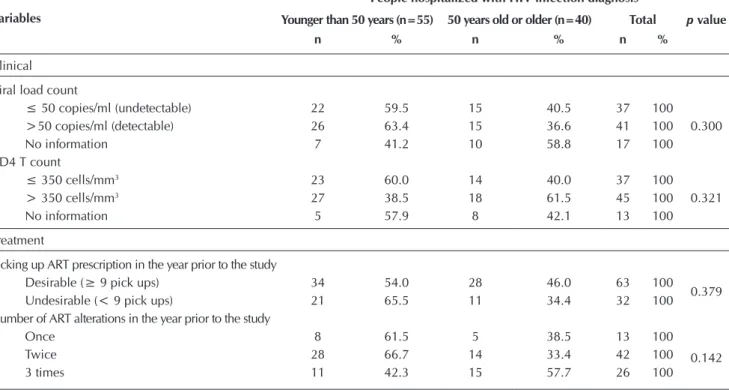
been with a sexual partner in six months prior to the study and 24 (25.3%) declared having used condoms in the last 6 months. Exposure category was sexual for 68 (71.6%) participants and 53 (55.8%) had been diagnosed with HIV infection for at least five years. Regarding clinical characteristics, 41 (43.2%) had a detect-able viral load and 37 (39.0%) a CD4+T lymphocyte count less
than or equal to 350 cells/mm3. Regarding treatment, 63 (66.3%)
had picked up their antiretroviral prescription nine or more times in the year prior to the study and 68 (71.6%) mentioned chang-ing their therapy in this same period (Table 1).
Logistic regression analysis showed that the predictors that maintained statistical significance related to the age group of HIV infection diagnosis was the 50 to 60 age group and sexual category of exposure to HIV (Table 2).
Table 1 – Distribution of the association of variables of people living with HIV/AIDS who were hospitalized (n=95), accord-ing to age group of people diagnosed with HIV infection, state of São Paulo, Brazil, 2011-2015
Variables
People hospitalized with HIV infection diagnosis
Younger than 50 years (n=55) 50 years old or older (n=40) Total p value
n % n % n %
Sociodemographic
Gender
Male 31 53.4 27 46.6 58 100
0.295
Female 24 64.9 13 35.1 37 100
Age group (years)
50 |----| 60 48 65.8 25 34.2 73 100
0.007
≥ 61 7 31.8 15 68.2 22 100
Ethnicity
White 39 58.2 28 41.8 67 100
1.000
Black 16 57.1 12 42.9 28 100
Occupation
On medical leave/benefit 6 66.7 3 33.3 9 100
0.436
Retired/receives pension 15 53.6 13 46.4 28 100
Unemployed 10 76.9 3 23.1 13 100
Working 24 53.3 21 46.7 45 100
Affective-sexual
Sexual orientation
Heterosexual 45 52.6 31 47.4 76 100
0.796
Homo/Bisexual 10 59.2 9 40.8 19 100
Sexual partnership in the 6 months prior to the study
Yes 16 43.2 21 56.8 37 100
0.033
No 39 67.2 19 32.8 58 100
Condom use in the 6 months prior to the study
Yes 13 54.2 11 45.8 24 100
0.005
No 3 21.4 11 78.6 14 100
No relations 39 68.4 18 31.6 57 100
Epidemiological
Category of exposure to HIV
Sexual 36 52.9 32 47.1 68 100
0.167
Nonsexual 19 70.4 8 29.6 27 100
Time of HIV diagnosis
≤ 5 years 10 23.8 32 76.2 42 100 0.000
> 5 years 45 84.9 8 15.1 53 100
DISCUSSION
The characteristics of the studied population were similar to those of other PLHA in the same age group, with a prevalence
of men(6-7), diagnosed with HIV infection for over five years(6),
with sexual partnerships(7), retired(6), with predominance of
sexual exposure(6) and CD4 count above 350 cells/mm3(6).
Among the analyzed variables, despite the statistically sig-nificant correlation of age group, time of diagnosis of HIV in-fection, sexual partnership and condom use in the six months prior to the study with the age group of HIV infection diag-nosis of hospitalized PLHA, only the 50 to 60 year category of the age group variable was predictive of the participating sample, representing a protection factor against hospitaliza-tion. Thus, early diagnosis and in younger individuals served as a protection factor against the hospitalization of PLHA when compared with people who were diagnosed after the age of 50.
Health is an essential factor in order to enjoy the opportuni-ties provided by longevity, as decline in physical and cognitive
capacity bring negative implications to individuals and society(8).
A European study identified that late HIV/AIDS diagnosis was related to, among other factors, being 50 years old or older. The authors argued that the later the diagnosis of this
infection, the lower the survival rate(9).
An investigation on morbidities found that the older the individuals, the more likely they were to present several mor-bidities, with HIV/AIDS infection classified as the fourth most
prevalent morbidity in the studied population(10).
Another relevant study indicated that CD4+T lymphocyte
cell level above 350 cells/mm3 and the use of ART
signifi-cantly reduced risk of hospitalization(11).
Research conducted in the state of Paraíba, Brazil, showed a gradual increase in the number of AIDS cases in the popu-lation aged 50 years or older, especially among people with brown skin, low education levels and heterosexual practices,
Variables
People hospitalized with HIV infection diagnosis
Younger than 50 years (n=55) 50 years old or older (n=40) Total p value
n % n % n %
Clinical
Viral load count
≤ 50 copies/ml (undetectable) 22 59.5 15 40.5 37 100 0.300 >50 copies/ml (detectable) 26 63.4 15 36.6 41 100
No information 7 41.2 10 58.8 17 100
CD4 T count
≤ 350 cells/mm3 23 60.0 14 40.0 37 100
0.321
> 350 cells/mm3 27 38.5 18 61.5 45 100
No information 5 57.9 8 42.1 13 100
Treatment
Picking up ART prescription in the year prior to the study
Desirable (≥ 9 pick ups) 34 54.0 28 46.0 63 100
0.379 Undesirable (< 9 pick ups) 21 65.5 11 34.4 32 100 Number of ART alterations in the year prior to the study
Once 8 61.5 5 38.5 13 100
0.142
Twice 28 66.7 14 33.4 42 100
3 times 11 42.3 15 57.7 26 100
Note: CD4+T = T lymphocyte cells; ART = antiretroviral therapy.
Table 2 – Odds ratio (OR) of statistically significant variables with the hospitalization of people with a diagnosis of HIV infec-tion (n=95), state of São Paulo, Brazil, 2011-2015
Variables Crude OR *95% CI
Min – Max p value Adjusted OR
*95% CI
Min – Max p value
Age group (years)
50 |----| 60 0.072 0.023 – 0.541 0.001 0.221 0.077 – 0.633 0.005
≥ 61 Reference Reference
Category of exposure to HIV
Sexual 5.399 1.155 – 25.241 0.032 2.445 0.883 – 6.773 0.085
Non-sexual Reference Reference
emphasizing the need for health policies directed at this age group and the need to review health practices of
multiprofes-sional teams, reconsidering the specificities of this population(12).
One systematic review concluded that public policies should focus more on health promotion related to sexually transmitted diseases among older populations, as the behavior and epidemiological profile of this population has been
con-stantly changing(13).
Study limitations
The study sample was limited to 95 participants, as many patients did not meet the inclusion criteria. The main reason for exclusion were patients who were hospitalized more than once during the data collection period. Thus, the simultane-ous application of this study in two locations enabled a larger sample of this population.
Contributions to health
Even though most of the participants were taking ART during hospitalization and were also classified as “desirable adherence”, as they picked up 9 or more doses of antiretro-viral drugs in the 12 months prior to their hospitalization, a
high rate of patients presented detectable HIV viral loads and
CD4+T lymphocyte cell count below 350 cells/mm3. These
facts are seemingly contradictory and incite further investiga-tion to identify possible therapeutic flaws and clinical
man-agement actions that can be implemented(14).
CONCLUSION
The hospitalization rate of PLHA 50 years old or older was 17.8% in two health units specialized in infectious diseases at a large-scale teaching hospital in the state of São Paulo, Bra-zil. Among the variables related with hospitalization, the most significant was age group, showing that receiving a diagnosis between 50 and 60 years of age can act as a protective factor against hospitalization.
Recognizing the characteristics of this population implies formulating political and social strategies aimed at meeting the specificities and needs of this growing population. Such policies should aim for the hospitalization process of these individuals to be the last resource employed for reestablishing health conditions and, consider the implementation of mea-sures that aim to control infection with HIV/AIDS.
REFERENCES
1. The Joint United Nations Programme on HIV/AIDS (UNAIDS). New report shows that urgent action is needed to end the aids epidemic by 2030 [Internet]. 2016 [cited 2017 Jan 17]. Available from: http://www.unaids.org/sites/default/ files/2016050 6_UNAIDS_SG_Report_on_HIV_en.pdf
2. Brasil. Ministério da Saúde. Boletim Epidemiológico - AIDS e DST. 01ª a 26ª semanas epidemiológicas de janeiro a junho de 2016. V(1). Brasília: Ministério da Saúde; 2016.
3. Marin N, Luiza VL, Osório-de-Castro CGS, Machado-dos-Santos S, (orgs). Assistência farmacêutica para gerentes municipais. Rio de Janeiro: OPAS/OMS; 2003.
4. Saldanha AAW, Araújo LF, Felix SMF Aids na velhice: os grupos de convivência de idosos como espaços de possibilidades. In DVS Falcão, CMSB. Dias (Eds.). Maturidade e velhice: pesquisas e intervenções psicológicas. São Paulo: Casa do Psicólogo; 2006. p 225-45.
5. Montessori V, Press N, Harris M, Akagi L, Montaner JSG. Adverse effects of antiretroviral therapy for HIV infection. Canadian Medical Associations. 2004; 170(2):229–38.
6. Okuno MFP, Gomes AC, Meazzini L, Júnior GS, Junior DB, Belasco AGS. [Quality of life in elderly patients living with HIV/AIDS]. Cad Saúde Pública [Internet]. 2014 [cited 2016 Jul 16];30(7):1551-9. Available from: http://www.scielo.br/pdf/csp/v30n7/0102-311X-csp-30-7-1551.pdf Portuguese.
7. Lopes PSD, Silva MMG, Torres IC, Stadñik CMB. Qualidade de vida dos pacientes HIV positivo com mais de 50 anos. Rev Assoc Médica RGSul. 2011; 55(4):356-360.
8. Linhares CD, Tocantins FR, Lemos A. Ações de enfermagem na atenção primária e qualidade de vida do idoso: revisão integrativa. Rev Pesqui: Cuid Fundam [Internet]. 2014 [cited 2016 Jul 16];6(4):1630-41. Available from: http://pesquisa.bvsalud. org/saudepublica/resource/pt/bde-25842
9. Brasil. Ministério da Saúde. Protocolo clínico e diretrizes terapêuticas para adultos vivendo com HIV/Aids. Brasília, 2013. 216p
10. World Health Organization. World Report on Ageing and Health. WHO Press, Geneva. 2015.
11. Mocroft A, Lundgren J, Antinori A, Monforte Ad, Brännström J, Bonnet F, et al. Late presentation for HIV care across Europe: update from the Collaboration of Observational HIV Epidemiological Research Europe (COHERE) study, 2010 to 2013. Euro Surveill [Internet]. 2015 [cited 2016 Jul 16];20(47):7–18. Available from: https://www.ncbi.nlm.nih.gov/pubmed/26624933
12. Lenzi J, Avaldi VM, Rucci P, Pieri G, Fantini MP. Burden of multimorbidity in relation to age, gender and immigrant status: a cross-sectional study based on administrative data. BMJ Open [Internet]. 2016 [cited 2017 Jan 17];6(12). Available from: http:// bmjopen.bmj.com/content/6/12/e012812.full
Defic Syndr [Internet]. 2010 [cited 2016 Jul 16];54(3):248-57. Available from: https://www.ncbi.nlm.nih.gov/pubmed/20658748