455
Revista da Sociedade Brasileira de Medicina Tropical 43(4):455-457, jul-ago, 2010
Communication/Comunicação
Epidemiological proile of acute bacterial meningitis in the State of
Rio Grande do Norte, Brazil
Peril epidemiológico da meningite bacteriana aguda no Estado do Rio Grande do Norte,
Brasil
Wallace Andrino da Silva
1, Aline Macêdo Pinheiro
1, Leonam Gomes Coutinho
1, Luis Alberto Carneiro Marinho
2and Lucymara Fassarella Agnez Lima
11.Laboratory of Molecular Biology and Genomics, Department of Cell Biology and Genetics, Center for Biosciences, Federal University of Rio Grande do Norte, Natal, RN, Brazil. 2.Reference Hospital for Infectious Diseases Giselda Trigueiro, Natal, RN, Brazil.
Address to: Dr. Wallace Andrino da Silva. Laboratório Biol Mol e Gen/DBG/Centro de Biociências/UFRN. Campus Lagoa Nova s/n. 59072-970 Natal, RN, Brasil. Phone: 55 84 3211-9209; Fax: 55 84 3215-3425
e-mail: [email protected] Received in 16/02/2010
Accepted in 20/05/2010 ABSTACT
Introduction: Acute bacterial meningitis (ABM) remains a public health problem in Brazil. To evaluate the epidemiology of ABM cases at Giselda Trigueiro Hospital, Rio Grande do Norte, a descriptive retrospective survey was conducted covering 2005 to 2008. Methods: Clinical and laboratory data were collected from the epidemiology department of the hospital and analyzed. Results: Out of 168 ABM cases, 24.4%, 10.7%, and 2.4% were, respectively, caused by Streptococcus pneumoniae, Neisseria meningitidis and
Haemophilus inluenza b, and 5.4% by other bacteria. he mean age was 22.48 ± 18.7 years old. Conclusions: Streptococcus pneumoniae was the main causative pathogen in the young urban population
.
Key-words: Bacterial meningitis. Epidemiology. Brazil.
RESUMO
Introdução: Meningite bacteriana aguda (MBA) permanece um problema de saúde pública no Brasil. Para avaliar a epidemiologia da MBA atendida no Hospital Giselda Trigueiro, Rio Grande do Norte, um estudo retrospectivo-descritivo foi realizado de 2005 a 2008. Métodos: Dados clínicos e laboratoriais foram coletados do departamento de epidemiologia hospitalar e analisados. Resultados: Dos 168 casos de MBA, 24,4%, 10,7% e 2,4% foram, respectivamente, causados por Streptococcus pneumoniae, Neisseria meningitidis e Haemophilus inluenzae b e 5,4% por outras bactérias. A média da idade foi 22,48 ± 18,7 anos. Conclusões: Streptococcus pneumoniae foi o principal patógeno causador na população urbana jovem.
Palavras-chaves: Meningite bacteriana. Epidemiologia. Brasil.
Acute bacterial meningitis (ABM) is a public health problem worldwide and, in Brazil, in the 1990s, an average of 28,000 cases of meningitis were reported annually1. In an etiological survey
in northeastern Brazil in the 1980s, Bryan et al2 reported that
N. meningitides (meningococcus) was the most prevalent ABM pathogen, followed by Haemophilus inluenzae type b (Hib) and
Streptococcus pneumoniae (pneumococcus)2. However, after the
introduction of the anti-Hib conjugated vaccine to the public vaccinationprogram in 1999, there was a signiicant decrease in the incidence of cases of ABM due to H. inluenzae in Brazil3.
Because of the high mortality rate and long-term sequels, fast and accurate diagnosis and appropriate treatment of ABM are fundamental for a good outcome4. he initial antibiotic regimen is usually empirical,
and therefore, knowledge of the epidemiological proile of ABM in the community could lead to the best therapeutic choice5.
In the present study, we describe the epidemiological proile of ABM at Giselda Trigueiro Hospital (GTH), a reference center for infectious diseases in the State of Rio Grande do Norte, Brazil, between 2005 and 2008. We are not aware of any previous study on the epidemiology of ABM in this Brazilian state.
his study consisted of a descriptive retrospective survey of the cases of ABM that were atended at GTH between 2005 and 2008. During the period of this study, the hospital could not aford a pediatric ward, and children were sent to pediatric hospitals ater diagnosis and initial treatment.
Information on age, sex, home location (rural or urban area), laboratory results, criteria for diagnostic conirmation, previous use of antibiotics and outcome were collected from the oicial records of the Brazilian compulsory notiication system (SINAN), which were available in the hospital’s epidemiology department. he data were analyzed through SPSS (Statistical Package for the Social Sciences),version 13.0.
he diagnoses of cases with clinical signs and symptoms of ABM were conirmed in accordance with at least one of the following criteria: 1) cerebrospinal luid (CSF) culture; 2) CSF Gram stain; 3) blood culture or blood Gram stain; 4) latex agglutination test on CSF; and 5) CSF presenting pleocytosis (> 500 cells/mm3), predominantly
polymorphonuclear neutrophils, protein level > 40mg/dl and glucose level < 40mg/dl. Two cases did not it the above criteria and their diagnosis were conirmed post-mortem by means of autopsy.
Blood and CSF were seeded in chocolate agar enriched with 5% sheep blood. he latex agglutination test was used to identify polysaccharide antigens from N. meningitides, S. pneumoniae and Hib in CSF. Gram’s method consisted of a primary stain with crystal violet, followed by the addition of iodine, rapid decolorization with acetone, and staining with basic fuchsin.
he antibiotic susceptibility of the S. pneumoniae was identiied by means of the disk difusion method, in accordance with the definitions of the National Committee for Clinical Laboratory Standards (NCCLS, 1998).
456
Silva WA et al - Acute bacterial meningitis in northeastern Brazil
Between January 2005 and December 2008, 168 cases of ABM were admited to the GTH, among which 107 (63.7%) were male, 60 (35.7%) were female, and one (0.6%) was not identiied by gender in the notiication record. he mean age and standard deviation was 22.48 ± 18.7 years old (ranging from one month old to 78 years old). he mean ages according to the etiological agents were 29.8 years old for pneumococcus, 20.5 years old for meningococcus and 12.5 years old for Hib. Regarding the location of the patients’ homes, 123 (73.2%) were in urban areas, 28 (16.7%) in rural areas and 17 (10.1%) in intermediate areas.
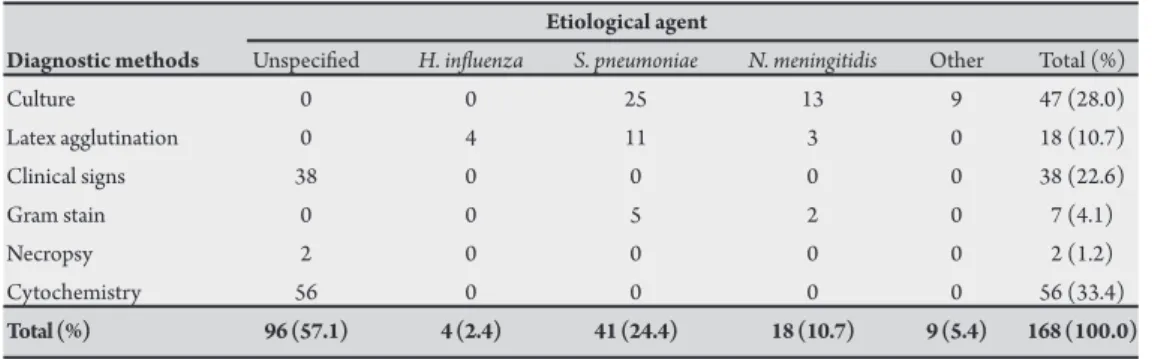
Out of the 168 cases in our sample, 96 (57.1%) were not identiied according to etiological agent, while 41 (24.4%) were caused by S. pneumoniae, 18 (10.7%) by N. meningitidis, four (2.4%) by Hib and nine (5.4%) by other bacteria, namely Staphylococcus aureus (two cases), Salmonella (two cases), Streptococcus viridans
(two cases), Klebsiella (two cases) and Proteus mirabilis (one case). he diagnostic criteria used according to the etiology are shown
in Table 1. Blood or CSF cultures were positive for only 47 patients (28.0%). Previous use of antibiotics at least 24 hours before the diagnosis and initial treatment of ABM was reported for 11 (6.5%) patients.
Sequels ater meningitis were recorded before discharge in 16 patients (9.5% of the cases), among which hearing loss was the most frequent. Of the three cases of hearing loss, one was related to chronic otitis media and another to trauma. he mortality rate among the sample was 11.3% (19 cases), and S. pneumoniae was responsible for the highest lethality rate (Table 2).
Seven cases of ABM due to S. pneumoniae were associated with skull-brain trauma, six cases were due to CSF istula, and one case was due to chronic otitis media. he antibiotic sensitivity of S. pneumoniae
was tested in 20 samples (Table 3).
Among the 18 cases of meningococcal ABM, N. meningitidis type B was identiied in 11 cases and N. meningitidis type C in two cases. he mortality rate was 11.1% (Table 2), and N. meningitidis type B was the cause of all of the deaths.
TABLE 1 - Diagnostic methods according to the etiological agent of ABM. Etiological agent
Diagnostic methods Unspeciied H. inluenza S. pneumoniae N. meningitidis Other Total (%)
Culture 0 0 25 13 9 47 (28.0)
Latex agglutination 0 4 11 3 0 18 (10.7)
Clinical signs 38 0 0 0 0 38 (22.6)
Gram stain 0 0 5 2 0 7 (4.1)
Necropsy 2 0 0 0 0 2 (1.2)
Cytochemistry 56 0 0 0 0 56 (33.4)
Total (%) 96 (57.1) 4 (2.4) 41 (24.4) 18 (10.7) 9 (5.4) 168 (100.0)
TABLE 2– Outcome according to the etiological agent of ABM. Etiological agent
Outcome Unspeciied H. inluenza S. pneumoniae N. meningitidis Other Cure (%) 59 (61.5) 3 (75.0) 25 (61.0) 14 (77.8) 6 (66.7) Death (%) 10 (10.4) 0 (0.0) 6 (14.7) 2 (11.1) 1 (11.1) Unknown (%) 27 (28.1) 1 (25.0) 10 (24.3) 2 (11.1) 2 (22.2)
Total (%) 96 (100.0) 4 (100.0) 41 (100.0) 18 (100.0) 9 (100.0)
TABLE 3 - Antibiotic susceptibility of S. pneumoniae causing ABM*. Sensitivity level
number of cases susceptible intermediate resistant
Antibiotic tested n (%) n (%) n (%)
Penicillin 14 13 (92.8) - 1 (7.2)
Oxacillin 4 4 (100.0) -
-Oloxacillin 8 7 (87.5) - 1 (12.5) Erythromycin 19 15 (80.0) 1 (5.0) 3 (15.0) Clindamycin 16 14 (87.5) 1 (6.25) 1 (6.25) Tetracycline 12 11 (85.7) 1 (14.3) -Chloramphenicol 11 10 (91.7) - 1 (8.3) Cotrimoxazole 12 2 (16.7) 1 (8.3) 9 (75.0) Rifampicin 19 17 (89.5) 1 (5.25) 1 (5.25)
Vancomycin 19 19 (100.0) -
-*17 strains were isolated from CSF and 3 from blood.
he high rate of failure to determine the etiological agent at GTH is consistent with other Brazilian reports, which range from 46.8 to 55.5%3,6. Although only 6.5% of the patients in the current
study reported previous use of antibiotics, which is most likely an underestimation, the low bacterial culture rate is probably greatly afected by the previous use of antibiotics5. In a Brazilian national
study conducted by Mantese et al5, 47.2% of the patients reported
previous antibiotic use5.
S. pneumoniae was the most prevalent ABM etiological agent in our sample, but was associated with relatively low mortality (14.6%), in comparison with previous reports referring to mortality rates greater than 30% for this bacterium7,1. However, the low mortality
rate in our study might have been masked by the poor routine for data records at GTH.
Pneumococcal ABM is associated with conditions leading to
457
Rev Soc Bras Med Trop 43(4):455-457, jul-ago, 2010
he occurrence of skull-brain trauma and CSF istula in 13 cases of pneumococcal infection may also have accounted for the displacement of the mean age of disease onset to 29.8 years of age. Pneumococcal ABM was most frequent in children < 5 years and the elderly, as reported worldwide8. Moreover, the lack of a pediatric
ward at GTH over this period contributed towards the higher mean age of the patients in the study.
We found that 7.2% of the pneumococcus isolates were penicillin resistant, while there was no cephalosporin resistance. hese rates are lower than the values found by Brandileone et al9, who reported that
there was an increase in the numbers of cases of invasive penicillin-resistant S. pneumoniae in Brazil, from 10.2% to 27.9%, between 1993 to 20049. Meningitis isolates were more frequently resistant
to cefotaxime (2.6%) than were non-meningitis isolates (0.7%). However, generally, there is high susceptibility to cefotaxime in Brazil, thus supporting the use of third-generation cephalosporins as the drugs of choice for meningitis treatment in this country. hese rates vary according to regions, and the northern and northeastern regions are less afected9. In this study, pneumococcus resistance rates
to chloramphenicol (8.3%), cotrimoxazole (75%), erythromycin (15%) and rifampicin (5.25%) were higher than rates reported in another Brazilian study that showed resistance rates of 1.3%, 65%, 6.2% and 0.7%, respectively9.
he higher prevalence of the N. meningitidis serogroup B, in comparison with serogroup C, conforms with previous Brazilian reports10,11.he cases of meningitis due to H. inluenza do not it
within the preferential age range for this bacterium. Indeed, the current Brazilian incidence of Hib meningitis in this age range is only 0.02 cases for every 100,000 inhabitants12.
he hearing loss experienced by 2.8% of the survivors was lower than the rate of 6.2% found in other Brazilian reports13. Our indings
cannot be taken as an estimation of permanent sequels since the GTH lacks a follow-up program for patients ater discharge.
Our identiication of S. pneumoniae as the main agent of ABM in the young urban population requires preventive epidemiological atitudes towards this group. Because of the low rate of penicillin-resistant pneumococci at GTH, careful planning of antibiotic usage and management of meningitis is important in order to avoid raising the pneumococcus resistance rate, which is increasing slowly in Brazil. herefore, knowledge of the regional epidemiological proile is crucial for improve the diagnosis, treatment and prognosis of ABM patients.
FINANCIAL SUPPORT ACKNOWLEDGMENTS
CONFLICT OF INTEREST
he authors declare that there is no conlict of interest.
REFERENCES
he authors would like to thank the laboratory and epidemiology department team of GTH, especially Mr. Dagoberto Mariz, Mrs. Alcilene Ribeiro Soares and Mrs. Graça Micussi.
The authors received financial support from UBS Optimus Foundation (Switzerland). LFAG and LGC have fellowships from CNPq.
1. Escosteguy CC, Medronho A, Madruga R, Dias HG, Braga RC, Azevedo OP. Vigilância epidemiológica e avaliação da assistência às meningites. Rev Saude Publica 2004; 38:657-663.
2. Bryan JP, de Silva HR, Tavares A, Rocha H, Scheld WM. Etiology and mortality of bacterial meningitis in northeastern Brazil. Rev Infect Dis 1990; 12:128-135. 3. Romanelli RM, Araujo CA, Dias MW, Boucinhas F, Carvalho IR, Martins NR,
et al. Etiologia e evolução das meningites bacterianas em centro de pediatria. J Pediatr 2002; 78:24-30.
4. Salih MA, Khaleefa OH, Bushara M, Taha ZB, Musa ZA, Kamil I, et al. Long term sequelae of childhood acute bacterial meningitis in a developing country. A study from the Sudan. Scand J Inf Dis 1991; 23:175-182.
5. Mantese OC, Hirano J, Santos IC, Silva VM, Castro E. Peril etiológico das meningites bacterianas em crianças. J Pediatr 2002; 78:467-474.
6. Weiss DP, Coplan P, Guess H. Epidemiology of bacterial meningitis among children in Brazil, 1997-1998. Rev Saude Publica 2001; 35:249-255. 7. Durand ML, Calderwood SB, Weber DJ, Miller SI, Southwick FS, Caviness VS,
et al. Acute bacterial meningitis in adults. A review of 493 episodes. N Engl J Med 1993; 328:21-28.
8. Schuchat A, Robinson K, Wenger JD, Harrison LH, Farley M, Reingold AL, et al. Bacterial meningitis in the United States in 1995. Active Surveillance Team. N Engl J Med 1997; 337:970-976.
9. Brandileone MCC, Casagrande ST, Guerra ML, Zanella RC, Andrade AL, Di Fabio JL. Increase in numbers of beta-lactam-resistant invasive Streptococcus pneumoniae in Brazil and the impact of conjugate vaccine coverage. J Med Microbiol 2006; 55:567-574.
10. Santos ML, Ruino-Neto A. Meningococcal disease: epidemiological proile in the Municipality of Manaus, Amazonas, Brazil, 1998/2002. Cad Saude Publica 2005; 21:823-829.
11. Puricelli RC, Kupek E, Bertoncini RC. Control of a community outbreak of group C meningococcal meningitis in Corupa, Santa Catarina State, Brazil, based on rapid and effective epidemiological surveillance and immunization. Cad Saude Publica 2004; 20:959-967.
12. Miranzi SS, Moraes SA, Freitas IC. Trends in Haemophilus inluenzae type b meningitis in Brazil in children under ive years of age from 1983 through 2002. Rev Soc Bras Med Trop 2006; 39:473-477.